This is my archive

bar

A UK Tariff Scorecard: We Lost

  10 > 3.3. With Donald Trump jumping around weekly in announcing this or that tariff increase or tariff cut, it can be hard to keep score. I’m still trying to figure out the Chinese scorecard. But the UK/US scorecard is starting to become clear: we lost. Colin Grabow at the Cato Institute put it well: Last Thursday, the Trump administration announced its first trade deal since its April 2 tariff hike, and it’s clear that higher tariffs are here to stay. Reached with the United Kingdom, the deal — billed by the White House as “historic” and a “breakthrough” — improves trade conditions only relative to the upheaval of recent weeks. Compared to the trade conditions that prevailed when Trump took office in January, there is little to celebrate. Before Trump unleashed his tariff whirlwind, Americans enjoyed an average tariff rate of 3.3 percent on imports. Now, goods arriving from the UK face a 10 percent rate (apparently the lowest tariff any US trading partner can hope for). Tariffs on British auto imports were just 2.5 percent only months ago, but will now be four times higher (and that’s only for the first 100,000 vehicles, with any auto imports beyond that number facing a 25 percent tariff). [DRH note: the tariffs on auto imports from Britain will be 4 times as much, not 4 times higher.] For all the talk of tariff hikes as a mere tactic, they are now an enduring feature of the trade landscape. That President Trump is touting an additional $6 billion in tariff revenue as one of the US-UK deal’s selling points further suggests their staying power.   I’ve had a number of pro-Trump friends assure me that Trump has a grand strategy and that at the end, other countries will have lower tariffs than before on our exports and we will have lower, or no higher than earlier, tariffs on imports from them. As Grabow points out, that’s not consistent with the Trump administration messaging. They seem to be settling on a minimum tariff rate of 10%. 10 is more than 3.3. Trump sometimes asks if we’re tired of all this winning. I certainly am.   Postscript: Trump loves to say that “tariffs” is the most beautiful word in the dictionary. So try this experiment. Recognize that tariffs are taxes. What would you think of someone who says “taxes” is the most beautiful word in the dictionary? (0 COMMENTS)

/ Learn More

They Took Our Jobs: The Sequel

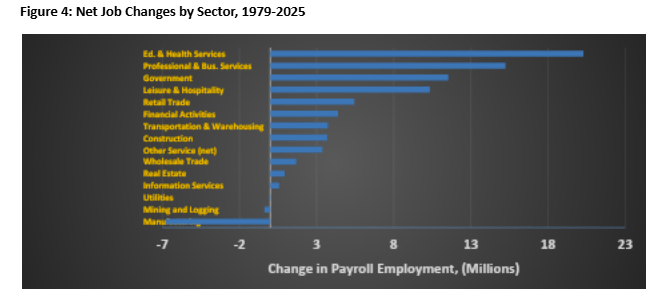
In my previous post, I took on the common claim that America is losing manufacturing jobs. Not only are jobs growing, but job growth has outpaced population growth—i.e. the increase in the number of people available to fill those jobs—and this has been the case for most of the last four decades. Is the fact that more people are working good news for the economy? As is often the case in economics, it depends. If real wages are rising and people want to work more in order to improve their standard of living, then sure, let’s celebrate the growth in productivity, output, and earnings. If wages are stagnant and some people would rather pursue non-labor vocations, but feel the need to earn a paycheck in order to keep up with the cost of living, then job growth would be at best a mixed bag. At any rate, broadly speaking there are plenty of jobs out there to go around. As I like to remind my students, the most important skill required to get and keep a good job is something I probably can’t teach them in the classroom: a strong work ethic and a willingness to learn. If you know how to show up, listen, learn, apply yourself, and contribute to a production process, you’re not only going to be okay, you’re going to climb a ladder of employment success and growing wages as you gain skills and experience.  Yet despite the ever upward-trending job numbers, demagogues will contend that we’ve replaced good, high-paying manufacturing jobs with lousy service sector jobs. The service sector, broadly defined, has seen basically all of US employment growth, accounting for 90% of new jobs created since our 1979 benchmark, as shown in Figure 4. But beware making hasty assumptions about a sector that employs nearly 110 million people. When we compare earnings across different sectors of the economy, we see that a majority of the new service sector jobs pay better than manufacturing jobs, and most service sector jobs are safer and more pleasant than the factory jobs they’ve replaced.  Table 1 presents Bureau of Labor Statistics data on the 15 largest sectors and sub-sectors of the US economy, which together capture essentially all of the total net increase in payroll employment for the post-peak manufacturing jobs era (1979 to 2025). This might come as a surprise to the anti-globalization crowd: while we lost 7 million manufacturing jobs, and some mining, logging and utilities jobs, we’ve seen a net increase of nearly 69 million total jobs. Of these net new jobs, more than half of them (53.5%) feature average hourly earnings greater than current average hourly manufacturing earnings. Another 20% of new jobs have average hourly earnings within 10% of current manufacturing jobs. In other words, most of the 69 million new jobs pay better or close to the same wages than those “good” manufacturing jobs. So, we lost 7 million good jobs, only to gain about 37 million better-paying jobs, about 14 million close-paying jobs, and about 18 million lower-paying jobs (about 26% of net new jobs pay substantially less than manufacturing).   We’ve established that, despite a major decrease in employment in the manufacturing sector, we’ve gained many more jobs than we’ve lost in the past 45 years, and that most of these new jobs pay better. Economic changes, while painful in the short run, have brought gains in output and employment not only for the US, but for the rest of the world as well. Overall, this is good news for the US and world economies. But even if we can get the protectionists to acknowledge that high-paying service sector jobs have more than replaced lost factory jobs, they’re still likely to whine that, “we don’t make things here anymore.” This complaint goes along with laments about the “deindustrialization” of America, implying that industrialization is over simply because the number of one particular kind of industrial job type (factory workers) is declining. This oft-heard refrain is patently false. We don’t make certain things, such as garments, toys or electronics, because global free trade and technological advances tend to shift America’s output into those industries in which our comparative advantage is greatest. But Americans do indeed make things, quite valuable things. This is nowhere more simply and obviously demonstrated than in the Industrial Production Index—a measure of the total US manufacturing output. As Figure 5 shows, after the expected steep decline following the Great Recession of 2008-2009, US manufacturing gradually recovered before getting walloped again during and after the Covid shutdowns. Still, this index, which consists mainly of manufacturing, has now recovered pre-Covid highs, and overall it’s grown by almost exactly 100% since the 1979 peak in manufacturing employment. From an economic perspective, nothing could be better news. US manufacturing creates 100% more value with 35% fewer workers. Creating more value with fewer workers means we’re more efficient than ever, more productive than ever. These awesome productivity gains have many sources, especially in the form of technological advances in areas like software, robotics, and now the emergence of AI as the next great source of creative destruction. Globalization and outsourcing have also played a role, as they allow American workers a greater degree of specialization in those sectors where our productivity edge is largest. Regardless of the relative importance of technology vs. outsourcing in driving these changes, the broader point still stands: the US economy is both more productive and has more job opportunities than ever before.  Economists know that it’s at best useless and at worst scurrilous to talk of other countries “beating us” at trade, or of other countries having “unfair” advantages. I love to play football, but let’s face it: Jaylen Hurts is a better player than I (and 99.999% of the population). It’s not “unfair,” it just is. But it’s okay—I’m better at economics and writing than probably 98% of the population. So we each find our niche—he’ll throw touchdown passes and entertain millions, I’ll give lectures and write articles and teach hundreds about specialization, comparative advantage, and the always-present gains from trade. The entire economic system will have more of everything if each of us focuses on his or her comparative advantage and stops whining about things being unfair. As I like to instruct my students, “fairness” is a word not found in the economics lexicon, but we do like to use words like “wealth,” “growth,” and “prosperity.” The first lesson of market economics is that trade, on the basis of specialization, is a massively positive sum game. This is true for individuals, and it remains true when we aggregate the gains at a national scale. The thing is, since nobody can know in advance or from above what everyone else’s most productive specialization might be, we need a decentralized market process that gives us information and incentives, through price signals, that help each of us find our best opportunities and fit into the broader system in a more productive, more wealth-enhancing way. One of the main tasks for economists, especially we who teach the subject, is to explain not only how this system works, but to impress upon our students that the free market—unfettered by arbitrary and restrictive policies like tariffs—is the only way we can hope to achieve sustained gains from the division of labor. They didn’t take “our” jobs. As long as we have even a semi-functional market economy, there will always be jobs to do. The real issue today is not creating jobs, but creating workers—people who are ready, willing, and able to show up, commit, and learn. So let’s stop the whining about “unfair” trade practices and the hectoring of other countries—especially our friends and allies—for “stealing” our jobs or “taking advantage of us” through trade that is necessarily mutually beneficial. Let’s instead count our blessings and make the best of a good situation. Teach people to have a good work ethic, and the rest will take care of itself.    Tyler Watts is a professor of economics and management at Ferris State University. (0 COMMENTS)

/ Learn More

They Took Our Jobs: The Sequel

In my previous post, I took on the common claim that America is losing manufacturing jobs. Not only are jobs growing, but job growth has outpaced population growth—i.e. the increase in the number of people available to fill those jobs—and this has been the case for most of the last four decades. Is the fact that more people are working good news for the economy? As is often the case in economics, it depends. If real wages are rising and people want to work more in order to improve their standard of living, then sure, let’s celebrate the growth in productivity, output, and earnings. If wages are stagnant and some people would rather pursue non-labor vocations, but feel the need to earn a paycheck in order to keep up with the cost of living, then job growth would be at best a mixed bag. At any rate, broadly speaking there are plenty of jobs out there to go around. As I like to remind my students, the most important skill required to get and keep a good job is something I probably can’t teach them in the classroom: a strong work ethic and a willingness to learn. If you know how to show up, listen, learn, apply yourself, and contribute to a production process, you’re not only going to be okay, you’re going to climb a ladder of employment success and growing wages as you gain skills and experience.  Yet despite the ever upward-trending job numbers, demagogues will contend that we’ve replaced good, high-paying manufacturing jobs with lousy service sector jobs. The service sector, broadly defined, has seen basically all of US employment growth, accounting for 90% of new jobs created since our 1979 benchmark, as shown in Figure 4. But beware making hasty assumptions about a sector that employs nearly 110 million people. When we compare earnings across different sectors of the economy, we see that a majority of the new service sector jobs pay better than manufacturing jobs, and most service sector jobs are safer and more pleasant than the factory jobs they’ve replaced.  Table 1 presents Bureau of Labor Statistics data on the 15 largest sectors and sub-sectors of the US economy, which together capture essentially all of the total net increase in payroll employment for the post-peak manufacturing jobs era (1979 to 2025). This might come as a surprise to the anti-globalization crowd: while we lost 7 million manufacturing jobs, and some mining, logging and utilities jobs, we’ve seen a net increase of nearly 69 million total jobs. Of these net new jobs, more than half of them (53.5%) feature average hourly earnings greater than current average hourly manufacturing earnings. Another 20% of new jobs have average hourly earnings within 10% of current manufacturing jobs. In other words, most of the 69 million new jobs pay better or close to the same wages than those “good” manufacturing jobs. So, we lost 7 million good jobs, only to gain about 37 million better-paying jobs, about 14 million close-paying jobs, and about 18 million lower-paying jobs (about 26% of net new jobs pay substantially less than manufacturing).   We’ve established that, despite a major decrease in employment in the manufacturing sector, we’ve gained many more jobs than we’ve lost in the past 45 years, and that most of these new jobs pay better. Economic changes, while painful in the short run, have brought gains in output and employment not only for the US, but for the rest of the world as well. Overall, this is good news for the US and world economies. But even if we can get the protectionists to acknowledge that high-paying service sector jobs have more than replaced lost factory jobs, they’re still likely to whine that, “we don’t make things here anymore.” This complaint goes along with laments about the “deindustrialization” of America, implying that industrialization is over simply because the number of one particular kind of industrial job type (factory workers) is declining. This oft-heard refrain is patently false. We don’t make certain things, such as garments, toys or electronics, because global free trade and technological advances tend to shift America’s output into those industries in which our comparative advantage is greatest. But Americans do indeed make things, quite valuable things. This is nowhere more simply and obviously demonstrated than in the Industrial Production Index—a measure of the total US manufacturing output. As Figure 5 shows, after the expected steep decline following the Great Recession of 2008-2009, US manufacturing gradually recovered before getting walloped again during and after the Covid shutdowns. Still, this index, which consists mainly of manufacturing, has now recovered pre-Covid highs, and overall it’s grown by almost exactly 100% since the 1979 peak in manufacturing employment. From an economic perspective, nothing could be better news. US manufacturing creates 100% more value with 35% fewer workers. Creating more value with fewer workers means we’re more efficient than ever, more productive than ever. These awesome productivity gains have many sources, especially in the form of technological advances in areas like software, robotics, and now the emergence of AI as the next great source of creative destruction. Globalization and outsourcing have also played a role, as they allow American workers a greater degree of specialization in those sectors where our productivity edge is largest. Regardless of the relative importance of technology vs. outsourcing in driving these changes, the broader point still stands: the US economy is both more productive and has more job opportunities than ever before.  Economists know that it’s at best useless and at worst scurrilous to talk of other countries “beating us” at trade, or of other countries having “unfair” advantages. I love to play football, but let’s face it: Jaylen Hurts is a better player than I (and 99.999% of the population). It’s not “unfair,” it just is. But it’s okay—I’m better at economics and writing than probably 98% of the population. So we each find our niche—he’ll throw touchdown passes and entertain millions, I’ll give lectures and write articles and teach hundreds about specialization, comparative advantage, and the always-present gains from trade. The entire economic system will have more of everything if each of us focuses on his or her comparative advantage and stops whining about things being unfair. As I like to instruct my students, “fairness” is a word not found in the economics lexicon, but we do like to use words like “wealth,” “growth,” and “prosperity.” The first lesson of market economics is that trade, on the basis of specialization, is a massively positive sum game. This is true for individuals, and it remains true when we aggregate the gains at a national scale. The thing is, since nobody can know in advance or from above what everyone else’s most productive specialization might be, we need a decentralized market process that gives us information and incentives, through price signals, that help each of us find our best opportunities and fit into the broader system in a more productive, more wealth-enhancing way. One of the main tasks for economists, especially we who teach the subject, is to explain not only how this system works, but to impress upon our students that the free market—unfettered by arbitrary and restrictive policies like tariffs—is the only way we can hope to achieve sustained gains from the division of labor. They didn’t take “our” jobs. As long as we have even a semi-functional market economy, there will always be jobs to do. The real issue today is not creating jobs, but creating workers—people who are ready, willing, and able to show up, commit, and learn. So let’s stop the whining about “unfair” trade practices and the hectoring of other countries—especially our friends and allies—for “stealing” our jobs or “taking advantage of us” through trade that is necessarily mutually beneficial. Let’s instead count our blessings and make the best of a good situation. Teach people to have a good work ethic, and the rest will take care of itself.    Tyler Watts is a professor of economics and management at Ferris State University. (0 COMMENTS)

/ Learn More

They Didn’t Take Our Jobs

In my previous post, I took on the common claim that America is losing manufacturing jobs. Not only are jobs growing, but job growth has outpaced population growth—i.e. the increase in the number of people available to fill those jobs—and this has been the case for most of the last four decades. Is the fact that more people are working good news for the economy? As is often the case in economics, it depends. If real wages are rising and people want to work more in order to improve their standard of living, then sure, let’s celebrate the growth in productivity, output, and earnings. If wages are stagnant and some people would rather pursue non-labor vocations, but feel the need to earn a paycheck in order to keep up with the cost of living, then job growth would be at best a mixed bag. At any rate, broadly speaking there are plenty of jobs out there to go around. As I like to remind my students, the most important skill required to get and keep a good job is something I probably can’t teach them in the classroom: a strong work ethic and a willingness to learn. If you know how to show up, listen, learn, apply yourself, and contribute to a production process, you’re not only going to be okay, you’re going to climb a ladder of employment success and growing wages as you gain skills and experience. Yet despite the ever upward-trending job numbers, demagogues will contend that we’ve replaced good, high-paying manufacturing jobs with lousy service sector jobs. The service sector, broadly defined, has seen basically all of US employment growth, accounting for 90% of new jobs created since our 1979 benchmark, as shown in Figure 4. But beware making hasty assumptions about a sector that employs nearly 110 million people. When we compare earnings across different sectors of the economy, we see that a majority of the new service sector jobs pay better than manufacturing jobs, and most service sector jobs are safer and more pleasant than the factory jobs they’ve replaced. Table 1 presents Bureau of Labor Statistics data on the 15 largest sectors and sub-sectors of the US economy, which together capture essentially all of the total net increase in payroll employment for the post-peak manufacturing jobs era (1979 to 2025). This might come as a surprise to the anti-globalization crowd: while we lost 7 million manufacturing jobs, and some mining, logging and utilities jobs, we’ve seen a net increase of nearly 69 million total jobs. Of these net new jobs, more than half of them (53.5%) feature average hourly earnings greater than current average hourly manufacturing earnings. Another 20% of new jobs have average hourly earnings within 10% of current manufacturing jobs. In other words, most of the 69 million new jobs pay better or close to the same wages than those “good” manufacturing jobs. So, we lost 7 million good jobs, only to gain about 37 million better-paying jobs, about 14 million close-paying jobs, and about 18 million lower-paying jobs (about 26% of net new jobs pay substantially less than manufacturing). We’ve established that, despite a major decrease in employment in the manufacturing sector, we’ve gained many more jobs than we’ve lost in the past 45 years, and that most of these new jobs pay better. Economic changes, while painful in the short run, have brought gains in output and employment not only for the US, but for the rest of the world as well. Overall, this is good news for the US and world economies. But even if we can get the protectionists to acknowledge that high-paying service sector jobs have more than replaced lost factory jobs, they’re still likely to whine that, “we don’t make things here anymore.” This complaint goes along with laments about the “deindustrialization” of America, implying that industrialization is over simply because the number of one particular kind of industrial job type (factory workers) is declining. This oft-heard refrain is patently false. We don’t make certain things, such as garments, toys or electronics, because global free trade and technological advances tend to shift America’s output into those industries in which our comparative advantage is greatest. But Americans do indeed make things, quite valuable things. This is nowhere more simply and obviously demonstrated than in the Industrial Production Index—a measure of the total US manufacturing output. As Figure 5 shows, after the expected steep decline following the Great Recession of 2008-2009, US manufacturing gradually recovered before getting walloped again during and after the Covid shutdowns. Still, this index, which consists mainly of manufacturing, has now recovered pre-Covid highs, and overall it’s grown by almost exactly 100% since the 1979 peak in manufacturing employment. From an economic perspective, nothing could be better news. US manufacturing creates 100% more value with 35% fewer workers. Creating more value with fewer workers means we’re more efficient than ever, more productive than ever. These awesome productivity gains have many sources, especially in the form of technological advances in areas like software, robotics, and now the emergence of AI as the next great source of creative destruction. Globalization and outsourcing have also played a role, as they allow American workers a greater degree of specialization in those sectors where our productivity edge is largest. Regardless of the relative importance of technology vs. outsourcing in driving these changes, the broader point still stands: the US economy is both more productive and has more job opportunities than ever before. Economists know that it’s at best useless and at worst scurrilous to talk of other countries “beating us” at trade, or of other countries having “unfair” advantages. I love to play football, but let’s face it: Jaylen Hurts is a better player than I (and 99.999% of the population). It’s not “unfair,” it just is. But it’s okay—I’m better at economics and writing than probably 98% of the population. So we each find our niche—he’ll throw touchdown passes and entertain millions, I’ll give lectures and write articles and teach hundreds about specialization, comparative advantage, and the always-present gains from trade. The entire economic system will have more of everything if each of us focuses on his or her comparative advantage and stops whining about things being unfair. As I like to instruct my students, “fairness” is a word not found in the economics lexicon, but we do like to use words like “wealth,” “growth,” and “prosperity.” The first lesson of market economics is that trade, on the basis of specialization, is a massively positive sum game. This is true for individuals, and it remains true when we aggregate the gains at a national scale. The thing is, since nobody can know in advance or from above what everyone else’s most productive specialization might be, we need a decentralized market process that gives us information and incentives, through price signals, that help each of us find our best opportunities and fit into the broader system in a more productive, more wealth-enhancing way. One of the main tasks for economists, especially we who teach the subject, is to explain not only how this system works, but to impress upon our students that the free market—unfettered by arbitrary and restrictive policies like tariffs—is the only way we can hope to achieve sustained gains from the division of labor. They didn’t take “our” jobs. As long as we have even a semi-functional market economy, there will always be jobs to do. The real issue today is not creating jobs, but creating workers—people who are ready, willing, and able to show up, commit, and learn. So let’s stop the whining about “unfair” trade practices and the hectoring of other countries—especially our friends and allies—for “stealing” our jobs or “taking advantage of us” through trade that is necessarily mutually beneficial. Let’s instead count our blessings and make the best of a good situation. Teach people to have a good work ethic, and the rest will take care of itself.   Tyler Watts is a professor of economics and management at Ferris State University. (0 COMMENTS)
/ Learn More

The Past and Present of Privacy and Public Life (with Tiffany Jenkins)

A paradox of our time is our willingness to bare all to strangers while worrying about who exactly is watching us online and anywhere else. Listen as author Tiffany Jenkins discusses her book, Strangers and Intimates, with EconTalk’s Russ Roberts. In this wide-ranging conversation, they explore the role of Martin Luther, J.S. Mill, reality TV, […] The post The Past and Present of Privacy and Public Life (with Tiffany Jenkins) appeared first on Econlib.

/ Learn More

Escalation dominance?

Kyle Chan recently made this claim in a blog post: There is no such thing as escalation dominance. Trump thinks the US will win in a trade war because China sells more to the US than the other way around. A tit-for-tat escalation on tariffs means the US will always be able to tariff more Chinese goods than vice versa. Adam Posen has recently argued it’s actually China that has “escalation dominance” (a RAND concept in nuclear deterrence) because China has other ways of escalating beyond tariffs, including potentially denying Americans access to Chinese-made goods from smartphones to medicines. However, the reality is neither side has escalation dominance because both sides have already gone far beyond trade measures. . . .  The US and China both believe they have escalation dominance, which makes the problem worse. US Treasury Secretary Scott Bessent said on CNBC that China had made a “big mistake” in retaliating against Trump’s tariffs because China was “playing with a pair of twos.” China’s Ministry of Commerce has said that China would “fight to the end.” While there are already signs that Trump is backing down, the confidence that each side feels—or at least tries to project—only fuels a downward spiral of recklessness and emotion-driven bravado. I mostly agree with those points, but would like to add a few others.  In China, the public has begun rallying around the flag.  Here’s Bloomberg: Financial investors, manufacturers in China’s eastern coastal region, policymakers in a range of departments and even elite factions that have lost out from Xi’s power grab are all rallying behind him. Even regular critics and entrepreneurs who have been pummeled by his policies in recent years want him to stand firm in the face of an unprecedented economic attack. . . . “A few months ago, I would have said I’ve never known people to be so unhappy — with their lives, with Xi, with worries about the future,” said a Chinese toy and textile manufacturer who runs factories in Guangdong, India and Southeast Asia. “Now, that’s all changed,” the person said. “People are still really worried about their jobs and income – they’re holding back from spending — but now the enemy is the US. They’re to blame for everything going wrong.” In contrast, public opinion in America is sharply divided.  President Trump is rapidly losing support, especially on question related to the economy and tariffs. In addition, the Chinese public is far more accustomed to accepting economic pain than are America’s consumers, who have never experienced events such as the Cultural Revolution.  Indeed the ability to “eat bitterness” is a core aspect of Chinese culture, and is not at all a prominent aspect of American culture.  Here’s AI Overview: The Chinese idiom “eating bitterness” (吃苦, chīkǔ) describes enduring hardship and adversity without complaint, often in the pursuit of a greater goal or personal growth. It signifies a stoic and perseverant attitude towards difficult situations, where the ability to suppress emotions and endure pain is valued. So how did the administration miscalculate so badly?  Perhaps they relied on a flawed economic model.  Economists understand that the greatest benefits from international trade go to the country that imports goods.  But most average people believe that it is exporters that gain the most from trade.  Those holding that view are likely to wrongly assume that our trading partners hold a weak hand.  Based on their public comments, Trump administration officials like Scott Bessent seem to suffer from this misconception.  I predict that the next few months will produce an unpleasant wake-up call.  Of course I cannot be sure that this will occur.  But there is one issue where I do have absolute confidence in my prediction, where there is almost metaphysical certitude.  If there is a trade deal with China, the administration will declare it to be a “win” for the US, regardless of the terms of the deal. PS.  The term ‘escalation dominance’ originated during the Cold War with the Soviet Union.   (0 COMMENTS)

/ Learn More

My Weekly Reading for May 11, 2025

  First, Happy Mother’s Day to all the mothers who are reading this post. CBO Score Shows Medicaid Is Inefficient and Current Spending Levels Unpopular by Michael F. Cannon, Cato at Liberty, May 7, 2025, Excerpts: These projections reveal a troubling and dangerous aspect of Medicaid. If the CBO’s assumptions are reasonable, they further suggest—and I expect every Medicaid observer would agree—that if Congress were to eliminate all federal Medicaid funding, states would respond by dropping tens of millions of enrollees from their programs. Again, the reason would be the same: states and voters value enrolling those people if states need only furnish 23 percent to 50 percent of the spending, but not if states must raise taxes high enough to furnish 100 percent of the spending. This should terrify anyone who cares about providing health care to vulnerable patients. Rather than make medical care and health insurance more affordable and secure for low-income households, Medicaid makes tens of millions of people dependent for their health care on government subsidies that lack political support and could therefore crumble like a house of cards. And: As my colleagues Krit Chanwong, Dominik Lett, and I write elsewhere: Congress should combine federal Medicaid, CHIP, and Obamacare funding into a single block grant that the federal government distributes to each state. The amount that states receive would not rise or fall with state actions. Block grants would, therefore, end the scams that have contributed to wasteful and fraudulent Medicaid spending. Block grants could deliver any level of savings Congress desires. Congress should set the total amount of federal Medicaid, CHIP, and Obamacare funding at the level the Republican Study Committee has proposed: $342 billion for 2026. Congress should set the growth rate of this funding stream at zero percent. Each year, in aggregate, states would receive $342 billion. Whereas the House Republicans’ budget resolution would merely reduce the rate of growth in federal Medicaid spending from 4.5 percent to 3 percent, this proposal would actually cut federal spending by $5.6 trillion below the CBO’s current-law baseline. It would reduce “primary” federal deficits (i.e., deficits excluding interest payments) by 61 percent over the next decade. It would eliminate the primary deficit by 2035. Even with these significant cuts, however, Congress would still have to take additional steps to balance the federal budget. This is one of Michael Cannon’s best recent articles.   Am I Rational? by David Friedman, David Friedman’s Substack, May 6, 2025. Excerpt: I start with an anecdote from about thirty years ago, when I was a faculty fellow at the University of Chicago Law School. One summer I mentioned to Richard Posner, a distinguished colleague, that in order to commit myself to riding a bike in to work I had not paid for a summer parking space at the school. Posner responded that he thought I believed in individual rationality; if riding a bike was the right decision I should not have to trick myself into making it.2 I responded that rationality was an assumption I made about other people. I knew myself well enough to recognize contexts where I would not take the action in my long run interest, used commitment strategies to correct errors I would otherwise make. I did not know other people, the masses of strangers whose behavior I used economics to predict and understand, well enough to improve on the first approximation provided by the rationality assumption.   Do More Powerful Unions Generate Better Pro-Worker Outcomes? by Liya Palagashvili and Ravena Sharfuddin, Mercatus Center, May 7, 2025. Excerpt: Labor unions are often evaluated through the wage premiums they secure at the bargaining table. Our study finds that although US unions have historically secured short-run pay gains, these victories often come at the expense of slower employment growth, fewer future job opportunities, reduced investment and productivity, and diminished firm growth and viability. Yet downstream job losses and firm decline can be traced not to the collective voice itself but to the statutory monopoly structures that amplify aggressive bargaining tactics and block alternative channels for cooperation. These trade-offs arise not because unions are uniquely “aggressive,” but because US labor laws promote a legally protected union monopoly that crowds out constructive representation and worker voice. Drawing on 147 studies, we find that when the monopoly face dominates and delivers seemingly “big wins” at the bargaining table, companies respond to wage pressure by trimming R&D, cutting capital, reducing company growth, and ultimately shrinking jobs for unionized workers—dynamics that explain roughly 55 percent of the decline in the Rust Belt’s share of manufacturing employment between 1950 and 2000. Cross-country evidence shows that systems permitting multiple forms of representation, voluntary unions, and flexible agreements retain the benefits of worker voice without the high costs linked to the downsides of monopolies. These findings show no link between greater union power and increased worker welfare: It is the structure of representation—not the presence of a collective voice—that determines whether unions help or harm workers. Policy reforms that relax monopoly privileges for labor unions in the US and encourage pluralistic forms of worker voice and moderate demands could preserve the gains of collective bargaining while mitigating its unintended costs.   The Microschool Revolution Is Just Getting Started by Michael Bindas and Erica Smith Ewing, Reason, May 8, 2025. Excerpts: Forget apples—this Teacher Appreciation Week, how about giving educators something they can actually use: freedom. Florida did this with a 2024 law that opened the door for educational innovation by easing zoning and land-use restrictions on microschools, making it easier for alternative learning models to flourish outside the traditional system. Following the passage of House Bill 1285, veteran educator Alison Rini repurposed a vacant day care center in the middle of a government housing project in Sarasota, Florida, and opened a microschool. A microschool generally refers to elementary, middle, or high school programs that are tiny by design, averaging just 16 students each. And: Instead of focusing on instruction, teachers who strike out on their own must navigate bureaucratic red tape, pass on-site inspections, and respond to demands for unnecessary building and fire safety upgrades. At some point, the regulatory burdens become unbearable, and teachers can find themselves trapped in the same system they previously escaped. These code compliance rules kick in as soon as any K-12 enterprise grows beyond a certain point. The threshold in Wisconsin is any “instructional program provided to more than one family unit.” The threshold in North Carolina is more than two families. Imagine needing lockdown drills and $97,000 fire sprinklers for groups this small. Our organization, the Institute for Justice, saw this abuse firsthand when a fire marshal in Cobb County, Georgia, tried to shut down St. John the Baptist Hybrid School—a microschool offering supplemental instruction for homeschoolers—overlooking a 2021 state law that protected microschools from over-the-top code enforcement.   The U.K. Trade Deal Screws American Consumers by Eric Boehm, Reason, May 9, 2025. Excerpt: The White House is hailing a new trade deal with the United Kingdom as “a great deal for America.” But is it a great deal for Americans? The specifics of the deal seem to suggest otherwise. The agreement maintains the 10 percent universal tariff that President Donald Trump imposed on nearly all imports to the United States. But even the president admits this is a tariff hike on American consumers, rather than a reduction. The point of comparison should be the average tariff rate on imports from the U.K. before Trump took office. In 2023, the most recent year for which full data are available, the average U.S. tariff on British goods was 3.3 percent. That means this “deal” charges American consumers a 10 percent baseline tax on goods that were previously taxed at 3.3 percent. That’s not a win for free trade or lower prices. (0 COMMENTS)

/ Learn More

Are Constitutionalism and the Rule of Law Dying?

If we believe Janan Ganesh’s latest Financial Times column, America may be doomed. The column’s subtitle encapsulates the argument: “The revolt against [Trump] isn’t huge, and it isn’t about constitutional principle.” That is, the columnist argues, a large and decisive proportion of Americans don’t believe in constitutional principles that constrain the state (“Take No Comfort from America’s Trump Backlash,”May 7, 2025). Constitutional political economy, an offshoot of the economic theory of public choice,  studies the choice of social rules and institutions. If we accept the “critical normative presupposition” that the location of value lies exclusively in the individual but that anarchy is unfeasible or otherwise undesirable, the basic rules and institutions of a political society—its “constitution,” formal or informal—must meet the unanimous consent of individuals as in a social contract. At the social-contract stage, politics is exchange. The requirement of unanimity, as an ordinary economic exchange, prevents the domination of some individuals by others, including by those who control the state. Constitutional political economy analyzes the economics of constitutionalism, the rule of law, and the constraints imposed on the state. (See Geoffrey Brennan and James Buchanan’s The Reason of Rules and my Econlib review of the book.) An interview of President Donald Trump by NBC’s Kristen Welker is relevant to constitutional political economy—for example: KRISTEN WELKER: But even given those numbers that you’re talking about [the “million or 2 million or 3 million trials” that would be required before deportation], don’t you need to uphold the Constitution of the United States as president? PRES. DONALD TRUMP: I don’t know. I have to respond by saying, again, I have brilliant lawyers that work for me, and they are going to obviously follow what the Supreme Court said. What you said is not what I heard the Supreme Court said. They have a different interpretation. Mr. Trump did say that he will obey Supreme Court decisions, although other pronouncements of his and of his officials leave some doubt. At his inauguration, he swore the oath prescribed by Article II, Section 1, Clause 8 of the Constitution. He literally said: I, Donald John Trump, do solemnly swear that I will faithfully execute the Office of President of the United States, and will to the best of my Ability, preserve, protect and defend the Constitution of the United States. So help me God. Wouldn’t “preserve, protect and defend” include “uphold”? Mr. Trump did not say “I don’t know” or “It depends on what my brilliant lawyers say.” Although today’s populists are not typically arguing for personal responsibility and integrity, they emphatically oppose experts, which must include lawyers. Or is it that everything can be reinterpreted according to the interests of the interpreter or that alternative realities exist? We have observed many instances of this approach. In Springfield, Ohio, we were told by the president and the vice-president, Haitians ate the pets of good Americans; the Trump administration has already saved the lives of more than one-third of Americans if we believe Attorney General Pat Bondi when she did not say three-fourths); the US government cannot bring back prisoners it illegally sent to a foreign country and paid its government to jail them; and so forth. To put the problem in a larger perspective, are constitutions incapable of “securing limited government and individual sovereignty,” as Anthony de Jasay argued? Or has the “end of truth” foreseen by Friedrich Hayek under socialism arrived in America? Some goals of the Trump administration can be related to the defense of individual liberty, but they are relatively rare and compromised by the use of authoritarian means that will very likely accelerate the progression of Leviathan, whether Republican or Democratic. The promotion of personal loyalty over principles, the substitution of courtiers for advisers, the attacks on independent judicial institutions and due process, and a shameless disdain for truth have become a continuous spectacle. Political tribalism is one of the hypotheses evoked by Ganesh to explain why more voters don’t react: For some voters, political tribe offers the sense of belonging that religious affiliation once did, before church membership declined in the US. The fellow feeling, the structure, is so dear to them as to override all ethical qualms, just as a worshipper won’t have a word said against an obvious low-life of a pastor. The left isn’t so different. We may also recall what Joseph Schumpeter, the economist of “creative destruction” fame, wrote about politics (Capitalism, Socialism, and Democracy, 3rd edition, p. 262), prefiguring observations by public choice economists (notably rational ignorance): The typical citizen drops down to a lower level of mental performance as soon as he enters the political field. He argues and analyzes in a way which he would readily recognize as infantile within the sphere of his own interests. He becomes a primitive again. ****************************** A primitive politician and his primitive voters primitives, by DALL-E and this blogger (0 COMMENTS)

/ Learn More

Caplan’s Experience of Mainstream Economists and My Students’ Surprise

  On his Substack, Bet On It, Bryan Caplan today posted a segment from his newest book, Unbeatable. The segment is short and so I recommend reading the whole thing. One key paragraph: Mainstream economics and free-market economics: Since I’ve long lived in both of these intellectual worlds, I know their inhabitants well. I don’t just know what these two breeds of economists are like now. I know their life stories – or at least their intellectual biographies. Their “neoliberal” reputation notwithstanding, calling mainstream economists “free-market” – or outright “free-market fundamentalists” – is a joke. Few such economists have ever had free-market sympathies. And even though they’ve won a few Nobel prizes, calling free-market economists “mainstream” or even “dominant” in their profession is likewise absurd. Just because your peers cite you doesn’t mean they like you. This reminded me of something that happened in one of my classes at the Naval Postgraduate School about 20 years ago. After only my first few years at the Naval Postgraduate School, I took a tack that I hadn’t tried earlier in my teaching. I told the students up front that if we became friends and they invited me to a poker game when the course was over, I would decline because I have the opposite of a poker face. The relevance, I said, was that when I taught, say, the minimum wage, my face would show my upset at politicians who do these things and, more important, my upset at the horrid results. So I owned up the first day to calling my self a small l libertarian. (By the way, the first time I did this, I was shocked when I read my end-of-quarter teacher evaluations. No one commented negatively on my revealing my political bias. To the extent they commented, they said it was refreshing to see someone admit his bias and not put on an act.) Now to the incident 20 years ago. We were well along in the quarter and I had showed the students why free trade is good for both sides: how rent controls causes shortages and reduces the quantity and quality of housing; why the gasoline lineups their parents experienced were due to price controls on gasoline; how minimum wages priced the least skilled workers out of the job market; and a number of other things. Remember that my students were military officers who were typically age 28 to 40 and had been around the world. So they had seen a lot of things and were fairly aware politically. One student said, “Wow, in light of what we’re learning, I bet there aren’t many Democratic economists.” I answered that I could see why he said that but that the reality was that the ratio of Democratic to Republican and Libertarian economics professors was about 4 to 1. He was stunned. As I looked around the class, I could see that many of the students were equally stunned. How could this be? I didn’t have a good explanation. I said that many of them came into economics from math and saw economics as a technical field. They hadn’t gone through Ph.D. programs like mine at UCLA and were involved in typically tiny parts of economics. That’s the best I had. And maybe I’m giving myself too much credit. I know I blamed math but I’m not sure I blamed narrow specialization. Well, Bryan Caplan nails it. Here’s what he goes on to write: The biography of a typical mainstream economist starts with a conventional left-wing teenage intellectual from an upper-middle-class home. His parents and school are center-left, but their complacency disturbs him. They pay lip service, while he believes. In college, he discovers economics – and realizes that the world is more complex than he thought. Eventually, the budding economist concludes that a few conventional left-wing views are overstated or mistaken. Support for rent control is a classic example. If you know no economics, rent control sounds like a fine idea: Want the poor to have affordable housing?[i] Then pass a law requiring wealthy landlords to rent at affordable rates. Intro econ highlights rent control’s big negative side effects: shortages, low quality, and dwindling quantity. Politically, though, “a few conventional left-wing views are overstated or mistaken” is normally the end of the line. If you start out as a conventional teenage leftist intellectual, undergraduate economics turns you into a slightly-contrarian twenty-something leftist intellectual. For most students who fit this profile, admittedly, intellectual curiosity is only a phase. They end up in non-intellectual jobs and turn into their center-left parents. They may even forget that a few conventional left-wing views are overstated or mistaken. The future mainstream economists, however, stay the course. Soon after earning their undergraduate degrees, they continue on to graduate school, where they acquire two new sets of skills. First, they spend two years grappling with mathematical economic theory. This is demanding material, but too otherworldly to shift grad students’ economic policy views. High theory presents dozens of esoteric ways for markets to fail, but Ph.D. students normally learned all the standard market failures as undergrads. If you’re already deeply worried about imperfect competition, asymmetric information, and externalities, discovering more exotic market failures rarely makes you like markets less. [DRH note: did Bryan mean more?] Second, unless they become pure theorists, grad students immerse themselves in one or two bodies of ultra-specific empirical research. This immersion occasionally shifts economists’ policy views in their areas of specialization. Yet the maximum effect is small because the volume of research is so massive that most economists end up with no more than a few narrow topics of expertise. In all other areas, mainstream Ph.D. students graduate with virtually the same policy views they held when they started grad school. Minor tweaks aside, that’s where they stay for the rest of their careers. They transition from conventional teenage leftist intellectuals to slightly contrarian twenty-something leftist intellectuals to slightly-contrarian mature leftist intellectuals. Possibly with truly contrarian economic policy views in a few ultra-specific areas they know best. Otherwise, mainstream economists barely connect their life’s work to economic policy. When policy comes up, most take off their researcher hat, and put on their slightly-contrarian left-wing intellectual hat. At UCLA, by the way, we graduate students had so many ah-hah moments as we learned the material that we started talking among ourselves about this same puzzle. A graduate student who was senior to me, Ted Frech (actually, Harry Edward Frech III) put it well. He said that it almost doesn’t occur to smart economists that there’s a tight connection between economics and the real world. I still remember Ted’s quip: “Paul Samuelson goes home from work and his wife tells him that the price of steak rose by 50 cents a pound; he responds, ‘Shoot the butcher.'” Postscript: I pointed out where I thought Bryan meant “less,” not “more.” No, he assured me, he meant less. Here’s how he explained it in an email: My point is that grad school doesn’t make leftist economists more leftist.   (0 COMMENTS)

/ Learn More

The Fed needs a “Strong” leader.

In general, it is assumed that the chair of the Federal Reserve Board is the leader of the Fed. But is that necessarily the case? During the 1920s, Benjamin Strong was effectively the leader of the Fed, despite being merely the president of one of its regional banks (the admittedly important New York Fed.)  Nothing in the Fed rules made him the leader of the Fed; he achieved that position by being a “Strong” leader.The most important Fed decisions are made by the FOMC, which includes the 7-member Board of Governors, the New York Fed president, and four other regional bank heads (which vary over time.)  FOMC decisions are made by majority vote–with the chair having no more formal power than the other 11 members. To truly understand the Federal Reserve, you need to look at the informal structure.  There are two key facts to keep in mind: Although the Fed chair has just one vote on the FOMC, the votes of other FOMC members usually (not always) align with the chair’s view. Although the power to set the all important interest rate on reserves is formally granted to the 7-member Board of Governors, there is currently an informal agreement that the decision will be made by all 12 members of the FOMC. This is how things are done today.  But things can change!  Suppose a president appointed a clearly incompetent person to chair the Fed, a lackey that would do the president’s bidding.  In that case, I’d expect the nomination to be rejected by the Senate.   But let’s suppose the unqualified nominee was approved.  What then?  The other 11 members of the FOMC might choose to align with a “shadow chair”, someone that would provide guidance as to the appropriate stance of monetary policy.  In that scenario, the newly appointed chair’s views would be ignored.  But how would the FOMC agree as to which member should become the shadow chair?  Think about focal point theory.  There’s one obvious choice—the former chair of the Fed.  The other 11 members of the FOMC are perfectly free to continue voting as if nothing had changed, as if the former chair had not been replaced. One objection to this idea is that former chairs usually resign from the Board after their term as chair ends.  But it doesn’t have to be that way.  Under very unusual circumstances, a former chair might remain on the Board and continue providing leadership on the direction of policy.  They would be especially likely to do so if their replacement were clearly unqualified. This story caught my eye: Powell’s term as chair expires in May 2026. His underlying role as a governor continues through January 2028. Asked at Wednesday’s press conference whether he would also step down from the board when his chair term ends, he declined to answer. A shot across the bow? (0 COMMENTS)

/ Learn More