

This is my archive

bar

Spoiled by success

Human beings are restless. Even at the point of our greatest success, we are often unable to leave well enough alone. We repeatedly seek to shake things up.Last October, The Economist did a cover story on the US economy entitled “The Envy of the World“. The US was outpacing almost all other developed countries, often by a wide margin. Flash forward to 2025, and we seem determined to blow up the international trading system that has contributed to our prosperity. Another example is occurring in California, a state that is home to many of the richest corporations on Earth.  Our relatively high income tax rates generate a firehouse of revenue from places like Silicon Valley.  In poorer states, tax money would be allocated more carefully, to insure a basic level of public services.  Because California has far more money than needed for these basic services, they’ve decided to waste vast sums on a high-speed rail boondoggle. The plan originally adopted by voters in 2008 called for a high-speed rail line to be built between LA and San Francisco, by the year 2020.  To no one’s surprise, the cost estimates have escalated, even as the project has run far behind schedule: The project’s price tag now exceeds $100 billion, more than triple the initial estimate. It has mostly been funded by the state through the voter-approved bond and money from the state’s cap-and-trade program. A little less than a quarter of the money has come from the federal government. The authority has already spent about $13 billion. And not a single mile of track has been laid.  But it gets worse, much worse.  The state has now abandoned the goal of building high-speed rail between LA and San Francisco.  The new plan calls for the high-speed rail line to be built between Palmdale and Gilroy: Finishing the line in the Valley is just the first step. Next, the train has to extend north toward the San Francisco Bay Area and south toward Los Angeles. Choudri’s goal within the next 20 years is to build to Gilroy, about 70 miles (113 kilometers) southeast of San Francisco. Under current public transit, it would then take at least one more train transfer to get into the city. Southward, he envisions building to Palmdale, 37 miles (60 kilometers) northeast of Los Angeles. From there, it takes more than one hour to drive or two hours on an existing train line to reach Los Angeles. Technically, it would still be possible to take a series of trains from LA to San Francisco, but it would take more like 7 hours, rather than the promised 3 hours.  In the unlikely event that this project is completed in 2045, almost no one will take the train (actually series of trains, with transfers.)  I can fly round trip from Orange County of Oakland for $80 in one hour each way; why would I take a 7-hour train trip at a far higher price? So why did this fiasco occur?  In a sensible world, the authorities would have figured out a plan before starting construction.  At some point they would have discovered that the project was infeasible, and abandoned the idea.  But the actual goal was not a high-speed rail line; it was funding lots of contracts building high-speed rail lines.  That project has succeeded.  For the contractors, Palmdale to Gilroy is just as good as LA to San Francisco.  Thus they decided to immediately begin constructing the line in order to present “facts on the ground” that would make it less likely that the project was abandoned.  To be clear, on a cost/benefit basis it still makes sense to abandon this project, even after $13 billion has been spent, because the actual costs will undoubtedly vastly exceed the current $100 billion estimate. Early on, the French were brought over to help build the line.  They were so appalled by the incompetence of the California officials that they left in disgust.  They shifted over to Morocco where they built a high-speed rail line that is already up and running. PS.  Off topic, in a recent post I discussed how the Trump effect had shifted the Canadian election from the Conservatives to the Liberals.  The post ended by suggesting “Up next, Australia”. Here’s today Financial Times: Anthony Albanese has ridden a wave of anti-Trump sentiment to win a landslide second term as Australian prime minister, just three months after polls suggested he faced a humiliating defeat.  Albanese has become the first Australian prime minister in more than 20 years to claim back-to-back victories and the first Labor leader to achieve that feat since Bob Hawke in 1990.  Labor needed 76 seats to form a government and was projected to win almost 90 seats as the count continued. The pendulum effect in action.  Canada, Australia, where will it hit next? (0 COMMENTS)
/ Learn More

Imports Arithmetic Doesn’t Explain GDP Drop

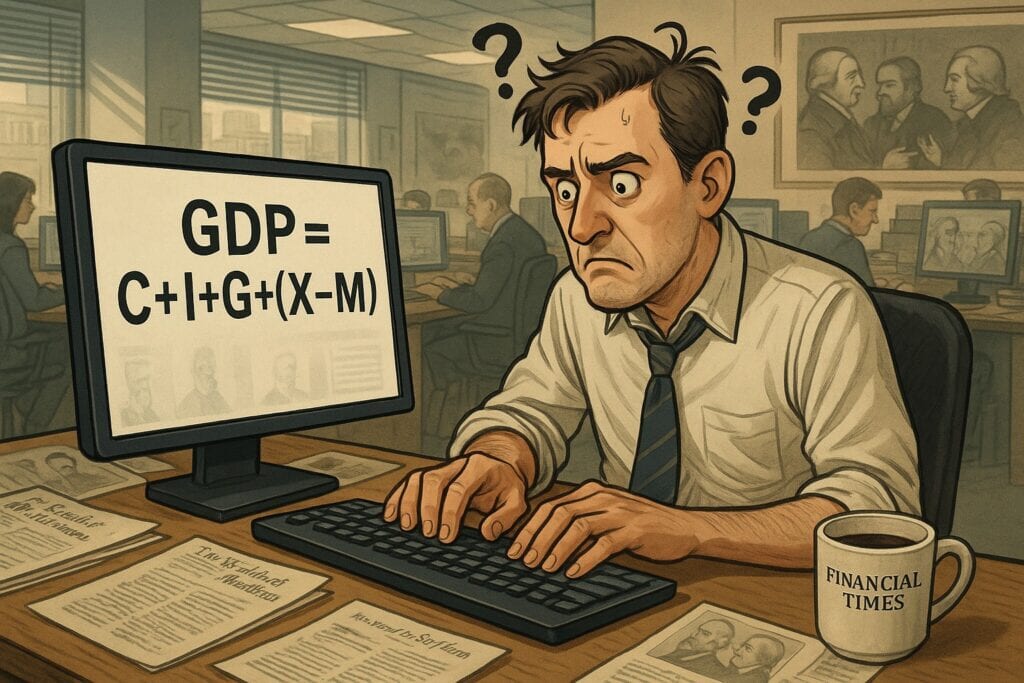
Suppose you measure something (say, GDP) in two steps: first, you add in some number (say, the value of imports); second, you subtract the same value. You may say, focusing on the second operation, that “imports are a subtraction in the calculation of GDP.” You may equally say, focusing on the first operation, that “imports are an addition in the calculation of GDP.” But if you consider the two operations together, the truth is that imports are not a part of GDP and thus neither decrease nor increase it: +A-A=0. The reason is that GDP is defined as the domestic production of final goods and services, which is the “D” in Gross Domestic Product. In its press releases (including the release of April 30), the Bureau of Economic Analysis (BEA) chooses the second formulation instead of the first one or of both together. This focus is highly misleading and does not correspond to the bureau’s methodology and technical literature. The total value of the final goods and services produced domestically in an economy (including capital goods and any increase in inventories) is, by definition, equal to total expenditures (including savings and what is produced but not sold during the period under consideration). In other words, looking at GDP from the expenditures side, we have the familiar equation: GDP = C + I + G + X – M. Forget M for the moment. The equation, which is an accounting identity, says that GDP must also be equal to the sum of consumption expenditures (C), investment expenditures (I), government expenditures (G), and exports (X), if none of these components include imports, for GDP is gross domestic product. In fact, each of these four variables (C, I, G, X), as statistically collected, does include imports. Consequently, the (separately calculated) total value of imports (M) must be subtracted to remove the imports from the total. Hence the formula above. The equation is typically rewritten as its exact mathematical equivalent GDP = C + I +G + (X – M), mistakenly suggesting the false interpretation that the “net exports” or “trade deficit” (X – M) subtract something from GDP. The expert or the economics student who has taken a good college course of introductory macroeconomics knows that this interpretation is not correct. But the ordinary person or the superficial journalist or editor is easily misled. The false interpretation also provides the protectionist activists (like Peter Navarro, despite his Harvard PhD in economics!) with the invalid argument that imports reduce GDP. The reader interested in further explanations and citations including to the BEA) will find several articles and posts of mine: “Gross Domestic Error in The Economist,” EconLog, May 28, 2019); “The St. Louis Fed on Imports and GDP,” EconLog, September 6, 2018; “Peter Navarro’s Conversion,” Regulation, Fall 2018; “Misleading Bureaucratese,” EconLog, October 30, 2017); “A Glaring Misuse of GDP,” Regulation, Winter 2016-2017, (p. 68) ; “Are Imports a Drag on the Economy?” Regulation, Fall 2015. As you can verify, neither the Wall Street Journal nor the Financial Times has come to grips with this simple statistical fact. Very interestingly, and for the first time to my knowledge, The Economist has just shown that it understands: see “Don’t Blame Imports for the Fall in America’s GDP,” May 1, 2025. It is important to distinguish between an accounting identity (such as the one discussed above) and an economic argument. The former is true by definition; the latter needs a valid theory and supporting evidence. It is difficult, if not impossible, to build a valid protectionist theory demonstrating that imports reduce GDP. Standard economic theory, on the contrary, can explain, among other phenomena, how a foreign war embargo or, equivalently, domestic tariffs or bans can hit production via imported inputs (inputs account for more than half of all imports in America). According to the BEA’s advance estimate (which is nearly always revised as more data become available), the American GDP declined by 0.3% in the first quarter of 2025 compared to the last quarter of 2024, while imports increased by 41%. One explanation for the coincidence of higher imports and lower GDP in Q1 is the frontloading of imports before President Trump’s tariffs hit. Consumers, intermediaries, and producers tried to beat the tariff deadlines. For example, car dealers increased their inventories of foreign-made cars (or those containing foreign-made parts) to satisfy the demand of their customers. The high maritime traffic between China and Los Angeles confirms the frontloading of many other imports. Responding to consumer demand, domestic production of substitutes could have been consequently reduced. But the phenomenon would soon be compensated by the (reverse) substitution of domestic for imported production as the tariffs come into force. Another explanation is simply that the uncertainty and pessimistic expectations provoked by Trump’s protectionist intentions were sufficient to start a recession, which is defined as negative levels of GDP and their consequences in terms of unemployment, etc. We will learn more as events develop and new data become available, but not with the help of an accounting identity that says nothing about imports. ****************************** ChatGPT took the initiative of adding a wall picture. It seemed to me that the person on the left looked like Adam Smith and the one in the middle like Karl Marx. I asked “him” about that and he confirmed. The one on the right, he said, is John Maynard Keynes. I decided it was not a bad idea and kept it, although such a picture would be unusual in a newsroom. Puzzled journalist (0 COMMENTS)

/ Learn More

Zoltraak: Competition versus Stagnation

There is a Japanese anime entitled Frieren: Beyond Journey’s End.  While anime has a justly-deserved reputation for being over-the-top and goofy, this particular series bucks the trend.  The plot follows Frieren, an elven mage.  Elves in this universe are incredibly long-lived; their typical lifespan reaches thousands of years long.  Frieren was part of a party of heroes who defeated the Demon King, the leader of a powerful nation of predators who hunted humans, elves, and the other humanoid races.  Due to Frieren’s long life, she outlives her companions and, as time moves on past their great victory over the Demon King, so too do the memories of their time together begin to fade.  The show is about Frieren’s grief and her unexpected (to her) desire to preserve the memories of her friends. The show also has many economic themes and examples.  I have a series of blog posts planned discussing these as I progress through my rewatch.  This post is the first of what I hope will be many.  I will do my best to keep posts spoiler free, but when necessary, I will label spoilers.   In the episode Killing Magic (season 1, episode 3), Frieren and her human apprentice Fern head to a village where a powerful general in the Demon King’s army has been sealed away since the war 80 years earlier.  During the war, this general, Qual, devastated the human armies with a powerful spell named Zoltraak.  This spell could bypass all barriers; there was no counter for it.  Its very name struck terror into the hearts of the humans.  This was the stuff of legends.  Indeed, Qual itself was so powerful that it could only be sealed away; no magic could touch it.   Fast-forward 80 years (to the present) and the seal around Qual has failed.  Frieren and Fern arrive to destroy Qual once and for all.  Qual, recognizing Frieren from the battle 80 years earlier, proceeds to threaten her and unleashes his all-powerful spell.  Fern blocks the spell.  Fern’s surprise is palpable:  “I don’t understand, Mistress Frieren.  That was just ordinary offensive magic.”  Frieren goes on to explain: humans, unlike demons and elves, are not innately magical.  They’ve had to adapt and overcome the challenges facing them.  Conversely, demons are innately and powerfully magical; they do not know how to adapt.  They just bludgeon everything until it submits.  When Zoltraak devastated human armies decades ago, the humans dedicated themselves to reverse-engineering it, understanding it, and perfecting it.  More importantly, the humans simplified it and it became so common that this spell, once solely in the hands of just one extraordinarily powerful demon, is now commonplace against even the lowest-skilled human mages. Here we see a demonstration of what Julian Simon calls “the ultimate resource,” namely the human mind.  Humans are insanely creative when faced with problems.  When prices are allowed to fluctuate (signaling relative scarcity/abundance) and proper institutions are in place that allow for and reward creativity, humanity is able to accomplish amazing things.  Consequently, the impossible becomes not only possible, but commonplace.  Coupled with the fact that technological change is a combinatorial process, it becomes mind-boggling what problems free humans can overcome.  Thus, we see another implication: that problems sow the seeds of their own destruction (or, as Frieren put it: “Zoltraak is just too powerful”).  Faced with challenges, humans will overcome.  If protected from challenges, stagnation results.  To quote the economist Mark Perry: “competition breeds competence.”  Competition not only breeds competence, but breeds superiority.  Let us unleash human creativity. (0 COMMENTS)

/ Learn More

Game theory in Crazy Town

Imagine a young child asks you to play with them. They say they have an invisible unicorn in their room. One response is to play along—perhaps you might suggest that you have an invisible penguin, and ask if it could play with the unicorn.The US government has recently become obsessed with “bilateral trade deficits”, which is a nonsensical concept to most economists.  (What’s your trade deficit with Starbucks?)  But based on a recent article in the Financial Times, the Europeans seem to be willing to play along: Brussels wants to increase purchases of US goods by €50bn to address the “problem” in the trade relationship, the EU’s top negotiator has said, adding that the bloc is making “certain progress” towards striking a deal. . . .  Šefčovič said the key argument he was making to US trade representative Jamieson Greer and commerce secretary Howard Lutnick was taking account of American services exports to the EU, which would bring the overall trade deficit with Europe to only about €50bn. That could be closed rapidly with deals to purchase more US gas and agricultural products, he said. “If what we are looking at as a problem in the deficit is €50bn, I believe that we can really . . . solve this problem very quickly through LNG purchases, through some agricultural products like soyabeans, or other areas,” Sefcovic said. Of course, the European purchase of an additional $50 billion worth of soybeans and natural gas would do almost nothing to reduce the overall US trade deficit, but it would reduce the US bilateral trade deficit with Europe (while enlarging the deficit by an equal amount with other countries.)  This is due to the fact that commodities are fungible, or easily interchangeable. Suppose that Europe had previous been purchasing soybeans from Brazil and natural gas from Qatar.  And suppose that East Asian countries had been buying soybeans and natural gas from the US.  Commodity trade could be rerouted such that Europe now bought its soybeans and natural gas from the US, while Brazilian soybeans and Qatari gas was rerouted to East Asia.  Nothing would change except that transportation costs would be a bit higher, making the world a bit poorer. In the kabuki theatre of American politics this might be viewed as a “big win”.  After all, we now live in an imaginary world where nothing is real.  A world where the administration saved 258,000,000 American lives (probably including your life), just in the past three months.  That’s 3/4th of the US population. The Europeans seem to have realized that if America wishes to play in this imaginary world, their best strategy is to play along, to humor the administration by pretending that bilateral trade deficits are real. PS.  I searched for the 1932 Betty Boop cartoon entitled “Crazy Town”, but the copies on the internet are of very low quality.  I saw these at the theatre when I was young, and for my money they are the best cartoons ever.  (Especially the surrealistic pre-code ones.)  These films are still under copyright, presumably because that will encourage “innovation”.  (Yes, I’m being sarcastic.) Here’s a unicorn: (0 COMMENTS)

/ Learn More

Free Trade and Economic Freedom

Donald Trump’s trade policies are rightly being derided as economically damaging. According to the Tax Foundation, the average American may experience a $1300 reduction in after-tax income this year if proposed tariffs go into effect. GDP is expected to decline by between 0.8% and 1% this year, depending on how other nations respond. Federal Reserve Chairman Jerome Powell has warned that we may be facing the twin evils of creeping inflation and rising unemployment in the near future. Yet the narrative that Trump is imposing tariffs on a nation previously committed to free trade is false.  At my institute, the Bridwell Institute for Economic Freedom, we spend our days trying to understand how variations in economic freedom impact broader social and economic trends. The Economic Freedom of the World Annual Report (EFW), on which my colleagues Robert Lawson and Ryan Murphy are two of several co-authors, contains a variety of metrics that help capture what it means for a country to be economically free. Area four (out of five) tracks several indicators related to freedom to trade internationally. In 1970, the first year for which we have data, the US ranked 4th in the world for trade freedom. We currently rank 53rd. There are 165 countries included in the most recent version of the index, so we aren’t even in the top quartile of countries for freedom to trade.  It’s important to note that our data is released on a two-year lag, so our most recent economic freedom data is for the year 2022. If Trump’s trade agenda succeeds even a little bit, our relative ranking on world trade will deteriorate even further.  The Freedom to Trade Internationally component of the EFW is comprised of 10 variables spread across four subcomponents: (1) tariffs, (2) regulatory trade barriers, (3) black market exchange rates, and (4) controls of the movement of capital and people. Both tariffs and non-tariff barriers are higher than they were in the early 2000s, though they have remained relatively stable since the early 20-teens. Still, we rank 62nd in the tariff subcomponent of the index, and 31st in the regulatory trade barrier component. We have no notable black market exchange rates that would impact the index. Where we have seen substantial deterioration since 2000 is in the fourth subcomponent reflecting controls on the movement of capital and people.  It’s important to note that the “movement of people” here does not refer to immigration, though that is another area on which Trump’s current policies are proving problematic. This instead refers to the freedom of foreigners to visit our country for purposes of either business or pleasure. We make this process unnecessarily difficult, ranking 44th in this category.  We also substantially regulate the flow of capital both into and out of our country. We rank 66th in the capital controls category. There are a number of controls, for instance, on the ability of non-residents to invest in the United States. These sorts of capital controls have a number of negative consequences, including distorting resource allocation, limiting access to foreign capital, discouraging foreign investment, and increasing costs due to the administrative burden of enforcing these restrictions.  The EFW rankings are relative rankings, so we can fall either because our terms of trade have deteriorated or because other countries have improved. As Douglas Irwin said in a recent WSJ article, “The U.S. shouldn’t have stupid tariff policies just because other countries have stupid tariff policies.” We’re now in a world in which other countries are enacting stupid policies in response to Trump’s misguided trade agenda. Even if our relative rankings improve, raw scores will undoubtedly decline here and abroad.  On a fundamental level, President Trump doesn’t believe that positive sum games are possible. The world, in his view, is a zero-sum game. Yet worldwide the average person is 4.4 times richer than they were in 1950, even with a concurrent explosion in population of 5.5 billion people. This explosion in prosperity was facilitated by the international alliances that were forged over this period. Indeed, countries like South Korea, Taiwan, and Singapore who opened themselves up to comprehensive international trade are now more than 30 times richer than they were in 1950. Trade is the ultimate positive sum game.  Two and a half centuries ago, Adam Smith explained that the way to prosperity was not mercantilism, but instead through creating opportunities to truck, barter, and exchange. President Trump’s policies are currently cutting off those engines of prosperity. In doing so, he is creating the conditions for a precipitous fall in economic freedom, which will likewise destroy many of the benefits that freedom brings.    Meg Tuszynski is the Managing Director of the Bridwell Institute for Economic Freedom in the Cox School of Business at Southern Methodist University. She is also a Research Assistant Professor in the Cox School. (0 COMMENTS)

/ Learn More

Victims of Communism Day

  George Mason University law professor Ilya Somin has been carrying on a campaign for years to make May 1 “Victims of Communism Day.” I agree with his goal, and I’m doing my bit here to publicize it. He writes: May Day began as a holiday for socialists and labor union activists, not just communists. But over time, the date was taken over by the Soviet Union and other communist regimes and used as a propaganda tool to prop up their [authority]. I suggest that we instead use it as a day to commemorate those regimes’ millions of victims. The authoritative Black Book of Communism estimates the total at 80 to 100 million dead, greater than that caused by all other twentieth century tyrannies combined. We appropriately have a Holocaust Memorial Day. It is equally appropriate to commemorate the victims of the twentieth century’s other great totalitarian tyranny. And May Day is the most fitting day to do so. Our comparative neglect of communist crimes has serious costs. Victims of Communism Day can serve the dual purpose of appropriately commemorating the millions of victims, and diminishing the likelihood that such atrocities will recur. Just as Holocaust Memorial Day and other similar events promote awareness of the dangers of racism, anti-Semitism, and radical nationalism, so Victims of Communism Day can increase awareness of the dangers of left-wing forms of totalitarianism, and government domination of the economy and civil society. While communism is most closely associated with Russia, where the first communist regime was established, it had comparably horrendous effects in other nations around the world. The highest death toll for a communist regime was not in Russia, but in China. Mao Zedong’s Great Leap Forward was likely the biggest episode of mass murder in the entire history of the world. Just as Paris is well worth a mass, so victims of Communism deserve a day. I lost my copy of the Black Book of Communism in my 2007 fire, but I do recommend at least paging through it to see the horror. Even from an early age, when I learned what Stalin had done in Ukraine, I was inoculated against Communism. Although, truth be told, it actually happened earlier than that, in 1956, when the USSR’s government invaded Hungary. When people ask what was the first major historical event I remember happening in real time, the invasion of Hungary is the one that comes up. I was 5 years old and turned 6 later that month. (0 COMMENTS)

/ Learn More

It’s Even Better Than A Consumption Surplus

Co-blogger Kevin Corcoran has an excellent recent blog post calling for rebranding the “trade deficit” away from its misleading phrasing and toward the more accurate phrasing of “consumption surplus.”  My beloved professors Don Boudreaux and Dan Klein have a similar proposal as well.  There is much merit in their arguments.  I argue that the situation is even better than they propose. It certainly is true that consumption is the end goal of all production.  Without consumption, production is valueless.  We work in order to achieve some desired end, not the other way around.  But what is also valuable is investment.  Investment, to the economist, is not buying of stocks and bonds (although those are valuable activities as well), but rather purchases of capital equipment, homes, and other things that go into production.  More precisely, investment is “the production or construction of capital goods that provide a ‘flow’ of future service” (Economics: Private and Public Choice by James Gwartney, Richard Stroup, Russell Sobel, and David Macpherson, 17th Ed, pg. 137).  Investment, therefore, is key to fueling economic growth well into the future. Imports exceeding exports necessarily means that more desired goods are flowing into the country.  Likewise, it means that more investment funds are flowing into the country as well.  Foreigners want American goods (we are the second largest exporter in the world at approximately $3 trillion worth of exports in 2023 alone), but they also want to put their savings into America.  A greater supply of savings means a lower interest rate (all else held equal).  Consequently, American firms and individuals can invest more than they otherwise would as the price of money falls.  This means more business creation, more homes, more college degrees, more retrofits, more upgrades, more research, more of everything that improves production, innovation, and general welfare.  Instead of the American production possibilities frontier being limited by domestic savings alone, it can be enhanced with foreign savings.  Trade lets us both consume beyond the production possibilities frontier and advance the production possibilities frontier.  All while using fewer resources. Political efforts to reduce the trade deficit results in killing the golden goose.  Borrowing costs will rise, investment will fall, and so will the standard of living. We have seen these results with the trillions of dollars in wealth that was annihilated by the “Liberation Day” tariffs.  Treasury Bond rates have been increasing.  In turn, slower economic growth and higher borrowing costs will actively inhibit the Administration’s supposed goal of righting the fiscal ship.  In short, I propose enhancing Kevin’s rebranding as “consumption and investment surplus.”  Trade deficits help Americans get wealthier not just now (consumption) but in the future as well (investment).  PS. While working on my International Trade lectures for this semester, I came across an interesting paradox: Americans earn more on their investments abroad than foreigners earn on their American investments.  Yet, the trade deficit, and net investment position, are negative (implying foreigners are investing more in the US than the US is abroad).  What accounts for this paradox?  Risk.  The US is seen as a safe haven, so foreigners put their money here.  But Americans search out a combination of risk and safety, so they chase the higher interest rates abroad while keeping some here.  Consequently, American investments abroad earn a higher return than foreign investments in the US.  This position reverses in bad times: Foreigners end up earning more on their US investments than US citizens do abroad as the US citizens bring money back to safe havens and the riskier investments do not pan out.  See Why Does U.S. Investment Abroad Earn Higher Returns Than Foreign Investment in the United States? (CBO, 2005) and New Evidence on the US Excess Return on Foreign Portfolios (Bertaut, et al, 2024). (0 COMMENTS)

/ Learn More

Fewer Rules, Better People: The Laws of Bureaudynamics

In his examination of why we should move away from legalism and more in the direction of discretion, Barry Lam concedes that there are strong arguments in favor of a legalist approach. His analysis of legalism continues by looking at what he sees as the selection pressures leading to legalism being further entrenched into social institutions – what he calls the two laws of bureaudynamics. The first law of bureaudynamics Lam identifies is: Rules and their administration increase in complexity over time. We can see this play out in many forms. Small companies and startups can often have rather vague and open-ended policies that give wide latitude for discretion. Large multination companies have voluminous writings on company policies and procedures attempting to spell out how to act in every edge case. As startups grow and eventually become large companies, we can see this process carry out. As Lam puts it: There’s a very natural evolution in administering rules in an organization, small to large, such that, over time, rules and their administration only become longer and more complex, never shorter or simpler. This is an almost unavoidable process, and not entirely without value, because making rules more detailed and specific helps bring out two important values in rules or laws: Fairness requires that rules need to fully inform people about what compliance requires. Philosophers of law call this the guidance value of law. When rules or laws are vague and unclear, it’s hard for any given person to know how they need to conduct themselves to avoid running afoul of the rules. If you don’t clearly understand what behavior falls in or out of bounds, you are subject to arbitrary enforcement. This same issue provides another important value that mirrors guidance value for those subject to laws – those who enforce the laws also need to have a clear understanding of what the law requires: The rule of law also requires that enforcers be given sufficient instruction on when a law is violated. Philosophers of law call this the process value of law. He cites an example of a city with a very complex noise ordinance outlining very specific noise levels permitted at all manner of locations, for all kinds of events, for all hours of the day, including a clause that noise at an individual property may not exceed the ambient noise level by more than five decibels. Applying these ideas, Lam says: This law has very poor guidance value but good process value. The typical citizen does not own a decibel meter and does not know that decibel scales are logarithmic so as to understand a five decibel difference. The typical complainant probably cannot tell you where a violator’s property line is. But any police officer carrying a decibel meter can show a violator right away why they are receiving a citation. But what Lam sees as the most important driver of the first law of bureaudynamics is mistrust. This leads to a demand for more complex and precise rules, partly on the part of enforcers: The more mistrust, the more rule makers will expect the devious citizen to look for loopholes and exceptions to the rule and anticipate them, turning a rule into pages of subsections and clauses. Legislation, a saying goes, is aimed at the dumbest and most devious among us. But this demand is driven to a greater degree by citizen mistrust of enforcers: Similarly, the mistrustful citizen reasons that enforcers will be tyrants, exercising unreasonable power over them unless the rules prohibit it. This is why citizens, not enforcers, tend to push for high process-value rules. Given a choice, they will refuse to accept any tax law with the clause “or other similar cases” or any laws that give interpretive discretion. This leads to the second law of bureaudynamics: Pressures to remove discretion in rule making are far greater than pressures to grant it. Lam describes a Supreme Court doctrine going back to 1926 called “void for vagueness” that is often applied to strike down laws that are insufficiently precise, and leave too much room for interpretive discretion: Whether the law is t00 vague depends on two tests. The first is whether an ordinary, reasonable person can understand how to comply with the law in various circumstances. This is the guidance value test. A law without sufficient guidance value, the reasoning goes, should not be a law. The second test is whether the law encourages arbitrary and discriminatory enforcement. This is a process value test. A law on the books with absolutely no process value is one that encourages, or at least permits, arbitrary and discriminatory enforcement. The mistrust leading to ever more complex rules also leads to a bias in favor of removing the application of individual judgment to individual cases: Mistrust is the root of legalism. And the asymmetry between how easy it is to lose trust and how hard it is to restore it explains why we only seem to march towards legalism and never away from it. Mistrust is the common explanation for both laws of bureaudynamics. It takes one high-profile case of someone exploiting a loophole in a rule and getting away with it to transform entire institutions into legalistic ones. It takes generations of complex rule making, fanatical compliance officers, and overzealous bureaucracies gumming up efficient or effective governance for anyone to hint at the need for reform. While Lam admits legalism has strong arguments in support of it in the abstract, in the real world the drive toward legalism is less the result of these arguments and more a result of these unfolding laws of bureaudynamics. Still, discretion is not gone from this world, nor can it ever be. In the next post I’ll be looking at how Lam examines the use of discretion in one of the most contentious areas of this debate – law enforcement.   (0 COMMENTS)

/ Learn More

Tariffs and the economy

I am seeing a lot of claims about how tariffs are likely to impact the economy. Here are a few of my views on the issue:1. The most important impact of tariffs is not their effect on inflation. 2. The most important impact of tariffs is not their effect on the business cycle. 3. Most economists overestimate the impact of “real shocks” such as tariffs on inflation and the business cycle. 4. The most important economic impact of tariffs is on long run economic growth.  (There are other non-economic impacts, such as increased risk of war.) 5. Most economists do not overestimate the impact of tariffs on long run growth. 6. The impact of tariffs on the business cycle and inflation depends largely on the response of monetary policymakers. 7.  Monetary policy has almost no impact on how tariffs affect long run growth. 8. When most average people think about how “the economy” is doing, they think in terms of the business cycle and inflation, not the far more important trends in long run growth. 9.  There is “a great deal of ruin in a nation” and hence even large real shocks usually have seemingly small effects on long run growth.  But those seemingly small effects are actually quite important.  A 0.2% decline in long run growth is far worse than a 2% fall in GDP for a single year. Put these nine points together, and you have a recipe for widespread misunderstanding regarding the recent trade war.  I don’t know how much monetary offset we are likely to get, and I don’t know how much the administration will adjust tariffs in the weeks and months ahead.  Thus it’s impossible to offer unconditional forecasts on inflation and the business cycle.  But I will offer a few tentative observations. 1. The current level of tariffs, by itself, is probably not enough to trigger a recession.  Nonetheless, a recession is possible due to the interaction of tariffs and monetary policy.  Put simply, the trade war will reduce the equilibrium or natural rate of interest, likely making monetary policy tighter in 2025.  I would recommend rate cuts if not for the fact that previous monetary policy has been too expansionary and inflation remains a significant problem. 2. The recent GDP figures understate growth in the economy during Q1.  Actual growth was likely higher than reported because a large amount of inventory accumulation was missed.  Put simply, lots of goods showed up (at the docks) as a negative in the import category, but have not yet been listed as a positive in “inventory investment” (in warehouses).  For the same reason, Q2 growth will almost certainly be overstated.  Focus on monthly data like the jobs report to see what’s actually going on. 3. The administration faces an interesting dilemma.  It can avoid recession by backing off on the trade war, at the cost of failing to address the trade deficit.  Or it can press ahead with a more aggressive trade war, at the cost of risking recession.  Recessions usually reduce the trade deficit.  4.  I view manufacturing as overrated.  But if we must obsess about manufacturing, it would make far more sense to bring back manufacturing output than it would to bring back manufacturing employment.  I.e., chip-making not iPhone assembly.   (0 COMMENTS)

/ Learn More

Global nationalism: Part 2

A few months back, I did a post discussing the internal contradictions of global nationalism. In yesterday’s election in Canada, we saw an almost perfect example of that problem: “Poilievre had been running a disciplined and effective campaign which had him with a 25-point lead in our final poll of 2024,” Graves told me. Poilievre’s argument, he said, boiled down to “Canada broken, Trudeau bad, and axe the [carbon] tax.” . . .   But suddenly everything was “radically disrupted” by several factors, Graves said, like Trudeau’s departure from the race in January. However, the “most important” disruption for Poilievre was the “visceral recoil” Canadians felt when they heard Trump talk about annexation. Starting in February, Trump launched a trade war against Canada, with on-again, off-again tariffs that left Canadians reeling. A wave of nationalism swept the country, with Canadians booing the American national anthem at hockey games, boycotting U.S. products, and all but abandoning cross-border travel. This put Poilievre in a near-impossible position. Much of his base—including many of his MPs—admire Trump. But with Trump openly attacking Canada, and with Poilievre’s own anti-woke rhetoric and disdain for the mainstream media, he found himself trapped. Attempts to distance himself from Trump could alienate core supporters, while embracing the American president would push away everyone else. Mark Carney is the leader of what is expected to be a new Liberal government in Canada (in coalition with a smaller party.)  He previously served as head of both the Bank of Canada and the Bank of England.  (Sadly, America is too nationalistic to contemplate foreign central bankers.)  As far as I know, no central banker has formally endorsed NGDP targeting, but Carney may have come closer than any other.  Here are some comments that he made back in December, 2012: “If yet further stimulus were required, the policy framework itself would likely have to be changed. For example, adopting a nominal GDP (NGDP)-level target could in many respects be more powerful than employing thresholds under flexible inflation targeting. This is because doing so would add “history dependence” to monetary policy. Under NGDP targeting, bygones are not bygones and the central bank is compelled to make up for past misses on the path of nominal GDP … However, when policy rates are stuck at the zero lower bound, there could be a more favourable case for NGDP targeting. The exceptional nature of the situation, and the magnitude of the gaps involved, could make such a policy more credible and easier to understand. Of course, the benefits of such a regime change would have to be weighed carefully against the effectiveness of other unconventional monetary policy measures under the proven, flexible inflation-targeting framework.” PS.  I would argue that the single most consequential action of President Trump’s first 100 days (for better or worse) was his trade war with Canada, which clearly prevented the election of a Conservative administration.  Before the trade war, the Conservatives were set to win by a historic landslide. Next up, Australia: SYDNEY, April 29 (Reuters) – Australian university student Jessica Louise Smith says she will cast her vote in Saturday’s general election with only one objective: avoiding the “worst possible” outcome of a right-wing government.   The 19-year-old said the prospect of conservative opposition leader Peter Dutton winning power was “very frightening”, after seeing the disruption caused by Donald Trump in the United States. It should be another close one. (1 COMMENTS)

/ Learn More