This is my archive

bar

The middle income trap

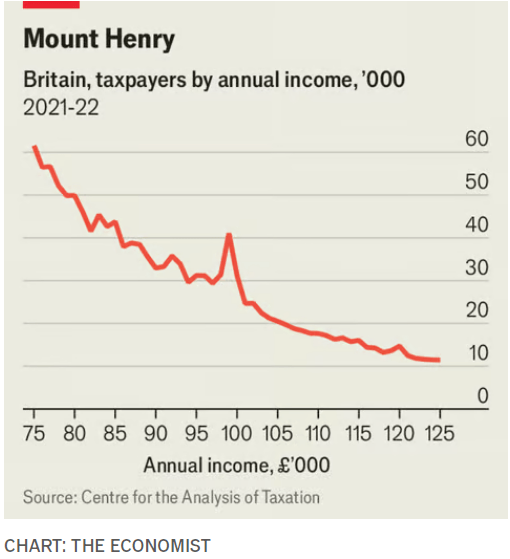
In America, the poor often face relatively high implicit marginal tax rates, because they lose many benefits as their incomes rise.  The Economist has an article discussing a similar situation in the UK, which affects the upper middle class, those earning over £100,000:  At £100,000, the removal of the tax-free allowance creates a 60% marginal tax rate for those lucky enough to have a fat salary. When national insurance and student-loan repayment—which act like a tax—are included, a young high-flyer can face a 71% rate. It is not quite 1960s levels, when The Beatles moaned about “one for you, 19 for me”, but it is not far off. . . .The Conservatives introduced lavish free child-care allowances, which are worth tens of thousands. Yet [the upper middle class] are excluded. When all this is put together, a [family] in London with two children under five is better off earning £99,999 than £149,000. Tax experts must often explain that tax rates ensure there are no gigantic losses when income crosses a certain threshold. In England, however, earning one pound over £100,000 can cost thousands. High implicit marginal tax rates create a disincentive to generate wealth.  A graph provided in the article shows that many taxpayers are bunched up at just under £100,000, presumably by refraining from working overtime when it threatened to push their incomes above the levels where they would lose the lucrative child tax allowance: Suppose the UK started with a program where all taxpayers were eligible for the child allowance.  Should a libertarian favor “means-testing” the program so that those earning over £100,000 no longer qualify?  On the one hand, this would reduce government spending.  On the other hand, it would raise the implicit marginal tax rate, making it harder to escape the middle income trap. The US may soon face this dilemma with its Social Security program.  I expect that there will be calls to reduce benefits for those with incomes above a certain threshold.  But this will implicitly act as a tax on saving, making those who saved in order to supplement their Social Security with private savings look like suckers.  If Americans respond by saving less, this might boost the trade deficit. When I read about modern British politics, I’m continually amazed at the extent to which the supply-side achievements of Margaret Thatcher have been trashed by the modern Conservative Party.  The Economist has two other articles that address the poor recent performance of the British economy.  In one article, they discuss how the UK failed to take advantage of the opportunities available after they left the EU, such as making their airline industry more competitive: The Competition and Markets Authority (CMA), a regulator, has been mustard-keen on such market reform for years; Rishi Sunak’s Conservative government appeared enthusiastic. Sir Keir’s Labour government is not. New ministers have their own priorities, and have concluded that an immensely complicated fight with vested interests is not worth the candle. It is an illustration of how Britain has engineered the worst of all possible Brexits. Since slot rules in Britain were fixed in EU law, here was that rare thing: a bona fide Brexit opportunity to shake off protectionist rules that cosset creaking national champions. Singapore-on-Thames would welcome Singapore Airlines. Instead Britain has lost EU–market access, thereby weakening competition on British firms, while undertaking precious little of the regulatory simplification that might have fostered it. Another article shows that the British public has come to regret the decision to leave the EU: One reason why the gap is widening is that Brexit supporters are dying off: During that campaign, Labour had a relentless focus on winning over wavering Tories. But the Reaper proved just as helpful. Between the elections of 2019 and 2024, roughly as many Conservative voters dropped dead as switched from Conservative to Labour. Dead Man’s influence is felt in policy as well as at the ballot box. The dead are among the strongest supporters of Brexit. Two-thirds of those who shuffled off this mortal coil after 2020 supported leaving the EU. (0 COMMENTS)

/ Learn More

Inside the Mysterious World of Credit Cards (with Patrick McKenzie)

Patrick McKenzie explains to EconTalk’s Russ Roberts how credit cards work, who makes money from them and how, and gives his take on whether cash customers and debit card users subsidize the users of credit cards with reward programs. The post Inside the Mysterious World of Credit Cards (with Patrick McKenzie) appeared first on Econlib.

/ Learn More

Two more examples of the nationalist’s dilemma

I’ve already done several posts on the internal contradictions of nationalism.  The Financial Times recently offered two such examples in a single issue.  Before considering the first example, recall that a portion of Romania contains a large ethnic Hungarian population living in a region that was once a part of Hungary.  Here’s the FT: Viktor Orbán’s support for an ultranationalist candidate in Romania’s presidential election has prompted a backlash in the Hungarian diaspora, potentially jeopardising the Hungarian leader’s own election chances next year. Romania is home to about 1mn ethnic Hungarians, many with dual nationality, who have been a crucial source of support for Orbán’s nationalist Fidesz party. But many of them have been incensed by his recent endorsement of George Simion — a populist with a history of physical and verbal violence against Hungarian speakers. “Hungary’s leader seems to have loftier plans than the fate of Hungarians in Transylvania,” said Szilárd Toth, a history professor at the Babeș-Bolyai University in Cluj. Nationalism derives much of its power from resentment against other nationalities.  This creates a dilemma—should nationalist leaders look to align with nationalists in other countries, or with minority groups that share their ethnicity? President Trump has frequently expressed admiration for Vladimir Putin.  Both are authoritarian nationalists that believe big countries should dominate small countries.  During the recent campaign, Trump suggested that he would be able to almost immediately end the war in Ukraine, presumably by using his influence with Putin, as well as by pressuring Ukraine (which relies heavily on US aid.)  The Trump administration even went so far as to join Russia, Iran and North Korea in voting against a UN resolution that blamed Russia for starting the war in Ukraine. Under pressure from the US, Ukraine has indeed agreed to a ceasefire that would leave Russia in control of a significant portion of Ukrainian territory.  But Putin refuses to agree to the ceasefire, causing frustration in the Trump administration.  Another FT story explains the situation: When US vice-president JD Vance was asked about the war in Ukraine at a foreign policy forum in Washington last week, diplomats were expecting Maga-style criticism of Kyiv and veiled sympathy for Russia. Instead, they heard something quite different. Vance said of a set of Russian proposals to end the conflict: “We think they’re asking for too much.” The phrase “Maga-style criticism” refers to the fact that many people in the Trump camp live in an alternative reality where Ukraine is to blame for the war and Zelenskyy is a bloodthirsty dictator. But even people living in an epistemic bubble must eventually face the reality that Russia is the aggressor: Vance’s comments were part of a noticeable shift in tone by the Trump administration. US officials appear increasingly impatient with Vladimir Putin, as suspicions grow that the Russian leader, rather than Zelenskyy, may be the biggest obstacle to peace. “The Americans had this simplistic idea — let’s charm Russia, put pressure on Zelenskyy, and we’ll get a deal,” said Wolfgang Ischinger, the former German ambassador to the US to whom Vance made his comment at last week’s forum. “It turned out that simply charming Russia is not enough.” Putin may share Trump’s authoritarian nationalist perspective, but he doesn’t share Trump’s view of “America First”.  Trump faces a dilemma.  Should he align the US with other authoritarian nationalists, or should he align the US with other regimes that share our national interest? The Trump administration offered major concessions to Russia before the negotiations even began, including a statement that Ukraine would never join Nato, as well as an offer that the US could accept the Russian acquisition of Crimea.  I’m no expert on “the art of the deal”, but I’d always assumed that you’d at least wait for the negotiations to begin before offering concessions. (1 COMMENTS)

/ Learn More

Contradictions Can Be Revealing: A Current Example

Expressing a contradiction can show plain ignorance or cognitive impairment. It can also suggest a hypothesis or theory that explains the contradiction away. Consider a current example. On the one hand, President Donald Trump argued that he would be a fool not to accept from a foreign autocrat the gift of a $400-million airplane (“Republicans Raise Concerns Over Trump’s Plane Gift as He Heads to Qatar,” Wall Street Journal, updated May 14, 2025): “Only a FOOL would not accept this gift on behalf of our Country,” Trump wrote on his social-media platform. … During an interview with the Fox News host Sean Hannity on Tuesday night, Trump called the proposed gift “a beautiful gesture” and disparaged critics as “stupid.” On the other hand, Trump denies the American residents’ freedom to import goods produced in China, one reason being that their production is deemed subsidized by the Chinese state. He unilaterally levied very high and often prohibitive tariffs on these goods (he later backed off, but high tariffs remain). One example that Mr. Trump used is dolls, both in his first term and more recently (“Donald Trump’s ‘Marie Antoinette Moment’: Call for National Sacrifice Falls Flat,” Financial Times, May 4, 2025), declaring: “Maybe the children will have two dolls instead of 30 dolls … and maybe the two dolls will cost a couple of bucks more than they would normally.” Chinese electric cars offer a similar example. Now very competitive with Teslas, these cars had gained a 50% market share of EVs in the European Union before new import tariffs there reduced it to 30% (“Chinese Carmakers Reset European Ambitions as EU Tariffs Bite,” Financial Times, April 28, 2025). The Seagull produced by BYD should be available in the UK for £18,000 later on this year, which includes compulsory safety upgrades and a 10% tariff (plus the VAT of 20%, a sales tax imposed on all cars sold in the country, domestic or foreign). Were it not for the prohibitive tariffs and non-tariff barriers in the US, the Seagull would cost $24,000 here (at the current exchange rate). Without obstacles from a government that “owns the store,” many ordinary Americans would be likely interested. Perhaps only a (non-rich) fool would not. BYD is a private company listed in Hong Kong. In 2023, Warren Buffett’s Berkshire Hathaway owned an 8% share. It is subsidized by the Chinese state’s industrial policy, only more interventionist than what the Bidens and the Trumps are fond of. (“How China’s BYD Played Catch-Up with Tesla,” Financial Times, July 6, 2022.) There is a persuasive moral argument, besides a legal obligation, against purchasing stolen goods. It presumably does not apply to goods subsidized by taxpayers. If it did, there is a large number of goods that one could not purchase, even in one’s own country. In the case of dolls and other goods produced by small companies or one-man businesses in China, production subsidies are likely not available. As for the argument that foreign government subsidies generate “unfair trade,” it is important to understand that free trade remains efficient—even assuming the importer gets no subsidy from his own government. For a group of individuals (say, a “nation”), free trade, like economic freedom in general, means their freedom to trade if they can find a buyer willing to pay their price or if they can find a seller whose price they accept. In a free society, each individual or private organization decides what to buy and from whom. That some competitors will be disappointed is no more a valid objection than the observation that each consumer who buys something implies that another consumer is outbid. In this view, Americans should be free, without special taxes called tariffs or prohibitive tariffs or non-tariff barriers, to import goods from China even if they are subsidized by the hapless Chinese taxpayer. To speak like Mr. Trump, only a fool wouldn’t accept an automobile partly gifted by Chinese taxpayers. (See also my post “Taking Comparative Advantage Seriously”.) A country where public officials could accept and even chase possibly corrupting gifts from foreign autocrats, but where private individuals could not accept gifts through trade, looks like a free society upside down. How then can we explain the contradiction voiced by Mr. Trump? Ignorance or cognitive deficit can offer explanations among others. A compulsive liar is bound to be mired in contradictions because he does not remember his previous lies and doesn’t care about the truth anyway. Or perhaps, like Molière’s Mr. Jourdain was doing prose without knowing it, Mr. Trump adheres to solipsism—the philosophy that only one’s own self exists. Another possibility in the present case is the implicit or sometimes explicit pretense of populism: the leader embodies “the people,” and any gift to him is a gift to the people. ****************************** A little contradiction to be explained (1 COMMENTS)

/ Learn More

My Weekly Reading for May 18, 2025

  German Censorship Highlights Europe’s Eroding Free Speech Protections by J.D. Tuccille, Reason, May 12, 2025. Excerpt: Putting the main opposition party under an “extremist” designation subject to surveillance is a frightening step for a democracy. “One of the things I appreciate about America is that when the federal government attacks free speech there’s instant pushback by civil society,” Jacob Mchangama, the head of The Future of Free Speech think tank at Vanderbilt University, responded to the controversy. “People take to the streets. In Europe free speech has been in steep decline for years, but there’s no real public outcry, no mainstream concern about democratic backsliding. In fact, the Old World is in a state of delusional ‘Censorship Denial.'” This wasn’t an isolated incident. Last month, David Bendels, an AfD-associated editor, was sentenced to seven months’ probation for posting a mocking meme of former German Interior Minister Nancy Faeser holding a sign digitally altered to say the German equivalent of “I hate freedom of speech.” Like other members of the last coalition, Faeser has a censorious reputation; she banned Compact magazine as “extremist” just last summer.   The China Shock Revisited: Job Reallocation and Industry Switching in US Labor Markets by By Nicholas Bloom, Kyle Handley, André Kurmann, & Philip A. Luck, Research Briefs in Economic Policy, No. 431, Cato Institute, April 30, 2025. Excerpt: Our research investigates the extent to which the opposing trends in manufacturing and services job growth are related. Our findings reveal that local labor markets more exposed to Chinese import competition experienced larger manufacturing job losses. But these losses were offset by stronger services job growth, which mostly came from job reallocation within firms. Importantly, the extent of this reallocation varied across regions. Places with a high share of college-educated workers—including much of the West Coast and large cities—saw successful transitions, with service job gains outpacing manufacturing job losses. Places with a low share of college-educated workers and high manufacturing dependence—including much of the Midwest and the South—experienced only limited services growth to compensate for manufacturing job losses. Our findings imply that the China Shock was, on net, a job creator and not a job killer. At the same time, the shock created winners and losers, not just across workers but also across regions, by relocating jobs from the industrial heartland to the coasts and large cities, thereby contributing to the changing geography of jobs in the United States. This experience offers a crucial lesson about today’s debate on tariffs: While trade barriers might bring back some manufacturing jobs, they may not only raise prices but also risk undermining the substantial growth in high-paying service-sector jobs that global trade has fostered, especially in high-education and high-productivity regions. In other words, the aggressive tariff policy advocated by the White House may create a few winners but will likely make America lose overall.   How a Small Share of Firms Drive Economic Growth by Timothy Taylor, Conversable Economist, May 13, 2025. Excerpts: A team from the McKinsey Global Institute writes about the mushrooms in “The power of one: How standout firms grow national productivity” (May 6, 2025). The thesis, as stated in the subtitle: “National productivity growth is a matter of few firms taking bold strategic action rather than millions of firms raising efficiency.” For the relatively short time frame they analysis in this study, from 2011 to 2019, this seems likely to be true. The authors have a dataset of 8300 firms across the US, UK, and German economy, all with at least 50 employees and many with more than 500 employees, and focused in four sectors: retail, automotive and aerospace, travel and logistics, and computers and electronics. They refer to this limited group of companies in each country as a “lab economy.” define a “Standout” firm as a company where the productivity growth in that single company, by itself, adds at least 0.01% to the productivity growth of the entire set of companies for the lab economy in one country. Conversely, they define a “Straggler” firm as a single company that, by itself, subtracts at least 0.01% of productivity growth from the entire economy. Of courses, most firms are between these extremes. And: First, a relatively small number of Standouts and Stragglers can drive the overall productivity growth patterns of an economy. The report notes: “Fewer than 100 firms in our sample of 8,300—a group that we have dubbed Standouts—accounted for about two-thirds of the positive productivity gains in each of the three country samples we analyzed. … To give a sense of how important a single firm can be, just another dozen or so of the largest Standouts could have doubled productivity growth in their entire country. … In the United States, for instance, 44 Standouts—5 percent of sample firms, accounting for 23 percent of employment share—generated 78 percent of positive productivity growth. … US Standouts included household names like Apple, Amazon, The Home Depot, and United Airlines. Second, the US has a higher proportion of Standouts relative to Stragglers, compared to the UK and Germany: “US productivity growth from 2011 to 2019 was faster than that of the other countries in our sample at 2.1 percent, compared with 0.2 percent in Germany and close to zero in the United Kingdom. … The US sample had three times more Standouts than Stragglers, while the German and UK samples had almost even numbers.” Third, US Standouts are more likely to grow and expand, while US Stragglers are more likely to contract, compared with the UK and Germany: “Firms in the US sample had more reallocation of employees from less productive to more productive firms. Leaders grew faster, and underperforming firms more swiftly restructured or exited. In the United States, Standouts include scalers (firms far above average sector productivity that contribute by gaining employees) and restructurers (firms with below-average sector productivity that contribute by losing employees). In Germany and the United Kingdom, this was not the case. Rather, these countries preserved underperforming firms as Stragglers. Frontier firms scaling and gaining share added 0.6 percentage point to productivity growth in the United States, and unproductive firms exiting contributed an additional 0.5 percentage point. Overall, dynamic reallocation, including reallocation across subsector boundaries, added 0.9 of 2.1 percentage points—slightly less than half—to productivity growth in the US sample. In contrast, the contribution of reallocation was negligible in Germany and the United Kingdom. This may be explained by the fact that the United States has highly dynamic factor markets, allowing for quick entry and exit as well as fast scale-up and restructuring. First, a relatively small number of Standouts and Stragglers can drive the overall productivity growth patterns of an economy. The report notes: “Fewer than 100 firms in our sample of 8,300—a group that we have dubbed Standouts—accounted for about two-thirds of the positive productivity gains in each of the three country samples we analyzed. … To give a sense of how important a single firm can be, just another dozen or so of the largest Standouts could have doubled productivity growth in their entire country. … In the United States, for instance, 44 Standouts—5 percent of sample firms, accounting for 23 percent of employment share—generated 78 percent of positive productivity growth. … US Standouts included household names like Apple, Amazon, The Home Depot, and United Airlines.   Spain’s Grid Collapsed in 5 Seconds. The U.S. Could Be Next. by Marc Oestreich, Reason, May 13, 2025. Excerpt: When a power plant trips offline or demand suddenly spikes, the power grid has no cushion; it must respond instantly or it unravels. That’s where inertia comes in. In coal, gas, and nuclear plants, massive turbine rotors spin at thousands of rpm. Even when power is cut, they keep turning, releasing stored energy that slows frequency shifts and buys precious time—seconds to a minute—for backup to kick in. It’s not backup power, it’s breathing room. Like the flywheel on a Peloton, it keeps things steady even when input falters. Once frequency drops too far, automatic protection kicks in. Plants shut down. Substations isolate. The grid severs its own limbs to survive. If imbalance spreads faster than recovery can respond, the collapse cascades. Entire regions go dark—not for lack of power, but lack of time. Even the right answer, a minute late, is no answer at all. That’s what happened in Spain. On April 28, solar energy was generating nearly 18 gigawatts of electricity—more than half of the national demand. Within an hour, more than two-thirds of it disappeared due to what authorities called a “technical fluctuation.” Grid frequency plummeted. France tried to send emergency power across the intertie, but the imbalance tripped the connection. In five seconds, the entire Iberian grid collapsed. Experts/government regulators are unsure if solar power alone caused the failure. But a system hell-bent on pushing renewables certainly ensured that the failure was catastrophic. This wasn’t bad luck. It was bad policy made manifest—a sequence I’ve come to call the Four Horsemen of Grid Failure:     (0 COMMENTS)

/ Learn More

Cardwell’s Cage and How to Break Free

Donald Cardwell, a British historian of science and technology, famously observed that “no nation has been very creative for more than an historically short period.” Known as Cardwell’s Law, this dictum haunts many people concerned about the future of innovation. Can the United States, or any other country, break free of the cage of Cardwell’s Law and create an environment that fosters innovation indefinitely? To better understand this challenge, it helps to zoom in from the level of nations to that of cities, which often function as engines of innovation. While intended to describe whole societies, Cardwell’s Law scales down well to the level of individual urban centers. After all, city-states were the first states and served as the sites of institutional experimentation. And for a long time, it was cities, not larger nations, that commanded loyalty. A grim message from my otherwise uplifting book, Centers of Progress: 40 Cities That Changed the World is that a city’s creative peak tends to be—as Cardwell noted—brief. As the British science writer Matt Ridley observed in the foreword to the book, “Global progress depends on a sudden series of bush fires of innovation, bursting into life in unpredictable places, burning fiercely, and then dying rapidly.” Are there any exceptions to that rule? Have any cities managed to maintain longer-than-expected golden ages of innovation, and what can we learn from them? The cities from earlier eras that I profiled in my book tend to be featured for their achievements over longer periods of time. That is, unfortunately, because in the distant past, progress was often painfully slow—not because someone had cracked the code to break Cardwell’s Law. Writing, for example, developed over multiple generations, as simple pictographs that accountants invented for record-keeping purposes evolved into a symbolic script and eventually into highly abstract, cuneiform characters. The birthplace of writing was Uruk, an ancient Sumerian city. The most noteworthy part of Uruk’s history lasted for many centuries, but only because the city’s great achievement took generations to accomplish. We should hardly want to emulate a society that advanced at such a pace. In contrast, when we turn to modern history, the pace of progress accelerates—but the creative window narrows. Manchester, the so-called workshop of the world, led the way during the Industrial Revolution, but only for a few decades. Houston’s heyday helping drive forward space exploration also only lasted a few decades. Today, the youngest living person to have walked on the moon is 89. Tokyo went from being a world capital of technology in the 1980s to decades of economic stagnation. The San Francisco Bay Area that birthed Silicon Valley and the digital revolution has lost its crown, with many technological breakthroughs now occurring elsewhere. In the modern era, the golden age of innovation in any locale tends to last only a few decades, or even less. To understand why this pattern repeats so consistently, consider the underlying conditions that support—or sabotage—sustained innovation. The economic historian Joel Mokyr, in an illuminating 1993 essay, describes the narrowness of the path that societies must walk to promote creativity, a veritable tightrope where one wrong move can lead to everything crashing down. “In retrospect, the most surprising thing is perhaps that we have come this far,” he concludes. What causes the downfall of centers of progress, making Cardwell’s Law so seemingly prophetic? While world-changing innovations have come from an extraordinarily diverse set of places, from Song–era Hangzhou to post–World War II New York, sites of creativity almost always share certain key features. It is the loss of those factors that spells their doom. These feature are: conditions of relative peace, openness to new ideas, and economic freedom. Free enterprise and healthy competition encourage innovation, and the freedom to trade across borders plays an important role by increasing that competition. At the same time, free exchange across borders must not be confused with the total dissolution of borders: vast empires under centralized control tend to stagnate technologically, and complete integration of countries under a global government would in all likelihood be a disaster. A certain type of international competition can be beneficial—just not the kind of rivalry that leads to war. War redirects creative energies toward making deadlier weapons and away from technologies aimed at improving living standards. And, of course, losing a war can lead to a society’s complete destruction. Moreover, war prevents innovators from collaborating across borders, and even thinkers within the same country often cannot put their heads together due to the secrecy inherent in war. While some credit WWII with speeding up the creation of the computer, a case can be made that the conflict actually delayed the computer’s invention by preventing collaboration between many innovators, from Konrad Zuse in Berlin to Alan Turing in Great Britain. Even in peacetime, innovation can be stifled when freedom and openness are curtailed. In short, progress is threatened when peace is lost to war, openness is stifled by the suppression of speech, and freedom is undermined by restrictive or authoritarian laws. Hong Kong provides a recent and illustrative example of how quickly the conditions for progress can disappear. During its whirlwind economic transformation in the 1960s, Hong Kong rose from one of the poorest countries in the world to one of the wealthiest. It accomplished this feat through policies of “noninterventionism”: simply allowing Hong Kongers to freely compete and collaborate to enrich themselves and their society. But the city’s proud tradition of limited government, the rule of law, and freedom has been abruptly extinguished by a harsh and unrelenting crackdown from the Chinese Communist Party. Despite sobering examples such as that of Hong Kong, there is reason for hope. Centers of progress are often short-lived, but the fact that throughout history most societies remained creative for only a short time should not discourage us. To defy Cardwell’s Law, all that is needed is a clear-eyed willingness to learn from the mistakes of the past and to fiercely protect the conditions needed for further progress. (0 COMMENTS)

/ Learn More

Stablecoins and monetary policy

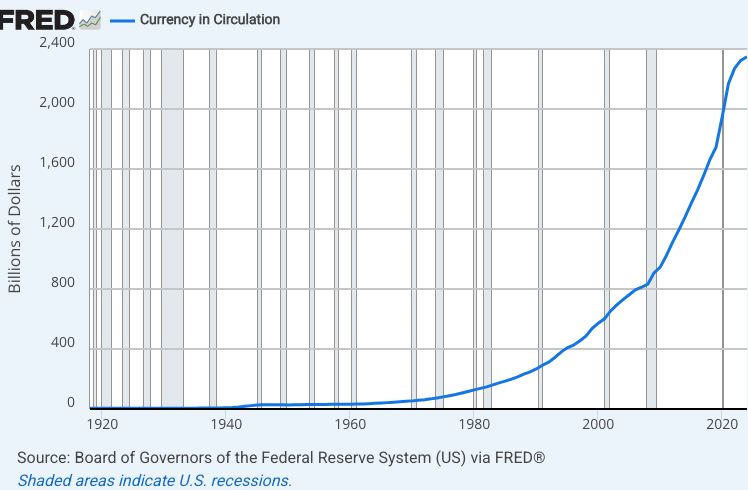
Do stablecoins present any significant problems for monetary policy? Consider this discussion in a recent Conversations With Tyler: DIXON:  I think you’re going to have every bank probably issuing, I hope, a stablecoin the way you have them issuing credit cards. These all have users and customers. The banks will have a button that says, “Send a stablecoin.” What I’m hoping is that there’re enough legitimate actors around this who create a network effect that, to your point, yes, there will be that stuff, but it will be marginalized.COWEN: In that world, should we infer that the Federal Reserve loses control of the money supply? Create a stablecoin. It’s backed by a T-bill. In a funny way, it’s like a private open-market operation. I’m fine with that. I’m not sure the Fed controls the money supply today. Does that become a macro issue?DIXON: I feel like I’m talking to a famous economist. [laughs] I’m on your territory now. It’s dangerous because I’m not an economist.COWEN: Well, I haven’t figured this out myself either, to be clear. I’m genuinely asking various people. I asked Austan Goolsbee the same question because I don’t know. In a recent post, Tyler said the following: The AI is your smartest reader. It’s your most sympathetic reader. So why is he asking “various people”?  Why not ask an AI?  I suspect the answer is that “smartest” can be defined in many ways, and while the top AIs are the smartest in many respects, they are not the smartest in the most challenging areas.  I asked ChatGPT about this issue, and its answer is far inferior to the one I’m about to provide.  (I’m being a bit mischievous here.  Tyler’s right that AIs are smarter than me on the vast majority of questions—but not in areas where I have expertise.) So here’s my answer: Stablecoins do not present any problem for monetary policy.  The Fed will still control the monetary base, and they have almost unlimited ability to adjust both the supply and the demand for base money.  This means they will be able to react to the creation of money substitutes as required to prevent any impact on macroeconomic objectives such as employment and the price level. The Fed can directly control the supply of base money through open market operations, that is, the purchase and sale of Treasury securities.  That’s all the power they need to completely offset the impact of stable coins on the demand for base money.  But they have an additional powerful tool that also impacts the demand for base money: interest on bank reserves.  With these two policy tools, the Fed has the technical ability to move the price level to any position they like.  Of course, political considerations would preclude the Fed engineering any extreme move up or down in the CPI, but that’s not an issue when the Fed is trying to stabilize the price level in the face of growing use of stablecoins. BTW, some of my views on monetary policy are controversial, and not accepted by the experts.  I don’t believe that my view on this particular issue is at all controversial, unless base money demand fell to zero.  This seems quite unlikely, especially as the stablecoins will probably need to be backed by some form of government money, and at least some cash will continue to circulate. PS.   Contrary to popular opinion, demand for currency has not declined even as we’ve moved to a “cashless economy”.  Currency demand, even as a share of GDP, is higher today than it was 100 years ago, when people routinely used cash to make purchases.  That’s because increased government regulation (i.e., the war on drugs, etc.) and higher taxes have caused the demand for currency as an anonymous store of value to rise much more rapidly than the transactions demand for currency has declined. Conceivably, the recent slowdown in currency demand growth might be partly due to stablecoins, but more likely it reflects the fact that much higher nominal interest rates since 2022 have increased the opportunity cost of holding zero interest currency as a store of value.     (0 COMMENTS)

/ Learn More

How Tariffs Built the World’s Worst Car that Only the Rich Could Have

As the White House aims to bring more manufacturing to the United States with its bludgeon of a disastrous tariff policy, most economists have focused on the short-term hits to American firms’ profitability.  Harder to imagine is how a protectionist policy does such corrosive damage over the long term because we may never observe what might have been.   Over its history, United States has been the place where people try out new ideas and take risks. It is a better place to fail and try again than any other country in the world. In recent years, we’ve excelled in retail and distribution, in many cases letting other countries handle the onerous manufacturing. But our central comparative advantage has always been nurturing fresh new ideas like nowhere else in the world.  In 1998, Former Federal Reserve Chairman Alan Greenspan addressed faculty at the University of California with a question: “Is there a new economy?”  His fascinating observation was that  creative destruction leads to the United States’ GDP weighing less over time. Fiber optic cable replaced huge tons of copper wire. Lightweight building materials have replaced heavy concrete blocks. More recently, we can have a doctor’s appointment over the internet instead of using a car and gasoline to go to the medical office. We do more with less, but that’s not possible without a free market that is always pushing the next entrepreneur to make life easier or better for a new customer. This is part of the reason why we’ve evolved towards services and away from manufacturing.  The White House tariff policy is meant to act like a time machine, ostensibly bringing back high paying and heavy manufacturing jobs like we had in the 1950s. But it’s a time machine that keeps a society frozen in amber, never evolving or improving because the manufacturers face far less competition.  For some Americans like me, a trip to Cuba provides a window into what life would have been like if automobiles had never evolved- 1950s era American taxis still ply the streets with none of modern features of safety, ergonomic design and computer assisted driving, because of a 60 year embargo on trade by the United States.  But India provides an even better comparison, because Cuba never manufactured automobiles. The Hindustan Ambassador, built in India between 1957 to 2014, is arguably the worst car ever built, from a perspective of serving consumers’ wants and needs.  India’s idea, like President Trump’s today, was to build cars in India in order to create domestic manufacturing jobs. However, once a government decides which industries to protect and give special exceptions to (see the case of Apple getting a reprieve on iPhones from tariffs) it is a slippery slope over how involved government becomes in industrial production.  The Indian government decided that it, not the free market, was best suited to pick which aspects of the economy needed protection from foreign competition. Aside from trade protection, an industrial licensing system kept private enterprises in check, and it  required all private firms beyond a certain small size to obtain a license whenever they wanted to do anything such as relocate a plant, expand capacity or produce new products. Thus, the system put the activities of the private sector under significant control of the government. This protective “infant industry” argument allowed the Hindustan company to crawl ahead with slow changes, even as other car companies were sprinting forward with new features such as cruise control, air condition and disk brakes by the early 1960s.  By 1990, the Ambassador was woefully behind its foreign-built counterparts.  After 33 years under India’s oppressive regulations and trade protections, it lacked power-steering and brakes, as well as an automatic transmission.  One BBC reporter noted that: You needed really strong triceps to work the ridiculously heavy steering, the deftness of a surgeon to slot home the spindly column shifter into each gear (shifting from second to third gear was an art form) and immense strength to make the car stop – you had to nearly stand on the brakes. The car broke down constantly, and India banned foreign parts, so poor quality  improvisations had to be built instead. In the summer, the heat would shut the car down and owners would have to put a wet rag on the fuel pump to cool it down before they could be on their way. The car was so slow that a person could probably outrun it for a time-  the car accelerated from zero to 60 mph in just under 50 seconds, taking about the length of an airport runway. Top speed was 65 mph with its smoky diesel engine spewing noxious smoke out the tailpipe.  And its leaf springs resulted in a harsh ride not unlike an 1800s horse cart.   In a country of nearly 1 billion people, at its height the Ambassador sold just around 24,000 vehicles a year, making this terrible car only available for the well-connected.  For the relatively rich, the waiting period for a new Ambassador was just over 8 years at its peak. But prime ministers, bureaucrats and MPs got to the head of the line with specially outfitted cars. Taxi drivers were next on the list.  It wasn’t all the car company’s fault. Under the oppressive regime that regulated many aspects of the free market, carmakers could not increase prices or make more cars without getting a signoff from a government bureaucrat. They also couldn’t import technology from other countries.  By 2014, India was letting foreign car companies into the market, and only 2,214 Ambassadors were sold. By then, the factory’s productivity was in decline and the company was saddled with debt. After 56 years the car that was never modern, ceased production.  The Ambassador serves as a reminder of the perils of tariff policy. It sets a country on a different track where government, not the free market, dictates what people need and want, and under what time frame it delivers the goods. Absent the threat of losing customers, car companies with tariff protection are apt to act more like the Department of Motor Vehicles.  That’s a loss not only in the short term, but for generations of would-be entrepreneurs and customers to come. 1996 Hindustan Ambassador N574PVL Old Warden [Rob Hodgkins, CC BY-SA 2.0, via Wikimedia Commons]A popular television commercial for the Peugeot 206 created by Giovanni Porro, known as “The Sculptor”, involved a young Indian man deliberately damaging a Hindustan Ambassador (including having an elephant sit on it) and then spending the night welding it. The following day, the car emerged as an dinged replica of the 206’s exterior  shape, much to the envy of his friends.        (0 COMMENTS)

/ Learn More

Fewer Rules, Better People: Lam on Legalism’s Moral Cost

Lam’s book Fewer Rules, Better People: The Case for Discretion is filled with specific examples of cases where the absence of discretion compels people to take actions contrary to justice or even just common sense. In one chapter, he tells of a woman who, through her organization, was hosting a roundtable conversation at a conference. She wanted to order coffee for the event, but her institution had a rule that all catering orders must go through a particular vendor. But there was a problem – the roundtable began at 9:30, but the vendor didn’t even start taking orders until 10:00. However, there was a Starbucks right around the corner, and it turned out that the vendor in question subcontracted out coffee orders to Starbucks – indeed, to that particular Starbucks location. So the woman hosting the event tried to get her institution to just let her place the order directly with Starbucks, to no avail: Surely, my host argued, this was enough evidence that this coffee purchase was within the spirit of the rules. The administrator disagreed and did not approve the purchase. It was against the rules. It might be easy to dismiss this sort of rule-mongering as being little more than annoyance, but not indicating anything substantial. But Lam disagrees. He thinks that being ruled over by administrators dedicated to unyielding submission to policy manuals and rulebooks can be as corrosive to the fabric of civil society and moral development as life under tyranny: Tyranny has done as much as anything else to keep humans from flourishing. Western liberals have been less concerned with a figure who is the opposite of the tyrant in disposition but no less to be feared. This is the by-the-book bureaucrat. These bureaucrats are naturally inclined toward legalism and deeply afraid of exercising discretionary judgment. They do not want the responsibility; they fear all blowback so they are highly risk averse. Confronted with a decision that they are unsure about, they look up the governance language and are comforted when they find that the issue is out of their hands. If someone goes to the by-the-book bureaucrat with a novel idea, the only way to get them to yes is if there are explicit rules in favor of the idea. A critical capacity for us as individual people, and for developing a flourishing society, is the ability not merely to recognize a rule and know how to comply with it – it is the ability to understand the reason and purpose behind the rules. Rules are not self-justifying simply because they are rules – by their very nature, rules are meant to exist in service of some other, larger purpose. A commitment to live one’s life by simply applying the rules, whatever they may be, blunts our moral development and our capacity to exercise virtue. This isn’t just true of the by-the-book bureaucrat. It’s also true for the citizens whose behavior is determined by subservience to legalistic algorithms: But I think that even worse than this is the effect such societies have on the obedient. The goal of surveillance-state legalism is to turn all citizens into compliance robots and every bureaucrat into a by-the-book bureaucrat. It does this by turning human motivation in all of its rich complexity into fear of stepping out of line and into a love of acting for the sake of rules. This is the true horror of legalism. He makes a personal analogy by reflecting on his own responsibility as a parent to teach his daughter not merely to follow a list of prescribed actions, but to understand the why behind those actions: The aim of creating responsibilities and holding her to them is not for her to act for the sake of the rules and the punishment and rewards they bring. We want her to feed, water, and brush her bunnies because they are vulnerable living things whose well-being depends completely on their caretakers. We want her to empty the dishwasher in a timely way because it is important for a kitchen to be clean and useful, because it is essential not to be a free rider in the home, and because you have obligations to other people. We want to cultivate in her the spirit and reasoning behind the rules, especially when they are good ones. We also want her to have the judgment to figure out when rules are not good, either because the rationale behind them is flawed or because she has figured out a better way to do things. He admits that it might be simpler to simply legalistically enforce the rules on his child. But that would be a failing on his part: Make the penalties severe and consistent enough and I’m sure I could get better, more consistent compliance. But if my child ends up being the administrator who refuses to approve the coffee purchase, I have failed to raise a decent, reasonable person as much as I would have failed if I had raised a tyrant. Choose between a world of apparatchiks who follow the letter of the law and a world of imperfect decision-makers who have judgment and motivation to do well by the spirit of the rules, who are ready to identify better ways to do things, I’ll take the latter 100 percent of the time. Not only does legalism diminish our ability to develop as moral agents, it also leaves people unprepared for, and incapable of, acting in the face of situations the rules didn’t or couldn’t account for: Novel circumstances will require judgments based on the reasons behind the rules. People who live out of fear of noncompliance will have no idea what to do in such circumstances. Even worse, they will apply rules in ways contrary to the reasons those rules exist in the first place. They will act unjustly under the cover of law, whether it is in denying coffee or denying freedom. Lam is also particularly concerned about the growing tendency to make decisions via AI generated algorithms as a substitute for human judgment. Use of AI algorithms in decision-making robs us of even the possibility of understanding the reason behind the rules: These are equations for which there is no explanation in human language. A programmer can show you this equation, though you could never read it for its length, and the only coherent description of what it means is “this is the equation that fits all the past verdicts the best.” Deep learning is not just opaque, it is humanly indecipherable. Deep-learning rules are the logical endpoint of the proliferation of rules. It is the endpoint of legalism, where the laws of bureaudynamics take us in the most extreme case, where no one even understands the rules that govern us. Thus the use of AI generated rules does little to alleviate the problems of the by-the-book bureaucrat: AI is like any by-the-book bureaucrat who, settling on the rule that prohibits coffee purchases from any vendor but A, will give you no explanation as to why vendor A can purchase Starbucks coffee but you cannot. Asked why that rule is the right rule, they only insist that it is the rule. Ultimately, Lam believes that Han Fei reverses the true relationship between mediocrity and rules: Han Fei believe that legalism was the antidote to mediocrity. I think legalism is the cause of it. Standardized food, standardized homes, standardized essay grading, and standardized bureaucrats are at best okay, merely passable objects to be tolerated. They are never excellent, and they do not inspire excellence. But this discussion calls for more than just second-order, abstract discussions about why discretion needs to gain ground against legalism and rules. For the ideas in the book to be meaningful in a practical sense, the rubber will have to hit the road at some point. To that end, Lam has a series of ideas about how and where to expand the role for discretion. I’ll cover that in the next post. (0 COMMENTS)

/ Learn More

Can Students Get Better Feedback?

One of the best experiences of academic growth that I had was because  of my high school English teacher who took time to write specific comments on  my essays. Back in the 2000’s when typing a paper required a human, I wrote those essays myself in Word on a boxy desktop computer. My teacher, of course, invested large amounts of his time to read our essays and provide thoughtful comments.   Personalized feedback hasn’t gotten cheaper or easier with time. As Russ Roberts asks in this episode, “How do we scale grading and feedback?” Until recently, it’s been a bottleneck, constrained by the availability of skilled human time. We can’t (yet) completely automate empathy, discernment, or pedagogical intuition. For now, the question is still what kind of feedback teachers can give that really benefits students. Daisy Christodoulou, the guest on this episode, offers a sobering critique of how educators tend to give feedback in education. One of her points is that much of the written feedback teachers give is vague and doesn’t actually help students improve. She shares an example from Dylan William: a middle school student was told he needed to “make their scientific inquiries more systematic.” When asked what he would do differently next time, the student replied, “I don’t know. If I’d known how to be more systematic, I would have been so the first time.” The teacher knows what a more “systematic” essay would look like, but the student has (presumably) not done specific practice exercises that would help them achieve mastery.  Christodoulou articulates that students who aren’t doing well often don’t know how to get better, and generic feedback like “try again” or “be clearer” offers no path forward. I loved her metaphor comparing writing to marathon training. You don’t train for a marathon by running one every day. You build up to it with a mix of shorter runs, strength training, stretching—activities that don’t even look like running but are essential to running well. Similarly, becoming a better writer doesn’t always mean writing another full essay. It might mean building vocabulary, practicing sentence construction, or doing targeted inference work. Christodoulou emphasizes the need for teachers to think in terms of models of progression—to identify the small, specific steps that move a student from where they are toward mastery. One example she gives: a student told to “infer more insightfully” might not need another essay assignment, but instead a focused set of lessons on vocabulary, prefixes, and suffixes. That’s what meaningful feedback looks like—it leads to action. Christodoulou also turns to the question many of us are now grappling with: can AI help scale meaningful feedback? Can it grade essays in a way that’s actually useful? As of this recording in early 2025, the answer is: not quite. There are still issues with accuracy, consistency, and what AI models tend to “hallucinate.” Some of those problems may eventually be solved—but even now, Christodoulou and her team are experimenting with hybrid models where teachers give audio feedback and AI transcribes and organizes it. This kind of collaboration, where the teacher remains the source of insight and the AI handles the labor-intensive part, might be one path forward. At the same time, there’s a growing tension in classrooms: students increasingly want to skip the hard work of writing altogether and turn to AI-generated answers. So, we’re trying to scale authentic feedback just as students are even more tempted to shortcut the learning process because of how easy it is. That challenge of how to preserve the value of thinking and writing in the age of instant text generation is one we’ll be wrestling with for a while. As a teacher, Christodoulou has encouraged me to think beyond “let me show you again” for my students. I will try to break down smaller exercises that will help them achieve mastery of new advanced skills.  (0 COMMENTS)

/ Learn More