This is my archive

bar

First impressions

Three years ago, the Atlanta Hawks traded Luka Doncic to Dallas in exchange for Trae Young and the right to draft Cam Reddish. Over the next three years, there was an almost universal view among NBA basketball fans that the trade was very lopsided, with Atlanta losing badly. Last night, Atlanta was eliminated from the playoffs. Nonetheless, one TV commentator suggested that the trade now looks much more even. Young was spectacular in the playoffs before getting hurt a week ago, and while it’s too soon to fully judge Reddish, he looked very good in a couple playoff games after coming off an injury. Atlanta went much further in the playoffs than Dallas. This example demonstrates something I’ve noticed quite often. People are far too quick to make judgments. Pundits that focus on the economy often proclaim this or that policy to be a success or failure, long before we have enough information to make an informed evaluation. Consider: 1. During the 1930s, it was widely agreed that the Great Depression demonstrated that unregulated capitalism is unstable. Only in the 1960s was it discovered that the Depression had been caused by tight money, not “the inherent instability of capitalism”. 2. During the 1960s, it was widely agreed that there was a tradeoff between inflation and unemployment, often called the Phillips Curve. Only in the 1970s did we discover that this trade-off is illusionary, at least in the long run. 3. In 1972, it was widely agreed that Nixon’s wage/price controls were an effective means of slowing inflation. A few years later we learned that price controls don’t work. 4.  In the early 1990s, it looked like the former communist countries that had reformed quickly had made a mistake.  A decade later, it looked like the countries that were slow to reform were the ones that had made the mistake. 5. In 2002, it was almost universally agreed that there had been a massive NASDAQ stock price bubble in 2000. Today, the NASDAQ market of 1999-2000 no longer looks overpriced. Instead, 2002 looks absurdly underpriced. 6. In 2010, it was almost universally agreed that housing prices in 2006 were a “bubble”. Today that claim is far from obvious. 7. In 2013, some Keynesians claimed that fiscal austerity was slowing the economy. By 2014 that claim looked implausible. 8. In early 2014, there were claims that terminating the extended unemployment insurance program was slowing growth. By 2015, it had become clear that employment growth sped up in 2014. I could cite dozens of similar examples. It is certainly possible that a year from now Trae Young’s stock will have fallen and Doncic will once again look like the far better player. It’s possible that NASDAQ circa 2000 and the house prices of 2006 will again look like bubbles. All evaluations are provisional, liable to be changed as new information comes in. I find that evaluations based on time-tested propositions tend to hold up better than other claims. These include the idea that free market economies are best, that monetary policy drives nominal variables, and that money is neutral in the long run. The idea that price controls don’t work. The idea that asset prices tend to be efficient because it’s hard to get rich by consistently beating the market. The idea that paying people not to work tends to discourage them from working. If you believe in these time-tested principles, don’t let yourself be bullied by pundits suggesting that you are out of date and need to get with the times. Very likely, you’ll be the one proved right in the long run. PS.  I’ve always found the criticism of Atlanta’s decision to be a bit excessive.  After all, Sacramento picked Marvin Bagley over both Young and Doncic.  It’s like people who complained that money was too tight in 2019, but were silent on the issue in 2008.  You may be right about 2019, but where are your priorities? (0 COMMENTS)

/ Learn More

There is No Shortage of Labor

Except if remuneration—the price of labor—is capped by government, there can be no more shortage of labor than a shortage of, say, steel. As is currently the case, labor can become more expensive like car rentals have become; it could be very expensive, like BMWs, if demand were even higher compared to supply. But if a market price obtains at which as much as one wants is available, speaking of a shortage is a confusing use of language. Indeed, it is precisely because a non-government-controlled price can rise, thereby reducing quantity demanded and increasing quantity supplied, that there is no shortage. (See my econlog post “Don’t Confuse Shortage and Smurfage.”) When an employer says he cannot get the labor he needs, he is typically trying to say (assuming that remuneration is determined on the free market) that he cannot get as much of it as he wants at the current remuneration rate (wages and benefits), and does not find it worthwhile to pay more. In other words, he does not “need” more labor more than he needs more Champagne and a Ferrari. If he did, he would bid up the price until he gets what he wants or until he decides he wants it less than higher bidders do. A free market is a permanent auction where ordinary individuals can bid microprocessors away from Ford, as they have been doing for their PCs and game consoles. This little bit of economic theory is illustrated by a Wall Street Journal report: Patrick Thomas, “This Summer, Jobs Come With a Hefty Signing Bonus (July 1, 2021). The reporter observes: As U.S. employers’ search for hires increases in urgency—especially in the manufacturing, logistics, healthcare and food-service industries—truck drivers, hotel cleaners and warehouse workers are being offered signing bonuses of hundreds and even thousands of dollars. These increases in remuneration are widespread across the service industry, including restaurants and hospitality businesses. Some other examples: A pest-control service specialist job in Charlotte, N.C., comes with a $1,200 bonus. A diesel mechanic job in Gulfport, Miss., advertises a $1,500 bonus. A forklift operator job in Gainesville, Ga., with Kubota Manufacturing of America pays a $2,000 bonus. … In June, nursing jobs offered hiring incentives ranging from $100 to $30,000. In food preparation and service roles, signing bonuses ranged from $100 to $2,500. … “It gives us a leg up,” [Kubota’s Phil Sutton] says. “It’s been a great success in terms of recruiting.” The reason is not that business owners have become nicer, more charitable, or more woke. Their demand for labor (a “derived demand” in economic jargon) has increased because the consumers’ demand for their products has grown. And they want to satisfy their customers’ demand because that’s how they earn a living. “Businesses are jockeying for workers,” [Brad Hershbein, senior economist at the W.E. Upjohn Institute for Employment Research] said. … They are going to try that first, and if it’s not enough, then they will have to do persistent wage increases.” It has already started. One example: Foodservice distributor US Foods Holding Corp. posted a night warehouse role for the 5 p.m. to 3 a.m. shift in Coralville, Iowa, that pays between $18 and $23 an hour, with a $5,000 signing bonus, and medical, dental, vision and life insurance and a 401(k) starting on the first day of employment. People respond to incentives, so higher remuneration brings more labor from within or outside the industry, or from people not in the labor force. A $1,000 signing bonus, coupled with a $1,000 retention bonus, helped the Choctaw Casino & Resort in Oklahoma “hire hundreds of people in less than 90 days.” Note that the soon expiring (or alread expired in some states) unemployment supplements of the federal CARES Act did not create any labor shortage in the proper sense of the term, although they did reduce labor supply and increase the market price of labor. Employees move to the occupations that pay them more because the goods or services produced in these occupations are currently the most valued by consumers. This happy result requires that remuneration be allowed to adjust on free markets. We have all heard the stories of Cuban physicians, whose remuneration is controlled by the state, switching to taxi driving because it pays more. We can guess there is a real shortage of physicians in Cuba. Interestingly, nobody criticizes “price gouging” by workers. They move to the jobs for which, other things being equal (including their tastes, of course), they get the best remuneration. This system is economically efficient for the same reasons that it is efficient to let the prices rise of any market where demand increases or supply decreases; for the same reasons that “price gouging” laws are detrimental. There are not many exceptions to the economic law that price increases solve shortages. One exception is that long production lags and long-term contracts for non-standardized goods may delay this adjustment as we are seeing in the market for microprocessors. Another one is the possibility that a significant number of customers (notably socialist-minded ones) like established stores to privately ration goods by limiting the number of items a customer can buy or by having no item to sell at all. Still another exception, of course, is when the government forbids suppliers to increase prices (or to increase them more than necessary), as we saw during the pandemic. In that case, governments’ harmful success was fortunately mitigated by the diversity of “price gouging” laws across the states and the grey markets that developed, notably online. (1 COMMENTS)

/ Learn More

Benefits of the American Revolution: An Exploration of Positive Externalities

It has become de rigueur, even among libertarians and classical liberals, to denigrate the benefits of the American Revolution. Thus, libertarian Bryan Caplan writes:  “Can anyone tell me why American independence was worth fighting for?… [W]hen you ask about specific libertarian policy changes that came about because of the Revolution, it’s hard to get a decent answer. In fact, with 20/20 hindsight, independence had two massive anti-libertarian consequences: It removed the last real check on American aggression against the Indians, and allowed American slavery to avoid earlier—and peaceful—abolition.”1 One can also find such challenges reflected in recent mainstream writing, both popular and scholarly. In fact, the American Revolution, despite all its obvious costs and excesses, brought about enormous net benefits not just for citizens of the newly independent United States but also, over the long run, for people across the globe. Speculations that, without the American Revolution, the treatment of the indigenous population would have been more just or that slavery would have been abolished earlier display extreme historical naivety. Indeed, a far stronger case can be made that without the American Revolution, the condition of Native Americans would have been no better, the emancipation of slaves in the British West Indies would have been significantly delayed, and the condition of European colonists throughout the British empire, not just those in what became the United States, would have been worse than otherwise. These are the two opening paragraphs of a very powerful article by economic historian Jeffrey Rogers Hummel, “Benefits of the American Revolution: An Exploration of Positive Externalities,” Econlib, July 2, 2018. Of the more than 100 articles I lined up and edited during my 11 or so years with Econlib, this is my favorite. Jeff handles so many issues and addresses so many things I had not know about. (0 COMMENTS)

/ Learn More

Two Objections to Free Trade

In my recent Defining Ideas article titled “A Refresher Course on Free Trade,” I made the case for free trade. A large part of the economic case is that free trade makes people in the country that adopts it better off than if their government hadn’t adopted it. It makes imports cheaper, allows consumers to get a more varied range of goods, and causes labor and capital to be allocated to areas of the economy where they are most productive. In the United States in recent years, there have been two main objections to free trade. The first is that when free or freer trade is introduced into a particular sector, producers in that sector, both owners of capital and laborers, will be worse off. Therefore, argue some of the people who make this point, either trade shouldn’t be liberalized or, at least, introduction of trade should be accompanied by government spending to compensate the losers. The second objection is that free trade benefits mainly the wealthy and does little for the workers who are living on the economic edge. The first objection is often true in the short run but almost always false in the long run; it also applies to any economic change whether that change is caused by international trade or purely domestic economic interactions; in short, the objection proves too much. The second objection is simply false. This is from David R. Henderson, “Dispelling Two Objections to Free Trade,” Defining Ideas, July 1, 2021. Another excerpt: Second, there is nothing special about free trade. Indeed, in a large economy like that of the United States, most trade is not across borders but is between people within the US borders. In 2019, imports were about 14.6 percent of gross domestic product. That sounds high, and is high, but that number confirms that most trade in the United States is between and among people in the United States. When a new technology or even a new way of running a business helps consumers, it also destroys many businesses and hurts workers who lose their jobs or who must work at a lower pay to keep their jobs. We don’t need to go back far to see such examples. When I taught in the business school at the University of Rochester in the late 1970s, some of my evening MBA students who worked at Kodak called it the “big yellow money machine.” Kodak was riding high on the technology that innovator George Eastman and his successors had created and perfected. But digital cameras in the 1980s and 1990s and, later, cell phones that got better and better at taking still shots and movies, virtually destroyed the market for Kodak’s product. It’s true that part of the causes was international trade in cell phones. But even without cell phones from other countries, US cell phone producers were plenty capable of competing Kodak into bankruptcy. One more excerpt: For 2019, the latest data available, households in the bottom two quintiles, which is about 53 million households, spent an average of $1,032 per year on clothing. That’s out of an average after-tax income of $22,591. So they spent 4.6 percent of their income on clothing. Because clothing prices fell over that time, they would have bought more clothing at the lower price. So we will understate their gain if we assume that they were insensitive to price and bought the same amount of clothing that they would have at the higher pre-expanded-trade price. Even assuming no further drop in clothing prices after 2103, the 24 percent drop in price was important for a household with such limited means. The clothing they would have bought in 1997 would have cost an inflation-adjusted amount of $1,358.  So the average family in the two bottom fifths of the income distribution saved $326 on clothing alone. Over 53 million households, that is a gain of about $17.3 billion. Assuming that the 650,000 people who lost their jobs lost as much as $10,000 each per year, which is probably an overestimate, their loss was $6.5 billion, which is less than 38 percent of the gain. Moreover, the average worker in a clothing factory in the United States, along with her or her family, almost certainly earned more than $22,591, the average income of the bottom two-fifths. Read the whole thing. (0 COMMENTS)

/ Learn More

Mike Gravel on Sunk Costs in War

Former Democratic Senator from Alaska Mike Gravel died on Monday in Seaside, a city on the Monterey Peninsula. He was my favorite candidate for the Democratic president nomination in 2008. Here’s his best minute and a half in one of the debates. I like the whole thing, but the part that’s a really nice application of the sunk cost theorem is the last 10 seconds: You know what’s worse than a soldier dying in vain is more soldiers dying in vain. Personal note: When I had my old office on Alvarado St. in Monterey in the early 2000s, I looked out my window and thought I saw Mike on the street. I rushed down the stairs and talked to him, finding out that he lived in my area. How did I recognize him? Back in late 1979, the Hoover Institution and the University of Rochester had held a joint conference on the draft at Hoover that Marty Anderson had organized. (Some members of Congress had been making strong noises in favor.) I was at the Cato Institute in San Francisco at the time and there was no way I was going to miss this. The last event at the two-day conference was a debate about the draft between Republican Congressman Pete McCloskey, who supported it, and Milton Friedman, who opposed it. I’ve often told people that I think I saw Milton’s worst performance ever and it was still pretty good. In Q&A, a middle-aged guy I didn’t recognize got up and claimed that he had ended the draft. He then went on to say that he had been in the U.S. Senate at the time, representing Alaska, and had engaged in some procedural move that helped end the draft. He told us his name was Mike Gravel. So I recognized him on the street and wanted to find out what specific move he was referring to. So I asked him and he told me.  His story was a little vague and I later learned that it was false. But he did his best. What he was referring to was his attempt to filibuster in 1971 to prevent renewal of the draft.   (0 COMMENTS)

/ Learn More

The stories we tell

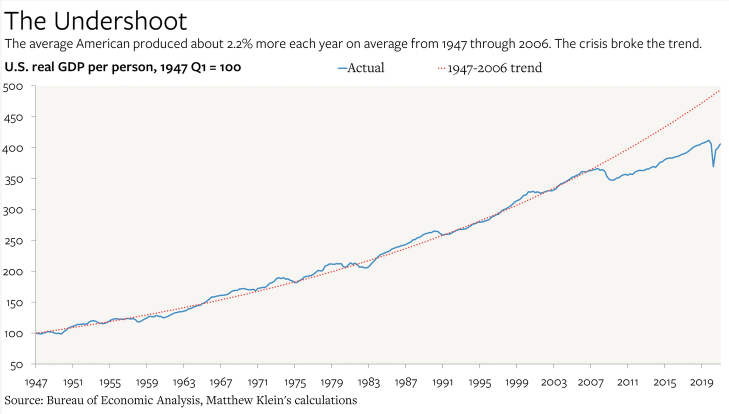
The field of economics is a set of stories that we tell to better understand the economy. I thought of this when reading a new post by Matthew Klein: If I had to pick one chart to tell the story of the U.S. economy since the end of WWII, it would be this: Indeed Klein views the post-2006 slowdown in RGDP per capita as being so important that his Substack is entitled ‘The Overshoot”, an indication that we need to work on reversing the recent undershoot. Of course literary theorists know that stories can have many interpretations.  What is Kafka’s Metamorphosis actually about? If I were to tell a story about this a graph, the year 2006 would be of no importance at all.  I would begin my story by focusing on productivity, not output per capita.  Doesn’t real GDP per capita measure productivity?  No, it does not. So here’s my story.  Between 1900 and 1973, America’s engineers and inventors made extraordinary strides that completely transformed a wide range of our industries.  Here’s a 1903 airplane above a 1968 airplane: I won’t bother showing you a 2021 airplane, as it looks similar to a 1968 airplane.  Its interior electronics and engines are better, but the percentage gain is tiny compared to the gains during 1903-1968.  Great strides were made in many other industries as well, including autos, home appliances, lighting, and infrastructure such as indoor plumbing.  Life expectancy soared much higher. After 1973, America’s engineers and inventors made extraordinary gains in one industry—computers.  Productivity growth slowed sharply, with one exception.  There was an upward blip in productivity growth during 1995-2004, which might have been real or might reflect a mismeasurement of the impact of PCs on the US economy.  It’s a “matter of opinion”.  In any case, that brief surge ended in 2004. So if 1973 was the turning point when productivity growth slowed sharply, why does Klein’s graph make it look like 2006 was the turning point?  What’s my “story”? It turns out that various demographic changes disguised the productivity slowdown for several decades, at least when examined from the perspective of RGDP/person.  After 1973, the share of the population that worked rose for several decades, as (non-working) children became a smaller share of our population and as more women entered the labor force.  This growth in the labor force roughly offset the decline in output per worker, keeping RGDP/person growing at a relatively steady rate even as growth in RGDP per worker was slowing sharply. By the mid-1990s, this demographic transition had mostly played out and RGDP/person growth would have slowed sharply if not for the nine year PC boomlet in productivity (or at least measured productivity.)  In 2004, that boomlet ended and productivity growth went back to the slow rate of 1973-1995, where it has stayed ever since.  Now there were no longer any special factors to disguise the productivity slowdown, and hence RGDP/person slowed sharply.  And as boomers began retiring, the demographic dividend started to move in the other direction, a perfect storm of factors slowing RGDP/person. In my story, there is nothing special about 2006.  You had productivity growth slow after 1973 because our tech people were no longer able to radically transform almost all our industries, instead radically transforming only the computer industry.  Of course it’s possible that at some point computers become so powerful that robots begin transforming almost all our industries, leading to a renewal of fast productivity growth.  But we aren’t there yet.  (It’s also possible that AI will destroy life on Earth.) Every story has policy implications.  If you believe something dramatic happened after 2006, you might focus on policies that could prevent a repeat of the Great Recession.  I also want to focus on policies that prevent a repeat of the Great Recession, but not because I think the Great Recession had a significant impact on long run growth in RGDP/person.  I see no evidence for that claim.  The 1995-2004 boomlet in productivity ended even before the Great Recession of 2008.  Rather, I want to prevent another Great Recession because big recessions are very bad. (1 COMMENTS)

/ Learn More

The “good old days” that never were

Will Wilkinson has a post discussing how residential zoning laws were originally instituted to exclude certain minority groups: In 1926, the Supreme Court ruled that zoning was cool in Euclid v. Ambler Realty. However, despite the fact that Euclid’s lawyers insisted that their law had nothing to do with race, the district court judge whose decision the high court reversed didn’t see much difference between the law in Euclid Township, Ohio (a suburb of Cleveland) and the Louisville law declared an unconstitutional encroachment on property rights and freedom of contract in Buchanan. He wrote, “The blighting of property values and the congesting of the population, whenever the colored or certain foreign races invade a residential section, are so well known as to be within the judicial cognizance” — which translates roughly as: “Don’t try to bullshit me; I see you, Euclid.” Wilkinson relies heavily on a book by Richard Rothstein, who makes a very interesting point about the Supreme Court: Rothstein notes the suspicious oddity of the Lochner-era laissez faire court’s tolerance of the infringement of property rights and economic liberty in this one case: Over the course of nearly 40 years, the Court struck down all kinds of regulation (not only zoning as in Buchanan, but most notably, health and safety and minimum wage regulation) on the grounds that it interfered with freedom of contract. Euclid’s permission for economic zoning was the only significant exception to this rigidly ideological approach. . . It was about race. Some libertarians believe that there was a sort of Golden Age when the Supreme Court had a principled objection to government economic regulations that interfered with property rights.  I’m skeptical of that view.  It’s always been about who gains and who loses. PS.  The politics of zoning is interesting: 1980s:  Conservatives insist that zoning is an example of inefficient government regulation, citing Houston as evidence that people flock to cities without zoning.  Progressives worry that urban areas would be a mess if you didn’t have zoning laws. Late 2010s:  Progressives gradually realize that residential zoning laws make it hard for the poor and minorities to move to where the jobs are, and begin opposing zoning.  Conservatives suddenly see merit in restrictive residential zoning. “You like it?  Then I hate it!”  I’ve never seen this country more polarized. (0 COMMENTS)

/ Learn More

Royal Caribbean’s Response to DeSantis’s Restrictions on Freedom of Association

Unintended consequences strike again. Earlier this month, the line [Royal Caribbean] said that certain venues on the ship would be off-limits to unvaccinated passengers, but it didn’t give specifics. This week’s listing of forbidden venues fleshes out the plan. The newly posted list includes: The Chef’s Table Izumi Hibachi & Sushi R Bar Schooner Bar The Pub Viking Crown Nightclub Solarium Bar Solarium Pool Casino Royale (the ship’s casino) Casino Bar Vitality Spa (the ship’s spa) This is from Gene Sloan, “Royal Caribbean to unvaccinated travelers: No sushi (and a lot of other things) for you,” The Points Guy. Why is Royal Caribbean doing this? Sloan explains: The new rules come in the wake of threats from Florida Gov. Ron DeSantis that any cruise line that requires passengers to show proof of a COVID-19 vaccine will be fined. A new Florida law forbids businesses in the state from requiring customers to show proof of a COVID-19 vaccine. I wrote about Governor DeSantis’s attack on freedom of association in early April. The good news is that I didn’t anticipate how clever Royal Caribbean would be in responding to it. HT to Donald Wittman. (0 COMMENTS)

/ Learn More

Security States

Two well-told stories in the most recent issue of Wired magazine highlight complex technological and human security challenges that will remain with us for the foreseeable future. The first is, “The Full Story of the Stunning RSA Hack Can (Finally) be Told,” by Andy Greenberg. It’s about a 2011 breach at security firm RSA, which compromised master-key like information central to the firm’s secure-ID products, used by the likes of Fortune 500 clients and the Pentagon to verify employees’ identities. The second story, “The Manhattan Project,” by Geoff Manaugh and Nicola Twilley, examines the ongoing construction of the Department of Homeland Security’s new $1.25 billion lab, “the National Bio and Agro-Defense Facility,” located in Manhattan, Kansas. This facility will be used to study dangerous and contagious plant and animal pathogens at Biosafety Level 4, the highest standard for containment. The RSA story is backward looking, even as the incident is billed as a harbinger of things to come, but with the expiry of many former RSA executives’ non-disclosure agreements on the matter, Greenberg can dive much deeper into the progression of the hack than was possible to report on at the time of its occurrence. Some of the details are rather stunning. Executives resorted to paper and in-person communications because they thought their phones had been tapped, their emails surveilled, and their offices bugged (some even claim to have discovered listening devices, of unknown origin); others were worried about long-range laser-microphone surveillance, which works by detecting vibrations on windowpanes caused by conversation–so they covered their office windows with layers of butcher paper. This paranoia confirms that the Chinese state-sponsored hackers were in deep alright (although how deep exactly no-one knows), and as one employee put it, the firm was forced to act for years afterward on the assumption that the attack was still ongoing. The existence of malicious backdoors was taken as a given once the front gates had been so spectacularly, yet subtly, breached. Summing up the situation, one former RSA executive said it was “a glimpse of just how fragile the world is,” and a reminder that even the best security features often amount to little more than “a house of cards during a tornado warning.” This takeaway becomes even more sobering when applied to the second story, about the new bio and agro-defense lab being built on the plains of Kansas. The logic for the new facility goes something like this: We (the United States, the West) are reliant on the global food supply chain, within which concentrated animal feedlots and monocrop fields are significant—you might even say foundational—links. Given the limited genetic diversity of mass-production crops, cows, pigs, chickens, and other plants and animals, and the limited (if at all present) security at many of the facilities where these things are grown and raised and processed en masse, in the eyes of Homeland Security the food production network is rife with “soft targets.” Certain terrorist organizations have in the past expressed interest in attacking these soft targets (at least according to reports of materials seized in Afghanistan and Syria), possibly through the introduction into animal populations of nasty and effective pathogens such as the virus that causes foot-and-mouth disease. Thus the new, ostensibly ultra-secure facility will serve to study such harmful pathogens (both in advance of, and in response to their release, should that ever occur) and to come up with ways to stop them. That is, without bringing in police and military units for a mass destruction of infected populations… a la the UK in 2001, when six million sheep, pigs, and cattle had to be put down to quell an outbreak of foot-and-mouth disease caused by contaminated, illegally-imported pork being fed to pigs. Some have criticized the construction of the new bio-defense facility on two main fronts: it is near significant portions of the nation’s agriculture and mass husbandry operations, so an accidental release could unleash costly havoc with relative ease, and the site is in an area prone to super-strong tornados. But the design has been “hardened” to withstand even the most punishing weather events, and the decontamination and containment processes are said to be world-class. For instance, a researcher working in the facility can move through it only in one direction; same with the animals; there is no “going back” without going through total decontamination, which involves for humans a series of chemical and normal showers inside a personal airlock. “Constant training” and a “buddy system” will also be in place to, at least in theory, prevent lapses in protocol. (A lingering criticism raised by the authors centers on varying risk estimates of how likely a willful violation of the safety rules might be.) As for the non-human component, redundancies are also in place. “Thermal tissue autoclaves”—described as “big pressure cookers with a paddle inside” —will produce out of lab animal carcasses “a kind of tissue smoothie” that, while actually sterile enough to be used as fertilizer, will instead be incinerated in 55-gallon drums, again out of an abundance of caution. Yes, caution seems to haunt the minds of those designing this facility and others in its class. The question is, will an abundance of caution be enough to keep the lab secure? Certainly I join many others in hoping so, but then again, hope alone doesn’t count for much when trying to contain dangerous pathogens. Lately I have wondered about the degree to which we humans ought to be regularly interacting with them in laboratories at all, particularly when the aim is anything like “gain of function.” Pre-emptive study and modification are bound up with the risk of accidental release, and it’s not clear to me that the possible value of the former outweighs the decidedly negative consequences of the latter. But if such research is going to take place, competent institutional and facilities design offer a better foundation than wishful thinking, hope, or naïve faith in the competence of scientific researchers. It should also be remembered that human behavior, accidental and intentional, can throw wrenches into the gears of even the most fine-tuned of plans. At the same time, this is a complex problem being worked on by lots of smart people, from the public and private sectors, who understand the stakes. Theoretically incentives are aligned such that the designers, builders, managers, and employees of the facility all have an interest in minimizing the possibility of a leak or accident ever occurring. None of them would look good, and perhaps all of them would be on the hook, if such an incident were to take place. There are several more security and design features discussed in the article that I won’t get into here (such as the prohibition on lab workers keeping personal chickens), and I should stress that in my opinion (and seemingly also that of the article authors) the facility will do a much better job than the current US alternative, a place built in the 50s called Plum Island (which is not even BSL-4 and cannot handle large livestock). But that doesn’t mean that there won’t be problems, and unlike Plum Island, New York, Manhattan, Kansas is not surrounded by the harsh, virus-insulating ocean. Rather it exists amidst a sea of plants, animals, and people, often flowing state to state in step with the rhythms of global demand and supply. Manaugh and Twilley’s article (not yet online as of this writing, perhaps because it’s an excerpt from a forthcoming book) doesn’t discuss this angle at any length, but I can’t help but wonder whether the designers and managers of the new Manhattan facility will keep in mind the lessons of RSA, and the slate of cyberattacks and ransomware extortions and digital security breaches that have taken place since 2011. One sentence from the article stands out in this respect. “The [lab] building has a computerized maintenance management system that all but tells the operating staff what it needs.” What could go wrong with that? In fairness, though, problems with the agricultural animal population of America might arise well before any security incident at the new National Bio and Agro Defense Facility. Other than foot-and-mouth, the main not-yet-found-in-the-US disease that’s been under study at Plum Island is African Swine Fever, an outbreak of which DHS states would “terminate the ability of the US to export pork” (we’re the largest single-nation exporter) and take a significant chunk, in dollars and in pig lives, out of the $25 billion a year, 115-million-hog domestic pork industry. China, the largest pork producer and home to over half of the world’s population of swine, has seen an ASF outbreak reduce its total pig count by around 50% since late 2018. It could happen here, and perhaps it will. According to the USDA, “There is no treatment or vaccine available for this disease [although the FDA claims some are in development]. The only way to stop this disease is to depopulate all affected or exposed swine herds.” That’s about as unpleasant as it sounds, for pigs and for their human destroyers. Fortunately, plans are already in place to surveil domestic swine for outbreaks of the disease. Still, a modest amount of hope against the manifestation of the worst possible outcomes would not be misplaced. (0 COMMENTS)

/ Learn More

Knowledge, Reality, and Value Book Club Replies, Part 3

Here are my replies to your comments on Part 3 of the Huemer Book Club. KevinDC: [I]n the reading I’ve done on the free will debate, I’ve never heard anyone argue that the predictability of behavior is evidence against free will. (Possibly due to the fact that most of the arguments I’ve read have come from philosophers and neuroscientists rather than social scientists?) I usually hear a nearly opposite sentiment – even those who argue strongly against free will also argue that this does not imply predictability of human behavior – Steven Pinker, David Eagleman, Robert Sapolsky, Sam Harris, Dan Wegner, Susan Blackmore, and Patricia Churchland come to mind. Fans of social science often argue that behavior is predictable, so we don’t have free will.  This isn’t the same thing as arguing that we have free will because behavior isn’t predictable.  Though in Bayesian terms your probability of determinism should at least slightly rise as predictability goes up. John: Of course, sometimes failing to find or come across evidence for the existence of x is itself evidence against the existence of x. If I’m wondering whether there’s an intruder hiding in my house and I look all around and fail to find “any evidence of” an intruder, I should downgrade my credence in there being an intruder. But in that case I’ve actually come across evidence against the existence of an intruder.  If looking and seeing an intruder hiding in my closet is evidence of an intruder, as it obviously is, then looking and not seeing an intruder hiding in my closet is evidence against an intruder (at least on a Bayesian framework). But if I don’t look around the house, and just sit there, the fact that I don’t gain or have any evidence of an intruder isn’t evidence against an intruder: my prior regarding the existence of an intruder should remain unchanged. I don’t think we disagree.  When I say “absence of evidence,” I’m picturing a situation where you could have found some evidence, not when you’re simply “out to lunch” or having zero relevant experiences.  Though isn’t the fact that no intruder has revealed himself while you’re inside the house a relevant experience? Alan Reynolds: How does one really disagree with the idea that all human behavior can be traced to physical causes? Doesn’t the libertarian free will argument have to assume that humans are someone exempt from the laws of nature that govern literally everything else? I don’t even know what it would mean for human choice to operate independently of causal/deterministic networks. I don’t even know how you could not even know this.  If “human choice does not operate independently of causal/deterministic networks” is meaningful to you, how can the negation not be meaningful?  Even in math, I know what “1+1=3” means.  The proposition is false, but still meaningful. The argument about how alcoholics can choose not to drink if they want is totally beside the point. Of course in some sense this is true. But the determinist simply believes that whatever choice is made is the product of previous causes (from both nature/nurture, brain/environment, etc). On this story, being an alcoholic would be no less free than anything else, right?  Which is what I was trying to convince Huemer of. John Alcorn: Upon inspection, the Gospels say surprisingly little about Jesus’ look — quite the opposite of what Bryan calls “very specific.” Instead, the Gospels narrate at a breathtaking pace, focusing squarely on Jesus’ deeds and pronouncements, about righteousness, problems of living, and social tensions. My point is not that Christians meet the burden of proof. My narrow point is that portrayals of Jesus in the Gospels aren’t implausibly specific. I’m thinking of details like the story of Jesus’ birth (including Herod’s alleged Massacre of the Innocents) and his meet-up with John the Baptist.  Though it’s the fantastic parts of the story – born of a Virgin, raised from the dead, and so on, that move the traditional story from somewhat implausible to incredibly unlikely. Final point: Several readers pointed out that in Huemer’s “Made by God” crystal hypothetical, he specified that the writing emerged as a result of the “laws of nature.”  I missed this stipulation of the hypothetical.  I still think it would be vastly more likely to result from advanced aliens than “God,” but I concede that (like any Biblical-style miracle) would be some slight evidence for God’s existence. (0 COMMENTS)

/ Learn More