This is my archive

bar

Elegy for a Friend: In Memory of Steve Horwitz

On June 27, 2021, the world lost the gracious presence of one Dr. Steven G. Horwitz. This date will forever be marked in my mind because, while the world lost a first-rate economist, academic and intellectual, I lost a mentor and a friend. It was cancer, and not the first time that accursed murderer has taken someone from me much too soon. Steve was much too young, only 57, and he would have gotten a kick out of living in a world where the notion of 57 as too young is a thing. Truthfully, he did get a kick out of living in such a world, and he did everything within his not insignificant power to spread and share his sense of wonder and joy. I am not really writing an elegy here. I have no idea how…I’m not Legolas (although Steve could give a fair approximation of the wisdom of Gandalf). He probably would have enjoyed a soulful dirge performed by his beloved Rush, although he and Neil Peart are in the same place, now. For those reading this article who are unfamiliar with Dr. Horwitz, I suppose it’s important to note that he was Distinguished Professor of Free Enterprise at Ball State University, following many years as a Charles Dana Professor at St. Lawrence University. A Senior Affiliated Scholar at the Mercatus Center as well as a Senior Fellow at the Fraser Institute, he was also a member of the prestigious Mont Pelerin Society and the Director of the Institute for the Study of Political Economy. Those are all, of course, Very Important Things™, and they only convey a fraction of his professional stature and accomplishments, but they are only a small part of the measure of the man. He is perhaps best known for his work on monetary theory within the lens of the Austrian point of view, but his most enjoyable work in my opinion was Hayek’s Modern Family: Classical Liberalism and the Evolution of Social Institutions. In technical terms, it is a Hayekian-Austrian analysis of the family as a socioeconomic institution. It is that, but beyond it being another economic study in the vast sea of economic studies, it is a celebration of the ties that bind as into units of mutual interest, and, most importantly, love. It ain’t nothing, after all, but a family thing. This was the essence of Steve. He believed in people, even when, no- especially when, we gave him every reason not to. That is, of course, exactly what faith is. Where other economists presented markets as some inscrutable thing that make people better off through processes the masses can’t possibly comprehend, Steve presented them as transformative collaborations between people worth having faith in. These collaborations are often messy, and sometimes confusing, but overall, they have lifted billions out of the short life spans and subsistence existence that historically hallmarked all but the wealthiest among us. Illness, famine, ignorance…these things yet exist in places where markets are not allowed more or less free reign, but they have become ever more a side note than a defining plot. Some have said that he could be a scold, and that is true. It never seemed to me that his scolding moments came from a place of malice, but rather that place in the soul possessed by all the Great Teachers that drives them to impart upon us, “You can do better. You can be better.” He truly believed that you could do and be better. I remember when I was first approached by Liberty Fund Senior Editor and Fellow Sarah Skwire, who happens to be his wife, about becoming a contributor here at EconLog. As I considered the invitation, one of the first people I contacted was Steve. When I told him that his wife had lost it, and that I didn’t belong with the august minds at EconLog, he simply responded with, “except, you really do.” No long speech. No sappy pep talk. Just a gentle reminder that, “You can do better. You can be better.” There are people who knew Steve longer and better than I who have written their own memorials, and they are all important in the service of keeping his memory alive. He is a memory, a set of memories, more than worth preserving. He was a friend to anyone wishing to live in freedom and peace, and a scourge upon those who opposed the right to live free. He was a scholar, a thinker, an academic, a husband, a father, and a friend.  I know that whenever I lose faith in people, whenever I falter in the fight for a cosmopolitan, classically liberal world, that still, small voice whispering, “You can do better. You can be better,” in my ear is you. Sleep well, my friend, and I hope to see you on the other side. (0 COMMENTS)

/ Learn More

Two types of debt monetization (and one misconception)

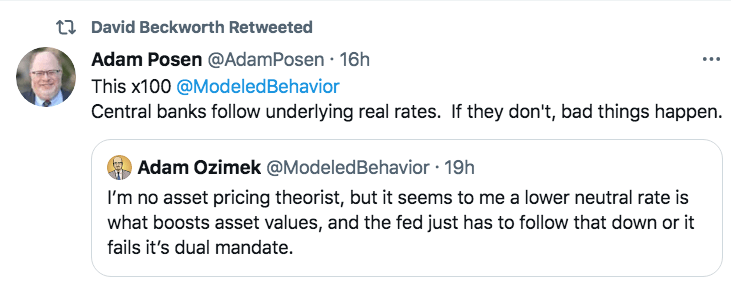
I see a lot of discussion of Fed “debt monetization”, and yet it’s not exactly clear what that term means. Here I’ll discuss two types of debt monetization, and a third policy that is often wrongly viewed as debt monetization. The best example of debt monetization is a large, one-time increase in high-powered money, which the central bank uses to purchase interest-bearing government bonds. High-powered money is base money that pays no interest, such as currency and zero interest bank reserves. This policy produces a one-time increase in the price level, but no persistent increase in the rate of inflation. A second type of debt monetization involves a persistent increase in the rate of inflation, such as we saw during the 1960s and 1970s. This is only effective if a substantial amount of government debt is in the form of long-term bonds. The inflation reduces the value of these bonds in real terms. In contrast, if all government debt is in the form of short-term T-bills, then the interest cost on T-bills rises with the higher inflation, producing no real gain to the government. This second type of “debt monetization” doesn’t actually involve very much conversion of debt into money. That’s because at high rates of inflation the real demand for high-powered money falls sharply. If the Fed switched to an 8% inflation target tomorrow, then the Fed would likely have to reduce the amount of high-powered money in circulation.  (Interest-bearing bank reserves are not high-powered money, as there is no long run fiscal gain is swapping interest-bearing reserves for interest-bearing T-bills.) Some people regard a “low interest rate policy” as another form of debt monetization. This is false. Indeed low interest rates are not even a policy; they are the outcome of various other monetary policies, plus other non-monetary factors.  The Fed has only a very transitory effect on real interest rates, which are determined by underlying economic fundamentals. As a result, a policy of persistently low nominal interest rates requires persistently low inflation, i.e. a tight money policy. That does not provide a fiscal gain to the government, as one can see from the example of Japan. David Beckworth recently retweeted a couple of Adams making a similar point: PS.  The recent surge in the CPI is not relevant to this post, as it’s likely just a transitory supply-side shock.  While I follow convention in focusing on price inflation, NGDP growth is the more relevant variable for this sort of analysis. (0 COMMENTS)

/ Learn More

Knowledge, Reality, and Value Book Club, Part 5

Now it’s time to finish up my tour and critique of Huemer’s new book.  This week: animal ethics. My Preamble Five years ago, I had an extended debate on animal ethics with Huemer on EconLog.  Here are segments 1, 2, 3, 4, 5, 6, and 7. As expected, Huemer and I failed to convince each other.  Unexpectedly, at least two people I personally know told me that Huemer changed their minds.  No one has ever told me that I changed their minds on this issue.  If my favorite philosopher says I’m wrong, and successfully changes my friends’ minds in a fair debate, I have to suspect that he’s right and I’m wrong.  So while I’m tempted just to declare an impasse, I feel obliged to resume the argument. Before I delve into this chapter, however, let me quote a passage from Huemer’s “Defending Liberty: The Commonsense Approach,” an essay in Foundations of a Free Society. The fundamental fallacy of rationalism is the idea that human knowledge proceeds from the abstract to the concrete, from the general to the specific; that one arrives at particular judgments by applying pre-given abstract rules to particular circumstances. The evidence of human experience stands almost uniformly against these assumptions, in virtually every area of human intellectual endeavor. In the sciences, one does not begin with an abstract theory and then use it to interpret experiences. If one wants to develop a theory, one begins with a large collection of concrete facts; patterns may emerge and explanations may suggest themselves, once one has collected a sufficient body of background facts. One’s theories must conform to and be driven by the concrete facts, not the other way around… The same is true in philosophy.  [I]f we wish to arrive ultimately at some general theory of ethics, we must start from a variety of relatively concrete, particular ethical truths. It is those who proceed in the opposite direction—declaring some general, abstract theory and then demanding that the particular facts conform to it—who are responsible for the mountains of failed (and often absurd) theories that dominate the landscape of the history of philosophy. My fundamental problem with Chapter 17 is that Huemer almost completely loses sight of these insights.  Virtually everyone accepts a long list of “relatively concrete, particular ethical” views that give animals near-zero moral weight.  And instead of taking these ubiquitous intuitions seriously, Huemer sets them all aside in favor of two extremely abstract and general claims.  Namely: 1. Suffering is bad. 2. It is wrong to cause an enormous amount of something bad, for the sake of relatively minor benefits for ourselves. The correct intuitionist approach, I say, would be much more concrete.  Along the lines of the following short dialogue:   A: It is wrong to cause an enormous amount of suffering, for the sake of relatively minor benefits for ourselves. B: So if the only way for me to build a swimming pool is to bulldoze a den of mice, causing them to horribly suffer, it is wrong to build my pool? A: Perhaps I overstated. B: Indeed.   Why is this more concrete approach superior to Huemer’s?  Because B’s concrete, particular ethical claim that mouse suffering is no big deal is far more plausible than A’s sweeping moral generalization. Doesn’t this undermine Huemer’s Problem of Political Authority, which makes an intuitionist case for anarchism?  No, because as Huemer shows in great detail, the case against government pits ubiquitous concrete, particular views about the ethical treatment of humans against sweeping moral generalizations about government authority.  In his words, “I do not, of course, lay claim to common sense political views. I claim that revisionary political views emerge out of common sense moral views.”  The whole project of Chapter 17, in contrast, is precisely to defend a revisionary moral view about the proper treatment of animals.  And as Huemer makes clear in Chapter 17, his view is deeply revisionary, condemning virtually all human beings as moral monsters. Chapter 17: Applied Ethics, 2: Animal Ethics In previous chapters, my disagreements with Huemer have been so rare that I’ve been able to register virtually all of my objections.  For Chapter 17, I’ll have to focus on my larger criticisms.  Here goes: The most common argument for ethical vegetarianism is something like this: 1. Suffering is bad. 2. It is wrong to cause an enormous amount of something bad, for the sake of relatively minor benefits for ourselves. 3. Factory farming causes an enormous amount of suffering, for the sake of relatively minor benefits for humans. 4. Therefore, factory farming is wrong. 5. If it’s wrong to do something, it’s wrong to pay other people to do it. 6. Buying products from factory farms is paying people for factory farming. 7. Therefore, it’s wrong to buy products from factory farms. Shortly thereafter, he adds: The usual target is premise 1: Defenders of animal cruelty claim that only human suffering is bad; animal suffering isn’t. They then need to identify some relevant difference between humans and animals that explains why that would be so. I’d say this is overly generous to Premise #1.  Making extremely evil humans like Hitler or a serial killer suffer is actually very good.  A weird view?  Hardly; it’s classic retributivism. Furthermore, if animal suffering is only slightly bad, then an enormous amount of animal suffering would still not be enormously bad.  So you need an additional premise in between (1) and (2). (Aside: We could delete (1) and replace (2) with little change in plausibility: “2.’ It is wrong to kill a living creature, for the sake of relatively minor benefits for ourselves.”) The rest of the argument seems fine. Huemer then moves on to “Defenses of Meat-Eating.”  The good news is that my preferred argument comes first.  The bad news is that he swiftly dismisses it. Argument 1: It’s okay to torture other animals for our own pleasure, because we are intelligent, and other animals are not. Replies: 1. This is a non sequitur. What does intelligence have to do with the badness of pain and suffering? Is the claim that pain is only bad if you’re smart? Why would that be? 2. Human babies are also unintelligent. Argument 1 thus implies that it would be permissible to torture babies for fun. 3. Similarly, Argument 1 implies that it would be permissible to torture mentally retarded people for fun. My replies to Huemer’s replies: (1) This is not supposed to be a deductive argument, so it makes no sense to call it a “non sequitur.”  Instead, it is a moral premise – “The suffering of intelligent beings is much more morally important than the suffering of less-intelligent beings.”  And this premise strikes most of us as highly intuitive.  We can see this clearly in science fiction.  In the Star Wars universe, for example, we readily accept the idea that it is wrong to kill Wookies or Ewoks.  Why?  Because they are other intelligent beings.  Killing Banthas, on the other hand, is no big deal, because they’re just alien animals. (2) If you haven’t had much time to learn, ignorance and intelligence are perfectly compatible.  Why?  Because “intelligence” is roughly synonymous with “learning ability.”  And since human babies go from knowing zero languages to one language in a couple of years, one can plausible say that they are in fact highly intelligent.  If that doesn’t convince you, I’d appeal to the separate moral premise that, “The suffering of beings who will normally develop intelligence is much more morally important than the suffering of beings who will never develop intelligence, though probably not as important as the suffering of beings who are already intelligent.”  Also highly plausible. And yes, the latter premise lends some support to a moderately anti-abortion view, but I say that is a feature, not a bug. (3) Most mentally retarded humans are still much more intelligent than almost any animal, so this does not follow.  In the rare cases where humans are reduced to the mental level of an animal, we routinely consider options like euthanasia (or at least “pulling the plug”) that would be out of the question for a functional yet mentally retarded human. Huemer’s critique of Arguments #2-9 seem basically right. His reply to Argument #10, though, falls short: Argument 10: Plant farming also kills animals! Farmers kill insects with pesticides. Even if you buy organic foods, they probably kill field mice sometimes in the process of tilling fields and harvesting vegetables with machines. Therefore, vegetarians are no better than carnivores! Reply: Animal agriculture is worse than plant agriculture in a number of ways. 1. Factory farms confine animals in unnatural and unpleasant conditions, subjecting them to pain and suffering for their entire, brief lives before killing them. Plant farms do not do this. 2. Chickens, pigs, and cows definitely feel pain and suffering. Insects almost certainly do not, due to the absence of nociceptors (the kind of nerves that generate pain sensations in us). This is why insects can continue what they are doing even when their bodies are severely injured, they place the same weight on an injured leg as on an intact leg, etc.113 3. Animal farms require food for the animals, which comes from plant farms. The amount of food you have to feed the animals in the course of raising them is greater than the amount of food you get out of them at the end. Hence, meat production causes more of whatever harms are caused by plant farming, in addition to the harms directly inflicted on the animals in the factory farms. Thus, while it might be true that plant farming causes some harm, this can’t be used to excuse animal farming. In general, one can’t justify some bad behavior by saying that the alternative action causes some (much smaller) amount of harm. My reply: (1) This is a hyperbolic caricature of a reasonable argument.  Namely: While “It is wrong to cause an enormous amount of something bad, for the sake of relatively minor benefits for ourselves,” probably allows you to incidentally kill animals in order to stay alive, even strict vegans usually cause far more animal suffering than they need to survive.  After all, cutting your calories by 5% wouldn’t ruin your vegan life, and cutting those vegan calories by 5% would probably reduce a lot of suffering.  Or you could try to buy food from areas with low rodent populations.  I’ve never heard of any vegan doing such things, though admittedly I’m out of their loop.  (The same goes for living in housing with a small footprint, since building any architectural foundation is likely to bring serious suffering to pre-existing animals in the vicinity). (2) Upshot: You could say, “Fine, even strict vegans are moral monsters.”  Or you could reassess the “It is wrong to cause an enormous amount of something bad, for the sake of relatively minor benefits for ourselves” principle. (3) The “insects almost certainly do not feel pain” argument still seems grossly overstated.  There could easily be many neurological pathways to pain, and pain has so much survival value that you would expect almost any ambient species to evolve it.  And while you can point out differences between how humans and insects respond to pain, these are dwarfed by the similarities.  Have you ever seen an insect fighting for its life? (4) Even if Huemer is right about insects, moral philosophers couldn’t have known this until recent decades.  So until then, a proto-Huemer should have been as committed to reducing insect suffering as modern-day Huemer is to reducing non-insect suffering now.  Which again strikes me as a reductio ad absurdum.   General point: I agree that almost all of the pro-meat-eating arguments that Huemer analyzes are terrible.  And most of them are not straw men; I’ve heard people make them. While Huemer concludes that – in light of their terrible arguments – meat-eaters are desperately trying to rationalize obviously evil behavior, I have an alternative explanation.  Namely: The moral unimportance of animal welfare is so obvious to almost everyone that asking them for arguments confuses them.  As Huemer knows, normal humans often flounder when asked to justify the obvious.  If you ask people to “Prove they exist,” they present inane arguments.  The same goes if you ask people for proofs of the external world, knowledge, consciousness, or morality. While you could conclude that all of these “common-sense” beliefs are actually ridiculous, the more reasonable inference is that non-philosophers are too confused to say, “It’s obvious” (and too ignorant of the history of philosophy to appeal to G.E. Moore). I say the same is going on with animal ethics. All this explains why, if you agree with the arguments of this chapter, you should not only refrain from buying factory farm products yourself. You should also exert social pressure on other people around you. E.g., express serious disapproval whenever your friends buy products from factory farms. If you meet someone for a meal, you should insist on going to a vegetarian restaurant. By the way, if you do this, you can expect other people to act resentful, and indignant, and often to insult you. This is because, again, they are horrible. Given their horribleness, their main thought when someone points out their immorality is to get angry at the other person for making them feel slightly uncomfortable. They won’t blame themselves for being immoral; they’ll blame you for making them aware of it. It’s sort of like how a serial murderer would get mad at you if you tried to stop him from murdering more people. He would then blame you for being “preachy”. Perhaps the murderer would then refuse to be your friend any more. If so, good riddance. If Huemer is right, merely “exerting social pressure on other people around you” seems like a tremendous underreaction.  If non-vegans are half as awful as Huemer claims, he shouldn’t be “insisting on going to a vegetarian restaurant.”  He shouldn’t be socializing with them at all.  This is just an application of this moderate deontological principle: “Don’t socialize with moral monsters unless the benefits greatly exceed the costs.”  Seems plausible, doesn’t it? And things don’t stop there.  If you insist on eating at a vegetarian restaurant, why not refuse to patronize any shopping center that allows non-vegan restaurants in the complex?  A single landlord will normally own the entire shopping center, after all.  Or you could refuse to eat vegan food unless the deliverymen are vegans as well.  Sure, don’t starve yourself to death for veganism.  But if comparisons to the Holocaust are in the right ballpark, extreme social pressure is well-warranted. In saying this, my hope is not to turn Huemer and other ethical vegetarians into hermits.  I like Mike.  My point, rather, is that even they are less radical in their behavior than their rhetoric suggests.  And the best explanation is that on some level they intuit that their pro-vegan premises are considerably more dubious than they admit. Chapter 18 No objections, so I’ll just quote my favorite passage: [G]ood philosophers answer objections. If you have a philosophical view (or any view really), and you know that a lot of smart people disagree with it, you really need to think about why they disagree. And I don’t mean “Because they’re jerks” or “Because they’re evil.” What you need to think about are the best reasons someone could have for disagreeing. If you can’t think of any, then you probably haven’t thought or read enough about the issue; you should then go look up some intelligent opponents and see what they say. And I don’t mean television pundits or celebrities on Twitter. The best defenders of a view are usually academics who have written books about it. You should then think seriously about those objections and whether they might be correct. If you don’t find them persuasive, try to figure out why. This is the part of rational thought that most human beings tend to skip.           (0 COMMENTS)

/ Learn More

The New World of Radio

“Are you willing to do this on Zoom?” said the familiar voice on the other end of the line. “Sure,” I said. So he emailed me a Zoom link within a minute and, for the first time, we did the radio interview on Zoom. After the 20-minute interview, the interviewer, who asked me not to list his name or his radio network, panned his camera around his study in Connecticut to show me his $600 RODEcaster and explain some of its features. He used to interview me from his Manhattan office but now he doesn’t need to go there. His show runs on the radio network at night, and he interviews people in Europe in the early morning, people like me at midday, and people in Asia in the evening. In his view, podcasts will be a huge part of radio broadcasting. I want me one of those RODEcasters. (0 COMMENTS)

/ Learn More

What can we infer from the Swedish Covid policy?

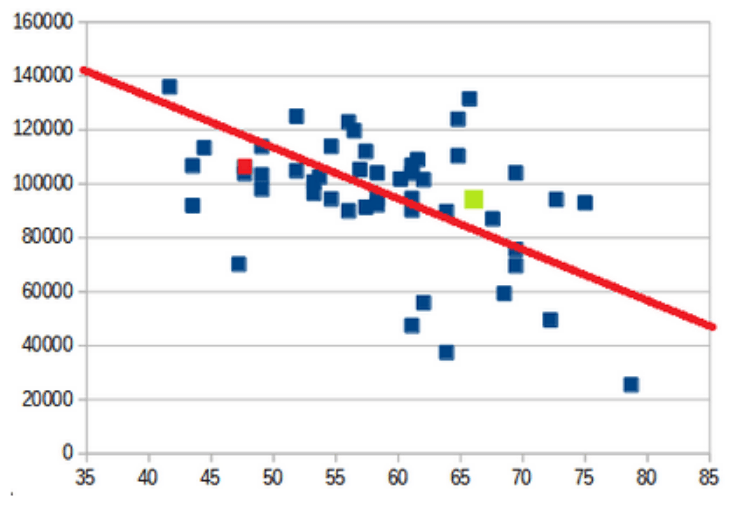
There’s been a great deal of discussion of what we can learn from the Covid policy adopted by Sweden.  One side suggests that the Swedish outcome shows that lockdowns don’t have much impact on Covid infection rates, while the other side reaches the opposite conclusion.  I’m rather skeptical about the effectiveness of lockdown policies, but I don’t entirely agree with either side of the debate over Swedish policy.  (This article in The Economist is also mildly skeptical of the cost efficiency of lockdowns, accounting for both the impact on the economy and on human freedom.)  At the same time, I’ve long suspected that the Swedish government didn’t handle the epidemic very well.  That requires some explanation. Scott Alexander has a very long and thoughtful article on the effectiveness of lockdowns, and does a good job of presenting both points of view.  Here’s what he says about Sweden: Anyway, a reasonable conclusion might be that Sweden had between 2x (if we compare it to an average European country) and 6x (if we compare it to an average Scandinavian country) the expected death rate in the first phase of the pandemic. Philippe Lemoine is extremely against this conclusion. He first argues that since we don’t know why Finland+Iceland+Norway+Denmark did so well, we can’t assume it’s a “Scandinavia effect” and so we can’t assume Sweden would share it. Therefore, we should be judging it against the European average rather than the (better) Scandinavian average. I would counter that, although we can’t prove that just because X is true of Finland+Iceland+Norway+Denmark and not other European countries, that it should also be true of Sweden, but we should have a pretty high prior on it . . . That’s exactly my view.  In the past, I did a cross-sectional study of developed countries, and while doing so I found that the Nordic countries are actually quite distinctive.  According to a wide range of measures they are quite similar to each other and quite different from other countries.  So I have the same prior as Alexander, and thus lean toward the view that Sweden really did do much worse.  But . . . I don’t believe this was primarily due to Sweden’s lockdown policies. Recall that Sweden is just a single data point.  When we look at more systematic studies, the effect of lockdowns seems to be much smaller.  Here is Alexander, citing a study of US states that found some impact from lockdowns: This is a victory for lockdowns insofar as the correlation is significant, but strong proponents might be surprised by how small the effect was. A few small isolated northern states like Vermont did very well. But most states – from California [green dot] and New York to Florida [red dot] and Texas – clustered in a band between 80,000 and 120,000 cases per million. States at the 75th percentile of lockdown strictness had about 17.5% fewer cases per million than states at the 25th percentile. And even that may overstate the effect, as people in states with stricter lockdown policies might also contain people that would be more careful in the absence of lockdowns.  On the other hand, Alexander points out that there was lots of voluntary behavioral change in states with weak lockdown policies, so this doesn’t suggest that we should have just lived life as normal during Covid, rather it casts some doubt on mandatory lockdowns having much marginal benefit. So why did Sweden do far worse than its Nordic neighbors while places like South Dakota did only marginally worse than states with more restrictive lockdowns?  I don’t know, but I suspect it might have had something to do with other Swedish policies.  Here it’s useful to recall that Sweden has a high level of what’s sometimes called “civic virtue”, which is the tendency of the public to cooperate with what is seen as sound public policies.  Sweden is a “high trust society”.  And at least early on in the pandemic, some Swedish public officials seemed to be recommending a “herd immunity” approach to the pandemic.  Consider the following, from August 2020: While most of the world has come to terms with covering their noses and mouths in crowded places, people in Sweden are going without, riding buses and metros, shopping for food, and going to school maskless, with only a few rare souls covering up. Public health officials here argue that masks are not effective enough at limiting the spread of the virus to warrant mass use, insisting it is more important to respect social distancing and handwashing recommendations. “I think it’s a little bit strange. Sweden, as a small country, they think they know better than the rest of the world. (It’s) very strange,” says Jenny Ohlsson, owner of the Froken Sot shop selling colourful fabric masks in Stockholm’s trendy Sodermalm neighbourhood. Last year, I recall reading that when Swedish people were interviewed, they cited government recommendations when explaining their lax behavior. In my view, Sweden ended up with much higher caseload than its Nordic neighbors mostly because of voluntary differences in behavior, partly attributable to dubious recommendations from the Swedish authorities.  That would explain why lockdowns seemed to have had a much more damaging effect in Sweden than elsewhere; the actual problem was a range of other behavioral differences that were not directly due to a lack of mandatory lockdowns.  (Some also cite Sweden’s inept nursing home management, but even that doesn’t fully explain the differences.) So what are we left with?  Lockdowns are overrated in importance in two different ways.  First, they didn’t save nearly as many lives as their proponents assumed.  Second, their economic cost was lower than their opponents assumed.  Most of the economic damage was due to voluntary behavioral changes.  But lockdowns also restricted human freedom. On balance, I lean toward the view that the gains in public health were not large enough to offset the admittedly modest economic damage, plus the substantial loss of freedom.  And this view is not based on any dogmatic opposition to any and all government regulation.  If the case fatality rate had been 60% instead of 0.6%, then lockdowns might have made sense as a temporary policy.  But even in that case it’s not entirely clear they would have been necessary, as the voluntary behavior response would have been far greater.  Rather the restriction on human freedom that would have made the most sense is a temporary restriction on inbound airline flights. PS.  Lockdown policies had virtually zero impact on my life over the past 15 months, so my views here do not reflect grouchiness over being inconvenienced.  Rather, I believe that lockdown policies did restrict the behavior of many other people. PPS.  This post does not apply to countries that successfully implemented a near-zero Covid policy, such as Australia and New Zealand.  It applies only to countries where Covid was widespread.  In a future pandemic, it is almost inevitable that all developed countries will try to emulate Australia, at least initially.  You may not like that fact, but it seems inevitable to me. PPPS.  This issue is almost endlessly complicated, as Sweden did have some “lockdown” rules, and later in the epidemic it made the rules more restrictive in response to soaring caseloads.  As a result, Scott Alexander focused mostly on the early phase of the epidemic, to minimize the “endogeneity problem”.  Similarly, “herd immunity” was never the official Swedish policy, rather government officials spoke of it as a reasonable objective.       (0 COMMENTS)

/ Learn More

Knowledge, Reality, and Value: Huemer’s Response, Part 4

The latest from Huemer: Thanks, everyone, for the discussion! Here are my responses to the comments about part 4: Bryan’s Comments “BC” indicates Bryan’s comments; “MH” is me, from the book. (1) BC:      When defending moral realism, Huemer places a fair amount of weight on linguistic evidence … I find this evidence less probative than he does. Why? Because human beings often frame non-assertions as assertions for rhetorical effect. “Yay for the Dodgers!” is almost equivalent in meaning to “Dodgers rule!” More about the linguistic evidence: Each of the linguistic tests for proposition-expressing sentences corresponds to a non-linguistic, metaphysical truth. E.g., the reason why it’s linguistically odd to say “I believe hurray for the Dodgers” is that belief is an attitude toward a proposition; it doesn’t make sense to speak of believing something that isn’t a proposition. Granted, one could always claim that the word “believe” has a special, alternative meaning for ethical contexts. But it’s going to be a pretty incredible coincidence if that happens with every single expression in the language that normally gets attached to proposition-expressing clauses. I think the linguistic evidence is pretty good, partly because it’s relatively objective. There is so much in philosophy that can be fudged, and people will just claim to have different intuitions. But it’s really uncontroversial that statements like “I believe taxation is wrong” and “It’s possible that abortion is permissible” are meaningful. As to the Dodgers: It may be that “the Dodgers rule” just means something like “the Dodgers are extremely good.” (Let’s not worry about getting down the exact meaning.) If so, that is a proposition-expressing phrase (as I’ve argued). Now, even when making a factual assertion, people are often not very interested in the fact they’re asserting and may instead be trying to make some move in a social game. So a Dodgers fan might be asserting (with no justification) that the Dodgers are extremely good in order to express his quasi-tribal affiliation as a Dodgers fan. That doesn’t stop it from being an assertion, though. Compare: a person might assert that Barack Obama is a Muslim as a way of expressing hostility to the Democrats and tribal affiliation with the alt-right. This doesn’t stop “Obama is a Muslim” from being a proposition-expressing phrase, though. (2) BC:      Is moderate deontology fully intellectually satisfactory? No. But why the doleful “least bad” rather than the hopeful “rather good”? Basically, many deontological intuitions lead to paradoxes in certain cases. See my papers: “Lexical Priority and the Problem of Risk”, http://www.owl232.net/papers/absolutism.pdf “A Paradox for Moderate Deontology,” https://philpapers.org/archive/HUEAPF.pdf I mentioned this in the chapter, but those papers give more detail. Those aren’t the only puzzles, just the ones written about by me. There are many puzzles that arise when trying to think through deontological principles, to explain and justify them. Here’s another challenging paper, by Caspar Hare: “Should We Wish Well to All?”, http://web.mit.edu/~casparh/www/Papers/CJHareWishingWell.pdf BC:      And for the “two or more actions,” problems, what’s wrong with implicit or hypothetical consent…? This was in reference to the following scenario: You have a chance to perform an action that harms person A while benefitting person B by a greater amount (and with respect to the same good). You also have available an independent action that would harm B while benefitting A by a greater amount (with respect to the same good). Each action is wrong, considered by itself, according to deontologists. But the combination of actions simply benefits both A and B. So x is wrong, and y is wrong, but (x&y) is okay. Does consent save us from the paradox? This is discussed in section 4 in my paper (https://philpapers.org/archive/HUEAPF.pdf). Suppose A does not consent. A wants you to perform only the action that benefits him while harming B; he won’t consent to the action that harms him while benefitting B (not even conditional on your doing the other action simultaneously). Now what? It looks to me like we still have the original problem. I also thought there were some worthwhile points on behalf of utilitarianism in the book in 14.3.2 and 14.5.3. (3) BC:      If you regress fertility on income alone, higher income predicts lower fertility. However, if you add more variables, the picture changes. At least in the US, for example, the highest-fertility people have high income combined with low education. (Bryan includes a link to another post where he says that education decreases fertility, but if you control for education, then income increases fertility. That’s very interesting, so thanks for that. The context of the discussion in the book was that some people think we shouldn’t aid people in poor countries because that will just cause them to have more babies. I was rejecting this, saying that aid will more likely decrease fertility. Taking account of Bryan’s point about education vs. income, I still think my main point is true. If we successfully help the poor, their income will probably go up together with their education levels; they won’t get increased income but somehow be forced to stay at the same education levels. So aid to the poor will still likely decrease fertility. (4) MH:    … if we can alleviate world poverty, this would actually reduce population growth. BC:      If true, this is probably the best consequentialist argument against alleviating world poverty. After all, most poor people are happy to be alive. If saving the lives of the most miserable of the world’s poor causes their total population to greatly shrink, how is that a win? Because the living standards will be higher. This brings up a debate in population ethics that I didn’t go into in the book, because it would be a long and challenging discussion. If you have a fixed set of conscious beings, then it’s straightforward how consequentialist reasoning works. You just always produce the largest net benefit you can (summing your action’s benefits minus its costs, regardless of who the beneficiaries and victims are). This maximizes the total utility of the fixed set of beings; it also maximizes their average utility. But what should you do if your choices not only produce benefits and costs but also affect how many and which people will even exist in the future? Should we try to maximize total utility, such that we’d have reason to try to create lots of new people to rack up the utils? Or maybe we should try to maximize the average level of welfare of the population? Or maybe we should do something in between? Or none of the above? This area of ethics is full of difficult and confusing problems, which we don’t have time to go into (see Derek Parfit’s Reasons and Persons and my article “In Defence of Repugnance”). Suffice to say that there’s no generally accepted theory, and every theory has at least one highly counter-intuitive consequence (usually more than one). So I’m not going to try to resolve the issues in population ethics now. However, I would note that people in developed countries are really a lot better off than people in the poorest nations of the world. Even if you think that increasing population is good ceteris paribus, it’s plausible that the increase in welfare levels resulting from economic development outweighs the decrease in population. Consider: If you had the chance to go back in time and somehow sabotage the industrial revolution, so that Europe and America (etc.) would never have industrialized and never have become fabulously wealthy as we are today, would you do it? Before answering, note that our population today would probably be much larger, though also more miserable. I bet that most people would answer “no”. (5) BC:      Memory is highly fallible. Memory varies so much between people. Yet we can’t do without it. Even math relies on memory! … The same applies at least as strongly to natural science. Unless you’re directly staring at something, natural science is based not on observation and experimentation, but on what we remember about past observation and experimentation. Yep. Btw, it’s not even what we remember about past observations – nearly all scientific beliefs are almost entirely based on what we remember hearing from other people. Science depends on memory, testimony, observation, reasoning, and intuition. And none of those information sources can be checked without relying on itself, with the possible exception of testimony (but even there, we have not in fact done much to check the reliability of other people). All those sources are fallible. Yet science is still pretty good. Reader Comments I can’t address everything, because I have other stuff to do, but here are a few of the comments:   (1)        “It’s hard to see how demandingness is a particularly strong objection to utilitarianism. All moral theories can be extremely demanding in certain circumstances.” Yes, they can (almost all). I assume Bryan would say that utilitarianism is extremely demanding in a much wider range of circumstances; also that its demands are much less intuitive.   (2)       “Huemer is overlooking the fact that in utilitarianism future people count just as much as present people. If I invest my surplus wealth, I will benefit future people…” Sure, if you’re good at investing, then maybe you should invest everything you don’t need to survive, in order to grow your fortune to the maximum amount possible before you die, then donate it to charity in your will. This is still just as demanding as the original idea (of giving your money to charity continuously).   (3)       “without empirical data, Huemer is not appealing to linguistic or introspective evidence in any systematic and rigorous way: he’s simply appealing to his intuitions about how language works” I’m not sure what we’re talking about. I used premises like this: “John thinks that taxation is bad” makes sense. “I wonder whether abortion is wrong” makes sense. “If abortion is wrong, then fetuses are people” makes sense. “John thinks that ouch” doesn’t make sense. “I wonder whether please pass the salt” doesn’t make sense. Etc. Is that what we’re talking about? Is the commenter saying that I need to conduct a rigorous scientific study to figure out whether (a)-(e), etc., are true? I find that kind of bizarre.   (4)       “But neither his nor my personal experiences, introspective reports, or intuitions are very good evidence of whether most people are moral realists.” I did not say most people are moral realists. My argument is about what’s true, not what most people believe.   (5)       “Even the earlier studies found equivocal evidence, with most participants expressing inconsistent and mixed metaethical standards.” That’s pretty close to what I said in the preface to Ethical Intuitionism.   (6)       [Commenter #1] “To you, does “if murder is wrong, then assassination is wrong”, really seem just as well formed as “if boo Dodgers, then go Giants”? [Commenter #2] “No, but I’m not a noncognitivst. And this would only stand as at best an objection to very old and flat-footed noncognitivist accounts. Even some of those could probably handle this fairly well, but contemporary expressivist accounts can handle the semantics of moral language even better…” Three points: First, notice that this is a completely different response. Lance’s first response was “Huemer is just using intuitions, so his so-called ‘evidence’ is worthless.” This new response seems to grant that the non-cognitivist actually needs to accommodate (“handle”) my evidence. Second, I don’t agree that they “handle” those well. I don’t have time to write a lengthy discussion here, but I discussed this in Ethical Intuitionism. Third, conditionals were just one example of a much more general type of problem. Non-cognitivists have spent a lot of time on trying to interpret conditionals with moral clauses, and a few other types of sentences. But the problem isn’t just with a few types of sentences. The problem is with every single linguistic context in which you can embed a proposition in a larger proposition. Someone has to explain why every single one of those works with moral statements. You can of course claim that, coincidentally, every single word or phrase that lets you embed a proposition also has a different meaning that lets you embed moral sentences even though moral sentences are non-propositional, but doesn’t let you embed any of the uncontroversial examples of non-propositional sentences. The willingness to say this sort of thing is a good illustration of why philosophers make a lot less progress than scientists.   (7)       “Would we look for an answer to scientific realism by checking how people in fact use the language of science? … Why would it be any different for moral language?” Because we were talking about semantic theories. Non-cognitivism is a semantic theory. It says moral statements don’t express propositions. (No one that I know of holds a non-cognitivist view of science.)   (8)       “I’m less confident that the Trolley Problem is a useful critique of utilitarianism. It’s quite far outside the normal range of human experience…” Just to be clear, the Trolley Problem is typically not used to criticize utilitarianism. The example is more often used to support utilitarianism, because most people intuitively judge that you should switch the trolley away from the five toward the one. There was, by the way, a real case like this in Los Angeles in 2003. A group of 31 Union Pacific freight cars started rolling downhill out of control, due to improperly set brakes, heading for downtown Los Angeles. This could have been a disaster. The Union Pacific officials decided to switch the train to a side track into Commerce City, a much less populated area. The train derailed in Commerce City. Miraculously, no one was hurt. I would say the Union Pacific employees did the right thing. (Given the situation. Of course, the really right thing is to set the brakes properly at the start!) I guess Bryan would say no, they should have let the train continue into downtown Los Angeles. Now, you could say, “Let’s avoid train accidents altogether.” And sure, that’s the right thing to say if our actual interest was train accidents. But that’s not really the point when people raise such examples in ethics. The trolley example is given to illustrate something about utilitarianism – it’s interesting because it’s a case in which most people have the utilitarian intuition.   (9)       “Given the world as it is, utilitarianism makes some pretty stringent active demands on citizens of wealthy countries. But any moral theory that doesn’t make these demands thereby makes even more stringent passive demands on those in poverty. […] They have to die of a preventable disease.” This isn’t really a demand of the moral theory in the same sense. The non-utilitarian theory doesn’t say that people are obligated to die of a preventable disease. It doesn’t, for example, say that if you have a way of saving your life, you’re obligated not to take it. One could consistently say that (a) other people aren’t obligated to give their money to help you, but (b) you are permitted to steal money to save your life, if you have the chance to do that. (Which I actually think is plausible.) Of course, most people don’t in fact have that chance, so many will die of preventable diseases each year. But that’s not because a moral theory is telling them to do that.   (0 COMMENTS)

/ Learn More

Don Boudreaux on the Pandemic

Economist Don Boudreaux of George Mason University talks about the pandemic with EconTalk host Russ Roberts. Boudreaux argues that a perfect storm of factors created a huge overreaction, including unnecessary lockdowns that accomplished little at a very high cost in physical and emotional health. Instead, Boudreaux argues, we should have focused attention on the population most at risk of dying from COVID–the elderly and especially the elderly with co-morbidities. The conversation includes a discussion of externalities and the insights of Ronald Coase applied to the policies during the pandemic. (0 COMMENTS)

/ Learn More

Don Boudreaux on the Pandemic

Economist Don Boudreaux of George Mason University talks about the pandemic with EconTalk host Russ Roberts. Boudreaux argues that a perfect storm of factors created a huge overreaction, including unnecessary lockdowns that accomplished little at a very high cost in physical and emotional health. Instead, Boudreaux argues, we should have focused attention on the population most at […] The post Don Boudreaux on the Pandemic appeared first on Econlib.

/ Learn More

Trillions of Dollars of Retirement Wealth Have Been Mislaid

  And once they are accounted for, measured wealth inequality plummets.  One reason that the illiquid and non-market resources of DB [defined benefit] pensions and Social Security are typically excluded from studies of wealth concentration is that they are not directly available in household-level survey data. Our work addresses this issue by taking data from the Survey of Consumer Finances (SCF), estimating work histories to predict future Social Security income streams, and combining these results with estimated accrued DB assets and other market wealth holdings to form an expanded wealth measure. We look at households aged 40 to 59, who are building up to peak wealth accumulation before drawing down assets in retirement. Our estimates show that the value of DB pensions and Social Security are [sic] significant relative to other forms of wealth—throughout the wealth distribution but especially at the lower half of the wealth distribution. Indeed, we find that, even for the median household, the present value of DB pensions and Social Security benefits accounts for more than half of all wealth. With respect to their effects on the distribution of wealth, we find that (1) including DB pension and Social Security wealth results in markedly lower measures of wealth concentration, and (2) trends toward higher wealth inequality over time, while moderated, are still present. In particular, the “90/50 ratio”—the ratio of wealth held by those at the 90th percentile of wealth to those at the 50th percentile—is reduced by nearly half for the 50– 59 age group (from 13.4 to 6.8 in 2019) and for the 40–49 age group (10.7 to 6.4) when we include the estimated value of Social Security. The “50/10 ratio” declines even more with the inclusion of Social Security; for 2019, the ratio falls from 13.1 to 4.3 among those aged 40 to 49 and from 21.3 to 4.2 for the 50–59 age group. The share of wealth held by the “top 5 percent” drops from about 72 percent down to 51 percent when defined contribution (DC) plan and DB pension wealth are added to non-retirement wealth; it falls even further, to 45 percent, when Social Security benefits for those aged 40 to 59 are included. The inclusion of each measure, however, has a somewhat different effect: Social Security decreases wealth concentration “at the top,” whether we look at the top 5 percent’s share of wealth or the 90/50 ratio; DB decreases the top 5 percent’s share, but in more recent years, it actually increases the 90/50 ratio. The top 5 percent’s share of our expanded wealth measure rises 8 fewer percentage points compared with the top 5 percent’s share of non-retirement wealth over the 1989–2019 period. This is from Lindsay Jacobs, Elizabeth Llanes, Kevin Moore, Jeffrey Thompson, and Alice Henriques Volz, “Wealth Concentration in the United States Using an Expanded Measure of Net Worth,” Federal Reserve Bank of Boston, Working Papers, April 2021. HT2 Tyler Cowen and Scott Lincicome. Economists have known for a long time that something like their claims had to be true. For very wealthy people, defined benefit pensions and Social Security are a small percent of their wealth. For the non-wealthy, defined benefit pensions and Social Security are a large percent of their wealth. So leaving those two things out badly distorts two things: (1) the measure of wealth for the non-wealthy and (2) the extent of wealth inequality. NOTE: The title is an attempt at humor. One of the early articles I read when I was learning economics in the early 1970s was Robert J. Gordon, “$45 Billion of U.S. Private Investment Has Been Mislaid,” American Economic Review, June 1969.       (0 COMMENTS)

/ Learn More

Thanks to the Oppressed Chinese

Assuming a nuclear war can be avoided, perhaps future historians will remember the growth of the Chinese influence in the world as the event that saved individual liberty, prosperity, America, and Western civilization. At least, that’s the optimistic way to look at Chinese tyranny and its impatient imitators in the West. This hope is inspired by the Cold War. When Communists were conspicuously and proudly in power in the Soviet Union (and in China and elsewhere), they served as a foil for Western rulers and citizens, who were constantly reminded of what not to become. Communist policies such as restrictions on international trade, central planning, tax tyranny, police surveillance, philosophical and artistic crushing, philosophical poverty, persecution of dissidents or eccentrics, enforced prudishness, or militarization of society suggested what the government of a free society should not do. Not that everything was perfect in “free societies,” far from it. McCarthyism was not a glorious episode of American history. The opponents of communism were often tempted to justify domestic repression in the name of combatting communist-style repression. But we faced a constant spectacle of the terminus (given the technology of the times) of what Friedrich Hayek called “the road to serfdom” (see The Road to Serfdom, University of Chicago Press, 1944). These economic, philosophical, political, and aesthetic barriers crumbled with the fall of the Berlin Wall. Several decades then passed in a philosophical vacuum where democracy is, by default, a common and vague shared value, as if the German Democratic Republic, the Democratic Kampuchea, or the Democratic People’s Republic of Korea had never claimed to be the real democracies. (Alan Kors notes this point in “The Ethics of Democracy,” Georgetown Journal of Law & Public Policy 18.) The new cold warriors, those against China, now seem liberated from all scruples against using dirigisme similar to that of the enemy. A Wall Street Journal article illustrates what I mean: Alex Leary and Katy Stech Ferek, “Biden Builds on Trump’s Use of Investment Review Panel to Take On China,” July 7, 2021. We can observe how Leviathan grows, whether Democratic or Republican: The evolving mission means the multiagency panel led by the Treasury Department [the Committee on Foreign Investment in the U.S., or CFIUS] is set to be a linchpin in the Biden presidency’s plans to square off with the world’s second largest economy and potential peer competitor of the U.S., current and former officials said. … For much of its existence, Cfius only reviewed deals that were voluntarily submitted for scrutiny. Its more assertive course began under the Obama administration which grew alarmed at Chinese buying sprees of tech companies, and accelerated during the Trump administration. Congress in 2018 expanded the committee’s powers with bipartisan legislation that gave it more power to look for deals that could potentially harm U.S. national security but weren’t submitted for review. The Biden administration continues to add staff to seek out those cases that it deems should be scrutinized. Controls on foreign investments have also intensified in other countries. Although this movement seems to be directed at China, it is an easy prediction that it will soon hit companies in friendly countries. Trump himself showed the slippery way with tariffs on steel and aluminum from allied countries under the excuse of national security. Magnachip Semiconductor Corp. is a recent example of the new activism of CFIUS, which has blocked the sale of the company to Chinese interests. Magnachip is domiciled in Luxembourg, carries most of its operations in South Korea, and sells mainly in Germany and Asia, but has many American investors and is listed on the New York Stock Exchange. Control of foreign investment or trade is like international sanctions: it “works” (from the American government’s viewpoint) because it threatens Americans with serious penalties. Except for the extreme case of a raging war, I think there is no serious case for the government of a free country to prohibit its own citizens or subjects from selling goods and services, or corporations or shares of corporations, to any foreign buyer. Any company operating in the United States or listed on an American exchange is anyway overregulated by, and potentially under the total control of, the US government. And pretending that the government in DC will help the American economy prevail (whatever that means) over the Chinese economy by emulating Chinese dirigisme, that is, by limiting the economic freedom of Americans, is a tragic illusion. That is not how the Cold War was won or could have been won. It is of course important to always distinguish Chinese residents and businesses on one hand and their tyrant on the other hand—illustrating the danger of using “China” for both the tyrant and the tyrannized. It is in the interests of most Americans—of most individual Americans—to be free to trade with China; if it were not, they would not have to be coerced by their own government to refrain from doing it. If it is true that the deepening of Chinese totalitarianism will help Western people and their rulers rediscover the difference between a free country and an unfree one, we should thank the poor oppressed Chinese for their unwitting help. Perhaps they will in the process discover the difference themselves. (0 COMMENTS)

/ Learn More