This is my archive

bar

Why don’t firms pay more?

I often see people argue that if companies are short of workers then they should pay higher wages: Many businesses say extra unemployment benefits put in place during the pandemic have given some unemployed workers the incentive to stay home. In some states a jobless worker can earn almost as much or even more in benefits than what their old job paid. The Biden administration and other skeptics of that argument say the solution is simple. “Pay them more,” the president said last week. In fact, it is unrealistic to expect companies to boost their wage rate if doing so will reduce profits, and perhaps push the company into bankruptcy.  There are many reasons why higher wages might not be the optimal way to address a labor shortage.  One problem is downward wage stickiness after the economy returns to normal: The number of workers quitting their jobs has climbed to a record high. Most of them did so because they found another company desperate enough to hire workers that it paid more. Yet companies are only going to go so far. While it’s easy for businesses to raise or lower prices for customers based on the costs of their own supplies, they are loath to cut wages because of the damage it causes to employee morale. “You can’t take labor wages away,” said Timothy Fiore, chairman of manufacturing survey produced by the Institute for Supply Management. Another problem is that consumers might refuse to purchase goods if the price is too high: Many are in very competitive industries and they can’t easily pass higher labor costs onto customers. You can raise the wage of people who pick tomatoes in California, but you can’t stop consumers from switching to Mexican tomatoes if the price of the American version becomes too high.  You can raise the wages of Uber drivers, but you can’t force people to use Uber. There are many ways in which society might try to raise wages for low wage workers, all of which have drawbacks: 1.   Socialism.  Delink wages and productivity. 2.  Minimum wage laws. 3.  Worker training programs to boost productivity. 4.  Government wage subsidies for low wage workers. In my view, option #4 is the least inefficient method.  But one thing I know for sure is that simply exhorting companies to pay higher wages won’t work.  Companies will generally set wages at the profit-maximizing level. So should companies stop complaining about a shortage of workers?  No, keep complaining.  Maybe Washington will stop paying people not to work.       (0 COMMENTS)

/ Learn More

Libertarian SDB

I often rail against Social Desirability Bias, our all-too-human tendency to lie when the truth sounds bad.  Critics occasionally treat my railing as thinly-veiled ideology: I dismiss non-libertarian rhetoric as “mere Social Desirability Bias,” while treating libertarian rhetoric as objective truth. To clear the air, then, let me bluntly state that most libertarian rhetoric is also drenched in Social Desirability Bias.  Consider a few standard examples: 1. “The effect of government regulation can only be to worsen the very problem is purports to solve.”  This sounds good, but is almost always a gross overstatement.  The phrase “can only be” strongly suggests not just certainty, but a priori certainty.  And this is silly.  While I think the minimum wage does worsen the problem of poverty, this verdict depends on labor demand elasticity, the effect of income and employment on happiness, and other subtle empirical questions.  Could the effects of the minimum wage be otherwise?  Of course. 2. “Inevitably…”  Oh brother!  Libertarians love to use this word.  But as Tetlock teaches us, predictions without an expiration date are virtually meaningless.  “Paper money will lead to hyperinflation in the next 25 years” is at least worth entertaining, but “Paper money will inevitably lead to hyperinflation” is empty verbiage. 3. “Without exception…”  Oh brother!  The entirety of human history contains not a single exception?  Have you even looked for exceptions? 4. “I disagree with what you say, but will defend to the death your right to say it.”  Sounds great, but how many libertarians would even give a finger for their own right to loudly announce their own most controversial belief?  So they probably aren’t prepared to die for a stranger’s free expression, are they? 5. Almost every claim that a specific regulation will “destroy an industry” or even “destroy the economy.”  As Adam Smith quipped, “There is much ruin in a nation.”  While hyperbolic rhetoric draws more attention than “Will make us .03% poorer,” that doesn’t make it true.   Question: If both libertarians and their opponents habitually practice Social Desirability Bias, is there anything libertarian about my one-man crusade for ugly truth?  The answer is a subtle Yes.  I’ve already explained that betting kills hyperbole, the lifeblood of activist government: Why are proponents of government action so prone to hyperbole?  Because it’s rhetorically effective, of course.  You need wild claims and flowery words to whip up public enthusiasm for government action.  Sober weighing of probability, cost, and benefit damns with faint praise – and fails to overcome public apathy. Now suppose my Betting Norm were universally accepted.  Any public figure who refuses to bet large sums on his literal statements is an instant laughingstock, a figure of fun.  What happens?  Political hyperbole ends for politicians and pundits alike.  Hysterical doom-saying and promises of utopia vanish from public discourse.  No one serious can afford them!  As a result, it becomes very rhetorically difficult to make the case for government to do anything – or at least anything new.  Without an inspiring case for government action, government sits still. Much the same goes for Social Desirability Bias more generally.  If proponents of big government had to speak the plain unvarnished undemagogic truth at all times, the case for their favorite policies would be uninspiring at best. Imagine trying to sell the minimum wage with, “We can raise hourly pay by 10% while cutting employment by 5%.  A modest net gain for workers despite those who suffer as a result.” Or imagine a world where every politician was limited to ONE “top priority.” Once he says, “Fighting poverty is our top priority,” the most he can say about terrorism is, “Fighting it is our second-highest priority.” Or imagine trying to launch a war of choice with, “There’s a 30% chance we’ll make things better, 50% chance they stay the same, and a 20% chance we’ll make things worse.  I like those odds.” Government wouldn’t wither away in a world without Social Desirability Bias.  Yet passionate statist activism would.  And to state another ugly truth: Passionate statist activism harms human liberty far more than passionate libertarian activism helps it. (0 COMMENTS)

/ Learn More

Adults These Days

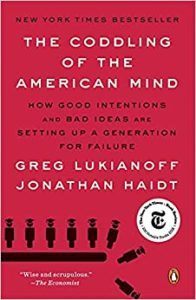
A review of The Coddling of the American Mind: How Good Intentions and Bad Ideas are Setting up a Generation for Failure, by Greg Lukianoff and Jonathan Haidt (Penguin Books, 2019)   People who write about campus trends have noted phenomena such as the disinviting of speakers, the conflation of controversial ideas with violence, and student hectoring of professors. Other writers have noticed that children seem to have far less unstructured play time than they once did. Many parents of a certain age have noted the prevalence of peanut allergies in children, a condition barely even heard of when they – ok, we – were young. What ties all these things together? According to Greg Lukianoff and Jonathan Haidt, they’re all the result of the advent of a kind of “coddling” of the youth, ironically by an older generation raised in exactly the opposite way. The use of the word “coddling” in the title is likely to make some people assume the book is some kind of “right-wing” diatribe against the perceived “snowflake” culture of the modern left. That assumption would be mistaken. For one thing, neither author identifies as right-wing. Also, the subtitle contains a clue: they think the people they’re disagreeing with have good intentions. It’s just that they are operationalizing those intentions in ways that Lukianoff and Haidt think are quite mistaken, the result being that today’s youth live in a state of enhanced fragility. So, is this one of those books that rails against the failings of the younger generation? After all, every generation seems to think that “kids these days” are deficient in something. But this book is also not one of those. The problem isn’t the kids. It’s the adults. Lukianoff and Haidt catalogue three mistaken ideas that they think are largely responsible for the change. They are “mistaken ideas” in the sense that if they were applied in any other context, their wrongness would be apparent, which the authors illustrate in a wonderful allegory that opens the book about a bizarro “sage” who is wrong about everything. One is that children are extraordinarily fragile rather than adaptive and antifragile. This means that opportunities to learn and grow are curtailed rather than sought out. It leads to an expansion of the concepts of trauma and safety, which Lukianoff and Haidt argue is not grounded in legitimate psychological research. The myth of fragility also leads to what they call “safetyism,” a world view on which all threats must be eliminated and no trade-offs are ever needed. The second mistaken idea they explore is emotional reasoning. According to cognitive behavioral therapy, emotional reasoning is one of the cognitive disorders that fosters or exacerbates depression and anxiety. Lukianoff and Haidt argue that despite the consensus of contemporary psychological therapists (and ancient philosophers!), the current generation of adults encourages children (up through college students, although these are in one sense not children) to engage in emotional reasoning, which results in, among other things, a tendency to interpret the actions of others in the least charitable way possible. The third mistaken idea Lukianoff and Haidt identify is “us-versus-them” thinking, which amplifies our worst instincts towards tribalism and black-and-white oversimplifications. The prevalence of these three ideas, and their synergy, is what leads to phenomena such as “call-out culture” (both on campus and on social media), increased incidence of anxiety and depression in teens, bureaucratic intrusion in the name of safety, and paranoid parenting. Think about the many levels of irony involved in modern parents who won’t let their children walk to the park alone to play with friends. One, these parents almost certainly spent their youth engaging in just the sort of unsupervised play they now deny their children. Two, they do this out of fear of violence or abduction, despite the fact that the rates of those crimes are way down over the last several decades. And three, these are the same parents who want their kids to learn the piano and soccer and coding by age ten, yet are cutting off real opportunity for learning and development through socialization. The book does mention LetGrow.org and the Free-Range Kids movement as possible pushback, and while some parents have faced legal trouble for letting their kids walk around the corner alone, some states are now starting to amend their laws. Lukianoff and Haidt do an excellent job showing how the “three great untruths” play an enormous role in so many of the social and psychological problems faced by today’s teens and college students. Their argument is coherent and compelling, and also well-documented. The notes at the back reveal that a tremendous amount of research went into the book, differentiating it from ranty jeremiads. Their writing and organization are refreshingly clear. This book should be widely read by the older folks who have played a role in promulgating the great untruths, and also by the younger people who might really benefit the most from seeing what misconceptions they’ve been tormented by. One problem, of course, is that so many people now have a vested interest in the way things have become, from school administrators to safety bureaucrats to student leaders, that it’s hard to see how the trend could be reversed now. But it’s possible, and the effort requires a book such as this one. Aeon J. Skoble is professor of philosophy at Bridgewater State University and a senior fellow at the Fraser Institute.  (0 COMMENTS)

/ Learn More

Knowledge, Reality, and Value Book Club, Part 4

Part 4 (“Ethics”) of Knowledge, Reality, and Value contains four chapters that seem extremely reasonable to me, and one that continues to strike me as deeply wrong.  As a result, I’m going to split the discussion into two parts.  This week: the extremely reasonable Chapters 13-16.  Next week: The deeply wrong Chapter 17. As usual, I will focus almost entirely on my disagreements with Huemer’s careful, enlightening, and inspiring book. Chapter 13: Metaethics When defending moral realism, Huemer places a fair amount of weight on linguistic evidence: The most obvious problem with non-cognitivism is that moral statements act exactly like proposition-asserting statements in all known respects. They do not act like interjections (like “Ouch!”), commands (like “Pass the tequila”), or any other non-assertive sentences. While I agree with Huemer’s conclusion, I find this evidence less probative than he does.  Why?  Because human beings often frame non-assertions as assertions for rhetorical effect.  “Yay for the Dodgers!” is almost equivalent in meaning to “Dodgers rule!”  Yes, grammatically you can say, “The Dodgers rule is false,” but not “Yay for the Dodgers is false.”  But at least for football fans, the former is almost equivalent to, “Boo on the Dodgers!” The introspective evidence against non-cognitivism is much stronger.  While many people treat ethics as a team sport rather than an intellectual endeavor, almost no one will admit to doing so.  Why?  Because almost everyone thinks that moral reasoning, unlike sports fandom, is supposed to be a search for moral truth, not a celebration of identity. Okay, I think this might be what is really motivating nihilists and other anti-realists: Objective values are weird. In fact, one famous argument against moral realism is officially named “the argument from queerness”. If there are objective values, they are very different from all the things that science studies… Maybe weirdness just amounts to being very different from other things. But then, lots of things are weird in that sense. Matter, space, time, numbers, fields, and consciousness are all weird (different from other things). Why should we believe that weird things don’t exist? This is just a very lame argument. The underlying idea, I think, is that STEM contains the totality of “real knowledge” and everything else is just poetry (or garbage).  Thus, I’ve known quite a few engineers who scoffed at the idea of “social science.”  Why did they scoff?  The problem was not merely that social science has been intellectually subpar so far; the problem is that social science is just too imprecise/subjective/whatever to ever be intellectually satisfactory.  Of course, engineers have social science views, too.  At the meta-level, though, they think these discussions are inherently phony.  And if that goes for social science, obviously it will go for ethics as well. Huemer and I would agree that this view is absurd, but that’s what we’re up against. Chapter 14: Ethical Theory, 1: Utilitarianism Huemer’s chapter on utilitarianism is great.  My only notable disagreement comes near the end: That being said, utilitarianism is not a crazy view (pace some of its opponents). I grow more sympathetic to it as time passes. I say utilitarianism is utterly crazy.  After all, as Huemer previously told us: It’s worth taking a moment to appreciate how extreme the demands of utilitarianism really are. If you have a reasonably comfortable life, the utilitarian would say that you’re obligated to give away most of your money. Not so much that you would starve, of course (because if you literally starve, that’ll prevent you from giving away any more!). But you should give up any non-necessary goods that you’re buying, so you can donate the money to help people whose basic needs are not met. There are always plenty of such people. To a first approximation, you have to give until there is no one who needs your money more than you do. If that’s not crazy, what is? And yes, the right answer to the Trolley Problem is that you may not murder one man to save five.  (Even if you think otherwise, however, don’t miss the Trial by Trolley card game!) Chapter 15: Ethical Theory, 2: Deontology Here’s another example, which Kant actually discusses: Say you’re sailing a cargo ship. Your ship has cargo that belongs to someone else, which you promised to deliver to its destination. The ship runs into a storm, and it is in danger of sinking unless some weight is thrown overboard. According to Kant, it would be wrong to throw any of the cargo overboard, since that would involve breaking your promise and intentionally destroying someone else’s property. So you just have to take your chances. Maybe the ship will sink, destroying the cargo and killing everyone aboard, but at least you would not have intentionally destroyed it. As you’ve probably noticed, that’s also crazy. I think all this is much crazier than utilitarianism. I’m tempted to say “equally crazy,” but Kant makes the added mistake of forgetting implicit and hypothetical contracts.  Namely: Most customers wouldn’t want the crew to have this level of care, because they’d have to pay a markedly higher price to purchase this ultra-premium service.  Even on his own terms, then, Kant should only condemn the crew for destroying cargo if customers paid an explicit upcharge to die before destroying cargo. Though the chapter is great, Huemer is oddly ambivalent at the end: Finally, moderate deontology requires drawing seemingly arbitrary lines, and it also seems to create the possibility of cases in which two or more actions are each wrong, and yet the combination of them is morally okay. Overall, I judge the problems for moderate deontology to be the least bad. There is little reason for “arbitrary line” problems to bother an intuitionist.  Should you murder one innocent to save X lives?  We have clear intuitions for X

/ Learn More

Congressman Rumsfeld on the Draft

I first heard of Donald Rumsfeld in 1969, when I became a strong opponent of the draft and wanted to get more information. I picked up a copy of Sol Tax, ed., The Draft: A Handbook of Facts and Alternatives, University of Chicago Press, 1967, and read it cover to cover. It’s a transcript of all the papers given and discussions after the papers from the famous 4-day conference on the draft at the University of Chicago. It took place from December 4 to 7, 1966. It was this conference that Milton Friedman stated, in his joint autobiography with Rose Friedman, Two Lucky People, was an important step toward ending the draft. Four people from Congress attended: Democratic Senators Edward M. Kennedy from Massachusetts and Maurine Neuberger from Oregon, Democratic Representative Robert W. Kastenmeier from Wisconsin, and Republican Representative Donald Rumsfeld from Illinois.  Kennedy was pro-draft, and Kastenmeier and Rumsfeld were anti-draft. Neuberger’s position was difficult to discern from the discussion: she didn’t say much and her comments tended to be questions about how things would work. I got the sense that she was pro-draft, but I’m not sure. Rumsfeld was quite active in the discussion. Here’s my favorite of his comments: What bothers me is that I came here with a belief that a voluntary system was possible. Professor [Geoffrey C.] Hazard, in following through these four questions, dismissed it very quickly by suggesting that really, after all, none of us would want to live in a society where there were a sufficient number of people who would voluntarily serve in the military, and that this sort of desire on the part of American citizens would be sufficiently distasteful that we really shouldn’t want to have a voluntary system because it might encourage people to be of such a mind. The subject of policemen and firemen was raised here, and there is an analogy. People in the law, very few actually, send people to the electric chair. Very few of the military actually are involved in combat; very few policemen are actually arresting individuals. [DRH comment on the policeman point: Really?] It would be helpful to me to discuss here a bit, if Professor Hazard would, why he so easily concludes that we would not want a voluntary system because we wouldn’t want a society where people would want to be in the military. Why is compulsion a better value for a society than voluntarism? (p. 298) Here’s my second favorite comment by Rumsfeld, one that I marked up when rereading the book decades later after I had become more interested in foreign policy and more skeptical about giving the executive branch the power to make war without a Congressional declaration: Congress has voluntarily, on a piecemeal basis, over many decades, yielded up what amounts to something approximating total authority to the Executive to function in the foreign policy and national security decision-making area in practically any situation ranging from total war to total peace. The words “declaration of war” are almost meaningless. It’s not useful any more. And the Joint Committee on the Organization of Congress, notwithstanding recommendations by me and others that they give attention to this question, refused to give attention to this question. We must see if there are different degrees of authority that the Executive should have in the differing types of emergency situations that the country finds itself in. They’ve not done this and they should do this. Certainly the academic community and the rest of our society should bring enough pressure to bear on the Congress to see that it does give attention to deciding what the desirable degree of involvement by the legislative branch should be in the foreign policy and national security decision-making process. I don’t know precisely what it should be. I do know that it’s wrong to have arrived where we’ve arrived without giving systematic thought and attention to where we were going. I recognize that the Executive does need greater flexibility in emergency situations. Because of excessive Executive power, we are presently denying the areas of foreign policy and national decision-making the benefit of that check between branches of government which is built into our system, and we’re denying it unnecessarily and unwisely. (p. 376) This is not a strong endorsement of Congressional control but it’s better than what we’ve seen from most of Congress.       (1 COMMENTS)

/ Learn More

The Power and Pervasiveness of Spontaneous Order

According to Nobel Laureate economist James Buchanan (1977, p.96): … there is only one principle in economics that is worth stressing…. Apart from this principle there would be no basis for general public support for economics as a legitimate academic discipline, no place for economics as an appropriate part of a liberal educational curriculum. I refer, of course, to the principle of the spontaneous order of the market…. Spontaneous order is crucial for understanding human institutions as fundamental as language and the law, and as pervasive as morals, markets and money. It is also central to a key defense of individual liberty. Nevertheless, many people find the notion of spontaneous order counter-intuitive, seeing nothing between planning and anarchy. Some respectable academics have even claimed that the notion is incoherent. This piece will therefore aim to clarify spontaneous order as it relates to human institutions, and make it more comprehensible.1 It will suggest a characterization of spontaneous order that may help make it easier to identify. And it will highlight the operation of spontaneous order in often unsuspected fields, ranging from natural resource management to academia and artificial intelligence. Meaning What is spontaneous order? When people act spontaneously, they do so impulsively, typically without forethought or concern for the consequences of their actions. Similarly, spontaneous orders feature neither planning nor intention, and just emerge; they are self-generating and self-organizing. Commentators often refer to the ‘invisible hand’ mentioned by Adam Smith. Or they adopt a variation of a formula that was originated by Adam Ferguson in the eighteenth century, and popularized by F.A. Hayek in the twentieth. Spontaneous order, they say, is ‘the result of human action, but not of human design’. Although strictly true for institutional examples, that shorthand description is unfortunately open to misunderstanding, especially if taken in isolation. Notably, it does not adequately distinguish between orders and their components.2 An order is a state of affairs that consists of items which exhibit some regularity or pattern, and the relations among them. Orders have conventionally been considered to be either natural or artificial. They are wholly natural if they and their constituent related items exist independent of human action, e.g., crystals, cats. They are artificial if they are man-made, e.g., sonnets, skyscrapers. Artificial orders are always constructed: they result from a conscious agent intentionally imposing some pattern or arrangement on the constituent items, typically to achieve a goal. Thus, parts are assembled to build a car; records are alphabetized to facilitate retrieval. Orders can, however, also be of third kind: they can be spontaneous. Unlike wholly natural orders, spontaneous orders can have human actions as their components. Unlike artificial orders, spontaneous orders are not constructed: they involve no intentional coordination of the constituent items. They arise when the items fall into a pattern without themselves intending to do so, or their being arranged by an external agent. Natural examples include snowflakes, and iron filings’ reaction to magnetism. Spontaneous orders of human actions exist when, without the intervening agency of any coordinator, the actions of multiple dispersed individuals give rise to an overall pattern. The order was not intended by anyone; each participant was simply acting to achieve his own, particular objectives. A spontaneous order of human actions can thus be characterised concisely as ‘an unintended order of intentional action’. More generally, spontaneous orders are self-organizing, complex adaptive systems: a spontaneous order exists when a pattern that has not been arranged by any coordinator emerges from the behaviours of multiple, dispersed individual components. Core examples of spontaneous order include language, the common law, and the outcomes of evolution. Obstacles to understanding Spontaneous orders are often not recognised. Organisation commonly results from the deliberate imposition of a pattern or arrangement. Deliberate design thus tends to be the default when explanations are sought. The existence of a designer—however elusive—is typically presumed: recall Smith’s metaphor of the ‘invisible hand’…. Even people who eschew theological Intelligent Design in favour of biological evolution, often assume design in respect of human institutions: how could law or money exist without it, they wonder. But consider language: who or what could have designed it? Is it plausible that prior to the existence of language, any human agent could have authoritatively associated meanings with particular sounds or symbols throughout a community? Language probably evolved from many separate individuals seeking to solve particular communication problems. They assigned meaning to sounds or symbols in specific situations; some of those associations were sufficiently accepted over time by a community to constitute its language. “Extreme complexity is commonly thought to exacerbate the need for conscious direction. Arguably, however, deliberately constructed orders are less capable than spontaneous orders of handling complexity….” Recognising the price system as an example of spontaneous order may be at least as challenging, especially to non-economists. Extreme complexity3 is commonly thought to exacerbate the need for conscious direction. Arguably, however, deliberately constructed orders are less capable than spontaneous orders of handling complexity. Constructed orders are inflexibly limited by what the designing mind can encompass, and much of the information needed is ‘never so given to a single mind…’ (Hayek 1945, p.530). The limitation is not one of computing power. Even if technological advances could provide enough to deal with any number of given, static inputs, the relevant inputs for economic coordination are neither static nor simply given. Dispersed among innumerable human actors, they are instead a) constantly subject to being adjusted in response to changing circumstances, including the other inputs; and b) reflect knowledge that is both tacit and privileged. Individuals have knowledge of how to do things, and of local particularities of time and place that include their own personal preferences. Their knowledge is not directly available to other people, cannot reliably be predicted, and both affects and is affected by others’ preferences. According to Hayek, only a spontaneous order based on general rules is capable of integrating that sort of dynamic, interactive information into a simple, real-time signalling system. Full central planning is not only unnecessary, but theoretically impossible: it is incapable of solving the ‘knowledge problem’. This limitation is shared by all general command and control economic systems; it fatally undermines socialism. The extent to which spontaneous orders are optimal is controversial. The environment that supports the optimality of spontaneous market order has several special features. They include not only well-defined and enforceable private property rights, freedom of contract and freedom of exchange, but also the rule of law, and a moral code of behaviour that legitimises those conditions. Whether or not spontaneous orders are generally optimal, spontaneous orders are better than constructed ones insofar as they respect individual liberty. They do so in three ways. First, spontaneous orders are essentially non-coercive: by their very nature, they involve no imposition, and a fortiori, no forcible imposition. Second, the mere existence of spontaneous order proves that planning is not the only way that order can be established. Since alternatives are available, imposition cannot be assumed to be necessary, and a basic presumption of coercive government is thereby refuted. The third way that spontaneous orders support freedom, is that they require it in order to function. For the privileged knowledge that only individuals possess to be used optimally, those individuals must be free to act on it. If they are not, the order ceases to be self-adjusting and self-correcting. Interference with spontaneous orders impedes the orders’ operation and typically makes things worse. To the extent that the benefits of spontaneous order are valued, this constitutes a strong argument for freedom and against coercive intervention of any sort, however well-intentioned. Correcting Confusions Despite its significant role in supporting individual liberty, and in explaining key human institutions, the notion of spontaneous order may still seem dubious: how, after all, can something be ‘the result of human action, but not of human design’? The confusion often results from not recognising that orders are neither the same as, nor reducible to, either their constituent items or the relations connecting them: ‘spontaneous’ modifies ‘orders’, not the constituent parts. Insofar as the components of the order are human actions, and actions presuppose intention, design is necessarily present in institutional orders. What is not intended or deliberately designed, is the emergent, meta-phenomenon—the order—that arises from those components’ complex interactions. The integration of the components into a coherent system ensues automatically, without any arranger or planner actively coordinating them… not even the human members themselves intend or seek that ordered outcome. The absence of a coordinator is the definitive feature of spontaneous order. Commentators offer many illuminating characterisations of spontaneous order, but typically fail to identify or emphasise this crucial element. When determining whether an order is spontaneous, it does not matter whether the coordinator consists of a single mind (a curator arranging an exhibition) or a group (a government drafting an army), or whether its decisions may subsequently be subject to revision (those of a trial court jury): the coordinating agency is ‘final’ only in respect of designating an authoritative4 outcome. Equally irrelevant is whether the items being coordinated might themselves be constructed orders: consider the interplay of constructed corporations in the spontaneously ordered economy. Nor does it matter whether the coordination is imposed by one of the constituent items (the officer of a private club) or some outside agency (the university administration). It’s also irrelevant whether the imposed pattern was wholly or partly planned in advance, or was the subject of explicit deliberation: even if adopted on the spot (a salad improvised from leftovers), being constructed is what counts. Finally, the absence of coercion and being unintended are each necessary but not sufficient conditions for constituting a spontaneous order. Constructed orders (e.g., partnerships) can be formed cooperatively and accepted voluntarily, and not all unintended consequences are orderly. Unlike the Ferguson formula of ‘human action but not human design’, the alternate formula—’the unintended coordination of intentional action’—clearly differentiates orders from their elements. It therefore also helps clarify the relation of spontaneous order and reason. Orders that have not been deliberately planned or intended are sometimes considered irrational. But even by that very restrictive characterisation of rationality, if the order’s components are intended human actions, those actions may be at least partly rational, and the order itself will simply be non-rational. It may also be that the order emerged (and survived) because it served some important human purpose. If so, spontaneous orders might be recognised as satisfying a more substantial understanding of rationality. The alternate formula can also help to resolve other questions. Are works created by committees examples of spontaneous order? The outcome is often a compromise that was not intended, designed or even wanted by any of the participants. And it may be difficult to identify any specific agent or coordinating intelligence responsible for the result of the committee’s work—recall the old joke about camels being committee constructs. Committee outcomes may therefore seem to qualify as ‘the result of human action, but not of human design’. But regardless of their quality, the outcomes hardly seem spontaneous. Committee members are—at least nominally—presumed to be aiming at a common goal. Moreover, the official outcome gets determined by some agreed procedure of collective choice. Accordingly, the results of committee actions—like those resulting from negotiations—would seem not to be examples of spontaneous order. Insofar as unintended consequences are coordinated, they are not spontaneous. Where might genuine instances of ‘the unintended coordination of intentional action’ be found? Extended Example 1: Natural Resource Management A perhaps surprising example is in the management of shared natural resources. Its operation there has confounded the expectations of conventional wisdom and the implications of basic game theory. Economists used to hold that there was a ‘tragedy of the commons’ that necessarily affected non-excludable and rivalrous natural resources. These are resources whose use cannot readily be prevented, and whose consumption reduces the amount available for others. It was believed that such natural resources would inevitably be over-exploited and destroyed unless they were coercively managed by governments. Nobel Laureate in economics Elinor Ostrom conclusively disproved this notion. She showed that complex adaptive systems can and do emerge that allow common-pool resources to be cared for and used sustainably. Moreover, those emergent systems conserve the resources better than state regulation does. Empirical evidence from locations world-wide detailed such systems, and related not only to pastures, fishing waters, and forests, but also to groundwater basins and even public safety services provided by metropolitan police forces. Extended Example 2: Literature and the Arts Where else might spontaneous orders be found? Literature initially seems an unlikely source: literary works are intimately associated with and identified by reference to their authors. ‘Literary works’ in this context includes all writing in a genre usually intended for publication in print or other media, both fiction and non-fiction; they need not be ‘literary’ in the sense of high culture or achievement. Literary critic and professor of English Paul A. Cantor has nevertheless argued forcefully that: …the serialization of novels as it developed in the nineteenth century offers a good example of spontaneous order—of a self-regulating or self-correcting mechanism. Novelists could experiment with different characters, situations, and plot developments, and see what worked with their audience, thus allowing for midcourse corrections in the composition of a novel. (2002, pp.53-4) Cantor cites the abbreviated Ferguson formula to support his assertion, stating that the serialized novel is ‘the result of human action but not of human design.’ Serialized novels were produced not only (famously) by Dickens, but also by Trollope and Thackeray, Thomas Hardy and George Eliot, and even Dostoevsky and Tolstoy. The authors released a few chapters at a time, typically in popular periodicals; material was distributed before the entire novel was written, and was often produced to tight deadlines. Serialized novels frequently contained inconsistencies, as characters and plot lines got changed in the course of the novel’s development. Cantor offers many examples of how production of the nineteenth century novel did not fit either the Romantic notion of the autonomous artist, or the conventional New Criticism picture of the solitary author creating the perfectly planned work. He acknowledges that: …conscious human minds are involved at every stage of the evolution of a novel as we have described it. Authors consciously write their novels installment by installment, readers consciously make decisions as to which parts of the novels they like, the authors in turn consciously decide how to respond to the feedback they get from their audience, and so on. But this process can still be regarded as a form of spontaneous order because no single mind controls it from start to finish. (Cantor 2002, pp.63-4) This is an intriguing claim, but ultimately an implausible one. Neither Cantor’s dual test here, nor the mechanisms mentioned in the previous quotation, capture what is essential for being a spontaneous order. First, being produced by multiple minds is no obstacle to a literary work’s being constructed. Examples abound. Some are deliberately co-authored: the novels of Ellery Queen, philosophy texts by Rasmussen & Den Uyl. Some result from committee agreements: the US Constitution. And some have been generated collectively by groups intentionally assembled for that purpose: TV scripts of series (e.g., Friends) employing writers’ rooms. There are also works in which fictional characters are deliberately perpetuated by authors who did not create them. These include not just the many pastiches involving Sherlock Holmes (e.g., novels of Laurie King) or Elizabeth Bennett (by, e.g., P.D. James), but cases in which trustees of the original creator license new works featuring the characters (as Jill Paton Walsh has been licensed by the Dorothy Sayers estate). Finally, popular genre series are sometimes ‘branded’ with the name of the initial volumes’ author (e.g., James Patterson) even though subsequent volumes are written by other people. In each case, even though more than one author is involved, the participants were deliberately involved in crafting a literary work. Care is needed properly to identify the nature and value of the various contributions, but in every case they were coordinated by some person(s) to form the outcome. Consequently, the outcomes in these examples—the published literary works—are not spontaneous. Second, insofar as ‘start to finish’ control involves total end-to-end planning, it is often absent even from the carefully constructed works of a single author. Trial-and-error, sequential revision in response to self-editing and/or external criticism, and even serendipity can all play a part without the resultant product lacking a unifying organizer. So long as some person has designated an authoritative version, a constructing mind is evident: the hand is visible. The earlier features of spontaneous order that Cantor cited—’being a self-regulating or self-correcting mechanism’—also do not suffice. HVAC systems with thermostats are the product of deliberate human design; so are self-policing trade associations. Moreover, serialized novels were not in fact either self-regulating or self-correcting. At each stage of every particular work, some mind (even if not always that of the nominal author) decided how to coordinate the various inputs provided by the publisher, printer, sales outlets, etc.. The feature of the serialized novel that most plausibly supports Cantor’s claim is its reflecting reactions from the reading public. Readers individually seeking their own entertainment incidentally provided valuable information about the acceptability of instalments’ contents. The information was provided independently, without any coordination, and typically without any intention of directly shaping the literary work. Nevertheless, though the feedback was spontaneous, it does not suffice for the resulting work to be. Readers’ responses were only efficacious if they were taken into account by whoever was responsible for composing subsequent chapters, and for integrating the total work. Serialized novels were constructed, albeit in a complicated way. Do other art forms provide any examples of spontaneous order? One candidate might be the unmediated output of a jazz ‘jam’ session. Although the participating musicians presumably intend to make music together, their improvised interaction resembles a conversation, with no predetermined content, shape or direction. Having neither score nor conductor, the ensuing musical piece might well seem an example of spontaneous order. In contrast, despite their suggestive names, improvisational theatre and improvisational comedy seem less plausible examples, insofar as a situation or a prop is specified as the basis for the actors’ contributions, and the result is moderated. Similarly, although also suggestive nominally, ‘found art’ is considered art because some artist declares it to be so, imposing the category on some ordinary object. Extended Example 3: Genres, Professions, Academic Disciplines Nevertheless there is something about literature and the art that does seem to qualify as spontaneous order: the overall practices that they constitute. ‘Practice’ here refers to a loosely organised but identifiable activity or institution, often but not always rule-governed. The core examples of spontaneous order—language, money, law—are practices. So, arguably, are artistic genres, the professions, and academic disciplines. Consider the novel as a literary genre. There is no reason to suppose that the authors ordinarily recognised as contributing to its development were intending to establish a new literary form for use by other writers. They were simply seeking to communicate and have their fictional prose narratives read. Even if they consciously experimented with new techniques, it was in an attempt to better express themselves and reach audiences. As a literary genre, the novel had no deliberate designers. Nor is there any authority that can definitively determine what counts as an example of the novel: the genre has just evolved over time. The same might be said of other forms of literary and musical expression, and of the visual and plastic arts. The sonnet, the symphony and sculpture have evolved from the actions of diverse artists’ creating their own art works, without any coordinating agent imposing order on their attempts. The genres do appear to be instances of spontaneous order. The reasoning that applies to artistic genres, seems to apply equally to the professions and to academic disciplines. Both seem to be examples of what, following Hayek, might be termed a polycentric order: ‘The order results… from the separate responses of the different elements to the particular circumstances which act on them….” (Hayek 1964, p.6)5 Typically, in the uncoordinated course of addressing particular situations as they arise, individual practitioners independently exercise their personal judgements, and experimentally seek solutions. Operating within an existing practice, each practitioner’s initiative both takes into account and influences the activities of other practitioners. This ‘self-coordination of independent initiatives leads to a joint result which is unpremeditated by any of those who bring it about.’ (Polanyi 1962, p.3) Over time, some approaches come to be recognized as a part of what it is to engage in a practice—to practice medicine or engineering, to be an accountant or an architect. A similar process operates with respect to academic disciplines. What it is to be an academic philosopher, physicist, or historian has developed spontaneously over time. Academics typically have their own, uncoordinated, personal reasons for choosing which topics to explore. In some subjects, the results of their investigations may be cumulative and inform subsequent research. Even in the contested social sciences and liberal arts, the results of a strong trend may shape the direction of professional activity. Consider the ‘linguistic turn’ away from the world taken by academic philosophy…. The standards employed by academic departments and professional associations typically reflect the interaction of multiple, often unidentifiable inputs that were directed at their own ends, rather than at constructing an overall order. Extended Example 4: Diverse Where else might examples of spontaneous order be found? Almost anywhere, according to Michael Polanyi (1941, p.438): The social legacies of language, writing, literature and of the various arts, pictorial and musical; of practical crafts, including medicine, agriculture, manufacture and the technique of communications; of sets of conventional units and measures, and of customs of intercourse; of religious, social and political thought; all these are systems of dynamic order which were developed by the method of direct individual adjustment…. To illustrate just how widespread but unrecognized spontaneous order is, consider a few short examples, all prompted by unrelated broadcasts on BBC Radio 4, a popular British radio station. The first concerns ‘street furniture’. A commonly used illustration of spontaneous order is that pedestrians seldom collide—even on a crowded airport concourse—because each makes the necessary adjustments to avoid the others. The emergence of a comparable spontaneous order was expected to result from removal of physical traffic barriers from a busy central London thoroughfare, the location of several major museums. According to the local council, The new single surface design is kerb-free with the minimum of street furniture and barriers. Having a less distinct ‘track’ for through traffic encourages motorists to drive more cautiously and slowly, with greater awareness and consideration for pedestrians. It also provides greater flexibility in the way Exhibition Road can be used in the future.6 And so it proved. No traffic accidents were observed during the subsequent survey, even though car speeds increased. The second example is equally mundane. How do people learn to cook a poisonous plant safely? Cassava (a.k.a. yuca) contains cyanide, but is nevertheless the source of tapioca, and is also a staple source of carbohydrates for much of the developing world. It can be so, because of cultural transmission. By trial and error, some groups discovered ways of preparing cassava that preserved life and nutrition. Traditions that favoured the safe methods developed; they enabled people to survive and thrive, and helped their knowledge to spread. The next examples also involve trial and error, albeit by extremely sophisticated artificial intelligence programs developed by DeepMind. Instead of using ‘thousands of rules and heuristics handcrafted by strong human players that try to account for every eventuality in a game’, the computer program AlphaZero replaces these hand-crafted rules with a deep neural network and general purpose algorithms that know nothing about the game beyond the basic rules. To learn each game, an untrained neural network plays millions of games against itself via a process of trial and error called reinforcement learning. At first, it plays completely randomly, but over time the system learns from wins, losses, and draws to adjust the parameters of the neural network, making it more likely to choose advantageous moves in the future. The amount of training the network needs depends on the style and complexity of the game, taking approximately 9 hours for chess, 12 hours for shogi, and 13 days for Go.7 That’s how little time it took for it to ‘become the strongest player in history’ for each game. Even more significantly, another DeepMind program, AlphaFold2, has used deep learning to make a fundamental biological breakthrough, accurately predicting how proteins will fold to within the width of an atom. Since proteins are involved in catalysing chemical reactions (enzymes), fighting disease (antibodies) and acting as chemical messengers (hormones such as insulin), this major development in discerning their structure may revolutionise the discovery of new treatments. None of these examples of spontaneous order was recognized as an example of it, even though the outcomes emerged without any constructing or coordinating agent arranging the components. Conclusion For more on these topics, see “The Tradition of Spontaneous Order,” by Norman Barry, Literature of Liberty, available at Econlib. See also the EconTalk podcast episode Don Boudreaux, Michael Munger, and Russ Roberts on Emergent Order; the AdamSmithWorks essay “Spontaneous Order in Adam Smith,” by Steven Horwitz; and the OLL Collection “Spontaneous Order”. Why is it important to identify spontaneous orders? Primarily, because where they operate, coercive interference is not just unnecessary, but positively counterproductive: freedom is needed to obtain the benefits of scope, self-adjustment and self-correction. Spontaneous orders are likely to be more effective than stifling constructed ones in making best use of diffuse knowledge, and allowing improvements to emerge. As Hayek said of the spontaneous order of the price system: … if it were the result of deliberate human design, and if the people guided by the price changes understood that their decisions have significance far beyond their immediate aim, this mechanism would have been acclaimed as one of the greatest triumphs of the human mind. (Hayek 1945, p.527) Footnotes [1] Contemporary writings on spontaneous order are usually commentaries on the work of F.A. Hayek. Although I gratefully acknowledge his many valuable contributions, this will be an exercise in philosophical analysis, not Hayekian scholarship. [2] Confusingly, a single term is often used to refer to the thing or institution exhibiting the order as well as to the abstract order itself; commentators sometimes even use the term to refer to the relations determining the kind of arrangement. [3] ‘…complex in the sense that each element is related specifically to many others…’ (Polanyi 1941, p.435) [4] In the sense of being a version actually published or otherwise distributed or officially recognised (e.g., the version of the thesis text submitted for the degree). There may be several authoritative versions of the same basic work (e.g., Shakespeare Folios, the Director’s Cut). [5] This is a somewhat different usage than the term had when it was invoked by Polanyi (1951, p.210) to describe an order in which each input is related to each of the others. [6] See https://www.rbkc.gov.uk/exhibitionroad/what-has-changed. Exhibition Railroad. RBKC.gov.uk. [7] See https://deepmind.com/blog/article/alphazero-shedding-new-light-grand-games-chess-shogi-and-go. Deepmind.com. Resources Buchanan, James M. (1977 [2001]). “Law and the invisible hand”. The Collected Works of James M. Buchanan, vol. 17. Indianapolis, IN: Liberty Fund. See also Online Works by James M. Buchanan. Cantor, Paul A. (2002) “The Poetics of Spontaneous Order: Austrian Economics and Literature,” in Cantor, Paul A. and Stephen Cox, eds. (2009), Literature and the Economics of Liberty: Spontaneous Order in Literature. Auburn, AL: Ludwig von Mises Institute. Hayek, Friedrich A. (1945) “The Use of Knowledge in Society”. The American Economic Review, Vol. 35, No. 4 (Sep), pp. 519-530. American Economic Association. — (1964) “Kinds of Order in Society.” The New Individualist Review. Chicago: University of Chicago. Reprinted at https://oll.libertyfund.org/page/hayek-on-kinds-of-order-in-society. Indianapolis, IN: Liberty Fund. 1981. Included in The Best of the OLL No. 18: Friedrich Hayek: https://oll.libertyfund.org/titles/2493 Indianapolis, IN: Liberty Fund, 2013. Ostrom, Elinor (1999) “Coping with Tragedies of the Commons,” Annual Review of Political Science. Vol.2: 493–535. Polanyi, Michael (1941) “The Growth of Thought in Society,” Economica, New Series, Vol. 8, No. 32. pp. 428-456. Wiley on behalf of The London School of Economics and Political Science and The Suntory and Toyota International Centres for Economics and Related Disciplines. — (1998 [1951]) The Logic of Liberty. Carmel, IN: Liberty Fund. — (1962) “The republic of science: its political and economic theory.” Minerva, I (1), pp.54-73. * Elaine Sternberg is a philosopher specializing in business ethics and corporate governance. She earned her Ph.D. at the London School of Economics, where she was also a Fulbright Fellow and a Lecturer. She is a Research Fellow in Philosophy at the University of Leeds, a Bradley Fellow and Visiting Scholar at the Social Philosophy and Policy Center of Bowling Green University, and she is Principal of Analytical Solutions, a consultancy firm specialising in business ethics and corporate governance. She is on the academic advisory councils of the Institute of Economic Affairs, the Globalization Institute, and Public Concern at Work. (0 COMMENTS)

/ Learn More

Beavers, Barbados, and the British Empire

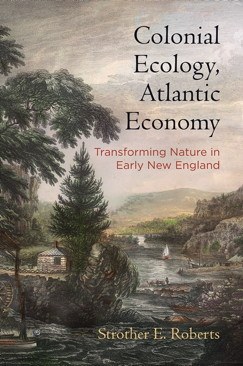
A Book Review of Colonial Ecology, Atlantic Economy: Transforming Nature in Early New England, by Strother E. Roberts. University of Pennsylvania Press. 2019.1 What do beavers in Connecticut have to do with sugar in Barbados? A lot, it seems. So much, actually, that, if I may push the argument that Strother Roberts makes in Colonial Ecology, Atlantic Economy, Caribbean sugar would not have been possible without New England beavers. And given that by the end of the 18th century, taxes on sugar were the highest source of revenue from imported commodities for the exchequer, beavers played a fundamental role in the British Empire. How so? Because, as Strother Roberts explains, of the interconnections of markets that the British Empire created. Sugar in the 17th and 18th century was too profitable not to use all the possible land in the Caribbean islands to produce it. Which meant that everything else that was needed to live and work there had to be produced elsewhere and imported, from flour and meat, to working animals and enslaved workers, even including the ships and the barrels that carried sugar to its consumers in the north and across the Atlantic. These imports for the West Indies came from the Connecticut Valley, home of the beavers. “Roberts tells an impressive story of economic incentives, which brought together the different parts of the British Empire on the Atlantic coast….” Roberts tells an impressive story of economic incentives, which brought together the different parts of the British Empire on the Atlantic coast. The interdependency of the North American colonies, the West Indies colonies, and the metropole, is a commercial interdependency that in its turn depends on the interdependency people have with nature and the local ecological environment. The imperialism that Roberts describes is thus an imperialism that extends to the environment. It did not help that, at the time, there was the belief of a causal relation between climate and civilization. “Civilized” societies and mild climates came together; “civilized” societies would emerge when “savage” climates and landscapes had been “civilized.” So by making the landscape of New England more like the landscape of England, the Puritans hoped that the harsh climate of New England, with its very hot summers and very cold winters, would become closer to the mild climate of England. The English wanted to reproduce England, with its cultivations, its animals, its luxuries, its fireplaces. They wanted to create, indeed, a “new” England. According to Roberts, they succeeded only in the 19th century: In a sense, the early nineteenth century saw New England truly become a “new” England. In the seventeenth and eighteenth centuries, England had commanded an empire of goods that ultimately saw raw materials from the colonies flow to the metropole and manufactured goods flow out […] In the nineteenth century, New England became the manufacturing center of a new American Empire” (207). Before that, New England had to feed its hunger for British-ness with trade. New England was peopled with English newcomers and with indigenous communities—all with a desire for English goods. The English wanted English luxuries, and the indigenous peoples wanted English weapons and metal objects. Here is where the beavers come into play. First, beaver fur was not only warm and soft, but it was very fashionable in Britain in the 17th century. The Connecticut Valley was an ideal home for beavers. For centuries, these little engineers built dams and ponds in the Connecticut River. Indigenous communities would hunt them and sell their fur to the British colonists, who in turn would sell them to the metropole to feed the local fashion. In return, indigenous nations got their English weapons and the Puritans their English luxuries. Within a century, the beavers were decimated, their dams collapsed, and their ponds drained. They left lush meadows, fertile land, and no habitat for mosquitoes carrying malaria. They also left a decreased biodiversity, increased flooding and terrain erosion, and indigenous communities with severe food scarcity problems. Indigenous lands were sold to the English to pay for indigenous debts. Indigenous men increasingly joined indigenous women as workers in English farms and households, vanishing from historical records. In possession of excellent land, the English wanted to replicate England. They thus disregarded the native features that contributed to that fertility. Indigenous peoples would use fire to regenerate land. The English were instead skeptical of fires, as not practiced in the old continent. Rather than corn, they wanted to grow wheat. But New England soil was not suitable for wheat. Rye would have worked better, but rye bread was darker than the white wheat bread typical of the old England, so rye was not a welcome substitute. Only the Connecticut Valley proved to be a good new home for the old grain. And so by the end of the 17th century, the Connecticut Valley fed not only New England but the West Indies too, as the West Indies fed sugar to England. The trade went through the ports of Massachusetts, where sugar and molasses were made into rum, then exported to Africa as part of the slave trade directed to the West Indies. “Without this intraempire trade, it would likely have been impossible for the settler economies of either the West Indies or New England to have grown at the rate which they did” (78-9). But Connecticut farmers could not rely on wheat alone. Indigenous peoples had a mixture of crops that did not deplete the nutrients of the soil; the English instead not only plowed their field, exposing nutrients to erosion, but grew only wheat, with decreasing yields. Diversification became necessary, and it came with flax, flaxseeds to be more precise. To produce linen, flax needs to be harvested before it matures to produce seeds. So some plants need to be spared for seeding. The Connecticut Valley soil would not yield a good quality harvest, but it could grow a lot of seeds. Ireland did have the soil to produce excellent fiber. And so Connecticut specialized in the production of flaxseed, exported the seeds to Ireland where high quality cloth would be produced and then exported back to New England. New England consumers thus completed a great circle of imperial commerce, sporting linens produced abroad with English or Irish labor, woven with Irish flax that was grown from Connecticut Valley seed. […] [When the clothes wore out, they would sell] the rags of Irish linen to be recycled by a regional paper mill. Finally the linen rag paper produced would provide the medium upon which local newspaper would print new advertisements by merchants seeking flaxseed for export (93). Ships returning from Ireland would carry back English manufactures and salt. Salt was needed to preserve meat sold to feed colonial cities and the enslaved sugar workers of the West Indies. By the 1670s Massachusetts alone had a fleet of over seven hundred merchant vessels going along and across the coasts of the Atlantic. Sailors in these ships needed to be fed, too. The English, in their quest to create a new England, imported English animals. To protect them, they exterminated the local predators. To feed them, they replace local grasses with English ones. The result was the destruction of the major sources of proteins for the indigenous peoples. Cattle affected water quality both when alive and when slaughtered. Grazing near water meant trampling on and destroying root systems that would hold soils together. Fat, bones, hair, and residues from the leather industry washed into waterways, deoxygenizing the waters, resulting in the decimation of certain fish. But by the late colonial period, the Connecticut River was the main trade avenue that made the ports of Connecticut become the most important centers for exporting live animals as well as pork and preserved meats. Live animals in the sugar plantations were used to power the sugar mills and to transport sugar for export and imports for consumption to and from the plantations and the ports. The harsh work and the heat caused early death for most animals. Acquired in the most productive time of their life, they were worked to death, and then replaced with new imported ones. The same logic was used also for human labor. The calculus of the market encouraged sugar planters and their agents to rely on importing draft animals, rather than breeding them locally. Successfully breeding livestock in the numbers required to keep the plantation system running would have meant shifting land and labor away from the production of staple crops. In many ways, the decision to import draft animals rather than breed them locally, paralleled the inhumane logic by which plantation managers approached the slave trade (179). The profitability of the market for animals, as well as the reliance on manure for agriculture, increased the incentives for deforestation. The lack of records of woodlots in early times testify to the abundance of wood. But within about fifty years the natural supply of wood was significantly decreased. It did not help that the cold of the harsh New England winters could not be mitigated by the English style fireplace, which consumed an immense amount of wood and produced poor results. So the new inhabitants chose to sacrifice their wooded land to produce more marketable products and relied on regional markets to get firewood. Valley timber made its profitable way to the West Indies, raising conflicts between the local settlers and the Empire. The British Navy engaged in conservation policy for naval timber, and with the 1691 White Pine Acts, reserved all white pines in New England with a diameter over twenty-four inches to the Crown and the Royal Navy, for ship-building purposes. “By 1760, one out of four merchant ships active within the British Empire had been constructed in New England” (137). Taxation on exported timber was also established under the pretense of conservation. For Roberts, it was more likely that exported timber was taxed as a good source of revenue instead. White pine was among the most desirable building materials both in the colonies and especially in the tropical climate of the Caribbean, and thus a quite profitable resource for the colonists. Colonists threatened surveyors, and violence increased with enforcement attempts. It may not come as a surprise to learn that many of the surviving buildings from the 18th century were built with boards twenty-two or twenty-three inches wide. Deforestation did bring changes to the climate, but not the ones hoped for. Deforestation caused both more droughts and more flooding when it did rain. And without the beavers’ dams, sediment would flush downriver causing severe impediments to oceangoing vessels at the mouth of the Connecticut River. By the early 19th century, deforestation in the Connecticut Valley was such that lumber production had moved to the forests of Maine. With railroads, west-ward expansion, and industrialization, woodland was no longer profitable in New England, and reforestation expanded so much that “by the end of the twentieth century, the landscape would support more trees than any time prior to European colonization” (161). The American Revolution disrupted a market that supported both New England and the sugar islands. With a smaller market, sugar profits declined and some land was converted to provisions. For more on these topics, see the EconTalk podcast episode Stanley Engerman on Slavery. See also “The Secret History of the Dismal Science. Part II. Brotherhood, Trade, and the Negro Question,” by David M. Levy and Sandra J. Peart, Library of Economics and Liberty, March 26, 2001; and “Slavery, Snakes, and Switching: The Role of Incentives in Creating Unintended Consequences,” by Glen Whitman, Library of Economics and Liberty, May 7, 2007. The focus of the story that Roberts tells us, may seem limited in focus to New England and the Connecticut Valley during colonial times, but it is a precise analysis of how economic incentives, opportunity costs, and comparative advantages (without ever naming them explicitly), shape the relationship between humans and the environment. It is an historical account of how the seemingly universal desire for luxuries, which motivated the Puritans, the English in the old continent, as well as the indigenous nations, connected faraway people through trade, improved their living standards, reshaped nature, and brought millions of individuals into slavery. This is a book worth reading. Footnotes [1] Colonial Ecology, Atlantic Economy: Transforming Nature in Early New England, by Strother E. Roberts. University of Pennsylvania Press. 2019. *Maria Pia Paganelli is a Professor of Economics at Trinity University. She works on Adam Smith, David Hume, 18th century theories of money, as well as the links between the Scottish Enlightenment and behavioral economics. For more articles by Maria Pia Paganelli, see the Archive. As an Amazon Associate, Econlib earns from qualifying purchases. (0 COMMENTS)

/ Learn More

How Economics Drives News Media

The membership payers do not pay to get news for themselves (they already know the news). … They require newsrooms to operate with values, not news. This slowly forces journalism to mutate into crowdfunded propaganda—postjournalism. … Classical journalism pretended to be objective; it strived to depict the world-as-it-is. Postjournalism is openly normative; it imposes the world-as-it-should-be. —Andrey Mir, Postjournalism1. P. 7 and p. 264. Andrey Mir’s Postjournalism offers a powerful, sweeping narrative of how news media have evolved over the centuries. Mir’s framework is that media technology determines how journalism is supported financially, and those who finance news media in turn shape its contents. In the 21st century, the newspaper industry has lost advertising revenue to Internet companies from Craigslist to Google. The pandemic cut newspaper advertising even further. A few newspapers have salvaged themselves by generating paid online subscriptions. Mir argues that this has changed how media portray our lives. “The media relying on ad revenue makes the world look pleasant. The media relying on reader revenue makes the world look grim.” (8) Advertisers want to reach an audience that is relatively at peace. Hence, the age of advertising-supported media was one which did not stoke controversy and anger. But relatively placid stories do not motivate people to pay subscription fees. Today, people can get news for free. They can get sports scores, financial information, and entertainment without going to newspapers. Mir argues that nowadays people pay newspapers to validate their worldviews. Newspapers do this most effectively by highlighting stories about the outrageous actions of their subscribers’ political adversaries. Mir sees the contemporary online subscription as in large part a donation. The subscriber is supporting a cause. Mir calls this “donscription,” short for donation/subscription. “Subscribing to a preferred media source is like supporting your favorite sports team or the college from which you graduated. Donscribers are not really interested in acquiring information….” Subscribing to a preferred media source is like supporting your favorite sports team or the college from which you graduated. Donscribers are not really interested in acquiring information. They want to raise the status of their preferred narrative. “Asking for subscription as donation causes the media to politicize, radicalize and polarize agendas, contributing to general discord in society.” (13) In fact, hardly any newspapers have been able to execute the donscription model successfully. Mir compares the print circulation of newspapers in 2002 with their digital subscriptions in 2019. By this measure, the Washington Post and the New York Times have more than doubled their readership. But others, such as the Los Angeles Times and the San Francisco Chronicle, saw their audience plummet by more than 80 percent. Mir sees Donald Trump’s presence on the political stage as a major factor accelerating the trend toward postjournalism. Before 2015, the mainstream media tried to maintain the practices of objective journalism that had been built up during the advertising-supported era. Over the subsequent five years, they migrated toward activism and exaggeration, fanning the allegations of Mr. Trump’s collusion with Russia for example. With Mr. Trump’s defeat, Mir predicts a significant decline in paid subscriptions. Mir argues that what we think of as “traditional” objective journalism is not the historical norm. Prior to the late 19th century, print media were very expensive. Newspapers were paid for by elites and catered to those elites. Over the course of the 1800’s, a number of inventions dramatically reduced the cost of printing. Along with rising literacy rates, this transformed the newspaper industry. Since then, their commercial and political impact has rested not on the access of the literates, but on their affordability to the masses. Different funding models became possible: political sponsorship, news retail, advertising sales and different combinations of them. (51) High fixed cost and low marginal cost made for mass media, with limited competition and relatively secure profits. Newspapers entertained the masses with comics and sports scores. Television entertained them with soap operas and sitcoms. Bundled in with this entertainment was objective news reporting, which served the interests of advertisers by not alienating any particular political viewpoint. Mir writes, News itself is a very paradoxical commodity. It always ‘needs’ to be read; it is always in some kind of demand from below. But there is always someone from above who wants to pay for certain news to be delivered to the public. And those from above—those in power or advertisers—want to pay to deliver the right news much more than those from below, who are willing and able to pay to receive the news. (55) In other words, “news content will always be paid… by those who want to deliver it and not by those who want to receive.” (137) In short, those who provide the financial backing for news media will shape what is presented to the public. As mass-market advertising falls away from newspapers, and they turn to online subscriptions, the relatively bland news preferred by advertisers gives way to the angry, partisan outlook preferred by donscribers. The availability of news on web sites and social media accentuates the trend away from objectivity in newspapers. Straight reporting by traditional news outlets adds relatively little to what people already know. “In the 2010s, with the widespread internet and social media, journalism tends to be opinion-leaning. Reporting has surrendered to commenting” (100). Mir makes the interesting argument that free speech is under fire because access to media has become democratized. Before the Internet, speech was effectively filtered by the cost of obtaining the ability to use mass media. But now Freedom of speech has become technically guaranteed to everyone and as a result has lost its universal paramount value; moreover, the overproduction of free speech resulted in the necessity for society to find other filtering mechanisms…. From being technically (power-) conditioned, free speech, because of overproduction, is becoming socially (morally) conditioned. (280) Start with the assumption that most are actually frightened by free speech. We have the luxury of championing free speech as long as those who offend us have little access to a wide audience. But once the megaphone becomes available to anyone, we realize that we want to restrict the content of what other people say. For more on these topics, see “Political Romance in the Internet Age,” by Arnold Kling, Library of Economics and Liberty, August 5, 2013. See also the EconTalk podcast episodes Martin Gurri on the Revolt of the Public and Megan McArdle on Internet Shaming and Online Mobs. Indeed, Mir argues that many of our liberal enlightenment values are products of a media era that began half a millennium ago and may now be ending. “The newspaper or journal article was the last text of modernity, the last text of the literate era, the last text of the Gutenberg Galaxy and, in fact, simply the last text.” (361) How can we defend liberalism against postjournalism in particular and the post-modern influence of contemporary media in general? The digital reality is becoming a natural environment for people resettling there. There is no need to teach anyone how to use social media or the internet, just as there is no need to teach people how to breathe. These skills come naturally. Media education must focus on withstanding the power of natural forces. Techniques for control of the digital body should teach users how not to breathe. (374) Given the importance of media education, I cannot recommend Postjournalism highly enough. Mir’s treatise is one that you should read and re-read. Footnotes [1] Andrey Mir, Postjournalism and the death of newspapers. The media after Trump: manufacturing anger and polarization. *Arnold Kling has a Ph.D. in economics from the Massachusetts Institute of Technology. He is the author of several books, including Crisis of Abundance: Rethinking How We Pay for Health Care; Invisible Wealth: The Hidden Story of How Markets Work; Unchecked and Unbalanced: How the Discrepancy Between Knowledge and Power Caused the Financial Crisis and Threatens Democracy; and Specialization and Trade: A Re-introduction to Economics. He contributed to EconLog from January 2003 through August 2012. Read more of what Arnold Kling’s been reading. For more book reviews and articles by Arnold Kling, see the Archive. As an Amazon Associate, Econlib earns from qualifying purchases. (0 COMMENTS)

/ Learn More

Claudia Hauer on War, Education, and Strategic Humanism

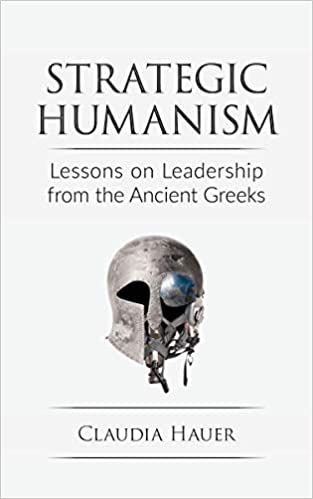
Claudia Hauer of St. John’s College and the Air Force Academy talks about her book Strategic Humanism with EconTalk host Russ Roberts. Topics discussed include war, rage, terrorism, and what a modern warrior might learn from Homer. The post Claudia Hauer on War, Education, and Strategic Humanism appeared first on Econlib.

/ Learn More