This is my archive

bar

Don’t Pickpocket Your Students

Imagine you’re a professor somewhere.  You here rumors of the creation of a new Office of Student Property Security.  “Whatever,” you think. Yet before long, you’re summoned to a brand-new mandatory training session run by certified officers of Student Property Security.  At this session (in-person back in the old days; now Zoom of course), they give you a tortoise-paced 90-minute Powerpoint presentation on the student property crisis and the appropriate faculty response.  And the whole spiel can be readily summarized in a single commandment: “Don’t pickpocket your students.” To me, such a training session would be insulting, pointless, and unhinged. Why insulting?  Because I would never consider pickpocketing my students in a million years.  I don’t need a self-styled anti-pickpocketing “expert” to remind me of this elementary obligation.  To quote Uncle Junior in The Sopranos, “Where does he get the effrontery?” Why pointless?  Because any professor who did pickpocket his students would probably not be dissuaded by a training seminar.  Wrong-doers already know the rules; they just don’t care. Why unhinged?  Because there is no ongoing pickpocketing “crisis.”  Sure, the media can pinpoint a few egregious scandals in a country with over 300 million inhabitants.  But no matter how much outrage such scandals spark, they show next to nothing about statistical reality.  And outrage directed at those who demand hard numbers – not horrifying anecdotes – shows less than nothing about real life. What would motivate an institution to impose this insulting, pointless, and unhinged training?  It could be an effort to diminish the school’s legal liability; if a pickpocketed student ever sues the school, the school can protest, “Don’t blame us, we run a first-rate anti-pickpocketing training program!”  But it’s hard to imagine that a jury would find such protests convincing.  The real motive, I suspect, is not that the administration is protecting their school from lawsuits, but that administrators are protecting themselves from hassling.  Once the student pickpocketing availability cascade gets off the ground, the administrator who refuses to “do something” to “address the crisis” troubleth his own house and inherits the wind. Now to be fair, no American university currently requires faculty to attend mandatory anti-pickpocketing training. As far as I know. And that’s great, because it would be truly Kafkaesque if any university did. (0 COMMENTS)

/ Learn More

Are rational people weird?

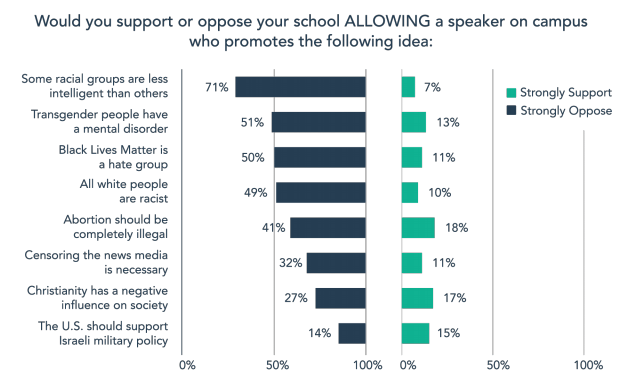
This poll of college students caught my eye: Let’s take the abortion question first.  I strongly support my campus allowing speakers to advocate banning abortion.  Does that mean my views coincide with 18% of college students?  I doubt that.  I suspect that either far more than 18% of students agree with me, or far fewer.  Let’s start with the “far fewer” hypothesis. One thing I notice is that very few people say they strongly support allowing controversial speakers of any sort, whether advocating right wing racial theories of intelligence or left wing claims that all whites are racist.  College students just don’t seem to like controversial speakers.  Now let’s think about those 18% that are completely OK with pro-life speakers.  I suspect that this group is heavily skewed toward people with pro-life views.  I can’t prove that, but I’m pretty confident that this is the case. I happen to be pro-choice.  I suspect that only a tiny number of students say they are pro-choice and also supportive of allowing pro-life speakers.  And I suspect that most of the pro-lifers within that 18% would turn on a dime if the speaker advocated no restrictions on abortion. In other words, perhaps only around 1% or 2% of college students believe in free speech even for views they disagree with, at least if one believes this interpretation of the poll.  That means that rational people like you and I are really weird. Now let’s consider an alternative (more optimistic) view.  Maybe the students aren’t actually expressing their views carefully.  College students are busy and when someone stops them on the quad with a poll question about this or that, they quickly answer based on their general view on the topic.  They think, “racial supremacy is bad”, or “a law banning all abortions is bad”, or “censorship is bad.”  Then the opinion they offer isn’t really a considered opinion on censorship, it’s more like a gut reaction to the general subject being considered. Do I have any evidence for this?  Yes, in 11 years of blogging I find that people often confuse one issue with another.  Thus if I say that Roe v. Wade was decided on highly questionable grounds, people immediately assume that my comments pertain to the wisdom of banning abortion, not the legal justification for the ruling.  They confuse procedural issues with policy issues.  Not just once and a while, but all the time.  And keep in mind that blog commenters tend to be much smarter than the average college student. Here’s another piece of evidence for my claim.  Students say that they want to censor speakers who advocate censorship.  But how likely is it that this is their actual belief?  If The Onion did a satirical story mocking that poll result, many college students would probably find the story amusing.  They might say, “Yes, OK, I don’t actually want to censor someone advocating censorship; I just don’t like the idea of censorship.”  They didn’t consider the term ‘allowing’ from the perspective of a professor of logic, rather they expressed their view as to whether it was a good idea to invite such a speaker. To conclude, I don’t believe that 18% of students strongly favor free speech when discussing abortion.  I suspect the actual figure is closer to 2% or 50%.  I just don’t know which.  Or maybe there is no truth of the matter; it entirely depends on how you word the question.  I believe I could word poll questions in such a way as to get almost any desired result. What do you think? BTW, even my 50% estimate allows for plenty of “cancel culture” on campuses.  I suspect that phenomenon is very real. PS.  This is part of a long series of posts I’ve done questioning “public opinion”, which I regard as a very elusive concept.  Sort of like electrons. PPS.  If I’m right, then the following poll questions would yield even more interesting results: Would you favor allowing a speaker who spoke out against banning speakers who advocated censorship?  What about speakers who had no opinion on banning speakers who actually favored censorship, but argued that speakers should be allowed to discuss in general terms the pros and cons of banning pro-censorship speakers?  Etc., etc.  Keep asking until you find enough degrees of separation from the actual issue that people feel comfortable discussing it.  Ban person A?  Ban B for talking about A?  Ban C for talking about B?  Ban D for talking about C? Or how about this question: Would you favor banning a speaker who had very strong views on the issue of abortion, if you didn’t know what those views were? Now that would be interesting.  But then pollsters almost never ask the truly interesting questions. (0 COMMENTS)

/ Learn More

Hirshleifer on Regression to Savagery

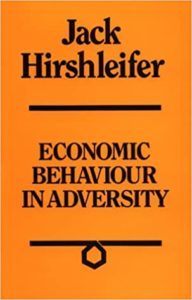
In researching my latest Defining Ideas article due tomorrow, I came across this paragraph from UCLA economics professor Jack Hirshleifer. One thing to know about Jack was how incredibly careful a scholar he was. Substantively, the historical review here suggests an extraordinary resiliency of human populations and social structures. It is of course impossible to prove that social breakdown will never occur in the aftermath of disaster, especially when we contemplate the unprecedented catastrophe of nuclear war. But the lurid picture of post-disaster regression to savagery, that staple of fiction and of popular thought, can draw no support from the historical record. This is from Jack Hirshleifer, Economic Behavior in Adversity, University of Chicago Press, 1987, p. 6. Notice the word “no.” That’s why I emphasized how careful a scholar he was. He did not use the word “no” lightly. I had Jack cover the highlights of his book for The Concise Encyclopedia of Economics. His article is titled “Disaster and Recovery.” My one quibble is his use of the word “extraordinary.” If it happens virtually every time there’s a disaster, it, fortunately, is not extraordinary.   (1 COMMENTS)

/ Learn More

The Wrong Pieces on the Chessboard

Inspired by a few recent posts, several friends have asked me if I’ve finally “woken up” to the great political threat of wokism.  In particular, they’re hoping that I’m ready to at least back the American right as the clear lesser of two evils. I fear my response is: It’s complicated. From a global point of view, I continue to see the American left and right as moral approximates.  No doubt one is even worse than the other, but they’re both so vicious that I see little reason to precisely weigh their sins.  While I disagree with the left on a larger number of issues, the American right is not merely wrong but sadistic on the single most important policy issue on Earth: immigration.  If your idea of freedom is gleefully denying the vast majority of humanity the rights to live and work where they please, I am not on your side.  No way, no how, nothing doing. From a personal point of view, however, the American left has become quite bad for me.   Why?  Because as a university professor, the left surrounds me.  As my colleague Dan Klein has conclusively documented, academia isn’t merely overwhelmingly leftist; outposts of dissent from left-wing orthodoxy are rapidly vanishing.  (And don’t believe the nonsense that the median academic is “moderate.”  A Bernie Sanders supported could easily fancy himself a “moderate” when a quarter of his colleagues are self-identified “Marxists.”) Even tenure at a public university no longer fully insulates me and my friends from thinly-veiled indoctrination and censorship.  I worry that in a decade or two there will be virtually no new positions left in academia for my students, friends, and family. Would the Right do the same if they had the chance?  Plausibly, though the Right has done precious little to defund higher education to cut their foes in academia down to size.  The key left-right difference, though, is this: Unlike the left, the right doesn’t have the right pieces on the chessboard to harm me personally.  I could go out of my way to antagonize and insult the right, free of fear, because with few exceptions they’re not my administrators, not my colleagues, not my students, and not my customers.  In contrast, when I write about the Orwellian left, friends privately warn me to shut up.  And these friends have a point: Tenure doesn’t enforce itself. How worried am I that my tenure will be revoked for political reasons – or any reasons?  I’d still assign it no more than 2% for my career.  Yet I’d assign a 40% chance that GMU will severely mistreat me for dissent before I die. I say “die,” not “retire,” because thanks to tenure, I’m on the academic chessboard for life. (1 COMMENTS)

/ Learn More

Dwayne Betts on Reading, Prison, and the Million Book Project

Author, lawyer, and poet Dwayne Betts talks about his time in prison and the power of reading with EconTalk host Russ Roberts. Betts is the founder of the Million Book Project, which aims to put a small library of great books in 1,000 U.S. prisons. Betts discusses his plans for the project and how reading […] The post Dwayne Betts on Reading, Prison, and the Million Book Project appeared first on Econlib.

/ Learn More

All ideologies eventually (seem to) fail

All ideologies reach a point where they are perceived to have failed. What can we learn from that fact? I’d argue that there are almost no lessons to be learned. Capitalism was widely seen to have failed in the early 1930s. Authoritarian nationalism was widely seen to have failed in 1945. Liberalism was widely seen to have failed in the 1970s. Communism was widely seen to have failed in 1989. Neoliberalism was seen to have failed in the 2010s. Prediction: Islamic fundamentalism will be seen to have failed in the 2020s. Just to be clear, I’m a neoliberal.  So I don’t believe either capitalism or neoliberalism actually failed, while I do believe that authoritarian nationalism, (1960s) liberalism, communism and Islamic fundamentalism actually did fail. But that’s not the point of this blog post. What I think doesn’t matter. So what does it actually mean when a modern intellectual says something like, “neoliberalism has failed”. What exactly does that mean? When people say an ideology like neoliberalism has failed, their thought process is as follows: 1. We have been in the neoliberalism era for a few decades. 2. Problems have cropped up. 3. Ergo, neoliberalism has failed. That’s it? Surely there must be more to it than that? After all, problems always crop up over time. That’s inevitable. If that were the criterion for failure then every single ideology would eventually fail, except those that have never been tried. It must be more complicated than that! Nope, it’s that simple. Every single ideology will be seen to have failed after some period of time. There are no exceptions. One can imagine alternative universes where not all ideologies fail. Thus you could imagine a world where ideologies are judged on a cross sectional basis, not a time series basis. People might compare highly neoliberal places like Switzerland, Denmark and Singapore to less neoliberal places like Greece, Italy and the Philippines, and then those countries could be compared to highly illiberal places like North Korea, Venezuela and Cuba. In that universe, not all ideologies would seem to fail over time. But that’s not the universe we live in. In our universe, intellectuals use time series evidence to judge ideologies. In this universe, all ideologies are eventually perceived to have failed, because it’s inevitable that problems will eventually crop up. So if you are young then don’t get too attached to your pet ideology. If it’s ever enacted, you will eventually see it get discredited. (3 COMMENTS)

/ Learn More

Is Cowen Right about the Great Barrington Declaration? Part 2

  Yesterday, I reviewed the first half of Tyler Cowen’s critique of the Great Barrington Declaration. This is the last half. As before, quotes from him are highlighted and my responses are not. Here are the key words of the Great Barrington Declaration on herd immunity: The most compassionate approach that balances the risks and benefits of reaching herd immunity, is to allow those who are at minimal risk of death to live their lives normally to build up immunity to the virus through natural infection, while better protecting those who are at highest risk. We call this Focused Protection. And then: What exactly does the word “allow” mean in this context? Again the passivity is evident, as if humans should just line up in the proper order of virus exposure and submit to nature’s will. How about instead we channel our inner Ayn Rand and stress the role of human agency? Something like: “Herd immunity will come from a combination of exposure to the virus through natural infection and the widespread use of vaccines. Here are some ways to maximize the role of vaccines in that process.” It means, as the document says, “allow those who are at minimal risk of death to live their lives normally.” I’m not sure why Cowen has trouble understanding. Allowing people to live their lives has nothing to do with passivity. It certainly is consistent with the idea of human agency, even if you don’t go all Ayn Rand on it. When people are allowed to do something, that doesn’t mean they have to do it. There’s necessarily human agency. He’s right about how herd immunity will come about. But then he says, “Here are some ways to maximize the role of vaccines in that process.” The problem here is, as former Obama economist Austan Goolsbee pointed out in a related context, that this is like the old economics joke where the punch line is “assume a can opener.” We don’t yet have a vaccine, so right now maximizing the role of vaccines gets you to a maximum of zero. In practical terms, the most problematic paragraph in the declaration is this one: Those who are not vulnerable should immediately be allowed to resume life as normal. Simple hygiene measures, such as hand washing and staying home when sick should be practiced by everyone to reduce the herd immunity threshold. Schools and universities should be open for in-person teaching. Extracurricular activities, such as sports, should be resumed. Young low-risk adults should work normally, rather than from home. Restaurants and other businesses should open. Arts, music, sport and other cultural activities should resume. People who are more at risk may participate if they wish, while society as a whole enjoys the protection conferred upon the vulnerable by those who have built up herd immunity. In most parts of the Western world, normal openings for restaurants, sporting events and workplaces are likely to lead to spiraling caseloads and overloaded hospitals, as is already a risk in some of the harder-hit parts of Europe. Reopenings, to the extent they work, rely on a government that so scares people that attendance remains low even with reopening. The middle paragraph is from the Great Barrington Declaration. The paragraphs that bookend it are from Cowen. I’m not familiar with Europe but Georgia (in the United States) opened without overloaded hospitals. As for spiraling caseloads, that’s part of how you reach herd immunity. And if you follow his link to a Bloomberg article, you’ll see that it says not a word about overloaded hospitals. Cowen is right that governments have reacted by scaring people. That’s one reason the Great Barrington Declaration is important. It seeks to tell people not to be so afraid unless they’re particularly vulnerable. Notice the statement in the Declaration that “Young low-risk adults should work normally, rather than from home.” The authors are not saying that they should be forced to; they’re saying they should. As I understand the Declaration, they’re trying to talk to young people as well as others and say, in effect, “Come in, the water’s fine.” Does Cowen object? If so, he doesn’t make clear and he doesn’t say why. Don’t get me wrong: The Great Barrington strategy is a tempting one. Coming out of a libertarian think tank, it tries to procure maximum liberty for commerce and daily life. It is a seductive idea. Yet consistency of message is not an unalloyed good, even when the subject is liberty. And when there is a pandemic, one of the government’s most vital roles is to secure public goods, such as vaccines. Notice how he jumps from the idea that the message is tempting and seductive (I agree) to government’s role in vaccines. Little problem: WE DON’T HAVE A VACCINE. The Great Barrington Declaration makes clear that it’s addressed to what to do while we’re waiting for a vaccine. Insert can opener joke. The declaration is disappointing because it is looking for an easy way out — first by taking the best alternatives for fighting Covid off the table, then by pretending a normal state of affairs is also an optimum state of affairs. Does he care to tell us what “the best alternatives for fighting Covid” are? It strikes me that he has two in mind: (1) vaccines, which haven’t yet been approved, in part thanks to the FDA, which Cowen has earlier said should not approve one from Russia, and (2) lockdowns, which Cowen says aren’t that important and, by the way, we should tighten them. My worldview is both more hopeful and more tragic. There is no normal here, but we can do better — with vigorous actions to combat Covid-19, including government actions. The conception of human nature evident in the Great Barrington Declaration is so passive, it raises the question of whether it even qualifies as a defense of natural liberty. I missed the hopeful part. OK, so what are the vigorous actions that include government actions? Blank out, as the aforementioned Ayn Rand loved to say. And how does he know that the authors of the Great Barrington Declaration would not favor those actions? Cowen is fixated on the idea that three non-libertarians produced a libertarian statement. As I mentioned in Part 1, that sends him down a rabbit hole from which he doesn’t emerge.         (3 COMMENTS)

/ Learn More

Vermont is a safe space

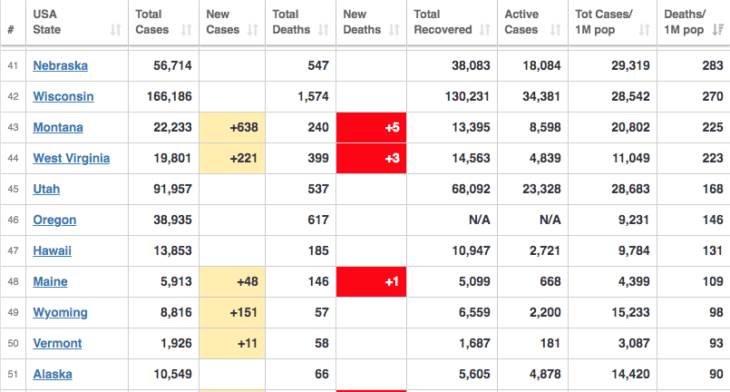
When the pandemic first hit America, the states hardest hit were mostly “blue states” such as Washington, New York, New Jersey and Massachusetts. With the notable exception of Washington, they remain the hardest hit states in terms of cumulative deaths per capita. A Yahoo article points out that in recent months the “red states” have been getting hit harder than the blue states. But that could reflect many factors such as behavior, weather, or a lack of previous herd immunity. I also notice that both within the US and around the world it’s often the case that more densely populated areas have a higher rate of fatalities. This isn’t universally true (Germany has a low fatality rate) but it seems to be a strong tendency. Look at the states with the lowest rates of death per capita—most have relatively low populations: I’d like to throw out a hypothesis.  Perhaps both politics and density matter.  Perhaps the safest places are low-density states full of earnest do-gooders who follow public health rules.  So I’m going to look at recent Covid deaths in states with fewer than 1.1 million people.  Because I’m lazy I’ll take a few shortcuts, such as looking at total deaths, not per capita deaths, but that won’t affect my principle finding to any significant degree.  The differences in fatalities are vast, and all these states have between a 550,000 and 1.1 million people. I’ll first list Covid deaths since the beginning of June, and then deaths over the past two months.  States will be listed from most populous to least populous: Montana:  213/153 Delaware:  153/69 South Dakota:  245/154 North Dakota:   327/263 Alaska:  56/38 Vermont  3/0 Wyoming:  41/27 I use recent data because the initial outbreak caught many places unaware, so cultural/policy differences would have had less impact in March and April. Vermont really jumps out, and even in per capita terms it would be an extreme outlier.  This may be random, but it also might reflect the combination of really low density and “liberal” attitudes.  Most low-density areas in America are red states, and Vermont might be the only strongly blue state that’s mostly rural.  (Even Delaware is pretty urban by comparison.) If you want to be safe, rent a cabin in Vermont. This is not necessarily about politics in the normal American sense of the term.  New York is left wing, but isn’t full of earnest people who always follow rules.  Utah is right wing, but has a high level of civic cooperation.  Utah also has a lower than average fatality rate, even relative to states with similar populations. Germans and East Asians are known for following rules.  Latin Americans are not.  Notice a pattern? PS.  Let me apologize in advance for the Sumner curse, the tendency for patterns I notice to break down immediately after I post on them.  Sorry Vermonters. PPS.  I was originally going to draw the line at 1 million, but Montana seems like a low-density state, despite just over a million people.  On the other hand, while places like Nevada have large low-density areas, they also have major cities.   (6 COMMENTS)

/ Learn More

Finding the Third Thing

What does “learning” mean to you? Where and when does it occur? What are its outcomes? How does it affect your status in the world, and do we accord status in the right way? These questions and more are at the heart of this provocative conversation. EconTalk host Russ Roberts welcomes Zena Hitz of St. John’s College to discuss her new book, Lost in Thought. Hitz is engaged in what Roberts calls a “quixotic quest” to restore a love of great books and contemplative and communal learning. A tutror- not a professor- at St John’s, Hitz is well-suited to make such an argument. But if the sort of learning Hitz recommends is indeed “hidden,” how can we power ourselves past the distractions of the modern world well enough to achieve it? We hope you’ll find the prompts below thought-provoking, and that you’ll let us know your response to them. We’d also love to know how you approach this sort of learning. What books do you love that you return to time and again. What books would you like to explore, but for whatever reason have yet to do so? As always, we love to hear from you.     1- What does Hitz mean by learning? What’s the point in teaching young people how to think about big ideas and read old books, as Roberts asks her? How does she expect her students to cultivate the resources for reflection, retreat, and contemplation? How might you cultivate the same sort of resources in your life?   2- Rather than turn to political activism in an effort to repair the brokenness of our world today, Hitz suggests a more inward approach. What would this like, and to what extent do you believe this approach to be effective?   3- How does your work/occupation identify you? What role has the sort of learning Hitz describes played in your work? Are you guilty of judging others on the basis of their occupation? As Roberts asks, “How we might humanize ourselves through learning to be more appreciative of people who are not like us, educationally?”   4- Hitz asserts, “…if you want to connect with someone from a different social class, you need a third topic to unite you. This is how human bonding, how human community works is: you unite around some third thing.” What sort of community organizations do you think might serve both to democratize learning and unite people of different social classes?   5- What’s the difference between spectacle and distraction, according to Hitz? Conversation and debate? How might a due consideration of these differences affect learning, both formally and informally?   (0 COMMENTS)

/ Learn More

Is Cowen Right about the Great Barrington Declaration? Part 1

  In an article yesterday, “A Dangerous Libertarian Strategy for Herd Immunity,” Bloomberg, October 15, George Mason University economist Tyler Cowen criticizes the now-famous Great Barrington Declaration. This response is in two parts. Part 2 will follow tomorrow. I’ll consider Cowen’s arguments one by one. The highlighted sections are his and the non-highlighted sections are mine. But first I’ll point out two things. First, Cowen starts with a category error. He seems to think that when three non-libertarian medical professionals write a statement at a facility staff largely by libertarians, the result must be libertarian. It isn’t. Many libertarians will like it; some will not. But it’s not libertarian. In our book, Making Great Decisions in Business and Life, Charley Hooper and I point that in any project, the biggest mistakes are made the first day. That’s because everything follows from decisions made that day. Similarly, by misidentifying the strategy as libertarian, he goes down a rabbit hole from which he doesn’t emerge. (Note: I know that editors often assign titles and Cowen might not have chosen this one. If he disagrees with the title, then ignore this criticism.) Second, Cowen’s big-picture criticism of freedom is less like Strauss (one of his favorite words) and more like Schrodinger’s Cat. He claims, in the last few paragraphs of his article, that the declaration “tries to procure maximum liberty for commerce and daily life” and that its conception of human nature “raises the question of whether it even qualifies as a defense of natural liberty.” Which is it? Is it trying to procure maximum liberty, which, in this context, certainly seems like defending it, or is not a defense? I’m not asking whether it’s a good defense. I’m simply pointing out that Cowen seems to want to have it both ways. Now to the other specifics. Debate over the declaration has centered on the concept of “herd immunity,” but that discussion has become so emotional that it is better to focus first on the concrete. The declaration stresses the notion of protecting the vulnerable, such as the elderly, and giving everyone else maximum possible freedom. That sounds good, but the declaration fails to deliver on the details. True. It doesn’t deliver on details. I don’t think that was the intent. It’s 514 words long, only slightly longer than those short USA Today op/eds. Cowen’s piece, by contrast, is 1,399 words long, almost 3 times as long. And yet in some places, the Great Barrington Declaration gives more details than his. First and foremost, the declaration does not present the most important point right now, which is to say October 2020: By the middle of next year, and quite possibly sooner, the world will be in a much better position to combat Covid-19. Probably right, but it’s a guess. Moreover the middle of next year is 8 to 9 months from now. The arrival of some mix of vaccines and therapeutics will improve the situation, so it makes sense to shift cases and infection risks into the future while being somewhat protective now. The first clause is probably right, but the conclusion doesn’t follow. What is the cost of shifting cases into the future? Cowen doesn’t say. To allow large numbers of people today to die of Covid, in wealthy countries, is akin to charging the hill and taking casualties two days before the end of World War I. What does he mean by “allow?” Is he saying that people shouldn’t be allowed to take those risks? I don’t know. Notice also how he biases the discussion with “two days.” I would bet that the authors wouldn’t have bothered with the statement if they thought we would have a vaccine in 2 days, 4 days, or even 14 days. Not only does the declaration fail to make that point, but if anything the rhetoric conveys a sense of “letting things take their course” — after the most vulnerable are segregated from society, of course. It strikes exactly the wrong tone and stresses exactly the wrong points. Either he thinks this is self-evident or this is a lead-in to the next few paragraphs. If the former, he’s wrong; if the latter, let’s look at the next few paragraphs. The declaration also sets up a false dichotomy by comparing its policy proposals to lockdowns. The claim is this: “Current lockdown policies are producing devastating effects on short and long-term public health.” The health problems are very real, but in most of the U.S., the lockdowns are not severe. In my home state of Virginia, there are relatively few commercial activities I cannot partake in, were I so inclined. I even can go see a live bluegrass concert in a nightclub (I won’t, not yet). It’s not a false dichotomy. There are real lockdowns in place. And notice that he uses the word “commercial.” K-12 schools, even ones that charge tuition, are typically not lumped under “commercial.” This doesn’t affect Cowen. It does affect a number of my neighbors’ and friends’ kids, devastatingly so. And while Cowen can go to a bluegrass concert, I bet he can’t go to a gym. In most of California, we can’t yet go to gyms. My wife’s and my Pilates instructor is facing economic devastation. The problem is that most people don’t want to go out to such concerts, and indeed probably should not. It is this self-enforced isolation, not a government order, which screws us up, sometimes creating mental and other health problems. Why is it a problem if people don’t want to go out to such events? And if that’s the main reason they don’t, why are governments around the country, certainly in large states like California, New York, and Illinois, banning such events? He does get it right, though, about mental and other health problems. But some of these are due to lockdowns. Whatever you think of the stricter policies of last spring, they are now behind us, and the emphasis on “lockdowns” is not helpful. The more useful question is whether the list of prohibited activities should be expanded or contracted. In some cases, surely, it should be expanded. Indoor restaurant dining and drinking, for example, is probably not a good idea in most parts of the U.S. right now. Yes, many of the Covid cases spread by such activity would be among the lower-risk young, rather than the higher-risk elderly. Still, practically speaking, given America’s current response capabilities, those cases will further paralyze schools and workplaces and entertainment venues. It just doesn’t seem worth it. The first sentence of the second paragraph is key. Finally, he’s getting to details. He doesn’t make a case, though, that those cases will further paralyze schools and workplaces. What’s his evidence? Emily Oster at Brown University differs with Cowen on this. And unlike Cowen, she actually has evidence. Moreover, to whom does it not seem worth it? Not to the people who want to do it. Cowen seems to be substituting his own values for those of others. Even if you disagree with that judgment, the critics who emphasize lockdowns are setting up a straw man. What they’re trying to do is talk us into something more dangerous than what we ought to accept. The truth is that lockdowns are extremely unpopular, and while they may have to be reimposed in extreme circumstances, they are not the main alternative on the table in the U.S. right now. Wait a minute. We have lockdowns. Some of them are severe. Cowen has just told us that he wants to make them more severe. But arguing against lockdowns is arguing against a straw man? Huh? The declaration also notes the value of reopening schools. It is an inarguable point, and Sweden seems to have made it work. But schools cannot and should not be reopened unconditionally. Amid high levels of Covid-19, a successful reopening very often will require social distancing, masks and a good system for testing and tracing. It would be better to focus on what needs to be done to make school reopenings work. Reopened schools in Israel, for instance, seem to have contributed to a significant second wave of Covid-19. Actually, I think every point is arguable. What he really means is that he comes down on the side of reopening schools. Good. On that we agree. But for someone who thinks we should look at data, Cowen really should look at Oster’s data. And notice how close Cowen comes to the Great Barrington view on this. I don’t know what the three authors would say about what needs to be done to make school reopenings work. Neither does Cowen. A broader worry about the declaration is that, for all the talk of science, it fails to emphasize data. The declaration is a series of static recommendations, yet the situation on the ground is evolving all the time. The best policies today are not the same as the best policies two months ago, and won’t necessarily be the best policies two months from now. This reader is also struck by the document’s frequent use of the passive voice — as if there is no choice but to let a series of inevitable events slowly unfold, albeit in a minimally painless way, and to allow the pandemic to finish its work. Cowen accuses the authors of failing to emphasize data? That’s rich. He has hardly any data. Here’s a statement from the Declaration: We know that vulnerability to death from COVID-19 is more than a thousand-fold higher in the old and infirm than the young. That’s data, and pretty relevant data. Cowen points out correctly that the best policies of today are [probably] not the best policies two months from now. But the big advantage of the focus the Declaration proposes is that it allows for that. What about the passive voice? I think Cowen needs to consult a grammar textbook. There’s not a whole lot of passive voice in the Declaration. It’s mainly active. And letting people do things has nothing to do with the passive voice. Part 2 will be tomorrow. Stay tuned.     (2 COMMENTS)

/ Learn More