This is my archive

bar

Is Amazon a Corporate Mother Teresa?

Amazon is in many ways a fascinating company and deserves to be defended against most of its mainstream critics. However, it would be simplistic to explain its campaign for a $15 federally-imposed minimum wage by identifying it with a corporate Mother Teresa. Its more obvious reasons to preach for minimum wages are not defendable. I will not repeat all the arguments against the minimum wage, summarized in a good article by Cato Institute’s Ryan Bourne (“The Case Against a $15 Federal Minimum Wage: Q&A”). My co-blogger David Henderson has also defended many of the standard economic arguments. There exist some disagreements among economists about the employment effect of minimum wages, but they mainly relate to the size and victims of the negative effect (see Bourne’s overview). One thing is sure: Amazon would benefit from forcing higher costs on its small competitors, including mom-and-pop businesses. A higher minimum wage would have exactly this effect while it would have zero effect on Amazon’s costs. As the company already pays a starting wage equal to the proposed $15 minimum, the latter would be non-binding and irrelevant for the retail behemoth. One reason why Amazon was able to bid up the wage of its entry-level workforce is that its technology and other capital embedded in its warehouses and distribution network increase the productivity of its employees, which justifies the bidding up from a pure profit-maximizing viewpoint. There is nothing wrong with profits, but there is something wrong wtith using state power to bankrupt one’s competitors. This is what is happening. Jonathan Meer, an economist at A&M University observes: It’s a lot harder for Joe’s Hardware. We should take note that Amazon—the place with no cashiers—is the one calling for a higher minimum wage. Other large companies—such as Walmart—have come out in favor of an increase in the federal minimum but not up to $15. In their case, indeed, $15 would be binding for some employees. (Cf. Eric Morath and Heather Haddon, “Many Businesses Support a Minimum-Wage Increase—Just Not Biden’s $15-an-Hour Plan,” Wall Street Journal, March 1, 2021) Amazon has another reason to be politically correct, that is, to signal its virtue under current faddish and unrealistic ideas. The company can hope to cajole DC’s powerful men to spare it from some regulation that would bite. The systemic effects of such behavior point to crony capitalism and groveling toward the state, which are not good for free enterprise and future prosperity. It is not clear, to say the least, what kind of acceptable ethics could justify Amazon’s current behavior. (0 COMMENTS)

/ Learn More

Keyhole Solutions: The Song

When you do a Jack Stafford podcast, he writes and records an original song inspired by the interview. Are you ready for “Keyhole Solutions: The Song”? No joke! P.S. The actual podcast is here. (0 COMMENTS)

/ Learn More

I Hereby Resign as an Expert on Systemic Racism

  Many of the comments on my post yesterday, “Bernie Sanders, Minimum Wage, and Systemic Racism,” March 1, were particularly good. They have convinced me that I need to walk back some of the things I said. Like most people, I hate to admit that I’m wrong. Unlike most people, I’m typically quite quick to admit that I’m wrong. Back in the 1970s or 1980s, my friend Michael Walker, who founded Canada’s Fraser Institute, asked Friedrich Hayek why people don’t seem to be convinced by evidence or logic. Hayek replied (I can just picture him doing this with his characteristic half wince/half grin) that people’s ideas are one of their most treasured forms of private property and when you convince them that they’re wrong, they suffer a capital loss. That fit my experience. But my next thought on hearing it was that you already had the capital loss; you just, to use tax lingo, realized it. And to push the metaphor maybe too far, you get a tax break on the loss. Translation: you’re better off admitting you’re wrong because then you won’t make that mistake again and you’ll get clarity for the future. Now to the issue at hand. I’ll focus on 8 comments. BC writes: Then, is “systemic racism” used synonymously with “unequal outcomes”?  If not, then what would be an example of unequal outcomes that are unfavorable for African Americans that does not reflect systemic racism? Good question, BC, to which I don’t have a good answer. It’s the first comment that got me wondering whether there is such a thing as systematic racism, at least as defined by the NAACP’s President Derrick Johnson. John Hall, after raising the issue of SAT scores, writes: I think David needs to think on this issue a little harder to distinguish between this case and the minimum wage case. I think John is right. Vivian Darkbloom, as is Vivian’s wont, has one of the best comments, writing: I’m opposed to a minimum wage increase to $15 for all the reasons likely discussed here previously. Nevertheless, I’m wondering how someone in favor of such a hike would respond to this definition (and the conclusion therefrom that the hike constitutes “systemic racism”): “[NAACP President Derrick] Johnson defined systemic racism, also called structural racism or institutional racism, as ““systems and structures that have procedures or processes that disadvantages [sic] African Americans.”” It’s highly likely that a disproportionate number of African Americans would either lose their jobs or fail to get one (or work fewer hours) as a result of such a minimum wage hike.  However, is it possible that a disproportionate number of African Americans (those that keep their jobs or manage to get one) would benefit from a wage raise and enjoy a slightly higher standard of living? What I’m getting at here is whether, per the proposed definition, one should look  solely at those disadvantaged, or  should one weigh the *net* effect on those all those affected by the change?  Could Bernie Sanders reply “I acknowledge that there will be some loss of employment and some reduced employment as a result of this hike.  But, those negative effects are exceeded by the benefits of those who will get a pay raise”. The same thought goes for those “disproportionately arrested” for whatever reason.  Is it possible that African Americans “disproportionately benefit” from more policing in those communities? I don’t have a ready answer, but on the side of those opposed, one tends to refer only to those who tend to lose, and those in favor only to those who tend to gain, with neither side seriously attempting a net benefit analysis.  I think it is rare with respect to policy changes that there are only winners *or* losers rather than winners *and* losers. I agree with Vivian that one should look at all the effects and that, in doing so, one might find that the gains to the black gainers outweigh the losses to the black teenage losers. I doubt it, because a high percent of low-wage people are employed in industries that produce goods that are sold to other low-wage people. Think of McDonald’s in Alabama, for example. But Vivian’s point remains. Also, Vivian’s point about the disproportionately arrested black people is also relevant. Heather Mac Donald often makes the point that cops in low-income neighborhoods are valued highly by residents, including black residents, because they protect them from crime by other people and that the criminals are disproportionately black. So one would want to look at the total effect. That last point is interesting because it was precisely the “disproportionately arrested” point that my friend made who convinced me that there is systemic racism. I called my friend to talk it out and actually got him to doubt his own claim, based on Vivian’s reasoning. zeke5123 writes: I think this definition [of systemic racism] is dangerous. I am reminded of an example by Kendi that lowering capital gains tax is racist, because it disproportionately favors non-blacks since blacks are less likely to have wealth. The counter to this is if lower capital gains rates lead to net efficiency, it is a sound policy regardless of the impact on certain cross sections of the populace. Indeed, if you implement enough net efficiency policies, it is very likely that you end up lifting up all cross sections. But this is basically just saying: implement policies that are Kaldor-Hicks improvements. Once when, with a single policy, you bring into the discussion how it impacts certain cross-sections of the populace (i.e., in this case race), you are more likely not to implement Kaldor-Hicks efficiency polices because racism is bad. No — that way lies madness. Focus on Kaldor-Hicks efficiency generally* and the rest will follow. I think in your examples you believe changing those policies is Kaldor-Hicks efficient — that is, you think on net minimum wage is bad. But if you argue we should eliminate minimum wage (or not raise it) to reduce structural racism, then why can’t Kendi argue we should raise capital gains to reduce structural racism? I get that people can walk and chew bubblegum at the same time, but ultimately I think your case against the minimum wage is that it is bad economics; not that it harms black people because that would be your argument against raising capital gains tax rate (assuming you agree doing so would be bad). *I would worry about situations where a policy causes massive losses to Group A to benefit Group B by the losses plus epsilon. There are mismeasurement errors, political risks, etc. So, I would limit Kaldor-Hicks efficiency where there is not (i) massive losses to a particular group and (ii) the gains clearly outweigh the losses. For me, a good rule of thumb is a strong presumption of liberty. I pretty much agree with what zeke said, including that it’s a dangerous definition and that there’s a strong presumption of liberty. My guess is that my presumption of liberty is even stronger than his, but that’s just a guess. Knut P. Heen writes of Derrick Johnson’s definition of racism, which I adopted but am now furiously backpedaling on: A definition of systemic racism which excludes all races but one. Great. I thought this was the definition of racism. Touche. Andrew_FL writes: Minimum wage laws have disparate impacts on many groups, but no one would say the minimum wage is part of “systemic ageism” or “systemic credentialism” even in the rare case of someone who would both correctly understand the consequences of such laws and be inclined to agree with this definition of “systemic racism” The whole notion is more about proving that we are all guilty collectively of a crime none of us can be said to be guilty of individually. Of course, if committing the category error of attributing racialist ideology and malice to non-human things like “systems” leads to a vast deregulatory push in housing and labor markets, that’s great. If it leads to a mass redistribution of wealth from the supposed perpetrators to their supposed victims, not so much. The first paragraph is particularly on target. Andrew’s second paragraph points out the perils of using bad arguments for good policies: they can also be used for bad policies. Better just not to use bad arguments, period, even when they help you, which is getting to where I’ll get to soon. Tom Nagle writes: While I concur with all your facts, your concluding logic seems flawed when you assert that “Bernie Sanders, therefore, advocates systemic racism”. Think in terms of a Venn diagram. Circle A is defined to encompass all policies that embody systemic racism as defined in your post. Overlapping a small part of Circle A is another Circle, label it B, that encompasses all policies designed or intended to increase the share of national income earned by low wage workers. Bernie Sanders is a socialist who likely supports all the policies in Circle B. But is it fair to claim that Sanders “advocates systemic racism”–that is, the policies in circle A–even if the overlap is small, the consequences unintended, and he clearly does not support an overwhelming share of the policies that could be classified as systemically racist. Would it be fair to state that “David Henderson advocates the suppression of women’s rights in Afghanistan” because that is an unintended consequence of pulling the US military out of there, a policy that you support? Good point. Tom, by the way, is the person who convinced me, with the police example, that there is systemic racism. As I noted above, in response to Vivian Darkbloom, he is starting to wonder about his own belief. Finally, BW writes: Here is a relevant Slate Star Codex post. I read it. As is often true, that post is very good. Damn the New York Times. So where am I? I’m back to doubting that we have systemic racism. And this might answer the first questioner, Dylan. He asked what I had thought systemic racism was before Tom Nagle convinced me that it existed. I had in mind things like slavery, compulsory segregation of restaurants, government requirements that people on buses and streetcars be segregated, etc. Moreover, I doubt that the concept is useful. Let’s say that you convince me that Bernie Sanders does not believe in systemic racism. And, by the way, the commenters have convinced me. Does that make me dislike his proposal for a $15 minimum wage any less? No. Does it mean that the $15 minimum wage would not cause as much harm as I think it would? No. I hereby resign as an expert on systemic racism. (0 COMMENTS)

/ Learn More

The confidence man

A few months back, Alex Tabarrok criticized the delay in approving the new vaccines: I am getting very angry at people like Anthony Fauci who say that FDA delay is necessary or useful to alleviate vaccine hesitancy. Fauci told Fox News that the FDA “really scrutinises the data very carefully to guarantee to the American public that this is a safe and efficacious vaccine. I think if we did any less, we would add to the already existing hesitancy on the part of many people because … they’re concerned that we went too quickly.” The WSJ says much the same thing just with a slightly different flavor: …this regulatory rigmarole is essentially a placebo to reassure the public it will be safe to get inoculated. The ‘we must delay to allay’ argument is deadly and wrong. Now Fauci is at it again, this time with first-dose-first: “We’re telling people [two shots] is what you should do … and then we say, ‘Oops, we changed our mind’?” Fauci said. “I think that would be a messaging challenge, to say the least.” Fauci said he spoke on Monday with health officials in the United Kingdom, who have opted to delay second doses to maximize giving more people shots more quickly. He said that although he understands the strategy, it wouldn’t make sense in America. “We both agreed that both of our approaches were quite reasonable,” Fauci said. So the “experts” have decided that the risk of the public eventually figuring out that they were lied to, and that thousands died needlessly, is smaller than the risk that the public will lose faith in the experts if they change their minds?  Yes, I guess that’s possible.  But what sort of training in social psychology does Fauci have that would allow him to make that sort of life and death decision? And if first-dose-first is not reasonable for the US, then why is it reasonable for the UK? Fauci said the science doesn’t support delaying a second dose for those vaccines, citing research that a two-shot regimen creates enough protection to help fend off variants of the coronavirus that are more transmissible, whereas a single shot could leave Americans at risk from variants such as the one first detected in South Africa. Then why does Fauci approve of the J&J vaccine, which is one dose?  You might argue that J&J was tested as one dose, but that doesn’t answer the question.  AFAIK, the test of J&J vaccine did not show any more efficacy against the South African strain than did one dose of Pfizer or Moderna. Fauci acknowledged that the United States repeatedly has shifted strategy during the pandemic — including his own reversal on whether Americans should wear face coverings — but said that the stakes are higher when it comes to communicating about vaccines. “People are very skeptical on vaccines, particularly when the government is involved,” he said. But if the stakes are higher, isn’t that even more reason to get it right? Personally, I believe that the public would have more respect for experts if they didn’t repeatedly lie to us for our own good, if they honestly told us exactly what they believed. I was just a boy when I first heard the term ‘confidence man’. The phrase sounded sort of good—a person who inspires confidence. Later I learned that it was equivalent to con man. Thus confidence is a two-edged sword, something that can help you or hurt you. Don’t try to make me confident; act in such a way that I will respect you.  That will give me confidence. Right now, I don’t have much confidence. (0 COMMENTS)

/ Learn More

My Social Media Experiment: A Self-Assessment

Early last year, I foresaw the epistemic horrors of the impending 2020 election, so I made this pledge. I am ceasing intellectual discussions on social media until March 1, 2021. I will continue blogging and promoting my own work, but will not engage until then. Here's why:https://t.co/bPAdhuxFpg — Bryan Caplan (@bryan_caplan) January 24, 2020 Near the end, I asked Jonathan Haidt a question on twitter, and I impulsively responded to his answer.  I’d call that a clear violation of my pledge, but to the best of my knowledge, it was the only such violation. So what did I learn as a result of this self-experiment? 1. Overall, I was glad that I made this pledge.  Not only did I avoid arguing about the election on social media.  As a free bonus, I also avoided arguing with anyone about COVID on social media.  Two exercises in futility averted. 2. As a result of the pledge, I ran many more Twitter polls.  Devising good questions felt more constructive, and I definitely learned more about other people’s views than I ever would have learned from arguing with them.  A nice illustration of my rule that asking questions is underrated. 3. What did I do with all the time I saved?  Honestly, I probably spent most of the savings homeschooling my younger kids, who joined my homeschool back in March.  But I also pursued a bunch of new side projects; most notably, my Amore Infernale is now being illustrated. 4. Did I miss arguing on social media?  Nope.  While free-wheeling exploration of ideas is my life, only a small share of my pre-pledge engagements qualified.  And searching for the pearls was an ordeal in itself. 5. During my experiment, I kept reading other people’s arguments on social media.  My modal reaction was, “Even now, this person has yet to find wisdom.” 6. The “wisdom” I had in mind was mostly the Epicurean realization that you have to set your expectations for human behavior down to rock bottom to avoid daily disappointment.  I never felt angry about the absurd vaccine delays because I expected all this and worse.  I never felt angry about the election because I expect every presidential election to be a disgrace.  The incidents that outrage almost everyone else are just a rounding error to me. 7. Other than Nazis and Communists, I used to respond to virtually everyone on social media.  My new plan is to only engage with people with exemplary manners.  Perhaps I’ll lower that high bar for a while when my next book comes out.  We’ll see. 8. Many people describe social media as an “addiction.”  I never would have so self-described, but outsiders might have called me an “addict” based on my pre-pledge behavior.  But at least for me, stopping required only mild concentration at first, then became second nature. 9. If stopping was so easy, why go “cold turkey” as I did?  Because the bandwidth gains are non-linear.  If I spend an hour a day arguing on social media, I’ll probably spend another hour thinking about the disputes.  But if I cut down to to 5 daily minutes of argument, I’d still probably spend at least 50 minutes rehashing everything in my mind. 10. Doesn’t argumentation hone my thinking?  If so, doesn’t non-argumentation atrophy my thinking?  You, dear readers, are in a better position to judge this than me.  Please share in the comments. (1 COMMENTS)

/ Learn More

Bernie Sanders, Minimum Wage, and Systemic Racism

Last fall I argued with a friend that we don’t have much systemic racism in this country. My friend said we do and defined “systemic racism” as policies that aren’t necessarily intended to hurt black people disproportionately but do hurt them disproportionately. Once he said it that way, I agreed. I thought of black people being disproportionately arrested for drugs, stopped more often by police even when it doesn’t end in confrontation, etc. And I found this definition in an article in USA Today last June: [NAACP President Derrick] Johnson defined systemic racism, also called structural racism or institutional racism, as “systems and structures that have procedures or processes that disadvantages [sic] African Americans.” Given more time to think, I’ve realized that there’s a lot of systemic racism. One of the big ones is minimum wage laws, which hurt black youth disproportionately. Milton Friedman was aware of that point back in 1966. In his Newsweek column “Minimum-Wage Rates, September 26, 1966, discussing Congress’s passage of a bill to raise the minimum wage from $1.25 an hour to $1.60 an hour in 1968, Friedman wrote: Women, teenagers, Negroes, and particularly Negro teenagers will be especially hard hit. I am convinced that the minimum-wage law is the most anti-Negro law on our statute books–in its effect not its intent. Actually, if you examine the history, you find that it was anti-black in intent also as recently as the previous decade.  Massachusetts Senator John F. Kennedy, who favored the minimum wage, was explicit that he wanted to hamper competition from black workers in the South. But Friedman’s point remains. Intent aside, the minimum wage law is effectively anti-black. Senator Bernie Sanders, in his all-out drive to get a $15 minimum wage, is pushing to have employers taxed extra if they don’t pay that minimum. If Bernie were to succeed, and it appears, fortunately, that he won’t, then black youths would be disproportionately hurt. Bernie Sanders, therefore, advocates systemic racism. HT2 Donald Boudreaux. (0 COMMENTS)

/ Learn More

About those “bond vigilantes”

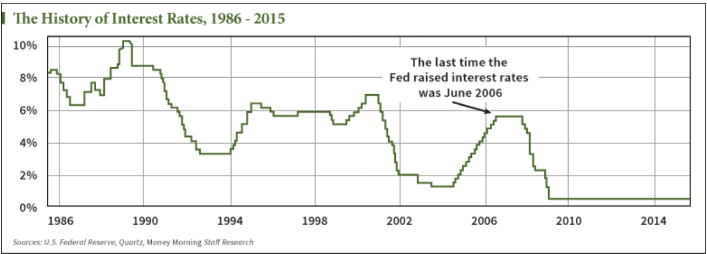
Adam Tooze has a post discussing the bond vigilante theory: The phrase “bond vigilante” is normally attributed to Ed Yardeni a Wall Street economist who coined it in the 1980s to describe the role of bond markets in disciplining governments. “Bond Investors Are The Economy’s Bond Vigilantes”, Yardeni once declared. “So if the fiscal and monetary authorities won’t regulate the economy, the bond investors will. The economy will be run by vigilantes in the credit markets.” As Yardeni later spelled out: “By vigilantes, I mean investors who watch over policies to determine whether they are good or bad for bond investors … If the government enacts policies that seem likely to reignite inflation”, Yardeni elaborated, “the vigilantes can step in to restore law and order to the markets and the economy.” This is an example of reasoning from a price change.  If bond traders fear that government policies are likely to lead to higher inflation, this may result in higher interest rates (via the Fisher effect.)  But higher interest rates due to the Fisher effect are not a contractionary policy.  In order to prevent the inflation from occurring, the government must stop engaging in inflationary policies.  Bond vigilantes won’t solve the problem. Tooze discusses the 1994 bear market for bonds, an example often cited by proponents of the bond vigilante theory: Furthermore, 1994 was not a spontaneous bond market attack. It too was triggered by the Fed. In the summer of 1993 Alan Greenspan had become worried about the acceleration of inflation. Even though the Clinton administration in August 1993 had forced through the fiscal consolidation plan that would return the US Federal government to surplus, Greenspan wanted to add further dampening pressure. He was convinced that allowing for inflation expectations real interests rates had fallen to zero. Tooze is appropriately skeptical of the bond vigilante theory, but is also reasoning from a price change.  Tooze assumes the rate increase was caused by the Fed, presumably a contractionary monetary policy by the Fed.  I see no evidence for this claim. Here it will be helpful to revisit an analogy I often use. A bus drives from Denver to Salt Lake City.  What determines the path of the bus?  Is the path determined by the way the driver adjusts the steering wheel, or by the layout of the highway (combined with an assumption that the driver prefers to avoid going off the road?)  In this analogy, the bus driver is the Fed and the road is the natural rate of interest under a 2% inflation target. Here language fails us.  It’s not clear what people mean when they ask what “determines” the path of the bus.  The driver or the road? Tooze provides this helpful graph of short-term interest rates: Why did interest rates rise during 1994?  One could argue that the increase was caused by the Fed’s decision to raise its short-term rate target. Or one could argue that the Fed raised its target rate because the natural rate of interest rose as the economy strengthened in the mid-1990s, and they had to raise rates to keep inflation close to 2%.  I find the latter explanation more useful. If someone asked me to explain why I drove though Green River on my way from Denver to Salt Lake City, I would not explain this fact by referring to how I turned the steering wheel left and right at various times, I’d refer to the layout of I-70.  I’d assume the listener understood that I tried to stay on the road. But that view is not always adequate.  If I plunged off the road and fell into a deep canyon, I would not explain that fact by pointing to the map, I’d point to my incompetence as a driver.  If I wanted to explain why the US end up with 13% inflation in 1980, I would not assume that actual short-term interest rates always followed the path of the natural rate of interest, rather I’d assume they were mistakenly held below the natural rate during the late 1970s. The 1990s were a successful period for monetary policy, and thus it’s enough to point to the map—movements in the natural rate of interest.  We can infer from stable 2% inflation that the actual interest rate stayed pretty close to the natural interest rate during the 1990s. HT:  Matt Yglesias (1 COMMENTS)

/ Learn More

Modern Monetary Theory: Nothing New Under the Sun

What is Modern Monetary Theory? The term “modern” in Modern Monetary Theory (MMT) is probably not the best choice of words, since it implies there is something new in MMT. As many MMT critics point out, looking for something new in MMT is a pointless excercise. There is nothing new to be found. Paul Krugman,1 Lawrence H. Summers,2 and Kenneth Rogoff3 are three renowned economists who did not pull their punches when evaluating MMT. Still, the lack of novelty and the strong adverse reactions have not stopped MMT’s rising popularity, especially among progressive-leaning policymakers. How so? To understand this situation, it is important first to clarify what MMT is and is not. At least as I understand this theory, the term “modern” in MMT does not refer to something new or novel but to the modern-world way of doing monetary policy. Namely, the term modern refers to the epoch that starts with the abandonment of the remaining remnants of the gold standard 1971. “Modern” refers to the full adoption of fiat money; it is not a reference to a new model or theory. We can agree that the adoption of fiat money is a gamechanger in policymaking but disagree on the implications of such monetary regime change. The fact that central banks issue fiat money means they do not have any IOU obligation to redeem the banknotes into gold or any other asset. Therefore, if the government can issue debt denominated in its own currency, treasury bonds can be paid for with monetary expansion without any risk of default. Furthermore, there is no limit to how much debt the Treasury can issue. Consequently, there is no limit to how much government spending can increase. There is no inflation risk in monetizing the deficit. Because this country issues a world-reserve currency, its demand is unlimited. This is, in a nutshell, MMT’s thesis. Suppose a country can issue debt denominated on its own currency. In that case, modern-world conditions mean that its government can increase its spending without any limit. MMT’s conclusion that money creation is a free lunch has been seriously questioned by the economic profession. MMT conclusions seem more magical4 than real. It is no wonder that progressive-leaning policymakers are fond of MMT. This theory promises that paying for large programs such as the Green New Deal is free of economic problems. Nothing New Under the Sun I: The Model “If MMT is found confusing by a large audience of professional economists, as seems to be the case, then the problem is not with the audience but with MMT.” One of MMT’s problem is its lack of clarity, especially when it comes to explaining why its bold predictions are consistent even if not self-evident and in contradiction with the profession at large. This lack of transparency makes it difficult to identify MMT’s uniqueness. One way to highlight MMT’s distinctiveness is to re-frame MMT in terms of standard economic models. By doing this, any difference between MMT and well-known models or theories should become apparent. So far, MMT has not provided that exercise. The point is not so much about having a mathematical model per se, but us about building one as a way to bring clarity and self-awareness to what MMT stands for. If MMT is found confusing by a large audience of professional economists, as seems to be the case, then the problem is not with the audience but with MMT. As a matter of fact, we already have models and theories that offer the same predictions as MMT. Old Keynesian models, such as the IS-LM and the Keynesian cross, predict the possibility of an increase in aggregate demand without affecting the price level. These models reach this prediction by assuming the price level is constant (the price level is not part of the model) because of the large number of idle resources. MMT reaches the same prediction by assuming an infinite demand for money. Leaving the merits and demerits of these Keynesian models aside, MMT fails to offer a significant difference. Consider, for instance, what the assumption of an infinite demand for money implies for the MMT model. Assuming an infinite demand for money means that the price level is stable even if monetary expansion occurs under full employment. Furthermore, the simple-Keynesian characteristic of MMT does not work in its favor. These models’ price level stability depend on very particular conditions, such as a large number of idle resources. However, as the economy approaches full employment, inflation is to be expected. When pushed regarding this situation, MMT advocates recognize that inflation can be a problem in the limit. In such a case, fiscal policy (taxes) should be used to bring inflation under control. This stepback makes MMT look just like simple Keynesian models with a new cover. The alternative is that MMT is a theory that holds the undefendable assumption that there is no resource scarcity. MMT’s recognition that inflation may be a problem is not a minor detail. It means that MMT’s prediction is contingent on present economic conditions rather than on universal assumptions. However, recognizing this contingency provides a difference between the Keynesian episode of the 1930s and MMT. The Keynesian revolution occurred during the Great Depression, a time where the assumption of high unemployment was appropriate. It was also a time with smaller governments and lower levels of public debt than the levels we see today. MMT arose, however, in a context closer to full employment and already large governments with more debt on their shoulders. It is the case that, in contrast to the time of Keynes’s General Theory, today central banks issue irredeemable fiat money. It does not follow, however, that the possibility of monetizing deficits is a free lunch. MMT’s conclusion does not follow from its own premises. If MMT conclusions were correct, we should expect to see inflation rates go down in countries that issue a world-reserve currency. Yet, we know this is not what happened. Countries like the United States have seen the inflation rate increase with fiat money adoption rather than fall. MMT does not seem to offer anything significantly different than the simple Keynesian models. However, as problematic as they may be, the simple Keynesian models were developed by paying consideration to the economic conditions present at the time. MMT seems to assume unrealistic initial conditions. Even if theoretically consistent, the admission that inflation can be a problem means MMT is inapplicable in current times. Nothing New Under the Sun II: The Political Economy of MMT There is no mystery about the political appeal of MMT. This idea promises a way to do away with the price tag of large government projects such as the Green New Deal, free healthcare and education for everyone, or any type of full-employment program. MMT is a gospel5 for policymakers who favor big government plans. For them, MMT means there is no budget constraint. The limit is their own imagination and any opposition from other political parties. It should not be a surprise if this description sounds familiar. Once again, MMT offers a parallel to the Keynesian episode. MMT is not only known for its bold predictions. It is also known for its confusing, opaque, and contradictory rhetoric.6 Anyone familiar with Keynes’ General Theory will probably remember how confusing, opaque, and contradictory it is. However, for policymakers, such semantic confusion proved to be an asset rather than a shortcoming. Keynes’ General Theory provided an ideal platform7 (or excuse) to embark on a big government project. John Maynard Keynes, a renowned British Professor, discovered an obscure economic insight that justified the execution of large government programs. Keynes did not provide just theoretical support to large spending advocates; he also provided psychological support. The success of the Keynesian-view of the world was partly due to a combination of a moral mandate and the political convenience of embracing Keynes’ ideas. In the long-run we are all dead, Keynes famously said; it is therefore immoral to sit and wait for the free market to finally correct itself. The government has the capacity and the moral obligation to take over when the market fails. Taking the high moral ground that the government ‘must do something’ during a crisis means the theoretical shortcoming of Keynes and MMT theories become less relevant. Because the moral argument takes precedence, those who oppose an extensive spending program or MMT insights must be either ideological blindfolded or protecting their own self-interest. James Galbraith’s recent defense8 of MMT is an example of this situation. Maybe the fact that an MMT defense must resort to this type of ad-hominem strategy9 is inidcative of its inconsistency problems. This is the rhetorical argument surrounding MMT policies. The government has a moral mandate to create jobs or save the environment. And MMT provides an eye-opening theoretical discovery that only those who can (or want to) understand it can see. The field of Public Choice offers an extensive literature that explains how and why ill-designed policies get to be embraced by policymakers. It is a common feature in economic history that many well-established economic conclusions clash with policymakers’ ambitions. Avoiding minimum wages, adoptiong free trade and peaceful immigration, and low and simple taxes are only some examples of how far the political world is from basic economics. Maybe the rapid and enthusiastic embrace of progressive-leaning policymakers of MMT should be read as a warning sign rather than as a missed opportunity to embark on pharaonic projects. Nothing New Under the Sun III: The Historical Evidence Another salient feature of MMT is its speculative tone. MMT predicts what would happen under certain conditions if a specific policy is executed. Explaining what actually happened seems to be less relevant. This builds some tension between historical records and MMT’s predictions. It seems futile to point out countries that suffer or have suffered inflation as proof of MMT inconsistencies. The reason is that these countries do not evince the conditions required for MMT to hold. That is, they either cannot issue debt on their own currency, or they do not issue a world-reserve currency. Take the case of Argentina, which has been suffering high inflation rates for more than a decade. Argentina cannot issue peso-denominated debt, and its currency has no demand in the rest of the world. It is not even a good store of value for Argentines. Argentina’s inflation does not offer conflicting evidence to MMT because the required pre-conditions are not present. And this is the situation for any country with high inflation. Suppose one were to contrast MMT with real-world experience. In that case, one will find that either inflation is present in countries that do not conform to MMT requirements or countries that do evince MMT requirements but do not put into practice MMT policies. Either way, there is no empirical challenge to MMT. However, the lack of empirical evidence regarding MMT’s prediction changes significantly if we revise the previous paragraph’s question. Instead of asking if countries with high inflation contradict MMT predictions, we should ask if MMT is not the reason these countries are where they are today. By changing the focus of the question from present conditions to past policies, the historical record becomes more illuminating. These countries become economically troubled (high inflation and unable to issue debt on their own currency) by following what we can call “MMT ideas.” Latin America10 can be considered a continental-size experiment of the outcomes of MMT-inspired policies. Countries like Argentina11 are not a challenge to MMT because they suffer inflation if they print too much money, but because MMT-type policies are how they got to be in their current situation. The historical view is important to avoid a misreading of the empirical evidence. The experience of countries such as Argentina is relevant because they came to lose the MMT-requirements precisely by adopting MMT ideas. Conclusions For more on these topics, see Gold Standard, by Michael D. Bordo, Concise Encyclopedia of Economics. See also Democracy in Deficit: The Political Legacy of Lord Keynes by James M. Buchanan and Richard E. Wagner, Library of Economics and Liberty; and the EconTalk podcast episode Steve Fazzari on Stimulus and Keynes. MMT has been enthusiastically embraced in some corners of the political world. It will not be a surprise if its popularity increases in the short-term. MMT offers a convenient gospel and a rhetorical device for the big-spending programs favored by the new government administration. The critical reaction to MMT from a broad spectrum of economists is not because this theory is complicated. It may seem that the economics profession has overreacted to MMT. After all, there is no clear theory nor novel insight to reply to. The reason for such a critical reaction is because, far from being a free lunch policy, adopting MMT would be playing with fire.12 As far as MMT increases in popularity, we may conclude the opposite, that the critical reaction was not strong enough. Paraphrasing George Selgin,13 MMT is too good to be true, though a very appealing doctrine for policymakers. Footnotes [1] Krugman, Paul (2019). “Running on MMT” (Wonkish). The New York Times. February 25th. [2] Summer, Lawrence H. (2019). “The Left’s Embrace of Modern Monetary Theory is a Recipe for Disaster.” The Washington Post. April 4, 2019. [3] Rogoff, Kenneth (2019). Modern Monetary Nonsense. Project Syndicate. March 4th. [4] Cochrane, John (2020). Maginal Monetary Theory Full Review. The Grumpy Economist. July 5th. [5] Lemieux, Pierre (N/A). MMT Gospel : Is This Time Different?. Library of Economics and Liberty, Feb. 3, 2020.. [6] Bisin, Alberto (2020). Book Reviews. Journal of Economic Literature 58 (4): 1197-1201. [7] Buchanan, James M. and Richard E. Wagner (1977[2000]). The Collected Works of James M. Buchanan: Vol. 8 Democracy in Deficit. Library of Economics and Liberty. Indianapolis: Liberty Fund. [8] Galbraith, James K. (2020). Who’s Afraid of MMT? Project Syndicate. December 23rd. [9] Cachanosky, N. (2021) Galbraith Offers a Poor Defenseof MMT. American Institute for Economic Research. January 16, 2021. [10] Edwards, Sebastian (2019). Modern Monetary Theory: Cautionary Tales from Latin America. Economic Working Paper 19106. Hoover Institution. [11] Cachanosky, N. (2019). What Should Modern Monetary Theory Learn from Argentina? American Institute for Economic Research. March 27, 2019. [12]Yang, Ethan (2020). Modern Monetary Theory is Playing with Fire. American Institute for Economic Research. August 8, 2020. [13]Selgin, George (2019). “The Modern New Deal That’s Too Good to be True. “Alt-M: Ideas for an Alternative Monetary Future. February 8, 2019. *Nicolás Cachanosky is an Associate Professor of Economics at Metropolitan State University of Denver (MSU Denver) Department of Economics, Senior Fellow at the American Institute of Economic Research (AIER), and co-editor of LIBERTAS: Segunda Época. As an Amazon Associate, Econlib earns from qualifying purchases. (0 COMMENTS)

/ Learn More

Modern Monetary Theory: Nothing New Under the Sun

What is Modern Monetary Theory? The term “modern” in Modern Monetary Theory (MMT) is probably not the best choice of words, since it implies there is something new in MMT. As many MMT critics point out, looking for something new in MMT is a pointless excercise. There is nothing new to be found. Paul Krugman,1 Lawrence H. Summers,2 and Kenneth Rogoff3 are three renowned economists who did not pull their punches when evaluating MMT. Still, the lack of novelty and the strong adverse reactions have not stopped MMT’s rising popularity, especially among progressive-leaning policymakers. How so? To understand this situation, it is important first to clarify what MMT is and is not. At least as I understand this theory, the term “modern” in MMT does not refer to something new or novel but to the modern-world way of doing monetary policy. Namely, the term modern refers to the epoch that starts with the abandonment of the remaining remnants of the gold standard 1971. “Modern” refers to the full adoption of fiat money; it is not a reference to a new model or theory. We can agree that the adoption of fiat money is a gamechanger in policymaking but disagree on the implications of such monetary regime change. The fact that central banks issue fiat money means they do not have any IOU obligation to redeem the banknotes into gold or any other asset. Therefore, if the government can issue debt denominated in its own currency, treasury bonds can be paid for with monetary expansion without any risk of default. Furthermore, there is no limit to how much debt the Treasury can issue. Consequently, there is no limit to how much government spending can increase. There is no inflation risk in monetizing the deficit. Because this country issues a world-reserve currency, its demand is unlimited. This is, in a nutshell, MMT’s thesis. Suppose a country can issue debt denominated on its own currency. In that case, modern-world conditions mean that its government can increase its spending without any limit. MMT’s conclusion that money creation is a free lunch has been seriously questioned by the economic profession. MMT conclusions seem more magical4 than real. It is no wonder that progressive-leaning policymakers are fond of MMT. This theory promises that paying for large programs such as the Green New Deal is free of economic problems. Nothing New Under the Sun I: The Model “If MMT is found confusing by a large audience of professional economists, as seems to be the case, then the problem is not with the audience but with MMT.” One of MMT’s problem is its lack of clarity, especially when it comes to explaining why its bold predictions are consistent even if not self-evident and in contradiction with the profession at large. This lack of transparency makes it difficult to identify MMT’s uniqueness. One way to highlight MMT’s distinctiveness is to re-frame MMT in terms of standard economic models. By doing this, any difference between MMT and well-known models or theories should become apparent. So far, MMT has not provided that exercise. The point is not so much about having a mathematical model per se, but us about building one as a way to bring clarity and self-awareness to what MMT stands for. If MMT is found confusing by a large audience of professional economists, as seems to be the case, then the problem is not with the audience but with MMT. As a matter of fact, we already have models and theories that offer the same predictions as MMT. Old Keynesian models, such as the IS-LM and the Keynesian cross, predict the possibility of an increase in aggregate demand without affecting the price level. These models reach this prediction by assuming the price level is constant (the price level is not part of the model) because of the large number of idle resources. MMT reaches the same prediction by assuming an infinite demand for money. Leaving the merits and demerits of these Keynesian models aside, MMT fails to offer a significant difference. Consider, for instance, what the assumption of an infinite demand for money implies for the MMT model. Assuming an infinite demand for money means that the price level is stable even if monetary expansion occurs under full employment. Furthermore, the simple-Keynesian characteristic of MMT does not work in its favor. These models’ price level stability depend on very particular conditions, such as a large number of idle resources. However, as the economy approaches full employment, inflation is to be expected. When pushed regarding this situation, MMT advocates recognize that inflation can be a problem in the limit. In such a case, fiscal policy (taxes) should be used to bring inflation under control. This stepback makes MMT look just like simple Keynesian models with a new cover. The alternative is that MMT is a theory that holds the undefendable assumption that there is no resource scarcity. MMT’s recognition that inflation may be a problem is not a minor detail. It means that MMT’s prediction is contingent on present economic conditions rather than on universal assumptions. However, recognizing this contingency provides a difference between the Keynesian episode of the 1930s and MMT. The Keynesian revolution occurred during the Great Depression, a time where the assumption of high unemployment was appropriate. It was also a time with smaller governments and lower levels of public debt than the levels we see today. MMT arose, however, in a context closer to full employment and already large governments with more debt on their shoulders. It is the case that, in contrast to the time of Keynes’s General Theory, today central banks issue irredeemable fiat money. It does not follow, however, that the possibility of monetizing deficits is a free lunch. MMT’s conclusion does not follow from its own premises. If MMT conclusions were correct, we should expect to see inflation rates go down in countries that issue a world-reserve currency. Yet, we know this is not what happened. Countries like the United States have seen the inflation rate increase with fiat money adoption rather than fall. MMT does not seem to offer anything significantly different than the simple Keynesian models. However, as problematic as they may be, the simple Keynesian models were developed by paying consideration to the economic conditions present at the time. MMT seems to assume unrealistic initial conditions. Even if theoretically consistent, the admission that inflation can be a problem means MMT is inapplicable in current times. Nothing New Under the Sun II: The Political Economy of MMT There is no mystery about the political appeal of MMT. This idea promises a way to do away with the price tag of large government projects such as the Green New Deal, free healthcare and education for everyone, or any type of full-employment program. MMT is a gospel5 for policymakers who favor big government plans. For them, MMT means there is no budget constraint. The limit is their own imagination and any opposition from other political parties. It should not be a surprise if this description sounds familiar. Once again, MMT offers a parallel to the Keynesian episode. MMT is not only known for its bold predictions. It is also known for its confusing, opaque, and contradictory rhetoric.6 Anyone familiar with Keynes’ General Theory will probably remember how confusing, opaque, and contradictory it is. However, for policymakers, such semantic confusion proved to be an asset rather than a shortcoming. Keynes’ General Theory provided an ideal platform7 (or excuse) to embark on a big government project. John Maynard Keynes, a renowned British Professor, discovered an obscure economic insight that justified the execution of large government programs. Keynes did not provide just theoretical support to large spending advocates; he also provided psychological support. The success of the Keynesian-view of the world was partly due to a combination of a moral mandate and the political convenience of embracing Keynes’ ideas. In the long-run we are all dead, Keynes famously said; it is therefore immoral to sit and wait for the free market to finally correct itself. The government has the capacity and the moral obligation to take over when the market fails. Taking the high moral ground that the government ‘must do something’ during a crisis means the theoretical shortcoming of Keynes and MMT theories become less relevant. Because the moral argument takes precedence, those who oppose an extensive spending program or MMT insights must be either ideological blindfolded or protecting their own self-interest. James Galbraith’s recent defense8 of MMT is an example of this situation. Maybe the fact that an MMT defense must resort to this type of ad-hominem strategy9 is inidcative of its inconsistency problems. This is the rhetorical argument surrounding MMT policies. The government has a moral mandate to create jobs or save the environment. And MMT provides an eye-opening theoretical discovery that only those who can (or want to) understand it can see. The field of Public Choice offers an extensive literature that explains how and why ill-designed policies get to be embraced by policymakers. It is a common feature in economic history that many well-established economic conclusions clash with policymakers’ ambitions. Avoiding minimum wages, adoptiong free trade and peaceful immigration, and low and simple taxes are only some examples of how far the political world is from basic economics. Maybe the rapid and enthusiastic embrace of progressive-leaning policymakers of MMT should be read as a warning sign rather than as a missed opportunity to embark on pharaonic projects. Nothing New Under the Sun III: The Historical Evidence Another salient feature of MMT is its speculative tone. MMT predicts what would happen under certain conditions if a specific policy is executed. Explaining what actually happened seems to be less relevant. This builds some tension between historical records and MMT’s predictions. It seems futile to point out countries that suffer or have suffered inflation as proof of MMT inconsistencies. The reason is that these countries do not evince the conditions required for MMT to hold. That is, they either cannot issue debt on their own currency, or they do not issue a world-reserve currency. Take the case of Argentina, which has been suffering high inflation rates for more than a decade. Argentina cannot issue peso-denominated debt, and its currency has no demand in the rest of the world. It is not even a good store of value for Argentines. Argentina’s inflation does not offer conflicting evidence to MMT because the required pre-conditions are not present. And this is the situation for any country with high inflation. Suppose one were to contrast MMT with real-world experience. In that case, one will find that either inflation is present in countries that do not conform to MMT requirements or countries that do evince MMT requirements but do not put into practice MMT policies. Either way, there is no empirical challenge to MMT. However, the lack of empirical evidence regarding MMT’s prediction changes significantly if we revise the previous paragraph’s question. Instead of asking if countries with high inflation contradict MMT predictions, we should ask if MMT is not the reason these countries are where they are today. By changing the focus of the question from present conditions to past policies, the historical record becomes more illuminating. These countries become economically troubled (high inflation and unable to issue debt on their own currency) by following what we can call “MMT ideas.” Latin America10 can be considered a continental-size experiment of the outcomes of MMT-inspired policies. Countries like Argentina11 are not a challenge to MMT because they suffer inflation if they print too much money, but because MMT-type policies are how they got to be in their current situation. The historical view is important to avoid a misreading of the empirical evidence. The experience of countries such as Argentina is relevant because they came to lose the MMT-requirements precisely by adopting MMT ideas. Conclusions For more on these topics, see Gold Standard, by Michael D. Bordo, Concise Encyclopedia of Economics. See also Democracy in Deficit: The Political Legacy of Lord Keynes by James M. Buchanan and Richard E. Wagner, Library of Economics and Liberty; and the EconTalk podcast episode Steve Fazzari on Stimulus and Keynes. MMT has been enthusiastically embraced in some corners of the political world. It will not be a surprise if its popularity increases in the short-term. MMT offers a convenient gospel and a rhetorical device for the big-spending programs favored by the new government administration. The critical reaction to MMT from a broad spectrum of economists is not because this theory is complicated. It may seem that the economics profession has overreacted to MMT. After all, there is no clear theory nor novel insight to reply to. The reason for such a critical reaction is because, far from being a free lunch policy, adopting MMT would be playing with fire.12 As far as MMT increases in popularity, we may conclude the opposite, that the critical reaction was not strong enough. Paraphrasing George Selgin,13 MMT is too good to be true, though a very appealing doctrine for policymakers. Footnotes [1] Krugman, Paul (2019). “Running on MMT” (Wonkish). The New York Times. February 25th. [2] Summer, Lawrence H. (2019). “The Left’s Embrace of Modern Monetary Theory is a Recipe for Disaster.” The Washington Post. April 4, 2019. [3] Rogoff, Kenneth (2019). Modern Monetary Nonsense. Project Syndicate. March 4th. [4] Cochrane, John (2020). Maginal Monetary Theory Full Review. The Grumpy Economist. July 5th. [5] Lemieux, Pierre (N/A). MMT Gospel : Is This Time Different?. Library of Economics and Liberty, Feb. 3, 2020.. [6] Bisin, Alberto (2020). Book Reviews. Journal of Economic Literature 58 (4): 1197-1201. [7] Buchanan, James M. and Richard E. Wagner (1977[2000]). The Collected Works of James M. Buchanan: Vol. 8 Democracy in Deficit. Library of Economics and Liberty. Indianapolis: Liberty Fund. [8] Galbraith, James K. (2020). Who’s Afraid of MMT? Project Syndicate. December 23rd. [9] Cachanosky, N. (2021) Galbraith Offers a Poor Defenseof MMT. American Institute for Economic Research. January 16, 2021. [10] Edwards, Sebastian (2019). Modern Monetary Theory: Cautionary Tales from Latin America. Economic Working Paper 19106. Hoover Institution. [11] Cachanosky, N. (2019). What Should Modern Monetary Theory Learn from Argentina? American Institute for Economic Research. March 27, 2019. [12]Yang, Ethan (2020). Modern Monetary Theory is Playing with Fire. American Institute for Economic Research. August 8, 2020. [13]Selgin, George (2019). “The Modern New Deal That’s Too Good to be True. “Alt-M: Ideas for an Alternative Monetary Future. February 8, 2019. *Nicolás Cachanosky is an Associate Professor of Economics at Metropolitan State University of Denver (MSU Denver) Department of Economics, Senior Fellow at the American Institute of Economic Research (AIER), and co-editor of LIBERTAS: Segunda Época. As an Amazon Associate, Econlib earns from qualifying purchases. (0 COMMENTS)

/ Learn More

Understanding Modern Monetary Theory: Part 2

In my previous essay, “Understanding Modern Monetary Theory: Part 1,” I explained how adherents of Modern Monetary Theory (MMT) overestimate the role of fiscal policy because they underestimate the role of monetary policy. MMT denies that monetary policy determines the path of aggregate demand, rendering it pointless to give central banks an inflation target. In this essay, I show where MMT fits on the ideological spectrum, relative to other schools of thought. On a wide range of issues, MMT occupies a position on one extreme of the ideological spectrum, where Chicago school economists such as Milton Friedman are at the other extreme. Finally, I examine why MMTers have difficulty communicating their ideas to other economists. Putting MMT onto the ideological spectrum One way to understand the views of MMTers is to compare their beliefs about a wide range of issues with those of mainstream economists, as well as those on the other end of the ideological spectrum. First, a word of caution; not all MMTers hold the same views. As an analogy, most Keynesians are left of center, but Martin Feldstein was a relatively conservative Keynesian, as is Gregory Mankiw. While Keynesians often favor government spending during a slump, the basic Keynesian model also suggests that tax cuts can provide economic stimulus when demand is depressed. Similarly, not everyone who is skeptical of the efficacy of monetary policy is left wing. Nonetheless, MMTers do tend to be left of center on a wide range of issues. There are a striking number of examples where the MMT view is almost the exact opposite of the “Chicago school” views of economists, such as Milton Friedman. Here are a few examples: 1. Chicago school economists see the supply and demand model as applicable to a wide range of industries- even many industries that are less than perfectly competitive. MMTers tend to be skeptical of the usefulness of supply and demand models, whereas mainstream economists are somewhere in between the two extremes. 2. Chicago school economists favor free market policies in the overwhelming majority of cases. Mainstream economists believe that free market policies are often appropriate. The MMT textbook written by Mitchell, Wray, and Watts (MWW) is highly skeptical of “neoliberalism” and suggests that free market ideology has become a sort of religion, accepted as a matter of faith. Many MMTers advocate a more activist government, including a guaranteed jobs program. 3. Chicago school economists do not believe there is much value in talking to bankers when trying to understand how monetary policy works. In their model, an injection of reserves into the banking system leads to changes in a wide range of asset prices, which indirectly lead banks to engage in more lending. MMTers believe that knowledge of the nuts and bolts of the banking industry is highly important when trying to understand monetary policy. Because bankers report that the availability of reserves is not a constraint on lending, this makes MMTers skeptical of the efficacy of monetary policy. 4. Chicago school economists believe that the concept of opportunity cost is extremely important, and applies to almost all policy debates.  Mainstream Keynesians believe that opportunity costs are often an important consideration. In contrast, MMTers believe that the economy is generally well below full employment and thus there is no opportunity cost to additional government expenditure. 5. Chicago school economists are extremely skeptical of the “Phillips curve” approach to business cycles and inflation.  Milton Friedman developed a model of the natural rate of unemployment where there was a short run tradeoff between inflation and unemployment, but no long run trade-off.  Mainstream economists mostly agree with Friedman, but allow for the possibility that there might be some long run trade-off due to the effect of unemployment on job market skills and employability. This idea, termed ‘hysteresis’, suggests that on some occasions the actual rate of unemployment can get stuck well above the natural rate. MMTers are at the other extreme from the monetarists. In their view, aggregate demand determines the unemployment rate, even in the long run. They are quite skeptical of claims that unemployment will automatically adjust back to the natural rate once inflation expectations adjust to actual inflation. 6. Chicago school economists favor employing monetary policy to control nominal spending, and are highly skeptical of the efficacy of fiscal policy.  Mainstream economists favor of mix of the two, whereas MMTers prefer fiscal policy and are skeptical of the efficacy of monetary policy. 7.  Chicago school economists argue that it is most useful to treat money as exogenous, i.e. under control of the central bank, at least under a fiat money regime.  Mainstream economists treat money as endogenous in short run models with interest rate targeting, and exogenous in long run models trying to explain large changes in the trend rate of inflation.  MMTers treat money as being almost completely endogenous. 8. Chicago school economists believe that changes in interest rates primarily reflect the income and Fisher effects.  Thus, falling interest rates are usually an indication that money has been tight in the recent past.  Mainstream economists view interest rates as being heavily influenced by monetary policy (the liquidity effect), but also reflecting the income and Fisher [Irving Fisher] effects, especially in the long run.  MMTers see interest rates as almost entirely reflecting monetary policy, at least under a fiat money regime.  They mostly ignore the income and Fisher effects, and reject models of the “natural rate of interest.” 9. Chicago school economists see investment being determined by savings rates. Mainstream economists see investment as being determined by savings rates during normal times, but also worry about a “paradox of thrift” when interest rates are extremely low.  In this view, an attempt by the public to save more may end up depressing national income, and in the end neither saving nor investment will increase. MMTers see the paradox of thrift as being the norm, even when interest rates are positive. 10. Chicago school economists believe high inflation to be caused by excessive money growth.  Mainstream economists see high inflation as being caused by a mix of monetary policy and supply shocks.  MMTers see high inflation as mostly reflecting aggregate supply problems. MMT tends to have more appeal to non-economists During my three decades of teaching economics, I often encountered students who were confused by certain economic theories. For instance, students would often have trouble understanding how the income and Fisher effects impacted interest rates, as they were so used to thinking in terms of interest rates being set by the central bank. I would frequently find myself in a position of needing to correct these “myths” about monetary economics. That same student would likely be much more open to the MMT view of interest rate determination, which focuses almost exclusively on the role of the central bank Non-economists often see Japanese monetary policy as being highly expansionary because interest rates in Japan have been close to zero for the past quarter century. Mainstream economists would generally attribute those low interest rates to the negative impact of extremely low rates of growth in prices and output. In contrast, MMTers often point to Japan as a sort of success story, demonstrating that a central bank can arbitrarily hold interest rates down to zero for an extended period of time. But if Japan is an MMT success story, it is a very peculiar one.1 Since the mid-1990s, Japan has seen by far the weakest growth in aggregate demand of any major industrial economy—perhaps the slowest growth in modern history. Some conservative economists don’t see that as a big problem—after all, Japan has fairly low unemployment—but MMTers view growth in aggregate demand as the sine qua non of a healthy economy. Thus, it is odd to single out a “success story” that achieved low interest rates by an extraordinarily slow rate of growth in nominal spending. Mainstream economists often complain that MMT theories are difficult to understand. Previously I discussed their odd definition of “net saving”; but there are other communications barriers as well. Paul Krugman compared debating MMTers to playing Calvinball—just when you’ve addressed one issue you are told that they are actually making a different point. Here Paul Krugman tries to get a prominent MMTer to answer some specific questions on monetary and fiscal policy: Are MMTers claiming, as Kelton seems to, that there is only one deficit level consistent with full employment, that there is no ability to substitute monetary for fiscal policy? Are they claiming that expansionary fiscal policy actually reduces interest rates? Yes or no answers, please, with explanations of how you got these answers and why the straightforward framework I laid out above is wrong. No more Calvinball.2 And here’s how Stephanie Kelton responded: Quick responses first, followed by explanations behind my thinking. #1: Is there only one right deficit level? Answer: No. The right deficit depends on private behavior, which changes. MMT would set public spending always to the level required to achieve full employment, and then accept whatever deficit may result. #2: Is there no ability to substitute monetary for fiscal policy? Answer: Little to none. In a slump, cutting interest rates is weak tea against depressed expectations of profits. In a boom, raising interest rates does little to quell new activity, and higher rates could even support the expansion via the interest income channel. #3: Does expansionary fiscal policy reduce interest rates? Answer: Yes. Pumping money into the economy increases bank reserves and reduces banks’ bids for federal funds. Any banker will tell you this.3 Here it seems like Kelton has not understood Krugman’s questions. In context, it is clear that she thinks the answer to the first question is “yes”, and yet she says no. Indeed, she wrongly believes the first question is actually two separate questions. Then she responds to the question about fiscal policy as if Krugman had asked about monetary policy. On Twitter, Paul Krugman offered a point by point rebuttal, and then concluded as follows: Sorry, but this is just a mess. Kelton’s response misrepresents standard macroeconomics, my own views, the effects of interest rates, and the process of money creation. Otherwise I guess it’s all fine. See what I mean about Calvinball?4 “Because MMTers define terms such as ‘saving’ and ‘monetary policy’ and ‘fiscal space’ in a way that is radically different from the definitions used by mainstream economists, it is difficult to engage in a fruitful debate on these issues.” Because MMTers define terms such as “saving” and “monetary policy” and “fiscal space” in a way that is radically different from the definitions used by mainstream economists, it is difficult to engage in a fruitful debate on these issues. It is as if claims must be translated from French into English before their validity can be evaluated. As a theoretical model, MMT is clearly not ready for prime time. That does not mean that MMT will have no policy impact. Over the past 40 years, the natural rate of interest has been declining steadily in all major economies. This makes deficit spending much more attractive than during the 1980s, and hence it is quite possible that the world will see larger budget deficits and near zero interest rates for an extended period of time. To mainstream economists, those large budget deficits will represent a sensible response to new economic conditions. To MMTers, the low interest rates and large deficits will be seen as proof of the validity of their model, indeed they often cite the example of Japan. On closer inspection, however, the Japanese case is actually at odds with much of what MMTers have been advocating. Between 1993 and 2012, Japan saw no growth in nominal GDP, despite some of the largest peacetime budget deficits in world history: During that period, Japan’s gross government debt rose from below 100% to nearly 240% of GDP.5 When Prime Minister Abe took office at the beginning of 2013, Japan switched to a policy regime combining fiscal austerity and monetary stimulus. After the beginning of 2013, Japan’s nominal GDP finally began rising, even as the national debt leveled off. This pattern is exactly the opposite of what the MMT model would have predicted. Conclusion For more on these topics, see Keynesian Economics, by Alan S. Blinder, Concise Encyclopedia of Economics. See also “The Paradox of Money,” by Pedro Schwartz, Library of Economics and Liberty, January 6, 2014; and “Interpreting Modern Monetary Theory,” by Jeffrey Rogers Hummel, Library of Economics and Liberty, April 1, 2019. Modern Monetary Theory adopts some of the ideas of traditional Keynesian economics, including the advocacy of fiscal stimulus in a depressed economy and skepticism about the efficacy of monetary policy. They push this idea much further, however, even questioning the potency of monetary policy in an economy with interest rates well above zero. Given that my own views on macroeconomics are in some respects out of the mainstream, I do not automatically reject a theory just because it is unconventional. Even if some of their non-traditional claims are valid, however, MMTers are likely to remain a fringe group unless they are able to present their ideas in a way that is intelligible to mainstream economists who might be receptive to some of their policy proposals, especially Keynesians like Paul Krugman. Thus far, they have been unable to do so. Footnotes [1] Ben Dooley, “Modern Monetary Theory’s Reluctant Poster Child: Japan,” The New York Times. June 5, 2019 . [2] Paul Krugman, “Running on MMT (Wonkish).” The New York Times, February 25, 2019. [3] Stephanie Kelton, “Paul Krugman Asked Me About Modern Monetary Theory. Here Are 4 Answers.” StephanieKelton.com. Previously published at Bloomberg, March 1, 2019. [4] Paul Krugman on Twitter. Thread available at “Stephanie Kelton responds — and I feel a sense of despair 1/”. [5] While some measures of net debt are considerably lower, even that figure rose sharply. In addition, there are also large future pension obligations in Japan, so all of these estimates are imprecise. *Scott Sumner is Professor Emeritus in Economics at Bentley University in Waltham, Massachusetts, and Research Associate on monetary policy at the Mercatus Center. He earned his Ph.D. in economics at the University of Chicago in 1985. He blogs both at EconLog and also at his personal blog at The Money Illusion. For more articles by Scott Sumner, see the Archive. As an Amazon Associate, Econlib earns from qualifying purchases. (0 COMMENTS)

/ Learn More