This is my archive

bar

Sam Enright Responds

On Tuesday, October 26, I posted on what I saw as a particularly weak argument that Sam Enright used against open borders. He argued that open borders would substantially raise incomes of immigrants from poor to rich countries [true] and that this would increase the demand for products of factor farming [almost certainly true.] I pointed out that if we accept this argument for restricting immigration, then, if reducing Americans’ real income substantially reduced the demand for factory farming, then it would be hard to argue on his basis against drastically reducing Americans’ real income. Sam Enright has replied. He clearly understands my argument. But he seems to think that he has taken care of it with his reply. Here’s his whole reply: Enough people were confused by this that I really should have made it clearer. I’m not saying that open borders are a bad idea because of animal suffering. I’m saying that, if we think that eating meat is wrong at all, then open borders is less good of an idea than it otherwise would be. The response to this has been a reductio: “Doesn’t this imply that it’s actually good to kill people or make them poor?”. But this only shows that the amount that animal suffering impacts these arguments is somewhere between “not at all” and “humanity is terrible and you should feel bad”. I don’t get it. In his original review, Sam seemed to be saying that open borders are a bad idea because of animal suffering. Otherwise, why raise the issue? But now he says that he’s not saying that. Good. So what is he saying? He’s saying that “open borders is less good of [sic] an idea than it otherwise would be.” So then wouldn’t he have to say that, for the same reason, economic growth for Americans is less good an idea than it otherwise would be? And if that’s so, how much reduction in economic growth does he advocate? He sums by saying what my argument “only shows” but again I don’t get it. I don’t see that it shows only the range of issues that he claims. We’re back to the basic issue: Is the purported increase in factory farming due to higher incomes, which are due to more immigration, a good argument for limiting immigration? And if not, why raise the argument? What say you, Sam?   (0 COMMENTS)

/ Learn More

Bring Back Shame and Blame

In this episode, EconTalk host Russ Roberts welcomes back Arnold Kling to talk about two ideas we think a lot about- improving government and improving public discourse. Kling has some ideas about how to improve both, and he shares them throughout the conversation. Why has the administrative state grown so much? Kling and Roberts agree that its intrusiveness in our lives is more an issue than its magnitude. But what can be done? If we could bring back shame and blame, could it help? Let’s hear what you think of Kling’s proposals for making government more efficient. And of course we’re going to ask you to pick your own hypothetical Fantasy Intellectual Team. Share your thoughts with us in the comments below, or use our prompts to start your own conversation offline. No matter how you do it, we love to hear from you. 1- How does Kling describe the difference between “naïve” and “state capacity” libertarianism? How do the government’s response to the COVID pandemic and the fragility of the power grid illuminate this distinction?   2- To what extent have property rights become more ambiguous in today’s world? Is there a greater role for government in safeguarding them today, as Kling seems to suggest? How might private sector governance be employed to safeguard such intangible assets?   3- Kling proposes two ideas to make the administrative state both more effective and accountable. What are they? What do you see as the advantages and disadvantages of each? What’s the likelihood of either or both coming to fruition?   4- The conversation closes with a discussion of Kling’s Fantasy Intellectual teams project. What do you think makes someone a good (public) intellectual? Why is it so hard to find out who’s really an expert?   5- Ok, let’s hear it. Which seven people would you put on your Fantasy Intellectual Team? We hope you’ll share below so we all can see and comment on each others’ teams! (0 COMMENTS)

/ Learn More

Using the Geneva Conventions

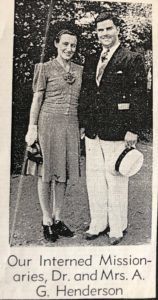
Just Say No   Next month, I’ll be giving a talk in Monterey about my Uncle Fred and Aunt Jamie Henderson, who were captured by the German navy in April 1941 on their way to Africa to be medical missionaries. It’s titled “Surviving the Zam Zam.” In 1993, I interviewed Uncle Fred about his experiences. That was fortunate because he died a year later. In the interview, I thought we had covered everything interesting about his capture, his work as a doctor in a German P.O.W. camp, and his escape to Switzerland from a prison camp in occupied France. So I turned to another question. We had grown up with a story from our parents and I wanted to see if it was true. I thought it had nothing to do with his time in the prison camp. I was wrong. Here’s the segment from the interview. DRH: Another story I remember hearing my parents tell, I think. The St. Charles Country Club is near here? Fred: Yes. DRH: Yes. You were a golfer and you were thinking of joining but you found out that they woudn’t accept Jews. And you refused to join because they discriminated against Jews. Is that true? Fred: Yeah. DRH: Yeah. That’s neat. Then Uncle Fred paused and looked pensive. As you’ll see, I think the incident reminded him of why he was so opposed to anti-semitism. Fred: I can remember in the German prison camp we had sick parade every morning and the German doctor [who supervised Uncle Fred] would often say to the people coming up for medical treatment “Sind sie Jude?” “Are you a Jew?” Hitler of course was against the Jews. I had to get the Swiss Protecting Power to get the German doctor to promise that he wouldn’t ask whether they were Jews or not. DRH: Oh, wow. This was where? Fred: In the (garbled name) the German prison camp. DRH: So you actually got the German doctor not to ask that? Fred: Yeah. DRH: How did you do that? Fred: Because the Swiss Protecting Power could get the German doctor to promise that. DRH: In a prison camp in Germany? [Actually Poland, but that distinction didn’t matter to Hitler.] Fred: Yeah. DRH: That’s neat. I didn’t know that. I had no idea. I thought once you were in a prison camp and you were Jewish, that was it. So you just said no. This is not right and I’m going to protest. Fred: Yeah. DRH: That’s wonderful. You probably saved some lives.     (0 COMMENTS)

/ Learn More

The nominal recovery is now complete

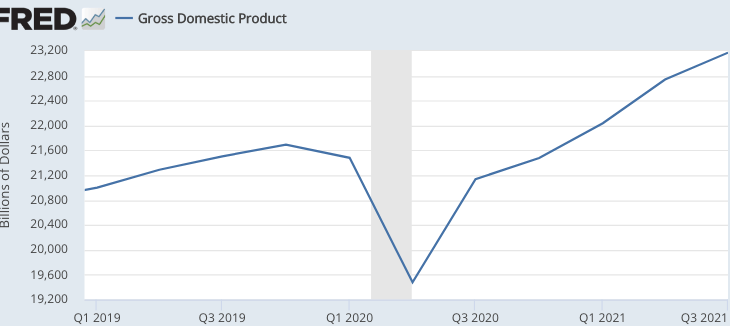
The 3rd quarter NGDP figures were just released, and they show the nominal economy is roughly back on the old trend line, with NGDP rising at a 3.8% annual rate since the fourth quarter of 2019. The economy still has lots of problems, but they are no longer nominal problems, they are real problems. Or, if you prefer the confusing terminology used by economists, the economy no longer has a “demand” problem; it has “supply” problems. What a contrast to the Great Recession, which we entered with a trend rate of NGDP growth of roughly 5%, then quickly fell 8% below trend, and then instead of returning to the old trend line we started recovering along an even lower trend line of roughly 4% NGDP growth.  Unemployment fell very slowly. This time, the Fed used its new flexible average inflation targeting (FAIT) approach to aggressively push the economy back to the old trend line. And it worked perfectly!  Unemployment fell from 14.8% to 4.8% in only 17 months, something almost no one (other than Lars Christensen) anticipated last year. My only fear is that we might overshoot. NGDP growth was at an annual rate of 7.8% in the third quarter, which is fine when recovering from a recession.  But we wouldn’t want growth to continue at that clip going forward. The Fed needs to bring NGDP growth down to a level of roughly 4%, to insure it can meet its FAIT objectives for the 2020s.  The TIPS spreads have me a bit worried. PS.  Would slowing to 4% NGDP growth cause a rise in unemployment?  I don’t think so.  There’s a massive labor shortage out there, and the areas of the economy that are currently overheating are concentrated in consumer goods, which are often imported.  There needs to be some rebalancing toward (job intensive) services, but that can occur with 4% NGDP growth.  To be clear, I think NGDP growth will probably overshoot 4% next this quarter, but the Fed needs to bring it back to roughly that level ASAP.  And yes, the actual target is 2% inflation, not 4% NGDP growth.  But they won’t achieve that over the 2020s unless NGDP growth is relatively close to 4%.  Please don’t turn success into failure! PPS.  Notice that when NGDP recovers quickly we don’t have a financial crisis?  That’s not a coincidence.  Financial crises occur with deep and prolonged declines in NGDP. PPPS.  The Hypermind NGDP market is now predicting negative NGDP growth in Q4.  If you disagree, then I’d encourage you to place your bets. (1 COMMENTS)

/ Learn More

Sowell on Academic Standards

As I mentioned a few days ago, I’ve been reading and enjoying Jason Riley’s Maverick: A Biography of Thomas Sowell. One particular passage about the weird nature of academia stood out. It fits so much of my experience. I’ll quote from the book and then tell my own similar story from early in my career. Riley writes: “I doubt seriously if I would have written Basic Economics if I were still part of an economics department,” Sowell told me. “People would have said, ‘What the hell is Sowell doing writing a book about things any decently trained economist already knows? He’s supposed to be advancing the frontiers of knowledge.’” Basic Economics has sold more copies than any other book he has written, but his fellow faculty members likely would have shrugged—or worse. “I remember at UCLA sitting among the senior faculty deciding the fate of a junior faculty member, reviewing contracts and granting tenure,” he said. “And I remember one fellow being considered, and someone said he’d written a couple of very good textbooks. And then one of my colleagues said, ‘I don’t regard that as evidence of scholarship. I regard it as negative evidence of scholarship.’” I’m pretty sure I know who the junior faculty member was. The main reason is that the person I have in mind is the only assistant professor who wrote two textbooks during that era. Each was path-breaking in its own way, but especially the macro text. I learned a ton by TAing for this assistant professor in his very rigorous introduction to macro class. I’ve written him. He replied that if the event happened in academic year 1972-73, then yes, it was he. The person I have in mind is Chuck Baird, whom, coincidentally, I posted about earlier this year. Now to my own story that’s similar to Tom Sowell’s. I was an assistant professor at the University of Rochester’s Graduate School of Management from 1975-79. The faculty really cared about hiring and junior faculty were listened to. We had each received a pile of CVs and were discussing how to winnow them down. One promising candidate had listed on his CV an op/ed he’d written for the New York Times. My sense, by the way, was that although many of the faculty on ideological grounds did not favor the NYT, what I’m about to tell you is not about ideology. I think the faculty member’s reaction would have been almost as strong if the job candidate had had an op/ed in the Wall Street Journal. Also, it wasn’t about content because no one at the meeting had actually read the op/ed. Here’s the line I remember crystal clearly from one of my colleagues: How strong a negative weight should we put on the New York Times op/ed? (1 COMMENTS)

/ Learn More

The Goalposts of Consent

People routinely justify government on the basis of “consent.”  As in: “There’s a social contract, and you’re obliged to follow it.” If you deny consent, they just move the goalposts of consent very close.  In fact, they usually give the government an instant touchdown. How exactly do they move the goalposts?   Step 1: Switch from explicit to implicit consent. If you say, “I never signed this social contract,” they reply, “The social contract is implicit.” Step 2: Switch from implicit consent to hypothetical consent. If you object, “You can always deny implicit consent with explicit non-consent,” they reply, “The social contract is hypothetical.” Step 3: Switch from hypothetical consent to pseudo-consent. If you object, “You can always deny hypothetical consent with actual non-consent,” they reply, “The social contract is what hypothetical reasonable people would consent to.  If you deny consent, you’re not reasonable, so your non-consent doesn’t count.” Which is tantamount to: You consent whether you consent or not.   Similarly, people routinely justify sex on the basis of “consent.”  As in: “You consented to have sex, so you can’t claim to be the victim of a sexual assault.”  Yet in recent years, especially on college campuses, activists have responded by moving the goalposts of consent very far.  In fact, some fanatics apparently treat consent as ex post: Have sex first, then decide if you consented afterwards. How exactly do they move the goalposts?   Step 1: Switch from implicit to explicit consent. If you say, “My partner never said no,” they reply, “Unless your partner explicitly says yes, they didn’t consent.” Step 2: Switch from explicit consent to repeated explicit consent. If you say, “My partner said yes,” they reply, “Your partner must say ‘yes’ every time contact escalates.” Step 3: Switch from explicit consent to explicit consent without “pressure.” If you say, “My partner said yes repeatedly,” they reply, “They felt pressured to do so” or “They had too much to drink.” Step 4: Switch further to “enthusiastic consent.” If you say, “My partner said yes repeatedly, without pressure, while sober” they reply, “You still should have noticed that they weren’t thrilled about it.”   In the background, there lurks an severe gender-based double-standard.  Most obviously, women don’t have to worry that they’ll be accused of sexual assault if they have sex with a drunk male.   If we step back, the effect of moving the goalposts of consent is obvious. Moving the goalposts for government legitimizes everything that government does.  If you can’t withdraw consent from government, then you consent to whatever it does to you.  Even military slavery. Moving the goalposts of consent for sex delegitimizes most of the sex that actually occurs.  After all, most sex happens in long-term relationships – and people in long-term relationships normally rely on implicit consent alone.  (And yes, people in long-term relationships occasionally use extreme pressure to get sex, such as threatening divorce if refused).   The motivation for moving the goalposts of consent for government is similarly obvious.  People move the goalposts because they are statists.  They think government should have a free hand to trample naysayers.  In the words of Dexter‘s Miguel Prado, “I’ll do what I want, when I want, to whomever I want! Count on it!” The motivation for moving the goalposts of consent for sex is, in contrast, rather mysterious.  It’s tempting to say that their goal is total celibacy, a la Orwell’s Junior Anti-Sex League, but the shoe doesn’t fit.  People who insist on the absurdly high bar of enthusiastic consent still seem confident that lots of sex is going to happen.  And as far as I can tell, they are quite comfortable with their expected high-sex scenario. So what’s really going on?  My best guess: People who move the goalposts of consent for sex are horrified by the idea that any woman might have an unpleasant sexual experience.  (In principle they worry about men as well, but they tacitly embrace the stereotype that men rarely have unpleasant sexual experiences).  And they’re too economically illiterate to realize that the only way to prevent all unpleasant sexual experiences is to prevent sexual experiences of any kind. What’s more, they’re too psychologically oblivious to realize that they’re making the silent shy majority even more anxious about sex than they already are. P.S. My chief doubt about the latter story is that the only person I actually know who sympathizes with moving the goalposts of sexual consent is highly economically literate.  But I say that he’s a lone outlier. P.P.S. Looking forward to speaking at the University of Chicago tomorrow.  If you see me, please say hi! (0 COMMENTS)

/ Learn More

A Reminiscence about George Akerlof

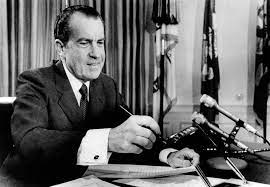
How I persuaded George Akerlof to advocate a Nixon veto of a minimum wage increase. I posted recently about Treasury Secretary Janet Yellen’s draconian proposal for surveilling bank accounts of high rollers who have an ingo or outgo of more than $10,000 per year. Writing about her brought to mind two interactions I had had with her husband, George Akerlof, in the summer of 1973. George is also an economist and he shared the Nobel Prize in economics in 2001 with Michael Spence and Joe Stiglitz. In the summer of 1973, I was a summer intern at the Council of Economic Advisers under Herb Stein. My boss for the first few weeks of the summer was Robert Tollison. He and I got along very well and he recommended that I replace him for about a month that summer before his real replacement arrived for the next academic year. Surprisingly, Herb Stein said yes. So, at age 22, I was an acting senior economist. I got to go to meetings with people at the Assistant Secretary and Undersecretary level. I wasn’t a passive observer. I remember once, at a meeting with the Undersecretary of Transportation, taking on George Hay, chief economist at the Antitrust division of the Justice Department. I was really feeling confident. One day in August, when I was coming back to the Old (now Eisenhower) Executive Office Building after lunch, I saw a young man chaining his bicycle to the fence outside the building. He looked like a young Woody Allen. He seemed like a nice guy, and it turned out that I did end up liking him. I said hi and asked him where he was going. He told me that he was going to be working at the Council of Economic Advisers. “That’s where I work,” I told him. “Are you a summer intern?” As I said, he looked like a young Woody Allen. “No,” he answered, “I’m going to be the senior economist for labor.”  And he introduced himself to me as George Akerlof from UC Berkeley. He said, unprompted, that he was a Maoist. I took that with a grain of salt. I had already run into enough academics who claimed identities that didn’t seem to fit. It seemed like an “epater les bourgeois” approach. A day or two later, I dropped by his office to chat. One of the hot issues was an increase in the minimum wage that both houses of Congress had passed and that Nixon would have to decide whether to veto. At the time the minimum wage was $1.60 an hour and the bill would have raised it to $2.20 an hour. I figured that George would recommend to Herb Stein that Herb recommend to Nixon that Nixon veto it. Economists generally, wherever they were on the ideological spectrum, thought minimum wages would put unskilled workers, especially black teenagers, out of work. James Tobin thought that, Paul Samuelson thought that, and Milton Friedman thought that. A standard example of a price floor that we taught in introductory economics classes was the minimum wage, with its unintended, but totally predictable, effects. But I had learned not to assume. I asked George what he would recommend. He replied that he was leaning towards advocating that Nixon sign. I didn’t hit the ceiling. I just calmly made the standard argument. George didn’t deny it, but the argument seemed to carry little weight with him. So I changed my strategy. I told him that this would be one of his first acts as the CEA’s labor economist and that he could be over 90 percent sure that, whatever Nixon did, Herb would recommend a veto. If George recommended signing, he would, with his first impression, lose a little credibility with Herb. Then we parted. A day or two later, I ran into George and asked him if he had made a recommendation. Yes, he answered. “What was it?”, I asked. He answered, “I recommended a veto.” Nixon did veto it in early September. Here’s his veto message. (0 COMMENTS)

/ Learn More

Enright on Caplan on Immigration

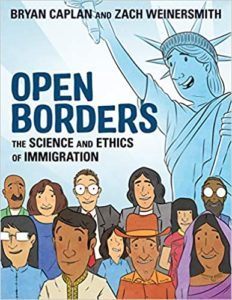
Sam Enright has written a good review of Bryan Caplan’s Open Borders: The Science and Ethics of Immigration. I like it for two main reasons: (1) he takes Bryan completely seriously and doesn’t take cheap shots, and, related to that, (2) the tone is quite nice. I do have a number of criticisms, but I’ve been thinking about one main one. Enright writes: I’m also concerned about the animal suffering that would result from open borders. Globally, the production of meat, 90% of which comes from factory farms, creates an almost unimaginable level of suffering. There are two reasons why open borders would make this worse: the Western diet is more meat-heavy than diets from other rich parts of the world, and richer people, in general, consume more animal protein. People sometimes talk about the meat-eater problem: many interventions in global development look much less cost-effective if you give moral concern to animals, since, if the interventions save human lives or make people better off, they lead to greater meat consumption. Increased demand for meat may be unusually harmful now, because it further entrenches factory farming as the default way meat is produced. At first I found this criticism somewhat persuasive. The recent discussion between Bryan and philosopher Michael Huemer has caused me to be uncomfortable with factory farming and I’m starting to explore ways of eating meat, which I love, without eating meat from factory farms. I don’t buy the idea of rights of animals, but I think it is wrong to raise in animals in circumstances where they suffer for their whole lives. But as I thought about it, I realized that this is not a good argument at all. Let’s say we could reduce the demand for factory farming by imposing draconian regulations that reduce Americans’ per capita income by 80 percent. Would that justify those regulations? I think not. So then how, if we accept the other parts of Bryan’s argument, can we justify, based on reducing factory farming, draconian immigration restrictions to keep many people’s income 80 percent lower than otherwise. Even if you think regulation is justified to reduce factory farming, shouldn’t the regulation be aimed, not at keeping people poor, but at reducing or ending factory farming? I’ll have more to say about other parts of the review. But that is my biggest criticism of Enright’s review. (0 COMMENTS)

/ Learn More

Fred Foldvary, a Joyous Friend

I met Fred in the 1990s, through a shared interest in the voluntary provision of collective goods. In 1996 I joined the faculty at Santa Clara University, and soon thereafter worked with Fred, Henry Demmert, Larry Iannaccone, and Bob Finocchio in a campus institute. Fred was a great friend, colleague, and campus partner during my years at Santa Clara. For decades he was immersed in Bay Area free-market, libertarian, and Georgist circles, teaching at SCU, San Jose State, Cal State-East Bay, and elsewhere. He was also a good friend of the Independent Institute in Oakland. He lived in Berkeley. Fred and I coedited a book about how technological progress often dissolves the rationale put forward for a government intervention. The rationale grows flimsier than ever, but the intervention persists, and textbook rationales die hard. And when I started Econ Journal Watch, Fred was a core partner, working with me, together at Santa Clara University. To the right is a photo from a 2003 planning meeting. Planning meeting for the formation of Econ Journal Watch, St. Louis, Missouri, 2003. Standing: Randall Holcombe, Donald Boudreaux, George Selgin, Daniel Klein, Matthew Brown. Seated: Bruce Benson, Jane Shaw, Deirdre McCloskey, Lawrence H. White, Fred Foldvary. Fred’s help in EJW was vital. He contributed an article that I regard as the go-to explanation of the ground-rent—or “geo-rent”—tax reform. I’m reluctant to talk it up because the coercionists would only add it atop current confiscations. But Fred persuaded me that it is the least-bad tax. The article nicely explains the idea and its comparative merits. Adam Smith liked the idea, too! Fred wrote a great economics dissertation at George Mason University under the direction of Richard Wagner, and it became Public Goods, Private Communities: The Market Provision of Social Services (Elgar, 1994), a work with 600 Google Scholar citations. The book examines the “public good” rationale for the governmentalization of goods and services, exposes “market-failure” cant, and tells of how private parties provide collective goods and services in real life, voluntarily. Foldvary had great teachers at George Mason in Richard Wagner, Charles Rowley, and others. Still, he was an autodidact. He let all manner of human experience inform his scholarly judgment, and all manner of moral philosophy. In Public Goods, Private Communities, he draws on Adam Smith’s The Theory of Moral Sentiments to exposit the realities of voluntary community. Sentiment plays a role in his theorizing. Fred did not let his academic training incapacitate him. Public Goods, Private Communities imparts a richness to the idea of territoriality. There is a lot to territoriality that relates to issues of problems of excluding non-payers. It is not merely a matter of travel costs, but also of local knowledge and of feeling welcomed and liked. A sense of place involves a spirit of propriety. It’s not about clubby homophily but rather that free riders and free loaders are disliked. “Nature, when she formed man for society, endowed him with an original…aversion to offend his brethren. She taught him to feel…pain in their unfavourable regard. She rendered…their disapprobation most mortifying and most offensive” (Smith, TMS). Fred brought moral facts into his theorizing. Before his studies at George Mason, Fred had worked as a computer programmer. But it seems he had always been the intellectual and autodidact. The extensiveness of Fred’s thinking showed early, in a little-known book in ethics and intellectual history, The Soul of Liberty: The Universal Ethic of Freedom and Human Rights, published in 1980. The Soul of Liberty is an ambitious and joyous statement of ethics. It was written before Fred became immersed in economics. When he did, he identified especially with Georgism and Austrianism. He worked closely for many decades with the Robert Schalkenbach Foundation. His friends and colleagues there produced a touching video remembrance of Fred. In 1997 Fred published “The Business Cycle: A Georgist-Austrian Synthesis” in the American Journal of Economics and Sociology. In it, he wrote: “The 18-year cycle in the US and similar cycles in other countries gives the geo-Austrian cycle theory predictive power: the next major bust, 18 years after the 1990 downturn, will be around 2008, if there is no major interruption such as a global war.” Pretty good call more than a decade before the fact! Furthermore, as Mason Gaffney explains, “in Spring 2007, well before the crisis hit, Fred published a booklet entitled The Depression of 2008” (link). Fred was ever creative, writing copiously for Progress.org and producing other significant books including Dictionary of Free-Market Economics and Beyond Neoclassical Economics: Heterodox Approaches to Economic Theory. Fred was 75 when he died in June 2021. He was a good friend and colleague to me. He was an independent spirit with an independent mind. He was a theist but so far as I know did not go to services. As a supporter of liberty, he was soft-spoken, thoughtful, learned, and dedicated. In the pursuit of wisdom, he was earnest but always playful, too. He taught thousands of students in classrooms. He was liked by everyone who knew him or worked with him. Thank you, Fred, it’s an honor to have shared time together in friendship on this rock.   (0 COMMENTS)

/ Learn More

What kind of immigrants does the GOP want?

In recent years, I’ve seen many conservatives argue against illegal immigration, warning darkly of our society being polluted by “rapists and murderers”, despite the fact that immigrants have a lower crime rate than native born Americans. They also seem to worry about the fact that immigrants come from different cultures. This has always struck me as odd, because one of American’s most distinctive features is that for hundreds of years there have been lots of whites, blacks, Hispanics and Native Americans living in this area. There is no single America culture to destroy. If there were, it would have already been destroyed when millions of eastern and southern Europeans joined our mostly northern European population in the late 1800s. Another concern is that immigrants will be less productive, and will become a burden on our welfare system. That has not happened in the past, but who knows about the future? Thus I was very surprised to learn that Republicans now oppose legal immigration precisely because they fear the immigrants will be just like us.  They fear that the new immigrants will be productive, hard-working members of society, and thus take away our jobs.  Here’s the National Review: In particular, Republicans are pointing at a provision in the House bill that for ten years would exempt certain immigrants, along with their spouses and children, from numerical limits on “family-sponsored preference” and “employer-based” green cards, as established in the Immigration and Nationality Act. Earlier this month, the Republican Study Committee cited the provision as one of the 42 worst parts of the reconciliation bill, because it would create a “hidden pipeline” that would allow employers to flood middle-class careers with foreign workers. In his letter to Sanders, Hagerty wrote that “no corporate lobby has more consistently and vociferously lobbied for these uncapped foreign worker programs than the technology giants in Silicon Valley.” I recall a time when Republicans championed dynamic economic change and ridiculed tired old socialist “lump of labor” theories. I really miss the 20th century. (1 COMMENTS)

/ Learn More