This is my archive

bar

When the Elite Become the Elect

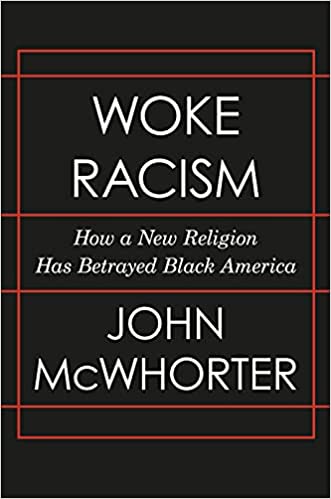
With the rise of Third Wave Antiracism we are witnessing the birth of a new religion, just as Romans witnessed the birth of Christianity. The way to get past seeing the Elect as merely “crazy” is to understand that they are a religion. To see them this way is not to wallow in derision, but to genuinely grasp what they are. –John McWhorter, Woke Racism, p. 231 Conservatives and old-fashioned liberals find themselves increasingly confounded by the movement that calls itself antiracist. In particular, antiracists insist that racism explains every adversity in the outcomes of African-Americans. They brand as racist anyone who suggests that other factors, including material disadvantages or cultural habits, could play a role. John McWhorter has concluded that it is futile to argue with these antiracists. To the question, “Are you a racist?” they will accept neither no nor yes for an answer: To apologize shows your racism; to refuse the apology, too, shows your racism. To not be interested in black culture shows your racism; to get into black culture and decide that you, too, want to rap or wear dreadlocks also shows racism. p. 10 McWhorter sees the anti-racists as promulgating a new religion, in which they are the Elect and others are the heathens. He terms it a religion because it includes many beliefs that are illogical and even contradictory, but to which one must nonetheless commit if one is to join the Elect: Key to being Elect is a sense that there is always a flock of unconverted heathen. Many of the heathen are, for example, the whites “out there,” as it is often put about the white people who were so widely feared as possibly keeping Barack Obama from being elected (twice). p. 34 McWhorter does make one attempt to describe a central belief implicit in this religion: Battling power relations and their discriminatory effects must be the central focus of all human endeavor, be it intellectual, moral, civic, or artistic. Those who resist this focus, or even evidence insufficient adherence to it, must be sharply condemned, deprived of influence, and ostracized. p. 11 Anyone would concede that power relations exist and are important. But to strip away all other elements of human culture in order to focus solely on power is unrealistic and unwise, as McWhorter points out. McWhorter suggests that the irrational belief that racism is the essential and ever-present feature of our society gains traction from the fear that it instills in most of the rest of us: Now most cringe hopelessly at the prospect of being outed as a bigot, and thus: In being ever ready to call you a racist in the public square, the Third Wave Antiracist outguns you on the basis of this one weapon alone. Even if their overall philosophy is hardly the scriptural perfection they insist it is, that one thing they can and will do in its defense leaves us quivering wrecks. And thus they win. p. 14 If antiracism is indeed a religion, then perhaps it is not surprising that between the time Woke Racism was written and the time it was published, antiracist curricula became a heated issue in the context of public schools. Although they would not put it in these terms, the parents going to school board meetings to protest “Critical Race Theory” are trying to maintain the separation of church and state. “Antiracists have not consciously set out to create a religion. As McWhorter concedes, they would object to their movement being characterized as such.” Antiracists have not consciously set out to create a religion. As McWhorter concedes, they would object to their movement being characterized as such. How, then, should it be characterized? For example, is antiracism just another reform cause of the sort we have seen often in American history? Examples include anti-slavery, women’s suffrage, temperance, civil rights, and opposition to the Vietnam War. I would argue that those other movements articulated particular goals, with organizations and activities that were devised to try to achieve those goals. With antiracism, the goals are vague—and the movement has hardly any organizational structure, with no official hierarchy. The main activity seems to be spotlighting the heathen and forcing their submission and/or punishing them. Because they had goals and organizations, earlier reform movements thought in terms of persuading others. The Elect have such a strong conviction in their righteousness that they see no need to persuade. Instead, they come across as seeking to indoctrinate or intimidate those who would disagree with them. McWhorter says that it is pointless to argue with this viewpoint: The Elect must be othered. We must stop treating them as normal. Already, the term “woke” is used in derision, but using that term with a snicker is about as oppositional as many dare to be against this mob. It isn’t enough. How do we step up with such a destructive current of cognitive interference in our way, wielded by people of power, and chilling us with the threat of social excommunication? p. 152 Earlier reform movements offered adherents the hope for a better tomorrow. So, too, did religions, if only in the afterlife. Antiracism lacks such a positive vision: To these people, actual progress on race is not something to celebrate but to talk around. This is because, with progress, the Elect lose their sense of purpose. Note: What they are after is not money or power, but sheer purpose, in the basic sense of feeling like you matter and that your life has a meaningful agenda. p. 40 For more on these topics, see the EconTalk podcast episodes Glenn Loury on Race, Inequality, and America and Jason Riley on Race in America. See also “Black Power Gained, Black Agency Sacrificed,” by Arnold Kling, Library of Economics and Liberty, May 3, 2021. Woke Racism is a book with many insights. But I came away from it thinking that McWhorter’s account is incomplete. For one thing, he does not cover the gender-identity movement, which shares with antiracism the same irrationality, moral righteousness, and eagerness to identify and punish heretics. I find the focus on heresy to be the most distinctive feature of contemporary social justice movements. Almost every political movement has its scapegoats, and almost every religion offers adherents a sense of possessing superior moral insight. But fending off heresy is only one element of religious and political movements that we have seen until recently. What is distinctive about contemporary social justice movements is that the identification and punishment of heretics is so central that it has become almost the sole activity to be undertaken. It has become the “sheer purpose” or the “meaningful agenda” for many people. I find that quite confounding. Footnotes [1] John McWhorter, Woke Racism: How a New Religion Has Betrayed Black America *Arnold Kling has a Ph.D. in economics from the Massachusetts Institute of Technology. He is the author of several books, including Crisis of Abundance: Rethinking How We Pay for Health Care; Invisible Wealth: The Hidden Story of How Markets Work; Unchecked and Unbalanced: How the Discrepancy Between Knowledge and Power Caused the Financial Crisis and Threatens Democracy; and Specialization and Trade: A Re-introduction to Economics. He contributed to EconLog from January 2003 through August 2012. Read more of what Arnold Kling’s been reading. For more book reviews and articles by Arnold Kling, see the Archive. As an Amazon Associate, Econlib earns from qualifying purchases. (0 COMMENTS)

/ Learn More

Speculations on Origins and Endings: An Essay on The Essential UCLA School of Economics

An Essay and Book Review of The Essential UCLA School of Economics, by David R. Henderson and Steven Globerman.1 When you think about dinosaurs—which you should; dinosaurs are awesome—you always end up with the same two questions: where did they come from and where did they go? Yes, all life evolves through a process that begins and ends with random change, but dinosaurs are more than one of many possible jackpots in nature’s slot machine. Dinosaurs did a magnificent job of “understanding” their world—not in the sense of explicit cognition, of course, but in the sense of adaptation as a kind of biological understanding of the environment. And as far as their disappearance, how could such soundly designed animals just… vanish? Was it a natural event leading to abrupt environmental change? Or, more hopefully, did the dinosaurs become birds? Now this may seem like a snarky start to an essay on a book describing economists who no longer roam the Earth—am I really calling economists like Armen Alchian and Harold Demsetz dinosaurs? Yes I am. But in drawing that analogy I emphatically reject the Flintstone version of dinosaurs as cartoonish, plodding, cold-blooded creatures with tiny brains. I also reject the Jurassic Park version of dinosaurs as ruthless killers. Evolution is about adaptation, not progress. Dinosaurs aren’t inferior to modern animals. Dinosaurs were exactly what was needed for the environment they inhabited. Dinosaurs are exactly the right metaphor for examining David R. Henderson and Stephen Globerman’s useful (and well-written, interesting and FREE) new book, The Essential UCLA School of Economics. From the mid 1960s until at least the 1980s, the UCLA department of economics occupied a unique and important niche in the evolution of economic thought. The UCLA school—led by Armen Alchian, William Allen, Harold Demsetz, George Hilton, Jack Hirshleifer, Benjamin Klein, and others—didn’t just present interesting, provocative research, they advanced a way of thinking about social organization. They showed us what questions are really interesting and how their approach to economics can help find the answers. “[The book] is an advocacy for a unifying approach to economics.” The best thing about David Henderson and Steven Globerman’s book (even better than the fact that it’s well-written, interesting, and offered at zero price) is the way it connects research that came out of UCLA to broader ideas. The book is much more than a collection of abstracts from a few dozen books and articles. It is an advocacy for a unifying approach to economics. And ‘advocacy’ is the right word here: both Henderson and Globerman are very much products of the UCLA school, and they very much believe in that worldview. So what is that unifying theme? Henderson and Globerman come up with a compelling answer but only after, I’m afraid, starting the book on the wrong foot. In the very first paragraph they write “The UCLA school of thinking was a strong free market tradition in late 20th Century economics.” That’s true but it’s not important. What is important is found later in the introductory chapter where Henderson and Globerman quote from what might well be the manifesto of the UCLA school: Armen Alchian and William Allen’s University Economics. Alchian and Allen introduce their textbook by writing “Ever since the fiasco in the Garden of Eden, most of what we get is by sweat, strain, and anxiety. Two villains—nature and other people—prevent us from having all we want.” The UCLA school understood that scarcity and struggle are a constant of human existence, and perhaps this helps us understand their association with free market economics. The thing about the origin story in Genesis is that humans are meant to remember the world before the Fall. The authors of Genesis may have sound theological reasons for giving us that memory, but it leads us to entertain the disastrous fantasies of “utopian socialism.” UCLA economics knew better. But the UCLA school was more than just a brief for reality. Notice that Alchian and Allen’s quote features two villains: it’s not just a cruel nature, it’s also other people. That’s because they understand that, above all else, we are social animals. Whatever success we have in coping with a harsh and indifferent nature is achieved only by cooperating with other people in order to reap the gains from specialization. To understand our world requires us to understand the habits and institutions that shape the way we cooperate. This idea, of course, did not originate around the economist’s lunch table at UCLA. Adam Smith understood the social nature of man. Smith’s pin factory is much more than a simple example of the benefits of the division of labor, it’s the start of a conversation about a fundamental human problem. A successive line of brilliant thinkers, such as David Ricardo, John Stuart Mill, and F. A. Hayek, spent their lives reflecting on how we capture the benefits of specialization. It isn’t hard to find the DNA of these earlier economists in the UCLA school. Henderson and Globerman, though, aren’t much interested in placing UCLA on the proper limb of the economics family tree. They don’t want to tell the origin story; they want to explain the ideas and methodology that defined the UCLA school. That’s a good thing. Even if you are—like me—someone who’s read a fair amount of what the UCLA economists wrote, you’ll enjoy seeing it all laid out in context. If you’re someone who hasn’t thought much about economics since you were an undergraduate, you’ll find these ideas… well… cool. Take seriously the idea that people respond to incentives—that in Alchian’s memorable claim “tell me the rules and I’ll tell you the outcome”—and you can make sense of a whole lot of behavior that baffles people who don’t take economics seriously. I wonder, though—and I really don’t know the answer to this—whether there is a generation of millennial-age economists who haven’t heard about the UCLA school? Armen Alchian retired in 1984. Nearly two generations of economists have been trained and reached intellectual maturity since then. Do they know this stuff? I hope so. Either way, reading or re-reading about this genre of economic thought will teach the current generation something that has never been more important. It will teach them to be brave. The UCLA school believed in economics. Reading Henderson and Globerman’s book, you see that the UCLA school thought the proper role of economics was to study how people arrange their relationships so as to capture the gains from specialization. This meant no topic was really off limits. More importantly, they thought economic principles could supply the answer. In 1950, when in Alchian wrote Uncertainty, Evolution and Economic Theory, he might have worried whether he was setting a course very different from the comfortable, conventional view of the time. If so, it seems as if he didn’t care. The title of the very first section of that paper, “Profit Maximization is not a Guide to Action,” is a clear signal that Alchian was going to march—if not to his own drummer—then to a beat very different from the intellectual rhythms of that moment. Which brings me back to my dinosaur metaphor. Henderson and Globerman don’t write about the UCLA school origin story or the extinction/evolution story but they do give us clues. Let’s start by speculating on the origins. (And, to be clear, I really am speculating. Henderson and Globerman led me to the question. They didn’t propose an answer.) Why did the UCLA school evolve when and where it did? Here, it is useful to remember that dinosaurs were not the first large, complex animals to walk the earth. They evolved only after a catastrophic event, the breakup of the last supercontinent, Pangea, which led to extraordinary environmental destruction (including global warming on a scale beyond even the wildest dreams of today’s econ-warriors). Is it reasonable to think that in a similar way the social disasters of the first half of the twentieth century presented the UCLA economists an opportunity to rethink economics? A global depression, two world wars, and the horrors of Stalinist/Maoist Marxism didn’t vanquish the collectivist mentality that characterized “modern” economic thought. But surely it gave a niche for a new kind of economist. At the risk of over-reaching the metaphor, there’s one other part of the origin story worth thinking about: the role of Los Angeles as a place. In 1950 California wasn’t separated from the intellectual culture of the Northeast in the same way that South America and Africa were separated in the early Cretaceous period, but the divide was massive by today’s standards. Economists in 1950 didn’t blog or tweet; they wrote letters. Journals today are mostly a screening mechanism, a way for the high priests to sanctify a few blessed articles. In 1950, journals were a way to encounter new ideas. Los Angeles was a long way from Boston at a time when phone calls were expensive and air travel was a rare luxury. Could the UCLA school have evolved to become what it was had it been less geographically isolated? The origin story is interesting, but the UCLA ending story is much more important. We’re told that 66 million years ago a massive asteroid hit the Earth, killing off most dinosaurs. Did some similar intellectual asteroid strike the economics profession and wipe out the UCLA school? I’m certainly not claiming that happened. But if it had, the attack would have come from one of three possible directions: theoretical, empirical, or methodological. Start with the theoretical foundations laid by the UCLA school. Despite what some may care to believe, these economists weren’t primitive cave men mindlessly espousing free market ideology. They advanced real theories; theories based on logic. The UCLA school may have been criticized for not doing enough math but as far as I can tell, no one has said that their theories were illogical. But how did the theory stand up to empirical reality? After all, the obvious failures of planned economies should have doomed progressives like Richard Ely. And the stagflation of the 1970s should have embarrassed—and did embarrass—dogmatic Keynesians. Were there any comparable economic events that so obviously proved the UCLA school wrong? Quite the contrary. Airline and railroad deregulation in the 1970s might have happened without UCLA but the success of those policies is a clear vindication of UCLA economics. The UCLA emphasis on property rights and transaction costs is consistent with success in controlling environmental problems (e.g., cap and trade for sulfur dioxide) and it helps understand failures in housing markets where regulations work to abridge property rights. Clearly, the UCLA school didn’t vanish because their theories didn’t make logical sense or because their theories were inconsistent with empirical reality. What happened is, I think, now obvious: just about the time the founders of the UCLA school left the scene, economics began to experience a methodological transformation. And as luck would have it, this is an especially good time to press that point, since the 2021 Nobel Prize in Economics went to three economists who led that transformation. The winners of the prize—David Card, Joshua Angrist, and Guido Imbens—fundamentally changed the way empiricists test theories. The post-UCLA generation of economists were fascinated by the new empiricism. In part, this is a tale as old as time: the next generation seeks status and validation by rejecting the old paradigm—remember Cain invented fratricide because he was upset with his father. But there’s a lot more going on here than simple rebellion. Most economists like to think of themselves as scientists, and they know that means they will be judged by the extent to which their theories are consistent with empirical fact. The new empiricism celebrated by this year’s Nobel Prize gave younger economists a promising new pathway to reclaim the banner of “science.” I think this all needs to be understood in the broader context of an academic culture that tends to be suspicious of the UCLA school’s “free market ideology.” To repeat, I don’t think ideology is what makes the UCLA school interesting, but it does raise the cost of embracing their ideas. We all like to be liked. The new empiricism gave the post-UCLA generations a way to rebel and conform at the same time. They could reject the previous generation’s methodology and claim affinity with the ethos of their peers. Now none of this is meant to dismiss the new empiricism as a mere fad. Teenagers in the 1960s fawned over the Beatles in part as a way of creating a tribal identity distinct from their parents. But the Beatles were remarkable, transformative artists. We will certainly discover limits to the new empiricism, but I share the consensus view that they have made a clear and important improvement to the way economists use data. My speculation about the rise of the new empiricism may be correct, but it still doesn’t mean that the UCLA school lost out in some methodological duel. Remember that natural selection is not a zero sum process. Just because a new genotype proves useful doesn’t mean that earlier genotypes need to go away. Some dinosaurs had feathers before they evolved into modern birds. Sadly, Alchian, Allen, Demsetz and most of the other founders are no longer with us. And UCLA, while still a fine economics department, may have lost its unique style. But the UCLA DNA is easy enough to spot. And this points to another real contribution of Henderson and Globerman’s book: it is not a simple guided tour through a kind of natural history museum. It’s a field guide to where we are now. And so I’ll end with some thoughts about where I think we can find the UCLA school today. To begin, a number of economists today share the UCLA school’s respect for the value of markets as a way of organizing—and thus facilitating—specialization. Label this as an ideology if you want but we all bring priors into our thinking. If you inherit your priors from the UCLA school, you’ll start off on solid empirical and—yes—moral grounds. (I do worry that economists with free market priors are becoming increasingly segregated in specialized “think tanks” that often have only weak ties to established economics departments. But that’s a topic for a different day.) The other place to look for UCLA in today’s economic ecology is in the way modern economists seem to embrace—and I use this word in the best sense—economic imperialism. The UCLA school didn’t think they were examining narrow, technical economics questions. They thought they were looking at fundamental questions of social organization. That meant nothing was off limits. If you have a bit of extra time and good access to online journals, go take a random plunge into the last few years of, say, The Journal of Political Economy and the American Economic Review. For more on these topics, see the EconTalk podcast episode David Henderson on the Essential UCLA School of Economics and the interactive media resource “The Pin Factory,” at AdamSmithWorks. See also “Economics Works,” by David R. Henderson, Library of Economics and Liberty, May 6, 2019; and “Economics Works,” by David R. Henderson, Library of Economics and Liberty, May 6, 2019. The book Universal Economics, by Armen A. Alchian and William R. Allen is available at the Liberty Fund book catalog. Reading the abstracts and flipping through the pages, you’ll see a style very different from that found in the writings of the UCLA economists from the 1960s and 1970s. The theory papers use a lot more math and the empirical papers deploy much more complex—notice I didn’t say sophisticated—econometrics. But you’ll also find a fascinating range of topics. The September 2021 issue of AER, for example, has an article on carbon pricing next to an article on the rhetoric of Father Charles Coughlin. Even more encouraging, many of these articles take seriously the same sorts of things the UCLA school thought important. For example, in April 2021 the JPE published an article by Beher, Glaeser, Ponzetto, and Schliefer titled “Securing Property Rights.” It may not read like something Harold Demsetz would have written 50 years ago, but it is a topic (and title!) of which he surely would have approved. The physicist Max Planck is credited with saying that science advances one funeral at a time. It’s a clever cliché but applying it to the UCLA school confuses causation with correlation. The group of economists described in Henderson and Globerman’s book have been gone now for a generation. But their funerals didn’t advance our economic understanding. Their remarkable ideas did. Footnotes [1] David R. Henderson and Steven Globerman, The Essential UCLA School of Economics. Available online at EssentialScholars.org. * Michael L. Davis is a member of the faculty at Southern Methodist University’s Cox School of Business, and is associated with the Bridwell Institute for Economic Freedom. For more articles by Michael L. Davis, see the Archive. (0 COMMENTS)

/ Learn More

Does compulsory vaccination work?

A specter is haunting Europe—the specter of compulsory vaccination. In the face of the Omicron variant, European governments are escalating in their anti-Covid measures. Compulsory vaccination is on the table, but so is the idea of going back to at least partial lockdowns. It is interesting that by now shutting down at least part of social life is sort of a default option, happily embraced by governments and experts as a first resort application of the precautionary principle. “When in doubt shut down”. Who would have predicted this, say, two years ago? One of the reasons for this is a particular belief which has been circulated since Sars-Cov-2 reached us from Wuhan: the idea that “closed societies” are better at protecting people and fighting epidemics than open societies. Interestingly enough, those holding this belief do not waste their time in producing any evidence in support of their contentions. The idea that individual liberty is a nuisance in a pandemic is sort of taken for granted. This meant and still means that the tougher things get, the less justification is apparently needed to curtail older liberties. Since Omicron appeared, just to recap, Ursula van der Leyen, the EU’s President, has mentioned the possibility of compulsory vaccination all through Europe; Germany, which thus far has not made recourse to this measure, went for a “lockdown of the unvaccinated,” and even Portugal, where 87% of the population is double jabbed, tightened rules including a compulsory week of “remote working” on January 2 to 9. I fear the consequence of this activism may actually damage vaccinations, fueling the very vaccine skepticism that it is aimed to contrast. The same can be said of making vaccination mandatory. People tend to believe that compulsory vaccination means the police going home by home and jabbing people, resorting to force when needed. Well, not quite: you will always have a portion of the population which objects to the measure, and perhaps in a more vocal way. The Guardian ran an interesting survey of the pros and cons of compulsory vaccination. There may be unintended consequences or, if you prefer, side effects (pardon the puns). In particular: “There are a number of concerns, including that it may risk undermining public confidence in public health measures. “I think the main problem is public backlash, increase in polarisation and the possibility of political parties gaining ground on the anti-vaxx ticket,” said Dr Samantha Vanderslott of the Oxford Vaccine Group. “Also it might ignore improvement of vaccine services and access to vaccines,” she said. Savulescu also pointed out concerns. “The risks are public confidence in government but more importantly, liberty should only be restricted to the least extent necessary. Unless the public health system is on the verge of collapse, it is hard to justify treating the decision to treat the unvaccinated differently to the decision to smoke, drink alcohol, eat unhealthily, not exercise etc,” he said, adding if mandatory policies were brought in, they should be as selective as possible. “The Greek approach of making [Covid] vaccination mandatory for over-60s is more ethically defensible than the Austrian or German proposals to make it mandatory for all adults,” he said.” (0 COMMENTS)

/ Learn More

Toward the Final Transition

A Book Review of Grand Transitions: How the Modern World Was Made, by Vaclav Smil.1 Over the last two decades, Vaclav Smil has produced a series of outstanding scholarly works across a range of interconnected topics. The core interest in all cases is energy—its sources and uses—but this is embedded in a wider concern with natural resources of all kinds and the natural world and the impact of human activity on those. These, in turn, have led him to develop an interest in the nature of growth, technology, and innovation, natural and material limits, and the short- and medium-term prospects for humanity and modern civilization. He is often associated with the idea that he is particularly associated with is that of dematerialization—a change in patterns of production and consumption—and in the way these are organized—that reduces the physical impact of human beings upon the planet. His works are notable for their empiricism and foundation in factual evidence, rather than theory or fancy, and for a cautious and reserved approach to their subject—particularly when it comes to forecasts. He is very much a scientist, but his work can also be found located in the disciplines of sociology, politics and, above all, history. He has apparently remarked that he does not think he will ever own a mobile telephone—a point that is relevant to this review. Smil’s most recent book, Grand Transitions, brings together his main concerns and interests. The subject of the book is the popular one of the nature of modernity and the modern world, the ways in which they differ from the greater part of the historic human past, and the process by which the old world of traditional society gave way to the one we now inhabit:, the modern. The work deftly combines two ways of addressing these:, by identifying and quantifying the novel or contrasting features of modernity as compared to the traditional, and by setting out and quantifying the processes that brought these into being. This also makes possible the subject matter of the final part of the book, which is an argument about what the future may hold. Revealingly, this last part is done more in terms of negatives—arguments about what will almost certainly NOT happen rather than extrapolations or forecasts of what WILL happen. The reason for this is the (correct) argument that we can be much more certain about what is impossible or highly unlikely than about what is possible. It would be easy for such an expansive survey to become ill-defined and sprawling but Smil avoids this with because of his clear conceptual framework and the argument that flows from it, something that draws upon his previous work. “[Smil] takes the view that attempts to identify causes for observable major changes are almost always bound to fail because of methodological challenges but, above all, because of the central role of contingency and randomness in the historical human story.” The key concept is that of a transition. This is not original to Smil, of course, but is widely employed in discussions of modernity. The way it works is to identify in a major area of human life—such as demography, politics, or economics—the dominant features of the traditional world that we can see persisting across the centuries and variations of geography and culture and compare and contrast them to the persistent and dominant features of the contemporary world. The next step is to identify and describe the way one changed into the other over the last two to three centuries (never more than that), and so to define the nature of the transition from the one to the other. What this makes possible is a quantitative approach that also examines qualitative questions. The issue that is not easily addressed—either in Smil’s work or others like it—is that of causation, of what it was that caused the transitions. Smil’s own approach is resolutely empirical, and he explicitly argues against the use of theoretical models (especially those involving advanced and complex mathematics) and elaborate abstract theory. He takes the view that attempts to identify causes for observable major changes are almost always bound to fail because of methodological challenges but, above all, because of the central role of contingency and randomness in the historical human story. The reason for this is the nature of complex systems (examples being with both human societies and natural ecosystems being examples of that) and the difficulty of directly linking outcomes to preceding states in such a system, along with the notorious problem of high dependence upon random initial conditions and strong path dependency. What one can do—and he does expertly—is to present a careful account of the shifts and processes, as accurately as possible given the limitations of evidence. This modest approach is refreshing and welcome when we contrast it to the elevated claims to insight and knowledge that we find elsewhere. Smil identifies four key transitions—the ‘”grand transitions”’ of his title. These are: demographic, agriculture and diet, energy, and economic. For many, the most familiar for many is the demographic, the transition from a world of high birth rates and high mortality levels—particularly among children—to one of low birth rates (often below replacement level) and low death rates. The transition involves a time period when for some time the birth rate remains high while the death rate falls with a dramatic rise in population as a result until the birth rate declines. This transition has been completed in many parts of the world but is still in process in others. All the indications are that it will have happened everywhere by the middle part of this century. One aspect of this transition that is now becoming apparent is an ageing of the population, with an unprecedentedly high proportion of the population being elderly. The second—agriculture and diet—is marked by the movement from a world of subsistence where food production was often precarious, to one where a combination of economic integration and technological innovations (such as artificial fertilizers and pesticides) plus innovation in both varieties of crops and farming methods has produced a level of food supply that our ancestors would have seen as abundant. Smil emphasizes how this is not simply a matter of more food of the traditional kind being produced and consumed as there has also been a dramatic transition in diets with a move towards much greater variety and, generally, much higher intakes of fats and refined carbohydrates and meat (as opposed to grain products). This has pled to the novel situation of health problems caused by overeating rather than starvation and malnutrition. The last two are separate in Smil’s account but reading the relevant chapters reveals that for him economic and energy transitions are so interconnected that it could make sense to see them as a single phenomenon. The economic one is the well-known path in which we have gone from a world where living standards were low for the overwhelming majority and very stable over the long term despite periodic fluctuations to one where they rise steadily. The energy transition is the movement from a world where the primary source of energy is human and animal muscle power—augmented where possible by wind and water—to one where these are enormously added to by energy derived from fossil fuels and, more recently, nuclear and renewable sources. The two transitions are connected because of the way that the great increase in productivity (and, hence, living standards) since the early nineteenth century is clearly in large part connected to the increasing employment of these new sources of energy—notably but not only in the form of electricity. All this raises several questions. There are four transitions for Smil, but could we also argue that there are others? The obvious candidate is innovation with a transition from a world where innovation was rare, slow to be adopted and diffused, and systematically restrained and discouraged by both overt power and social institutions, to one where it is omnipresent, rapid, and generally lauded (at least officially). This clearly plays a part in all the other transitions. I suspect that the reason why Smil does not add this is because it is much more difficult to measure (given that, for various reasons, patents are for various reasons not a reliable measure and, in any case, only exist for the period since the other transitions were under way). Another question is this: the four transitions are clearly interconnected but might we argue that one is foundational and driving all the rest? The best candidate for that is the energy transition, but even there it is not clear how that can be seen to have caused the demographic one. Smil shows that the evidence does not support the common belief that it is the economic transition that drives the demographic one if anything the opposite is true. Alternatively, and more in line with Smil’s own approach, might we argue that the four transitions are so interdependent that none of them could take place singularly and that all four had to happen together or not at all?. This would emphasizse the degree to which we are dealing with a complex phenomenon that can be measured and described but which resists analysis, much less prediction. That in turn brings us to the final part of Smil’s work, which summarizes much of his previous writings, and looks at where we are now and what is the likely future of these transitions is. One central point, —which is why he uses the term ‘”transitions”—is that, in his view, it is overwhelmingly unlikely that the processes that have produced these transitions will continue indefinitely or even for much longer. Instead of an open-ended process, what we will have is a movement from one stable state to another, a step change and hence a transition (as opposed to e.g. a ‘”take-off”’). The way this can be put mathematically is that we are not looking at exponential curves in the various indicators but logarithmic ones (S curves). The argument Smil makes—here and elsewhere—is that the transition is almost complete and that therefore we are therefore approaching the top of the logarithmic curve where it rapidly flattens out. For example, this implies for example that we are coming to the end of an era of economic growth and arriving at the steady state predicted by inter alia Adam Smith and John Stuart Mill. Another implication is that population growth will fall dramatically and be succeeded by decline until there is a new steady state, while yet another is that both the impact and rate of innovation will decline. If true, aAll of this has far-reaching implications if true. So much of our political thinking, for example—in all parts of the spectrum—is built around the presumption of continued growth that it will be a radical disruption if this does stop. It will make sense, in that case, to return to the thinking—and maybe even the practice—of thinkers from earlier periods who did not have that foundational presumption, or at least to update them. One thing Smil argues very forcibly is that we will not see either a continued growth in energy usage or a major switch to renewable energy. He reiterates the argument he has made elsewhere that this is extremely unlikely because of the fundamental problem of energy density. The great advantage of fossil fuels is that they contain large quantities of energy in lightweight and compact form, so they have a high density, which in turn means they can do a lot of work. By contrast, renewable energy sources—particularly solar power and wind power—are diffuse, which means they have much less usable energy. They are fine for producing electricity (allowing for intermittency) but it is difficult to impossible to employ them for things such as transport, or industrial heating (including processes such as steel making and cement production). The problems with all the alternatives suggested are both technical and economic—there is the common problem of technologies that are technically feasible but hopelessly uneconomic. The consequence is that we can look forward to not only a stagnation of energy usage but a significant decline, due to the declining EROEI ratio of existing sources (EROEI = Energy Return Over Energy Invested, the ratio between the amount of energy gained and the energy that has to be expended used to get it). This has very obvious and extensive implications, which most people have not started to consider. One point that Smil spends a lot of time exploring is the question of whether the final stage of the transitions will be a move to greater “‘dematerialization”’ brought about by the combination of greater wealth and increased difficulties with energy supply. The argument is that the pattern of the economic transition is for increasing productivity in which resources are used ever more intensively to produce ever larger amounts of physical output. As with all processes, this faces diminishing marginal returns and, eventually, what is increasingly produced are not physical products that require inputs of raw material and energy but immaterial ones where the only major input is time. These are not subject to the limits that restrict the continued growth in the production of physical products and services. All of this is very similar to the speculations of J. S. Mill in his consideration of the steady state towards the end of his Political Economy and again raises all kinds of fascinating questions as to the implications for our current economic, social, and political arrangements. Smil himself is too cautious and respectful of the limits of his evidence to come to a firm answer although he clearly thinks that this route of dematerialization of economic life is probable. For more on these topics, see the EconTalk podcast episodes Andrew McAfee on More from Less and Matt Ridley on How Innovation Works. See also Economic Growth, by Paul Romer in the Concise Encyclopedia of Economics. This book is a great starting point for anyone interested in exploring finding out about Smil’s work and thought for the first time—even though it is his latest work—because it is in some ways a summation of the main themes and arguments he has explored over the years. It is also a wonderful read for anyone interested in the question of what exactly the difference is between the traditional world and the modern world and how we got from one to the other, with a wealth of solidly grounded information—Smil’s work of synthesis saves much time in going to the original or, alternatively, points to where to go to look further. It is also a work of great interest for people interested in political thought, or philosophy, or cultural analysis inasmuch as it presents us with a clear challenge: if we are indeed coming to the close of a three- hundred- year period of transition from one steady state to another, how will that affect the way we live and order our affairs, and how must our thinking change? Footnotes [1] Vaclav Smil, Grand Transitions: How the Modern World Was Made. Oxford University Press, 2021. *Dr. Stephen Davies is the Head of Education at the IEA. Previously he was program officer at the Institute for Humane Studies (IHS) at George Mason University in Virginia. He joined IHS from the UK where he was Senior Lecturer in the Department of History and Economic History at Manchester Metropolitan University. He has also been a Visiting Scholar at the Social Philosophy and Policy Center at Bowling Green State University, Ohio. A historian, he graduated from St Andrews University in Scotland in 1976 and gained his PhD from the same institution in 1984. He has authored several books, including Empiricism and History (Palgrave Macmillan, 2003) and was co-editor with Nigel Ashford of The Dictionary of Conservative and Libertarian Thought (Routledge, 1991). As an Amazon Associate, Econlib earns from qualifying purchases. (0 COMMENTS)

/ Learn More

Michael Faye and Paul Niehaus on GiveDirectly

Economic theory teaches that people make choices that provide them with the greatest benefit. So why not extend this idea to the realm of charity? Economists and social entrepreneurs Michael Faye and Paul Niehaus of GiveDirectly argue that giving people cash with no strings attached is the most cost-effective means of helping the poorest people in […] The post Michael Faye and Paul Niehaus on GiveDirectly appeared first on Econlib.

/ Learn More

More Populist Deregulation

Co-blogger Bryan Caplan had an excellent post on December 1 in which he argued that there is some low-hanging for regulations that could be eliminated. It’s low-hanging in the sense that a strong can be made for deregulation and that the case could be popular. That doesn’t mean that the deregulatory changes are popular now; instead, they could be made popular if Republicans and even some moderate Democrats step up and make a strong relentless case. I have more such deregulations to add. 1. Allow liquor to be sold across state lines. 2. Extend the Covid-inspired deregulation of telemedicine, including across state lines. 3. End or curtail asset forfeiture when the person or company whose assets are forfeited is not charged with a crime. (The Institute for Justice has done some excellent work on this. Check out this amazing video. It caused me to get off my duff and send a contribution that’s a little higher than my usual to IJ.) 4. Repeal the Foreign Account Tax Compliance Act (FATCA), which creates huge hassles for Americans living abroad in return for what appears to be (I’m not sure) very little additional tax revenue. 5. Deregulate shower heads. I think that with a little more thought, I could easily come up with a dozen more. How about you? What do you think would be candidates for deregulation that fit two criteria: (1) they would matter for people’s lives, and (2) the proposals are popular or could be made popular with some relentless advocacy? (0 COMMENTS)

/ Learn More

Kowtowing to the CCP

There has been recent criticism of US business leaders who give in to pressure from the Chinese government. JP Morgan’s CEO recently apologized for making an innocuous joke about the Chinese Communist Party. Here’s another example of a controversial statement: The billionaire investor Ray Dalio likened China’s move to banish private citizens from the public eye to that of a “strict parent.” And here’s the Wall Street Journal: Mr. Musk’s response to the pressure has been to become a high-profile cheerleader of China’s ruling Communist Party, in sharp contrast to his renegade persona in the U.S., where he has clashed with the Securities and Exchange Commission and mocked President Biden in tweets, once calling him a labor union sock puppet. “The economic prosperity that China has achieved is truly amazing, especially in infrastructure!” Mr. Musk tweeted when the party celebrated its centenary on July 1. Actually, this isn’t a particularly good example.  Musk’s comment is technically false; China is less than half as rich as other East Asia economies such as Japan, Korea, Taiwan, Hong Kong, Singapore.  But let’s assume that Musk meant something like: The economic growth that China has achieved since 1980 is truly amazing, especially in infrastructure! Then I would agree with him.  Indeed I’ve made similar comments.  But this would not represent praise of the CCP; indeed China is much poorer than many of its neighbors precisely because it has been ruled by the CCP since 1949.   Business leaders remind me of tenured college professors unfairly attacked by woke fanatics.  Both will occasionally react shamefully when false accusations are made against them, responding with abject apologies that are obviously insincere.  You might argue that this behavior is understandable, as they have a lot to lose.  Of course it’s understandable, if it were not understandable then it would not be shameful.  It is understandable because they are clearly placing personal advantage ahead of ethical values, and that’s also why it is shameful. I might do the same if under sufficiently intense pressure.  If I did, I would feel ashamed. Public criticism of shameful behavior is appropriate when the gains from insincere apologies are modest relative to the person’s wealth or position.  How much more money does a billionaire need?  How much more job security does a tenured professor in the US need?  On the other hand, can you blame a Chinese professor for issuing a forced apology during the Chinese Cultural Revolution?  Or even in today’s China?  What is the alternative? PS.  Don’t view this post as a blanket endorsement of everything Elon Musk has said.  (Some of his tweets are questionable, to put it mildly.)  While I don’t agree with how the WSJ interpreted the aforementioned comment, Musk may well have been excessively supportive of the CCP in other comments.     (0 COMMENTS)

/ Learn More

The politics of “right to die”

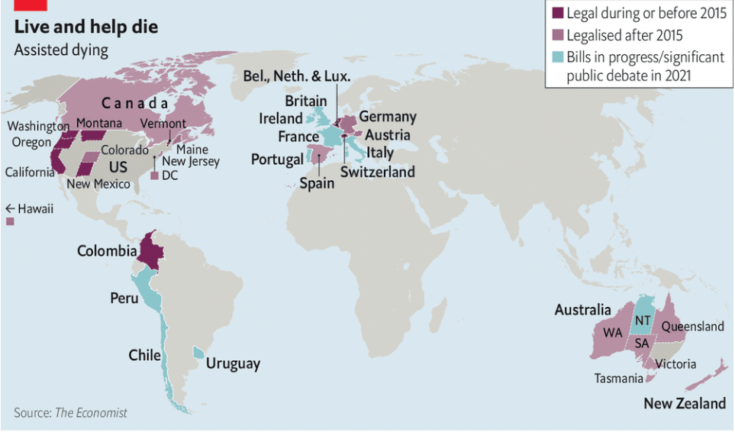
The Economist has an interesting story on laws allowing for physician assisted dying for people with certain health conditions. The first such law was passed in Northern Australia back in 1995. More recently, many other jurisdictions have adopted similar laws. This map caught my eye:With the exception of Hawaii, every single state with assisted dying is also a state where pot is legal.  Notice that these states tend to be in the western US.  (Canada also allows both pot and assisted dying.)  All but Montana are “blue” states. The politics of marijuana legalization is quite interesting.  Support for legal pot is far higher among the public than among politicians (of either party.)  According to the Economist, the same is true of assisted dying: In Britain, an Oregon-style bill passed its second reading in the House of Lords in October. But to become law it would also need the support of the House of Commons and the government, which looks unlikely. Three-quarters of Britons support a right to die, but only 35% of MPs do. Perhaps this reflects the fact that elites don’t like the idea of ordinary people being able to decide for themselves how to live (or die).  Elites like to be in control. On the other hand, for at least one type of assisted dying, support is actually higher among the old than the young (at least in Canada): This is the exact opposite of the case with marijuana, where the young are more in favor of legalization. I wonder what explains the difference?  One possibility is that young people tend to have milder forms of mental illness, which they don’t see as being severe enough to justify terminating a life.  Or perhaps older people with mental illness have just given up hope: John Scully, who has lived with severe depression and ptsd for decades, agrees. At home at night in Toronto, Mr Scully, who is 80, is haunted by the horrors he witnessed as a war correspondent: the dead torn apart by vultures, the AK47 scoped to shoot him. He also experiences physical pain. “There is no cure,” he says. Nineteen shock therapies, countless medications and six stints as a psychiatric patient have failed to bring him relief. The “only help available”, he believes, is assisted dying. He sees it as a far more dignified choice than suicide, which he has attempted twice, and he thinks it would be less painful for his family. Perhaps if you are 30 years old then you can still envision a better future. PS.  You don’t know how depressing it is for me to see Boomers listed as the very oldest group in that chart.    (0 COMMENTS)

/ Learn More

Are taxes the price we pay for civilization?

Autumn is usually the time when countries’ parliaments try to reach an agreement on the amount of taxes to be paid during the twelve months of the coming year. If, as many people seem to believe, “taxes are the price of civilization,” this seems to imply not only that we live under the implicit threat of barbaric chaos, but also that there is some mischievous organization out there which, in order not to unleash that chaos on our doorstep, demands that we pay an expensive ransom. In other words, if taxes are the price of civilization, that is a sign that someone has effectively and successfully claimed for themselves “the monopoly of the legitimate use of physical force” in our common territory. This person, or group, is called the State (it is Max Weber – surely not an anarchist – who states this at the very beginning of his famous essay “Politics as a Vocation”). Curiously enough (or perhaps not), the way that this modern State of ours legitimizes its “monopoly of physical force” is precisely by telling us that such “kidnapping” is done in our name (“we are the state.”) and for our own good (“it was the National Health Service that saved us.”). Nonetheless, the kidnapping remains – and in this, libertarians, beyond looking up to Frederic Bastiat (“The state is the great fiction by which everyone endeavors to live at the expense of everyone else.“), also end up agreeing with Engels: “the state is nothing but a machine for the oppression of one class by another, and indeed in the democratic republic no less than in the monarchy.” What they do not agree on is what constitutes the relevant social classes. The libertarian class struggle is not the one that Karl Marx brought into the world (despite the 3rd volume of his Capital ending precisely when he was at last going to explain us “what constitutes a class“…). To libertarians, as long as this “kidnapping argument” serves as the foundation of government, the class struggle will always be between the governing and the governed (see Dunoyer, Comte and Thierry, or Calhoun), that is, between those who live off the ransom and those who pay for it. As has been noted for several centuries (see La Boétie or David Hume), the rulers, being a minority, would easily be put at a disadvantage in a direct clash. Rulers need to make the citizen believe that they are the only bulwark that prevents the Hobbesian “state of nature” from swallowing up the routine of everyday life. To achieve this, the most effective way is for the State to create an ever-larger layer of the population whose livelihood depends, at least in the short term, on maintaining this civilizational kidnapping – be it by belonging to the literal or figurative (administrative, functional, academic, retired) armies of the State, be it by having close relatives who belong to them, or be it by, say, benefiting from Minotaur-subsidized goods and services. This layer of the population will constitute the class whose interests and “guarantees” ensure the maintenance of the ruling minority. If, in the meantime, one is able to centralize power and undermine the autonomy of all the independent fortifications that could oppose the expansion of the Bismarckian Minotaur, so much the better (on this point, de Jouvenel is required reading). Still, it is interesting – and important! – to note that most liberals in the classical tradition do not support this pessimistic and cynical view of the nature of the state. Ludwig von Mises, who confided with Weber in Vienna for a few months in 1919, goes so far as to claim in his last work that government is “the most necessary and beneficial institution” of life in society. To classical liberals like Mises, “if all men were able to realize that the alternative to peaceful social cooperation is the renunciation of all that distinguishes Homo sapiens from the beasts of prey, and if all had the moral strength always to act accordingly, there would not be any need for the establishment of a social apparatus of coercion and oppression.” To these authors, it is not even correct to say that the State constitutes a “necessary evil,” because in their view the evil is not in the State but in the imperfection of human beings (John Locke, three hundred years earlier, was saying essentially the same thing). Thus, taking both arguments into consideration, perhaps the most sensible thing to do would be to follow Mark Skousen and settle that taxes are, in fact, “the price we pay for failing to build a civilized society”, a definition that is also in line with the Spencerian libertarian ideal, since from it we can derive that “a centrally planned totalitarian state represents a complete defeat for the civilized world, while a totally voluntary society represents its ultimate success.” Now, note the dichotomy that emerges from these two alternative “prices”. If taxes constitute “the price of civilization”, this suggests not only such “civilizational kidnapping” as libertarians see it, but also such social engineering as envisioned by social-progressives, who consider it on the State to foster the advance of civilization. If, on the other hand, taxes are “the price of uncivilization”, such definition makes it clear that the burden is on the individual to promote (and implement) a set of institutions and moral rules that, little by little, fulfill the civilizational fate of mankind and leave behind the “uncivilizational” vestiges of the State – of the “machine for the oppression of one class by another” (something that the communists from Marx’s time would supposedly also like to achieve, but through completely counterproductive means…). Moreover, the economist in me also can’t help noting that, if taxes are “the price of civilization”, then it means that this “good” – i.e. civilization, social peace – is probably the only one whose price has continued to escalate since the dawn of modern civilization, regardless of the monetary policy pursued by the central bank (a development which, in accordance with the libertarian view, does not speak well for government management of this “public good”…). On the other hand, if taxes are seen as “the price of our failing to build a civilized society”, then the reason for our current tax burden becomes clear… So, whatever the reader’s preferred definition of what the State is and should do, I believe that the Fall period could well serve as a sort of “Budget Lent”, in which we honestly reflect on the essence of taxes and the State. Pedro Almeida Jorge is an Economist and Library & Translations Coordinator at Instituto +Liberdade, in Portugal. (0 COMMENTS)

/ Learn More

Great Moment in Shetland

My wife and I finished the first season of the crime drama Shetland on Amazon Prime and are now onto the third season. (It seems that they skipped Season 2.) In the first episode of Season 3, there’s a great scene where one person lays out accurately an illustration of the law of unintended consequences and the other misses the point (maybe on purpose?) and retreats to a line that makes sense only if the first person’s reasoning is right. The main cop, Jimmy Perez, whom my wife and I generally like and who has a lot of integrity, asks a drug addict he knows about a drug that is MDMA (ecstasy) mixed with PMA. The purpose of the PMA, I gather, is to bring down the person after the high he gets with MDMA. This is relatively new on the island. Both the drug addict and Jimmy agree that it’s a toxic mix. The drug addict explains that the reason PMA is added is that it replaces marijuana, which people had used to come down from the ecstasy high. Why replace marijuana? The addict explains that the government has done such a good job of sniffing out weed that comes to the island that the drug sellers needed to come up with a new drug that couldn’t be detected so easily. Thus PMA. Drug Addict: It’s the law of unintended consequences. Jimmy: It’s people trying to make a profit selling PMA. Notice that it’s the drug addict who goes to the fundamentals. It’s true that the reason people newly make money on PMA is that there’s a new demand for it, but the reason there’s a new demand for it is that the government has squeezed out a safer drug. The writing for this show is very good, by the way, and I don’t think it’s my imagination that Jimmy’s retort was too quick and defensive. He probably recognizes at some level, even if only for a split second, that his own law-enforcement colleagues bear some responsibility. The picture above is of PMA. (0 COMMENTS)

/ Learn More