This is my archive

bar

Anne Case and Angus Deaton on health care and wage stagnation

I’ve often cited America’s health care industry as a factor in the slow growth of real wages for unskilled workers.  In a recent Bloomberg interview, Anne Case (AC) and Angus Deaton (AD) make a similar point: AC: One thing that hasn’t come up so far is the role that the health care industry plays in the low-skilled labor market. We tie people’s health insurance to their employment in a way almost no other rich country does. As health care costs have skyrocketed, employers look at a low-skilled worker and think, I really don’t want to pay my share on a $20,000-a-year policy for a working-class family, because this worker is just not worth that plus what I have to pay him or her in wages. We think the healthcare industry has a lot to answer for as well here in terms of destruction of good jobs for less-skilled people. . . . AD: If you think of a $10,000 a year policy, which is for a single person, if that person works 2,000 hours a year, it’s an extra five bucks an hour on the wage. Think of all the fuss around the minimum wage. People don’t talk about this to the same extent, but it’s a horrible drain. It’s like tying dead weight to the less-skilled labor market. So exactly what does the health care industry “have to answer for”?  It’s not price gouging in the ordinary sense of the term.  Rather their actual sin is lobbying for a set of subsidies and barriers to entry that make health care much more expensive than in a free market.  Today, health care spending in the US has risen to roughly 17% of GDP. This might not be a problem if everyone bought health care in proportion to their income.  But that is not the case.  As an analogy, in a free market lower income Americans might buy a 3-year old Chevy compact car, wheres more affluent Americans might buy a brand new Mercedes.  But that sort of rational behavior is heavily restricted in the health care industry, where regulation tends to prevent the provision of cheap and effective alternatives to our very expensive mainstream health care.  Thus health care costs are an especially large share of the budget for lower wage workers, which reduces their living standards.  Some of this is mitigated by various government subsidies, but not all. As always in economics, don’t “follow the money”; you need to “follow the resource allocation”.  Ultimately, our living standards depend on what we produce.  The more labor and capital we allocate to health care (and to our almost equally wasteful education system), the less labor and capital is available to provide nice new cars, houses, restaurant meals, and vacations at Disney World.  No amount of subsidies can paper over that problem.  Nor does it help if the employer supposedly “pays for” your health care. If America devotes lots of resources to health care, then our consumption of other goods will suffer. There is no free lunch. If America insists on an egalitarian health care system where everyone gets the same health care, then it should be a much cheaper system.  I don’t want that sort of one-size-fits-all system.  But if our current system doesn’t improve (i.e. get much cheaper), then the political pressure to move in that direction will be unrelenting. (0 COMMENTS)

/ Learn More

Berkeley’s Swartzberg Implicitly Endorses Great Barrington Declaration

How should you protect yourself? Your precautions depend on your age, health and tolerance for risk, said Dr. John Swartzberg of UC Berkeley’s School of Public Health. “People have to do their own calculus. If they’re very anxious, they’re going to want to do [sic] comfortable doing less,” he said. “What’s your situation? Are you 65 or older? Immunocompromised? Do you have pulmonary disease, diabetes, obesity or cardiac disease? In that circumstance, you’re going to want to do more,” he said. “On the other hand, if you’re 30-something, in great health and boosted, you might not need to do very much.” But remember others, he added. When gathering, plan how you’ll protect the person who is most vulnerable or most anxious. This is from Lisa M. Krueger, “Expert advice on how to get through our fourth wave,” San Jose Mercury News, reprinted in Monterey County Herald, December 19, 2021. These suggestions are quite sensible and they track the recommendations in the Great Barrington Declaration. Of course, critics of my post will point out a big difference: these recommendations, as the last sentence of the second last quoted paragraph above reminds us, are for a post-vaccine world whereas the GBH came out well before the FDA allowed us to have the vaccines. Still, it would be interesting to ask Dr. Swartzberg if his advice would have been any different in April 2020, by which time we knew just how little risk young healthy people were facing from COVID-19. (0 COMMENTS)

/ Learn More

Henry Olsen on Isabelle Ayuso

Henry Olsen interviewed Isabel Díaz Ayuso, the President of the Madrid region, for the Washington Post. She made quite an impression: Free-market conservatives have been looking for a hero in this populist, Trumpian age. They might just have one in the president of the Madrid region, Isabel Díaz Ayuso.   I’ve written before about Ayuso and how she tried, in Madrid, to counter the pandemic and keep contagion under control while avoiding lockdowns and preserving the liberty of individuals in their daily life. She was recently positively portrayed in the Wall Street Journal, too. I think Olsen is right that she is a bright spot for “free-market conservatives”, who have not recently seen many leaders embracing lower taxes and lighter regulations. To her immense credit, Ayuso did so in daring circumstances, in which many a political leader went for an easier pay off: lock down, leave people at home and subsidize them. In Madrid, it is quite amazing to roam around and find her picture in small shops, whose owners are grateful that she allowed them to continue work and earn their living in the same way they used to. Olsen captures her persona, besides her politics: Ayuso is decisive and fluent in the details of government. More important, she speaks passionately about her devotion to liberty. “I believe in freedom,” she says. “I believe in the person, in the individual.” She is also thoroughly modern; a nonreligious, nightlife-loving woman who sports a Depeche Mode tattoo on her forearm. Many young American conservatives yearn for a smart, serious and principled leader like her. Read the whole thing. (0 COMMENTS)

/ Learn More

Like Hayek? Check Out These New Books in Austrian Political Economy

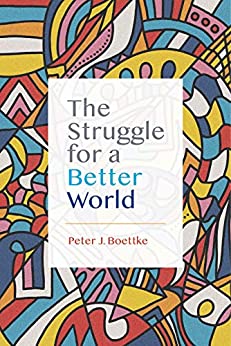
The presses were busy in 2021 with new work in Austrian political economy. The label ‘Austrian economics’ reminds some of early 20th century scholarship on the economic calculation debate, or of the Austrian’s contributions to the earlier marginal revolution. I use the term Austrian political economy to refer instead to the living research agenda that emphasizes social interconnections, process thinking, subjectivism, and patterns of order in the absence of central direction (also known as spontaneous order, emergent order, or invisible hand processes). These new publications very much demonstrate how alive the Austrian-inspired research agenda is today. There’s something here for everyone—the books on this list deal with militarism, propaganda, social movements, civil unrest, monetary policy, public policy, interdisciplinarity, and the future of liberalism. And—as a bonus for those who are interested in the intellectual history of Austrian economics as well as its present—an exciting volume of reprints of sometimes difficult to find writings by the great Karen Vaughn. There’s a good chance I’ve left important and interesting work off this list, so please add to the comments to share any other new Austrian and market-process inspired books. Happy reading!   The Struggle for a Better World, Peter J. Boettke Boettke’s The Struggle for a Better World is a collection of lectures and addresses that bring together decades of deep thought on the future of the Great Society and the viability of a flourishing liberal society. He presents liberalism as a doctrine of emancipation, and challenges those who consider themselves liberal to think deeply about how to bring freedom to those who face oppression.   Money and the Rule of Law: Generality and Predictability in Monetary Institutions, Peter J. Boettke, Alexander William Salter, and Daniel J. Smith A new investigation into the operation of monetary policy that will be of great interest to anybody interested in political economy in general, or the operation of contemporary monetary institutions in particular.   Manufacturing Militarism: U. S. Government Propaganda in the War on Terror, Christopher J. Coyne and Abigail R. Hall In this follow-up to 2018’s Tyranny Comes Home, Coyne and Hall turn their attention to modern day military propaganda. They make the case that military propaganda is not a thing of the past. Rather, the U.S. military actively invests in advertising and information control in order to encourage us to focus on exaggerated foreign threats rather than the dangers posed by our proximity to the United State’s own large and powerful military.   Elinor Ostrom and the Bloomington School: Building a New Approach to Policy and the Social Sciences, eds. Jayme Lemke and Vlad Tarko No doubt a self-interested choice, but as Walter Williams used to say, it’s a sad dog that won’t wag it’s own tail. This volume is in my view a diverse and readable introduction to the Bloomington School of political economy that takes its Austrian foundations seriously. The contributors address Austrian economics, public choice, new institutionalism, behavioral economics, economic sociology, environmental policy, public administration, and more.   Freedom in Contention: Social Movements and Liberal Political Economy, Mikayla Novak Novak studies historical and contemporary social movements in order to better understand how they operate and the role they play in liberal societies. She is heavily influenced by contemporary Austrian thinkers like Pete Boettke, Emily Chamlee-Wright, Don Lavoie, and Virgil Storr, and offers a great deal of food for thought for anybody interested in trying to understand the variety of social changes and movements playing out around us in the world today.   Essays on Austrian Economics and Political Economy, Karen Vaughn Karen Vaughn’s work in and about the Austrian tradition is insightful, careful, and deserves to be more widely read. This new volume is a great opportunity to pick up her work. And, check out this podcast where Karen and I talk about her work and career.     Jayme Lemke is a Senior Research Fellow and Associate Director of Academic and Student Programs at the Mercatus Center at George Mason University and a Senior Fellow in the F.A. Hayek Program for Advanced Study in Philosophy, Politics, and Economics. (0 COMMENTS)

/ Learn More

Contra Caplan on Covid caution

Bryan Caplan has a new post that contests some of the claims I made in my recent post about the regulation of safety.  I do agree with Bryan on several points.  First, most of the Covid regulations were misguided.  Second, today many people are foolishly being far too cautious about Covid.  (I’d add that many people are not cautious enough, i.e. unvaccinated adults.)  But I also disagree on a number of points: 1.  It’s not obvious to me that the widespread Covid caution during 2020 was unwarranted. 2.  I think Bryan underestimates the risk posed by Covid and overestimates the hardship of Covid caution. 3.  I think Bryan puts too much weight on regulatory differences between jurisdictions, which played only a very modest role in Covid caution. 4.  While I oppose some of their draconian restrictions, I’m not convinced that the lifestyle sacrifices in places like Australia were any greater than in America. Part of this post will address specific claims of Bryan, but another part will address claims I’ve seen made by others in the comment section.  So for instance when I talk about “innumeracy”, I’m certainly not talking about Bryan. Bryan suggests the costs of reaction may be 15 times as high as the cost of the pandemic: By my math, the total cost of the reaction for the U.S. was roughly fifteen times the total cost of the pandemic itself.  (Similar calculations for Canada here).  But that’s fifteen times a genuinely enormous cost of 800,000 lives, implying many trillions of dollars of overreaction. He links to a November 24, 2020 post, which cites this estimate: A few weeks ago, the NYT reported that “The Coronavirus Has Claimed 2.5 Million Years of Potential Life.” The earlier post then discusses Caplan’s poll of how much regular life people would trade off for one year of living under Covid restrictions.  He estimates that the average person views a year of Covid life as worth about 5/6 years of regular life, and then makes this claim: So what?  Well, we’ve now endured 8 months of COVID life.  If that’s worth only 5/6ths as much as normal time, the average American has now lost 4/3rds of a month.  Multiplying that by the total American population of 330M, the total loss comes to about 37 million years of life.  That’s about 15 times the reported estimate of the direct cost of COVID. As I’ll explain later, I don’t accept that claim.  But even if it were true, the claim would be meaningless.  To see why, consider this analogy.  Suppose the US could have been 100% shielded from Covid with one small intervention—say a travel ban from China until a vaccine was developed.  (Yes, in practice that wouldn’t have done the job, but consider it as a thought experiment.)  Also suppose that this China travel ban reduced social welfare in America by $1 billion.  Don’t you think most Americans would support it?  Remember, I’m assuming this one small intervention would have reduced Covid deaths in America to zero.  But Bryan’s cost approach would suggest that it’s a bad idea.  Because in that case you’d have a billion dollars in regulatory restrictions weighed against zero Covid costs.  Obviously the correct comparison is with the number of people who would have died without Covid restrictions, not with the restrictions. How could Bryan have made such a basic error?  He didn’t.  In the November 24, 2020 post he added the following: Casual readers will be tempted to declare that the cure has been much worse than the disease.  The right cost-benefit comparison, however, is not to weigh the cost of prevention against the harm endured.  The right cost-benefit comparison is to weigh the cost of prevention against the harm prevented.  You have to ask yourself: If normal life had continued unabated since March, how many additional life-years would have been lost?  I can believe that the number would have been double what we observed, even though no country on Earth has done so poorly.  With effort, I can imagine that the number would have been triple what we observed.  There’s a tiny chance it could have been five times worse.  But fifteen times?  No way. When he wrote this post, the US death toll was under 275,000.  Long time readers know that I have often argued that Covid would have killed 2 million Americans if people took absolutely no precautions to avoid the illness.  A year ago, commenters seemed to view my claim as being far fetched, even though that’s the implication of the 0.6 IFR.  There are two complications, which push the estimate in opposite directions.  Herd immunity might have kicked in at 80% or 90%, somewhat lowering the death toll.  But most of the deaths would have occurred quite rapidly, overwhelming hospitals and before best practices for treatment had been fully worked out.  So I still think 2 million is a ballpark estimate.  We already have over 800,000 dead, and would have had far more if not for the fact that a very high proportion of older people were vaccinated in early 2021 So yes, there is only a “tiny chance” that it could have been 5 times worse, but that’s because it likely would have been 7.5 times worse. In Bryan’s recent post he cites the “15 times” figure without this qualification from the 2020 post.  I’d argue that even if his estimate of Covid costing the equivalent (in utility) of 37 million life years were accurate, the correct ratio would be 2 to 1, or perhaps 5 to 1 if you account for living through 21 months of Covid (although restrictions became less onerous after vaccines, and in my view we should have gone “back to normal” at that time).  But I don’t think the poll results he cites have any value at all, for all sorts of reasons: 1. Most people are whining drama queens 2. Most people focus on costs and forget benefits 3.  Most people are innumerate 4.  Talk is cheap If someone asked me this question in a bar, I might also have thrown out a figure like 5/6ths.  But when I really think about it, that can’t be right.  Most of the costs I faced in 2020 were small.  I wore a mask when visiting the grocery store.  I cut my own hair.  I did takeout rather than in-person dining.  But I still visited my mom in Arizona.  Missing a teeth cleaning was no big deal.  Not having to fly to the office in DC was a big benefit in terms of my utility.  (How many people take into account avoiding all those annoying commutes to work.)  Honestly, there are lots of other things in my life that affect my utility far more than Covid caution–such as health problems. I get that I was one of the lucky ones, and don’t doubt that the average person was more adversely affected.  But I don’t trust their self reported estimates of life equivalents.  I’m not saying that Bryan is clearly wrong, just that these estimates are very unreliable. BTW, if I were a crude utilitarian, I might argue we’d all be better off (in aggregate) if everyone lived a wild, hedonistic, risk-taking lifestyle, which reduced life expectancy by 5% on average.  Then bump up the birthrate enough to prevent any decline in the aggregate flow of life years for the total population.  What do you think of that idea?  Plan to get your son a motorcycle and lifetime cocaine supply for his birthday?  That may seem like a ridiculous analogy, but Bryan isn’t discussing the cost and benefits of specific governmental regulations, his thought experiment involves a world of zero private voluntary Covid caution.  So I can also do far-fetched thought experiments. One problem with the motorcycle and cocaine idea is that it ignores the pain a parent suffers when their son dies in an accident.  Similarly, if I died of Covid, the loss of utility for my (8 years younger) wife would be at least 10 times greater than the loss of utility for an old curmudgeon like me.  (Of course if you take the hedonic set point hypothesis seriously, then almost nothing matters—so ultimately I’m agnostic on all these calculations.) When I read critics on Covid caution (not Bryan), I see a lot of innumeracy.  People talk about a 1% chance of dying as if it’s a small risk.  Only a bit over 2% of US soldiers died in the Vietnam War, and an even smaller percentage in Iraq.  Yet war is pretty risky.  If you had a 1% risk of being bitten by a mosquito, that’s no big deal.  A 1% risk of dying is actually pretty large.  Even worse, at least some of the people who make this claim will also say things like “That horribly dangerous Boeing 737 Max never should have been allowed to fly!”  Really?  Why not? Some argue that the Covid death figures are overstated, even though the alternative excess death data suggests that the official Covid death figures are understated. Or they talk as if there are only two types of people.  “Old people” at high risk of dying and “young people” at extremely low risk.  It’s not that simple.  Old people are more likely to die, but it’s a continuum.  Roughly 200,000 Americans under the age of 65 have died of Covid.  That’s a lot!  Only about 5000 people were under the age of 30, but high school students are often taught by 60-year old teachers.  (That’s not to deny that school closings were greatly excessive, especially after vaccines.)  Or they’ll suggest that society could have been neatly partitioned between “young” and “old”, with the young going on with their lives.  But if my daughter caught Covid, very likely I would have as well.  She was cautious for that reason. Am I old?  I guess at age 66 the answer is yes.  But when I think of my 95-year old mom, I don’t feel like I have one foot in the grave.  Some talk about the risk for the under 65 group being merely people with pre-existing conditions, as if those people are sickly invalids.  But I often see pictures in the media of healthy looking cops who have died of Covid.  On closer inspection, some of them looked a bit overweight.  And of course obesity is a major a pre-existing condition.  I’m rather thin, and play tennis three times a week.  So I’m healthy, right?  Actually I’ve had crappy lungs my entire life, with several bad cases of pneumonia in my 30s. (If I’d been born before antibiotics, I doubt I would have lived to age 40.)  So am I at higher risk?  I honestly don’t know.  But I really don’t see the point of people saying Covid is only a problem for the old and those with pre-existing conditions.  Lots of people have at least one pre-existing condition.  Obesity is not exactly rare in America. And death is not the only risk; people get flu vaccines because getting the flu is unpleasant.  NBA player Joel Embid said after recovering from Covid that he’d felt so sick he thought he was going to die.  Other NBA players have struggled for many weeks to get back to normal.  And these are some of the healthiest people on the planet. Bryan also compares America to other countries: I’m now convinced that the U.S. had the least-bad Covid response of any major English-speaking country.  The United Kingdom, Canada, Ireland, Australia, and New Zealand all beat us in terms of fatalities/population.  But almost no part of the U.S. ever put innocent people under house arrest.  For most of Covid, I lived in one of the strictest regions of the U.S., yet there was never a day I couldn’t walk outside with my family, mask-free.  I never even had to pretend to shop or exercise. I don’t necessarily disagree here, but this issue is trickier than it looks at first glance.  Based on what I’ve read, there are places such as Western Australia where daily life went on normally all though the pandemic, with the exception of travel.  From a utilitarian perspective, it’s not easy to weigh the costs of very strict actions taken against some people, which allow the majority of people to live under much fewer restrictions than in the US.  I tend to oppose most of the restrictions imposed by governments, but I also am not a fan of governments that don’t do enough to control the pandemic, but do have enough restrictions to make our lives more frustrating.  We don’t have the worst of both worlds, but we have the pretty bad of both worlds, whereas Western Australia is worse in one respect and far better in most others—even from a libertarian perspective. And finally, as I’ve previously argued I think people tend to grossly overestimate how much of the response reflects government restrictions, and underestimate how much reflects private actions.  There’s a reason that Sweden’s economy was hit just as hard as the other Nordic countries. When I travel to more restrictive states (Washington) and less restrictive states (Arizona), I hardly notice the difference in government policies at all.  Rather what I notice is different cultures.  Even within California, people in the Bay Area are much more Covid cautious than down here in Orange County.   I’ve never paid any attention to mask mandates.  Like Matt Yglesias, I just look in the window.  If people are wearing masks, I put one on before entering.  If not, then I don’t.  No big deal.  (Wearing a mask is a pain?  All I can say is if you think that’s a major problem, I wish I could have your life!!)  In the spring of 2020, I recall hearing about some sort of “stay at home order”.  But when I went outside, people were strolling along the sidewalk just like normal. To reiterate, I think we are often overreacting to Covid (especially after vaccines), and I am a libertarian who opposes government restrictions except in a few extreme cases.  If a travel ban from China really would have protected us from Covid long enough to help us prepare, I would have reluctantly favored it.  In most cases, however, government regulations have made the problem worse.  But I don’t buy the argument that Covid caution is some sort of huge problem, not when compared to 400,000 Americans being in prison for violating drug laws, and not even compared to residential zoning restrictions.  Most Covid caution in 2020 was justified. (0 COMMENTS)

/ Learn More

Lower Concentration for Consumers

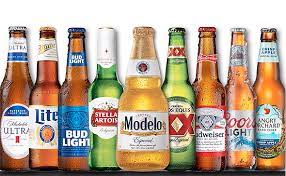
In 2011, I asked the following question on a problem set: About 140 years ago, most—maybe all—major U.S. cities had a number of beer companies that produced and sold beer just for the particular city they were in plus about a 30-mile radius.There were well over 100 beer companies, no one company sold more than about 4% of the total amount of beer sold nationally, and the top 8 companies sold less than 25% of the total amount of beer sold. Then two things happened over the next few decades. (1) Major U.S. cities began to be connected by railroads. (2) Beer companies merged and consolidated:  the number of beer companies fell by half. Question: With fewer beer companies, did the beer market become less competitive than it had been before the railroads?  Why or why not? What I wanted the students to see, and many did see, is that with a decline in shipping costs, there would likely be more companies selling in a given market and so the increase in concentration nationally was irrelevant. If the consumer has more choices, then, all other things equal, the market is more competitive. I thought of that when I came across C. Lanier Benkard, Ali Yurukoglu, and Anthony Lee Zhang, “Concentration in Product Markets,” NBER Working Paper 28745, April 1921. Here’s the abstract: This paper uses new data to reexamine trends in concentration in U.S. markets from 1994 to 2019. The paper’s main contribution is to construct concentration measures that reflect narrowly defined consumption-based product markets, as would be defined in an antitrust setting, while accounting for cross-brand ownership, and to do so over a broad range of consumer goods and services. Our findings differ substantially from well established results using production data. We find that 42.2% of the industries in our sample are “highly concentrated” as defined by the U.S. Horizontal Merger Guidelines, which is much higher than previous results. Also in contrast with the previous literature, we find that product market concentration has been decreasing since 1994. This finding holds at the national level and also when product markets are defined locally in 29 state groups. We find increasing concentration once markets are aggregated to a broader sector level. We argue that these two diverging trends are best explained by a simple theoretical model based on Melitz and Ottaviano (2008), in which the costs of a firm supplying adjacent geographic or product markets falls over time, and efficient firms enter each others’ home product markets. Benkard and Yurukoglu are at Stanford University’s Graduation School of Business and Zhang is at the University of Chicago’s School of Business. Are anti-trusters in the Biden administration familiar with this important finding? Specifically, I wonder if Lina Khan, chair of the Federal Trade Commission knows this and sees its importance for the discussion of competition. (0 COMMENTS)

/ Learn More

Capitalism Breeds Innovation: A Hallmark Christmas Movie Moment

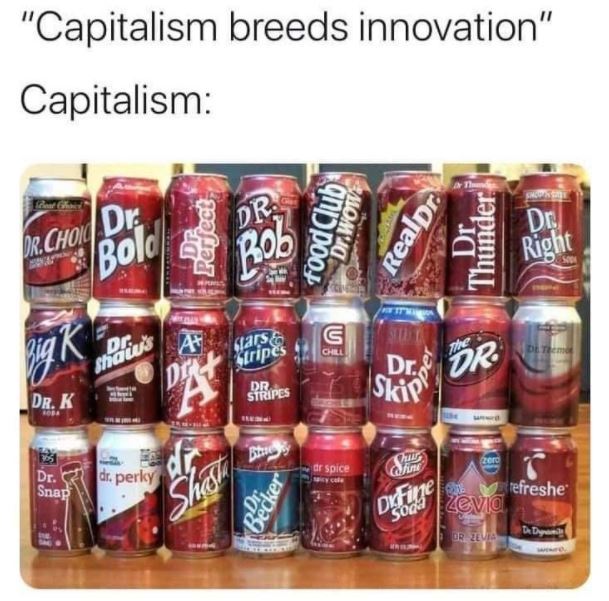
It’s shopping season, which means it’s time to pick on capitalism.  The latest meme for doing that is to create a collage of very similar products and tag it with the comment “Capitalism breeds innovation.” And the latest version of that meme, illustrated here, uses the Hallmark Christmas movie genre as its illustrative example. It’s a good joke. (Though I’m a bigger fan of the prose version that goes: What has 15 actors, four settings, two writers, and one plot? 632 Hallmark movies.) And there is something both creepy and funny about all those smiling, shiny, green and red clad couples posed affectionately on the movie posters.  But it’s a pretty bad criticism of capitalism’s ability to inspire innovation. These Hallmark movies all look alike, it’s true. And they are, in a certain sense, really all alike. But they are alike only in the same way that Coke and Pepsi and their variants are all alike. Or in the way that Dr. Pepper and its knock-off versions (another popular meme target) are all alike.  As anyone who has encountered a die-hard Pepsi or Coke fan knows, there are distinct differences between the two brands, and equally distinct differences among their sub-brands. Coke Zero drinkers want little or nothing to do with Diet Coke, for example, and would probably rather drink water than Diet Pepsi. To me, all their variations taste like overly sweet battery acid mixed with television static, but to connoisseurs, the distinctions among them are subtle, nuanced, and important. And when it comes to all those knock-offs of Dr. Pepper? I’m sure their consumers are similarly loyal to their own favorite version. In addition, to me, there seems to have been considerable creativity put into finding innovative ways to name each of these drinks in order to point consumers to the resemblance to Dr. Pepper, without actually violating its copyright. Equally, while the can’s share some visual similarities, a closer look demonstrates wild innovation in typefaces and other design elements. Many of the cans are also store brands, indicating innovations in price points and purchasing convenience for shoppers–no matter how much the drinks may taste alike to casual consumers. So shouldn’t we approach Hallmark movies with the same assumptions? I cannot see the variety that they surely contain, and I’m not overly interested in watching a few dozen of them in order to discover it. But surely we can trust fellow consumers who do enjoy them, and who have particular favorite films to which they are devoted. They see subtleties and distinctions that many of us do not, and the market is fulfilling their preferences for them. And even if the movies are all essentially indistinguishable, that is, in itself, an innovation. It’s an innovation in marketing, and an innovation in family traditions for many people for whom “watching the new Hallmark movies” is now as much a part of the holiday season as caroling or decorating a tree. I’m not going to spend my December cracking open a Coke or Pepsi while I watch a Hallmark movie. But I’m also not going to spend it claiming that my ability to choose among a few hundred ways to do so is a sign that capitalism is a failure.    (0 COMMENTS)

/ Learn More

Inflation: What Next?

Does the Fed Control Interest Rates? Many economists will tell you that the most important variable to watch to assess the looseness or tightness of monetary policy is the interest rate and, in particular, the federal funds target rate. But while that rate matters and I would certainly want to pay attention to it, neither the federal funds rate nor the Fed’s target for that rate is a good way to assess monetary policy. To see why, it’s important to understand what the federal funds rate is. The federal funds rate is the interest rate that banks charge each other on overnight loans. Why bother borrowing overnight? Because banks must meet daily the reserve requirement that the Fed has set for them. If a bank’s management sees that it will be, say, $30 million short on a given day, it will go into the federal funds market and borrow that money from other banks that have excess reserves. So notice something interesting: even though the Fed sets a target range for the federal funds rate—the target range is currently zero percent to 0.25 percent—it does not participate in the federal funds market. Moreover, because capital markets are global, the Fed, though one of the biggest players in capital markets, is not a large player as a percent of the market. Its sales or purchases of bonds are a small percent of worldwide financial assets. The answer to the subtitle above, therefore, is no. This is an excerpt from David R. Henderson, “Inflation: What Next?” Defining Ideas, December 16, 2021. Another excerpt, estimating my predictive ability: I still think, as I said in May, that there’s less than a 20 percent probability that there will be a twelve-month period between May 2021 and December 2022 over which inflation will be as high as 10 percent. Also in May, I gave an 80 percent probability that there will be a time period between May 2021 and December 2022 over which inflation, measured by the CPI, will be 5 percent or more. That prediction, unfortunately, is looking good. Between May 2021 and November 2021, the CPI rose by 3.85 percent. So if in the next six months the CPI rises by just over 1 percent, my prediction will come true. One of the costs of inflation: Consider the US federal tax system for individual income before 1985. Back then, even if inflation caused your wages or salary to increase at the same rate as overall prices, inflation put many people in a higher tax bracket. And even those who were not put in a higher tax bracket found that a higher percentage of their income was in their top tax bracket. When that happened, even those whose incomes kept pace with inflation found that their after-tax real income was lower than before the inflation. Fortunately, this ended at the federal level in 1985 when inflation-indexing of tax brackets, which was part of the tax act that President Ronald Reagan signed in 1981, began. Interestingly, former Fed vice-chairman and current Princeton University professor Alan Blinder admitted this point in his 1987 book, Hard Heads, Soft Hearts. But shockingly, he said that unless you’re an economist or an accountant, that cost of inflation “will leave you yawning.” Here’s what I wrote in my November 1987 review of his book in Fortune: Where was Blinder during the late 1970s? I knew people with only a high school education who noticed instantly that an 8% increase in their hourly rate translated into only a 6% or so increase in their take-home pay, not enough to stay abreast of inflation. They didn’t yawn when that happened—they got mad, which is one reason taxes ended up being indexed. When I wrote that, I had in mind my secretary, Chrissy Morganello, who completely understood how inflation combined with the unindexed federal income tax to make her worse off. But the federal tax system is not fully indexed. Inflation creates apparent capital gains that are not gains at all. If you buy stock whose value in dollars rises, and then you sell, you will pay tax on the whole gain, which includes the part that simply compensates you for inflation. I call this a “phantom gain.” Also, the income thresholds beyond which you pay taxes on your Social Security income have not been inflation-adjusted in three decades. Finally, many state governments still have not indexed their state income tax brackets for inflation. Read the whole thing. (0 COMMENTS)

/ Learn More

Measuring Overreaction

Scott Sumner is happy to admit that we’ve overreacted to Covid, but presents the overreaction as relatively mild: Pundits often criticize the US government for overreacting to Covid, especially the excessive mandates for masks, vaccines, etc. I share their concern. But I also wonder where some of these people have been. On a list of regulatory overreaction, these mandates don’t even make my “top 100”. For decades, overreaction to tiny safety risks has been getting worse, with no end in sight. Elaborating: Unlike airline crashes, Covid has killed roughly 800,000 Americans, despite all sorts of social distancing, of which nearly 200,000 are less than 65-years old.  Yes, we are overreacting, but it’s not like with airline crashes where the risk is entirely imaginary.  Covid really is somewhat dangerous; not in absolute terms, but at least relative to the almost absurd safety of modern America. In a sense, Scott is completely right.  If you measure overreaction using the ratio of the reaction to the actual harm, then the Covid response probably doesn’t even make the U.S. “top 100.”  After all, many government crusades target “problems” that cause zero harm.  Or, like immigration, negative harm. In another sense, however, Scott is completely wrong.  If you measure overreaction using the total amount of effort that fails a cost-benefit test, then Covid has arguably been the greatest overreaction in U.S. history.  By my math, the total cost of the reaction for the U.S. was roughly fifteen times the total cost of the pandemic itself.  (Similar calculations for Canada here).  But that’s fifteen times a genuinely enormous cost of 800,000 lives, implying many trillions of dollars of overreaction. In contrast: If the total cost of the reaction to shoe bombs was fifteen times the total cost of shoe bombs, the total harm would still be trivial, because shoe bombs themselves are trivial.  You could have a 1000:1 ratio, and the sum of the harm of the overreaction would remain moderate.   You might argue that a 1000:1 ratio is somehow more intellectually jarring.  But if you could push a button to get rid of just one overreaction, you should clearly push the button that undoes more total harm, not the one with the most ludicrous cost/benefit ratio. Sumner also remarks: I don’t disagree with those who point to excessive fear of Covid, but why is anyone surprised?  I’m surprised the regulations aren’t far worse.  Given our history of overreaction, I would have expected us to emulate Australia.  Indeed.  Which is why despite everything, I’m now convinced that the U.S. had the least-bad Covid response of any major English-speaking country.  The United Kingdom, Canada, Ireland, Australia, and New Zealand all beat us in terms of fatalities/population.  But almost no part of the U.S. ever put innocent people under house arrest.  For most of Covid, I lived in one of the strictest regions of the U.S., yet there was never a day I couldn’t walk outside with my family, mask-free.  I never even had to pretend to shop or exercise.   More importantly, due to America’s strange experiment in federalist dictatorship, large swaths of the U.S. returned to near-normalcy in a matter of months.  This didn’t merely allow these states’ original populations to breathe freely again.  It also provided an escape valve for locationally-flexible, risk-tolerant people around the country.  And despite some minor exceptions, no U.S. state seriously tried to close its borders to other states.  Thank you Texas, Florida, and Tennessee, where I’ve now lived for about five months of Covid. Do I damn the U.S. with faint praise?  Sure.  But when I talk to my friends elsewhere in the Anglosphere, I still pity them for the tyranny they’ve endured – and often continue to endure. P.S. Expect light posting for a while.  Happy Holidays to all! (3 COMMENTS)

/ Learn More

Who is hurt most by inflation?

Tyler Cowen has a new Bloomberg column that starts off as follows: With inflation now rising faster than at any time in the last four decades, economists are debating which group suffers more from inflation, the poor or the rich. This kind of economy-wide question is not easy to answer, especially when rates of inflation have been so low in recent times and hard data are scarce. Nor is it obvious how exactly to compare the losses to the poor to the losses to wealthier groups. Nonetheless, the arguments suggest that the poor are likely to take a beating. Tyler’s right that this is not an easy question to answer, as the term ‘inflation’ applies to many different and somewhat unrelated phenomena.  Thus an adverse supply shock that raises the price of specific commodities while reducing real GDP is often called “inflation”.  Inflation is also the outcome of a positive demand shock that raises a broad range of prices while also increasing real GDP.  Not surprisingly, the welfare effects of a shock that decreases real GDP will not be the same as the welfare effects of a shock that increases GDP. And that’s just the beginning.  One must also distinguish between short and long run effects.  I believe that a highly expansionary monetary policy raises welfare in the short run, helping both the poor and the rich (albeit for different reasons–less unemployment for the poor and higher real asset prices for the rich.)  And yet I oppose such policies because I believe the long run effects are quite negative, and more than offset the positive short run impact.  More specifically, highly expansionary monetary policies can create an unstable economy, a cycle of boom and bust.  They also lead to higher real tax rates on investment income, slowing economic growth. Here’s Tyler: The poor is the socioeconomic group that finds it hardest to purchase a home, and real estate seems to be one of the best inflation hedges. U.S. real estate prices have been on a tear for some time, including through the recent inflationary period. Rents are rising at a rapid clip, due to the mix of rising demand and bottlenecked supply. The biggest losers there will be the poor. This is all true, but a word of caution.  While real estate is an inflation hedge, I doubt the recent increase in real estate prices has much to do with that fact.  Rather the price of homes has become increasingly expensive during the 21st century due to a combination of NIMBYism and low real interest rates.  The low real interest rates do not necessarily affect monthly rents, but NIMBYism and tighter regulation on mortgage lending to the working class do push up rents. Certainly real estate is a significant part of “inflation” in an accounting sense.  But in my view it makes more sense to analyze specific products such as housing in a microeconomic context.  How are the poor affected if the real or relative price of housing rises?  In other words, one reason why Tyler’s question is hard to answer is that it is actually multiple questions: 1. What is the impact of an expansionary monetary policy on the poor and rich?  Is the effect different in the short and long run?  Does the effect depend on whether the policy was anticipated or unanticipated?  Does it depend on whether the tax system is indexed to inflation? 2.  What is the effect on the poor of NIMBY regulations that make it more difficult to built homes? 3.  What is the effect on the poor of regulations that restrict health care production, making health care more expensive? 4.  What is the effect on the poor of a decision by OPEC to reduce oil production? And I could name 100 more such questions.  These all get lumped together as “inflation”, and in an accounting sense they are a part of the inflation process.  But they are radically different questions. Here are two somewhat more clearly defined questions: 1. Would the poor in America benefit (on average) if the Fed announced today that its monetary policy going forward would be slightly more contractionary than currently expected by the markets? 2. Would the poor in America benefit (on average) if the Fed announced today that its monetary policy going forward would be much more contractionary than currently expected by the markets? I believe the answer to the first question is yes and the answer to the second question is no.  I’d give the same two answers if you asked me about the middle class.  And I’d give the same answers if you asked me about the rich. PS.  Here’s an analogy.  If patient asked a doctor what was the impact of a fever of 101.4 degrees, the doctor might respond by first ascertaining the cause of the fever.  Inflation is sort of like a fever, evidence of certain underlying conditions affecting the economy.  But the focus should be on the underlying conditions, not the symptom. PPS.  Shorter version of post:  Never reason from a price level change. (0 COMMENTS)

/ Learn More