
This is my archive

bar

James Mackintosh’s Misunderstanding of Markets

Pierre Lemieux pointed out a crucial way in which Wall Street Journal reporter James Mackintosh biased the result with this statement: “Sure, it is true that free markets are the best way to run an economy that is fully competitive, has no unpriced side effects, or ‘externalities,’ such as carbon emissions, and where contracts cover every eventuality.” Pierre pointed out that when you have free markets, no one is “running” the economy. When I went to read Mackintosh’s original news story, “What I Learned About ‘Woke’ Capital and Milton Friedman at the University of Chicago,” June 9, 2023, I found some other major misconceptions on Mackintosh’s part. Start with this sentence in his first paragraph: “I expected to be surrounded by anti-ESG, pro-capitalist supporters of the status quo in American finance.” Which is it? Did he expect to be surrounded by anti-ESG, pro-capitalists or did he expect to be surrounded by supporters of the status quo? It can’t be both. In case Mackintosh hasn’t noticed, with the myriad regulations we have now, the status quo is now far from capitalist. Here’s Mackintosh’s other big error that is as egregious as the one Pierre highlights: “Sure, free markets work—but only when a bunch of vital assumptions hold.” That’s false. Free markets work if a bunch of assumptions hold. They also work well even when many of those assumptions don’t hold. We don’t, for example, need “perfect competition” to have healthy competition among firms. Moreover, as Jon Murphy pointed out in the comments on Pierre’s post, we should ask “work compared to what?” Did Mackintosh look at how well Amtrak is run, how government-built housing works, or how carefully the feds and the California state government handed out unemployment benefits in 2020, to name just three? And I was left wondering whether the economists whose classes he sat in on ever raised that issue. When he was at the University of Chicago, economist Harold Demsetz pointed out in a famous 1969 article that many economists use the “Nirvana approach.” They compare actual markets with ideal government programs run by all-knowing bureaucrats with benevolent motives rather than comparing actual markets with actual government. I’m hoping this was Mackintosh’s failure to understand what the U of Chicago economists were teaching and not the economists’ failure to teach. I’ll end with this stunner. Mackintosh writes, “It takes time for academic work to filter into politics; Friedman’s pro-business radicalism had to wait a decade for Ronald Reagan as the 1970s saw government regulation of evermore areas of the economy.” First, Milton Friedman was not pro-business. He was pro-market, a distinction that Mackintosh seems unaware of. Second, while it’s true that from about 1970 to 1978, government regulation did cover ever more areas of the economy, from worker safety (OSHA) to environmental regulation (the EPA) to oil prices (price controls) to fuel economy (CAFE), the last year of the 1970s and first year of the 1980s, before Ronald Reagan took office, saw massive deregulation: of airlines, trucking, and railroads. That was under Jimmy Carter, not Ronald Reagan. I hope this is just Mackintosh winging it by assuming history rather than checking it. (0 COMMENTS)


/ Learn More

Rebecca Struthers on Watches, Watchmaking, and the Hands of Time

Called “a poem in clockwork,” the self-winding Breguet watch made for Marie Antionette was meant to be the most beautiful example of mechanical art in the world. Yet when she was imprisoned in the Tour du Temple, she wanted only a simple watch that would mark the passing of the hours until her meeting with […] The post Rebecca Struthers on Watches, Watchmaking, and the Hands of Time appeared first on Econlib.

/ Learn More

A rising tide lifts yachts and rowboats

The Financial Times recently interviewed Daron Acemoglu: The research shows that major technological disruption — such as the Industrial Revolution — can flatten wages for an entire class of working people. It also points to the distributional conflict and power dynamics inherent in it. “Yes, you got progress,” Acemoglu says, “but you also had costs that were huge and very long-lasting. A hundred years of much harsher conditions for working people, lower real wages, much worse health and living conditions, less autonomy, greater hierarchy. And the reason that we came out of it wasn’t some law of economics, but rather a grassroots social struggle in which unions, more progressive politics and, ultimately, better institutions played a key role — and a redirection of technological change away from pure automation also contributed importantly.” This is not an accurate description of the Industrial Revolution.  Technological progress greatly raised living standards, especially during the pivotal 19th century. My research focused on the interwar period.  During the late 1920s, the living standard of American blue collar workers was far higher than 100 years earlier.  And yet almost none of the “progressive” ideas advocated by leftists had been put in place.  There was no minimum wage, no federal unemployment compensation, no OSHA, and labor unions were fairly weak.  In 1929, the federal government spent only a bit over 3% of GDP. When trying to understand living standards, it is more helpful to focus on output, not money.   Billionaires have no wish to own a million pairs of pants, or a million cars, or a million refrigerators.  As American industry began churning out vast quantities of consumer goods, it was almost inevitable that the living standard of the average American would rise sharply.  If Apple and Samsung produce a billion phones, then lots of people will end up owning smartphones. That’s not to say that income distribution plays no role in living standards.  For any given average income, a more equal distribution of income will generally provide higher living standards.  But the effects of distribution are completely dwarfed by the effects of technological progress on long run economic growth. PS.  Reason magazine has an excellent article explaining how the Netherlands created modern capitalism, without a strong central government.  This led to the emergence of the world’s first middle class.  Most readers of this blog probably have a middle class lifestyle.  If so, thank the Dutch. (0 COMMENTS)

/ Learn More

How to “Run the Economy” Is a Loaded Question

I will let my readers separate the grain from the chaff—and there is both—in the piece of a Wall Street Journal columnist who spent a few months as a journalist in residence at the University of Chicago’s business school (James Mackintosh, “What I Learned About ‘Woke’ Capital and Milton Friedman at the University of Chicago,” June 9, 2023). I will instead focus on two sentences that reveal a methodology which naturally leads to a preference for some sort of regimented society: Sure, it is true that free markets are the best way to run an economy that is fully competitive, has no unpriced side effects, or “externalities,” such as carbon emissions, and where contracts cover every eventuality. Unfortunately, these conditions aren’t met. If your starting question is what’s the best way to run the economy, you are most likely not to discover that an auto-regulated economy, an economy “run” by nobody, is the most efficient and just. Similarly, if you start with the question “what is the best way to run religion (in society)” or “what is the best way to run marriage” or “what is the best way to run trade,” you will likely not even consider laissez-faire, that is, to let each individual make his own choices. You will see “an economy” as an organization to be managed by some individual or group of individuals. The distinction between an organization and a spontaneous order is emphasized in Friedrich Hayek’s Law, Legislation, and Liberty (notably the first volume). The idea that only unanimously accepted rules can serve as the institutional basis of a society (and an economy) is defended from a different viewpoint by James Buchanan (see his Why I, Too, Am Not a Conservative and, with Geoffrey Brennan, The Reason of Rules). I am pretty sure that my criticism of the WSJ column above would also be accepted by Milton Friedman: he did not either look at society and the economy from the perspective of a philosopher-king. (2 COMMENTS)

/ Learn More

I Disagree with Bob Poole

Show me the contract. In effect, postwar single-family zoning represented an agreement under which homebuyers accepted restrictions on other types of uses in their neighborhood in order to be protected from negative externalities that neighbors might create, without the protection of the covenant provided by single-family zoning. To abolish single-family zoning is a violation of the contract between a municipality and its single-family homeowners. They selected the neighborhood and the house based on the protections offered by prevailing zoning. This is from Robert Poole, “A Brief History of Zoning,” Reason, June 10, 2023. I’ve been reading Bob Poole’s articles since age 18 and have always learned from them. This is the first time I can think of when I strongly disagreed with something he’s written. Bob makes a point that some commenters have made when I’ve argued against zoning: namely that people who bought houses under the zoning rules are being betrayed by the elimination of those rules. Bob even goes so far as to say that the local government had a contract with the home owners. Here’s the problem. There’s no contract. Instead, the government made a regulation, people bought assets with the idea that those regulations would be enforced, and there’s some chance that if the regulations are relaxed or eliminated, people who own those assets will suffer a capital loss. But libertarians aren’t typically in the business of saying that on that basis those regulations should be kept. People who bought medallions giving them the legal power to operate a cab in New York suffered a loss when Uber and Lyft were allowed to operate. Should Uber and Lyft be regulated out of existence? My wife and I own a house in an area that’s zoned R-1. We bought it in 1986 because we liked the house and by using all the cash we had and borrowing and getting gifts from parents, we could barely afford a 10% down payment. But we recognized that the zoning was a government regulation, not a contract. If I could have bought a house in an area that also allowed apartment blocks, and if the presence of those apartment blocks had made our house cheaper, I might have bought such a house. But we didn’t have that option. Whenever government gets rid of restrictive regulations, people who gained from those regulations will lose. But that doesn’t mean that the government violated a contract. Later in his article, Bob points out that state governments often put whole areas off limits for development and implicitly suggests that those limits be relaxed or abolished. I agree. He seems to think that it’s an either/or. Either we abolishing zoning or we abolish growth limits. I say that we should embrace the power of “and” and do both. For more on what I’ve written on zoning, see this and this and this.     (0 COMMENTS)

/ Learn More

Violence, Our Brains, and Our Darkest Selves

Russ Roberts hosts this episode of EconTalk with guest Eric Jacobus. Jacobus is a stuntman, actor, and martial artist who also produces action codes for movies and video games. In this wide-ranging conversation, Roberts and Jacobus talk about mirror neurons, violence, and how animals and humans are different with regard to violence. Let’s hear what you think. Leave your thoughts on the prompts below in the comments, or use them to start a conversation of your own offline. We’re here for it!     1- Roberts and Jacobus discuss the stark contrast in violent escalation between humans and animals. Animals avoid escalation and murder, as Roberts defines violence between animals as theatrical, where animals try to establish dominance as opposed to murdering each other. Roberts and Jacobus discuss the idea of processing intentions where humans have used ‘tools’ to assist them in violent acts. Along with the reality of accessible weaponry, why else are humans quicker to escalate violence than animals are? Why might someone who consumes more violent media or just media content in general be unbothered by or extremely concerned of the threat of violence?   2- Humans and animals both have mirror neurons, which dictate our conclusions about others’ intentions before we can even think about them. Citing Jacobus, we “virtualize everything.” What are some everyday motor actions that you find challenging to anthropomorphize and virtualize to make accurate, instantaneous judgements of others’ intentions? Apart from Jacobus’ and Roberts’ discussion of Muhammad Ali, who can you think of that is a master of ‘virtualizing’ others’ motor functions to their own advantage?   3- Jacobus and Roberts allude to the connection between virtualizing and advertising, where media can play to the sensors of mirror neurons in humans to entice or manipulate their attention. How does imagery in political advertisements utilize mirror neuron stimulants? Can you think of any examples where the media uses mirror neuron stimulants unethically?   4- Roberts and Jacobus highlight Adam Smith’s concept of moral sentiments as being logically adjacent to the idea of mirror neurons. How does the concept of virtualizing relate to Adam Smith’s conception of moral sentiments and the natural feeling of empathy people have for one another? What are your thoughts about the accuracy of mirror neurons over time; how do they develop in us?   5- Roberts discusses his repulsion towards more realistic violence in media, which can evoke depression for viewers; instead, he prefers stylized violence like in Jackie Chan’s films. Why is realistic, brutal violence so popular in shows and movies today? What might it have to do with Roberts’ claim about the darkest parts of ourselves as humans? Can humans confront and temper the parts of ourselves which we hide vicariously through fictional figures or public figures? How does violence in media contribute to humans’ long-lasting propensity to escalate violence in open conflict, with no external rules?   Brennan Beausir is a student at Wabash College studying Philosophy, Politics, and Economics and is a 2023 Summer Scholar at Liberty Fund. (0 COMMENTS)

/ Learn More

A Stunning Subsidy Graph

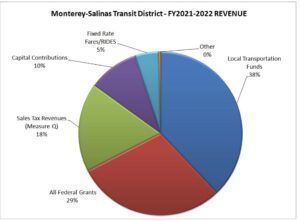
This week, the civil grand jury for Monterey County issued its report on the Monterey-Salinas Transit. It was tasked with answering a specific question. Go here if you want to read more about the question and the grand jury’s answer. But here is what I found striking: fares account for only 5 percent of the MST’s revenues. The rest is subsidies. (0 COMMENTS)

/ Learn More

The Wolf is Getting Closer

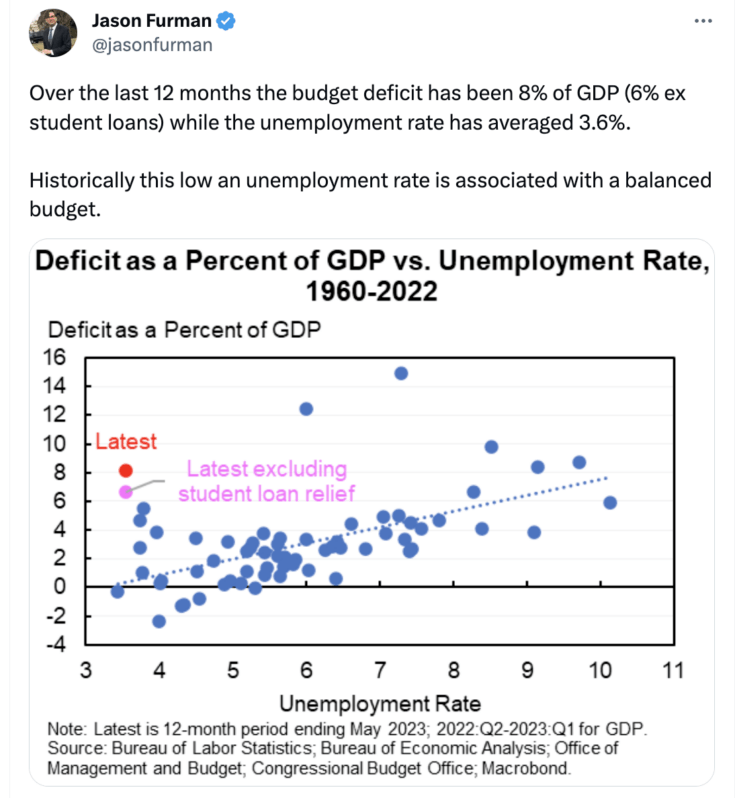
Over the past 90 years, the public has frequently been warned that the US budget deficit would lead to an economic crisis. As in the famous story about the boy who cried wolf, they eventually began to tune out those warnings. And it does no good to cite specific data about the budget deficit rising to hundreds of billions or even trillions of dollars; those figures have no meaning to average people. I suspect that if you polled people on the consequences of a $800 million deficit and a $800 billion dollar deficit, the answers would be similar. But this time is different, as something important has changed. The wolf is not yet at the door, but it’s getting closer. Over the past 5 years, the US budget deficit has shifted to a more unsustainable path. Matt Yglesias directed me to this tweet by Jason Furman: The dotted line is upward sloping because deficits are typically worse during periods of high unemployment, which is as it should be. The further above the dotted line, the more out of line the deficit, given the condition of the business cycle. Back in 2019, I argued that US fiscal policy was the most reckless in US history. It’s not that the budget deficit was all that high (4.6% of GDP), rather it was unusually high given that unemployment was near an all-time low. I knew that things would become far worse in the next recession, although I did not know that the recession would come so soon.   I stand by my claim that (at the time) 2019 fiscal policy was the most reckless in American history, even though each of the next 4 years ended up being even more reckless. In terms of vertical distance above the dotted line, 2020 was the very worst, then 2021, then 2023 (estimated—red dot), then 2022, and then 2019 (roughly tied with 2009.) The consequence of the reckless fiscal policy will not be a financial crisis. Nor will it be a default. Even the permanent monetization of the debt is unlikely, in my view. The most likely consequence will be higher future taxes and slower economic growth. This will lead to reduced living standards. It might also push politics in a more “populist” direction, with consequences that are difficult to predict (but unlikely to be desirable.) P.S.  The distinction between higher taxes and lower spending is less clear than you might assume. Thus one option is a $1000 tax increase on rich people. Another option is a $1000 cut in Social Security benefits for rich people. The first represents higher taxes while the second is lower spending. But the consequences for implicit marginal tax rates are quite similar. (1 COMMENTS)

/ Learn More

Environmental Religion

For years, libertarians and conservatives have charged that much of what passes for environmentalism in the West is little more than faith-based religion. Paul Greenberg and Carl Safina, both environmentalists and university professors, want to make it official.  In their Time magazine article, The Case for Making Earth Day a Religious Holiday, they take full ownership of the charge: For the two of us environmentalists—one of us nominally Jewish, the other a recovering Catholic—we find the ill-defined nature of the only day honoring the place that makes life itself possible more than a little sacrilegious. So, on this 53rd Earth Day we thought it useful to pose what a real Earth Day should represent and how it could form a central time for a new approach to worship. But their ambitions stretch far beyond a single day. Greenberg and Safina also modestly suggest that we “reframe” the Christian holy days of Christmas and Easter; the Jewish holy days of Hanukkah, Passover, and Sukkot; the Indian holy day of Diwali; and the Muslim holy days of Eid “as days of thanks for what the natural world gives and reminders that our responsibility for what remains is an ongoing covenant.” Marriage “might be an opportunity to remind young couples to consider the burden children place upon the planet and to make vows of sustainable patterns of behavior going forward.” Finally, they argue that for environmentalism to become a full-fledged religion, a “Bible of the Natural World” is needed, “replete with hymns to this world of the living,” and containing “the stories of the prophets of natural earth knowledge—Darwin and Carson, Galileo and Humboldt.” “In short,” the authors contend, “We must make nature central to our belief system with Earth Day or any number of earth-focused ceremonial days serving as regular reminders of what we owe our home planet.” What to make of this declaration of faith that each new child is a “burden” to the earth – another mouth to feed rather than a new mind and a new pair of hands? What to make of this call for a return to paganism? This modest suggestion that the world’s major religions be remade in radical environmentalism’s image? This rejection of science in the name of science? I for one welcome it as a forthright admission that they wish to replace discussion, reason, and scientific inquiry with religious dogma. Better a visible adversary than one shrouded behind words and phrases meant to conceal and deflect rather than to enlighten.   Richard Fulmer worked as a mechanical engineer and a systems analyst in industry. He is now retired and does free-lance writing. He has published some fifty articles and book reviews in free market magazines and blogs. With Robert L. Bradley Jr., Richard wrote the book, Energy: The Master Resource (0 COMMENTS)

/ Learn More

Freedom and the Limits of Intellectuals

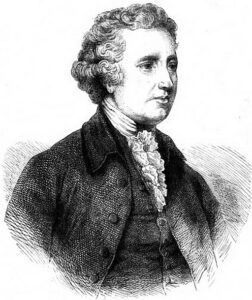
Edmund Burke once said, “It is the nature of all greatness not to be exact.” There is a certain kind of conversation I often have that brings this point to mind. I often argue that we underestimate the degree to which bottom-up, evolved orders can solve the kinds of public goods or externality problems that some insist can only be solved through top-down coercion. Occasionally, an interlocuter will follow up with what they imagine is a killer question – “Do you have a specific mechanism in mind people will use to solve this particular problem?” But asking this question only shows one has misunderstood the argument. Innovation occurs when someone comes up with an idea that nobody has thought of before. By their very nature, innovative ideas can’t be identified in advance. If we already knew what they were, they wouldn’t be innovative ideas, they would be established ideas. Similarly, freedom isn’t simply the liberty to stick to established ideas – freedom means giving people the room to deal with the troubles of life in ways that are new and innovative, ways that haven’t been tried before or specified in advance. In advance, I could not have identified the specific mechanisms people would have used to solve common pool resource problems of the kind Elinor Ostrom made a career out of identifying. Nor could I, in advance, have specified the “custom of the orchard” that emerged among beekeepers to handle the externalities associated with beekeeping. I’ve criticized this sort of thinking with the terribly clunky term “the 5-1 error” before – the inability to see solutions to collective action problems that evolve organically because one can only conceive of them as functioning by known mechanisms specified in advance. There is a certain breed of intellectual who holds their intellect in such high esteem that they fail to grasp how little their own mind can contain about the world around them. Thus, if they cannot see or identify a way for people to solve a problem among themselves, that’s as good as saying no such solution exists. Alternatively, intellectuals of this sort can go a step further, and offer a positive argument for why bottom-up solutions cannot work, thus requiring top-down coercive solutions to be created and imposed by…well, intellectuals such as themselves. In terms of raw brainpower, few people in history could claim to be at the level of John Stuart Mill. Yet Mill had many curious blind spots. He was very concerned with issues of distribution over production, because he believed the potential for productive growth had basically peaked – so all further improvements in the standard of living would have to come about through ever more efficient and clever distribution instead of increased production. He worried that we would soon run out of music to create, because the range of musical notes we can hear is finite and the number of possible note combinations is also finite. From his armchair, he produced an argument for why lighthouses, as public goods, could not be provided on the private market and thus required public provision. But Mill was wrong about all of these things. It should be obvious to the reader how Mill failed to predict how our capacity for production would continue to grow, and that musical innovation has only grown as well. But these are only failures of prediction on Mill’s part. His conclusion about lighthouses was not merely a failure of prediction, it was a failure of observation as well. Even as Mill made that argument, as Michael Munger points out, “most — more than three-quarters — of all lighthouses had been built, and were being operated, by private individuals.” Had Mill gotten out of his armchair and gone out to a port to check, he could have seen that his argument was mistaken, and people found private solutions to the public goods problem. But he saw no need to check – he had his argument showing private actors couldn’t solve the public goods problem and state action was needed. He saw no mechanism which he could specify in advance to solve this problem – which was as good as proving no such mechanism existed. J. E. Meade, too, had his argument for why beekeepers could not solve the externality problems related to beekeeping, and he felt no need to bother to actually check to see if he was right. He couldn’t think of a way to specify a solution, so no solution existed as far as he was concerned. He was wrong too. If people were only granted freedom when its benefits can be identified and specified in advance, freedom and innovation would utterly cease. Too many intellectuals see themselves as fit to set the boundaries on other peoples’ freedoms based on nothing more than the limits of their own understanding. As is often the case, Thomas Sowell said it better than anyone else: Freedom is not simply the right of intellectuals to circulate their merchandise. It is, above all, the right of ordinary people to find elbow room for themselves and a refuge from the rampaging presumptions of their “betters.”     (0 COMMENTS)

/ Learn More