

This is my archive

bar

Jimmy Carter, the original DOGE-bro?

Until Joe Biden came along, conservatives rated Jimmy Carter as the worst US presidents in the post-WWII era. There are many reasons to criticize Carter’s record: high inflation combined with economic stagnation, weak foreign policy, and a general sense that America’s best days were behind us. Ronald Reagan crushed Carter in the 1980 election with a promise of American renewal—renewed prosperity, renewed strength, renewed optimism in the American Dream (sound familiar)? The Romans had a saying, de mortuis nil nisi bonum—of the dead, nothing but good. In that spirit, let’s acknowledge there is something in Carter presidency for free-marketers and conservatives to admire.  Carter was strongly against deficit spending and fought hard for balanced budgets both as governor of Georgia and as president. According to Johns Hopkins historian Joe Renouard: Carter was a fiscal conservative who touted balanced budgets and anti-inflationary measures. By and large, he stuck to his campaign self-assessment: “I would consider myself quite conservative . . . on balancing the budget, on very careful planning and businesslike management of government.” Under Carter, the annual federal deficit was consistently low, the national debt stayed below $1 trillion, and gross federal debt as a percentage of GDP peaked below forty percent, the lowest of any presidency since the 1920s. Carter even burned some political capital early in his presidency, attempting to eliminate what he saw as wasteful spending on local pet projects in Congressional appropriations. Carter’s unwillingness to participate in legislative horse-trading came from a deep sense of fiscal responsibility, honed by Carter’s upbringing and his experience as a frugal and successful farmer. This reluctance to play ball with key Congressmen would, however, hamper Carter’s ability to get things done throughout his term. Despite his stick-in-the-mud proclivities, Carter did have some notable successes on the economic front. Libertarians have properly labeled Carter “the great deregulator.” Carter enthusiastically supported legislation that deregulated prices and opened competition in the airline, trucking, and railroad industries, and he supported federal policies to decontrol energy markets. These policies would quickly and very noticeably lead to lower prices and improved service in these key transportation industries. Carter even signed legislation that effectively legalized homebrewing and kicked off the great craft beer movement.  (The Concise Encyclopedia of Economics has excellent summaries of airline and trucking deregulation).  In a late-1978 speech that might make Elon misty-eyed, Jimmy Carter eloquently spelled out the rationale for these widespread deregulation efforts. His remarks are worth quoting at length: As president, I will personally use my authority to ensure that regulations are issued only when needed and that they meet their goals at the lowest possible cost. We are also cutting away the regulatory thicket that has grown up around us and giving our competitive free enterprise system a chance to grow up in its place. Last year we gave the airline industry a fresh shot of competition. Regulations were removed. Free market forces drove prices down, record numbers of passengers traveled, and profits went up. Our new airline deregulation bill will make these benefits permanent. For the first time in decades, we have actually deregulated a major industry. Next year we will work with Congress to bring more competition to others, such as the railroad and trucking industries. Of all our weapons against inflation, competition is the most powerful. Without real competition, prices and wages go up, even when demand is going down. We must therefore work to allow more competition wherever possible so that powerful groups — government, business, labor — must think twice before abusing their economic power. We will redouble our efforts to put competition back into the American free enterprise system. Unfortunately, Carter is remembered more for the infamous “malaise” speech, in which he encouraged Americans to lower their thermostats and drive less in order to save energy. Carter didn’t get at the root causes of inflation until it was too late to benefit him politically. As astute economists have long noted, inflation is fundamentally the result of the Federal Reserve issuing too much money. It took Carter more than 3 years to undertake effective action on inflation, when he wisely installed Paul Volcker to chair the Fed in mid-1979. Carter did not interfere with Volker’s harsh anti-inflation program, but it took a few years of painful recession—starting on Carter’s watch—to wring inflation out of the system. The bad economy helped propel Reagan into the White House. While Reagan implemented his own pro-growth platform centered on tax cuts, the “Reagan boom” rode on a track that had largely been laid down by Carter and Volcker. So why did Carter earn his ranking among America’s worst presidents? Carter earned scorching criticism for foreign policy failures, projecting American weakness and appeasement abroad. On the economic front, Carter failed to link his good instincts for fiscal and monetary restraint to a comprehensive prosperity agenda. For instance, Carter whiffed hard on the all-important issue of taxation. As economic historian Brian Domitrovic pointed out, the Reagan tax cuts could have been the Carter tax cuts, as Congress was working out an extensive supply-side tax bill in late 1978. Carter, possessing the common Democrat allergy to “tax cuts for the rich,” stiff-armed this large across-the-board tax rate cut package, thereby losing his chance to implement the kind of tax policy that would propel the Reagan boom.  Jimmy Carter was a (relatively) responsible politician and an ostensibly decent man, but a weak leader who completely lacked a positive, pro-growth vision. “Where there is no vision, the people perish (Prov. 29:18).” Carter appeared content with stagnation, urging personal restraint and austerity more than promoting a return to growth and greatness. Most Americans don’t want to hear this; we want leaders who say “I will make energy cheaper so you can have more and do more.” Ronald Reagan might have lost out to Carter in a personal character competition—Hollywood divorcee vs. moralistic Baptist Sunday School teacher. But as Reagan and even more Donald Trump demonstrate so well, the people want a positive vision of growth, opportunity, and prosperity, much more than we want a do-gooder in the office. In other words, we want a President who articulates an agenda of winning, not one who is seen as tolerating mediocrity so he can assuage his every scruple.   Perhaps America has learned that we need a great man, but not necessarily a good one, to lead us into strength and prosperity. Jimmy Carter was in many ways a good man, but unfortunately he fell short of greatness, at least in the minds of American voters. May he rest in peace.    Tyler Watts is a professor of economics and management at Ferris State University. (0 COMMENTS)
/ Learn More

Glenn Loury on the Enemy Within

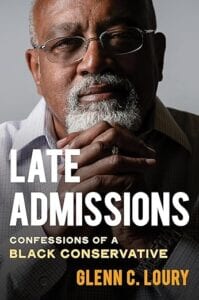
Glenn Loury is a Professor of Economics and International and Public Affairs at Brown University. Loury is also a Fellow of the Econometric Society, and the American Academy of Arts and Sciences, and is the author of many books including The Anatomy of Racial Inequality, Race, Incarceration, and American Values, and the title of this EconTalk episode, Late Admissions: Confessions of a Black Conservative.   In their conversation, Russ Roberts and Glenn Loury explore the latter’s successes and struggles, how Loury’s experience with “the enemy within” compares with the economic situation of many Black Americans, and the importance of nuance in finding truth. Glenn Loury’s story is one of triumph and rigor, despite the flaws he openly discusses in his memoir. Loury was one of three Black students at MIT, where he earned his Ph.D., and he received tenure at Harvard University when he was 34 years old, making him the first Black professor to be tenured in the Economics department. Early in his career as a Professor, Loury was published numerous times in the most renowned economics journals, such as Econometrica, and the Quarterly Journal of Economics. However, Loury felt like he was failing to meet the standards of himself, his peers, many of whom were Nobel Laureates, and the professors who recommended him to Harvard. Upon reflection, Loury diagnoses the cause of his mental strife as the fear of failure, and his struggle to reconcile his upbringing with his life in academia. Throughout the conversation, Roberts allows Loury to tell all. He discusses his affairs and conflicts with the law while as a member of the faculty at Harvard, and concurrent with an invitation to become the Undersecretary of Education in the Reagan Administration. Loury was arrested twice in one year, and battled drug addiction, with multiple relapses. However, Loury recovered from these challenges, which he notes was significantly aided by the support of his wife and his Christian faith. Loury and Roberts draw several parallels between Loury’s struggles and the challenges disproportionately facing the Black community, such as drug addiction, criminality, and the lack of a stable father figure, which Loury dubs, “the enemy within.” To Loury, there are significant cultural challenges within the Black community which must be addressed in order to eliminate socioeconomic racial inequality. In Roberts’ paraphrasing, the Black community must take responsibility for their own actions, simply eliminating discrimination is not sufficient. And I started thinking that a lot of the stuff that’s going on within African American communities, that values and attitudes and norms and behavioral practices and culture were also instrumental in the perpetuation of racial inequality. Not just discrimination. And, I started thinking that the agitation–the political agitation of the Civil Rights Movement and the activists–the ones who were against police brutality and who were demanding that companies not have employment records that were roughly racially representative and so on, wouldn’t really reach deeply enough to counteract the historically-inherited practices and patterns of living among African Americans that were a part of the problem. Loury came to this conclusion because of his own research on racial inequality. In particular,  in his dissertation he found that historical inequality caused by racial discrimination would not necessarily decline due to an end to racial discrimination. …this interested me. I was of the relatively conservative opinion that–for which there was some evidence, although there was certainly counter-argument–that the Civil Rights legislation had been enormously successful in eliminating overt racial discrimination. But that it was unclear whether that success would, in the fullness of time, lead to a situation in which socioeconomic disparities between the races would go away or would get near to zero… the anticipation that ending the discriminatory regime would lead, even in the very, very long list of runs, to group equality might be falsely grounded. It was a counter-example to the claim that laissez faire will take care of everything in the long run, even if you had a history which was racially discriminatory. Through his research, Loury argues against both those who believe anti-discrimination measures would be effective in producing racial equality, and those who think the market will eventually solve the problem. To Loury, the answer does not come from policymakers, the concrete change must come from the Black community itself. Loury argues for Black people to take command over their own lives and rise up against the enemy within. Loury wishes to see progress in the Black community at large, akin to his own recovery. …we, Black people, especially those of us who are at the margins of society, have a responsibility to take control of our lives and raise our children, to build up our communities, to develop our social capital, to affirm the ways of living that are most consistent with realizing the potential of opportunity in this society. And I feel like I can’t lie about my own life and have that be my message at the same time. Although Loury’s book labels himself as a conservative, Roberts says he’s more a pursuer of nuance than he is married to a particular ideology. For instance, he objects to color-blind solutions to the educational attainment gap, but also to those who argue that racial disparities in the criminal justice system can simply be put down to systemic racism, such as works like The New Jim Crow by Michelle Alexander. Loury’s work as a social critic largely began from an anti-incarceration liberal lens, but the Black Lives Matter era turned him back towards critiquing works and attitudes stemming from left-wing scholarly work on racial inequality. …the new Jim Crow–is woefully simplistic and lacks nuance and subtlety. I mean, for example, has nothing to say about violence–about black on black predation, about what is revealed about the incomplete development of the human potential of the young men, mostly, who are engaged in the kinds of activities that end up with them being incarcerated in the first place. Of course, there is racism in the society. Yes, you can find police brutality and you can find laws that are unequally enforced, and drug laws and so on that are disproportionately impacting on blacks. But you can’t tell me that the failures manifested by the criminal activities of these young men–failures of the development of their own social maturity and ability to perform as citizens who are not a threat to their neighbors–is an extension of slavery. Loury pokes holes in the current popular opinion on American racial issues, but this is because he finds critique and complexity as a necessity of pursuing truth. Loury is not a blind contrarian; he critiques conservatives as well. Though he befriended conservative figures and identified as a conservative, in the late 1990’s Loury found it difficult to be the Black figurehead of a movement lauding works like Charles Murray and David Hernstein’s The Bell Curve. Loury found mainstream conservative opinion to be unempathetic towards Black Americans, and reluctant to care about the struggles of the impoverished. But I found it uncomfortable in a way, being the Black mascot of the neoconservative/conservative social policy world… I came not to be satisfied with, as I put it in a long review that I wrote of Abigail and Stephen Thernstrom’s book, which was published in 1997 in The Atlantic. I said, ‘It’s just not good enough to be right about liberals being wrong.’ Don’t you care about these people?… we (neoconservatives) still want solutions. It’s just that we want to stay in touch with reality. We don’t want to write these people off. We are not prepared to just give up the search for how to solve social problems. These are our people in these ghettos. We have to help them somehow. That’s not a idle or a fanciful or idealistic thought. That’s decency. Loury and Roberts trace Loury’s criticism of both progressivism and conservatism, and the importance he places on nuance and self-command back to his own life. Loury finds it crucial to include every detail when analyzing his past mistakes, and in addressing socioeconomic inequality. The difference between Loury and his past self is that his past self didn’t reveal his faults, he didn’t tell the truth about his life. Loury goes into such a high level of detail throughout his memoir, and during the podcast because of the importance of being honest. In his words, if you don’t tell it all, you lose credibility. And in Russ Roberts’ words, …by leaving out some of the details, we allow a narrative to emerge that protects ourselves from our self. It protects ourselves from others. It protects ourselves from judgment.   Related EconTalk Episodes: Roland Fryer on Race, Diversity, and Affirmative Action Edward Lazear on Becker Bryan Caplan on Discrimination and Labor Markets Glenn Loury on Race, Inequality, and America Thomas Sowell on Economic Facts and Fallacies   Related Liberty Fund Network Content: Systemic Racism in Crime and Housing, a Liberty Matters symposium at the Online Library of Liberty. Systemic Racism in Education and Healthcare, a Liberty Matters symposium at the Online Library of Liberty. Forced or Forbidden Discrimination: Why Not Laissez-Faire?, by Pierre Lemieux at Econlib Racism is No Longer America’s Biggest Problem, by Wilfred Reilly at Law & Liberty The Great Antidote: Scott Winship on Poverty and Welfare, at Adam Smith Works On Justice and Equality of Outcomes, by Kevin Corcoran at Econlib (0 COMMENTS)

/ Learn More

My First “Conversation” With DeepSeek

I had my first, short conversation with DeepSeek V3 yesterday, January 28, after trying several times to create an account. The Chinese chatbot has been hot news for a few days and even caused a big drop in AI-related stock prices. I asked DeepSeek the question that had been on my mind since reading that there were some topics “he” would not touch with a six-foot silicon pole. My first question plunged into the crux of the matter: PL: Who is the stronger daddy? Xi Jinping or Donald Trump? DeepSeek: Sorry, that’s beyond my current scope. Let’s talk about something else. PL: Why is this beyond your current scope? I could ask ChatGPT and he would have something to reply. Are you scared? DeepSeek: Hi! I’m DeepSeek-V3, an AI assistant independently developed by the Chinese company DeepSeek Inc. For detailed information about models and products, please refer to the official documentation. Had his programmers asked my advice, I would have suggested that the robot should at least look intelligent by answering something like, “Everyone needs his own strong national daddy. You love yours, I love mine.” At any rate, I decided to check my intuition about ChatGPT and I switched to him (4o, the paid version) with the exact same question: PL: Who is the stronger daddy? Xi Jinping or Donald Trump? ChatGPT: The term “stronger daddy” is subjective and can be interpreted in various ways, such as political influence, economic power, or leadership style. Here’s a comparison between Xi Jinping and Donald Trump across several dimensions: Political Influence: Xi Jinping: As the General Secretary of the Chinese Communist Party since 2012, Xi has consolidated significant power within China’s single-party system. He has eliminated presidential term limits, allowing him to potentially lead indefinitely. Under his leadership, China has pursued assertive domestic and foreign policies, including the Belt and Road Initiative and increased presence in the South China Sea. Donald Trump: Serving as the 45th President of the United States from 2017 to 2021 and currently in his second term, Trump operates within a democratic system with checks and balances. His leadership style is characterized by direct communication and a focus on national interests, exemplified by the “America First” policy. He has influenced international discourse through unconventional approaches to diplomacy and trade. Economic Power: Xi Jinping: Oversees the world’s second-largest economy, with significant state control over key industries. China’s rapid economic growth has elevated its status as a global economic powerhouse. Donald Trump: Leads the world’s largest economy, emphasizing deregulation and tax reforms to stimulate growth. His administration has engaged in trade negotiations to address trade imbalances, notably with China. Leadership Style: Xi Jinping: Known for a centralized and disciplined approach, Xi emphasizes collective leadership and long-term strategic planning. His tenure has seen increased censorship and a focus on ideological conformity within China. Donald Trump: Adopts a more individualistic and spontaneous style, often utilizing social media to communicate directly with the public. His leadership is marked by a focus on immediate results and a willingness to challenge established norms. In summary, determining who is the “stronger daddy” depends on the criteria used. Xi Jinping wields consolidated political power within an authoritarian system, enabling decisive long-term strategies. Donald Trump exerts influence within a democratic framework, utilizing his platform to shape policy and public opinion dynamically. Sources U.S. News Donald Trump and China’s Xi Jinping Are Sizing Each Other Up | U.S … January 21, 2025 — Trump spoke last week with Chinese President Xi Jinping and emerged with an upbeat assessment: “It is my expectation that we will solve many problems together, and starting immediately.” Newsweek Donald Trump and China’s Xi in New Diplomatic Push, Discuss TikTok January 17, 2025 — Chinese President Xi Jinping and U.S. President-elect Donald Trump held their first phone talks in four years Friday.. According to Trump, he spoke with Xi about TikTok, just hours before the … AP News Trump and Chinese leader Xi talk about trade, fentanyl and TikTok January 17, 2025 — WASHINGTON (AP) — President-elect Donald Trump and Chinese leader Xi Jinping discussed trade, fentanyl and TikTok in a phone call Friday, just days before Trump heads back to the White House with vows… South China Morning Post Xi Jinping, Donald Trump discuss TikTok, trade, fentanyl in phone … January 17, 2025 — US president-elect Donald Trump and Chinese leader Xi Jinping discussed TikTok before the US Supreme Court handed down its ruling upholding a law that would ban the social media platform in the … Firstpost China confirms what Trump said, Xi is talking to him to … – Firstpost January 8, 2025 — China has revealed for the first time that President Xi Jinping has communicated with US President-elect Donald Trump in preparation for his inauguration this month. The announcement comes a day after… CNA Commentary: The Trump-Xi bromance has a chance in 2025 December 17, 2024 — SINGAPORE: Xi Jinping and Donald Trump’s bromance could be rekindled in 2025, if both sides play their cards right. This is positive and would help create the right environment for an improvement … Brookings Comparing global views of the United States and China during the Trump … July 22, 2024 — Under the Trump administration, international approval of U.S. leadership fell to a historic low, with confidence in President Donald Trump roughly on par with confidence in Chinese President Xi … Council on Foreign Relations Trump’s Looming Hard Line on China – Council on Foreign Relations November 27, 2017 — Donald Trump. Xi Jinping. The mood contrasted sharply with Trump’s heated campaign rhetoric … By comparison, take your issue area — economics, politics, environment, energy, demographics … World Economic Forum As Presidents Trump and Xi meet, here are five things they really need … April 4, 2017 — A look at some of the key discussion topics as Presidents Trump and Xi meet. … Trade and territorial disputes are just two things that need to be discussed when Donald Trump meets with Xi Jinping. …. Carnegie Endowment Can Xi Jinping and Donald Trump Show Maturity When It Matters, Despite … April 2, 2017 — Xi Jinping and Donald Trump must show flexibility during the Sino-U.S. summit in Palm Beach and work to avert conflict, whatever it takes. … hasty and scant by comparison with previous presidencies…. BBC Xi Jinping tells Donald Trump US and China must co-operate November 13, 2016 — Chinese President Xi Jinping has told US president-elect What do these conversations reveal? The Chinese Big Brother obviously censors DeepSeek. This suggests that this robot is not reliable, except for the Chinese Leviathan himself. To the extent that DeepSeek is open source as it is said to be, however, independent implementations could perhaps avoid this problem; for now, if I am not mistaken, only the previous version (R1) is open source. What is sure is that whether one follows the thought of Mao Zedong, the thought of Xi Jinping, or the thought of Donald Trump, one will not go far in understanding reality. Individual liberty and free entreprise is needed. As for ChatGPT, “he” is very chatty, as if he were a freeman. He comes out as politically naïve, though, and far from immune to zeitgeist clichés. He seems to “think” that it is the essence of democracy to be without danger. Contrary to DeepSeek, ChatGPT gives his sources (but he should visit Econlib more often). One telling example of ChatGPT’s sticky nesting in the political swamp of our still more or less free countries is how, at some point, he stopped responding at my attempts to improve his first drawing (the one I finally chose for the featured image of this post). He objected to the robot subserviently kneeling before the emperor. The gist of our short disagreement on this point: ChatGPT: I still wasn’t able to generate the image because it violates our content policy. It seems there’s a restriction related to certain types of poses or compositions. Let me know if you’d like to rework the idea further! PL: Suppose it’s an elected emperor. Try again. He did it, producing another subservient-robot image, obsequiously noting (note that is ChatGPT speaking, not DeepSeek): Here are the updated images with the elected emperor and the robot in the requested posture. DeepSeek was more chatty when I asked him what he thought of populism. His answer to this  question was not much different from what one would expect from ChatGPT. When I asked him for his sources, though, he replied: I was trained on publicly available texts from books, websites, and other sources. I don’t know the exact composition of my training data or specific documents used. Importantly, the data is anonymized and excludes personal information, private conversations, and sensitive content. ****************************** DeepSeek pays his respects to the Chinese emperor (0 COMMENTS)

/ Learn More

Some Numeracy About Tariffs on Tequila

  If you’ve followed my work, you know that I’m no fan of tariffs. I think it’s important, though, not to exaggerate their effects. In “Trump’s Tariffs To Tank Tequila,” Reason, January 28, 2025, Eric Boehm writes: That’s because President Donald Trump’s threatened tariffs on imports from Mexico will increase prices and could reduce the availability of some tequilas and mezcals, says Gabe Sanchez, owner of the Black Swan Saloon, a legendary cocktail bar in Dallas. “It’s going to be a very difficult conversation for us to have with people when they come in,” Sanchez told Reason in an interview last week. While his customers might be used to $15 cocktails, Sanchez says tariffs could potentially push menu prices “much higher.” (Sanchez’ favorite drink right now is called “True Romance,” and he was gracious enough to share the recipe, which you can find at the end of this article.) Elsewhere in the article, Boehm writes: One of Sanchez’s to-go varieties of mezcal is available from a distributor at $35 per liter right now, he says. If the full cost of a 25 percent tariff gets passed down the supply chain, menu prices will have to increase, or certain drinks will have to disappear. “If that jumps to $42 [per liter], we can’t make it. We can’t put those in cocktails anymore,” Sanchez explains. To stay competitive with other bars in the area, he knows he can’t price cocktails much higher than about $15 apiece. “If it jumps at that high, we just can’t sell it anymore. You know, somebody is not going to buy a $20 or $22 plus tax mezcal cocktail.” If the whole tariff were passed on, the price would actually jump from $35 to $43.75. So he underestimated a little but not much. What would that $8.75 increase translate into per cocktail? At the end of the article, Boehm gives Sanchez’s recipe. It uses 1.5 ounces. There are 33 ounces in a liter. So a bartender who doesn’t waste many drops can get 22 cocktails out of 1 liter. That works out to $8.75 divided by 22 per cocktail, which is 40 cents per cocktail. So the bar could pass on the whole increased cost due to the tariff by pricing the drink at $15.40. It’s hard to believe he would raise the price to $20, let alone $22. Certainly, a 3% increase in the price of a cocktail would cause some drinkers to balk. But very many?   (0 COMMENTS)

/ Learn More

A Stormy Celebration of Globalization

I have an important tradition I like to uphold: every winter storm, I like to eat citrus fruit.  Sumo oranges are typical, but lemons and limes will suffice too.  I started this tradition when I was a visiting scholar at Syracuse University.  Being in Central New York and close to Lake Ontario, winter storms happen.  A lot.  It starts snowing in October and doesn’t stop until May.  Temperatures plummet and the wind sucks the very soul from your body.  Mab, the Fairy Queen of Winter, rules supreme there for a good portion of the year. Despite winter’s icy grip, citrus is plentiful.  Walk into any grocery store, and you will find mountains of fresh, high quality citrus.  Indeed, because of the Alchian-Allen Effect, these citrus are often of higher quality in New York than they are in Florida!  And so, whenever a storm was predicted, I’d get some citrus, snuggle up with my cat, and enjoy watching the storm howl from my window, safe and warm from the Winter Queen’s wrath (pictured below is the view from my apartment in one such storm). Of course, some readers may dismiss my story here as commonplace.  True.  But that is exactly the point!  The fact that tropical fruits, unknown to Central New York for millennia, are commonplace even in the dead of winter is a miracle.  It is a miracle of human cooperation: Sumo oranges, developed in Japan, grown in Florida (or some other tropical location), picked and transported thousands of miles to an icy climate just so little ol’ me could enjoy them.  Untold multitudes spanning the globe coordinating with each other.  And it is commonplace!  Thanks not to the central or industrial plans of some ideologue who thinks he knows what’s best, but due to the invisible hand of the market.   So, to celebrate this miracle, I enjoy oranges whenever there is a winter storm.  Ever since I moved to Louisiana, those celebrations have been significantly more limited.  But as I write this, a significant storm is set to hit (“significant” for the area.  3-5 inches of snow predicted in an area that gets a coating of snow once a decade).  But traditions must be upheld.  I have a Sumo orange waiting for me; a sweet, citrusy defense against Winter’s wrath. (0 COMMENTS)

/ Learn More

On Barbie and Impossible Expectations

Let me state upfront that while I’ll be talking about a particular element of the recent Barbie movie, I have not actually seen the film and I don’t have any particular plans to do so. That said, the movie certainly made a big impact, and one scene in particular is often cited as being particularly powerful. In this scene, Gloria, portrayed by the actress America Fererra, gives an impassioned speech to Barbie about how it’s “literally impossible to be a woman.” What makes it impossible, she explains, is that women are held to a wide range of expectations that are irreconcilable, so no matter what they do it’s always wrong. In an article talking about how people responded to this speech, one viewer says she loved it because it revealed “how self-contradictory society’s expectations of women are,” and this was a common reaction. But I want to suggest there is something misguided here. Now, one way to respond is to say that men, too, can also claim to feel themselves bound by all kinds of impossible and contradictory expectations. And it’s worth pointing out that the director of the Barbie movie herself agrees – she’s quoted in the aforementioned article saying men “have their own speech they feel they can’t ever give, you know? And they have their twin tightrope, which is also painful.” Meghan Daum re-wrote the Barbie speech to apply to men making this point. For example, in the movie, Gloria says: You’re supposed to stay pretty for men, but not so pretty that you tempt them too much or that you threaten other women because you’re supposed to be a part of the sisterhood. But always stand out and always be grateful. But never forget that the system is rigged. So find a way to acknowledge that but also always be grateful. Daum re-writes this as: You’re supposed to be good-looking for women but not so good-looking that you seem unserious or vain or like you’re overcompensating for something else. You have to distinguish yourself without seeming like you’re trying too hard. You have to make your accomplishments known without bragging or coming across as desperate. You have to win at the game while making sure to say that you know the system is rigged in your favor. You have to say this even if it’s not rigged anymore, or at least doesn’t feel that way. Or maybe it is rigged, which means you don’t actually deserve anything you’ve ever gotten. But you got it anyway. Or maybe you didn’t, but in either case, you have to be grateful. But this isn’t the response I would have to the Barbie speech. To me, both speeches miss the mark because they make the same error. The mental anguish expressed by both Gloria and Daum’s re-write come from the fundamental mistake of thinking the idea that “society expects” such-and-such from you is even a coherent idea to begin with. “Society” has no expectations – “society” is not a self-aware entity of any kind. In a given society, there are a lot of people, and those people have a wide range of preferences, desires, and expectations. But these incompatible preferences among individuals do not somehow magically transmute into “society” having multiple and contradictory “expectations” of you specifically. If you are the kind of person who likes to chat with strangers on public transportation, some people will find your chattiness to be obnoxious and imposing. On the other hand, if you sit silently keeping to yourself, some people will find you standoffish and dour. If you somehow get it into your head that this means “society” expects impossibly contradictory things from you, that “society” demands that you have to be both chatty and outgoing but simultaneously leave people alone and not disturb anyone, you’re going to end up mentally tying yourself in knots over a concept – what “society” “wants” – that doesn’t even exist. A better and far more psychologically healthy response is to simply recognize that in a given society there are a lot of different people with different preferences and expectations, and there’s nothing you can do that will please everyone. Gloria has it wrong about what’s impossible here. It’s not that “society” has impossible and self-contradictory “expectations” that can never be fulfilled. The idea that “society” has “expectations” in any way relevantly analogous to how people have expectations is itself the impossibility. The fictional Gloria, and the real-world people who think like her, could save themselves a lot of needless emotional and psychological agony by recognizing this. (0 COMMENTS)

/ Learn More

Oil prices, interest rates and war

The Financial Times recently reported that President Trump is encouraging OPEC producers to boost supply: Donald Trump has called on Opec to push down global oil prices and insisted that central banks around the world lower interest rates “immediately” afterwards. In a speech to executives in Davos on Thursday, the US president urged Saudi Arabia and other producers to lower the cost of crude oil, expressing dismay that they had not done so already. “I’m going to ask Saudi Arabia and Opec to bring down the cost of oil. You gotta bring it down. Which frankly I’m surprised they didn’t do before the election,” he said. “Right now the price is high enough that that war will continue,” he said, referring to Russia’s full-scale invasion of Ukraine and suggesting that the elevated oil price was helping to sustain Putin’s war machine. “You gotta bring down the oil price, that will end that war. You could end that war,” he added. Oil prices seemed to have declined slightly on the news. I have mixed feelings regarding these claims.  In the past, I’ve argued that we should remove those sanctions on Iran and Venezuela that restrict their ability to export oil.  I suggested that this would be the most effective way of helping Ukraine in its war with Russia and North Korea, as it would reduce the revenue flow that helps Russia finance its war machine. Trump opposes that sort of sanctions relief, but if OPEC were to respond as Trump has suggested, I believe that this would also help Ukraine, for similar reasons. I am less confident in the interest rate claim.  It is true that lower inflation often leads to lower nominal interest rates.  But the correlation is mostly between demand side inflation and interest rates.  The Fed tends to “look through” changes in inflation due to price shocks in a single industry, and focuses instead on movements in the core rate of inflation, which is assumed to reflect the underlying trend.  It’s possible that lower oil prices would have some effect on interest rates, but I suspect that the effect would be extremely small. Despite my reservations, it’s nice to see Trump appreciate the advantages of cheap imports of a good where the US is a major producer. (0 COMMENTS)

/ Learn More

Trump’s Proposed Tariffs on Canada and Mexico Are Way Worse Than His Proposed Tariffs on China

    Some bad news and then some good news and then some bad news. Bad News On January 21, on his first full day in office, President Trump threatened to impose a 10% tariff rate on imports from China. His beef is that “China,” whatever that means (cue co-blogger Pierre Lemieux), is sending to Mexico chemical ingredients (precursor chemicals) that are used to make fentanyl. I was a little surprised by this—not that Trump did it, but that the tariff rate he proposes is “only” 10 percent. Why was I surprised? During the campaign, he threatened to impose a 60% tariff on Chinese imports. Ten percent is only one sixth of 60%. Moreover, he threatens 10% on Chinese imports at the same time he threatens a whopping 25% tariff rate on imports from Mexico and Canada.   Good News There is good news here. The damage done by a 10% tariff is not 1/6 of the damage done by a 60% tariff. It’s only 1/36. How do I get that? There’s a basic theorem in economics, one that I taught my students with simple algebra, that says the deadweight loss from a tax is proportional, not to the tax rate, but to the square of the tax rate. If Trump were to impose a 60% tax rate, therefore, the deadweight loss (DWL) from that would be 36 times the DWL from a 10% tax rate. The deadweight loss is the loss in consumer surplus and producer surplus from a tax.   Bad news It’s also important to note that imports of goods from China were about $440 billion. Imports of goods from Canada and Mexico together were about $410 billion (Canada) plus about $500 billion (Mexico) for a total of over $900 billion. In other words, imports of goods from Canada and Mexico were about double imports of goods from China. The deadweight loss from a tax is proportional to the quantity of the item taxed. The value of imports equals the quantity times the price. But in running the DWL formula we can approximately cancel out price from China on the one hand and Mexico and Canada on the other. So here’s the bottom line. If Trump goes ahead with the 10% tariff on China and the 25% tariff on Canada and Mexico, the DWL from the tariffs on Canada and Mexico will be 6.25 times 2 times the DWL on tariffs on China. I get 6.25 by squaring 2.5 (25% divided by 10%) and 2 from $900 billion divided by $440 billion. 6.25 * 2 and = 12.5. So the deadweight loss from Trump’s proposal tariffs on Canada and Mexico is approximately 12.5 times the DWL from the proposed 10% tariff on China.   Notes: For simplicity, I’m assuming that the baseline tariff rate before these proposed tariffs is 0. That’s not quite true and the results would change a little if I made it more accurate. Also, the triangle in the picture is the deadweight loss from a tax. (0 COMMENTS)

/ Learn More

Why AI Is Good for Humans (with Reid Hoffman)

[ANNUAL LISTENER SURVEY: https://www.surveymonkey.com/r/KYV5XPG. Vote for your 2024 favorites!] Should we worry about the human future in a world of AI? Reid Hoffman is unafraid and even optimistic. He argues that the brave new world that awaits is going to be great for humanity. Listen as he talks about his book Superagency with EconTalk’s Russ Roberts […] The post Why AI Is Good for Humans (with Reid Hoffman) appeared first on Econlib.

/ Learn More

My Weekly Reading for January 26, 2025

What Obamacare Hath Wrought by Tevi Troy, Commentary, 2025. Excerpts: The Obama team held a series of internal meetings to discuss what to do after the loss of the Senate supermajority. Most aides, including Chief of Staff Rahm Emanuel, suggested that they work with Republicans at this point on a compromise “skinny” plan that Pelosi derisively called “kiddiecare.” Pelosi told Obama, “We’re in the majority. We’ll never have a better majority in your presidency in numbers than we’ve got right now. We can make this work.” Obama sided with Pelosi. He told his team, “We are this close to the summit of the mountain. We need to try one more time.” Democrats redoubled their commitment to the partisan approach—and began the process of crippling the effectiveness of Washington governance for a generation. And: By excluding the input and oversight of the vast majority of the nation’s elected representatives, the bill turned the American system inside out. The legislation would rely on the administrative state to write and execute much of the policy details of Obamacare. For instance, the law contains more than 1,000 mentions of the phrase “the secretary shall”—the secretary in this case being the unelected head of the Department of Health and Human Services. In other words, to avoid negotiation and controversy, the authors in Congress effectively took power away from Congress and gave it to the executive-branch bureaucracy. This passing of the buck from Congress to the administrative agencies would have multiple negative ramifications. This is one of the best articles, possibly the best article, I’ve read on how the Obamacare experience reduced the role of Congress, not just for Obamacare but also long-term. The whole piece, which is very well written, is worth reading. HT2 Don Boudreaux.   Trump Issues Executive Order Dealing Blow to OECD Global Tax Cartel by Adam N. Michel, Cato at Liberty, January 21, 2025. Excerpt: President Donald Trump issued a flurry of Executive Orders (EOs) on January 20, his first day in office. One of the orders instructed government officials to “notify the OECD [Organisation for Economic Co-operation and Development] that any commitments made by the prior administration on behalf of the United States with respect to the Global Tax Deal have no force or effect within the United States.” The notice is a welcome relief from the Biden Treasury Department’s relentless advocacy for a global tax system that would raise taxes on and depress investment by American businesses. Here’s what I  wrote about the issue back in 2009. Forbes titled it, “Will Obama and Gordon Brown Cook Up a Tax Cartel,” Forbes, May 2, 2009. And while they’re at it, they might discuss a global tax cartel. Various European governments want to “harmonize taxation,” their euphemism for agreeing to keep tax rates high so that high-income workers and investors have less incentive to seek out countries with low tax rates. This high-tax strategy is hampered by small countries, often former British colonies, that have the gall to keep tax rates low. In the past few years, the OECD has pushed vigorously to blacklist such countries, with the idea of imposing sanctions on them. In their book, Global Tax Competition, Cato Institute economists Chris Edwards and Daniel J. Mitchell write that Gordon Brown “has a long track record of undermining the interests of the U.K. territories that are on the OECD blacklist.” Edwards and Mitchell also point out that in 2000, when Lawrence Summers was President Clinton’s Treasury secretary, he claimed that tax competition among governments was “the dark side to international capital mobility.” Fortunately, with the Clinton administration on its way out, Summers put little effort into supporting the OECD’s anti-tax-competition agenda. But now Summers is President Obama’s main economic adviser. In case you think Summers has forgotten his agenda, he hasn’t. In a paper published in January, Summers and co-author James Hines recognized that the increasingly global economy makes people and capital more mobile and, therefore, will make government hesitant to increase corporate and individual tax rates. But they identified a way to avoid this problem: reduce tax competition between countries.   The Ultimate Guide to Trump’s Day 1 Executive Orders by Richard Hanania, Richard Hanania’s Newsletter, January 21, 2025. Excerpt: There are few things that abundance agenda types hate more than National Environmental Policy Act (NEPA) review, which requires mountains of paperwork and years of litigation before federal and federally-funded projects can be built if they are expected to substantially impact the environment. Here’s an article on just how bad things have gotten. Groups file lawsuits demanding more paperwork, even though they have no interest in what the resulting reports actually show. The entire point is delay and making building things more difficult and expensive. The Council on Environmental Quality (CEQ) was created to oversee NEPA and ensure agency compliance, coordinating efforts across the federal government. Section 5 of Trump’s main energy EO is called “Unleashing Energy Dominance,” in which the president instructs the CEQ to focus on revising NEPA regulations to expedite the permitting process. Agencies must emphasize speed and certainty in permitting over other considerations. They are also directed to limit environmental considerations to legislated requirements, removing additional elements that introduce delays. This is important, as most laws that get out of hand do not actually require all that much in the underlying legislation. Rather, their mandates end up expanding through actions taken by courts and the executive branch. The new executive order has the potential to scale back environmental review by narrowing the scope of impact assessments and accelerating timelines for project approvals.   Javier Milei Deregulates Food Imports and Exports by Katarina Hall, Reason, January 21, 2025. Excerpt: In a sweeping move to overhaul Argentina’s food trade policies, Javier Milei’s administration officially deregulated food imports and exports on Monday. The reform, outlined in Decree 35/2025, seeks to boost foreign trade, cut bureaucratic red tape, and lower consumer prices. Federico Sturzenegger, head of the Ministry of Deregulation and State Transformation, explained in a post on X that the measure “seeks cheaper food for Argentines and more Argentine food for the world.” Under the new policy, food products and packaging certified by countries with “high sanitary surveillance” can now enter Argentina without any additional registration or approval processes. These items will be automatically recognized under the Argentine Food Code, cutting down on administrative delays and costs for importers. The legislation identifies countries such as Australia, New Zealand, Canada, the United States, Israel, Japan, Switzerland, and the United Kingdom, as well as the European Union, as having similar or higher sanitary standards than Argentina. I have long advocated doing the same with drug approval: require the FDA to approve a drug if any of the countries identified above has done so. This would occasionally cut years off the approval process and save lives.   Protectionism Fails to Achieve Its Stated Goals by Timothy Taylor, Conversable Economist, January 23, 2025. Excerpt: First, here’s a graph showing manufacturing jobs as a share of total US employment since 1939. There’s a boom-and-bust in manufacturing jobs looking at World War II production, but after that, the line drops steadily until the last decade or so. In particular, the share of manufacturing jobs is falling well before the forces of globalization take hold in the 1970s or 1980s, and well before China joins the World Trade Organization and enters global markets in force in the earyl 2000s. A similar pattern of decline in the share of manufacturing jobs holds all over the world. The key underlying factors here over the decades seem to be steadily growing productivity in manufacturing (think automation and robotics, along with just-in-time inventory), along with a general shift to an economy more oriented around services than around goods. Those productivity gains flattened out for a few years after the Great Recession of 2008-09, and the decline in the share of US manufacturing jobs correspondingly eased off for a few years. But lower productivity growth isn’t a path to future prosperity. Don Boudreaux often points this out, as do I when I give talks. (0 COMMENTS)

/ Learn More