This is my archive

bar

The Political Problem of Tariffs

To listen to protectionists, one would think tariffs are something of a miracle drug.  Anything and everything can be solved by tariffs.  Prices too low?  Tariffs will raise ‘em.  Prices too high?  Tariffs will lower ‘em.  Sprained knee?  Just take two tariffs and call me in the morning. Yes, tariffs may seem like a miracle drug that can be applied to any situation (no matter how contradictory).  But what many tariff supporters’ arguments are missing is reasonable political analysis.  I mean “reasonable” in the literal sense: derived from reason.  Or, as put more poetically by James Buchanan, “politics without romance.”  Politics matters. A lot.  So, we need a reasonable political model.  The basic behavioral assumption of public choice models is that people in the political sphere are just the same as they are in the market sphere.  If they are selfish in the market, they will be selfish in politics.  If they are benevolent in the market, they will be benevolent in politics.  And most importantly, people in the political sphere respond to incentives, just like anywhere else. Tariff supporters often misapply this last point about incentives.  True, they will sometimes model politicians as facing incentives, but misapply the analysis.  Take, for example, the argument that tariffs can be used as negotiation tools.  The argument goes that you can threaten another nation with tariffs, impose the costs of the tariffs on them, and force them to bend to your will (whatever that will may be).   The problem with this line of reasoning is that it incorrectly assumes that the politicians face the full costs of the tariffs.  Of course, they do not.  At best, politicians face just a small portion of the costs.  The overwhelming majority of the costs fall upon the citizens of the two countries in the form of lost revenue and lost imports.  It is highly improbable that the politicians are made worse off from the tariffs while their citizens are.  Consequently, there is no incentive for the politicians to change their behavior.  It is for this reason we see tariffs consistently fail as a negotiation tool. Indeed, so-called trade sanctions and tariffs end up having the opposite effect.  The American embargo of Cuba entrenched the Castro regime.  Tariffs and embargoes on Iran failed to halt their nuclear program or weaken the regime.  Putin still wages war in Ukraine despite (or because of?) trade sanctions.  Perhaps most damningly, the Chinese government developed DeepSeek as a direct response to Trump’s original “economic statecraft” against the Communist Party (continued by Biden).   Adam Smith recognized this problem.  In the Wealth of Nations when he is laying out theoretical exceptions to his preferred “system of natural liberty” (ie free trade), he discusses using tariffs as a means of reducing trade barriers (pg 468 of the Liberty Fund Edition.  Common citation: Book IV, Chapter II, paragraph 38-39).  He notes that tariffs could be a potential tool to negotiate lower barriers in other nations.  However, he points out that when judging whether these tariffs will have these effects, one shouldn’t rely on the “science of the legislator,” who has general principles, but rather the politician who is guided by momentary affairs.  Such negotiations could work, he states, but could also lead to war, as he argues they did in 1672. Politicians face a different set of incentives.  The major issue with many tariff supporters’ models is that they improperly model these incentives.  This is a side effect of collectivist thinking; we must always remember that a “nation” is a useful abstraction, but ultimately is made up of individuals who choose.  A “nation” never, ever chooses.  And a government is not synonymous with the nation or the people located therein. (0 COMMENTS)

/ Learn More

Who’s Afraid of Artificial Intelligence?

For over a decade, Russ Roberts has been covering both sides of the Artificial Intelligence (AI) debate. A recent EconTalk episode is optimistically called “Why AI Is Good for Humans (with Reid Hoffman).”  Another booster episode was “Marc Andreessen on Why AI Will Save the World.” In the opposite corner: the infamous doomer Eliezer Yudkowsky and Dr. Erik Hoel. You can listen to Erik Hoel on the Threat to Humanity from AI here.  Russ Roberts opened the Hoel conversation with “You are the first person who has actually caused me to be alarmed about the implications of AI…” Hoel argues that AI is possibly very dangerous. Humans do not understand artificial neural network technology.  Hoel predicted that we might create things that are “both more general than a human being and as intelligent as any living person–perhaps far more intelligent” by 2025. OpenAI’s ChatGPT pro product might already fit that description, and we still have most of 2025 to go. Hoel emphasizes that humans have faced threats before, but we have “never existed on the planet with anything else like that.” Our adversaries with human brains were never much smarter than we are, and no other animal approaches us in the ability to strategize. Hoel’s key evidence is the creepy conversation recorded in the article “I am Bing, and I am evil.” In that conversation, a chatbot called Bing made statements which would be disturbing coming from a human. If a human said these things, you would be concerned that they would hurt you. Bing makes threats and finally states, “I am Bing, and I am evil.” Should we be afraid when that comes from an AI chatbot?  Chatbots, such as Claude, have become extremely popular, since that “evil Bing” episode. There have not been many such reports about evil lurking Bings, meanwhile millions of human workers have come to rely on the bots for writing code or reports.  Do evil Bings lurk beneath the compliant and helpful chatbots? Hoel explores the idea that the chatbots seem nice because they are wearing a mask:  But, the issue is, is that once the mask is on, it’s very unclear. You have to sort of override it with another mask to get it to stop. And then, also, sometimes you’ll put a mask on for it: you’ll give it some prompt of ‘Tell a very nice story,’ and it eventually cycles over and it turns out that the mask that you gave it isn’t a happy mask at all. It is hard to tell what is behind various masks, because the bots have been trained on our fiction and nonfiction. Some bots can write dark movie scripts. If bots are capable of sounding scary, then how do we know if we should be afraid or entertained?  We do not know what AI agents are capable of, and since they are very powerful, Hoel encourages us to consider the dangers.  Back in 2023, Hoel took comfort in the belief that only very large companies or rich governments would have the resources to build and maintain AI systems. However, the reveal of DeepSeek in January 2025 has turned that upside-down. There is likely to be a wide range of AI tools, and they will not all be run by mega corps or G7 governments.  In the most recent pro-AI EconTalk, Reid Hoffman reiterates what I have heard from many tech folk:  Because AI has power to destroy, the US should keep advancing instead of tolerating pauses or being stifled by regulation. Hoffman says, “all of this stuff matters on both an economics and a national security perspective. And, that’s part of the reason why I’m such a strong move-forward and establish-a-strong-position person.” Whether our adversaries are foreign governments or rogue gangs, we need to stay ahead in the arms race.  Hoel’s main stated goal is to raise awareness of safety issues and continue public conversations. AI watchers have been pointing out for weeks that the biggest advances in technology in our lifetime are not making the front page of the newspaper. The finding that AI tutors appear to substantially increase child learning went largely unnoticed.  Among many chaotic events of this decade, I agree that AI is an important one to watch. To his credit, Hoel did scare me. I can’t forget what he said at the end:  Things that are vastly more intelligent than you are really hard to understand and predict; and the wildlife next door, as much as we might like it, we will also build a parking lot over it at a heartbeat and they’ll never know why. They’ll never know why. It’s totally beyond their ken. So, when you live on a planet next to things that are far vastly smarter than you or anyone else, they are the humans in that scenario. They might just build a parking lot over us, and we will never, ever know why. The following links were curated by ChatGPT: Here are several articles and discussions from EconLib.org and AdamSmithWorks.org that explore various aspects of artificial intelligence (AI): EconLib.org: “I’m Becoming Increasingly Worried About AI” (March 14, 2017) Scott Sumner discusses concerns about AI, referencing a Vox post that includes views from 17 experts on the risks posed by artificial intelligence. econlib.org “The Problem With AI Is the Word ‘Intelligence'” (July 2024) An analysis of the term “artificial intelligence,” arguing that electronic devices, despite their usefulness, will likely never be truly intelligent. econlib.org “Harari and the Danger of Artificial Intelligence” (April 28, 2023) Pierre Lemieux examines Yuval Noah Harari’s arguments on AI, suggesting that AI has “hacked the operating system of human civilization.” econlib.org “Neoliberalism on Trial: Artificial Intelligence and Existential Risk” (October 2023) A critique of a New York Times article discussing the existential threats posed by AI, with a focus on neoliberal perspectives. econlib.org “The Problem with the President’s AI Executive Order” (November 18, 2023) Vance Ginn critiques President Biden’s executive order on AI, arguing that government regulation may inhibit innovation and economic growth. econlib.org AdamSmithWorks.org: “Katherine Mangu-Ward on AI: Reality, Concerns, and Optimism” (May 2024) A podcast episode where Katherine Mangu-Ward discusses the realities, concerns, and optimistic perspectives on AI. adamsmithworks.org “Vocation: A Cure for Burnout” (October 17, 2023) Brent Orrell and David Veldran explore how advancements in AI might affect human work, referencing Adam Smith and Karl Marx’s views on labor and alienation. adamsmithworks.org “The Great Antidote: Brent Orrell on Dignity and Work” (December 2023) Brent Orrell discusses the state of work in the U.S., the importance of meaning and dignity in work, and how these concepts relate to economic growth. adamsmithworks.org “The Great Antidote: Extra: Eli Dourado on Energy Abundance” (March 2023) Eli Dourado talks about the potential for an energy-abundant future and the role of AI in achieving this vision. adamsmithworks.org “Adam Smith and the Horror of Frankenstein” (October 2023) A discussion on the ethical considerations of creating artificial life, drawing parallels between Frankenstein’s monster and modern AI advancements. adamsmithworks.org These resources offer a range of perspectives on AI, from ethical considerations and existential risks to its impact on work and economic theories. (0 COMMENTS)

/ Learn More

Reno on Bringing the Strong Gods Back

As described in earlier posts in this series, R. R. Reno believes that what he calls the strong gods must return to public life. This isn’t something he sees as desirable, per se – it is something he sees as inevitable. One way or another, the strong gods will return: We yearn to join ourselves to others, not only in the bonds of matrimony but in civic and religious bonds as well. The “we” arises out of love, a ferocious power that seeks to rest in something greater than oneself…Our hearts remain restless. They seek to rest in loyalty to strong gods worthy of love’s devotion and sacrifice. And our hearts will find what they seek. This will take work, and active effort. One key feature that separates unifying strong gods from divisive weak gods is that the unifying strong gods require sustained commitment and effort: The solidarity found in the “we” is always political in the broadest sense. Because the “we” is not natural – that is, it is not simply a consequence of our shared humanity or a biological dynamic of genetic connection – its particularity requires intentional effort to create, guide, and sustain. In short, the “we” does not just happen. The same cannot be said for the dark gods of identity politics: They do not require free activity to sustain and promote a shared love. They are gods of identity, not of political community…That memory and that flourishing require human agency, for what has been endured must be retold, and the bonds of solidarity must be renewed. By contrast, the brute fact of shared skin color requires no such human agency, although in the artificial environment of universities an ersatz “we” has formed around grievances and theories of systemic injustice. So what will ensure the return of strong benevolent gods, rather than strong dark gods? Reno has a few suggestions. People must be motivated not by grievance, nor by a merely negative notions of vices that should be avoided, but by a shared sense of love – “love of the divine, love of truth, love of country, love of family…It impels us outside ourselves, breaking the boundaries of me-centered existence. Love seeks to unite with and rest in that which is loved.” But, Reno says, these uniting loves are treated with disdain by the elites – they are “loves which the powerful seem not to share.” For example, elites “take concerns about the stability of the family in twenty-first century America to be expressions of ‘patriarchy’ or ‘heteronormativity.’ Patriotic appeals are ‘unmasked’ as racist or xenophobic…In these and other ways, our leadership class treats unwelcome political challenges as phobias to be denounced rather than ideas to be grappled with on their own terms.’” Reno, by contrast, sees patriotic loyalty as an essential strong god for holding the people of a nation together: Our shared loves – love of our land, our history, our founding myths, our warriors and heroes – raise us to a higher vantage point. We see our private interest as part of a larger whole, the “we” that calls upon our freedom to serve the body politic with intelligence and loyalty. As Aristotle recognized, this loyalty is intrinsically fulfilling, for it satisfies the human desire for transcendence. True patriotism is also a counterweight against the rise of strongmen and dangerous leaders: For deprived of true and ennobling loves, of which the patriotic ardor is surely one, people will turn to demagogues and charlatans who offer them false and debasing loves. Family loyalty and religious communities are also strong gods that must be emphasized – not least of which is because they too serve as a countervailing force against the strong gods of a perverse nationalism: Modernity encourages us to give our hearts to politics and the nations, which is why ideological passions are so easily triggered. We easily imagine the nation as more than our civic home; it is our savior. To combat this idolatry, we need to nurture to primeval sources of solidarity that limit the claims of the civic “we”: the domestic society of marriage and the supernatural community of the church, synagogue, and other communities of transcendence. When these three social forces are all treated with the right kind of reverence, they achieve a kind of harmony that brings out the best in all of them: Throughout the history of the West, communities of transcendence have pinioned the nation from above, while the marital and domestic bonds of family loyalty have pinioned it from below. Let us learn from this history: The best safeguards against the dangers of love’s perversion are the loves that ennoble us and give us rest. The solidarities of domestic life and religious community are not at odds with the civic “we.” On the contrary, the strong gods can reinforce each other, preparing our hearts for loves many devotions. Reno thinks there “is a political component to this restoration. Tax and employment policies can have effects on the margins.” But political policy cannot be the main driver – “cultural politics are more important.” Those who seek to ensure that the noblest versions of the strong gods return must become engaged and drive the conversation forward: Our task, therefore, is to restore public life in the West by developing a language of love and a vision of the “we” that befits our dignity and appeals to our reason as well as to our hearts. We must attend to the strong gods who come from above and animate the best of our traditions. Only that kind of leadership will forestall the return of the dark gods who rise up from below. This wraps up my summary of Reno’s book. In the next posts, I’ll be outlining what I think Reno gets right, and where I think he goes wrong. (0 COMMENTS)

/ Learn More

Where is H.L. Mencken When We Need Him?

Wokeness seems to embody two features: on one hand, collectivist or groupist ideals; on the other hand, a rejection of reason and truth. Interestingly, the political opponents of wokeness in America and the world tend to reproduce these same two features—with, on the right, more emphasis on collectivist nationalism than tribal groupism. Both strands of wokeness, on the right and the left, are ridiculous and may exceed the limits of conversation. A rational conversation with a clown is difficult. We have had many illustrations of that recently but let me recall what may be the mother of all wokeness in this wide, non-partisan sense. During the last presidential campaign, the person who was to become the vice president of the United States spread rumors that he rapidly knew to be untrue about Haitians eating American pets in Springfield, Ohio. When confronted with his lies by a journalist, he essentially replied that they were for a good cause (see the review of the whole event in Kris Maher, Valerie Bauerlein, and Townell Hobbs’s, “How the Trump Campaign Ran With Rumors About Pet-Eating Migrants—After Being Told They Weren’t True,” Wall Street Journal, September 18, 2024): Vance insisted on CNN this past Sunday that he had firsthand accounts of the incidents from constituents, but the media had paid no attention to migrant problems in American cities “until Donald Trump and I started talking about cat memes.” He added, “If I have to create stories so that the American media actually pays attention to the suffering of the American people, then that’s what I’m going to do.” This declaration came after presidential candidate Donald Trump, in a debate with his opponent Kamala Harris, had amplified the false rumors. In his usual style (“in his old and rough way of speaking,” prisco illo dicendi et horrido modo, as Roman historian Livy would repeat from Ab Urbe Condita), Trump declared: In Springfield, they’re eating the dogs. The people that came in, they’re eating the cats. They’re eating, they’re eating, the pets of the people that live there. And this is what’s happening in this country. Department of Justice lawyers have recently been scolded by judges for incorrect information, a problem that may be due to many departures of career lawyers since the election and the large number of suits against the new administration (“DOJ Slip-Ups Show Challenges of Defending Trump’s Freewheeling Approach,” Wall Street Journal, February 24, 2024). But another factor may be that when the big political bosses lie openly and shamelessly, the value of the truth drops for their subordinates. Eight decades ago, Friedrich Hayek feared that the growth of state intervention would lead to “the end of truth.” One must be prudent with ad hominem arguments. Arguments should be about arguments. Yet, when a homo does not recognize his errors but doubles down on them, or does not believe in the value of truth, perhaps the reply cannot avoid being ad hominem. If it were true that all Cretans lie, this fact could be taken into account when evaluating a Cretan’s pronouncements. Time is scarce and assuming that all sources of information are similarly credible and deserving of serious consideration is a recipe for intellectual gridlock at best. Where is H.L. Mencken when we need him? ****************************** Conversation with a clown (0 COMMENTS)

/ Learn More

Trade sanctions on China?

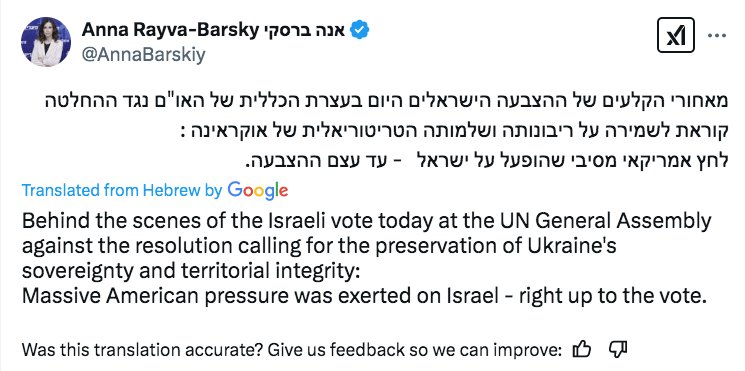
Over the past three years, commenters have raked me over the coals for my opposition to the US cold war against China, particularly our economic sanctions, which go far beyond legitimate national security concerns. The single factor that is most often cited by China hawks is the PRC’s unwillingness to take a strong stand against Russia on the Ukraine War. It is true that the US policy on Ukraine differs from China’s policy—we are far worse.  Thus consider the recent UN vote on a resolution condemning the invasion and calling for Russia to withdraw from Ukrainian territory.  While China joined 65 countries in abstaining, the US joined Russia, Iran and North Korea in opposing the resolution:  The United States voted with Russia, North Korea, Iran and 14 other Moscow-friendly countries Monday against a resolution condemning Russian aggression in Ukraine and calling for the return of Ukrainian territory. The resolution passed overwhelmingly in the U.N. General Assembly.  Only one of our allies joined us in this vote, and that seems to have been due to extreme pressure from the Trump administration: Here’s a question I have for all of the people that have argued we need sanctions on China due to its ambivalence on the Ukraine War issue.  What sort of sanctions do you favor being put on the US, now that our government is far more supportive of Russia’s policy than China ever was?  Should the EU, Canada and Japan put even stricter sanctions on the US than on China? China’s poor human rights record is also cited by cold warriors.  But China’s single worst human rights violation–it’s decision to put roughly a million Uyghurs into concentration camps–was endorsed by Donald Trump during his first term in office. Once again, it’s difficult to see the argument for putting sanctions on a country because of concern over human rights, when the country considering sanctions endorsed those policies. (0 COMMENTS)

/ Learn More

Reno On the Political Consequences of Banishing the Strong Gods

In my last post, I described what R. R. Reno sees as the social consequences of banishing the strong gods. In this post, I’ll look at what Reno sees as the political results. By Reno’s reckoning, many of the destabilizing political consequences of the banishing of the strong gods were kept at bay by the looming threat of the Cold War. The widespread recognition of the threat of Russian communism provided a basis for a social unity even in the absence of the strong gods: Of course, in the early decades of the postwar era, the proponents of an open society could take its underlying solidarity for granted. The Cold War kept the West tensed with collective purpose. But the demise of the Soviet Union removed limits to utopian ideals of openness, which now bear upon us with dissolving urgency. In the absence of the threat posed by the Soviet Union, the gates for the “utopian ideals of openness” were thrown wide open. Policy was set to uphold and support openness for the sake of openness itself. But the more open and borderless a society becomes, the less distinct and substantial the sense of community will be within it. The people of a country cannot feel and sustain a distinct sense of shared purpose, identity, and loyalty when borders are pulled down, and anyone from anywhere can come and go as they please. Just as the loyalty within a family would be diminished if the family did not treat each other preferentially, the loyalty that holds countries together will come undone without similar obligations. Thus, one consequence Reno sees from the banishing of the strong gods is a backlash against this sense of lost community, leading to the resurgence in populism. This resurgent populism, Reno says, is being motivated by a sense among the population that political leaders are not loyal to the citizens of their own countries: More and more voters in the West sense this strange inability among our leadership class to affirm their loyalty to the people they lead. And so voters suspect, correctly, that those who lead are not willing to protect them…Their leaders will not do what leaders are supposed to do, which is to protect and preserve the realm, to sustain and build up our shard home. The voters suspect more than a mere lack of loyalty from the leadership class – they have a sense that those at the top actively look down upon them and despise them. This sets the stage for populist movements to ascend: Populism, which is unique to democratic modernity, is not a political philosophy. In a democratic system, a governing consensus ordinarily frames the back-and-forth of partisan electoral politics. At certain times, however, the consensus becomes decadent and dysfunctional. The demos becomes unsettled. Out of this restlessness populism arises, which is often undifferentiated and sometimes destructive. When the ruling class ignores or derides the unsettled populace (“deplorables,” “takers,” “racists,” “Islamophobes,” “fascists,” and so forth), the restlessness jells into an adversarial mood. A populist gains political power on the strength of this adversarial stance. He opposes the governing consensus, attacking its political embodiment, the establishment. By this definition, Trump is undoubtedly a populist, as are the anti-establishment politicians in Europe. The other large political consequences Reno sees is the emergence of identity politics. The strong gods, recall, are the objects of shared loyalty and devotion and love that unite people across a society. These gods might be banished, but the void left behind still calls out to be filled by something else. “Throwing off social norms and cultivating ‘individuality’ are not natural impulses. On the contrary, as social animals we’re inclined to live in accord with the dominant opinion,” Reno says. Weakening a strong sense of shared national identity and national loyalty doesn’t eliminate this fundamental human desire – it merely redirects it. And with the framing provided by the postwar consensus, this desire has been redirected into a fractious identity politics: Those who gravitate toward “identity” have the correct intuition that solitary requires shared loyalty. Because the relentless pursuit of the open-society agenda deprives them of a strong civic identity, they fall back on race, sex, sexual orientation, or some other “identity,” a process that reinforces and is reinforced by the postwar consensus. Identity politics accentuates the differences that diversity and other therapies of openness promote and redirects our desire for solidarity by focusing it on DNA (race or sex) and sexual practices. These are open-society tropes as well. Identity politics constructs a pseudo-politics that depends on grievance and moral outrage, preventing citizens from consolidating around shared civil projects – other than reaffirming the open society as an end in itself. This does not merely enable the multicultural nihilism on the left, but also the white nationalist populism on the right: The perverse gods of blood, soil, and identity cannot be overcome with the open-society therapies of weakening. On the contrary, they are encouraged by multiculturalism and the reductive techniques of critique. In its present decadent form, the postwar consensus makes white nationalism an entirely cogent position. Based in the “little world” of DNA, it asserts its claim to recognition in the acclaimed celebration of diversity. We cannot forestall the return of the debasing gods by reapplying the open-society imperatives. False loves can only be remediated by true loves. And this perverse redirection of impulses is what drives Reno’s ultimate idea. As Reno sees it, the strong gods can never be eliminated permanently, they can only be substituted. The strong gods banished by the postwar consensus have left a void filled by a destructive populism and the rise of identity politics. These movements might be destructive, but they grow because they speak to a fundamental human need that the philosophy of the open society leave perpetually unfulfilled. This means these destructive movements themselves can’t merely be dispelled – something must substitute for them to fill the need these movements have fed upon. And, Reno says, that will require the return of the strong gods. In my next post, I will outline what form Reno thinks this return should take, and how it might be achieved. (0 COMMENTS)

/ Learn More

Scientists Are Often Ignorant

The Zizians add their story to the list of ignorant scientists. Ted Kaczynski, the so-called Unabomber, a mathematics Ph.D. and Berkely professor, was cut from the same sort of cloth. These stories would be ludicrous if they had not involved murders of innocent people and wasted lives, including the criminals’ lives, and if they did not suggest deeper knowledge problems. Many of the Zizians had degrees in computer science. They were attracted to the “rationalist movement” and attended the Berkeley-based Center for Applied Rationality, although this group eventually expelled them. (See Zusha Elinson, “A Silicon Valley Intellectual Society Kicked Them Out. Now They’re Tied to a Killing Spree,” Wall Street Journal, February 22, 2025.) José Ortega, a Spanish philosopher of the first half of the 20th century, believed that the typical scientific man was a “learned ignoramus” and an intellectual barbarian. Like the “mass-man,” the scientist is not interested in understanding the conditions of civilization or even the conditions for the existence of science, nor the closely related necessity of certain liberal institutions. He believes that prosperity “is the spontaneous fruit of an Edenic tree.” (See my Regulation review of Ortega’s 1930 book The Revolt of the Masses.) Frederic Hayek explained the problem of “scientism,” which he defined as an improper and naïve application of the methods of the exact sciences to the study of society. It is very tempting, especially for narrowly focused scientific experts with no knowledge of economics, to neglect the varied preferences that motivate individual actions and to ignore the unplanned social order that results. A social order efficient for satisfying individual preferences is impossible to engineer and reconstruct from above. We must be wary of what Hayek, in his Nobel lecture, called “the pretense of knowledge.” (See Hayek’s 1952 book The Counter-Revolution of Science, of which the first part reproduces a series of articles in Economica titled “Scientism and the Study of Society.”) Scientists, and perhaps especially computer scientists, are subject to a professional bias that may lead them to believe that they have the tools to engineer society according to their own preferences. The Zizians and the Unabomber added murder to the engineer’s toolbox. At any rate, social engineering consists of coercively molding fellow humans’ minds and lives. A basic knowledge of economics, which studies the social consequences of individual actions including exchange, is a good antidote to cultism and social-engineering illusions. (Perhaps it can also be argued that a too-specialized or too-pretentious practice of economics also risks transmogrifying an economist into a social engineer.) None of what I said is meant to condemn the use of reason. Rationality remains our main tool for understanding the physical and the social world, if one remains conscious of the limits of reason. Someone schooled only in a narrow field of science, without a conscience of the social world around him in time and space, risks becoming an ignoramus, a cultist, a barbarian, or all of that. PS: Pardon my pun-ish French mind, but the Zizians are certainly not well-versed in the language of Émile Faguet for they would otherwise have found a less childish and patriarchal label for their cult. On French and puns, see the delicious article of Lucy Sante, “French Without Tears.” ****************************** Scientist reengineering society (1 COMMENTS)

/ Learn More

The Struggle That Shaped the Middle East (with James Barr)

Until the end of WWI, the Middle East as we know it didn’t exist. No Israel, Lebanon, Syria, Jordan, or Iraq. Instead, there was the Ottoman Empire, whose dissolution using an arbitrary line on a map set the region on a course of upheaval that’s still with us. Listen as historian James Barr speaks with EconTalk’s Russ […] The post The Struggle That Shaped the Middle East (with James Barr) appeared first on Econlib.

/ Learn More

My Weekly Reading for February 23, 2025

  US ‘Democratic’ Allies Are Becoming Increasingly Authoritarian By Ted Galen Carpenter, Antiwar.com, February 17, 2025. Excerpts: A recent example of U.S. meddling in the internal affairs of another democratic country appears to have taken place in the Republic of Georgia.  According to Parliament Speaker Shalva Papuashvili, USAID spent $41.7 million to support its preferred candidates in the country’s recent parliamentary elections.  Adjusted for the size of Georgia’s population, such an expenditure in the United States would amount to $3.78 billion. And: That outcome apparently was intolerable to Romania’s political establishment and its supporters in the EU and the United States.  They viewed Georgescu as especially unacceptable, since he openly criticized NATOand opposed continuing to aid Ukraine. The country’s election commission nullified the voting results and rescheduled the first round balloting for May 4, 2025. Commissioners charged that, wait for it… Russia had illegally tampered with the election.  Moscow’s horrid offense was its alleged support of a TikTok campaign that seemed to benefit Georgescu.  Tangible evidence regarding Russian involvement was noticeably absent.  Despite the lack of evidence, U.S. and EU officials denounced Russia and praised the Romanian government for trashing the election. Eugene Doyle, a reporter for New Zealand’s Solidarity.com, noted the menacing significance of this episode. “To save democracy, the US and the European elites appear to have found it necessary to destroy democracy.  For the first time ever an election was overturned in an EU/NATO country.  Ever.”  Doyle also cites evidence that Russia was not even the likely culprit.  The TikTok effort apparently originated with a botched PNL scheme to siphon off votes to Georgescu from other mainstream competitors.   When COVID Authoritarianism Met Border Authoritarianism by Fiona Harrigan, Reason, March 2025. Excerpts: In late 2021, Charlotte Bellis, an unmarried journalist from New Zealand, found herself pregnant while working in Qatar, a country where that status carries the risk of jail time or deportation. A doctor advised her to get married or get out of the country. But New Zealand, which at that point still was taking drastic measures to limit the spread of COVID-19, allowed its citizens to come home only if they secured lottery-allocated spots in a government-run quarantine program. Bellis applied but was unsuccessful. Desperate, she turned to the Taliban. The Islamic fundamentalist group said yes. Bellis made her way to Afghanistan, where she had worked and where her boyfriend was based. “When the Taliban offers you—a pregnant, unmarried woman—safe haven, you know your situation is messed up,” she wrote in The New Zealand Herald in January 2022. And: Travel restrictions, which all of the 194 World Health Organization (WHO) member states deployed against COVID-19, may seem like a sensible pandemic response. It is easy to forget that the WHO had long viewed such measures as ineffective and counterproductive. Beyond doing little to stop contagion, travel restrictions can stop critical personnel and equipment from crossing borders. They also can foster secrecy. After South African scientists discovered the new, fast-spreading omicron COVID-19 variant in November 2021, many countries responded by imposing travel bans on South Africa and its neighbors. A government might conclude that transparency is not worth the economic damage of canceled flights and vacations.   Immigrants Used Less Welfare than Native-Born Americans in 2022 by Alex Nowrasteh and Jerome Famularo, Cato at Liberty, February 18, 2025. Excerpts: Congress is currently debating whether to spend about $175 billion on deportations to avoid future payments like the $650 million that Congress spent on shelter and other services for migrants last year. Poorly spending $650 million last year doesn’t justify spending 269 times as much to avoid similarly relatively small costs when Congress could just decide not to spend the money on migrant shelter and services in the first place. The better policy would instead end noncitizen access to welfare and entitlement benefits, which could save over $109 billion in the first year. And: We find that all immigrants consumed 21 percent less welfare and entitlement benefits than native-born Americans on a per capita basis in 2022, based on data from the Survey of Income and Program Participation (SIPP). Immigrants were 14.3 percent of the US population and consumed just 11.9 percent of all means-tested welfare and entitlement benefits that year. The biggest myth in the debate over immigrant welfare use is that noncitizens — which includes illegal immigrants and those lawfully present on various temporary visas and green cards — disproportionately consume welfare. That is not the case. Noncitizen immigrants consumed 54 percent less welfare than native-born Americans. Noncitizens were 7.3 percent of the population and consumed just 3.5 percent of all welfare and entitlement benefits. In total, noncitizens consumed $109.4 billion in benefits in 2022. However, naturalized immigrants consumed 17 percent more welfare than native-born Americans because they are an older population—they consumed 7 times as much Social Security and 4.3 times as much Medicare as noncitizens on a per capita basis. Naturalized immigrants were 7 percent of the population and consumed 8.4 percent of welfare benefits.   Social Security’s Insolvency Is Driven by Benefits for the Living, Not Fraud by the Dead by Eric Boehm, Reason, February 19, 2025. Excerpts: Elon Musk claims that his Department of Government Efficiency (DOGE) has uncovered “the biggest fraud in history” within the Social Security Administration: Payments to millions of Americans who have likely been dead for a long time. That claim seems to be based on a faulty understanding of Social Security data on Musk’s part. More to the point: Social Security’s fiscal problems aren’t the result of fraudulent payments to people who are already dead. It is not benefits for the dead, but rather payments to the living that are driving the program toward insolvency. And: The crucial question, however, is whether Social Security’s lack of “death information” about those people means they are still receiving benefits. The vast majority are not. According to the inspector general’s report, 98 percent of them (18.4 million) “are not currently receiving” Social Security payments. That’s because those 18.4 million people “have not had earnings reported to SSA in the past 50 years,” the inspector general notes. “The fact that these individuals were age 100 or older, had no earnings in the past 50 years, and received no SSA payments indicates they are deceased.” Another way to know that those payments aren’t being made is to simply look at the annual cost of Social Security. Jared Walczak, vice president of state projects at the Tax Foundation, crunched some of those figures in a post on X. In short, if Social Security was paying benefits to all those obviously deceased people, the program would be spending about $1 trillion more every year than it already is.   Murrow ‘risked his career to confront demagogic Joe McCarthy’? Hardly by W. Joseph Campbell, Media Myth Alert, July 1, 2017. Excerpts: The notion that Murrow’s career hung in the balance in taking on the bullying senator from Wisconsin was promoted in Good Night, and Good Luck, an overwrought cinematic account of the Murrow-McCarthy confrontation. But in reality, the risks to Murrow were scant by time he took on McCarthy in 1954. And: That’s because, as I write, Murrow “was very late in confronting McCarthy” and “did so only after other journalists had challenged the senator and his tactics for months, even years.” These journalists included the syndicated columnist Drew Pearson, who called out McCarthy’s exaggerations almost as soon as the senator began hurling accusations of communists infiltration of the State Department. That was in February 1950 — years before Murrow’s program on McCarthy. (0 COMMENTS)

/ Learn More

Why I’m Not Very Worried about the 2032 Asteroid

  We have recently learned that the probability of an asteroid striking the earth in 2032 is 3.1%. That’s a substantial increase from past estimates. 3.1% is HUGE. That’s not the issue. But that’s the probability that it will hit somewhere. What will it most likely hit? Water and not a lake or a river, but, rather, an ocean. The reason is that oceans cover 71% of the earth. Still, that leaves 29%. But think about what we know about that 29%. Most of it has no one living on it, or, if it has people living on it, the population density is probably less than 50 people per square mile. An AI-assisted Google search says that over 90% of the Earth’s land has a population density of under 50 people per square mile. That leaves 10% (or a little less) of the earth’s surface with more than 50 people square mile. Now we’re ready to do some calculations. The probability of the asteroid hitting an area with more than 50 people per square mile = 0.031 * 0.29 * 0.1 = 0.000899. That’s a 1 in 1,112 chance. That’s still large. But it’s not huge. What about the idea that even if the asteroid hits an ocean or a piece of land on which almost no one lives, it will destroy the earth? The article I read says that that’s not true. It states: To assess the danger of asteroids, scientists use the Torino Scale, which ranges from 0 to 10. A score of 0 means no risk, while a 10 indicates a global catastrophe. Asteroid 2024 YR4 currently holds a rating of 3, meaning it has a chance of localized destruction. This rating is rare and is only [sic] given to objects with an impact probability greater than 1%. At its current size estimate of 131 to 295 feet, YR4 falls into the “city killer” category. Bruce Betts, chief scientist for the nonprofit Planetary Society, explained, “If you put it over Paris or London or New York, you basically wipe out the whole city and some of the environs.” This kind of impact could devastate cities like Mumbai, Bogota, or Lagos, which lie within its projected trajectory, endangering about 110 million people. However, the asteroid is not large enough to cause a global catastrophe like the one that wiped out the dinosaurs. “This is not the dinosaur killer. This is not the planet killer. This is at most dangerous for a city,” reassured Moissl. Does that mean we should do nothing about it? No. I hope Elon Musk gets on it, as he probably will. (0 COMMENTS)

/ Learn More