This is my archive

bar

The Nato debate, one year later

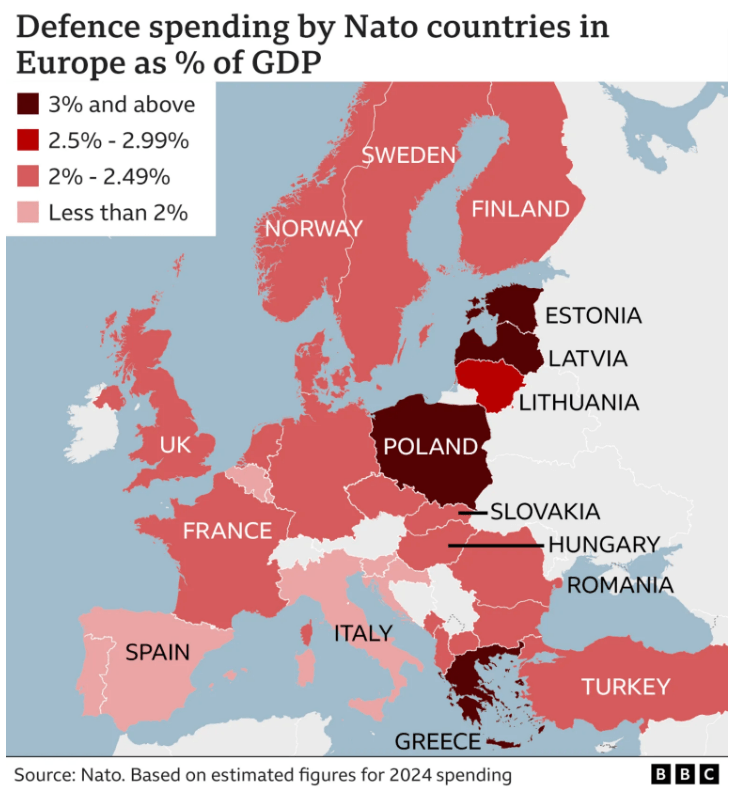
In this post, I’d like to revisit a debate from early 2024, when Trump suggested that he would not favor defending Nato members that spent less than 2% of GDP on defense.  Here’s what Tyler Cowen said at the time: As you probably know, Trump threatened to let NATO countries that failed to meet the two percent of gdp defense budget obligation fend for themselves against Putin (video here, with Canadian commentary).  Trump even said he would encourage the attacker. Long-time MR readers will know I am not fond of Trump, either as a president or otherwise.  (And I am very fond of NATO.)  But on this issue I think he is basically correct.  Yes, I know all about backlash effects.  But so many NATO members do not keep up serious defense capabilities.  And for decades none of our jawboning has worked. Personally, I would not have proceeded or spoken as Trump did, and I do not address the collective action problems in my own sphere of work and life in a comparable manner (“if you’re not ready with enough publications for tenure, we’ll let Bukele take you!” or “Spinoza, if you don’t stop scratching the couch, I won’t protect you against the coyotes!”).  So if you wish to take that as a condemnation of Trump, so be it.  Nonetheless, I cannot help but feel there is some room for an “unreasonable” approach on this issue, whether or not I am the one to carry that ball. That’s a plausible argument, but I had a different view: I believe that both Trump and Tyler misunderstand the role of Nato. The most important aspect of Nato is not the amount it spends on the military, rather its role is to provide a mutual defense pact so large that no nation would dare to attack even its tiniest members. In that regard, it’s a smashing success.Consider the recent war in the Ukraine, where Russia has been stalemated for 2 years. To say that Ukraine is weaker than Nato would be an understatement. Nato has 31 members, many of which are individually richer and more powerful than Ukraine. As long as Nato sticks together, Russia would not dare to attack even a small member like Estonia. It makes essentially no difference whether Germany spends 1.4% or 2.0% of GDP on its military. Nato is ten times over impregnable, if it sticks together.But will Nato stick together? Late in his first term, Trump told aides that he hoped to pull the US out of Nato in his second term. That’s why Putin desperately wants Trump to win the election.  Over the past two months, events have tended to confirm that my worry was justified.  Consider the following: 1. The 2nd Trump administration has been exceedingly hostile to Nato, with key members suggesting that the US leave the alliance.  This despite the fact that most of the important members of Nato have recently boosted spending to a level above the 2% threshold demanded by Nato critics (see below.) 2.  Yes, there’s a reasonable argument that even 2% of GDP is too low, as the US spends over 3% of GDP on defense.  But Trump now demands at least 5% of GDP, a figure that he surely understands is not going to be met by countries already struggling to finance their big welfare states, and is an obvious pretext for the US to walk away from the alliance.  That’s the sort of demand you make if you want the alliance to fail.  Trump lacks the legal authority to explicitly exit Nato, but he’s doing everything he can to create the impression of a de facto exit. 3.  In the Ukraine War, Trump has switched US support from Ukraine and Nato to Russia.  Before the election, my critics pointed to the fact that the first Trump administration was fairly tough on Russia, suggesting I was delusional to view Trump as pro-Putin.  They failed to understand that in his first administration Trump farmed out foreign policy to some mainstream Republicans.  But during the campaign Trump promised a radically different approach in his second term, a promise he has fulfilled.  The US is now voting with Russia and against Europe on the question of whether Russia is to blame for the war.  (Even China abstained!)  The US government calls Zelensky a “dictator” but refuses to call Putin a dictator.   Far from being delusional, I actually underestimated Trump’s support for Russia.  I expected him to cut off financial support for Ukraine, but didn’t expect him to needlessly hurt Ukraine in ways that did not save the US government any money, such as cutting off intelligence sharing and voting against resolutions that condemned Russia for the war.  Like Tyler, I am “very fond of Nato”; indeed, I regard it as one of the best innovations of the post-WWII era, an organization that moved Europe past the destructive nationalism of the first half of the 20th century.  I can imagine how a supporter of this sort of multinational organization could favor putting pressure on its members in order to make the alliance stronger.  That was Tyler’s view.  But Trump is not a supporter of multilateral organizations; he is an avowed nationalist.   He opposes Nato, just as he opposes the EU, Nafta, and even his own renegotiated version of Nafta (USMCA). When you argue that a controversial figure may have a valid point in one particular area, you need to be careful that the valid point they have in mind is the same as the valid point that you have in mind.  In the case of Tyler Cowen, Donald Trump and Nato, I don’t believe that was the case.   Some readers agree with me on economics but disagree with me on foreign policy.  So let me address that group with an analogy.  Suppose you are the sort of person that basically likes free markets, but didn’t at all care for the Trudeau government, and also believes the US has a few valid complaints about Canadian trade policy.  What would be the optimal US strategy? Perhaps the US government might quietly reach out and ask to renegotiate a few specific points, trading some favors to Canada in exchange for favors from Canada.  I’m not sure this was necessary, but I can see how someone might hold that view.  Perhaps the US would choose to wait until after the Canadian election, as the Conservative Party had a 25% lead in the polls, which was growing over time.  Now consider the effects of the recent US-Canada trade war: 1. The Canadian election is now a dead heat, almost entirely due to the fact that the Canadian public is outraged by US bullying.  The party you favor might well lose an election that weeks before was a lock. 2.  An anti-American mood in Canada makes it very difficult for any Canadian government to offer trade concessions; far more difficult than it would have been had the administration had a sincere desire to work quietly and cooperatively toward a win-win solution. So what’s my point?  It not enough to say you don’t like the current structure of Nato, or you don’t like the current structure of global trade.  Not every critic of those structures will be offering constructive solutions.  Some critics are nihilists, who simply want to blow it all up and start over. Many people don’t like international organizations.  But I suspect they will be missed when they are gone.  If smaller countries cannot rely on military alliances, they’ll need to develop their own nuclear deterrent.  Do you wish to see a world with dozens of nuclear powers?   What could go wrong? Here’s the BBC’s estimate of Nato military spending: (0 COMMENTS)

/ Learn More

Trade War Fears

One of my all-time favorite movies is the 1982 cyberpunk-noir classic Blade Runner.  Not only did the film single-handedly create the cyberpunk genre, but it inspired significant change in the sci-fi genre as a whole, led to classics such as Akira, and inspired great directors such as Guillermo del Toro, Christopher Nolan, and Denis Villeneuve.  Its themes of humanity, hyper-technology, hyper-capitalism, femininity, and ecology remain hotly debated to this day.  Not bad for a film considered a flop on its initial release. Set in the distant future of 2019 Los Angeles, the politically and economically dominant Tyrell Corporation has created synthetic humans known as replicants to do dangerous jobs in outer space.  For obvious reasons, some of these replicants aren’t thrilled with this arrangement and go rogue.  Blade runners are those dispatched to hunt down these rogue replicants.  The movie follows one such blade runner, Rick Deckard (played by Harrison Ford), as he hunts down four especially dangerous replicants.   I’ve seen the movie about a billion times.  One of the nice things about watching movies you can practically quote by heart is that you can observe the background.  Brainpower can be diverted from the plot into observing the setting and how it reflects the mindset of the author/filmmaker/society.  In my most recent rewatch, something about the setting jumped out at me.  The team that built the setting imagined 2019 Los Angeles as heavily Japanese.  Japanese food dominates the culture.  The Japanese language is written on signs.  Japanese corporations dominate the skyline.  Even the Tyrell Corporation was originally imagined as a Japanese conglomerate in early drafts of the film. Why Japan?  Simple: Japan was a rising economic influence and a supposed threat to American economic power in the 1980s.  For example, the economist Lester Thurow wrote several books in the 80s and 90s on how the Japanese style of state-guided economic management was destined to overtake America and make them the economic powerhouse of the world.  American corporations were afraid of Japanese competition.  Peter Drucker praised the Japanese style of management and pressed for it to be established in America.  Japan was an existential threat to American economic power, so much so that there were strong lobbies for Congress to impose tariffs and quotas on Japanese imports, lest the dystopia of Blade Runner come about. Of course, these fears were overblown.  Even as Thurow was writing his books, the Japanese economy was stagnating.  The 1990s and 2000s were characterized by economic stagnation in Japan, while American economic growth exploded.  Over the 30-year period from 1994 to 2004, Japanese real GDP rose just 24.9% (source) while American real GDP rose 115.1% over the same time period (source).  Over the same time period, Japanese industrial production (excluding construction) averaged just 0.1% growth (source) while US industrial production averaged 1.2% (source).  The widely feared economic dominance of Japan never came about.   Since about 2010, the same fears have arisen with China.  The above story doesn’t change, however.  Just replace “China” with “Japan” and “Peter Navarro” with “Lester Thurow.”  It’s the same claims of coming economic dominance by state-run conglomerates and the superiority of industrial policy.  America must be afraid, must capitulate to these supposedly superior foreign powers, must adopt their systems, lest we be overrun.  And just like with Japan, these fears are obsolete even as they are made.  The Chinese economy is stagnating.  They’re wasting resources left and right, something that is unsustainable.  Short of substantial market reforms, China will end up on the ash heap of economic history, just like Japan.  All those fears will soon be lost like tears in the rain. Fiction provides us useful insights into the past.  And one of the big lessons is this: the more things change, the more they stay the same.  The hand just rearranges the players in the game.     P.S. It is also interesting to me how sticky culture can be.  Even though the fears of Japanese dominance have faded, cyberpunk media still portrays Japan as a dominant influence in their worlds.  For example, in the video game Cyberpunk 2077, set in the distant future of 2077, Japanese culture is dominant in the fictional California city of Night City.  Ridley Scott’s arbitrary choice in the 1980s still appears in 2025. P.P.S. I gave Midjourney a picture of me and told it to put me in a cyberpunk setting.  Here is my favorite result:   (0 COMMENTS)

/ Learn More

Review of the Strong Gods III: Reno Swings and Misses on Economics

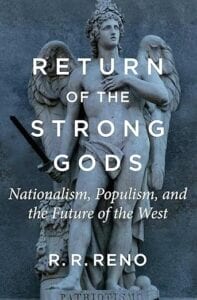
R. R. Reno’s book The Return of the Strong Gods is very broad in scope. He covers many disparate phenomenon, including some commentary on economics. Unfortunately, Reno’s arguments in this regard are disappointing. While describing possible causes of economic inequality, Reno says “This is the sort of assertion I prefer to leave to the economic theorists to debate.” This was a wise instinct on Reno’s part, and one he would have benefited from if it had been more consistently applied. Some of his claims are just strange – he says that economists argue that the “‘animal spirits’ of the economy need to be freed from oppressive regulations.” This is bizarre because, far from being a call for deregulation, “animal spirits” are invoked as a major reason why the economy needs regulation – starting with John Maynard Keynes, who said, in The General Theory, Even apart from the instability due to speculation, there is the instability due to the characteristic of human nature that a large proportion of our positive activities depend on spontaneous optimism rather than on a mathematical expectation, whether moral or hedonistic or economic. Most, probably, of our decisions to do something positive, the full consequences of which will be drawn out over many days to come, can only be taken as a result of animal spirits – of a spontaneous urge to action rather than inaction, and not as the outcome of a weighted average of quantitative benefits multiplied by quantitative probabilities. Similarly, any economist reading Reno’s book is going to wince when Reno confidently makes proclamations about, for example, how Apple can and should produce its products in America, asserting “The problem is not the ‘vast scale’ [of international supply chains]. Apple and other large companies could easily afford capital investments in large plants in the United States.” (When I read that line, I actually winced so strongly with secondhand embarrassment that my wife asked me if everything was okay when she saw the look on my face.) Reno also criticizes open-society thinking by saying, among other things, it ought to be in favor of “advantageous trade, not open trade.” But, of course, economists who argue in favor of open trade do so precisely because they believe that open trade is advantageous trade. Reno doesn’t try to describe the economic arguments in favor of open trade, let along engage with or rebut them. He simply declares open trade and advantageous trade are opposed to each other, but this is pure question-begging. He’s assuming the very point under dispute. One of the biggest misses in his book is his description of F. A. Hayek. He argues that the paradigm that took hold in the postwar period (what today would probably be called a “vibe shift”) held that strong social norms are unjustly constraining and should be weakened and opened up. But strangely – staggeringly, even – he ascribes this view to Hayek as well, despite the fact that Hayek was one of the 20th century’s most eloquent defenders about the importance of maintaining and upholding strong social norms! The examples of Reno making this odd claim are numerous – for example, he argues that for Hayek “there is always greater freedom for the individual when the social consensus about right and wrong is weakened.” And for Hayek, says Reno, “Since the basic principle of individualism is individual liberty, we must resist anything that compels our choices, even holding at arm’s length the compelling character of solid and significant moral truths.” As a summary of Hayek’s views, this is about as accurate as claiming FDR spent his free time during his presidency engaging in marathon running as a hobby. A much better summary of Hayek’s thoughts on this matter can be found in Erwin Dekker’s book The Viennese Students of Civilization: If we think back to our first section in which we argued that Menger and Schaffer changed the start and end point of economics, we recognize that in Hayek the individual is not the starting point anymore. What is perhaps even more surprising, he or she is also not the end point. Hayek argues that the submission to constrains is the only way that the individual can contribute to something that is ‘greater than himself’ (Hayek, 1948: 8); that, which is bigger than himself is the civilization of which is a part. Hayes argues that civilization makes individual autonomy possible, and that individual actions contribute to civilization. In no straightforward way can this be called methodological individualism anymore… Freedom for the Viennese students of civilization, and especially for Hayek, is not the absence of constraints. Freedom for them is enabled by traditions, morality, and institutions to which the individual must submit so that he can be free. Reno comes across as someone who reads his own theory into Hayek. And at some points, Reno seems aware that his description of Hayek’s ideas doesn’t fit Hayek’s writing – he occasionally tosses in disclaimers noting that Hayek “does not say it explicitly” or that Hayek’s outlining of these ideas “is not as precise as Popper.” Other times he speculates about what Hayek really meant, saying “By ‘good’ or ‘bad,’ the economist Hayek undoubtedly means increasing or reducing my utility rather than congruent with morality or not.” Reno needlessly narrows, and is seemingly unaware of, the full breadth of Hayek’s thought. There is a reason Hayek said “Nobody can be a great economist who is only an economist – and I am even tempted to add that the economist who is only an economist is likely to become a nuisance if not a positive danger.” What seems to be the lynchpin in Reno’s understanding of Hayek comes from this passage from The Road to Serfdom (emphasis added by me): What the German and Italian who have learned the lesson wants above all is protection against the monster state – not grandiose schemes for organization on a colossal scale, but opportunity peacefully and in freedom to build up once more their own little worlds. I say this seems to be the key to Reno’s understanding of Hayek because after quoting this passage, Reno references the phrase “little worlds” at least eighteen additional times, invariably in a critical way. Reno represents this passage from Hayek as having the following meaning: In our public affairs, we must renounce our desire for great things and transcendent vistas, seeking instead only “little worlds”: decent health, a modicum of wealth, and ordinary pleasures. The free society requires going small. This, too, seems like Reno simply reading his own theory into Hayek. First of all, Hayek never advocated that people renounce their desire for great things or transcendence – Hayek very much argued in favor of people seeking to contribute to that which was “greater than himself.” Hayek’s claim that people wanted the “freedom to build up once more their own little worlds” in no way entails or implies Reno’s claim that we should limit ourselves to “seeking instead only ‘little worlds’”, nor does it entail that one must renounce seeking the transcendent. Wanting to be able to live your day-to-day life free of direction from “the monster state” and its “grandiose schemes for organization on a colossal scale” is light-years away from saying that “little worlds” are the only things one should care about, nor does it imply one must renounce any desire for transcendence. Reno frequently makes similar, and similarly off-base, criticisms of Milton Friedman, but I don’t want to belabor the point. Reno making these kinds of mistakes immediately sets off my “Gell-Mann Amnesia” alert – a phenomenon identified by the author Michael Crichton. As Crichton said, Briefly stated, the Gell-Mann Amnesia effect is as follows. You open the newspaper to an article on some subject you know well. In Murray’s case, physics. In mine, show business. You read the article and see the journalist has absolutely no understanding of either the facts or the issues. Often, the article is so wrong it actually presents the story backward—reversing cause and effect. I call these the “wet streets cause rain” stories. Paper’s full of them. In any case, you read with exasperation or amusement the multiple errors in a story, and then turn the page to national or international affairs, and read as if the rest of the newspaper was somehow more accurate about Palestine than the baloney you just read. You turn the page, and forget what you know. In the same way, when I see Reno making such elementary mistakes in, say, his representation of Hayek’s thought, it immediately lowers my credence in his analysis on other specific points. I’m not well-versed in the thought of Albert Camus. Reno describes, and critiques, Camus’s thoughts. But should I take Reno’s representation of Camus at face value? Do I have some strong reason to assume he’s getting Camus right, when he gets Hayek so badly wrong? I’m highly skeptical. Maybe he’s spot-on in his description and criticisms of Camus, but based on what he’s said about topics I know well, I’m at the very least going to suspend judgment on that. In The Fellowship of the Ring, Bilbo Baggins, his life long extended by his exposure to the One Ring, tells Gandalf that he feels “thin, sort of stretched, like butter scraped over too much bread.” Like most authors of grand theories of society, Reno has stretched himself too far. He’s trying to bring in his evaluation of widely disparate ideas and fields of study into one grand approach, and in doing so, he has overextended himself. I enjoyed reading this book. And I do think there is some truth in it, and some value in his ideas. And I generally strive to be the kind of person who rules thinkers in, not out. So while Reno’s arguments fall well short of being a knock-down case, I’m still glad to have engaged them, and I’ll continue to ponder them over time, including considering whether there are ways to strengthen his case. And if a book can make me do that, then I’d say reading it was well worth my time. (0 COMMENTS)

/ Learn More

Social Security Is a Ponzi Scheme

Last week, Alex Tabarrok wrote a post at Marginal Revolution titled, “Is Social Security a Ponzi Scheme?” His answer is yes. That reminded me of what I wrote about Social Security in my 2001 book, The Joy of Freedom: An Economist’s Odyssey. Here’s the start of the chapter.   I say we scrap the current [Social Security] system and replace it with a system wherein you add your name to the bottom of a list, and then you send some money to the person at the top of the list, and then you . . . Oh, wait, that IS our current system. —Dave Barry, “Election could come down to who kisses most orifice,” Miami Herald, September 24, 2000 In 1991, one of my students, Stephen Banus, wrote to the Social Security Administration requesting information about the Social Security taxes he had paid and the benefits he could expect to receive. In the form letter he got back, Gwendolyn King, the commissioner of Social Security wrote: I want to assure you that Social Security is built on a sound financial foundation. Social Security benefits will be there when you need them. A prudent man and a good planner, Banus sent a similar request in 1995. This time, the message in the form letter was different. The commissioner of Social Security, Shirley Chater, wrote: The latest report of the Social Security Board of Trustees says the Social Security system can pay benefits for about 35 more years. This means there’s time for Congress to make the changes needed to safeguard the program’s financial future. In just four years, the commissioner had scaled back the blanket assurance that the benefits would be there “when you need them” to “about 35 more years.” What happened between 1991 and 1995? Actually, nothing much happened in those four years except that the Social Security Commissioner in 1995 was perhaps less dishonest than her counterpart in 1991. The fact is that Social Security was never on a “sound financial foundation.” Contrary to the Social Security Administration’s official propaganda, there is no real trust fund. Roughly 80 percent of the payroll taxes collected from current workers today are sent out to current retirees, with only a brief stayover in Washington. The government spends the rest of the money on other items. The so-called trust fund contains bonds that the government has created. These bonds are simply IOUs from one branch of government to another. Chris Jehn, an associate director of the Congressional Budget Office, compares these bonds to notes that you write every year and put in a box for your child’s college education. The note says, “I owe $5,000 to my daughter’s college fund.” After 18 years of such saving, when your child turns 18, you open the box and out comes, not $90,000, but 18 worthless pieces of paper. Those who retired in the early 1940s got huge benefits in return for paying low payroll taxes for only a few years. But as the system has “matured,” so that current retirees have been paying Social Security taxes for virtually their whole working lives, these retirees have received a much lower return. A private citizen who set up such a financial chain letter would go to prison. In fact, he did. His name was Charles Ponzi, and he was arrested in 1920 for promising investors that they could double their money in 90 days and using the proceeds from later participants to keep his commitments to earlier ones. Thus was born the term “Ponzi scheme.” There are two main differences between Ponzi’s original scam and the Social Security system. The first difference is that Social Security is run by government and, whatever its constitutionality and its questionable ethics, is legal. The second difference follows from the first: Whereas Ponzi had to rely on suckers, the government can and does use force. It’s true that the government refers to the Social Security payroll taxes—a hefty 10.6 percent (an extra 1.8 percent is for disability insurance and a further 2.9 percent, levied on all income from work, is for Medicare) of every worker’s earnings up to $80,400 in 2001—as “contributions.” But just try not “contributing.” That’s what Valentine Byler, an Amish farmer in New Wilmington, Pennsylvania, did in 1961. His religion taught that its members should care for each other and he tried to act on his religious beliefs by not paying Social Security taxes. The Internal Revenue Service responded by seizing three of his horses and selling them to collect $308.96 in unpaid taxes. The Social Security Administration’s new line is that the fund is solvent until 2037. What the government officials who say that really mean is that by 2037, the last of the special federal government bonds that the Social Security Administration has bought and kept in the Social Security “Trust” Fund will be sold off to the U.S. Treasury. This “sale” of bonds is simply a transfer between the government’s left and right hands. To free up the cash to pay for these bonds, the Treasury will have to float new bonds, increase taxes, or cut other spending. The more relevant date, therefore, is when the government’s benefit payments start to exceed its income from payroll taxes and from interest on these bonds—because that’s when the bonds will first be sold and the government will have to come up with extra cash. That date, the Social Security Administration now projects, will be 2024, about two-thirds of the way through the retirement of the baby boomers. In the late 1990s, the government’s own actuaries estimated that, to maintain promised benefits, the tax rate would have to rise over the next decades from its current level of 12.4 percent to more than 18 percent. At an 18 percent rate, Social Security taxes would be about 7.5 percent of overall GDP. But total federal revenues from all sources, not just from the Social Security payroll tax, have stayed within a narrow range of 18 to 20 percent of GDP since the early 1950s. If this historical constant held, then the Social Security program alone would take about 40 percent of the total tax revenues collected by the federal government, leaving the remaining 60 percent to pay for Medicare, interest on the debt, defense, and everything else the federal government does. That doesn’t seem likely, which means that the odds of raising the Social Security tax rate substantially are, fortunately, fairly small. At some point in the future, therefore, benefits will have to be less than promised. (0 COMMENTS)

/ Learn More

Organized Hatred From Above

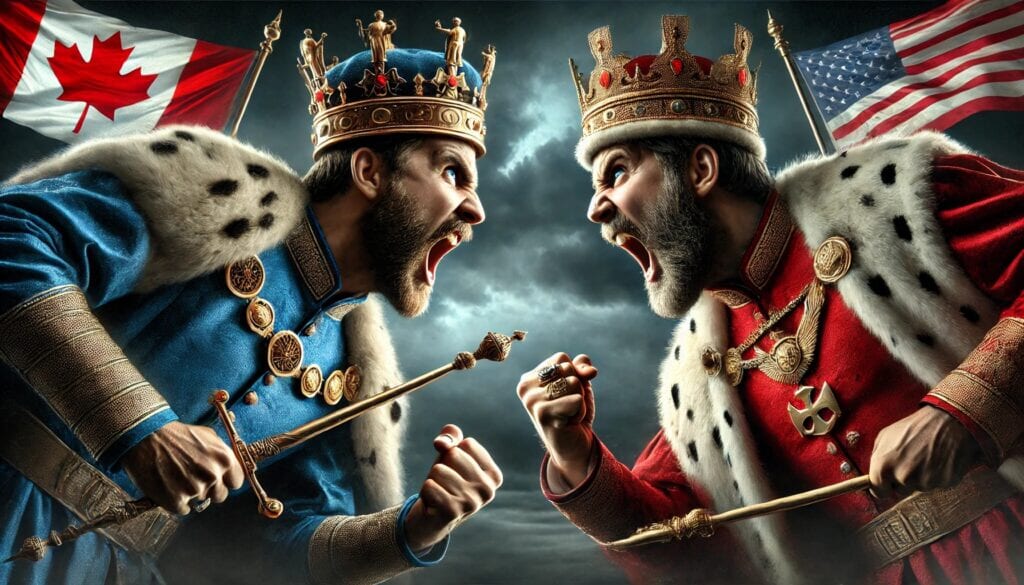
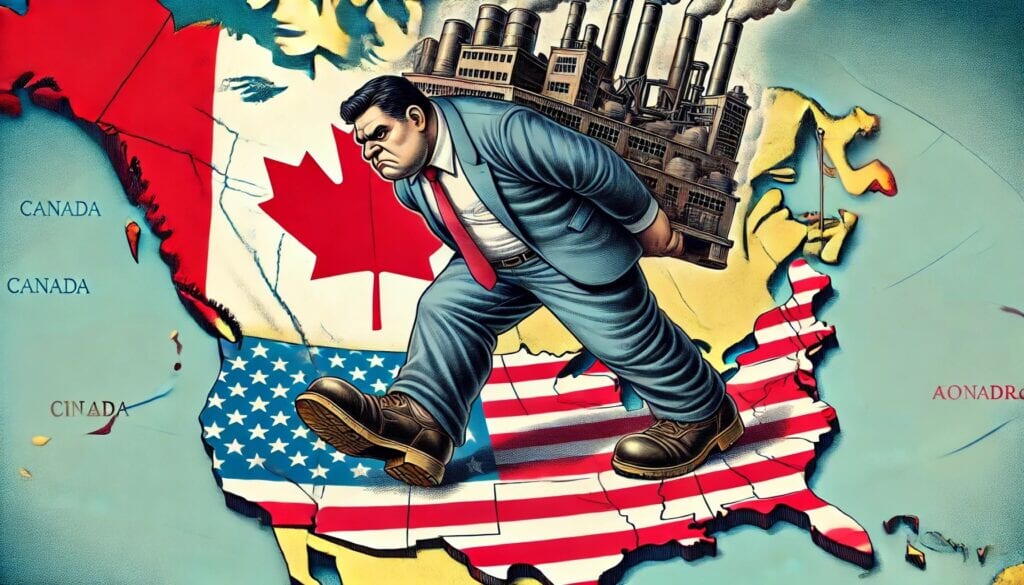
The trade war between the United States and Canada—more exactly between the American government and the Canadian government(s)—helps illustrate the opposition between two regimes: free trade between individuals or private organizations, which creates mutual gains and favors peaceful relations; trade between governments or directed by them, that is, mercantilism, which generates conflicts and hatred. After US President Donald Trump had announced 10% tariffs on imports of Canadian “energy products” and 25% import tariffs on all other goods, the federal government of Canada announced retaliatory tariffs on American exports. The premier of the province of Ontario, Doug Ford, just announced a provincial tax of 25% on Ontarian exports of electricity to New York, Michigan, and Minnesota. He declared (“Ontario Hits Power Exports to US With 25% Surcharge as Trade War Accelerates,” Financial Times, March 10, 2020): If necessary, if the United States escalates, I will not hesitate to shut the electricity off completely.” He had previously said (“Canada to Cut Off Electricity to US States: ‘Need to Feel the Pain,’” Newsweek, March 4, 2025): If they want to try to annihilate Ontario, I will do everything—including cut off their energy with a smile on my face, and I’m encouraging every other province to do the same. They rely on our energy. They need to feel the pain. Individuals and their private parties trade together with a smile on their faces. Governments intervene in trade and impose pain with a smile on their collective face, if we may use that analogy. The fact that the Ontario Government owns or directly controls a large part of the production and distribution of electricity in Ontario (“our energy”), as do to a lesser extent the governments of the importing US states, does not help depoliticize the market. Subject to weak constitutional constraints, governments can anyway impose tariffs, taxes, and prohibitions on whom they decide, and the consequence is not universal love. That Mr. Ford is himself a conservative with a populist streak, who once expressed his support for Mr. Trump, should remind us to beware of the “will of the people.” In a recent post, I quoted Henry Adams, who wrote that politics, as a practice, whatever its professions, has always been the systematic organisation of hatreds. From a moral viewpoint as opposed to a narrow economic viewpoint, which ruler starts the conflict is not irrelevant. ****************************** Two mercantilist kings (0 COMMENTS)

/ Learn More

Two excuses

During the mid-1930s, FDR pursued an aggressive set of policies including various actions intended to raise wages, as well as an undistributed profits tax.  These actions were widely seen as anti-business, a view reinforced by FDR’s frequent attacks on the “economic royalists”. In the second half of 1937, the US economy fell into a deep secondary depression, despite the fact that it had not yet recovered from the severe 1929-33 slump.  The Roosevelt administration blamed the downturn on a lack of investment in the business sector, asserting that there was a “capital strike” motivated by hatred of New Deal policies.  In fact, the slump was mostly caused by various New Deal policies, which pushed up wages at a time when monetary policy was reducing prices. I was reminded of this event when I saw the following story: After signing an executive order granting Canada and the US another temporary tariff reprieve, the US president blamed “globalist” nations and corporations for market-wide declines and shrugged off spooked markets. The Treasury secretary also chimed in: “There’s going to be a natural adjustment as we move away from public spending to private spending,” Bessent said Friday on CNBC. “The market and the economy have just become hooked and we’ve become addicted to this government spending, and there’s going to be a detox period.” It is possible that this sort of lagged effect might be true for the overall economy, but it is certainly not true for the financial markets, which are forward looking.  Policy initiatives that produce short-term pain and an even greater long-term benefit should be a positive for the stock market. That’s not to say that markets won’t bounce back—as stock prices are almost impossible to predict.  Think of a scenario where a policy initiative was put forward that other things equal might be expected to reduce stock prices by 10%.  Also assume that the market thought there was a 50% chance that the initiative would be quickly reversed, with no damage done.  In that case, you might expect stock prices to fall by roughly 5%.  But that would merely represent the initial reaction, as more information came in stocks would either fall further, or (if the initiative was reversed) would regain lost ground. On a related note, the Atlanta Fed has been forecasting a drop in real GDP during Q1.  The media suggests that this forecast is based on a recent surge in imports, particularly gold imports.  That may be true, but if so it is quite odd.  A $20 billion surge in gold imports to beat expected tariff increases would not be expected to have any effect on actual GDP.  The import category would move $20 billion in a negative direction while gold inventories would move $20 billion in a positive direction.  If the media reports are correct (and I have no reason to doubt them), this suggests the government does not know how to measure GDP.  It suggests that they are treating imports as a negative, but not applying an equal positive to investment (or consumption.)  Why would they do this? PS.  Greg Mankiw is of course correct, and I am almost certain that Kevin Hassett knows that.  I understand that we must all make compromises in our careers, but surely there are limits . . . (0 COMMENTS)

/ Learn More

David Bier on Legal Immigration

  I started noticing the change in Americans’ views on immigration in the early 2000s. Most people I talked to were not very upset about even illegal immigration. I saw the change in my students, who were primarily officers in the U.S. military. In any given class, the plurality of the students, and usually the majority, were in the U.S. Navy. I picked it up in little ways, in side comments about whatever issue we were discussing. I didn’t have a segment of my class on immigration per se, but I did have some readings on U.S. labor markets and so it was only natural that the issue of immigration would come up in that context. I have always believed that one should not hector students for their beliefs, that doing so violates a sacred trust. So I didn’t. But one day, towards the end of a quarter in which the students and I had got along particularly well, I felt comfortable in making a controversial statement that was not hectoring but was simply pointing out a reality. I stated, “This is the most anti-immigrant class I’ve had in my almost 20 years of teaching here.” One of the students jumped on it and said, “Anti illegal immigrants, sir.” “Touche,” I replied. “I want to point out, though, that when people say that those who want to come to this country should do so legally, they are essentially saying, even if they don’t know it, that those people can’t come to this country.” My impression was that a lot of the students didn’t know that. Many seemed to think that there was a straightforward process for people to immigrate. There isn’t. It’s not straightforward and even when some particular routes that are somewhat straightforward, most people don’t qualify. I thought of all that when reading an excellent post by David Bier of the Cato Institute. It’s titled “What Trump Has Done and Imminently Plans to Do on Immigration,” Cato at Liberty, February 3, 2025. Take a look. David, along with Alex Nowrasteh, follows immigration closely and keeps up on the rules. I thought of it further when reading that the Trump administration is trying even to strip away the green card of a permanent resident. Not just illegal immigration, but also legal immigration, is currently at risk. (0 COMMENTS)

/ Learn More

Will Guidara on Unreasonable Hospitality

What can the restaurant business teach us about leadership and management? Listen as Will Guidara, the former owner of Eleven Madison Park, explains to EconTalk’s Russ Roberts how his restaurant became good enough to be named the best restaurant in the world. Foodies will enjoy a look behind the scenes of a restaurant at the […] The post Will Guidara on Unreasonable Hospitality appeared first on Econlib.

/ Learn More

My Weekly Reading for March 9, 2025

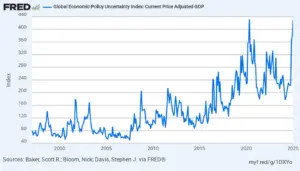
Jail Time for Cheap Rides? by Jack Nicastro, Reason, March 4, 2025. Excerpt: Empower, a ride reservation service, has been hounded by Washington, D.C., regulatorssince it began its operations in 2020. CEO Joshua Sear will be arrested on Wednesday for violating the Department of For-Hire Vehicles’ (DFHV) cease and desist order if the app doesn’t shut down by then. Mayor Muriel Bowser has the power to direct the DFHV to rescind its order, which would allow Empower to continue operating in the city. Sear founded Empower in 2019, not as a transportation company but as a software company that serves independent professional drivers. Empower differs from the flagship ride-share services in multiple ways. Unlike Uber and Lyft, drivers who use Empower do not receive 1099 forms—they are not contractors, but customers, according to the company. The company also does not collect a percentage of every fare, nor does it set them; its drivers set their own rates by adjusting their minimum and base fares, per minute, per mile, and surge prices as they see fit. They then pay Empower a flat monthly fee of $349.99 for access to the D.C. Monthly Platinum plan, which “provides drivers with unlimited access to Empower’s software and support services.” Empower’s suggested rates are “set so that drivers make 20% – 25% more on average than they would if they were driving on behalf of Uber/Lyft [and] riders also save 15-20% on average.”   Dead People Aren’t Bankrupting Us by Liz Wolfe, Reason, March 5, 2025. Excerpt: “Part of the confusion comes from Social Security’s software system based on the COBOL programming language, which has a lack of date type,” reported the Associated Press last month in response to DOGE reports about improper payments. “This means that some entries with missing or incomplete birthdates will default to a reference point of more than 150 years ago.” (The agency auto-stops payments to those older than 115.) The Social Security Administration’s inspector general has admitted as much: The agency is really struggling to figure out how to “properly annotate death information in its database” per the A.P., and there are nearly 20 million Social Security numbers of people born in 1920 and earlier who haven’t been marked as dead. But Trump is conflating “not marked as dead in a database” with “received benefits”—an absolutely wild leap we have no evidence to support. In fact, the July 2023 report from the inspector general notes that “almost none of the numberholders discussed in the report currently receive SSA payments.”   Economic Uncertainty in the US Economy by Timothy Taylor, Conversable Economist, March 5, 2025. Excerpt: The US uncertainty index is not official government data. It is based on a method developed by three economists, Scott R. Baker, Nick Bloom, and Steven J. Davis. I mentioned their approach here when it was first being developed back 2012. They combine three sources of data: “the frequency of newspaper articles that reference economic uncertainty and the role of policy; the number of federal tax code provisions that are set to expire in coming years; and the extent of disagreement among economic forecasters about future inflation and future government spending on goods and services.” The average value from 1985-2010 is arbitrarily set at 100. Thus, you can see spikes during the Great Recession, the pandemic, and now early in 2025.   How tariffs will make America poorer Editorial Board, Washington Post, March 4, 2025. Excerpt: All this could cost the typical U.S. household about $1,245 in lost purchasing power, according to a projection from the Budget Lab at Yale. Another model estimates that if Canada, China and Mexico retaliate symmetrically — imposing same-size tariffs on U.S. goods — American incomes would fall 0.5 percent in real terms. Real wages in Pennsylvania, Wisconsin, Michigan and Ohio would fall by almost 0.6 percent. To see how this works, consider the auto industry, the most integrated in North America. Thirty-eight percent of the value of cars imported from Mexico comes from parts and components made in the United States. Seventeen to 36 percent of the makeup of Cadillac models assembled in the United States is sourced in Mexico. Auto parts cross North American borders several times before ending up put together on a dealer’s lot. A 25 percent tariff would boost their price on every crossing, decimating the industry’s competitiveness. DRH note: Washington Post owner Jeff Bezos recently told his editorial writers that they should write editorials in favor of free markets. This editorial is implicitly in favor of free markets. Maybe the editorial writers are paying attention?   Government versus Private Vaccine Mandates by Jeffrey Miron and Karthi Gottipati, Libertarian Land, March 5, 2025. Excerpt: Libertarians, however, distinguish between government-imposed mandates and those set by private entities, emphasizing the unintended and potentially harmful consequences of government mandates. For instance, one study suggests that such mandates eroded public trust in government institutions and, paradoxically, made vaccine-hesitant individuals even less willing to get vaccinated. That said, libertarians defend the right of private entities to require vaccinations for employees, customers, or other stakeholders. A recent study illustrates the effectiveness of this private-sector approach: Our findings reveal that employer vaccine mandates significantly increased staff vaccination rates. This had life-saving effects on the health of nursing home residents, who experienced reductions in both COVID-19 cases and mortality. For every two facilities that implemented a mandate, approximately one life was saved. Given that a typical nursing home houses only 100 residents, this impact is substantial. Note: The accompanying picture is a graph of economic uncertainty. (0 COMMENTS)

/ Learn More

Firms Moving to the US Pay a Tariff Equivalent

About his new tariffs, President Donald Trump said (and repeated in different forms): “So what they have to do is build their car plants frankly and other things in the United States, in which case they have no tariffs.” This is seriously misleading. Recall the standard economic result that a foreign exporter does not typically pay the tariff: it is the importer and ultimately (in our case) the U.S. buyer who pays it. The cost imposed on the foreign exporter lies in lower export sales because of a lower quantity demanded in the US. If, as is usually assumed, American buyers prefer the domestic substitute ceteris paribus, the foreign exporters’ sales will decrease; the value of their productive assets will also decrease and some capital will be reallocated to other economic sectors. To avoid these costs, the owners of foreign exporting firms may indeed decide to move their plants to the US if the total cost of moving is lower than the cost of reduced sales to America. Moving and building a new plant, and quite certainly losing money on the sales of the old facilities (the owner does not literally move his plant across the border), is costly and takes time. Moreover, production costs will certainly be higher in the US, which is the reason why the firm did not previously decide to produce here—and the owners know more about this than any politician. The cost of moving to the US will be further increased if the American government imposes tariffs on inputs such as steel or aluminum. The uncertainty of ever-changing protectionist policies is another cost component. If the total cost of moving is worth incurring, it is because it is lower than the firm’s otherwise losing markets, but it is not necessarily much lower and it is anyway a cost increase compared to the starting situation. The moving firm has to pay a cost equivalent to a tariff, even if lower. This cost is not called a “tariff” (or a tax) simply because it is not paid by the former exporter to the US Treasury. A tariff is, by definition, a special tax on imported goods. But from the point of view of the exporter who moves to the US, it amounts to the same as paying a tariff—which of course comes over and above what American buyers pay in higher prices. Mr. Trump’s apparent ignorance of these considerations confirms what the Florida owner of a construction company with 35 employees (for now) said to the Wall Street Journal (Rachel Louise Ensign, Arian Campo-Flores, and Harriet Torry, “Tariff Whiplash Spooks U.S. Consumers,” March 5, 2025): He has no idea about the economy. Or, as The Economist puts it more diplomatically, the president and reality seem to be drifting ever further apart. … Because his approach lacks any coherent logic, there is no knowing how to avert his threats. Extending the problem into its moral dimension leads to questioning the idea that the coercive imposition of a cost is not coercive if the victim can reduce his (or her) cost with avoidance measures, and suggests a few analogies. Consumers who don’t like a tax simply need to stop buying the taxed good, in which case they have no tax to pay. Kidnap victims who don’t like the ransom demanded simply need to not pay it, in which case there is no ransom. East Berliners who don’t want to be shot just have to avoid jumping the Berlin Wall, in which case there is no shooting. ****************************** Unhappy investor moving his plant from Canada to the US (0 COMMENTS)

/ Learn More