This is my archive

bar

Is “provocative” a compliment?

What makes you angry? How do you feel about yourself when it happens? If you’re like EconTalk host Russ Roberts, you might feel like being angry is synonymous with a loss of control, or at least something you should learn how to control. Not so fast. In this episode, Roberts welcomes back philosopher Agnes Callard to talk about anger. Callard argues that anger is a moral sense. Anger is not just what we don’t like, but a principled response to perceived injustice. Anger is an important part of moral education, and has a unique normative structure. What influence has anger had on your life- has it been as, well, positive, as it might be in Callard’s outlook? What was your biggest take-away from this conversation, and how might it affect the way you respond to anger in the future? Let us hear your thoughts, and let’s continue the conversation.     1-  What does Callard mean when she says there’s something divine about anger? On the other hand, when is anger idolatry?   2- How is anger as Callard describes it related to her notion of aspiration?  How ought we to think about anger with respect to out relations with others?   3- Why does Callard believe one should never aim for revenge? What does she mean when she says that “the process of managing anger is really the process of restoring the relationship, and thereby the norm, to its healed positive state”?   4- How are anger and provocation related? Isn’t the job of the philosopher, as Roberts suggests, to provoke? How can (or should) one be provocative so as not to elicit anger?   5- Roberts describes how he typically reacts when a fellow guest at a dinner party expresses their support for a higher minimum wage. How does Callard advise Russ to respond instead? What should he take from such an interaction in lieu of anger? Have you had an analogous experience? How did you react, and how might you now react differently?       (0 COMMENTS)
/ Learn More

Did a lab leak cause a global pandemic?

An article by former NYT science reporter Donald McNeil suggests that the answer is likely yes: Despite constantly rising biosafety levels, viruses we already know to be lethal, from smallpox to SARS, have repeatedly broken loose by accident. Most leaks infect or kill just a few people before they are stopped by isolation and/or vaccination. But not all: scientists now believe that the H1N1 seasonal flu that killed thousands every year from 1977 to 2009 was influenza research gone feral. The strain first appeared in eastern Russia in 1977 and its genes were initially identical to a 1950 strain; that could have happened only if it had been in a freezer for 27 years. It also initially behaved as if it had been deliberately attenuated, or weakened. So scientists suspect it was a Russian effort to make a vaccine against a possible return of the 1918 flu. And then, they theorize, the vaccine virus, insufficiently weakened, began spreading. The paper McNeil links to suggests that the discovery of this accident contributed to a moratorium on gain-of-function research, which was instituted in 2014.  The ban was then lifted in December 2017.  Will recent claims of a Chinese lab leak origin for Covid-19 lead to a new ban of gain-of-function research? Harvard epidemiologist Marc Lipsitch has warned about the dangers of gain-of-function research for many years.  He recently signed a letter that suggested the Covid-19 virus might have come from either a lab leak or a natural source.  We don’t know.  But even if there is only a one in three chance it came from a lab leak, then the expected value for lab leak deaths over the past year would be more than a million (probably much more.)  So this is a risk that needs to be taken seriously. It seem to me that scientists who disagree with Lipsitch need to describe their views in very precise terms: 1. Are they saying that gain-of-function research is not in fact dangerous, even if there were a lab leak?  But in that case, why build BSL-4 level labs? 2.  Are they saying that such research is potentially dangerous, but in practical terms it is not dangerous because such research is done in very secure labs where accidents will not occur?  But in that case how do you explain the 1977-2009 H1N1 epidemic? 3.  Are they saying this research is dangerous, but the benefits outweigh the costs?  So why does Lipsitch say the benefits are small? But Marc Lipsitch, an epidemiologist at the Harvard T.H. Chan School of Public Health in Boston, Massachusetts, says that gain-of-function studies “have done almost nothing to improve our preparedness for pandemics — yet they risked creating an accidental pandemic”. He argues that such experiments should not happen at all.  I’m genuinely confused on this issue.  Obviously I’m not a scientist, and am not qualified to comment on purely scientific questions.  But I am very interested in public health risks, and would like the scientific community to more clearly explain why they think gain-of-function research does not expose the world to a risk of a pandemic that could kills hundreds of millions of people.  Why are Marc Lipsitch’s fears wrong? BTW, after my previous post I was taken to task for hyperbolic language about nuclear bomb experiments and Frankenstein monsters.  Thus this part of McNeil’s essay caught my eye: Like nuclear bomb testing, the need for “gain of function” research is hotly contested. Proponents argue that it is the only way to stay ahead of epidemics: in a world full of emerging diseases, if you can figure out which pathogens are only a few amino acids tweaks shy of disaster, you can develop and stockpile vaccines and antibodies against them. Opponents say that, noble as that goal may be, it is inherently too dangerous to pursue by building Frankensteins and poking them to see how strong they are. Maybe my analogies were not so far-fetched. (0 COMMENTS)

/ Learn More

Ridicule or Reach Out?

In my recent reading, following a number of links led me to this extensive article by Byron York about R. Emmett Tyrrell Jr., who began a magazine called The American Spectator. The article is appropriately titled “The Life and Death of the American Spectator.” It appears in the November 2001 Atlantic. The whole long piece is quite good. Here’s a part I found particularly interesting: For each issue of the Spectator, under the rubric “Public Nuisances,” Tyrrell wrote a sketch about a prominent person. His prose was wordy and ornate but also sharp-edged and funny, packing the punch of an old-style broadside. He went after people in politics, literary life, and pop culture, mostly but not exclusively on the left: Jimmy Carter, Bella Abzug, John Kenneth Galbraith, Lillian Hellman, Gore Vidal, Bob Dylan, Henry Kissinger, Walter Mondale, and dozens of others. Nearly every essay was built around a single theme: the subject was a fraud, usually an intellectual poseur, whom Tyrrell was perceptive and brave enough to expose. Of the President at the time, Tyrrell wrote, In an earlier era Jimmy Carter of Plains, Georgia, would be devoting himself to procuring his young daughter’s first pair of shoes, a bottle of Peruna for a fat wife, and a dusty flivver for himself. At day’s end he would withdraw to the humid coziness of the local Coca-Cola parlor, there to discourse upon the latest intrigues of the Popish camorra and to remain au courant with reports of frightening suicide rates experienced by misguided Negroes lured to the Sodoms of the North and taught to read. Of Vidal, living the exile’s life in Ravello, Italy, Tyrrell wrote, On summer nights the villa fills with the most renowned left-wing intellectuals of the West. In the soft light of the great vaulted living room sit Claire Bloom, Mick and Bianca Jagger, Princess Margaret, and the scholarly Newmans, Joanne and Paul. The talk turns to health care, and Gore laments that our system compares unfavorably with the barber shops of the last Persian empire, one of the few cultures he still admires (he finds it “subtle”).   Now back to me, David R. Henderson. I think Tyrrell was incredibly unfair to Jimmy Carter. And when I came to the Mick Jagger reference in the last paragraph above, I wondered: Did Tyrrell even know that Jagger, who majored in economics at the London School of Economics, once stated that his favorite economist was Friedrich Hayek? I bet not. When you’re looking to make fun of people, any complexity, anything interesting and positive, gets in the way of the narrative. It’s too bad. I’m not saying that my implicitly proposed strategy of nuance would have increased the number of subscribers. It probably would have reduced the number. Here’s the thing, though: If you are to trying to maximize subscribers, the odds that you’re going after truth are not high. Note: The picture above is of Tyrrell. (1 COMMENTS)

/ Learn More

Julia Galef on the Scout Mindset

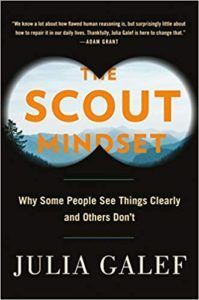
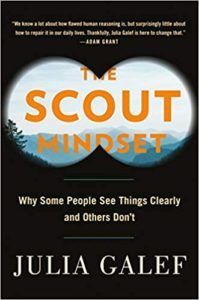
Podcaster and author Julia Galef talks about her book The Scout Mindset with EconTalk host Russ Roberts. Galef urges us to be more rational–to be open-minded about what we might discover about the world–rather than simply defend what we already believe, which she calls the soldier mindset. The conversation is a wide-ranging discussion of our biases and the […] The post Julia Galef on the Scout Mindset appeared first on Econlib.

/ Learn More

Julia Galef on the Scout Mindset

Podcaster and author Julia Galef talks about her book The Scout Mindset with EconTalk host Russ Roberts. Galef urges us to be more rational–to be open-minded about what we might discover about the world–rather than simply defend what we already believe, which she calls the soldier mindset. The conversation is a wide-ranging discussion of our biases and the […] The post Julia Galef on the Scout Mindset appeared first on Econlib.

/ Learn More

Julia Galef on the Scout Mindset

Podcaster and author Julia Galef talks about her book The Scout Mindset with EconTalk host Russ Roberts. Galef urges us to be more rational–to be open-minded about what we might discover about the world–rather than simply defend what we already believe, which she calls the soldier mindset. The conversation is a wide-ranging discussion of our biases and the […] The post Julia Galef on the Scout Mindset appeared first on Econlib.

/ Learn More

Knowledge, Reality, and Value Book Club

I’m launching a book club on Michael Huemer’s new introductory philosophy textbook, entitled Knowledge, Reality, and Value: A Mostly Common Sense Guide to Philosophy. I’ve already blogged a few highlights, but now that I’m done, I’m ready to declare this yet another fantastic work by my favorite philosopher. To keep the club interesting, I’ll focus almost exclusively on my disagreements with Huemer.  I’ll post the first segment on Part I on Monday, May 31, and respond to reader comments on Thursday, June 3.  After that, expect a similar pair of post every week until we cover all four Parts of the book. And if we’re lucky, Huemer himself will join the discussion.  The book is only $14.99 on Amazon, so order today!     (1 COMMENTS)

/ Learn More

The Miserable Americans

When I was in high school in Canada, I came home one day all excited about a short story we had read, an excerpt from a French novel. The novel was Les Miserables. I told my mother all about it and, of course, she already knew the story. The story, if I recall correctly, was titled “The Bishop’s Candlesticks.” In the story Jean Valjean is an escapee from a French prison and he was sent to prison for a term of 5 years for stealing a loaf of bread to feed a relative. I was outraged at the length of his prison sentence and my mother and I both expressed relief that nowadays (that is, the 1960s) in Canada (and, we thought, the United States) such an extreme penalty for such a small offense was a thing of the past. We were wrong. Here’s an excerpt from Elizabeth Nolan Brown, “This 38-Year-Old man Will Spend Life in Prison Over 1.5 Ounces of Marijuana,” Reason, May 13, 2021: With so many states choosing to legalize marijuana, it’s easy to forget how draconian the penalties for possession can still be. Case in point: The Mississippi Court of Appeals just upheld a life sentence for 38-year-old Allen Russell for being in possession of about one and a half ounces of the drug. Russell was sentenced in 2019, after being convicted for having 1.55 ounces (or about 44 grams) of marijuana. On appeal, Russell’s lawyers argued that his life sentence amounts to “cruel and unusual punishment and is grossly disproportionate.” Brown goes on to point out that this minor possession was a third strike. Actually, this is worse than what happened to Jean Valjean. Jean Valjean stole from someone. There was no allegation that Allen Russell stole his marijuana. I had had some hope, with a slight basis in his history of pardons, that President Trump would pardon such people. That hope, it turns out, was unjustified. Given both President Biden’s and Vice-President Harris’s harsh attitude to people (other than Harris) who use marijuana, I have even less hope for them to do anything positive on this issue. Even if they do, we have a long way to go to do better than 18th century France.   (0 COMMENTS)

/ Learn More

What about bribery?

This is a follow-up post to my recent proposal for banning corporations from paying ransom. Let’s think about another possible law, enacted to deal with the following scenario. Suppose that a US corporation has the best proposal to build a project in another country. Unfortunately, the government of that country won’t grant the contract unless a bribe is paid to a top official. The victimized company reluctantly pays the bribe, because paying the bribe reduces the market value of the company by less than losing the contract to another firm. That’s a pretty simple and straightforward example, isn’t it? Governments have been demanding bribes since the beginning of civilization.  Should we pass a law banning such bribes? If you read the comment section to my previous post, you’d assume that either nothing could be done about this problem, nothing should be done, or both. Why blame the victim, the poor company that is being squeezed by the powerful foreign company? After all, it’s only natural that it would want to pay the bribe, to avoid losing millions in potential profits. You certainly should not ban the paying of bribes, and in any case, corporations would simply ignore a law that did so.  At least that’s the implication of the arguments they used against my proposed law banning corporations from paying ransom. In fact, back in 1977 the US passed a law banning companies from bribing foreign governments, and many other countries have followed suit.  So this sort of law is certainly not inconceivable. Interestingly, the argument for banning the payment of ransom is far, far stronger than the argument for banning bribery. It’s all about “externalities”, which work in opposite directions in these two cases. One criticism of the Foreign Corrupt Practices Act is that it needlessly hampers US companies, and contracts are then diverted to companies with less ethical home governments.  Corrupt governments would naturally prefer to do business with countries that have weak controls on bribery. The “diversion” argument also applies to extortion, but in this case it works in favor of the ethical country.  If one country threatens to imprison corporate officials for 20 years if they pay ransom, extortionists will naturally seek out victims in less ethical countries that have not passed such a ban. Corporations are already banned from paying bribes because these payments fuel criminal corruption, which hurts the entire world, not just the parties directly involved.  Paying a ransom also fuels criminal corruption, hurting the entire world, not just the parties directly involved.  If you don’t believe me, ask a motorist in Florida that is unable to buy gasoline.  We ‘d be better off if corporations were not subject to such demands.  Making it illegal for US corporations to pay ransom would discourage extortionists from picking on US companies. Even today, institutions often refuse to pay ransom, and instead accept losses that are much larger than they would incur if they did pay ransom.  It can be done.  In the long run, US corporations might thank us for such a law. I understand that my proposal to ban corporations from paying ransom seems utterly crazy to many people, but don’t assume that it won’t happen some day.  Indeed we may already be inching in that direction: The U.S. Treasury Department is now stepping in with official guidance. In an advisory published October 1, it warns that a victimized organization that makes ransomware payments to certain identified notoriously high-profile cybercrime organizations, or entities in certain countries, could be subject to fines from the Office of Foreign Assets Control (OFAC). Any companies or contractors that a hacked organization works with—including those providing insurance, incident response, and digital forensics, as well as all financial services that help facilitate or process ransom payments—could likewise be subject to fines. In the comment section, Luc Mennet suggested an alternative to prison, a 1000% tax on ransom payments.  That tax would serve two purposes.  It would make extortion 90% less profitable, and it would divert the gains from extortion from the criminals to the government. (0 COMMENTS)

/ Learn More

Politics Without Romance

The public-choice school of economics, developed since the mid-20th century, assumes an individual who moves from the private sector to the public sector, whether as a government bureaucrat or a politician, remains the same mostly self-interested individual. He does not metamorphose into an altruist angel. This view of “politics without romance” (to quote James Buchanan) led to new and fruitful explanations of government actions. We would expect that a president (or another top ruler) will, if not effectively constrained by institutions (constitution, laws, and other sets of established rules), redefine his own self-interest as the “public interest.” Even if he wanted to do good for all citizens, he would typically be unable to do so because not all of them have the same preferences about what is good for them; so he better promote the public interest that is good for him. Viewed in this perspective, the actions of either Joe Biden or Donald Trump are not surprising. Each of them has been able to use the incredible power accumulated in the presidency for the pursuit of his own interest–for example, to be adulated by his supporters and 51% of the voters, to exercise power over people and show it, and (if age permits) to be reelected. Other motivations may play a role, but it is unrealistic and dangerous to ignore self-interest. If you are a Democrat and hated Trump, you should realize that he is, some idiosyncracies aside, the sort of ruler you are likely to suffer under the Leviathan you are calling for. If you are a Republican and hate Biden, you should understand that he is, some idiosyncracies aside, the sort of ruler you are likely to get under the Leviathan you long for. Mutatis mutandis if you are not living in America: that’s what you will get if you don’t already have it. Hence the argument, in “constitutional political economy” (or “constitutions economics”), for constraining government, that is, chaining Leviathan. (The featured image of this post reproduces Gustave Doré’s “The Destruction of Leviathan,” in reference to the original bible monster.) Chaining Leviathan is a goal that goes back to the source of classical liberalism. For example, David Hume wrote: In constraining any system of government and fixing the several checks and controls of the constitution, each man ought to be supposed a knave, and to have no other end, in all of his actions, than private interest. Similarly, John Stuart Mill: The very principle of constitutional government requires it to be assumed that political power will be abused to promote the particular purposes of the holder; not because it is always so, but because such is thenatural tendency of things, to guard against which is the special use of free institutions. These two quotes are reproduced in Buchanan’s article on public choice in the New Palgrave Dictionary of Economics. Buchanan wanted to reconcile “politics as exchange,” that is, the implicit exchange involved in the government’s production of unanimously desired public goods, with the need to constrain its exploitative power. Those who, like Anthony de Jasay, believe that public goods can be produced privately or that it is not possible to chain Leviathan opt instead for anarchy. The existence of a continuum between anarchy and Leviathan may provide some intermediary options, but this opens a Pandora box. (0 COMMENTS)

/ Learn More