
This is my archive

bar

There’s No Such Thing as a Free Education

Do murderers and criminals deserve a free education? Is there a certain level of morality that is corrupted by providing a free education to criminals? These are some of the questions that are explored in this episode of EconTalk. EconTalk host, Russ Roberts, talks with Max Kenner, founder and executive director of the Bard Prison Initiative, a program that offers college degrees to prisoners, about the program and how it functions. Kenner discusses the Bard Prison Initiative and the profile of the program as it was depicted in a four-part PBS documentary titled College Behind Bars. Roberts  questions the portrayal of the program in the film, the actual experience of the students, as well as the moral and financial arguments about whether a program like this is ethical and beneficial. Let’s hear your perspective on the education of incarcerated people. Answer our questions in the prompts below, or use them to start a conversation with friends offline.     1-Roberts mentions his dislike for the phrase ‘liberal arts education.’ Do you agree with his definition of a ‘liberal arts education?’ How do you think his view of a liberal arts education differs from others’ views? How is this relevant to the conversion of incarcerated people getting an education? Do you think this program is reflective of the overall goal of the American prison system? Explain.   2- Roberts suggests cynics may view this program as relatively pointless. It is not a program that can help all prisoners in the US, and in reality it has only helped a few hundred people. Do you agree with this point of view or do you agree with Roberts that helping even just one person to ‘transform’ is worth it? How do you feel about the funding of such a program? Should people be upset that criminals are being ‘rewarded’ with a free education, while other people who haven’t committed a crime have to pay for an education? How might your perspective change if the program is privately or publicly funded?   3- When further discussing the importance of a liberal arts education, Roberts asks Kenner a very interesting question: “Why should people who got no education, real education, growing up, who made a mistake or were treated horribly by the criminal justice system in the absence of a mistake, why should they study Homer, Shakespeare, and these other things? Why wouldn’t we give them a trade so they can thrive after they leave prison?” How did Kenner respond to these questions? How would you respond to these questions?   4- “Man wants liberty to become the person he wants to become.” Roberts mentions this James Buchanan quote in the context of ‘interior freedom.’ What does Kenner mean by ‘interior freedom?’ Why is this concept so important in relation to the education of incarcerated peoples?   5- Roberts and Kenner talk about the importance of learning things with other people. Why is this such a profound reason for having a chance of getting a liberal arts education in prison? Roberts mentions an example from the documentary of some inmates memorizing the opening paragraph in Moby Dick. What does Roberts have to say about memorization? Does this reflect some idea of community? How does this relate to the question of whether educating criminals is beneficial? (0 COMMENTS)

/ Learn More

Covid-19 and the Inefficiency of State Coercion

An article by legal scholar Richard Epstein published in the Hoover Institution’s Defining Ideas defends George Mason University professor Todd Zywicki who is challenging his university’s Covid-19 vaccine mandate (“The Uneasy Case for Universal Vaccinations,” July 27, 2021). Epstein presents economic and constitutional arguments against this sort of mandate, at least those imposed by a public institution. Epstein explains the gist of the economic case, based on individual incentives: A final consideration is that it might be wise not to impose any mandate at all. This view argues that the social case for vaccine mandates is not there. Most individuals will probably get the vaccine because it is in their self-interest to do so. Free riding is not an enticing option, given that it is highly unlikely that everyone else will get the vaccine. At the same time, high-risk individuals have every incentive to make the right choice for themselves, undercutting the need for paternalism. And anyone else who fears exposure will also provide implicit protection to others if they get a vaccine to protect themselves. … In close cases like this one, there is much to be said for respecting the presumption of liberty. I defended similar arguments in my Reason Foundation paper “Public Health Models and Related Government Interventions: A Primer” (March 2021). It is highly plausible that individual incentives produce the level of protection that individuals want more efficiently than coercive mandates from governments or public institutions. The presumption of liberty invoked by Epstein is more a moral or political-legal argument than an economic one. Ultimately, however, any government intervention rests on value judgments, even if the latter must be influenced by the ways the social world works (as analyzed with the tools of economics). In my Reason Foundation paper, I also review the history and ideology of the public health movement. On the presumption of liberty, I write: Translating these ideas in practical policy proposals starts with a general presumption for individual liberty, which should be corrected by government intervention only in the presence of clear market failures and when government failures are not likely to be worse. Expressed differently, coercion should be minimized. This approach is not as radical as it may look. It is related to the idea of economic freedom that led to the Industrial Revolution and the unprecedented explosion of prosperity that followed. From a moral-philosophical viewpoint, it can be thought as implementing John Stuart Mill’s principle that “over himself, over his own body and mind, the individual is sovereign.” (0 COMMENTS)

/ Learn More

Should policymakers maximize aggregate utility?

I favor a utilitarian approach to public policy.  One common objection to this criterion is that we cannot measure utility, and hence there is no objective way to use utility maximization as a guide to policy. I certainly agree that it is impossible to measure utility with any sort of precision, a fact that does somewhat reduce the attractiveness of utility maximization as a policy criterion.  Nonetheless, I believe utilitarianism is the least bad option, for two reasons: 1. Individuals who engage in charitable activities seem to use something close to utility as a guide to their decisions.  Thus it is far more common to see charity that involves redistribution from the rich to the poor than vice versa. Suppose it was literally true that we had no idea whether the marginal utility of an extra dollar was higher for the poor than for the rich.  Then there would be no basis for the sort of income redistribution that we often see from philanthropists. One counterargument is that philanthropists rarely engage in simple income redistribution, rather they often devise more paternalistic schemes such as helping the poor have access to more food, clothing, education or health care.  But that’s not really a criticism of utilitarianism; it’s an implied criticism of the view that something like a Universal Basic Income is the best policy from a utilitarian perspective.  Between 1973 and 1981, I was “poor” in an income sense, but I doubt there would have been much value in a billionaire donating money to me.  Alternatively, if a poor person is addicted to drugs or alcohol, it’s not obvious that giving them money will make them better off. 2.  While it’s true that one cannot directly measure utility, it’s also true that one cannot directly measure many of the alternative potential goals of public policy.  Thus suppose your alternative criterion for public policy was simply “protect natural rights”.  We would have the same problem as with utility maximization—it’s difficult to measure natural rights. Consider gun rights.  If people in some sense have a natural right to bear arms, that then forces us to define exactly which arms they have a right to bear.  Ordinary rifles?  Semi-automatics?  Machine guns?  Artillery?  Truck bombs?  I am sympathetic to Jeremy Bentham’s argument that the concept of “natural rights” is just “nonsense on stilts”.  When I try to think about what sort of legal or constitutional right to bear arms make sense, I’m unable to do so in anything other than utilitarian terms.  Which legal definition of this right works best?  If I did try to come up with a definition of a “natural” right to bear arms, I’d be using the same sort of judgment or intuition that utilitarians get criticized for using in other areas of public policy—trying to base policy on things that cannot be directly measured. One thing that we can measure (imperfectly) is GDP (or consumption.)  So perhaps we should simply have public policymakers maximize GDP and call it a day.  And indeed for many policy areas–including my own field of monetary policy–maximizing GDP does provide a rough approximation of success.  But in other areas such as environmental policy it does not. An alternative approach would be to maximize GDP adjusted for externalities.  To some extent we can use market prices to estimate external effects, say by comparing the price of a house next to a noisy airport and an equivalent house somewhere quieter.  But once we start down that road, it’s hard to know where to stop.  How about maximizing GDP adjusted for externalities and inequality?  It might even be possible to measure how fast the marginal utility of an extra dollar declines as income rises.  You could have a billionaire or a wealthy institution go to a low-income country and offer very poor people the choice between a certain $10,000 and a 50-50 shot at $100,000, and other similar wagers. Over time they’d be able to estimate the utility function for income or wealth.  That information might provide data of interest to policymakers designing the optimal tax system. My point is not that utility can be directly measured; I don’t believe that.  Rather I am arguing that it’s not clear that trying to measure utility is any more difficult than trying to measure any other plausible policy goal.  No one who contributes to charity knows for certain how it will impact the persons they are trying to help, or indeed even their own welfare.  And yet people still give money to charity.  We all make life decisions based on our best guess, and that will inevitably be true of the government as well. (0 COMMENTS)

/ Learn More

Hanania the Wise

Richard Hanania once again cuts through the absurdity of popular thinking about American politics.  Few modern thinkers are as wise and forthright.  Read the whole thing, but here are the highlights. First, talk of Critical Race Theory “bans” are silly hyperbole.  The debate is about public school curricula, not censorship. You may think high schoolers should learn such things, or not. But the fact is that if you have government schools, it is government that makes the rules. How could it be otherwise? Notice that by mandating one thing, you ban another. A classroom that is required to teach gender is fluid and homosexuality should be accepted is banning traditional sexual morality. One that teaches that every major racial census category has its own history decides which groups are singled out for official identities (“Hispanic” and “AAPI,” but not “Jewish” or “Italian”), and denigrates the idea that American history should be taught from a more unified perspective. The idea that government schools teach some things, but not others, and that a government school curriculum is set by government, has never been controversial. It’s only causing such debate now because instead of Democrats mandating that you teach identity politics and gender fluidity, it’s Republicans wanting to teach their own ideas. Now maybe you think Critical Race Theory is true. In which case, you should oppose these bans. If you think it’s a false and harmful doctrine, then banning it is pretty much the job of government. Second, de facto curricula matter far more than de jure curricula: More important than what CRT bans say is who will be interpreting them. A 2017 survey of school teachers and education bureaucrats showed that they voted for Hillary over Trump, 50% to 29%. That’s actually not as lopsided as I would have guessed, but there’s evidence that Democratic teachers are more committed to politics than Republican teachers, just as liberals care more about politics more generally. In 2020, educators who donated money to a presidential campaign were six times more likely to support Biden than Trump. So while Democrats may have “only” a 21-point lead in voting preferences among educators, when it comes to those who care more about politics, it’s more like an 85%-15% advantage. And teachers are probably conservative compared to the kinds of people who write textbooks, design curriculums, and work in education departments. With those kinds of numbers, there’s really nothing conservatives can do to make the schools friendlier to their ideas and values. A CRT ban might mean a teacher won’t say “Ok, kids, today we’re going to learn about Critical Race Theory!,” but they’ll still teach variations of the same ideas. Neither Robin DiAngelo nor Ibram X. Kendi, the two thinkers that seem to offend conservatives the most, identifies as a Critical Race Theorist. In fact, the American Federation of Teachers just announced a campaign to bring Kendi’s teachings to every student in the country, and they don’t appear to be deterred by CRT bans. This is their full time job, and they’ll still be at it whenever public attention has moved on from the controversy of the day. What is to do be done?  Undermine public education, of course. The implication here is that the only real option for conservatives is to attack public education and encourage a larger migration to private schools and home schooling. A state can ban CRT, but if it does, kids are still being taught by the same people who thought CRT for kindergartners was a good idea in the first place. Instead of passing the right law and relying on liberals to teach things more consistent with conservative values, simply transfer money from those liberals to people who would teach something else. The percentage of kids attending private schools has actually stayed quite stable for decades at around 8%, while home schooling has jumped from around 1.7% to close to 4% over the last 20 years. If you don’t like what’s being taught in schools, the goal should be to change those numbers. Aren’t private schools just as left-wing as public schools?  No. That being said, are private schools really any less liberal than public schools? Maybe not at the most elite level, as Bari Weiss has shown. Yet every indication is that private schools are in general more conservative. According to a 2015 study, “of the 5.8 million students enrolled in private elementary and secondary schools, 36 percent were enrolled in Catholic schools, 13 percent were enrolled in conservative Christian schools, 10 percent were enrolled in affiliated religious schools, 16 percent were enrolled in unaffiliated religious schools, and 24 percent were enrolled in nonsectarian schools.” Combining Catholic and “conservative Christian” schools, this indicates that at least half of private schools teach a sexual morality that would be illegal if promoted by a public educator, at least in California and other blue states. For me, what’s most impressive about Hanania is the absence of Social Desirability Bias.  He describes the world as it is, and offers advice to improve upon the ugly world in which we find ourselves.   (0 COMMENTS)

/ Learn More

The Long Road Backwards: Prelude to Another Housing Meltdown?

Those Who’s are at it again. Pursuant to the Supreme Court’s decision in Collins v. Yellen, which ruled that the requirement that the head of the Executive agency the Federal Housing Finance Agency (FHFA) can only be removed by the President for cause represents a violation of separation of powers, the Biden Administration has moved to terminate Director Mark Calabria. FHFA was the agency created by Congress to oversee Government Sponsored Enterprises (GSEs) Fannie Mae and Freddie Mac in the wake of 2008’s crash of the housing market. One of the agency’s first decisions was to place the GSEs into conservatorship, to ensure that they retained the financial assets necessary to continue to serve as the de facto guarantor for the mortgage market. Calabria, a former Director of Financial Regulation Studies at the Cato Institute, was a Trump appointee who wished to impose financial responsibility on the GSEs in order to minimize the rate of mortgage defaults. This did not sit well with Biden, who wishes for FHFA to play an active role in making housing affordable for those with the lowest incomes. It seems as if we have been here before, at this poisoned nexus between credibly good intentions and discreditably ignoring predictable outcomes. This is shades of 2002 McCulley and Krugman, calling for a housing bubble to artificially bolster an artificially dampened economy.  There are times I believe that those who fail to learn from history are doomed to become policymakers. There are those, such as Duke’s Manuel Adelino, who point out that subprime mortgages didn’t cause the crash, and they would be correct. The percentage of subprime defaults among the morass of toxic assets wasn’t enough to bring the house of cards a-tumblin’ down. The majority of those defaulting assets were owned by mid-to-higher income buyers, many of whom purchased homes for speculative purposes. This bears acknowledgment, but we simply cannot disregard the subprime market as a proximate cause. Private mortgage securitization was largely the result of the expansion of risky mortgages, as the inherent risk in such instruments came with the promise of higher yields. In this case, securitization also allowed financial institutions to play fast and loose with capital reserve requirements, encouraging profligacy by everyone involved, including the GSEs tasked with acting as a backstop against such behavior via their own, ostensibly safer, mortgage-backed securities. I can agree with the Constitutional reasons behind the Court’s ruling while being given pause by the reasons behind Mr. Calabria’s firing. Taking the shackles, so to speak, off FHFA will simply allow policy pressures to be exerted upon Fannie Mae and Freddie Mac that result in baggage and bailouts. Prior to the housing bubble, Fannie Mae’s annual losses averaged around 4 basis points. During the crises, those annual losses averaged 52 basis points. That is simply not acceptable for an institution designed to inject stability into the market. The duty of FHFA regulated GSEs should be, as publicly traded institutions, to their shareholders, and not the policy wishes of any given President. Of course, in a truly free and liberal society, how we handle the least among us says much about our health moving forward. There are any number of ways to encourage the availability of homeownership to those of lowest income without allowing public policy to hijack the market in potentially disastrous fashion: Encourage states to loosen occupational licensing requirements: The major deterrent to homeownership for the poor is the lack of income needed to properly qualify for non-subprime mortgages. For many workers who don’t possess high-paying skillsets, entrepreneurship is the best path to raising their income level. Occupational licensing laws serve as an unnecessary barrier to entry, creating a ceiling to upward mobility. I am entirely in favor of, say, the barber industry creating their own internal standards and certifications to assess practitioner skill and quality. I don’t see the need for barbers to be licensed. End the Drug War: The job prospects of individuals with prison records is severely limited. This creates poverty that is often intergenerational in scope. Nonviolent drug offenses should simply not be a barrier to upward mobility. This paradigm becomes increasingly harder for policymakers to justify as in increasing number of state legislatures are not only legalizing marijuana but collecting taxes and getting into the dispensary business themselves. Drug prohibition benefits no one except those whose income is derived from creating criminals. It’s time for this paradigm to end. Let the market market: There are any number of nonprofits and private organizations, such as the Neighborhood Assistance Corporation of America (NACA) which exist solely to extend the possibility of homeownership to low-income Americans. These organizations generally also provide financial counseling, credit repair, and other similar services that assist their clients in improving their financial health beyond purchasing a home. Provide tax incentives for rent-to-own programs: I am generally in favor of lowering taxes for any reason, and this would benefit both landlord and renter. Allowing a portion, or even all, of the amount of rent received as part of a rent-to-own contract to be written off would potentially incentivize owners of rental houses to engage in more of such contracts. Additionally, allowing a tax break for improvements made by renters engaged in such a living arrangement would both lower their tax bill and increase the value of the property once they have taken ownership. As an additional caveat to mitigate predatory landlords, if they fail, without cause, to execute the contract allowing the renter to purchase the home, they might be made subject to penalties covering both the tax breaks they received, and the improvements made by the tenant. Ultimately, the purpose of securitization is to spread and mitigate risk, and if government owned mortgage guarantors are to exist, they must operate solely within the parameters of this purpose. As fairly recent history has demonstrated, when Freddie and Fannie act irresponsibly, it provides a signal to market actors that the government approves of irresponsible securitizations, insurance schemes and risk, and will bail out bad actors. We simply cannot afford to travel this long road backwards. Tarnell Brown is an Atlanta based economist and public policy analyst. (0 COMMENTS)

/ Learn More

Trust, but verify

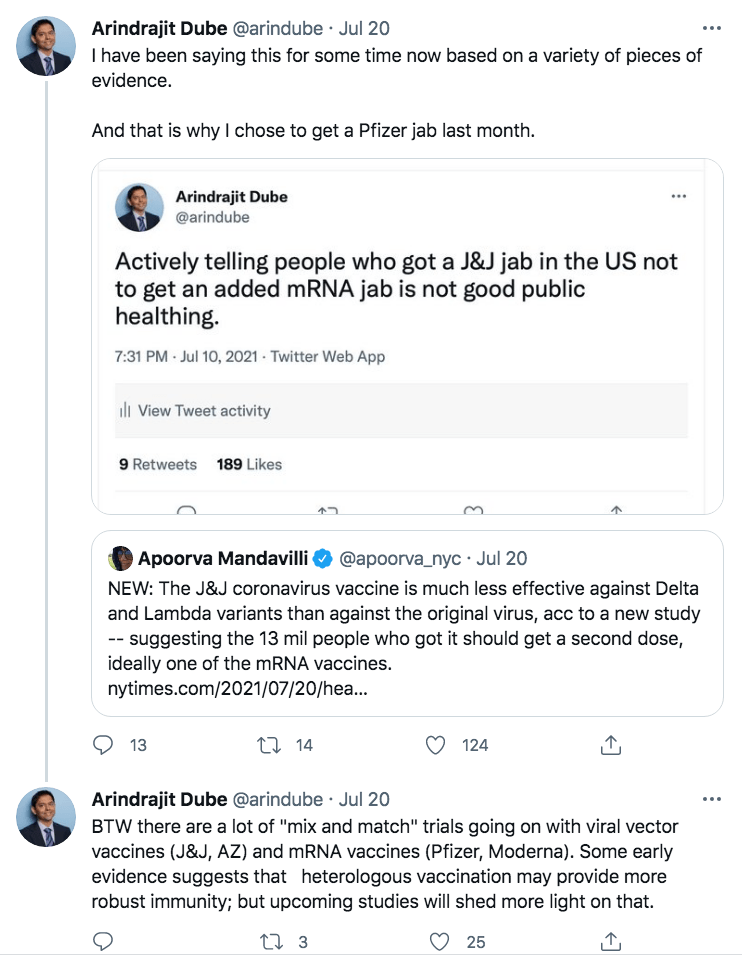
Yes, that’s a sort of oxymoron.  So let me put it this way.  Put more weight on an expert’s opinion than a non-expert’s opinion.  But also evaluate the soundness of the arguments used by experts; don’t accept them uncritically. A recent article at Yahoo followed a predictable path, pointing out how a low income Florida county is full of lots of obese people who refuse to get vaccinated.  The reporter has great sympathy for the overworked health care workers in their underfunded medical facilities.  Then the article took a surprising turn: On Wednesday morning, chief nurse Paige Tolley received a call from the clinic across the street, where Davis works, about rising COVID-19 cases. “Are y’all seeing multiple daily, too?” Tolley said on the phone. “Keep sending them if y’all need to. We’ll be here.” Tolley said cases have “really picked up in the past couple weeks,” mostly among unvaccinated people. “I hate to see the infection rate like it is,” she said. She and her staff print information on the vaccine from the CDC to give to patients. She encourages them, especially those with health conditions, to get vaccinated “if they think it’s the right thing to do.” She empathizes with those who refuse. “I’m not going to push anything on anybody,” said Tolley, who hasn’t been vaccinated. “I don’t know what the virus would do to me, I don’t know how it would affect me, because everybody’s different,” she said. “I also don’t know what the vaccine would do.” Her coworker, risk control nurse Janna Martin, a mother of three, also hasn’t gotten a COVID-19 vaccine. She’s afraid of unforeseen fertility ramifications. While experts say such claims are unfounded, Martin said her doctor suggested she hold off.  [emphasis added] And this: Martina said his wife, a nurse for 14 years, told him the vaccines hadn’t been studied enough. “She hasn’t taken it either.” Those who say that I should “stay in my lane” and trust people with training in health care (something I lack), would presumably say that I should defer to the expertise of doctors and nurses.  Indeed in the comment section of my two blogs I am frequently chastised for offering opinions on issues outside of my area of expertise.  But while I’m not a medical professional, I don’t find the arguments used by the people quoted in the article to be at all persuasive. I do believe that expertise is a plus, other things equal.  But you also need to consider whether the expert’s reasoning process sounds persuasive.  We know that even experts (including economists) are prone to making basic cognitive errors.  When doctors were asked a question that required Bayesian reasoning regarding disease probabilities, many of the doctors made an elementary error. One might argue that ordinary doctors and nurses are not the relevant “experts”, and that we should instead look to the FDA or CDC.  But that approach also has its drawbacks, as government officials may feel pressured to offer not the view that they believe is most likely to be true, rather the view that can be justified based on pre-existing and possibly inappropriate criteria.  Are they engaged in sound cost/benefit analysis? (I.e., for society, not for their own career.) Tolley said she knows the pros and cons of the vaccines authorized for emergency use by the Food and Drug Administration but considers them “just experimental right now.” She’s right!  The FDA does consider it “just experimental right now”. Here’s another case where an economist disagrees with the experts at the FDA: Personally, I’m included to agree with Dube.  That’s not because I think I know more about vaccines than the people at the FDA, rather it is because the FDA is not offering sound logical reasoning for its policy stance.  I suspect that many of them privately agree with Dube, but don’t feel free to state that opinion publicly. Recently I heard a public health expert on NPR.  I don’t recall the exact details, but much of the interview consisted of the expert basically saying “Option X is almost certainly best and will likely be approved soon, but for now were are recommending option Y.”  And this was not just on one specific issue; he was making this argument repeatedly in response to several of the interviewer’s questions. (0 COMMENTS)

/ Learn More

James Heckman on Inequality and Economic Mobility

Economist and Nobel Laureate James Heckman of the University of Chicago talks about inequality and economic mobility with EconTalk host Russ Roberts. Drawing on research on inequality in Denmark with Rasmus Landersø, Heckman argues that despite the efforts of the Danish welfare state to provide equal access to education, there is little difference in economic mobility between the United States and Denmark. The conversation includes a general discussion of economic mobility in the United States along with a critique of Chetty and others’ work on the power of neighborhood to determine one’s economic destiny. (0 COMMENTS)

/ Learn More

James Heckman on Inequality and Economic Mobility

Economist and Nobel Laureate James Heckman of the University of Chicago talks about inequality and economic mobility with EconTalk host Russ Roberts. Drawing on research on inequality in Denmark with Rasmus Landersø, Heckman argues that despite the efforts of the Danish welfare state to provide equal access to education, there is little difference in economic mobility […] The post James Heckman on Inequality and Economic Mobility appeared first on Econlib.

/ Learn More

Two Weaknesses of Socialism

Two weekend stories in the Wall Street Journal remind us of two weaknesses of socialism or, for that matter, of any collectivist control of the economy. The first story reports on how the federal and state governments have blundered in distributing a trove of money to landlords and tenants in order to prevent evictions due to the Covid and lockdown recession (Andrew Ackerman, “End of Eviction Moratorium Puts Many Tenants at Risk of Losing Their Homes,” Wall Street Journal, July 23, 2021): “The capacity to process applications does not match the volume of need,” said Jim MacDonald, chief community investment officer at the United Way of Greater Kansas City, which is helping distribute about $30 million in the area. In other words, the capacity to process applications does not match the volume of free goodies that people want. One could argue that the problem is due to partnerships with a private organizations (United Way in this case) that are typical of American governments—an objection related to the lack of government “capacity” criticized in Daron Acemoglu and James Robinson’s latest book, The Narrow Corridor (Penguin Book, 2019). But even a more monopolistic and bureaucratized delivery system has its limits. Governments cannot have all the information about individual preferences and circumstances of time and place that are necessary for efficient central control; nor do they have good incentives to respond to whatever information they have. This problem is illuminated in The State and Revolution (1918) where Lenin defends the ideal of the whole economy organized like the state postal service. Speaking of the intermediary stage of communism, he wrote: A witty German Social-Democrat of the seventies of the last century called the postal service an example of the socialist economic system. This is very true. … To organize the whole economy on the lines of the postal service so that the technicians, foremen and accountants, as well as all officials, shall receive salaries no higher than “a workman’s wage”, all under the control and leadership of the armed proletariat—that is our immediate aim. The second story is about Leonard Erdman, a New Mexico mechanic and body shop expert, who spent several months restoring a 1952 Ford pickup and inventing a new purple color for it. Speaking of his restored pickup, he said (see A.J. Baine, “He Invented a New Shade of Purple for His Souped-Up Ford,” Wall Street Journal, July 24, 2021): I tinkered with it for eight months until I came up with a vision of what I wanted to do. I wanted it to be in your face, almost like something you would see in a comic book. My vision included purple paint. Everyone told me I was crazy—even my wife. I kept saying, “It’s going to be OK. Trust me.” (The color invented by Mr. Erdman is roughly reproduced on the featured image of this post. Look up the Wall Street Journal if you have access to it.) A Marxist may reply that this sort of esthetic venture is exactly what Marx had in mind when he described the ultimate stage of communism (The German Ideology, 1845): In communist society, where nobody has one exclusive sphere of activity but each can become accomplished in any branch he wishes, society regulates the general production and thus makes it possible for me to do one thing today and another tomorrow, to hunt in the morning, fish in the afternoon, rear cattle in the evening, criticise after dinner, just as I have a mind, without ever becoming hunter, fisherman, herdsman or critic. The economic problem here is quite basic. Resources are scarce in relation to human desires. Once all factors of production are deemed to be “our national resources” or “our collective resources,” why would the collectivity permit a little mechanic to divert his labor to a time-consuming hobby, not to mention the material inputs (all the parts) that went into “his” old Ford pickup, while, as our democrat socialists in DC would say, American children are hungry and people lack medical care? Any Supreme Soviet would find this unacceptable and contrary to the collective priorities. Any woke government would force the crazy mechanic to devote to feeding children or building medical equipment the time that he selfishly spends restoring old cars,  hunting, fishing, or literary critique. The two lessons are that (1) government management of the economy is at best bureaucratic and inefficient and that (2), at worst, it requires the arbitrary control of “our” national or collective resources, that is, of us individuals. (0 COMMENTS)

/ Learn More

Yglesias on military spending

Matt Yglesias has a post discussing the new cold war with China. In the end, he’s skeptical of calls for more military spending to counter China, but along the way I think he concedes too much to the other side: But when defense spending went down in Obama’s second term, that was part of an across-the-board austerity agenda that was economically harmful. Under Trump, Congress cut deals to lift the sequester, and both military and non-military spending went up. That, it seems to me, was good. We should not let concern about China deprive us of funds for useful domestic spending. But whether or military spending actually crowds out or crowds in domestic spending depends on the situation. I strongly disagree with the first paragraph, and the second is also somewhat misleading. As I’ve pointed out in numerous previous posts, the 2013 austerity program represented a spectacular failure of Keynesian economics.  Keynesians predicted that the fiscal austerity would slow growth, perhaps triggering a recession, and instead both real and nominal GDP growth sped up after January 1, 2013.  That’s because the impact of fiscal shocks is normally offset by monetary policy, as was the case in 2013. I don’t accept Keynesian models of fiscal policy, but even if we accept the standard textbook Keynesian model, a persistent increase in military spending, say from 3% to 4% of GDP, completely crowds out domestic spending.  That’s because in the standard Keynesian model, military spending can only avoid being zero sum by reducing the volatility of the business cycle.  In other words, it would need to be “countercyclical.”  That’s presumably what Matt means by “depends on the situation”.  But that phrase doesn’t mean what many people think it means. If you permanently raise military spending from 3% of GDP to 4% of GDP, it doesn’t even have the effect of boosting GDP during a recession period.  The economy adjusts to the new trend rate of military spending, wages and prices reflect those levels, and shocks are just as likely to produce big recessions at 3% of GDP military spending as at 4% of GDP military spending.  In the more sophisticated Keynesian models, it’s not government spending that matters, it’s changes in government spending.  Again, to boost growth the military budget would have to be countercyclical. And here’s the basic problem, it’s very unlikely that military spending would be meaningfully countercyclical.  In any case, that would not be an argument for a bigger military, it would be an argument for a more countercyclical military.  If we are talking about long run changes in the military as a share of GDP, we need to assume 100% crowding out, if not more. In practice, the crowding out is more than 100%.  That’s because higher military spending requires higher taxes.  As taxes as a share of GDP rise, other things equal, the level of GDP per capita declines.  While rich countries often have fairly high taxes (i.e. Sweden), between two otherwise similar rich countries the one with lower taxes usually has higher per capita GDP.  (And even Sweden’s economy improved after it cut back on its extremely high tax rates during the 1990s.)  That’s one reason why America’s per capita GDP is higher than Europe’s—we have lower tax rates. In general, rich countries with lower taxes (the US, Canada, Australia, Switzerland, Ireland, Singapore, etc.) tend to be richer than those with higher taxes. PS.  A tiny part of military spending may involve growth generating R&D.  But that’s an argument for the government funding some R&D, not an argument for massive military spending. (0 COMMENTS)

/ Learn More