
This is my archive

bar

Liberty’s Crisis Crisis

I often remember the parting words of Robert Higgs’ Crisis and Leviathan: [W]e do know something – at least abstractly – about the future.  We know that other great crises will come.  Whether they will be occasioned by foreign wars, economic collapse, or rampant terrorism, no one can predict with assurances.  Yet in one form of another, great crises will surely come again… When they do, governments almost certainly will gain new powers over economic and social affairs… For those who cherish individual liberty and a free society, the prospect is deeply disheartening. That’s what Higgs said back in 1987, over a third of a century ago.  And how right he has been!  The Nineties were almost crisis-free; indeed, the collapse of Communism ended the forty-year crisis of the Cold War.  Ever since, however, we’ve had one exasperating crisis after another: 9/11, the Iraq War, the Great Recession, and ISIS, followed by Covid-19, the crisis that puts all the others to shame.  I maintain, of course, that the chief problem in each crisis has been government’s hysterical overreaction.  Verily, the cure is worse than the disease.  Still, that doesn’t change the fact that the net effect of these crises has been awful. As someone who, like Higgs, cherishes individual liberty and a free society, the retrospect has been deeply disheartening.  But at least Higgs psychologically prepared me to see people panicked and freedom trampled.  What I failed to anticipate, however, was the effect of crises on the liberty movement itself. When I first read Higgs, I figured that when governments used crises to expand their power, libertarians would reliably resist such expansions. That’s not what happened. Instead, every crisis opened a new libertarian rift.  Anti-war versus pro-war libertarians.  Anti-bailout versus pro-bailout libertarians.  Pro-immigration versus anti-immigration libertarians.  Anti-lockdown versus pro-lockdown libertarians. In part, these were rifts between radical and moderate wings of the liberty movement.  Radical libertarians swiftly opposed lockdowns; moderate libertarians, in contrast, largely waited for vaccines to support a return to normalcy.  Yet the radical-moderate divide is far from the whole story.  Muslim terrorism led many self-styled “radical libertarians” to bitterly turn against not just Muslim immigration, but immigration in general.  Moderate libertarians rarely did the same. Could the libertarian movement have successfully checked the expansion of government power if we’d only stayed united in the face of crisis?  I don’t know.  What I do know is that our habitual division during crisis practically ensures failure.  We can’t readily take a message of freedom to the broader world if every crisis prompts a vocal wing of the liberty movement to hop on the crisis bandwagon and urge fellow libertarians to “Get with the program.” The deeper ill, though, is that every crisis dramatically transforms the libertarian conversation.  Even libertarians who stay off every bandwagon wind up spending a major share of their intellectual energy doing “damage control.”  Externally, we try to downplay each crisis – or blame the government.  Internally, we try to convince fellow libertarians to stay off the bandwagon.  And before long, another crisis hits. Upshot: In the last twenty years, the libertarian movement has become almost entirely reactive.  Bad things happen; governments claim new powers; we try to get in the way.  Repeat.  Highly demoralizing. You could protest, “Eternal vigilance is the price of liberty,” and you wouldn’t be entirely wrong.  Arguing against government power grabs is a worthwhile endeavor.  I’ve done it myself, especially during Covid.  Yet in practice, sadly, crisis management has made libertarians lose sight of our original mission: Cogently making the affirmative case for a libertarian society. If you’ve forgotten what that means, let me refresh your memory.  Libertarians don’t believe in holding the line, in keeping policy from getting worse.  We favor a radical program of policy reform.  We are staunch believers in deregulation, austerity, and privatization.  Yes, there are long-running disagreements about how radical to be.  Milton Friedman personified the moderate libertarian position; Murray Rothbard personified the radical libertarian position.  Relative to normal Americans, though, even Friedman had a lengthy list of regulations and programs to abolish.  Abolish the minimum wage.  Abolish tariffs.  Abolish Social Security.  Abolish conscription.  Abolish national parks.  Not cut.  Abolish.  All this and more comes at the end of chapter two of Capitalism and Freedom. Personally, I have tried to carry this torch forward.  While I’ve occasionally written about the crisis of the day, most of my intellectual output consists in defenses of radical libertarian positions.  The Myth of the Rational Voter shows why markets far outshine democracy.  The Case Against Education defends the abolition of public education in all its forms.  Open Borders calls for full deregulation of immigration.  My impending Build, Baby, Build advocates the full deregulation of the housing industry.  Even my Selfish Reasons to Have More Kids has a libertarian stealth agenda: To get the people who read me, disproportionately libertarian, to be fruitful and multiply. Yes, I’m hardly alone in writing books that make an affirmative case for a libertarian society.  Yet in the last twenty years, far more libertarian output has been crisis-driven.  And that’s a big mistake.  Libertarians shouldn’t just doubt the answers of mainstream statist society.  We should doubt the questions of mainstream statist society as well.  Critiquing Covid tyranny is fine, but at this point it’s far better to change the subject to the horrors of housing regulation. Needless to say, if you’re not a libertarian, none of what I’ve said will make much sense to you.  That’s fine; while I normally try to address a broad audience, I’ve targeted this specific essay at my in-group.  What concerns me here, rather, is how fellow libertarians will react. The most obvious libertarian objection is, “I made an exception for crisis X because crisis X was genuinely terrible, and necessitated a major government response.”  The easiest rejoinder is: “And how did that major government response work out?  Not so good?  You should be more skeptical next time.”  More fundamentally, a moderate presumption of liberty plus an honest assessment of your own forecasting ability provides a strong reason to oppose any big government response to almost any crisis.  The statist says, “Prove it will fail.”  The libertarian says, “Prove it will work.”  When disaster strikes, action bias and rally-round-the-leader are human, but not libertarian. A more thoughtful libertarian objection is, “Our least-bad chance to push policy in a libertarian direction is to focus on the crises that everyone else is talking about.”  Perhaps, but probably not.  When everyone else is already talking about an issue, it’s hard to make your voice heard.  The crowd drowns you out.  The moral: If you want attention, don’t try to fit it.  Try to stand out.  Talk about the issues that aren’t on other people’s minds… until you put them there.  Sure, you can use current events as a hook, but as a means to the great end of selling neglected libertarian ideas.  And above all, be persistent in the face of apathy and hostility.  Picture libertarian ideas as a battering ram.  To succeed, we have to build a great intellectual edifice, then smash it into statist irrationality year after year, decade after decade, until we get freedom.  If that fails, we have to count on the next generation of libertarians to finish what we started. If I’m right, why do libertarians spend so much time reacting to the latest crisis?  The best answer is: Poor impulse control.  When dramatic events happen, humans yearn to engage them… even if, calmly considered, they have better topics to ponder. Policy change is hard.  If libertarians had followed my crisis-avoidant strategy since 2001, we still might have no policy victories to show for it.  Still, we couldn’t have done much worse than we did.  And the decades of moderate libertarian success – roughly 1970-2000 – clearly coincided with my battering ram strategy.  At minimum, my approach is better for morale, for recruitment, for retention.  Libertarians must get past our crisis crisis.  We really do possess a body of timeless ideas for a better world.  Those ideas, not the latest moral panic, should be our compass. P.S. Credit where credit is due: The great Corey Angelis really has leveraged the Covid crisis to markedly advance the cause of school choice.  Masterfully done, but Corey’s still the exception that proves the rule. (0 COMMENTS)
/ Learn More

Taxes? What Taxes?

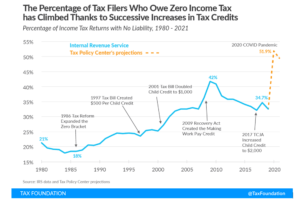
Per the Tax Foundation, the chart below shows that since 1980, the share, each year, of tax filers who owe no income tax. This chart of nonpayers who file taxes appears in an excellent article by Garrett Watson. But the author also highlights the data from the Tax Policy Center based on tax units, which is interesting too. Watson writes that: “the Tax Policy Center (TPC) released estimates on the portion of households with no federal income tax liability, finding that in 2020, about 60.6 percent of households did not pay income tax, up from 43.6 percent of households in 2019. Much of the 2020 increase was due to pandemic-related factors, but the growing share of households paying no income tax should be kept in mind when evaluating the progressivity of the federal income tax system and proposed tax hikes on higher earners.” That means that, in 2020, all of the income tax revenue was collected from only 40 percent of U.S. households. This is by design, and it is done by excluding households through a combination of personal exemptions, the standard deduction, zero bracket amounts, and tax credits. Since roughly 50 percent of federal revenue comes from individual income taxes, it means that a few households pay a big share of all federal taxes. The TPC estimates that the share of households paying no income tax will drop starting next year. However, these projections will not hold if President Biden extends or makes permanent many of the tax credits he plans. To that effect, the piece has a good discussion about the impact on the share of households, by income group, not paying taxes of making permanent or extending tax credits such as the expanded Child Tax Credit (CTC), Earned Income Tax Credit (EITC), Child and Dependent Care Tax Credit (CDCTC), the Premium Tax Credit provided originally through the Affordable Care Act (ACA), and others. It includes this: “TPC also found that extending these more generous credits would increase the number of households who pay no income tax from 42 percent to 45 percent in 2022. Notably, “the largest percentage increase would be among households with annual income between about $100,000 and $180,000.” The share of households not paying income tax in that income group would rise from about 4.5 percent under current law to 10.5 percent if the APRA credits were extended.” In other words, the share of households with zero income tax would continue to expand way beyond lower income households. Looking at the underlying TPC data, I notice another interesting thing. Also growing is the share of households that pay neither the income tax nor the payroll tax. For the record, for most people, the payroll tax is the biggest federal levy they face (not surprising considering how many are exempted from paying the income tax), so this trend is interesting. The share of households that don’t pay the income tax and that don’t pay the payroll tax grew from 14.8 percent in 2011 to 20.5 percent in 2020. The share stood at 16.8 percent in 2019, so there too pandemic-related factors are at play. Still, these trends should worry us all. But for those of us who would like to see the government significantly shrink, it should freak us out. It is easy to want more spending and larger government when you don’t have to pay for it. That’s one of the many things I find so problematic with government spending that’s paid for with Uncle Sam’s credit card. It shifts the cost of today’s programs onto future generations. Adding insult to injury, because the spending multiplier is less than 1 in most cases, all that spending is also reducing private economic activity. Some of these tax credits create serious disincentive to work, marry, or stay married, bad news all around, though not a new phenomenon. In addition, these tax credits make the tax code very complicated. Last year, I wrote a piece in the New York Times looking at this issue through after the “scandal” about President Donald Trump. Part of the carveouts people took issues with were corporate ones, but there is plenty on the individual side too.     Veronique de Rugy is a Senior research fellow at the Mercatus Center and syndicated columnist at Creators. (0 COMMENTS)

/ Learn More

Response from a Pro-Life Utilitarian (Sort of)

Six years ago, I asked, “Where are the pro-life utilitarians?” Recently I received this response, reproduced anonymously at the author’s request. Hey Bryan, You wanted to ask “where are the pro-life utilitarians”. Well, I think I’d say I’m one of them. Why you’ve not heard of them is simple in my opinion: it’s kind of progressive to talk about non-human animal rights, say, but it is seen as very regressive to be pro-life. Let me start by saying that I am not totally sure I am a utilitarian, it’s just what makes the most sense to me, and I agree that being full utilitarian would probably mean having lots of children. I think both that that’s probably the case, but also a weird conclusion. But even if I have some moral uncertainty, I think utilitarianism is the most correct moral theory. The historical reason for me being pro-life is that I was born in a Catholic family, even if Catholics in Europe are not as conservative as in the US, I think. In any case, I am not totally sure that abortion is super bad, it just makes me very uncomfortable, especially knowing that it’s mostly a social construct on the basis that “people will look at you as deeply irresponsible if you have an unwanted baby” and they feel ashamed. That is, when we discuss this issue we’re talking not about 9 months or physical discomfort: we are talking about the social cost in your personal and professional life of this decision. I’m male and have not gone through it, but I’m still young enough to be able to understand it feels deeply terrifying, even from the male side, and I think that societal pressure is the most important factor here (“now you have to tell your entire family, friends and perhaps even peers at the job/university that you were very irresponsible, and be heavily judged accordingly”). I don’t know, I would really like to have society change here and stop seeing getting pregnant as something bad even if unexpected (in the same way I’d like them to stop eating animals that suffer). From my point of view, there are alternatives that are much better than abortion. But you know, it’s even seen as reactionary to speak in this way (“you’re taking away basic women’s rights!”). This is not the way I see it though: I think every woman has the right to have a happy, free, and fulfilling life, but I don’t think abortion is the only or best way to get freedom from that criticism, and the 9-month freedom seems much smaller than the 75-year freedom of the baby. I’ve seen other utilitarians in the comments in your blog post but some of the comments, especially those mentioning animal welfare or climate change, seem motivated reasoning. Let me clarify: I think it is unfair to kill someone because statistically speaking he would cause a lot of animal suffering. I do not subscribe to this way of thinking, humans have agency, and if they eat meat that’s a totally different subject and something they (not you) are responsible for. It is exactly the same as when some people argue that if we help poor people they will pollute more: it’s deeply unfair, and I think deep inside everyone, they know it. With respect to your stronger objection: a pure utilitarian would not mind much if you kill someone and then compensate it having a baby, but feels wrong, so probably being a pure utilitarian is not perfect: that’s why I have moral uncertainty, and I acknowledge this feels in the limit of validity of utilitarianism. As such, I prefer to add some additional restrictions on what the ideal is: you should maximize total welfare, but it is bad to take away significant welfare from someone to give it to another person. Some may argue that you’re taking away a lot of welfare out of the woman, but to me, it seems much larger the future welfare from the concrete baby. In other words, I prefer to put the line further down: the baby is a very specific one, not just an abstract project. This feels a bit shaky, but I prefer to default to a more strict ethical theory when it comes to things as important as human life, instead of ignoring it altogether because you cannot articulate a bullet-proof theory, especially when the alternative is mostly “societal shame” (plus some pain and discomfort, but I think this is not the main reason). I think the stakes are high enough to do so. The takeaway from all of this is that I hoped society would be much more understanding and supportive of these women, instead of just handing them out quick patches and judging them. I also agree that my solution is not 100% perfect, but it’s the best I can think of. Also, I’m not claiming that my moral theory is the best possible, but rather the one that feels the most correct one I can think of. I write you here because I don’t want to get identified on the internet saying these things, but perhaps it helps you see what I believe and also why you will have a hard time finding people who say the same in public. Does this help?   (0 COMMENTS)

/ Learn More

The Word “Societal”

The current issue of The Economist challenges “the illiberal left.” Among other related phenomena, “the espousal of new vocabulary … is affecting ever more areas of American life. It has penetrated politics and the press.” The magazine observes, perhaps a bit late, that “it is starting to spread to schools.” How can the wokes succeed in changing common terms to advance their ideological agenda? Governments certainly help with their indirect subsidies to universities if not their open support of woke causes. In an appendix to his novel 1984 (published in 1949), George Orwell wrote, somewhat prophetically: The purpose of Newspeak was not only to provide a medium of expression for the world-view and mental habits proper to the devotees of Ingsoc [English Socialism], but to make all other modes of thought impossible. From fiction to reality, meet the word “societal.” It was apparently invented by a Minor Hugo (probably the pen name of Luke James Hansard), a utopian British communist and follower of Charles Fourier. (See Minor Hugo, Hints and Reflections for Railway Travellers and Others; or A Journey to the Phalanx [London, 1843], pp. 157 and 192.) The word really took off only in the 1960s and may have receded since. As far as I can see, the word is mainly used in soft sociology and social activism. The Encyclopedia Britannica has no entry for “societal” but mentions the word twice in its article on sociology. The Dictionary of Sociology (Oxford University Press, 2014) only has an entry for “societal reaction,” referring to the specific theory of social deviance and control. The Blackwell Dictionary of Modern Social Thought (Blackwell Publishing, 2003) has no entry for the word. Perhaps it is used by ethnologists and anthropologists, but it does not seem to be frequent. In general dictionaries, it appears as a non-technical word meaning the same as “social.” For example, the Oxford English Dictionary has an entry “societal,” defined as “Of or relating to society.” My hypothesis is that the word is mainly used to convey the impression of something more scientific than the mere “social” of both common mortals and economists. Interestingly, it has also become popular in corporate PR that bows obsequiously to woke fads by paying attention to the corporations’ “societal impact.” It is a favorite of the public health movement, which is trying hard to look scientific while eschewing the scientific analysis of economics. The term gives a scientistic look-and-feel to social balderdash. Note that welfare economics has gone quite far in the analysis of society without using the term “societal.” Nobody speaks of, say, a “societal welfare function.” There is no need for another word to say “social,” especially one that carries some baggage from 19th-century utopian communism. In his book The Fatal Conceit (University of Chicago Press, 1988), F.A. Hayek argued that many words related to discourse on society are part of “our poisoned language.” In the latter, he included the word “social,” but I suggest that “societal” (which Hayek may not have encountered) is worse given its scientistic look-and-feel. (0 COMMENTS)

/ Learn More

Conservatism in the 21st century

Americans pay little attention to Canadian politics, even though Canada is by far our largest export market and in many ways Canada is the country that is most similar to the US. In the upcoming election, Canada’s Conservative Party has recently been rising in the polls.  Interestingly, its message seems to be aimed at blue-collar voters: There are plenty of skeptics of O’Toole too. He’s propagating an interventionist, pro-labor and big spending program that Conservatives haven’t offered up in decades. On top of putting workers on boards, for example, he wants to change the labor code to empower unions and help them organize. . . . It’s all building up to be a disappointing turn of events for business, which worked hard in the run-up to the election campaign to make growth and productivity a priority. Instead, the two big parties appear to be taking pages from the left-leaning New Democratic Party, which promised this week to cut family mobile phone bills by C$1,000 ($792) a year. One sees similar trends in some other Western democracies, which raises a number of interesting questions: 1.  Why is this happening? 2.  Will the Republican Party in the US become a blue-collar party? Throughout history, conservatives have not always been associated with small government and/or market friendly policies.  Indeed in many countries the term ‘liberal’ connotes views on economics that would be viewed as conservative in America.  I suspect that the association of conservatism and small government has something to do with the rise and fall of Soviet communism between 1917 and 1991.  When conservatives viewed communism as the biggest threat to our way of life, they naturally gravitated toward ideologies that were the polar opposite.  This boosted the prestige of free market ideologues like Milton Friedman, and made the libertarian wing of the GOP disproportionately influential during the last half of the 20th century.  The Reagan administration spent more time enacting tax cuts and deregulation than in promoting social conservatism. With the collapse of communism, conservatism focused on other issues.  After 9/11, Islamic terrorism became the number one foe.  But after the disappointing interventions in several Middle Eastern countries, many conservatives lost faith in the neoconservative agenda of a highly interventionist foreign policy.  At this point, cosmopolitanism became increasingly seen as the number one problem.  Ironically, the success of the neoliberal revolution championed by people like Reagan and Thatcher served to transform our cultures in a number of ways that made conservatives uncomfortable. The most successful economies tended to shift toward a post industrial structure, where highly skilled people in big cities exported goods and services requiring a high degree of education, and more basic manufactured goods were imported from lower wage countries.  These same big cities drew immigrants from all over the world, so much so that places like London are increasingly filled with immigrants and their children.  Highly educated urban areas also tend to reject the sort of traditional values that are prized by many conservatives. Ex ante, it was not at all clear how this would play out in terms of electoral politics.  One could imagine a different scenario where the British Labour Party became a foe of globalization and held on to its support in working class towns in the north of England.  After all, they had traditionally been skeptical of the EU, viewing it as a neoliberal Trojan horse.  Instead, the Conservatives became the Brexit Party. In America, the Bernie Sanders of 2016 was a sort of transitional figure, skeptical of globalization and immigration, trying to put forth an “all lives matter” message that would appeal to white, black and Hispanic blue collar workers.  But the Democrats were moving in another direction, and Sanders eventually shifted with the party.  Similarly, pro-globalization, pro-immigration GOP figures like Jeb Bush discovered that their party had moved off in another direction. Political parties are highly complex entities, particularly in a two party system such as the US.  They are forced to become “big tents”, containing various groups that don’t see eye to eye on each and every issue.  The challenge for the Democrats is to hold onto low income/low education voters while reaching out to highly educated social liberals.  The challenge for the GOP is to attract working class voters while holding onto more affluent voters that own stocks and thus benefit from trade, deregulation and corporate tax cuts. If higher income voters in big cities continue drifting toward the Democrats (not a sure thing by any means), then the GOP will be likely to move away from its small government stance of the 20th century.  In the 2022 midterms, I expect the GOP to focus more on immigration, critical race theory and bashing tech companies than corporate tax cuts and repealing Obamacare.  I also expect President Biden to have trouble convincing Democrats in affluent areas to raise taxes on the rich.  But politics is so complex that I don’t have much faith in my ability to predict what the two big parties will look like in 2040. Almost anything is possible. One thing I know for sure is that neither party will consistently advocate “freedom”.  Almost no one believes in freedom.  So the parties will sort issue by issue.  Freedom to engage in physician-assisted suicide?  To sell one’s kidney?  To smoke pot?  To gamble?  Prostitution? Pornography? Freedom to have an abortion?  Freedom from government vaccine or mask mandates?  Freedom to enact private vaccine or mask mandates?  Freedom to sell unapproved vaccines?  Freedom to migrate between countries?  Freedom to trade with other countries?  Freedom to espouse conservative views in liberal corporations.  Freedom to kneel during the national anthem at football games? Please don’t mention freedom when talking about American politics.  Politicians that favor freedom are about as plentiful as this animal:   (0 COMMENTS)

/ Learn More

CBO Estimates Huge Deadweight Loss from Increased IRS Budget

On September 2, the Congressional Budget Office published an estimate of the amount of additional tax revenues the Internal Revenue Service would reap if its budget were increased by a total of $80 billion over a 10-year period. The answer? $200 billion. I was stunned by how low that number is. Think about what that means for the deadweight loss. We normally estimate DWL by looking at how the tax distorts the economy, causing a mix of producer surplus loss and consumer surplus loss. A standard number for the DWL from many taxes is 30 percent of the revenue raised. But the CBO analysis doesn’t even touch this; it’s just about auditing and collection costs. So if the standard 30 percent applies, this amounts to an overall DWL of 70 percent of the amount of revenue raised. That’s one inefficient way to raise tax revenue. Is there any factor that could make the 30 percent number be lower? Yes. To the extent people anticipate more scrutiny by the IRS, some might actually reduce their avoidance. They might, for example, declare income that they would have otherwise hid. It takes real resources to do that kind of avoidance, which is really evasion, the illegal part of avoidance. It takes good lawyers and lots of time, for example, to set up a bank account in Grand Cayman. So some people might actually engage in less avoidance and evasion. Interestingly, though, Phill Swagel, the director of the Congressional Budget Office, goes the other way. He writes: Second, CBO expects taxpayers to adapt to the IRS’s enforcement activities and adopt new ways of evading detection, so an enforcement activity may have a lower return in later years.   (0 COMMENTS)

/ Learn More

Progressives’ Desires to Help the Poor Will End Up Hurting Them Instead

President Biden is crisscrossing the country, pitching his “American Families Plan” at various town halls and press conferences. The White House plan promises to “create millions of new jobs, rebuild the country’s infrastructure… and (help) families cover basic expenses” such as education, childcare and housing.1 This plan would be largely financed by higher tax rates on households with more than $400,000 in earned annual income. However, by expanding public assistance programs, the President’s plan will unavoidably impose a higher, hidden tax rate—known as an “implicit marginal income tax rate” (which we shorten to implicit tax rate)—on low-wage workers who receive welfare benefits. Those workers will pay an implicit tax rate because many welfare benefits are reduced as earnings rise. Ironically, the poorest Americans often pay implicit tax rates that are far higher than the IRS’s explicit marginal income-tax rates imposed on the country’s highest income earners. Our analysis shows that making these changes in welfare policy will lead to a two-fold challenge that will have to acknowledge. First, as welfare benefits go up with added programs and higher funding levels, the implicit tax rate facing low-wage workers will go up, because more benefits will be cut as earnings rise. The higher implicit tax rates will undermine low-wage workers’ incentives to work and search for higher paying jobs. In many cases, their implicit tax rate will exceed 100 percent, erasing all incentives to work, because their lost benefits will be greater than their additional earnings. Second, if the administration attempts to moderate the rise in low-wage workers’ implicit tax rates, welfare benefits can be expected to be extended to a larger group of workers with higher incomes, including many workers in middle-class households. This means more Americans will face the implicit tax rates on higher earnings, which will impair their incentives to climb the economic ladder. The Plan to Expand Welfare Programs With considerable encouragement from progressive members of Congress, President Biden is seeking an increase in welfare expenditures over the next decade reaching into the trillions of dollars (with the number of trillions under heated debate at this writing). If the plan passes Congress, hundreds of billions of additional tax (and likely deficit) dollars will be distributed among a variety of new and expanded federally funded social programs, including two years of free preschool, paid worker leave for a variety of family problems, subsidized childcare, two years of free community college, expanded food subsidies, additional free school lunches, and a higher and permanent child tax credit, along with additional healthcare benefits.2 The President seeks to partially finance the added welfare spending by raising the top IRS-leveled explicit marginal income tax rate to 39.6 percent from 37 percent, increasing the corporate profits tax to 28 percent from 23 percent, raising the tax rate on capital gains and inheritances to 61 percent, and applying the 12.4 percent (combined employee and employer) Social Security tax to incomes above the current $400,000 cap. President Biden has repeatedly stressed that if Congress passes his American Families Plan, no American making less than $400,000 will pay “one single penny in additional federal taxes.”3 While that may be technically true, an expansion in welfare benefits will unavoidably lead to hikes in low-wage workers’ already high implicit tax rates. The Implicit Marginal Tax Rate on Low-Income Groups How do no-income and low-income Americans pay “taxes” when they are welfare beneficiaries? Very simply. Public assistance programs are “means tested,” structured to target households below certain income thresholds. The level of benefits a beneficiary receives under a given program falls at some rate as earned income rises, eventually reaching zero dollars in benefits. Consider a household that receives benefits from only two welfare programs, with one tapering off at 20 cents for each added dollar earned and another tapering off at 40 cents for each added dollar earned. Those cuts create an implicit tax rate of 60 percent, which means the worker has only 40 cents in additional spendable income for each added dollar earned. This implicit tax rate can be expected to affect work incentives in much the same way that a federal income tax rate does. To further illustrate, consider a real-life, low-income single mother of two children in Forsyth County, North Carolina earning $10 an hour in a full-time job, which means she has a monthly earned income of $1,600 (or $19,200 annually). Suppose the single mother receives monthly benefits from five welfare programs: $425 in food stamps, $1,471 in subsidized childcare, $370 in housing subsidies, $180 in WIC benefits, and $493 in an earned income tax credit (EITC). Her monthly welfare benefits will total $2,939 (or $35,271 a year). Now, suppose the single mother takes a new job paying $15 an hour, a 50 percent increase. Her monthly earned income will rise by $800 to $2,400 (with her annual income rising to $28,800 a year, an annual earnings increase of $9,600). However, she will face decreases in four out of her five monthly benefit streams, with each benefit reduction based on the same $800-increase in earnings (a problem known among welfare researchers as the “cumulative stacked effect”). The single mother will lose $231 in food stamps, $80 in childcare benefits, $216 in housing benefits, and $166 in EITC. Her total decrease in monthly benefits will reach $694 (which means her annual benefit total will drop by $8,328).4 Her implicit tax rate on her added monthly earnings of $800 is 87 percent—more than two times the highest explicit marginal tax rate proposed for the rich. (The details of our calculations are in a table we have appended to the end of this article.) In addition, the single mother will be required to pay an added $185 a month in federal and state income taxes on her added earned monthly income of $800, which is an explicit tax rate of 23 percent. Adding the 87 percent implicit tax rate to the 23 percent explicit tax rate leads to an overall tax rate of 110 percent. Her raise has left her $79 poorer in lost wages and benefits—surely a strong disincentive for her to take the higher paying job.5 But the total (implicit plus explicit) marginal tax rate on poor and low-income workers can be worse, and actually spikes to 1,400 percent at an earned income of around $43,000 (which is known as the “welfare cliff”).6 However, studies in different areas of the country show that the total marginal tax rate on poor and low-income workers within an annual earned-income range of $15,000 to $80,000 moves between 28 and 53 percent for full-time workers earning up to an annual earnings of $24,000 (or $12.50 an hour). The implicit tax rate for workers earning between $24,000 and $40,000 jumps to 90 percent.7 Why Welfare Increases Can Lead to Expanded Coverage of Low-Wage Workers In addition to raising the implicit marginal tax rates on welfare beneficiaries, the added welfare programs and funding levels will likely be extended to cover American workers who earn significantly more than those in the poor and low-income classes, possibly including middle-income (and possibly higher income) workers—for reasons we explain with a simple graph. To see how expanded welfare benefits can increase beneficiaries’ implicit tax rates on earned income, consider Figure 1, which has earned income on the horizontal axis and spendable income (earned income plus welfare benefits) on the vertical axis. Figure 1. Spendable and Earned Income The 45-degree line that extends from the graph’s origin indicates points of equal distance from each axis, which means that the line represents points at which spendable income equals earned income (meaning no benefits are received). At point y, for example, a person earns and spends $5,000 annually. At points above the line, spendable income exceeds earned income. Suppose the government establishes a welfare program under which a poor person earns nothing but receives $5,000 a year in subsidies across several welfare programs, or SI1 on the vertical axis. If everyone (without regard to their earned income) receives the benefit, the points of spendable income would be a line (not shown) parallel to the 45-degree line, starting at SI1. Importantly, there would be no implicit tax rate because the $5,000 in benefits would not decrease with earned income. However, such a welfare benefit would be very expensive since even billionaires would receive it (which means the never-decreasing benefit would likely receive little to no political support). Added Welfare Benefits and the Implicit Marginal Tax Rate In a more realistic case shown in the figure, the individual earning zero dollars and receiving a benefit of $5,000 a year (SI1) will see the benefits decline by $500 for each additional $1,000 in earned income, represented by line SI1a. Benefits end where SI1a crosses the 45 degree line, which is at an earned income of $10,000. The individual in this circumstance would encounter an implicit tax rate of 50 percent, graphically illustrated by the slope of SI1a. If policy makers want to reduce the implicit tax rate on an earned income of $10,000 to less than 50 percent, they must increase the slope of SI1a, which means that either the $5,000 benefit at zero earned income must be reduced or the break-even earned-income level must be raised, which means income earners above $10,000 would receive benefits. If the benefits are reduced to $3,000 at zero earned income, or to SI2, but the break-even, earned-income level remains at $10,000, the implicit tax rate goes down to 30 percent (monthly welfare benefits would have to be reduced by only $300 a month for each additional $1,000 in monthly earnings to reach zero at $10,000 of earned income). However, that reduction in the disincentive to work and earn income comes with a reduction in the total welfare benefit going to the beneficiaries by the area bounded by SI1aSI2. Extending the Benefits to Higher Income Earners If the break-even earned-income is raised from $10,000 to, say, $15,000, or to EI2, the line SI1a will shift to SI1b, resulting in an increase in the slope and, as before, a reduction in the implicit (marginal) tax rate, which will translate into an increase in initial beneficiaries’ after-tax incentives to earn additional income. However, more workers—all those with annual earned incomes between $10,000 and $15,000—will become beneficiaries and will face the same implicit tax rate (added to their explicit marginal tax rate) that all lower-income beneficiaries face. For example, a person with an earned income of $5,000 will now have $8,000 instead of $7,000 in spendable income (point z instead of point x). The total increase in the government’s transfer of expenditures would equal the shaded area in the figure bounded by SI1ab, approximately half of which would go to previously uncovered beneficiaries, those with $10,000-$15,000 in earned income. The increase in the break-even earned-income level would lower the implicit tax rate on the initial low-income beneficiaries (with earnings of up to $10,000) but would impose an implicit tax rate on those not originally covered (with earnings between $10,000 and $15,000), which will hike their total tax rate (implicit plus explicit) and their disincentives to earn additional income. Yet because more workers would be beneficiaries, fewer workers with earned income would share the welfare-induced added explicit tax burden. Thus, the explicit marginal tax rate on high-income workers could rise, further lowering their incentives to work and earn additional income. Policy Tradeoffs Our line of argument reveals the difficult (but largely unacknowledged) trade-offs policy makers unavoidably face when seeking to achieve the twin intertwined goals of helping poor and low-income Americans while minimizing their disincentives to earn additional income. To provide additional aid to low-income groups and contain their disincentives to work and earn additional income, policy makers must consider raising the break-even income level to cover workers not previously entitled to benefits. “There are economic (incentive-based) as well as altruistic limits to the government’s ability to transfer income from well-off taxpayers to the deserving poor.” Our analysis suggests a lesson that needs to be absorbed by well-meaning administration officials and their Congressional supporters: There are economic (incentive-based) as well as altruistic limits to the government’s ability to transfer income from well-off taxpayers to the deserving poor. Conclusion For more on these topics, see Marginal Tax Rates, by Alan Reynolds and Welfare, by Jeffrey M. Jones and Thomas MaCurdy in the Concise Encyclopedia of Economics. See also the EconTalk podcast episodes Mark Rank on Poverty and Poorly Understood and Susan Mayer on What Money Can’t Buy. The American Families Plan has been criticized for extending various welfare benefits (for example, preschool, childcare, and free lunches) to people in the middle and higher-income classes. (A single head of a household earning up to $75,000 in income and a couple earning up to $150,000 are, as we write, eligible for a federal monthly per-child benefit of up to $300.) Critics have stressed that the administration’s goal is to institutionalize cradle-to-grave dependence in the country. Maybe so, but we suggest that the critics have missed our central point: The extension of benefits to Americans previously not entitled to welfare benefits has been pressed by the need to moderate the increase in poor and low-income households’ already high implicit marginal tax rates and, thereby, their disincentives to work harder and smarter and to find higher paying jobs. Footnotes [1] Fact Sheet: The American Families Plan. Available online at https://www.whitehouse.gov/briefing-room/statements-releases/2021/04/28/fact-sheet-the-american-families-plan/. [2] For a brief discussion of the Biden administration’s proposed expansion in federal welfare programs, see Elizabeth Bauer, 2021. “7 Exorbitant Welfare Proposals Packed Into Biden’s ‘American Family Plan,'” The Federalist, May 3. [3] Geoff Earle, 2021. “Biden Says Americans Earning Less Than $400,000 Will ‘Not Pay a Single Penny in Taxes,'” Daily Mail, May 3. [4] The calculations for the implicit marginal tax rate are done as follows: (1-(net change in income + net change in benefits)/net change in income) * 100. Using figures from the table 1 in the Appendix, (1 – (800 – 694)/800) * 100 = 87%. For the explicit tax rate, the formula is nearly the same: (1- (net change in income – net change in taxes)/net change in income) * 100, or (1 – (800-185)/800) * 100 = 23%. Adding the two together yields an overall tax rate (implicit + explicit) of 110% in this example. [5] These figures were created by the Social Mobility Calculator, through the Center for the Study of Economic Mobility at Winston Salem State University, in partnership with Forsyth Futures. The interactive tool is accessible at https://www.forsythfutures.org/benefits-calculator-intro/. [6] Craig Richardson and Zachary Blizard, “Benefits Cliffs, Disincentive Deserts, and Economic Mobility” in Journal of Poverty (January 2021). Available at: https://www.tandfonline.com/doi/abs/10.1080/10875549.2020.1869665. [7] Randy Albelda and Michael Carr, “Between a Rock and a Hard Place: A Closer Look at Cliff Effects in Massachusetts.” UMass Boston Center for Social Policy. Available at: https://www.umb.edu/editor_uploads/images/centers_institutes/center_social_policy/Rock_and_a_Hard_Place_Sept_2016.pdf. PDF file. *Craig J. Richardson is the Founding Director of the Center for the Study of Economic Mobility (CSEM) at Winston-Salem State University and is the BB&T Distinguished Professor of Economics. For more articles by Craig J. Richardson, see the Archive. Richard B. McKenzie is the Walter Gerken Professor of Economics professor (emeritus) in the Merage School of Business at the University of California, Irvine. His latest economics book is A Brain-Focused Foundation for Economic Science (2018). For more articles by Richard B. McKenzie, see the Archive. (0 COMMENTS)

/ Learn More

Immigration and the Open Society

A Book Review of Immigration and Freedom, by Chandran Kukathas.1 Freedom is “in some way a very ordinary thing, consisting in not being hindered or obstructed in the pursuit of our everyday ends, or watched as we go about our business, or prevented from associating with others.”2 In his book Immigration and Freedom, Chandran Kukathas draws this idea of freedom “as being at ease” from Pericles’ famous eulogy.3 The Athenian statesman, according to Thucydides, in claiming the life style of his city as superior to Sparta’s, remarked that Athenians, “far from exercising a jealous surveillance over each other,” do not “even indulge in those injurious looks which cannot fail to be offensive, although they inflict no positive penalty.” Also, Athenians open their city to the world, and never “exclude foreigners from any opportunity of learning or observing, although the eyes of an enemy may occasionally profit by our liberality.” I always found that Thucydides passage rather striking. It is rather difficult to picture a modern ruler, even the most liberal one, forcefully arguing that it doesn’t really matter if enemies move around in our country, and even if they spy on our science and the way we manufacture our military devices, because impeding them from doing so would do more harm than good. The ancient world is typically not the best reference to understand freedom (the freedom of the modern, indeed), but Pericles’s speech, that Karl Popper considered the manifesto of the open society, is too good not to be read anachronistically. Chandran Kukathas begins with this vision of freedom as being at ease, in this elegant and splendidly written book, Immigration and Freedom. The book is both a serious philosophical essay and an argumentative tour de force. Kukathas does not pour erudition over the reader, but helps her with real world stories and historical examples. Those who won’t recognize the names of Will Kymlicka or Robert Nozick will nod at mentions of John Lennon and the movie The Lives of Others. A splendid epilogue challenges us to think what would happen were we to need a visa to fall in love. The book is as accessible as ambitious. It can be read as an attempt to offer a restatement of classical liberalism for our age, using the politically most heated issue of our age—immigration—to reflect upon the nature of the open society. Kukathas’s conclusions will be equally unpopular with contemporary liberals and contemporary conservatives. Though Oakeshottian conservatives, if only they were still around, and 1968-ish, anti-surveillance liberals, also now missing, may find much to their liking in it. Freedom is indeed at the center of the book. Immigration laws limit the “freedom of citizens and residents insofar as it necessarily restricts what they may do: who they may employ, whom they may teach or enroll, and even whom they may marry.” Kukathas embraces a telling quotation from F.A. Hayek’s The Constitution of Liberty: “the great aim of the struggle for liberty has been equality before the law.” This may explain his reluctance in being considered as advocating “open borders.” That label seems to imply a preference for more immigration, for a higher international mobility of people. That preference may go well with a passion for a more diverse and hence culturally richer society. It could be motivated by economic efficiency: allowing people to move more would help the poor in bettering their lot more than anything else, as the studies by Michael Clemens among others show. Yet this is not what Kukathas is really interested in. His key argument is as simple as it is powerful: immigration control cannot possibly end at an airport’s security check. Controlling (“governing”) immigration means imposing restrictions upon natives too. They will be less “at ease” in their hiring people or buying things from strangers whose legal status they would not otherwise be interested in knowing. It also means a further increase in red tape and in requiring documents from people, exacerbating an unfortunate trend in contemporary nation states. Kukathas points to a simple and yet often forgotten fact: immigration control means controlling more those who are not immigrants. It means, for example, checking on factories to make sure every worker is documented; to make sure that families are not employing a maid who does not have a regular permit to stay in that country; et cetera. Advocates of close(d) borders tend, indeed, to talk about border controls. Their very rhetoric draws a rather simple picture: our community is protected by borders; these borders somehow exist (or can exist); they are not merely imaginary lines (sometimes contested), hence they can be more open or closed, depending on our need for protection. They say they aim at regulating entry to a certain state territory (or supranational area, like Schengen). Yet controlling the border is something more than merely patrolling a street or guarding a fence. It does not mean only tighter controls over people getting in or out a country: just to keep the list of activities associated with it to a minimum, it includes a commitment “to regulate the terms of admission, including determining the right to work, the length of stay” and “to set the term of immigration integration”and “to establish enforcement policies to deter or prevent entry as to remove unauthorised or undesired immigrants”. Quoting Hayek, Kukathas reminds us that liberalism is built upon equality in front of the law. This needs, in turn, not “merely the formal establishment of a principle of equal treatment but a social transformation in which the least fortunate or powerful are protected by the law and can avail themselves of what is needed to secure that protection.” This can be seen as a classical liberal legacy: it is a kind of “equality” which has to do with the removal of privileges and the reduction of the scope of action of the sovereign. Kukathas, who considers the rule of law as much a product of the circumstances which nurture a particular constitution and set of norms as this very set of norms, points out that immigration control is precisely an exercise of discretionality, made all the more acceptable by growing anxieties and fears. Barriers to immigration “though cast as general laws” are in many cases “crafted so as to apply to specific classes of people”. Nor do they provide a space for the weakest and poorest in society to avail themselves of what is needed to be protected by the law. They are also threatening to the core idea of the rule of law, that is: the need for mere rules of the game which do not have a teleological purpose and do not pursue a given goal, but consist in agreed-upon procedures allowing individuals to pursue their own plans. In particular, they pose a strong burden on businesses and families, to prove they are not dealing with “illegal” immigrants. Kukathas knows that “Economic control is not merely control of a sector of human life which can be separated from the rest; it is the control of the means for all our ends.” Control has cost, to begin with “the costs borne by the regulated and monitored firms, institutions and organisations which have not only to comply with regulations but also to demonstrate that they have endeavoured to do so.” “The modern developed state has evolved to the point where it has subsumed and absorbed much of society.” That reality we see every day, “in the state’s capacity to monitor every law-abiding citizen (and most others as well) and regulate every group or association within its borders.” Kukathas does not mince words. Immigration regulation and control is but a part of a wider trend towards increased securitisation of our lives. European governments are hypocritical in claiming that “by deterring smugglers they are preventing deaths at sea” because “the reason so many take to boats is to escape circumstances so grim that they are willing to risk their lives.” He even points out that the claim that “mass surveillance must be extended for the increased convenience of travellers should also be taken with a grain of salt.” The idea that government acts benevolently is met with robust skepticism. Some states and political groups may argue that they favour controlling immigration, for the sake of enabling it in an orderly fashion. Kukathas advises us to be on our watch, “particularly when security is invoked as a justification for restrictions on freedom of any kind, since it is the oldest and most widely invoked reason offered for controlling human beings.” In the eyes of many, the strongest argument against freedom of movement for people is culture. Immigration risks endangering the delicate equilibrium of societies as they are and the rapid and uncontrolled influx of newcomers may weaken them culturally. Kukathas enjoys bringing together, as champions of the same argument, Enoch Powell, who was ultimately ostracised by his very Conservative party for his views on the matter, and progressive economist Paul Collier. There is little which distinguishes the arguments of one and the other. Actually, Western societies—though their cultural and political establishment will disdain the comparison—are approaching a kind of revised “Powellism”, being highly critical of the possibility of successfully integrating immigrants into the delicate texture of the social fabric. To the issue of identity, Kukathas devotes his preceding book, The Liberal Archipelago (2003). The orthographical metaphor suggests benign neglect towards groups and communities which want to pursue their values and identity in a communitarian dimension. The idea of government imposing a uniform, top down identity—no matter how secular or allegedly open minded—is at odds, for Kukathas, with a serious understanding of freedom. Likewise, in Immigration and Freedom he contends that “If the advocates of immigration restriction wish to do so on the basis of a thin conception of the cultural distinctiveness of national identity—one which sees that identity as given by little more than a shared language and commitment to democratic institutions—the tendency of immigrants to assimilate suggests that there’s little reason to limit either the numbers or source of people coming to settle.” But if they rely on a thick notion of national identity, then they almost invariably end up in “some form of racial, ethnic, religious or broadly cultural profiling,” which is at odds with the already rather “mixed” nature of contemporary Western countries. Nationalism thinks the world is naturally divided into nations, each of which ought to be a state. This world of nation states is a world of members: members of this or that nation state. But we are born people, not “members” of this or that nation state. Instead a nationalist outlook proclaims that “those who do not belong may have some rights, but not the same rights or as many rights as those who do.” This is more problematic than it seems, as “belonging” to a certain place comes in degrees: even within the boundaries of nation states, you do have internal migrations and a certain degree of differences. Who really belongs to a place? Those who are born in it? Those who share some common cultural trait? Those who speak the same language? Whatever your choice is, you entered a tricky game, particularly insofar as the need to draw a line that distinguishes between insiders and outsiders may become a fundamental political goal, so strong as to overcome the maintenance of rule of law institutions. Attempts to limit immigration tend to assume that an entire country is like a “home”, or a “family”, an analogy which should strengthen the need for insiders to keep others out. But the analogy is weak, as couples sometimes go through divorce, people change partners, and some families just break up. Real world families are certainly valuable and happen to be the situation in which we all come to this world, but they are imperfect. That’s the reason why few of us would endorse the idea of marriages mandatorily arranged by parents for their kids. Why would we be happier with state paternalism deciding how society should be formed? “Arguments against immigration based on ‘self-determination,’ the cornerstone of nationalism, beg the question: ‘what is the self whose self-determination is a matter of concern?'” Arguments against immigration based on “self-determination,” the cornerstone of nationalism, beg the question: “what is the self whose self-determination is a matter of concern?” The answer is far from clear, also because the important loyalties sometimes are not associated with the nation state (who “owns” the borders) but rather with smaller groups and institutions within its boundaries. But even if we assume a complete identity between the groups that matter, that is: “society”, and government, Kukathas points out that “societies do not control their economic welfare; or, for that matter, their political destinies.” Michael Oakeshott distinguished between civic and enterprise association, the first being associated with the rule of law and the idea that people get together to follow some rules of the game, so to say, which keep them at liberty to choose their own path; the latter consisting in human beings coming together with a specific goals and pursuing it. The rule of law requires an understanding of society as a civic association but nationalism is perhaps the political doctrine which makes the most of the concept of a society made up with people who share a project. Yet the “will of the people” is not at all clearly ascertained in democratic elections, which are typically won with roughly speaking 30% of the votes and more often than not thanks to campaigns which focus on contingent issues, very far from being the determination of the social self. Society’s mind changes continuously, as do societies themselves. “Any particular we that comes into existence will be an assemblage of sorts, but it is an accident that should not be invested with too much significance.” Immigration and Freedom confronts the idea that the world is made of members by talking about individuals. Kukathas supplements his theoretical argument with cases of real world individuals harassed by government agencies, often indeed “without regard for basic human rights or even simple decency.” These cases speak for how immigration policy and the need to cope with “irregulars” can justify a wide array of policy action. In real world bureaucracies, “the pressure to meet immigration targets, or be ‘tough’ on immigration, also inevitably gives rise to hasty action animated more by internal administrative imperatives than zealous attention to natural justice.” Kukathas’ book was written before COVID-19 but it is all the more relevant now. The way in which the pandemic has been managed makes his argument even more cogent. On the one hand, nation states have protected their “members” by making it impossible for non-members to join them. The borders were sealed, as foreigners were not seen as depriving natives of economic opportunities or wanna-be welfare queens (ideas which were disputed at least by part of the electorate) but as vectors of contagion (an idea which was at least implicitly endorsed even by the scientific community). Sealed borders included borders nobody ever thought to seal before, like the one between the United States and Canada or newly invented “internal borders,” like the ones between Italian regions or French departments during the lockdown, when people (either natives or recently migrated) could not leave their city of residence. Yet that was not enough: people’s freedom to move was restricted even within their municipalities and, with the stroke of a pen, some activities (like running) were deemed illegal while others (going to the grocery) were allowed. Norms may have been “general” on paper but in fact they were not, as they discriminated against individuals depending on their habits and wills. The superior goal was the preservation of public health (the health of the members of a community) but it was put in place at the expense of individual liberty and the rule of law. It is not by chance that this happened in the states and societies Kukathas describes all through his book and that are so sensitive to immigration control: nation states which enjoy a greater than ever ability to monitor and control their citizen and whose bureaucracy can develop and enforce a complicated set of norms and require ever newer documents. Greater social control in our societies, however, cannot be achieved only by law. Kukathas reminds us of the paradox of obedience: why do the vast majority of people obey, even though their rulers and their army are but a tiny fraction of them? Because of opinion or, to use a more contemporary word, because of consensus. “To be effective, control must not be resisted but embraced—if not by everyone, then at least by enough that those who are reluctant to accept it are too indifferent or fearful to put up a fight.” For more on these topics, see the Econlib articles “An Economic Case for Immigration,” by Benjamin Powell, Jun. 7, 2010; and “Why the Conventional View of Immigration Is Wrong,” by Daniel Kuehn, Sep. 2, 2013. See also the EconTalk podcast episode George Borjas on Immigration and We Wanted Workers and Immigration, by George Borjas in the Concise Encyclopedia of Economics. Freedom comes in degrees, Kukathas reminds us, and has a subjective component, which can’t but be influenced by the circumstances. This happens precisely because freedom is a concrete thing. It means to be as at ease as possible in your own undertakings, but it also ought to confront particular situations. In the Ottoman Empire “millet” system, different communities absorbed by the empire had no right to secede but were left “free to govern themselves and individuals were free to come and go.” This was perhaps not ideal, but better than being barred from all the occupations as happened at times at the Jews in the Middle Ages in Europe. But this also means that freedom is, as Kukathas points out by quoting Foucalt, a practice and hence somewhat path dependent. Our political decisions today contribute to the understanding of freedom we’ll have tomorrow, and that is true both for immigration control and pandemic management. Once people get used to their life being intruded upon in a certain ways, it is more difficult to reclaim the liberty whose habit they forgot. We are the most adaptable species on the planet, which is good news but not always. Footnotes [1] Chandran Kukathas, Immigration and Freedom, Princeton, Princeton University Press, 2021. [2] Ibid. P. 384. [3] Thucydides (c.460/455-c.399 BCE): Pericles’ Funeral Oration from the Peloponnesian War, (Book 2.34-46). Fordham University, Ancient History Sourcebook. *Alberto Mingardi is Director General of the Italian free-market think tank, Istituto Bruno Leoni. He is also assistant professor of the history of political thought at IULM University in Milan and a Presidential Scholar in Political Theory at Chapman University. He is also an adjunct fellow at the Cato Institute. As an Amazon Associate, Econlib earns from qualifying purchases. (0 COMMENTS)

/ Learn More

The Role of “We” Versus the Role of “I”

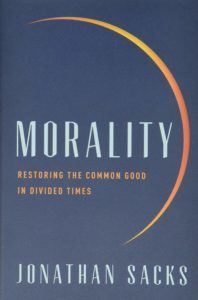
All countries and cultures have three basic institutions. There is the economy, which is about the creation and distribution of wealth. There is the state, which is about the legitimization and distribution of power. And there is the moral system, which is the voice of society within the self; the “We” within the “I”…. —Jonathan Sacks, Morality: Restoring the Common Good in Divided Times, p. 111 Rabbi Lord Jonathan Sacks died in November of 2020. Earlier that year, he published Morality, in which he sermonizes about the harms caused by an increase in selfishness. His long standing interest in philosophy, economics, and political theory results in a book that echoes others I have reviewed here, especially Raghuram Rajan’s The Third Pillar2 (which Sacks cites) and Yuval Levin’s The Fractured Republic.3 Sacks writes, What has happened in the past half-century has been precisely what de Tocqueville feared. It took a long time to appear, precisely because of the strength of the institutions on which he discerned American democratic freedom to rest: religion, community, family, and the sense of the nation as a moral community. As these eroded from the 1960s onward, individualism was left as the order of the day… The “I” prevails over the “We.” We have the market and the state, the two arenas of competition, one for wealth, the other for power, but nothing else, no arena of cooperation that would bridge the differences between the wealthy and powerful and the poor and powerless. (262) Sacks sees increased individual freedom as coming with costs as well as benefits. We are free as never before to be as we wish and live as we choose… We can do things of which our ancestors could hardly dream, but what they found simple we find extremely hard. Getting married. Staying married. Being part of a community. Having a strong sense of identity. Feeling continuity with the past before we were born and the future after we are no longer here. More of us live alone, and loneliness means increased risk of chronic disease, dementia, and mortality rates. (32-33) Sacks correlates this increased loneliness with increased reliance on both the market and the state. He argues that we have outsourced too much to both. Sacks sounds like a progressive when he criticizes corporations for their exclusive focus on profits and criticizes the market for producing great inequality of wealth. On the other hand, he sounds like a classical liberal when he speaks up for free speech. But resist with all your heart any attempt to substitute power for truth. And stay far away from people, movements, and parties that demonize their opponents. (194) He also decries the culture of victimhood and the return of public shaming. Sacks argues that humans have higher needs than just material wants. Citing Jerome Bruner, Sacks contrasts thinking in empiricist mode with thinking in story mode. One is logical argument, the other is telling a story. The word “then” means something different in the two cases. “If X then Y” is not the same kind of connection as “The king died, then the queen died.” The first is a timeless proposition, while the second is intrinsically set in time… Narrative is how we construct meaning out of the flow of events, and the fact that it does not have simple criteria of verification or refutation, the way science does, does not mean that it is mere fiction. On the contrary, storytelling is the essence of who we are as meaning-seeking animals. (246) But while we have criteria for evaluating what is a good scientific statement, Sacks does not directly address the issue of how to tell a good story from a bad one. Today, many fewer people in the West are attracted to the stories of traditional religions. But some of the stories to which many have turned, such as those described by James Lindsay and Helen Pluckrose in Cynical Theories, strike me as much worse.4 In a chapter entitled “Which Morality?” Sacks asks the question but seems to shy away from answering it. To become moral, we have to make a commitment to some moral community and code. We have to make a choice to forego certain choices. We have to choose the right restraints. And having fallen in love with some moral principle or ethical ideal, we have to build a structure of behavior around it for the moment when love falters. (274) In conclusion, Out of the many moralities available, there is one that is ours, and we do not have to denigrate the others to make that one our own. ( 275) Sacks exhorts us to return from “I” to “We.” He says that this means going beyond contracts to covenants. We sign contracts out of self-interest. A covenant generates a different type of relationship altogether. Recall that what makes it different is that in a covenant, two or more individuals, each respecting the dignity and integrity of the other, come together in a bond of love and trust, to share their interests, sometimes even to share their lives, by pledging faithfulness to one another, to do together what neither can achieve alone. (313) From my perspective, Sacks’ sermons suffer from a failure to distinguish the realm of the small community from the realm of the larger society. Although he cites Ferdinand Tonnies on the difference between Gemeinschaft and Gesellschaft, Sachs sometimes seems to want a large-scale society to have the characteristics of a small community. In my view, small units of society, including families and small work groups, function best informally. You do not want to use market prices to run your family. You do not want to write down formal laws to manage a small work group. Personal relationships and tacit understandings form a better basis for small-scale cooperation. As the scale of cooperation increases, particularly as it goes beyond the Dunbar number of about 150 individuals, informality must give way to written rules, well-defined roles and responsibilities, and market competition. “What Sacks celebrates as the ‘We’ seems to me most relevant to small-scale social units.” What Sacks celebrates as the “We” seems to me most relevant to small-scale social units. On the other hand, we must be very careful about invoking “We” on a large scale. More often than not, those who speak of “We” in the context of large-scale societies end up expanding government power while rarely achieving the ends that they have proclaimed. If there are to be many moral codes, as Sacks would allow, then the state needs to stand aside and let small communities choose for themselves. I think that the problems of loneliness and loss of meaning that Sacks identifies are due to a breakdown of covenants at a small-scale level. I wish that families were larger and stronger. I wish that neighborhoods had more continuity. I wish that the school environment for children could be informal rather than bureaucratic. I wish that long-term friendships were more prevalent. For more on these topics, see the biography of Alexis de Tocqueville in the Online Library of Liberty; and the EconTalk podcast episode Yuval Levin on The Fractured Republic. See also “Camping-Trip Economics vs. Woolen-Coat Economics,” by Arnold Kling, Library of Economics and Liberty, Feb. 2, 2015. But at the macro level, I think we are better off with a society of contract than with a society of covenant. The more weight we place on “We” at the national level, the less room for the sort of community that I would like to see at a local level. As we think in terms of larger scale, I think it helps to lose the “We.” Footnotes [1] Jonathan Sacks, Morality: Restoring the Common Good in Divided Times. [2] See “Contemporary Society’s Crumbling Pillar,” by Arnold Kling. Econlib, Apr. 1, 2019. [3] See “The Conservative Way Forward?” by Arnold Kling. Econlib, Apr. 4, 2016. [4] “Liberalism and Its Enemies: Pluckrose and Lindsay,” by Arnold Kling. Econlib, Oct. 5, 2020. *Arnold Kling has a Ph.D. in economics from the Massachusetts Institute of Technology. He is the author of several books, including Crisis of Abundance: Rethinking How We Pay for Health Care; Invisible Wealth: The Hidden Story of How Markets Work; Unchecked and Unbalanced: How the Discrepancy Between Knowledge and Power Caused the Financial Crisis and Threatens Democracy; and Specialization and Trade: A Re-introduction to Economics. He contributed to EconLog from January 2003 through August 2012. Read more of what Arnold Kling’s been reading. For more book reviews and articles by Arnold Kling, see the Archive. As an Amazon Associate, Econlib earns from qualifying purchases. (0 COMMENTS)

/ Learn More

Is Inequality a Problem?

Book Review of The Poor and the Plutocrats: From the Poorest of the Poor to the Richest of the Rich (Oxford University Press 2021) by Francis Teal.1 Is inequality a problem? Many people seem to think so, if we judge the public discussions in Europe and the United States over the last decade or so. These discussions are fueled by scholars like Thomas Piketty (2014) in France and Joseph Stiglitz (2015) in the United States, as well as by international organizations like the OECD (2015). The UN (2021) has as one of its sustainable development goals to reduce inequality in and between countries. Most often capitalism and globalization are blamed for causing increasing inequality and some even argue that the rise of nationalism and populism are caused by the same forces (e.g., Rodrik 2021). In a recent book, The Poor and the Plutocrats, (Oxford University Press 2021), Francis Teal, a research associate at the University of Oxford, tries to sort out some of these issues. The title of the book itself gives a good hunch about his leanings, but it is an ambitious attempt to summarize some of the relevant statistics and earlier research about the topic. This makes the book well worth reading, even though much more remains to be said on the topic, both empirically and normatively. To begin, it is today a well-established fact, confirmed by Teal’s analysis, that income inequality between or across countries, measured by differences in GDP per capita, has decreased dramatically in the last decades, a unique development at least over the last 300 years for which we have some data. Literally billions of people in some developing countries have been lifted out of poverty and starvation due to globalization and more open economies. As a result, the absolute number of poor persons has decreased in the world. In fact, among the relatively poor global incomes are rising faster than the average of the top 20 percent of the world’s income. China is of course the most important example, but other Asian Tigers, notably constitutional democracies like South Korea and Taiwan, are in many regards even more impressive, while many nations in Africa and South America are lagging. The explanation for this extraordinary development is precisely globalization in terms of a freer flow of ideas, goods, services, capital, and people across countries, and the opening of markets through more secure property rights, freedom of enterprise and the rule of law within these developing countries, i.e., very close to what most of us would call “capitalism”. Teal, however, does not have a good grasp either of the market economy or its institutional underpinnings. This is a major weakness of the book that I shall return to below. Equally well established is the fact that income inequality within many developed countries has increased over the last decades, whether we measure it in terms of Gini-coefficients, Lorenz curves, or different ratios of the top incomes to the bottom incomes. Especially, the share of incomes of the top 1 percent or even top 0.1 percent have increased dramatically. For example, in 2015 CEOs in the top 350 American firms made 286 times the salary of a typical worker, while in 1978 CEO earnings were roughly 30 times the typical worker’s salary. Teal also claims, even though he admits that data is shaky, that in 2014 the average income of the super rich, the 0.1 percent, in the United States was 3.6 million USD, while within that top 0.1 percent some 100 individuals had incomes that exceed 100 million USD. It is those 0.1 percent that Teal, without giving a strict definition, calls “plutocrats”. At the other end of the scale, the poor, the incomes of the relatively unskilled have stagnated or even fallen in parts of the developed world, and especially in the United States where wages of the lower middle class have been stagnant over the last decades. To describe and explain these developments is the major focus of Teal’s book, especially by comparing the United States with the United Kingdom. In the past, Teal argues, there was a strong connection between the development of the growth of workers’ earnings and labour productivity, but this does not seem to be the case anymore. Moreover, even though Chinese imports and offshoring may have contributed to a fall in well-paid jobs in manufacturing, the real cause is, he argues citing other research, changes in technology that have caused a sectoral shift to services where the wages are lower. This sounds familiar to the experience in Germany and other European countries. When it comes to the top earners, Teal notices that one the most striking aspects of the rise of the incomes have been the importance of labor incomes in their total incomes. For both the top 1 percent and the top 0.1 percent in the United States, their labor income grew faster than their income from capital in the period from 1962 to 2000. He also quotes Xavier Gabaix and Augustin Landier (2008) who have shown that the increase of CEO pay between 1980 and 2003 can be fully attributed to the six-fold increase in market capitalization of large American companies during that period. So much for the view that ‘capitalists’ do not work. In a rather confusing section Teal tries to analyse the sources of the wealth of British and American billionaires by distinguishing between different categories that he thinks correspond to ‘merit’ and ‘rent-seeking’ respectively. To the former category belongs ‘founders non-finance, exemplified by Bill Gates, and to the latter ‘self-made finance’, exemplified by Warren Buffet or bankers more generally, and ‘inherited’ exemplified by the Duke of Westminster. His rather vague conclusion is that, yes, the wealth of some billionaires in fact comes from the merits of founding and developing successful companies, but almost as important are ‘rents’ from financial markets or inherited land and the like. The latter two he implies arise because our societies and markets are dysfunctional or ‘crony’. “There is nothing in Teal’s book that shows that the rich he describes, individually or as a group, have political power or can influence politics or society in any illegitimate way.” So where does this all take us? Is inequality a problem or not? I am afraid Francis Teal’s book does not give us much help in answering these questions, despite its empirical ambitions. One of the reasons is that he uses the term plutocrat, without giving a strict definition, to describe those in our societies that earn a lot of money or are very wealthy. A ‘plutocrat’ In standard vocabulary and in most common dictionaries is a person whose political power derives from their wealth. According to Collins English Dictionary, “If you describe someone as a plutocrat, you disapprove of them because you believe they are powerful only because they are rich”. But there is nothing in Teal’s book that shows that the rich he describes, individually or as a group, have political power or can influence politics or society in any illegitimate way. This brings me back to Teal’s lack of understanding of the market economy and the importance of its institutional underpinnings. For markets to work, there must be secure property rights, freedom of enterprise, and the rule of law. This is a prerequisite for growth, innovations, and entrepreneurship, as shown by F. A. Hayek (1973) and many others. Given that these kinds of institutions are in place, which surely still is a matter of degree in many developing countries, the distribution of incomes and wealth that result can in themselves be regarded as ‘fair’. Not because they all can be attributed to merit, as Teal seems to think, but because they have come about within an institutional framework that most of us consider to be just. An entrepreneur, a founder, a CEO, or an owner of land are only successful as long as he or she satisfies the voluntary demand of buyers and consumers. Luck, timing, first-mover advantage and other circumstances that may not easily be attributed to ‘merit’ or hard work may contribute to such entrepreneurial profits and success in markets. In a digitalized and globalized economy, with network effects and huge scale economies, huge fortunes may be created through these market processes, an outcome we may label ‘fair inequality’. However, if the institutions are corrupt and the markets are ‘crony’ because the lack of rule of law, restrictions on the freedom of enterprise, or insecure property rights, then the outcome of the market process can surely be regarded as unfair and the incomes and wealth of plutocrats be a serious problem. Such inequalities should certainly be considered unfair. But to show this requires another type of analysis than Teal’s. The same is true for financial markets. It is nothing unfair to make money by handling risk, facilitating the financing of enterprises, helping savers to invest, and borrowing to buy a house, as long as the rules are not manipulated. On the contrary, the functions are an integrated part of the market economy. If someone is to blame for the huge incomes made in financial assets and stocks in the last decades, it is the governments and central banks that have used credit expansion and financial easing as the major dominant method to handle everything from business cycles to financial crashes. For more on these topics, see the EconTalk podcast episodes Thomas Piketty on Inequality and Capital in the 21st Century, Joseph Stiglitz on Inequality, Michael Munger on Crony Capitalism, and Luigi Zingales on Capitalism and Crony Capitalism. But could not inequality still be a problem, even if the institutions of markets are fair? Apparently, many people still think so, even if they themselves freely buy the products and services that have made some people super rich. And is it not a problem that the wages of even middle-class groups have stagnated in countries like the United States? I think so. Liberal democracy, the free society, and the market economy itself rest on institutions that cannot be supported if social divisions become too wide. Everyone, or at least a large majority, must be convinced that they have a ‘stake in the system’, that they also have a chance at a better life. Perhaps it is here those of us who still think inequality is a problem should put our emphasis in the promotion of an inclusive society: on social mobility, on improving the educational system, on easing the burden of financing university studies, and so on? Such an emphasis on a basic equality of opportunity, or ‘free-market fairness’ as John Tomasi (2012) puts it, would be a more constructive way forward than to criticize inequality itself. In a free society ‘fair inequality’ should be part of the game. References Gabaix, X. and Landier, A. (2008). Why has CEO Pay Increased so Much? The Quarterly Journal of Economics, 123(1): 49-100 Hayek, F. (1973). Law, Legislation and Liberty, Vol 1: The Rules and Order. London & Henley: Routledge & Kegan Paul. OECD (2015). https://www.oecd.org/social/inequality.htm Piketty, T. (2014). Capital in the Twenty-First Century. Cambridge, MA: Harvard University Press. Rodrik, D. (2021). “Why Does Globalization Fuel Populism? Economics, Culture, and the Rise of Right-Wing Populism.” Annual Review of Economics, Vol. 13. Stiglitz, J. (2015). The Great Divide. Random House, UK: Penguin Books. Teal, F. (2021). The Poor and the Plutocrats. From the Poor of the Poor to the Richest of the Rich. Oxford: Oxford University Press. Tomasi, J. (2012). Free Market Fairness. Princeton University Press. UN (2021). Goal 10—Why Addressing Inequality Matters. https://www.un.org/en/chronicle/article/goal-10-why-addressing-inequality-matters Footnotes [1] The Poor and the Plutocrats: From the Poorest of the Poor to the Richest of the Rich, by Francis Teal. Oxford University Press 2021. * Nils Karlson is Professor of Political Science and President of the Ratio Institute, Stockholm, Sweden. As an Amazon Associate, Econlib earns from qualifying purchases. (0 COMMENTS)

/ Learn More