This is my archive

bar

Man on a Tightrope

Various commentators over the years have pointed out that while the number of movies about the horrors of Naziism is large, as it should be, the number of movies about the horrors of Communism is small, as it shouldn’t be. Recently, TMC showed a 1953 movie directed by Elia Kazan titled Man on a Tightrope. I recorded it and my wife and I finally watched it last night. I would give it an 8 out of 10. It’s about a circus owner in Czechoslovakia in the early 1950s who wants to escape from Czechoslovakia into Bavaria, Germany and take most of his employees and most of his animals with him. Wikipedia writes: The screenplay by Robert E. Sherwood was based on a 1952 novel of the same title by Neil Paterson. Paterson based his true story, which first appeared as the magazine novelette International Incident, on the escape of the Circus Brumbach from East Germany in 1950. Members of the Circus Brumbach appeared in the film version in both character roles and as extras. The plot is slightly goofy in places with some humorous moments. But the humor is badly needed to lighten the mood after some pretty sinister interrogations and threats by Communist officials. Also the Hayekian insight about central planning is on display in the way some of the officials, one in particular, fail to take account of individuals’ circumstances of time and place. I don’t want to say much more because I would give it away. But I do recommend it. (0 COMMENTS)

/ Learn More

“You tell me the rules and I’ll tell you what outcomes to expect.”

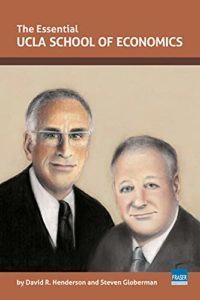
We hear a lot about the Chicago and Austrian schools of economics, but what about the UCLA school? In this episode, EconTalk host Russ Roberts welcomes EconLog’s David Henderson, who recently co-authored The Essential UCLA School of Economics with Steven Globerman. The theme of the conversation might as well be, as the title above suggests, Armen Alchian‘s famous dictum about understanding the role of incentives in economics and in everyday life. The Economic Way of Thinking dominates our approach here at Econlib, and this conversation is a great example of applying it to puzzles we see in the world. Let’s hear what surprised and (hopefully!) delighted you about this exploration. Please share your thoughts in the comments below. You might also try some of these questions out on your friends, and start your own conversation offline.     1- The conversation begins with a discussion of Harold Demsetz‘s 1967 AER article on property rights. Roberts and Henderson agree that this piece would both never be published in a top journal today, and that it remains a path-breaking contribution.  What was so significant about this article? How do you think Demsetz’s notion of mutually beneficial exchange compares to the notion of euvoluntary exchange as put forth by Mike Munger?   2- The conversation turns next to the theory of the firm and another AER article, this one-co-authored by Demsetz and Alchian. How does the theory of the firm emphasize the importance of a residual claimant? How can this theory help to understand how a team’s productivity can be measured?   3- What is the Nirvana Fallacy? How does Roberts push back regarding the role of government in correcting market failures? To what extent do you think Roberts’s push back is appropriate? Explain.   4- The conversation turn to the work of Jack Hirshleifer, particularly on Disaster and Recovery. What is the most important thing one should understand about that work, according to Henderson? How does Roberts suggest this lesson might apply to our experience with the COVID pandemic?   5- The conversation returns to Armen Alchian and his 1950 paper on profit maximization. Henderson describes Alchian’s position by saying, “firms don’t know enough to maximize profits.” What does this mean? What is the nature of Roberts’ caution about assuming people act as if they maximize utility?   Bonus Question: Which economic “puzzle” (and corresponding “solution”) most surprised you, and why? (0 COMMENTS)

/ Learn More

Contra Gensler and the Chinese Mirror

Gary Gensler, the chairman of the Securities and Exchange Commission, may be everything a classical liberal wants to avoid. I will take him as representative of the federal bureaucracies that want to control cryptocurrencies and the emerging decentralized finance (“DeFi”) markets. (See Andrew Ackerman, “Stablecoins in Spotlight as U.S. Begins to Lay Ground for Rules on Cryptocurrencies,” Wall Street Journal, December 25, 2021.) In an instructive article, The Economist evoked the breath-taking potentialities of DeFi: cryptocurrencies, blockchains technologies, fungible or non-fungible tokens, etc. (“Adventures in DeFi Land,” The Economist, September 18, 2021). A few quotes: Piece by piece a new kind of economy is being built through applications on various blockchains. Each addition makes it more likely that the whole will amount to something meaningful and powerfully disruptive. … The Ethereum blockchain, which underpins much of DeFi activity, settled $2.5trn-worth of transactions in the second quarter of 2021, including payments and transactions to facilitate trading and lending. (Visa, a payments giant, settled about the same amount in the same period …) … Innovations, such as automated marketmakers, arbitrage systems and self-stabilising currency regimes, are already pushing the boundaries of financial technology. … That makes it possible to construct smart contracts—self-executing agreements in which a chain of actions follows when certain conditions are met. These are automatically enforced and cannot be tampered with. … [Non-fungible tokens] for instance, could become more widely used. Today they are digital collectable claims, but in theory they could represent ownership claims on homes. Mortgage creation could then be wrapped into a single, efficient bundle. These developments illustrate what Friedrich Hayek explained was a major benefit of liberty (Law, Legislation and Liberty, Vol. 1: Rules and Order [University of Chicago Press, 1973], p. 56): Since the value of freedom rests on the opportunities it provides for unforeseen and unpredictable actions, we will rarely know what we lose through a particular restriction of freedom. The Economist often tends to trust government regulation at least as much as the autoregulating order of the market, but Gensler looks like an incarnation of the “man of system” described by Adam Smith: The man of system, on the contrary, … is often so enamoured with the supposed beauty of his own ideal plan of government, that he cannot suffer the smallest deviation from any part of it. He goes on to establish it completely and in all its parts, without any regard either to the great interests, or to the strong prejudices which may oppose it. He seems to imagine that he can arrange the different members of a great society with as much ease as the hand arranges the different pieces upon a chess-board. He does not consider that the pieces upon the chess-board have no other principle of motion besides that which the hand impresses upon them; but that, in the great chess-board of human society, every single piece has a principle of motion of its own, altogether different from that which the legislature might chuse to impress upon it. According to the Wall Street Journal (Paul Kiernan, “SEC’s Gensler Doesn’t See Cryptocurrencies Lasting Long,” September 21, 2021), Mr. Gensler compares cryptocurrencies to Wild West banking: Mr. Gensler likened the thousands of cryptocurrencies in existence to the so-called wildcat banking era that took hold in the U.S. from 1837 until 1863 in the absence of federal bank regulation. Before President Abraham Lincoln created the Office of the Comptroller of the Currency, banks issued their own currencies, which they sometimes refused to redeem for their purported value in gold or silver. What s a mythological view of economic history! Before and after Lincoln, American banks have been heavily regulated, often more heavily than banks in other Western countries. Canada provides a good comparison. Since 1840, Americans have experienced 12 episodes of banking panics with widespread withdrawal suspensions; Canadians have had zero. In 19th-century America, so-called “free banks” (which were not free at all) as well as the “national banks” were forbidden to issue money not backed by government bonds. They faced branching limitations and prohibitions, hence the proliferation of “unit banks” with a single place of business. In Canada, each bank could freely issue its own currency up to the value of its capital until the early 20th century. After Canada was officially founded in 1867, branching was never limited. Canada was the efficient Far West. American regulation has been the Far West only in the bad sense of the term. For more details as well as sources, see my “A Very Bad Solution to Very Real Problems,” Econlog, January 31, 2018. In 1933, under Franklin D. Rosevelt, the US government stopped redeeming dollars for their promised gold value and not only “sometimes,” but definitively. Not surprisingly given his biases and knowledge failures, Gensler thinks that investors need his protection. He says that the “robust enforcement and examinations regimes … are essential to protecting investors, maintaining fair, orderly, and efficient markets.” What about free markets instead of what politicians and bureaucrats think is “fair, orderly, and efficient”? (See his recent statement before the Senate Committee on Banking, Housing, and Urban Affairs.) Apparently, he needs to dictate what he thinks investors want—shibboleths like “environmental, social, governance” (ESG) disclosures—because only the government, as opposed to markets, can give people what they want. Also unsurprisingly, he complains that his agency does not have enough money and staff. Protecting so many people is an expensive piece of cake. Jennifer Schulp of the Cato Institute quotes from Gensler’s Senate testimony (“The SEC’s ‘Daddy’ Issues,” National Review, September 24, 2021): Senator [John] Kennedy [R, La]: As to the people and the companies that you regulate as chairman of the SEC, do you consider yourself to be their daddy? SEC Chairman Gensler: No. No. (laughs) Senator Kennedy: Then why do you act like it? Mr. Gensler shows blind confidence in the competence of the federal government—that is, of its politicians and bureaucrats. It is as if public-choice analysis had taught us nothing during the past seven decades. Government failures are generally worse than market failures. What does the Chinese mirror have to do with this? As I explained in a recent Econlog post, the image that Americans see when they look at China is, or should be, the deformed image of their own government’s authoritarian failures—deformed and multiplied of course by the extra power of the Chinese state. A case in point: just a few days ago, the Chinese government forbade all cryptocurrency transactions. The more totalitarian a government is, the more it fears cryptocurrencies and decentralized markets that can escape its authority. Let’s hope the US government will try to be different from its Chinese counterpart instead of being seduced by the image it sees in the mirror. (0 COMMENTS)

/ Learn More

Build, Baby, Build in Nashville

I’m speaking on Build, Baby, Build in Nashville on Thursday night.  Venue: The gorgeous Richland Country Club. Free for anyone with a .edu email address, and there is a lavish reception beforehand.  And no mask requirement. If you come, be sure to introduce yourself! Register here. (0 COMMENTS)

/ Learn More

Poverty Isn’t Just About Money: Expanding the Child Tax Credit

The Wall Street Journal’s editors have written another great editorial, this time on the expansion of the child tax credit into an UBI [Universal Basic Income] for children. Parents can now claim a maximum of $3,000 for those ages 6 to 17 and up and $3,600 for children under age 6, up from its previous $2,000 level. The expanded part of the credit begins to decrease as income rises above $75,000 for individuals, $112,500 for heads of household, and $150,000 for married couples. The $2,000 credit starts phasing out when income reaches $200,000 for individuals and $400,000 for married couples. The credit isn’t just bigger, it is also fully refundable, meaning that parents who don’t make enough money to pay the income tax will receive cash from the government in the full amount of the credit regardless of their income. There is also no work requirement attached to the benefit and the cash is distributed in monthly payments. These payments started in July and the Democrats want to expand them through 2025. The WSJ rightly explains that this is a typical case of government programs starting small and getting bigger overtime. …what started as a $500 political sop in the 1990s is no longer really a tax credit. It has kicked free of any connection to income or taxes and is now a full-fledged entitlement. The credit traditionally “phased in” as parents earned a modest amount of income, an attempt to ensure the benefit flowed to families with a working parent. No longer. Both parties deserve blame for expanding a program that shouldn’t even exist – a program that only adds further distortions of the tax code. And today, some Republicans, like Senator Mitt Romney of Utah, and other conservatives are pushing similar types of child UBI as the one described above. Here are the kind of benefits we are talking about: Taxpayers should understand the magnitude of the benefits. Before the expansion, the average child credit for a family below 100% of the poverty line was about $975, according to estimates from the Congressional Research Service. Now it’s $5,421. That comes on top of other transfer programs such as food stamps and the earned-income tax credit. And in case the sentence “The $2,000 credit starts phasing out when income reaches $200,000 for individuals and $400,000 for married couples” didn’t give you an clue that this isn’t really an anti-poverty program, the WSJ explains: The new child entitlement will reach well into the middle class, which is part of the political goal. A couple earning $100,000 that has three children ages 7, 4 and 2 would be eligible for $10,200 in payments. For all the talk of getting people out of poverty, this policy will likely backfire. As shown by the work of Robert Doar, president of the American Enterprise Institute – and someone who, having run New York City’s welfare programs from 2007 to 2013, also happens to have a better understanding of this issue than most people who write about welfare –  poverty isn’t just about money. Back in June, for instance, he wrote: My decades of work in New York’s social services agencies make me skeptical [that these checks will reduce child poverty]. People weather all kinds of challenges and hardships, and nothing is as simple as it seems. Sending money is sometimes helpful, but it rarely addresses the underlying issues. … This new, no-strings-attached cash from Washington, for example, will leave unaddressed the serious problems of substance abuse. By sending checks directly, the Biden administration will sever the contact between parents and social workers, which helps uncover signs of addiction. Not every unmarried, nonworking mother who dropped out of high school has a substance-abuse problem. But many do. Doar’s experience is confirmed by many scholarly works, including his own, as well as by that of his colleagues at AEI and in other places. Scott Winship, for instance, has a detailed paper on what the academic evidence says and doesn’t say about the ability of child allowances, à la Biden or à la Romney, on work and marriage incentives. As always, it’s complicated. But the bottom line is that these programs “run the risk of increasing the number of single-parent families in which no one is employed,” which “would potentially worsen entrenched poverty in the long run reversing gains the nation has made since the welfare reforms of the 1990s.” It’s useful to remember that before the 1990s welfare reforms requiring welfare recipients to work or prepare for work, not only were nearly nine in 10 families on welfare were workless, unwed births rose significantly and most of these families were stuck in long-term poverty, thus fueling a trend of unending, intergenerational child poverty. While money can help in the short run, the truth is that no country ever got out of poverty because of income redistribution (a point economist Thomas Sowell took great pains to demonstrate in his work). If such ‘redistribution’ could deliver such a happy outcome, the U.S. should have no child poverty at all. As Robert Rector of the Heritage Foundation recently noted, “before the COVID-19 recession, the U.S. spent nearly $500 billion on means-tested cash, food, housing, and medical care for poor and low-income families with children. This is seven times the amount needed to eliminate all child poverty in the U.S., according to Census figures.” This is in part due to the fact that most of these benefits aren’t counted as income in official government poverty reports. But the reality is that, to make a noticeable improvement on the poverty front, people need to improve their ability to earn and move up the income ladder. One final note: While I may not want a return to the pre-1990s welfare policies, many Republicans and conservatives seem intent to rewind ever further back in time, pre-1980s, when their support for government intervention rendered them indistinguishable from the left. Sadly, they’ll soon find out this won’t put them ahead because the Democrats will use this as a way to ask for even more. The WSJ seems to agree: Republicans have been missing in action on this seismic policy change, in part because their big government wing has been pushing the family subsidy as well. We’ve long warned that Democrats would outbid the GOP once Republicans conceded the principle of making the tax code an engine of social policy, and here we are.   (0 COMMENTS)

/ Learn More

The Continua of Excludability and Rivalry

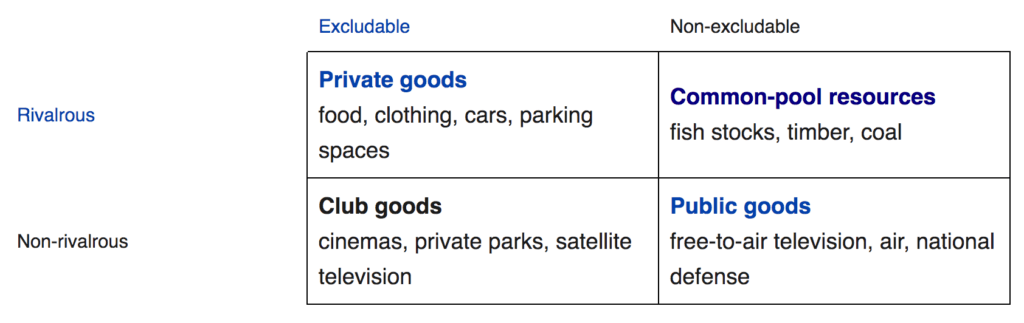
The classic definition of a “public good” is that it is both “non-excludable” and “non-rival.”  Textbooks normally treat these traits as binary, delivering this 2 x 2 typology: Yet in the real world, both excludability and rivalry lie on a continuum.  Almost nothing is 0% excludable.  If you spend enough effort, you can prevent non-payers from enjoying your product.  At the same time, almost every good requires some effort to exclude non-payers.  Hence, nothing is 100% excludable either. Think about software.  If you add a little security, you can prevent some people who haven’t paid you from enjoying your product.  But if that’s all you do, plenty of non-payers will slip through the cracks.  And the more you spend on security, the more non-payers you get to exclude. The same goes for rivalry.  Virtually nothing is 0% rival.  Adding consumers almost always slightly raises cost or reduces quality. Other people at a fireworks show obstruct your view.   Extra customers in a near-empty theater increase the costs of cleaning, wear-and-tear on the seats, and air conditioning costs (via body heat).  At the same time, almost nothing is 100% rival.  If you’re running a restaurant, you almost always end up throwing away some perfectly good food.  Furthermore, some goods are more than 100% rival.  It’s called congestion.  Doubling driving at rush hour doesn’t just double wear-and-tear on the roads; it can easily turn 60 mph roads into 20 mph roads.  You can even argue that some goods are less than 0% rival.  If there are only two people in your nightclub, adding more guests improves the experience for those already there. Despite the textbook 2 x 2 matrix, econ teachers normally insinuate that excludability and rivalry are at least positively correlated.  With binary traits, this basically means that the top left and bottom right boxes contain more goods than the top right and bottom left boxes.  Once you accept that excludability and rivalry lie on a continuum, however, matters become far less clear.  Even assigning proper excludability-rivalry coordinates is a challenge.  What, for example, are the average coordinates for Route 66 in the DC area?  We’ve added electronic toll collection, so clearly the road is excludable to some degree; but adding the tolls did come at great expense.  And when you don’t charge tolls, the roads are highly congested for many hours per day.  Knowing what I know, I’d probably assign excludability-rivalry coordinates of (.8, 1.3).  But that could be way off. Once you’ve assigned credible excludability-rivalry coordinates, you can finally test the standard insinuation that the two traits are positively correlated.  Are they really?  And from there, you can explore Dan Klein’s visionary hypothesis that technological progress gradually transforms public goods into private goods.  Not to mention my view that the correlation between “public goods” and “goods provided by government” is awfully low. Public goods theory is now about 70 years old.  So why has economics barely progressed beyond the simplistic textbook understanding of the problem?  I suspect that it’s left-wing bias.  If the textbook treatment sounds pro-market, most economists are eager to run empirical tests in the hopes of discrediting the textbook result.  If the textbook treatment sounds pro-government, in contrast, most economists want to just treat it as fact and move on.  Public goods theory sounds pro-government. Hence, we see hundreds of empirical papers testing whether the minimum wage “really reduces employment,” but near-zero empirical papers that test whether government “really supplies public goods.” Update: Jonathan Meer pointed me to this useful related piece by Jeremy Horpedahl. (0 COMMENTS)

/ Learn More

Noreena Hertz on the Lonely Century

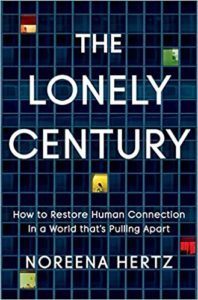
Author and economist Noreena Hertz of University College London talks about her book, The Lonely Century, with EconTalk host Russ Roberts. Hertz blames social media and the individualist, pro-capitalism worldviews of leaders like Margaret Thatcher and Ronald Reagan for the rise in loneliness in the developed world. Russ suggests some alternative causes. The result is a lively conversation about understanding and explaining social trends.

/ Learn More

Noreena Hertz on the Lonely Century

Author and economist Noreena Hertz of University College London talks about her book, The Lonely Century, with EconTalk host Russ Roberts. Hertz blames social media and the individualist, pro-capitalism worldviews of leaders like Margaret Thatcher and Ronald Reagan for the rise in loneliness in the developed world. Russ suggests some alternative causes. The result is a lively conversation […] The post Noreena Hertz on the Lonely Century appeared first on Econlib.

/ Learn More

Reply to Bob Murphy’s Query

Economist Bob Murphy writes: Dear David, I hope you’re doing well. I was puzzled by your “Angry Bears” post. (If you find your answer might interest EconLog readers, feel free to reprint my email.) I totally understand why certain libertarians would be upset at a busybody telling them to wear a mask on the plane, but it seemed odd to me when–if I recall correctly–you insisted that people attending your lockdown protest put on a mask. Were you the angry bear that day? (I hope you are not reading hostility or smugness in my tone; I am genuinely asking.) Bob I did not read hostility into his question; I know Bob well enough to know his good will. The protest he was referring to is the one that I helped organize in May 2020 in Monterey. And here’s my answer: We didn’t insist. We asked. But you missed the bigger point. We didn’t threaten any one with prison. By contrast, there was no doubt in my mind that if I hadn’t complied, she [the fellow passenger on the airplane] would have called the flight attendant. And twice in the previous 40 minutes the flight attendant had threatened passengers with prison. There’s a huge difference between asking someone to do something when there’s no implicit threat of force behind it [our request that people wear masks to the anti-lockdown demonstration] and asking someone to do something when underling the request is a threat to call in someone [the flight attendant] who has already threatened the use of force. So no, I was not an angry bear that day. (0 COMMENTS)

/ Learn More

What does “local control” actually mean?

[After writing this, I noticed a new David Henderson post that made some similar points.  If you only have time for one, read his excellent post.] In the US, public services such as police, fire and K-12 education are typically provided by local governments. On the other hands, federal rules prevent local governments from certain types of regulation. Local governments are not allowed to restrict speech or interstate commerce, for instance. What about property rights? Who should get to determine how a landowner uses his or her property. The Fifth Amendment to the US Constitution does provide some important protections for property owners, but courts have tended to view those rights in a very restrictive way.  For instance, courts have allowed governments to restrict land use through zoning regulations. Are local zoning regulations that limit the freedom to develop a piece of property similar to restrictions on speech and interstate commerce?  In that case, it might make sense to have a state or federal ban on such regulations.  Or are they like local services, where the default assumption is that local governments are best placed to address the needs of local residents? Matt Yglesias argues that there are important external benefits from new housing construction: A big part of that logic is that the benefits of increased housing supply, though extremely real, are also extremely diffuse. You are creating more housing supply on a region-wide basis. You are creating more tax revenue for an entire town. So lots of people who would benefit from more housing in Cambridge actually live in Somerville or Boston or Medford or Brookline, but all the costs of more housing in Cambridge fall on Cambridge residents. Since Cambridge residents get to vote on Cambridge town issues, they vote no. Then the same pattern repeats in Somerville. More housing would be beneficial, but many of the people who benefit live in Medford or Cambridge or Brookline or Boston, so they vote no. And more housing in Brookline would be beneficial, but many of the people who would benefit live in Medford or Somerville or Cambridge or Boston, so they vote no. Trying to tell people that a few more rowhouses and apartments in their neighborhood will address housing scarcity is like trying to drain the ocean with a teaspoon. But if you make it a state issue and the question becomes “more housing in Boston and Cambridge and Somerville and Brookline and Medford and everywhere else, but especially the highest-priced areas where latent construction demand is highest,” then everyone who benefits gets a vote. As an analogy, a specific restriction on some political speech or interstate commerce might benefit a particular local special interest group.  But the country as a whole benefits from a general rule allowing unlimited political speech and unrestricted interstate commerce. While the logic of local control is often quite compelling, there is no obvious reason why the argument should end at the city level.  If a city government is better able to determine zoning rules than a state government, why isn’t a small city neighborhood even more effective than an entire city?  And why isn’t an individual city block better able to set its zoning policy than a city neighborhood?  The reductio ad absurdum is to let each property owner set the rules for their own property, which effectively means no zoning regulation at all. That’s my preference. PS.  Timothy Lee has an excellent post discussing housing deregulation in California.  It turns out that my previous post missed California’s most important recent housing initiative. (0 COMMENTS)

/ Learn More