This is my archive

bar

The Fed 3.0

When the Fed was created in 1913, the US was still on the gold standard. Under that policy regime it made no sense to think in terms of ideas such as inflation targeting. In the long run, the price level under the gold standard is determined by global factors, well beyond the Fed’s control. (Although even then the Fed had some ability to control prices in the short run.) In March 1968, the US adopted a fiat money regime. At first the Fed did not know how to operate the regime, sort of like giving a sports car to a 14-year old boy. By the 1980s, they mostly figured out how to keep inflation relatively low and stable, at least on average over several years. (They still know how in 2022, but for some inexplicable reason have simply chosen not to do so.)I have a new paper in a Cato Institute book entitled Populism and the Future of the Fed, edited by James Dorn.  In this paper, I argue that the Fed’s mandate should be clarified to address new issues raised by the zero interest rate environment.  Here are a few points: 1. The Fed’s so-called “dual mandate” is actually a triple mandate, with the call for “moderate long-term interest rates” often overlooked.  We should take this mandate seriously and avoid any policy target that would lead to the ultra-low interest rates that we see in countries such as Japan, Germany and Switzerland.  That means the inflation target should be higher than zero in a world with ultra-low real interest rates (i.e., this world.) 2. Congress needs to clarify the Fed’s role in macroeconomic stabilization during periods of zero interest rates.  Is a large balance sheet appropriate?  Should the Fed do whatever it takes to stimulate the economy at zero rates, or should they defer to fiscal policy?  Which assets should the Fed be allowed to buy?  These issues never came up during 1968-2008, as no one envisioned a situation where the Fed would have to do QE to achieve its inflation target. 3.  The zero rate environment also makes the argument for level targeting much stronger than before.  NGDP level targeting would be great, but even flexible average inflation targeting (which is similar to NGDPLT) would be fine.  It’s a pity that the Fed recently abandoned FAIT. I offer several recommendations: 1. Congress could tell the Fed to confine its asset purchases to Treasuries when interest rates are positive, but allow the Fed to buy as many assets as necessary to achieve a stable monetary policy when rates are stuck at zero. 2.  Congress could explicitly allow the Fed to pay negative IOR if necessary, although the policy goal should always be positive interest rates.  Any use of negative IOR should be directed at raising longer-term nominal market interest rates. 3.  The Fed should focus on stabilizing inflation and employment, and not adopt additional goals in areas such as financial market stability, inequality, and the environment.  As Carola Binder and Christina Skinner recently explained, mission creep has become a big problem at the Fed.     (0 COMMENTS)

/ Learn More

Understating Progress: Economic Report of the President on Falling Poverty

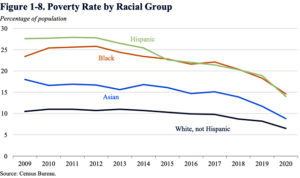
The 2022 Economic Report of the President is finally out. It was released on April 14, the latest ever. Here’s an interesting passage from page 42 of the ERP: Official estimates for the year 2021 will not be released until late 2022, but in 2020, the poverty rate fell to 9.6 percent from 11.8 percent in 2019, according to the Supplemental Poverty Measure, which accounts for the resources that many low-income households receive from the government (Fox and Burns 2021). Declines in poverty were even larger for particular racial and ethnic groups, with the supplemental poverty rate among Black and Hispanic Americans falling by 3.7 and 4.9 percentage points, respectively (figure 1-8). Accompanying it is the table at the top of this post. The paragraph quoted above is accurate. But notice what they don’t say. They don’t talk about the huge drop in black and Hispanic poverty from 2017 on. I think part of the reason is the 2017 tax cut. But whether you agree with me or not about the cause, the point is that they focus only on the part that they can arguably attribute, at least in part, to the huge federal subsidies in 2020. (0 COMMENTS)

/ Learn More

Environmental Despair Springs Eternal, Part 3: Mentors of the Modern Environmentalist Movement

Read Part 1 and Part 2. Discussions of the modern environmentalist movement typically begin with Rachel Carson’s (1907-1964) indictment of synthetic pesticides in her best-selling book Silent Spring (1962), Garrett Hardin’s (1915-2003) essay The Tragedy of the Commons on the unavoidable depletion of resources available to everyone and the pollution of freely accessible environmental sinks (1968), Paul Ehrlich’s (1932 -) neo-Malthusian The Population Bomb (1968) and the Club of Rome’s sponsored Limits to Growth report that predicted an impending shortage of critical resources (1972). Left out of most accounts, however, is that these authors are more remarkable for their popular success than their originality. For instance, much of Rachel Carson’s research for Silent Spring was based in part on the previous work and long-standing connections of prominent organic food activists. As noted by several commentators, Ehrlich’s Population Bomb is best understood as “climaxing and in a sense terminating the debate of the 1950s and 1960s” for “throughout the sixties, it appears that everybody was concerned about overpopulation.” (Actually, The Population Bomb sales only truly detonated after Ehrlich appeared on the Tonight Show in 1970.) Hardin revived the overexploited commons metaphor from political economist William Forster Lloyd (1794–1852) to illustrate, as the Malthusian Lloyd had done over a century and a half earlier, the necessity of population control. And the team hired by the Club of Rome echoed countless pessimistic reports published since at least William Stanley Jevons’ (1835-1882) The Coal Question; An Inquiry Concerning the Progress of the Nation, and the Probable Exhaustion of Our Coal Mines (1865) Another fact not widely known outside of specialist circles is that much of the infrastructure created to promote (neo)Malthusianism in the post-World War II era was built upon a dubious legacy. As economist Jacqueline Kasun (1924-2009) and many others have documented, eugenicists, whose movement had been discredited by Nazism, regrouped, “renaming their organizations, forming new ones, and, above all, burrowing into the councils of power.” By the early 1960s their movement had re-emerged in various organizations and campaigns devoted to checking the population explosion. Some key figures in this transition include the sociologist and demographer Kingsley Davis (1908-1997), a man who, like one time vice-president of the American Eugenics Society Garrett Hardin, fathered several children while advocating limitations on childbearing worldwide. Davis commented in 1945 that “in the long-run, Earth’s population has been like a long, thin powder fuse that burns slowly and haltingly until it finally reaches the charge and explodes.” In their 1947 book Human Breeding and Survival: Population Roads to Peace or War, sociologist Elmer Pendell (1894-1992) and Director of the American Eugenics Society Guy Irving Burch (1899-1951) argued that the land was already full “while our population is large and rapidly growing.” By 1951 one could see “forming for the American people, a future marked by conditions like those which prevailed in the times of scarcity and want which Europe used to know so well in past centuries and under which it now suffers.” As their title implied, overpopulation would again result in war. Peace, on the other hand, would only be secured through mandatory and systematic population reduction policies. Post-war neo-Malthusianism really took off with the publication of two books in 1948. The first was Road to Survival by ornithologist William Vogt (1902-1968), a book that remained the biggest environmentalist best-seller of all time until the publication of Silent Spring. Vogt argued that humans had behaved worse than parasites whose destructiveness “is limited by the absence of intelligence,” as they had used their brains to “tear down” nature and compromised their very survival in order to enrich themselves. He deemed “drastic measures… inescapable” in light of worldwide environmental destruction. “Above all else,” humans needed to reorganize their thinking, especially “all thought of living unto ourselves” for, in a “direct, physical sense,” humanity forms “an earth-company, and the lot of the Indiana farmer can no longer be isolated from that of the Bantu.” As he saw it, an “eroding hillside in Mexico or Yugoslavia affects the living standard and probability of survival of the American people.” Neither past beliefs in progress nor admonitions to be fruitful and multiply could provide useful guidance for the postwar era for such ideas, while “magnificent in their days,” had now become “millstones about [human] necks” and would most certainly turn out to be “idiotic in an overpeopled, atomic age, with much of the world a shamble.” Agricultural mechanization had been “of dubious value to the land, as it is more purely extractive than older methods,” had brought lesser quality land under cultivation, was too dependent on rapidly dwindling petroleum reserves and triggered a drift away from rural to urban areas, thereby reducing “the effectiveness of the self-contained rural population as an economic shock absorber” during future recessions. Vogt had no qualms about devising and implementing coercive policies such as linking foreign aid to population reduction provisions. As he saw things, “irresponsible breeding” made improvements of the conditions of the Greeks, the Italians, the Indians and the Chinese “difficult, if not impossible.” He predicted imminent petroleum shortages and famines in the next three decades in countries such Great Britain, Japan and Germany. He also considered public health measures unadvisable and even argued that the “flank attack on the tsetse fly with DDT or some other insecticide” carried out by “ecologically ignorant sanitarians, entomologists, and medical men” was going to make things worse because there was no “kindness in keeping people from dying of malaria so that they could die more slowly of starvation.” In the end, the road to survival could only be built on two foundations:  1) that renewable resources be used to produce as much wealth as possible on a sustained-yield basis; 2) that demand be adjusted to ‘natural’ supply, either by accepting less per capita (lowering living standards) or reducing population. The other 1948 best-selling eco-catastrophist book was Henry Fairfield Osborn Jr’s (1887-1969) Our Plundered Planet in which imminent environmental collapse was considered “eventually [more] deadly” than the Second World War, for “man’s destructiveness has turned not only upon himself but upon his own good earth – the wellspring of life.” In this context, man’s “avoidance of the day of atonement that is drawing nearer as each year passes” implied that he had to quickly learn “to work with nature in understanding rather than in conflict.” Failure to change would not only “point to widespread misery such as human beings have not yet experienced,” it would also, in the end, threaten “even man’s very survival.” Humanity had “now arrived at the day when the books should be balanced.” Osborn cautioned that the “miraculous succession of modern inventions” made it difficult to conceive “that the ingenuity of man will not be able to solve the final riddle – that of gaining a subsistence from the earth.” Yet the “grand and ultimate illusion” was that “man could provide a substitute for the elemental workings of nature.” For instance, “technologists may outdo themselves in the creation of artificial substitutes for natural subsistence,” but chemical fertilizers could never be thought of as “substitutes for the natural processes that account for the fertility of the earth” because, in the long run, “life cannot be supported… by artificial processes.” Both Vogt’s and Osborn’s books became mandatory readings in several institutions of higher education where they shaped the thinking of a whole generation, including Paul Ehrlich and Al Gore. Their influence was perhaps best summed up in 1977 by progressive journalist Allan Chase who lamented that every “argument, every concept, every recommendation” made by Vogt became “integral to the conventional wisdom of the post-Hiroshima generation of educated Americans.” As he put it: The postwar population explosion hysteria initiated by Guy Irving Burch and Elmer Pendell…, injected by Burch and Vogt into the body of Fairfield Osborn’s benignly intentioned books on natural conservation, and carried to full intellectual fruition by [William and Paul Paddock’s 1967 book Famine 1975], Ehrlich and Hardin, succeeded far beyond the wildest hopes of the oldtime eugenicists who started it all. Out of it came not only mass movements, such as Zero Population Growth, Inc., with chapters of active members in many American cities, but also new causes for older conservationist societies, such as the venerable Sierra Club. Another influential individual at the time was industrialist Hugh Everett Moore (1887–1972), who, profoundly influenced by Vogt’s book, wrote, published (over one and a half million copies) and publicized a short pamphlet titled The Population Bomb in 1954 whose title Ehrlich’s publisher eventually borrowed with permission. Pierre Desrochers is Associate Professor of Geography, University of Toronto Mississauga. (0 COMMENTS)

/ Learn More

National Conservatism Wants to Use the Ring of Power

Josh Hammer, speaking at the November 2021 National Conservatism Conference, said “Every important political issue in the year 2021 is a ‘cultural’ issue. ‘Fusionism’ and libertarianism are impotent, in light of this reality. Only national conservatism will suffice.” Hammer is hardly an isolated voice. Natcons generally are reacting to what they see as the failure of “fusionism,” the always fraught alliance between libertarians and conservatives.  Many have written about fusionism, but my own go-to source is Stephanie Slade, of Reason, who wrote this OLL piece and also this article. Jonathan Adler had this piece on fusionism as federalism. One definition of fusion is that  American-style conservatism has a dual mandate to preserve both liberty and virtue. Trading off between them is an impoverishment of the ideals of the American founding and, indeed, a rejection of the ideals of Western civilization itself. On the other hand, if one must choose, virtue is the more essential value. That kind of “why not both?” priority is a recipe for tension, at best. Conservatives are more likely to hold to some notion of virtue, based on cultural tradition, the application of right reason, or revelation of the sacred, and if virtue requires coercion so be it. Libertarians are more likely to hold to some notion of virtue as being defined by the individual and for the individual, so that values start with my own beliefs, and if we disagree that difference can never be a basis for coercion or force. The Frank Meyer synthesis in fusionism was the claim that the two notions of virtue and liberty cannot be separated. This is hardly a new idea; in The Spirit of the Laws, Montesquieu clearly had the same idea: It is true that, in democracies, the people seem to act as they please; but political liberty does not consist in an unlimited freedom. In governments, that is, in societies directed by laws, liberty can consist only in the power of doing what we ought to will, and in not being constrained to do what we ought not to will. (Book 11, Chapter 3) The problem with any view of America other than national conservatism, according to natcons, is that fusionists would say that all those value judgments that should properly animate the nation are consigned to the private sphere, left to the individual and his (or her) conscience. I don’t always use the “or her” addition, but since Hammer actually calls fusionism “effete, limp, and unmasculine,” it seems appropriate. Hammer is clear about what must be accomplished: the goal is to fight, and win, the culture war, using all possible means of gaining and controlling political power. The only way for the American right to [win] is to prudentially wield that power in the service of pursuing our ideal of the substantive good, and to reward friends of our just regime and punish enemies of our just regime within the confines of the rule of law…[which will] necessarily entail the institutional solidification of the political sovereigns equipped to achieve them, the bolstering of the bedrock social unit, the family, and the defeat of cultural wokeism and restoration of cultural sanity by partial means of the return of overt public religiosity. This made me think of one of the key conflicts in Tolkien’s Lord of the Rings trilogy. (To be fair, everything else also makes me think of Tolkien, so it’s not that surprising). When Frodo has run away from the others in the Fellowship, Boromir comes up to Amon Hen, the “Seat of Seeing,” to talk about power. Frodo believes (with Lord Acton) that the absolute power of the Ring will corrupt the person who wields it; Boromir desires the Ring, but genuinely believes that he can use that power for good. “The world is changing… [You say] Minas Tirith will fall, if the Ring lasts. But why? Certainly, if the Ring were with the Enemy. But why, if it were with us?” “Were you not at the Council?” answered Frodo. “Because we cannot use it, and what is done with it turns to evil.” Boromir got up and walked about impatiently. “These elves and half-elves and wizards, they would come to grief perhaps. Yet often I doubt if they are wise and not merely timid. But each to his own kind. True-hearted Men, they will not be corrupted. We of Minas Tirith have been staunch through long years of trial. We do not desire the power of wizard-lords, only strength to defend ourselves, strength in a just cause. And behold! in our need chance brings to light the Ring of Power. It is a gift, I say; a gift to the foes of Mordor. It is mad not to use it, to use the power of the Enemy against him. The fearless, the ruthless, these alone will achieve victory. What could not a warrior do in this hour, a great leader? The Ring would give me power of Command. How I would drive the hosts of Mordor, and all men would flock to my banner!” The “elves and wizards” are those limp, unmasculine libertarian fusionists, folks. All we need to do is hand over the ring of power to the natcons, finally admitting that the strictures of the Constitution enable our enemies but fetter our own actions, we can win. Once the real conservatives are allowed retake our birthright, by wielding unlimited extra-constitutional power, but for good, all men will flock to their banner. (0 COMMENTS)

/ Learn More

Michael Munger on Antitrust

Are tech giants such as Google, Amazon, or Facebook dangerous? Do they have too much power? Dive into the murky waters of antitrust as Michael Munger of Duke University talks with EconTalk host Russ Roberts about monopoly, antitrust policy, and competition in the 21st century. The post Michael Munger on Antitrust appeared first on Econlib.

/ Learn More

Dave Mayers RIP

An economist who understood price controls at a very personal level. Earlier this month, I learned that financial economist Dave Mayers died. Here’s his obit at the American Finance Association. He was a colleague of mine during my first academic year at the University of Rochester’s Graduate School of Management (now the Simon School.) He had the office across the hall from mine. At the time we were both single and so when I was in on a Saturday or Sunday and he was in too, I would take breaks from working on my Ph.D. dissertation to chat with him about various events. The author of the obit writes: In his research, Dave will be remembered for introducing non-marketable assets (such as human capital) in the CAPM, for some of the earliest research on block trades,  and for a considerable body of work on the insurance industry. But I’ll remember him most for a humorous remark he made. To get it, you have to remember how opposed economists generally are to price controls, especially maximum price controls and more especially to price controls that limit the price to zero. We had both heard on the news that a federal law had been passed banning pay toilets. We were both incensed at this extreme price control, but Dave put it best: This is an attack on the bowels of America. I still grin when I picture him saying that. (0 COMMENTS)

/ Learn More

Jason Furman was wrong

Yesterday, I did a post entitled “Jason Furman is right“. In the comment section, Rajat points out that in the middle of last year Jason Furman was complaining that a policy of NGDP level targeting would have required the Fed to begin tightening monetary policy.  While I still believe that Furman is now correct, last year he was wrong in opposing gradual tightening. Here’s Rajat’s very perceptive comment: I have two responses to this post.First, you are too kind to Jason Furman and I don’t like you being so generous to people who initially opposed your approach but eventually come around to it without admitting they were wrong, just because they are high-profile and influential. Maybe I haven’t followed Furman’s views closely enough, but on David Beckworth’s podcast last June, Furman criticised NGDPLT on the basis that it would have required higher/positive interest rates at a time when unemployment was still ‘high’ (nearly 6% but falling). At that time, as the transcript shows, Furman supported discretion over rules and argued that the Fed should look at unemployment as well as a nominal variable, which could be NGDP. He said: You in 2019, put down a really elegant framework for nominal GDP targeting. If we were following it now, we would already have lifted off interest rates. And we’re going to, with extreme likelihood, overshoot the nominal GDP target we were on. So under your framework, you’d have to make up for that with a sustained period of lower than trend on nominal GDP growth. I’m sure either by googling or going on your burner twitter account, you would also be able to find Furman’s tweets from August 5 where he crowed about how David’s estimate that the NGDP gap was closed in Q2/2021 was a reason why NGDPLT was inappropriate. For some bizarre reason that perhaps only a New Keynesian could understand, he went on to claim that “Under [David’s] forward-looking NGDP target rates should be well above neutral–maybe around 4% or more right now…. So would need very high interest rate for many years until NGDP got back onto its pre-pandemic path.” And then, just as he said in the podcast, Furman magnanimously added that none of what he was saying was to ‘pick on’ David. Yet now, he publishes a piece saying monetary policy was too loose in 2021 and somehow he is the prodigal son? Maybe, Scott, when I am your age I will be as zen as you about these sins, but for now I am still a (relatively) angry young man. Second, once again I have to chide you for reading an FT article without checking the author’s name – here, Martin Sandbu. Start a ‘black list’ and keep adding to it! In retrospect it’s 100% clear that monetary policy should have been tighter in the last half of 2021.  If the Fed had tightened enough to keep NGDP growth close to trend, then we wouldn’t be worrying about a possible recession next year.  Furman now says policy was too expansionary—does that mean he retracts his criticism of NGDP level targeting? In my view, people obsess too much about who was right and who was wrong.  Furman’s a great economist.  And it wasn’t just Furman that underestimated the momentum of the economy in mid-2021, I also failed to anticipate the severity of the inflation problem.  (I suspect David Beckworth would say the same.)  So I’m not trying to defend myself or criticize others; I’m trying to defend NGDPLT, which is a much more important goal.  Just as in 2008, we see NGDP providing the right signal to policymakers when lots of experts got things wrong.  That should count for something, shouldn’t it? PS.  A few comments on Rajat’s second point.  I have an excellent memory for statistical data and maps, but a horrifically bad memory for names. (Not a good trait in teachers.) But maybe that’s just as well, as in my early days of blogging I was much too critical of reporters, forgetting that they are people too.  PPS.  People often ask me to comment on the many, many conservatives who say the high inflation was caused by reckless fiscal policy.  My comment is simple.  They are all wrong, and it’s not really even debatable in my view.  The Fed’s job is to set monetary policy at the appropriate level for achieving their dual mandate, taking fiscal policy into account.  Full stop. I opposed the fiscal stimulus (except for the relief portion), which I regarded as a waste of money.  But no matter how many conservatives say otherwise, fiscal stimulus did not cause the high inflation. (0 COMMENTS)

/ Learn More

Think Correctly or the State of Florida Will Punish You

I totally agree with what co-blogger David Henderson wrote about the scandalous attack of the government of Florida against a private corporation doing business there, employing individuals who live there, and certainly having shareholders there. David beat me to the topic, but let me add or emphasize a fee points. As far as we know, the Florida legislature adopted a law precisely to punish the Walt Disney Company for not thinking correctly (“Florida Senate Passes Bill to Eliminate Disney’s Special Tax District,” Wall Street Journal, April 20, 2022). The law, An act relating to independent special districts, will abolish a number of what is also called “special tax districts,” including that of Disney. These special districts operate like municipal governments. They pay their local taxes to themselves but also finance much of the district’s public services such as roads and fire protection. A special district also receives the local taxes of other district businesses (such as hotels). Last week, the Wall Street Journal explained (Disney Faces Backlash in Florida Amid ‘Don’t Say Gay’ Controversy: Politicians threaten to strip the company of Mickey Mouse copyright, special tax status for Walt Disney World, as parents protest in Orlando,” April 15): Some Republican lawmakers in Florida are threatening to end a special tax district that has allowed the company to effectively govern the land on which Walt Disney World sits for decades. Members of Congress have called for Disney to be stripped of its original Mickey Mouse copyright. Friedrich Hayek, the 1974 winner of the Nobel Prize in economics, would certainly say that the affair shows how far we are down “the road to serfdom,” to use the title of his 1944 book. Many strands of government intervention converged towards the worrying outcome. The event that triggered the whole thing looks like a tempest in a teapot. It was the Act relating to parental rights in education, which the State of Florida adopted last month. As the Wall Street Journal notes in an April 21 editorial, the gist of the law lies in its section 3: Classroom instruction by school personnel or third parties on sexual orientation or gender identity may not occur in kindergarten through grade 3 or in a manner that is not age-appropriate or developmentally appropriate for students in accordance with state standards. After all, it seems that the mission of public schools is not to indoctrinate five-year-olds or nine-year-olds into fashionable sexual theories. The law does not, except perhaps in this context, impose a “don’t say gay” mandate. As The Economist noted, the new law also requires schools to notify parents of any “monitoring related to the student’s mental, emotional or physical health or well-being.” It also give the parents “the option to withhold consent or decline any specific service” in this regard. Nothing objectionable there. One may fear that the law will eventually be interpreted differently and drift into something else. A libertarian or classical liberal can only sympathize with this fear so often vindicated. But the danger seems less pressing here than in the million (literally) other prohibitions and obligations that federal laws and regulations impose, not counting local and state laws. Public schools cannot avoid representing the values generally accepted in a society, although this should be done intelligently. It should not prevent a child from learning to think for himself or herself. And parents who don’t like these values, should be free—and, in America, are largely free—to send their children to private schools or even to homeschool them. In a context where corporations are bullied by woke and other “social” activists, Walt Disney’s management tried to resist being involved in the debate surrounding the Parental Rights law, but it finally gave in to pressures from some of its employees. The company publicly expressed its opposition to the law. What does a producer of children movies and entertainment have to do in debates on LGBTQ+ and gender identity? Yet, the company has the right, like any individual, association, or corporate body, to express an opinion and criticize the government. But that it felt obliged to follow a fashionable mob and gave in to corporate politicization says something about the current perils for individual liberty. What if the “cancelling” mob were racist, as it has long been in parts of America? Walt Disney also has a constitutional right to suspend political donations to Florida governor Ron DeSantis and other backers of the Parental Rights, as it did, which Republican politicians did not like. In brief, disagreeing with Walt Disney and the wokes does not at all mean agreeing with DeSantis and the Florida Republican legislators. Being its own tax district since 1967 is a privilege that Disney lobbied for. Special privileges should not exist, even if it is not clear that this one actually allowed the company to pay less tax. The formula certainly helped it avoid a lot of regulations (on zoning and building, for example) and made it more self-governed in that respect. And what is wrong with self-government? Doesn’t everybody think that this is an American ideal–even if it often means being “self-governed” by others in a collective polity? Instead of criticizing this privilege, it could be argued that self-government should, to the extent possible, be recognized to everybody (a point also made by David Henderson). And note that Disney paid to purchase the land that became a tax district, and to develop it. Whatever legal privileges Disney obtained from the state in 1967 and over the years, it is a clear a violation of the rule of law for the government to remove a privilege if the recipient does not renounce its First Amendment rights. The ideal of the rule of law requires that the government only impose abstract and impersonal rules, as opposed to governing by direct commands or bribes to specific individuals or associations of individuals. And it is generally recognized that the rule of law is a necessary institution for a system of individual liberty and free markets. (On this topic, see my review of Friedrich Hayek’s Rules and Order, Econlib, March 7, 2022.) To add insult to injury, the Act relating to independent special districts signed by governor DeSantis on April 22 states that the abolished districts “may be reestablished on or after June 1, 2023.” In order to allow Disney to beg the state to reestablish its “self-government” in exchange for a promise to behave? What perhaps is most surprising in the whole affair is the cynical openness with which this step towards tyranny was taken, as if “lawmakers” could make any “law” they wanted. Let us hope that the courts will humble them and remind them that such open discrimination is unconstitutional. According to the Financial Times (“Florida Passes Bill to Strip Disney’s Special Tax Status,” April 22, 2022), DeSantis wrote to donors on Wednesday: Disney and other woke corporations won’t get away with peddling their unchecked pressure campaigns any longer. How far have those who call themselves “liberals” as well as those who call themselves “conservatives” have drifted from the classical liberal tradition was also illustrated by the Wall Street Journal editorial quoted above: it totally misses the egregious violation of the rule of law that the vengeful Florida government has committed. (0 COMMENTS)

/ Learn More

Friendly Advice to Journalists and their Editors

Today’s Wall Street Journal has an interesting and horrible story on war crimes: “Russia Turned a Bucha Building Into an Execution Site and Underground Prison,” by Thomas Grove. My advice is on a related but different issue and, don’t worry, it is directly related to America! A broom is made of a long handle and a brush. If you find a long handle lying around, you should say that you found a long handle, not a broom. Similarly, a cartridge is made of (1) a primer affixed to the bottom of (2) a casing which is filled with (3) powder, and of (4) a bullet at the other end of the casing. If you find a casing on the ground, you cannot say (as states a caption under an accompanying photograph, a detail of which is reproduced below) that you have found a bullet. The bullet is the part that went through somebody and is most likely stuck into some object tens or hundreds feet away. Perhaps it should be a condition of the job, even in America sadly, that journalists and their editors own and shoot guns. Similarly, a newspaper should not hire a journalist or an editor who cannot distinguish between a handle and a brush. The same story confirms a different and (perhaps) more substantive idea. The journalist reports on a Ukrainian arrested by Russian soldiers and later detained in an infamous jail and torture center: Mr. Zakharchenko said he wasn’t fighting and handed over his phone, a late-model iPhone his son had given him, so that the Russian soldiers could check the contacts and photographs. He watched a Russian soldier download the contents of his phone onto a computer and then look up his domestic identity number. The Russian officer then asked him about time he had spent in the Russian city of Tula as a welder in 2018. Encapsulated there is one major argument against ID papers and “domestic identity numbers” (like on your driver’s license, passport, or social security card): they too easily allow the agents of a foreign or domestic tyrant to find information to persecute those they don’t like. Details of a photograph in the Wall Street Journal, April 23, 2022 (0 COMMENTS)

/ Learn More

Jason Furman is right

Or at least shares my view of the current macro situation. I’ve argued that the current high inflation is increasingly driven by excess demand, and that monetary policy remains highly expansionary. Here’s former CEA chair Jason Furman: Commentators have generally offered two arguments about advanced economies’ performance since COVID-19 struck, only one of which can be true. The first is that the economic rebound has been surprisingly rapid, outpacing what forecasters expected and setting this recovery apart from the aftermath of previous recessions. The second argument is that inflation has reached its recent heights because of unexpected supply-side developments, including supply-chain issues like semiconductor shortages, an unexpectedly persistent shift from services to goods consumption, a lag in people’s return to the workforce, and the persistence of the virus. Of course there are some supply problems that have contributed to inflation, but Furman rightly focuses on NGDP growth, which has been extremely high: By definition, price growth equals the growth of nominal output minus the growth of real output (with a small difference due to compounding). Over the course of 2021, US real GDP grew by 5.5%, nominal GDP grew by around 11.5%, and GDP price growth thus came in at around 5.9%. Unfortunately, the Fed is still behind the curve: But households still have substantial excess savings, and the overall stance of monetary policy remains accommodative, suggesting that demand will continue to be strong. Unlike Furman, I’m not a Keynesian.  In market monetarist framing, the excess savings are viewed as a contributing factor making monetary policy more expansionary, not a separate factor.  I measure the stance of monetary policy in terms of (expected) NGDP growth. Overall, however, I’m thrilled to see an increasing focus from top economists on NGDP as an indicator of whether policy is too expansionary or too contractionary. Economists need to talk much more about NGDP—it’s the key policy indicator for demand-side policy issues (monetary and fiscal policy). PS.  On the other hand, looking at NGDP doesn’t necessarily lead to the correct policy, if one stubbornly refuses to face facts.  In the US, NGDP is already 3% above trend, and rising extremely rapidly.  That calls for tight money, right?  Not according to the FT: Second, central banks should clarify how they think their monetary policy works. Presumably, the point of reducing monetary stimulus is to take the wind out of the sails of demand in the economy, so as to bring it down to the damaged supply capacity. This was already hard to justify, given that nominal spending had only barely returned to pre-pandemic trends in the US and still fell short in the eurozone and the UK — hardly “excessive” demand. Huh?  The accompanying graph in the FT shows NGDP rising well above trend in the US. PPS.  I have a new piece at The Hill which makes some related points.   (0 COMMENTS)

/ Learn More