This is my archive

bar

The Cost-Price Illusion

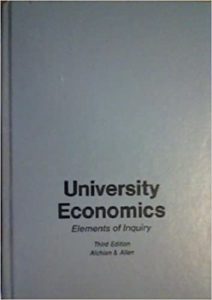
One of the best parts of Alchian and Allen’s classic textbook, University Economics, is its discussion of the cost-price illusion. The analysis, though worded somewhat differently, is also in the newer textbook Universal Economics, which is based on the original. It’s free on line from Liberty Fund. Here’s the passage: SPEED OF DETECTING CHANGES IN DEMAND OR SUPPLY: THE ILLUSION THAT COST DETERMINES PRICE Buffer stocks, inventories, and reserve capacity help make it appear as if prices are sluggish or inflexible and are determined by costs, instead of by competition among consumer-demanders. Suppose that for some reason (possibly higher incomes) demand for meat increases. As sales and consumption increase, butchers’ inventories are unexpectedly depleted. Normally, as with any retailer, inventories are large enough to accommodate transiently increased sales without producers having to raise prices. Inventories larger than an average day’s sales help assure that supplies are immediately available to demanders at predictable prices. One day’s above-average sales is not regarded instantly as a persistent increase at that price; nor is it viewed as a long-term sales increase that requires a higher price to keep inventories from being further depleted. When the increase in sales reflects a higher average demand, no seller will be able to detect the increase in demand immediately. A high transient deviation may induce retailers to purchase more for replacement of normal inventories, but they would buy even more if they knew the long-term demand had increased. If the public’s aggregate demand really had increased (not just toward this one butcher and away from other butchers), the demand by all butchers to restore inventories would increase the demand facing the meat packer-suppliers. Packers will see their inventories declining as they supply more meat to retailers. To replenish their extraordinarily depleted inventories, packers will compete with each other for more cattle than before. But with an unchanged supply of cattle, some packers must get less than the increased amount they demand at the old price. They bid up the price of cattle. The packers are, in this scenario, the first to see a price (cattle cost) rise consequent to the increased consumer demand, and they will correctly interpret that as a rise in their costs. The existence of inventories in the chain of suppliers from producer to consumer can cause a delay during which the increased consumer demand is communicated Edition: current; Page: [149] from retailers to initial producers. That delays the price increase until the cattle-producer stage. WHO IS RESPONSIBLE FOR HIGHER PRICES? LOOK IN THE MIRROR Packers raise their prices to retailers, saying their prices are higher because their costs are higher. But we know that costs are higher because it was the increased consumer demand that prompted a higher price of cattle at the feedlot. Because of the increased consumer demand, a higher price is obtained and maintained in the consumer market. When consumers complain about the higher price of meat, butchers say it isn’t their fault. Their costs have gone up. And the packers can say the same. To see who really was responsible for the higher prices, the consumers can look in the mirror behind the butcher’s counter and see themselves. Not all prices adjust instantly to the new equilibrium price to clear the market, as they do in the organized stock and commodity markets. In fact, a lag occurs between the time some demand or supply situation has changed and the time people detect and distinguish that from a random, transient, reversible change in the current purchase rates or in supply conditions. As emphasized earlier, the amount demanded may refer to the underlying average amount demanded in an interval, with momentary random offsetting deviations taking place around that average value. Because of the transient variations around the average, a shift in that average may be hard to detect quickly. An increase in sales may be interpreted as only a randomly high sales rate, rather than as a new higher normal sales rate. And once a seller begins to suspect that demand has shifted, difficulties exist in knowing what are the best adjustments to make in supply response. If the demand is believed to have fallen, should a supplier shift to some other production activity or should the price be lowered and work continued at a lower rate? Should an employer attempt to reduce wages of employees immediately when sales fall? So-called delays and lags in adjusting price or output are the result of inability to foresee the future perfectly and to understand what really is happening. They are not results of some inherent inflexibility in, or inability to change, prices. It takes time to decide that an underlying change, rather than a random, transient deviation has occurred. And the time it takes to discover what is the most appropriate adjustment misleads outside observers into thinking that prices are “rigid.” Prices actually are instantly flexible—as instantly as it is discovered that a change is appropriate. Edition: current; Page: [150] Why is this particularly relevant today? Because many commentators argue that cost increases are the cause of price increases. That can be true. But more often, given the huge recent increases in the money supply, it’s demand increases that are driving price increases. But the way that often shows up is similar to the analysis in Alchian and Allen. (0 COMMENTS)


/ Learn More

Kashkari’s schandenfreude

I’ve often argued that Fed policy should not try boost equity prices. It’s (at least) equally true that the Fed should not try to reduce equity prices. Not everyone seems to agree: Sharp stock-market losses show investors have got the message that Jerome Powell and his colleagues are serious about tackling inflation, said Minneapolis Fed President Neel Kashkari. “I was actually happy to see how Chair Powell’s Jackson Hole speech was received,” Kashkari said in an interview with Bloomberg’s Odd Lots podcast on Monday, reflecting on the steep drop after Powell spoke. “People now understand the seriousness of our commitment to getting inflation back down to 2%.” This sort of comment sets a bad precedent.  I have no objection to Fed officials being happy because markets take their comments seriously.  Thus Kashkari might have cited the modest fall in inflation expectations (measured by TIPS spreads) during Powell’s speech.   But TIPS spreads are a nominal variable.  Because the price level changes very little from one day to the next, a more than 3% drop in the stock market reflects implies an almost equally large drop in real equity prices.  It’s hard to believe that monetary policies likely to improve our economy would cause real stock prices to fall by more than 3%. Again, this doesn’t mean Powell should not be trying to reduce inflation expectations.  At the moment, a tighter monetary policy is probably appropriate.  But I don’t believe it is a good idea to use falling stock prices as a measure of success.  If it were, then why stop with a 3% decline?  The Federal Reserve of 1929 also tried to reduce stocks prices, and was far more “successful” in that endeavor than the Powell Fed.  And we all know how that ended up. (0 COMMENTS)

/ Learn More

In memory of Jean Baechler

Jean Baechler passed away a few days ago. I’ve written a short obituary for the Wall Street Journal. I’ve tried to highlight the key insight of his short-but-great 1971 book, The Origins of Capitalism: Economic growth, Baechler maintained, is the result of millions of “experiments” by people who act and think differently from the mainstream. For growth to happen, such acts of mutinous innovation must be permissible, if not explicitly permitted. Baechler saw capitalism as an offspring of Europe’s peculiar political condition. Despite the attempts of Charlemagne, Charles V, Napoleon and Hitler, Europe never became an empire. A great cultural homogeneity, provided mainly by Christianity, failed to produce a Continent wide political order. Baechler thought that political anarchy had been key to the development of the market economy in Europe. His book was not so much a work in economic history but rather in the history of political thought, addressing critically Karl Marx and Max Weber on the origin of capitalism. A few years ago I invited Baechler to give a lecture at Istituto Bruno Leoni in Turin. You can listen to it (in French) here. He was an eclectic scholar, who dealt with a number of different subjects, mostly in sociology, after that old book of his, though he regularly surveyed the status of the historiographical debate on the same matter. For the time we spent together, I can say he was a rather reserved man, with a dry sense of humour and with a prodigious memory. RIP. (0 COMMENTS)

/ Learn More

Inquisitions for Good Reasons

One problem with anti-abortion laws is that we can count on the state to use them as a new tool for privacy invasions, surveillance, and control—just as unconditional abortion leads to the debasement of human life. The government of the state of Georgia wants to prove that the first of these slippery slopes exists. (“Georgia Abortion Restrictions Spark New Debate Over Claims to Fetal Parenthood,” Wall Street Journal, August 27, 2022): Ed Setzler, the bill’s Republican author, said the recognition of fetal personhood is the logical extension of abortion bans. “If at the point of detectable heartbeat we’re going to protect children from the violence of abortion, naturally that protections should apply across Georgia law,” he said. Democrats and some legal scholars say the law opens the door for any of the dozens of local Georgia prosecutors to charge women with murder for taking abortion pills or traveling to an abortion clinic in another state. But the state is benevolent and serviceable: Setzler said that pregnant women could be allowed to drive alone with their fetuses on commuter lanes reserved for cars with passenger. But here is the catch: The state Department of Transportation said the issue would be one for local law enforcement to decide. According to the Georgia Department of Revenue, parents of an unborn child “with a detectable heartbeat” will be able to claim a personal income tax exemption of $3,000. But there is a catch again: The department declined to explain how someone would provide proof of an unborn child, or what should happen in the event a woman miscarries after claiming the exemption. The department will answer further questions about the impact of the law on taxes later this year, a spokesman said in an email. This sort of invasion of the “protected domain” (as Friedrich Hayek called it) around each individual and his property is reckoned to be illegitimate in much if not all the classical liberal and libertarian tradition. A general, impersonal, abstract principle would have to be found that both protects private property and allows checkpoints for women’s uteruses—a tall order, although the proliferation of checkpoints and decline of the Fourth Amendment have gone some way towards this Brave New World. In James Buchanan’s constitutional setup, such a rule would have to obtain, or be capable of obtaining, the unanimous consent of all individuals, which is even less likely. Philosopher Robert Nozick developed a Kantian theory of individual rights as strict constraints against what others, including the state, can do to an individual (Anarchy, State, and Utopia, Basic Books, 1974). It is interesting that both Hayek and Buchanan invoke Kant to buttress their otherwise quite distinct theories. Whatever the goals of the state, there are barriers it must not cross. If checking women’s uteruses does not cross them, one wonders what would. The state has already breached many barriers, often with approving clamors from the mob. On May 28, 2014, the Habersham County police in Georgia carried a late-night no-knock raid on a home where they thought a drug suspect would be. The SWAT rammed the door and tossed a flash-bang grenade inside. It landed in a playpen where a relative’s 19-month-old baby was sleeping, disfiguring him. Pardon the macabre joke, but the baby, called Bou Bou, had unfortunately been born 19 months before. No cop was criminally charged, except one who was indicted by a federal grand jury for lying on the affidavit requesting the warrant; she was acquitted. The parents received many millions of dollars in damages and settlements from municipal agencies. (See, for example, Mark J. Perry, “Baby Bou Bou Update, the Toddler Disfigured in a SWAT Drug Raid Based on a Warrant Obtained with False Information, AEI, July 24, 2015; “Ex-Georgia Deputy Acquitted After Flash Bang Grenade Hurts Toddler,” NBCNews, December 13, 2005; or google “Bounkham Phonesavanh.”. (Incidentally, that sort of story, which is not infrequent, suggests that Mar-a-Lago does not represent the most shameful home invasion in American history. Ordinary people get worst.) Selling drug to adults is a victimless crime because nobody is forced to buy. Readers who have seen my previous post on abortion know that I don’t believe that abortion is always a victimless crime (“Economic Reflections on Abortion,” EconLog, August 8, 2022). The general lesson is that we must be conscious of the permanent danger of coercive government interventions; mission creep is part of the danger. Federalism and the liberty to move to another state attenuate the danger, but don’t eliminate it. And my apologies for the slightly tabloid image I chose for this post. It can’t happen here? Frightened woman during the interrogation (0 COMMENTS)

/ Learn More

Prospects for a soft landing?

I have a new piece at The Hill, discussing the prospects for a soft landing: A useful definition of a soft landing would be a period of at least three years of economic growth with low inflation even after the labor market has full recovered from recession. Surprisingly, there is no evidence that the United States has ever achieved a soft landing, at least as far back as we have economic data. . . .Oddly, this is not the case in other countries, where soft landings are not particularly unusual. Japan has had extended periods of very low unemployment and low inflation. A notable example of a soft landing occurred in Britain during 2001-08, when unemployment stayed in the 4.7 percent to 5.5 percent range for seven years and inflation remained relatively low. Australia had no official recessions between 1991 and 2020. Note that the US has never even achieved a soft landing when conditions were favorable, such as a period when inflation and NGDP growth were relatively moderate and hence a tight money policy was not needed.  Today, we have very high inflation and NGDP growth, which makes it much more difficult to achieve a soft landing.  It’s like trying to land a 747 on an aircraft carrier in the midst of a typhoon. If three years from today the US has roughly 3.5% unemployment and roughly 2% inflation, then we could say that the Fed achieved a soft landing.  Unfortunately, that doesn’t seem very likely. PS.  Without Covid, I think we might have achieved a soft landing in the early 2020s.  But we’ll never know. (0 COMMENTS)

/ Learn More

Affidavit: NYT, WSJ, Other Criteria

The New York Times and Wall Street Journal editorials on the Mar-a-Lago search affidavit were more or less as expected. The New York Times argued expansively that nobody is above the law, including a current or former president. The Wall Street Journal (which tried hard to love Trump during a few years but understandably failed) argued that whatever crime Trump committed in keeping classified documents is a minor thing compared to the consequences of the Department of Justice going after him. It is useful to look at the issue in light of the theories of law developed by economists since the mid-20th-century century. One theory, identified to the Law and Economics movement or school, is that law should be efficient, in the sense that it should weigh the benefits and costs of any legal intervention, including of course its effect on incentives (an unorthodox view is given by David Friedman in his 2000 book Law’s Order). Both the New York Times’s and the Wall Street Journal’s editorials seem consistent with this theory. They simply don’t have the same evaluation of costs and benefits or apraissal on whom they fall—as typically happens in a cost-benefit approach. The two other major political-economy theories of law may look less “scientific,” but this mainly, if not only, because the scientific claims of cost-benefit analysis are much overrated. One theory was developed by FA. Hayek, a 1974 Nobel laureate in economics (see his Law, Legislation, and Liberty, especially the first volume, originally published by the University of Chicago Press in 1973, and my Econlib review of this book). The basic idea is that legal rules are those general, impersonal, and abstract rules that are essential for the maintenance of a free society, that is, for a social order where coercion is minimized and each individual can pursue his own purposes. In this perspective, the question would be something like: Can we universalize, in a free society, the rule that the chief executive of the government, in or out of office, may treat national security documents as he sees fit? Or is this rule just a rule applying to the organization called government? If yes, leave Trump alone on this matter. If not, the search of his office and residence is prima facie justifiable. The other major economic approach to the analysis of law is the constitutional political economy mainly developed by James Buchanan, laureate of the 1986 Nobel prize in economics (see, for example, his 2006 book Why I, Too, Am Not a Conservative and my review in Regulation). The basic idea is that, accepting the axiom that all individuals are “natural equals,” all politics must be based on, and limited by, general rules (“general” in the same sense as Hayek’s) that must be unanimously consented to or capable of unanimous consent, by all individuals of a society in a virtual social contract. Before giving his consent or opposing his veto, each individual balances his own benefits and costs. In this perspective, the question would be: Is it plausible that all Americans, fearful of Leviathan, would accept that the social contract allow a current or former chief executive of the government to use national security documents as he sees fit? If yes, leave Trump alone on this matter. If no, the search of his office and residence is prima facie justifiable. The answer to our question appears to be substantially the same whether we follow Hayek’s or Buchanan’s theory of law. The Hayek or the Buchanan approach would apply to other current or former rulers who misuse classified information—although some misuse may be more culpable than others. Whether it should also be applied to private parties who leak classified information is a different matter. One however cannot avoid wondering why Trump, when he was in power, did not work towards loosening the legal risk of those who use proprietary government information. It also bears remembering that the rulers are, or should be, tasked with maintaining a free society (Hayek’s approach) or with enforcing a unanimous social contract (Buchanan). One would think that the law would hold them to a very high standard. As a citizen, a ruler has exactly the same rights as other citizens; as a ruler, he must accept some special constraints. It is Donald Trump who had the job of protecting Edward Snowden’s rights, not the other way around. “It’s hard to believe that a dispute over documents would yield a criminal indictment,” says the Wall Street Journal, but they are speaking about Mr. Trump! This reminds me of the historical example that Mancur Olson, another famous economist, reported (Power and Prosperity, 2000, p. 40): In Venice, after a doge who attempted to make himself autocrat was beheaded for his offense, subsequent doges were followed in official processions by a sword-bearing symbolic executioner as a reminder of the punishment intended for any leader who attempted to assume dictatorial power. Little economic exercise to go further: (1) What would be the criterion by which political dignitaries would be judged under Anthony de Jasay’s “capitalist state”? (2) Did  Mr. Trump work to establish this “capitalist state”? (0 COMMENTS)

/ Learn More

Inflation Last Time

In the year to June, the Consumer Price Index increased by 9.1%, “the largest 12-month increase since the period ending November 1981.” Back then, the rate was declining from its peak of 14.6% in March and April 1980 and would bottom out at 2.3% in July 1983. What caused that inflation? How was it slowed? In the 1960s, monetary policy was grounded in a concept called the Phillips Curve. This held that there was an inverse relationship between inflation and unemployment so that as one rose the other fell. Policymakers could buy lower unemployment at the price of higher inflation and vice versa. At the end of the 1960s this relationship broke down. The inflation rate rose from 1.6% in 1965 to 5.9% in 1970 but unemployment rose too, from 3.5% in 1969 to 6.0% in 1971. Federal Reserve chairman Arthur Burns complained: “The rules of economics are not working in quite the way they used to. Despite extensive unemployment in our country, wage rate increases have not moderated. Despite much idle industrial capacity, commodity prices continue to rise rapidly.” In 1971, President Nixon imposed wage and price controls but inflation went on rising. The CPI rose by 11.0% in 1974 and President Ford launched the ‘Whip Inflation Now’ – WIN – campaign, whose most memorable component was the wearing of badges reading ‘WIN’. And unemployment continued to rise, hitting 8.5% in 1975. In 1978, with inflation at 7.6%, President Carter, said: “Inflation is obviously a serious problem. What is the solution? I do not have all the answers. Nobody does. Perhaps there is no complete and adequate answer.” This wasn’t quite true. Based on his monumental study with Anna J. Schwartz, A Monetary History of the United States, 1867–1960, the economist Milton Friedman – who had exposed the Phillips Curve fallacy in 1968 – had long been arguing that: “Inflation is always and everywhere a monetary phenomenon in the sense that it is and can be produced only by a more rapid increase in the quantity of money than in output.” Friedman rejected popular inflation bogies, notably the energy price hikes of “Arab sheikhs and OPEC:” “They have imposed heavy costs on us. The sharp rise in the price of oil lowered the quantity of goods and services that was available for us to use because we had to export more abroad to pay for oil. The reduction in output raised the price level. But that was a once-for-all effect. It did not produce any longer-lasting effect on the rate of inflation from that higher price level.” He contrasted the low inflation of Germany and Japan, which imported all their energy, with the high inflation of the United States, “which is only 50 percent dependent, or…the United Kingdom, which has become a major producer of oil.” The key variable was monetary policy. Inflation was not an impenetrable mystery: it resulted from printing money at a rate greater than the expansion of the real economy. It followed that if you controlled the growth rate of the quantity of money, you could control inflation. In July 1979, Carter appointed Paul Volcker Fed chair. He knew what he was getting. On their first meeting, Volcker told the President “You have to understand, if you appoint me, I favor a tighter policy than [his predecessor].” Volcker proved as good as his word. In October, he initiated a fundamental change in Fed policy. Changes in the daily level of the fed funds rate “tended to be too little, too late to influence expectations,” Volcker recalled, “We needed a new approach.” “Put simply, we would control the quantity of money (the money supply) rather than the price of money (interest rates). The widely quoted adage that inflation is a matter of ‘too much money chasing too few goods’ promised a clear, if overly simplified, rationale.” Interest rates would fluctuate and as money growth slowed, rates rose: rates on three-month Treasury bills exceeded 17%; the commercial bank prime-lending rate hit 21.5%; mortgage rates approached 18%. The consequences were brutal. Real GDP fell at an annual rate of 2.1% in the second quarter of 1980 and the unemployment rate rose from 5.6% in May 1979 to a peak of 10.8% in November and December 1982. To his credit, Carter, unlike his predecessors, did not push Volcker to loosen policy, even as he entered an election year. Ronald Reagan defeated him in a landslide. Volcker had once advised Nixon, “If you have to have a recession, take it early.” Reagan did and reaped the rewards. Real GDP growth hit 7.2% in 1984, the inflation rate fell to 1.9% in 1986, and unemployment to 5.3% in 1989. It was ‘Morning in America,’ Reagan said, and he was reelected in a landslide. Then, as now, ‘it’s the money supply, stupid.’   John Phelan is an Economist at Center of the American Experiment. (0 COMMENTS)

/ Learn More

District Attorneys Allege ADA Shakedown

HEADS UP, Monterey Peninsula business owners. A wheelchair bound disabled man who’s filed more than 800 lawsuits alleging violations of disability access laws has taken aim at more than a dozen mom-and-pop shops in Salinas, and the Peninsula could be his next target. Since July 5, Orlando Garcia — with the help of a San Francisco law firm that prosecutors in two major cities have accused of “shaking down” businesses — has filed 13 civil complaints in Monterey County Superior Court. Garcia and his attorneys allege the Salinas shops, bakeries, laundromats and other small businesses he visited earlier this year had inadequate or nonexistent disabled parking, high counters, tight door handles and other obstacles that made it difficult for him during his visits. Represented by the Center for Disability Access, a division of the Potter Handy law firm, Garcia and his attorneys boast of their litigation prowess. “In the year preceding the filing of this complaint, Garcia has filed approximately 634 lawsuits alleging violations of construction-related accessibility standards,” according to a July 19 complaint Garcia filed against the owners of La Mariposa Bakery & Deli in Salinas. This is from Kelly Nix, “Serial ADA plaintiff targets Salinas shops,” Carmel Pine Cone, August 26-September 1, 2022. It’s a front-page story. What I find refreshing about it is that even though it’s a news story, it doesn’t pull its punches. It’s more like a “news analysis,” to use the term the New York Times uses. But the Times editors would never have the guts to run a story like this. Here’s another interesting part: Los Angeles District Attorney George Gascon and former San Francisco District Attorney Chesa Boudin contend that Potter Handy’s scheme is to combine lawsuits court, allowing them to circumvent repeated attempts by the California Legislature to end ADA lawsuit abuse. The trick is to “falsely” assert standing in federal court, Gascon and Boudin said, thereby avoiding the strict requirements to file a claim under the state’s Unruh Civil Rights Act, while demanding small businesses pay “the heavy damages available under the Unruh Act. Notice the names Gascon and Boudin, two of the most unpopular California District Attorneys in recent history, Indeed San Francisco voters recently recalled Boudin. Later: The tactic is not what federal and state civil rights and accessibility laws were intended for, the prosecutors’ suit says. “It is a shakedown perpetrated by unethical lawyers who have abused their status as officers of the court,” according [to] Gascon and Boudin’s lawsuit. The fact that even Gascon and Boudin are on board with this is a somewhat hopeful sign.     (0 COMMENTS)

/ Learn More

Common Sense, Anyone?

In this episode, former EconTalk guest and author of Gut Feelings, Gerd Gigerenzer joins host Russ Roberts to talk about his latest book, How to Stay Smart in a Smart World: Why Human Intelligence Still Beats Algorithms. Whether fearful or excited about the impact and potential of AI, we think you will find this discussion scintillating. What aspects of AI concern you the most? What claims do you doubt? As always, we would love to hear what you think about and hope these questions will inspire you to share your thoughts with us.      1- Cancer treatments and investments are two areas where numerous variables and uncertainties abound. What else comes to mind that supports the “ common sense beats AI” argument?   2- EconTalk listeners are familiar with a favorite quotation of Russ Roberts’, ‘We are storytelling, pattern-seeking animals.’ How does Gigerenzer argue that AI can turn this human tendency against us?   3- What do you think about the coffee house analogy of online platforms? Which part rings truest to you- the free coffee, sales people as customers, or us as the product being sold? How much should you/we care about being surveilled?    4- PISA scores indicate that 90% of 15-year-olds, who are digital natives, do not know how to tell facts from fakes. Gigerenzer proposes that students should be trained to check the About Us tab, but the majority of Stanford undergrads don’t know this lateral reading technique. Do you believe this risk literacy deficit and inability to discern trusted sources is unique to this age group? Explain.   5- Better problem solving skills and knowledge of statistics might reverse the negative error culture that pervades corporations and individuals today. What other educational investment is needed to prepare students for complicated decision-making in a world of uncertainty?   (0 COMMENTS)

/ Learn More