
This is my archive

bar

Martha’s Migrants

If you are even slightly familiar with current affairs you are no doubt aware of the humanitarian disaster that is Venezuela.  After the election of socialist Hugo Chavez as president in 1998, the country was slowly and agonizingly plunged into economic, political, and social hell as destructive economic policies, political repression, human rights violations, compulsive money printing, and total disregard for the rule of law took a country that was once the wealthiest in Latin America to one that is now among the poorest and most dangerous. Venezuela has among the highest rates of malaria cases, kidnappings, hunger, and corruption in the world.  Its current inflation rate has actually eased to merely 927% after being 1,638% last year.  You read those figures correctly.  Its people suffer from chronic shortages of food, medicine, and basic goods.  IF you have access to real money (i.e. US Dollars) you can get whatever you want, but only elites and folks who work for the precious few foreign businesses left can obtain them.  The unemployment rate is close to 50%.  Crime is rampant; the police are corrupt, and the jails full of political prisoners.  If there was ever a poster child for what socialism unleashed can do it’s Venezuela. The Governor of Texas sent 50 migrants from Venezuela who had crossed the border into the US to Martha’s Vineyard in Massachusetts.  The move has set off a social media and news frenzy across the political spectrum with Democrats and Republicans finger pointing and grandstanding using terms like decency, morality, and political “pawns”.  Speaking as someone who has actually been to Venezuela- when it was merely bad and not nightmarish as it is now- I cannot help but be appalled by how badly everyone here is missing the point. NONE of those folks who were sent to the Vineyard are suffering or are having their human rights violated.  That was happening before they got to the United States.  Whether or not they are living in a shelter on the island or in a refugee holding facility in Texas they are much, much better off than they would be back home, like most immigrants from Latin America who assume substantial risks to try to get to US soil.  Once here, Venezuelan immigrants are not granted the same protections as Cubans, despite the fact that the regime they live under is as bad, if not worse, than Cuba. We are in the midst of a desperate labor shortage.  Every one of us should be welcoming to these people who have risked their lives for freedom and opportunity and understand what they are trying to do.  Nobody seems to understand this.  Near as I can tell, virtually no one among US political elites is seriously defending the Venezuelan regime any longer.  Even Sean Penn and Danny Glover are now conspicuously silent about what’s going on down there.  If Republicans really hate socialism and Democrats really care about the plight and suffering of people in the developing world, both sides should agree to grant asylum to Venezuelan immigrants when they reach the United States.  Martha’s migrants are actually lucky.  Give the millions still stuck in the hell of Chavismo some hope.  Open up our borders to those folks, and frankly many more, and end the myopic, counterproductive political games. (0 COMMENTS)


/ Learn More

The city without zoning

Houston is the only big American city without zoning. Some people argue that Houston is effectively zoned, as many neighborhoods have deed restrictions that limit development. But in his new book on zoning, M. Nolan Gray points out that only 25% of Houston is covered by those contracts, and even in those cases the restrictions are less rigid than with explicit zoning laws.  So how are things playing out in Houston? For the most part, Houston’s positives are linked to its lack of zoning, and its negatives are essentially unrelated to zoning.  Many people visualize zoning as somehow protecting people from negative externalities.  In fact, regulations against public nuisances have been around long before zoning was first adopted in 1916 (in NYC and Berkeley), and even Houston has many such rules.  Here’s Gray describing Houston: Pursuant to city regulations, slaughterhouses—an early zoning boogeyman—must remain 3,000 feet from the nearest resident; oil wells cannot be within 400 feet.  Strip clubs and other adult-oriented businesses cannot be within 1,500 feet of a school or church; liquor stores and bars cannot be within 300 feet (Evidently, lust is more offensive than gluttony.)  And the location of billboards is heavily proscribed throughout the city. So how does Houston benefit from a lack of zoning?  Think about how cities were built before zoning was created.  The densest area (say Manhattan) is in the center, with high-rise office buildings.  A bit further out (say Brooklyn) you have townhouses and big apartment buildings.  Even further out (say Long Island) you have lots of single-family homes.   After zoning was adopted and then made much more strict over the following decades, this natural growth pattern was artificially halted.  In a free market, central Los Angeles would have many more large apartment and condo buildings.  Central Houston has evolved more naturally than Los Angeles, as the city has grown into one of America’s largest metro areas (with roughly 7 million people, 2.3 million of which live right in Houston.)  In central Houston, residential lots with one old ranch house are rapidly being converted into three modern townhouses.  Lots of large apartment buildings and condos are also being built on the near west side.  The city is continually being remade, in a style appropriately reflecting its growth into a major city. In the tweet below, you can see how in just two decades Houston’s permissive permitting rules allowed a residential neighborhood to become much more dense. You might be thinking, “But I like single family homes with a large lawn.”  In that case, I have good news for you.  In a free market like Houston there are still plenty of such neighborhoods (and far more in the suburbs.)  At the same time, the market is telling us that there are plenty of people who prefer living in dense neighborhoods near the center of major urban areas.  Unfortunately, most zoning plans make such neighborhoods illegal.  Not all of Los Angeles County should look like Brooklyn.  But LA deserves a Brooklyn-like area close to its major job centers.    Houston is not as attractive a city as LA (or even Austin.)  It’s hot, humid, flat, prone to flooding, and (AFAIK) has the world’s largest collection of petrochemical facilities.  Yet despite all of those negative characteristics, lots of people move to Houston each year.  (Both affluent and working class migrants.)  That’s partly due to its housing policies, which keep prices reasonable despite the extraordinary growth in population.    PS.  Houston has had three referenda to allow zoning, and it was rejected all three times.  Gray suggests that this is partly because working class voters tended to oppose zoning, and more affluent neighborhoods were bought off with the promise that private deed restrictions would continue to be enforced.  In American politics, one never achieves anything without compromise.              (0 COMMENTS)

/ Learn More

Remembering Basil Yamey

Thanks to a selection by Erik Thompson for the mailing list of the historians of economic thought, I ran into this article commemorating Basil Yamey. Yamey passed away in 2020, at the respectable age of 101. I had the pleasure of meeting him a couple of years before. He was kind and generous with his time – and sharp as a razor. This piece by R.H. Macve focuses on Yamey’s impressive contributions to the history of accounting. The LSE obituary remembers Yamey’s interest in the arts: he was for a long time a Trustee of the National Gallery and published a splendid book on Art and Accounting. He was a colleague and friend of Peter Bauer and they two of them must have had one of the closest coauthor relationship ever. In this affectionate tribute to Bauer, Yamey, quite consistently with his natural understatement and his kind and humble demeanour, emphasised his friend’s work and underplays his own contribution. But clearly their partnership was a mutual effort, which depended much on Yamey’s input, too. He brought a keen eye for entrepreneurial effort, which is part of their criticism of foreign aid and its consequences. They were both perfectionist in writing, and tried to write well, eloquently and elegantly. Their work is still a pleasure to read. A good starting point, if you’re interested, is The Economics of Under-developed Countries. (0 COMMENTS)

/ Learn More

Francisco d’Anconia’s Speech on Money

I said earlier this month that I would, from time to time, highlight some of my favorite passages from Atlas Shrugged. October 10 will be the 65th anniversary of its publication. One commenter, Paul Sand, recommended Francisco d’Anconia’s speech on money. It’s one of my favorites also. I like it, not just because of its ideas but also because of something Ayn Rand does very well that she gets very little credit for: fresh phrasing. George Orwell talked about how when you use too many shopworn phrases, they replace thinking. Rand had an ability to come up with fresh ways of saying things. Some highlights within the speech follow. What I think of whenever I think about inheritance taxes: Do not envy a worthless heir; his wealth is not yours and you would have done no better with it. Do not think that it should have been distributed among you; loading the world with fifty parasites instead of one, would not bring back the dead virtue which was the fortune. Her great wording: Did you get your money by fraud? By pandering to men’s vices or men’s stupidity? By catering to fools, in the hope of getting more than your ability deserves? By lowering your standards? By doing work you despise for purchasers you scorn? If so, then your money will not give you a moment’s or a penny’s worth of joy. Then all the things you buy will become, not a tribute to you, but a reproach; not an achievement, but a reminder of shame. Then you’ll scream that money is evil. Evil, because it would not pinch-hit for your self-respect? That last line is so good. My guess is that Ayn Rand never saw a baseball game in her life. But what a fresh metaphor. Men who have no courage, pride or self-esteem, men who have no moral sense of their right to their money and are not willing to defend it as they defend their life, men who apologize for being rich–will not remain rich for long. They are the natural bait for the swarms of looters that stay under rocks for centuries, but come crawling out at the first smell of a man who begs to be forgiven for the guilt of owning wealth. They will hasten to relieve him of the guilt–and of his life, as he deserves. I love the wording but I strongly disagree with Rand’s view that someone like that doesn’t deserve to live. On making money: If you ask me to name the proudest distinction of Americans, I would choose–because it contains all the others–the fact that they were the people who created the phrase ‘to make money.’     (0 COMMENTS)

/ Learn More

Tolerance Does Not (Necessarily) Equal Approval

If you’re a certain kind of nerd who follows a certain kind of blog roll, you’re probably familiar with Scott Alexander’s writings on the motte-and-bailey fallacy. This is a close cousin of the classic fallacy of equivocation, where the same word is used to mean different things during an argument. The fallacy of equivocation, in its most blatant form, looks something like this: Taxes are a headache. Tylenol eliminates headaches. Therefore, Tylenol eliminates taxes. Do you see the mistake? Of course you do. What we mean by “headache” when we use that term to describe taxes is not what we mean by the same word when we talk about the effects of painkillers, so obviously statements about painkillers don’t apply to taxes. The motte-and-bailey fallacy, as Scott Alexander describes it, is more of a sneaky argumentative tactic than a logical fallacy – he also suggests the less clunky term “strategic equivocation” to describe it. In his words: So the motte-and-bailey doctrine is when you make a bold, controversial statement. Then when somebody challenges you, you retreat to an obvious, uncontroversial statement, and say that was what you meant all along, so you’re clearly right and they’re silly for challenging you. Then when the argument is over you go back to making the bold, controversial statement. I’ve noticed something like a motte-and-bailey happening over the last few years with the idea of tolerance. Tolerance, we are told, is a virtue, and to be publicly labeled as an intolerant person is to walk around carrying a scarlet letter “I” for the rest of your days. But what tolerance means, and what it requires, seems to be shifting. Originally, tolerance was meant in quite a literal way. To be tolerant of something was, well, just that. It simply meant that you tolerated it – you put up with it. You could dislike it, grumble about it, openly disapprove of it, and avoid it, but as long as you put up with it, you had fulfilled your obligation of tolerance. These days, however, the goal post has shifted. Tolerance is no longer a call to simply tolerate something. It now means something more like active approval and affirmation. If you disapprove of X, or if don’t actively support and affirm X, you are therefore, now, intolerant of X. But…that’s nonsense, right? Surely, we all know that it’s possible to disapprove of something but still tolerate it, right? That’s where the motte-and-bailey comes in. It seems very common for people to demand “tolerance as positive acceptance” on the one hand, but later insist they’re only after “tolerance as being tolerated” when even slightly pressed. Classical tolerance does not mean approval, it does not mean affirmation, it does not mean acceptance – it just means tolerating something. Wanting gay marriage to be made illegal is intolerant of gay marriage. Trying to pass a burka ban is similarly intolerant. But you can disapprove gay marriage or burkas and still tolerate them. I believe in classical tolerance. To insist on your right to be tolerated, however you define it, is also to place an obligation on others. Classic tolerance, the sort of thing tolerance originally meant, places a justifiable obligation on others. It doesn’t require their approval. Indeed, I can clearly recall how those insisting on tolerance in decades past made it clear that approval was not required or even necessarily desired. The attitude was, “It doesn’t matter if you approve of me or not – your acceptance is not what I’m after. Just leave me free to live my life as I see fit, and to pursue happiness as I wish, and you can stew with disapproval about it to your hearts content, for all I care.” Tolerance as acceptance, however, is placing a much greater demand on people. It says  “It’s not enough that you leave me to live my life in peace. You must also approve of how I live my life. I have a right to require that your personal thoughts, feeling, and convictions be favorably disposed towards me – if they are not, you have failed in your obligations to me.” This is too much. People don’t have a right to prevent you from living as you wish, but they do have a right to be wrong. Kevin Corcoran is a Marine Corps veteran and a consultant in healthcare economics and analytics and holds a Bachelor of Science in Economics from George Mason University. (0 COMMENTS)

/ Learn More

How Trustworthy is Wikipedia

It depends on the issue. Reason editor (and my friend) Katherine Mangu-Ward writes: As Twitter, Facebook, and YouTube have become consumed by controversy over moderation, governance, and the definition of free speech, Wikipedia quietly continues to grow in utility, trustworthiness, and comprehensiveness. In a literal sense, she may be right.Wikipedia may have become more trustworthy without being very trustworthy. On issues like sports and other areas where there is not much political controversy, Wikipedia is great. But John Stossel has laid out in some detail Wikipedia’s left-wing bias that causes simple factual statements that don’t fit left-wing narratives to be deleted, often within a day, sometimes within minutes. See, for example, what Stossel finds about the Hunter Biden laptop controversy, starting at about 2:30. Stossel points out, at about 7:30, that when he brought this to the attention of Wikipedia founder Jimmy Wales, Wales quit communicating with him. Maybe Katherine could still say that Wikipedia grows in trustworthiness. After all, it finally admits that Communism killed millions of people. It didn’t use to. The picture above is of Jimmy Wales. (0 COMMENTS)

/ Learn More

Donald Kohn on The Money Illusion

In my recent book entitled The Money Illusion, I was sharply critical of Fed policy during the Great Recession of 2007-09.  Donald Kohn was Vice Chair of the Federal Reserve Board during this period, and has written a very thoughtful review of my book.  I encourage people to read the entire piece. The most controversial aspect of my book is the claim that Fed errors in 2008 caused the recession to be much more severe than otherwise.  I based this claim on the fact that, in my view, a plausible alternative monetary policy regime would have prevented the sharp fall in NGDP growth during 2008-09.  Kohn argues that during a key period in 2008 the Fed lacked accurate data showing weakening NGDP, due to both data lags and errors in the initial estimates of NGDP growth: Moreover, the growing economic weakness in the current vintage of data for Q3 2008–which would have set off alarm bells in the Fed–was not evident in the immediate lead up to Lehman’s bankruptcy.Footnote 5 NGDP is now estimated to have grown only 0.9% at a seasonally adjusted annual rate (SAAR) in Q3 and to have collapsed at a 7.6% SAAR in Q4, which Sumner argues should have led the Fed to begin more aggressive easing in Q3. But at the end of July, Board staff was projecting 4.3% SAAR growth in NGDP for Q3 and 3.9% for Q4-2008 to Q3-2009. Private forecasters were in close agreement; the Survey of Professional forecasters in August saw NGDP growing at a 4.3% annual rate in Q3 and at 4.1% for the following four quarters, with rising interest rates. Obviously, none of this suggested an impending collapse that required immediate monetary policy attention in July and August. In fact, Q3 NGDP growth was first published—one month after the end of the quarter—at a 3.8% SAAR, and it was revised down only slightly through the next two revisions over subsequent months. The current estimate of only 0.9% SAAR growth, which Sumner cites as evidence of too-tight monetary policy, came much later. The difference between first-published and current-estimated growth was similar for Q4—a 3.5 percentage point downward revision (from − 4.1 to − 7.6). This experience underlines several serious weaknesses for NGDP targeting—the difficulty of accurately estimating and forecasting, the availability of only quarterly data with a lag, and the size of revisions; the latter could have a material impact on estimates of the policy necessary to achieve NGDP level targets. This is roughly the argument I would make if I were asked to defend the Fed’s position.  I have three responses to this general argument: 1. Other data clearly showed the economy was sliding into recession in mid-2008.  For instance, August unemployment had already risen by 170 basis points from the previous low, and that large a rise in the unemployment rate is a 100% accurate indicator of recession.  Indeed even a rise half that large would be a 100% accurate inflation indictor. This fact suggests the government must do a better job of deriving NGDP estimates in real time. I understand that complaining about our GDP data does not invalidate the core of Kohn’s argument.  My next two points that are more essential: 2. Lehman failed in mid-September, and soon after this occurred various market indicators (such as TIPS spreads) clearly suggested that money was too tight, as both inflation and employment forecasts were falling well below the Fed’s implicit policy mandate.  Thus even before we had the revised NGDP data, various asset market forecasts clearly suggested that we had a major demand shortfall.  The Fed needs to respond to forecasts, not backward looking NGDP data. Nonetheless, some might argue that by mid-September it was too late to do anything to avert a severe recession.  I don’t believe it was too late, but it’s my third point that is the most important: 3. Level targeting.  I cannot emphasize enough the need for some sort of level targeting policy regime.  The Fed needs to be telling the markets that whatever happens in the short run during a banking crisis, NGDP will be about 8% above current levels two years into the future.  They need to emphasize that they will do whatever it takes so that markets expect roughly 4% average NGDP growth over the next two years. When I mention level targeting, many people assume that I am obsessed with correcting errors, with undoing policy mistakes.  That is not the purpose of level targeting.  The point is to prevent the initial under or overshoot in NGDP growth (or at least make it milder than otherwise.) [Here I might use the analogy of the Mutual Assured Destruction doctrine in nuclear war game theory.  The point of massively retaliating against a nuclear attack on your country is not to seek revenge, not to “even the score”, the point is to deter the initial attack from occurring in the first place.  If you have not credibly committed to that doctrine ahead of time, then it’s pointless (which the theme of the film Dr. Strangelove.] Now let’s think about how these three pieces relate to late 2008.  Despite the flawed NGDP data, markets clearly saw that money was too tight to achieve the Fed’s implicit policy target of roughly 4% NGDP growth.  Markets saw high frequency data on everything from ocean shipping rates to payroll employment to US equity prices (and many more data points), and putting all of this data together understood that a recession was developing.  Under a level targeting regime, markets would have expected a very expansionary Fed policy to bring NGDP back to the trend line over the next few years. And leads us to the key point, which is missed in so much discussion of level targeting.  Market expectations of NGDP growth over the next few years is basically what Keynes meant by “animal spirits”.  Longer run NGDP expectations are the primary factor that drives aggregate demand in the short run.  (Michael Woodford has formally modeled the way that future expected demand growth drives current demand in the economy.)  This is why the current economy is extremely sensitive to the future expected path of monetary policy. In a policy regime where the Fed commits to bring NGDP back to the trend line ASAP, the initial deviations from that trend line become much smaller.  As an analogy, if a swing oil producer commits to do whatever it takes to bring oil prices back on target in three months, then the effects of a near term oil production disturbance caused by a missile strike on Saudi Arabia become much smaller.  Wholesalers sell oil out of inventory, anticipating they will be able to refill in 3 months at a reasonable price. Of course this is just an analogy, but the same is true for the macroeconomy.  Business investment decisions during a temporary period of banking distress will be much different if those making real investment decisions expect a deep and prolonged recession, as compared to the case where they expect the Fed to bring NGDP back to trend within two years.  In the latter case, even the initial drop would be much smaller.  NGDP soared during 1933, despite much of the banking system being shutdown for months, as dollar depreciation created expectations of higher NGDP in future years. Many events that look to most people like “exogenous shocks” are actually investment swings driven by a loss of confidence in the future path of monetary policy.  There may be some exogenous factors causing that lack of confidence (say financial turmoil or fiscal austerity) but it is the Fed’s job to offset those shocks. I don’t know if there will be a deep demand side recession in 2023.  But I do know that if there is a deep demand side recession in 2023, its cause will be market perceptions that the Fed will not create adequate NGDP growth in 2024 and 2025. PS.  I say “deep” recession, as one can at least plausibly argue that a very mild recession is an acceptable cost of bringing inflation down.  A deep demand-side recession would be inexcusable. (0 COMMENTS)

/ Learn More

Kieran Setiya on Midlife

John Stuart Mill’s midlife crisis came at 20 when he realized that if he got what he desired he still wouldn’t be happy. Art and poetry (and maybe love) saved the day for him. In this week’s episode, philosopher Kieran Setiya of MIT talks about his book Midlife with EconTalk host Russ Roberts. Setiya argues […] The post Kieran Setiya on Midlife appeared first on Econlib.

/ Learn More

Jones Act: A Great Protectionist Success

Thanks to the continuing efforts of Colin Grabow of the Cato Institute’s Center for Trade Policy Studies, we know of a great success in American protectionism: the 1920 Jones Act. This law, which replaced similar previous measures, protects US shipyards and ship owners from foreign competition: only US-flagged, US-built, and mostly US-crewed and US-owned vessels may transport cargo between two points in the United States. This legislation has succeeded so well that there is no foreign competition in domestic maritime shipping and that no domestic ships are able to do the job at internationally competitive prices. In some cases, there is no Jones Act compliant ship and thus no ship at all legally available to carry something between two American coastal points. Following the increase in (natural) gas prices due to the Russian government cutting supplies to Europe, we find a good example of the detrimental Jones Act in a recent letter that the governors of the six New England states wrote to the federal Department of Energy: We appreciate that the Biden Administration has been working with European allies to expand fuel exports to Europe. A similar effort should be made for New England. The Jones Act, which restricts the types of ships that may transport products between US ports, effectively precludes all US exported LNG from being delivered into New England. The insecurity of global natural gas markets in 2022 exacerbates the long-standing ramifications of the restriction and undermines reliability. We request that the Biden Administration work with the New England states to alleviate the unique fuel challenges that the region faces, including beginning to explore the conditions under which it might be appropriate to suspend the Jones Act for the delivery of LNG for a portion or all of the winter of 2022-2023. In one of his frequent and useful posts on the Jones Act, Grabow recently shared the governors’ letter and wrote: Although geographically part of the U.S. mainland, in terms of energy New England is almost an island. Lacking pipeline connections to refining centers outside the region, it also has insufficient pipeline capacity to transport natural gas—New England’s dominant fuel for electricity production—from other parts of the United States during wintertime spikes in demand. Instead, the region must turn to marine deliveries of liquefied natural gas (LNG) to meet its needs. That means imports. While the United States is one of the world’s top exporters of LNG, there are no ships to transport it to New England. More accurately, there are no ships to transport it that comply with the Jones Act. Of the world’s nearly 600 LNG tankers, none are U.S.-flagged, U.S.-built and mostly U.S.-crewed and owned. … And such a vessel isn’t likely to appear anytime soon, if ever. With U.S.-built LNG tankers estimated to cost over $500 million more than those from foreign shipyards—although no one knows for sure, since no such vessel has been constructed in this country since before 1980—the economic case for building and operating one is non‐existent. (Colin tells me that he has since discovered that the last two of these ships were built in 1980, so the “before” in the last sentence should be deleted.) Not surprisingly, for more than a century, the small and non-competitive US maritime shipping industry has been fighting against any attempt to cancel its protectionist privileges. It is a textbook example of the inefficiency of protectionism and of the rent-seeking that government power encourages. If the government is powerful enough to give you corporate welfare, including indirectly by banning your competitors, and you are politically powerful enough to get the privilege, why wouldn’t you? From the point of view of the small number of people protected against competition and the large number of consumers harmed, the Jones Act is a great protectionist success, although this is mostly true for the first capitalists who obtained the privilege. Since then, the value of the privilege must have been competed away, up to a normal return on capital, by other inefficient domestic rent-seekers. It is estimated that, in 2018, 3,380 mariners (or 1/48,000th of the US nonfarm employment of more than 163 million) worked on Jones Act oceangoing ships. Even if we accept the unrealistic estimate of the Transportation Institute, a defender of the Jones Act, which puts the number of jobs created by the Jones Act at 94,470, it would still correspond to only one job over 1,700 employed persons in the US. They have a much wilder estimate that includes “indirect” and “induced jobs” which, if we added such ghost jobs over all industries, would give us several times more employed people than there exist in the country. Anyway, were the Jones Act repealed,  workers in protected jobs could of course find employment elsewhere, as the vast majority of workers do. Similarly, investors would find an equal return on their capital in other industries, although the current shareholders protected by the Jones Act would lose what they have invested. In 1872, Rep. Samuel Cox (D-NY), speaking in the House about what their horse trading on tariffs amounted to, declared (quoted from Ida M. Tarbell, The Tariff in Our Times [The Macmillan Company, 1906], and partially quoted in Doug Irwin, Clashing over Commerce [University of Chicago Press, 2017]): Let us be to each other instruments of reciprocal rapine. Michigan steals on copper; Maine on lumber; Pennsylvania on iron; North Carolina on peanuts; Massachusetts on cotton goods; Connecticut on hair pins; New Jersey on spool thread; Louisiana on sugar, and so on. Why not let the gentleman from Maryland steal coal from them? True, but a comparative few get the benefit, and it comes out of the body of the people; true, it tends to high prices, but does not stealing encourage industry? Let us as moralists, if not as politicians, rewrite the eighth commandment: Thou shalt steal; because stealing is right when common. He could have added: Washington State steals from New England. Senator Wesley Jones (R-WA), who gave his name to the Jones Act, aimed at protecting Seattle shipping companies. Today, the ongoing fruit of the theft is a continuing deadweight loss, a pure economic loss that benefits nobody because resources are not allocated in conformity with consumers’ preferences and real economic costs. (0 COMMENTS)

/ Learn More

Inflation Has Peaked.

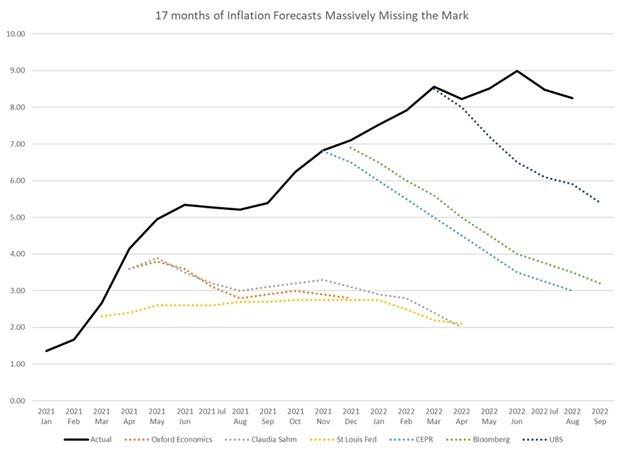
My Mercatus Center colleague Jack Salmon put together this nice chart. It compares the inflation forecasts of different institutions and economists to what has actually happened since early 2021. Jack has followed closely the predictions of many institutions and economists and has tracked many more than are shown on this chart. Along with these projections came analyses, nearly all of which proclaimed, time and time again, that “Inflation has peaked.” These predictions were also expressed with terrific confidence. Yet the performance of these models against reality goes to show that, while such models can be useful, we always must be careful not to put too much faith in their ability to predict the future. When it comes to modeling, projecting, and forecasting, more humility is better than less. When Salmon and I were talking about why and how this seems to happen regularly, he emailed me a possible explanation. Models/forecasts are often based on historical trends and so assumptions about inflation or interest rates always show variables falling back to trend (which is what the flawed forecasts in my chart demonstrate nicely). For example, economists who have observed low and stable inflation for 4 decades are biased into believing that inflation will quickly return to this trend, so these assumptions are often baked into their models. The same goes for interest rates—last year the CBO forecast that 10-year treasury yields would rise to 1.9% in Q3 2022. In reality, 10-year treasury yields are sitting at 3.4% in Q3. The same is true of believing that the path of this inflation and of fixing it will look exactly like the 1970s and 80s. Tt could be that this time around the hike in interest rates needed to tame inflation will be much lower than was needed in the 80s. This is what the Federal Reserve seems to believe. I am personally more concerned that this won’t be the case because the administration continues to spend like a drunken sailor with a death wish. More broadly though this set of model failures is one more data point that adds to my skepticism of such models and I feel compel once again to warn against the perils of economic forecasting in other context too. For instance, the optimism bias in in both public and private forecasts for economic data has been well documented for a while. Consider these two revealing paragraphs from a Financial Times article of a few years ago: So economists who tend to predict near the consensus are, by definition, unlikely to anticipate extreme events, while those who correctly predict the occasional Black Swan tend to get everything else wrong (or most everything else). Unfortunately, when it comes to economic forecasting, there’s really nowhere to turn, as the consensus view tends to miss even cyclical, non-Black Swan recessions. That certainly is true in budget projections. The bottom line is that predicting the future with models is hard.   Veronique de Rugy is a Senior research fellow at the Mercatus Center and syndicated columnist at Creators. (0 COMMENTS)

/ Learn More