This is my archive

bar

Minimum Wage Misery

I know of a young man who is mentally handicapped. He aspires for a job as a dishwasher in a restaurant, or stocking shelves in a supermarket, or pushing a broom around pretty much anywhere. He is big and strong, and can easily do any of these types of work, but he is slow. He has quirks. He tries to follow the orders of his bosses when he is employed, but cannot do that well enough not to be fired. He is located on the very edges of the labor market. He has had numerous jobs in the last few years, all too many. One of them lasted for almost a year, but that was rare for him. Usually, he stays on the payroll for a month or two, more often a week or two, all too often just a day or two. On the other hand, he is entirely reliable. Thanks to loving parents who drive him to work, he shows up on the dot whenever and wherever he is scheduled. He is very healthy, and rarely gets sick. This is not an insignificant attribute at this end of the labor market. How many people suffer from such maladies in the country? According to the National Institute of Mental Health, this debility affects almost 60 million people, or one in five of us. It is very important for such individuals to have a job, even a part time one, for even 10-20 hours a week. This young man is capable enough to know that insofar as employment is concerned, he is a failure. He is easily bored when jobless. He leads a very unsatisfying life. Why? This suffering is due to a great degree to an evil, vicious and pernicious bit of legislation, the minimum wage law. At the national level, employees must be paid $7.25 per hour. Many states mandate much higher levels. He is simply not worth even that amount of money. That is to say, his productivity is way lower than any such level. Any employer hiring this human being at that rate of pay, will lose money on the deal. The government has programs for this sort of person, but it is difficult to qualify for them. I do not know what is the productivity level of this young man. Stipulate, arguendo, that is it $3 per hour. At that rate, he would be fully employable, permanently employed; he could keep a job as long as he wanted one. He would no longer be a failure in his own eyes. He would no longer lead a very miserable life. Bosses would make allowances for him. They would be glad to have him on their payroll, at, say, the level of $2.75 hourly. They could earn an actual profit off of him! His life would be immeasurably improved, and that of this parents as well. But anyone who now paid him anything like this amount would forthwith go to jail. To do so would be in contravention of the minimum wage law. Imagine: arresting two people for agreeing to the capitalist act between consenting adults of paying less than the amount stipulated by law. It is one of the most depraved laws we have on the books. Why? Because it preys upon the least, the last and the lost of us; the economically weakest of us all. This legislation in effect prevents this young helpless young man and many others like him from working and being paid for the modest tasks of which he is capable. Do not be fooled into thinking that the minimum wage law permanently raises the compensation of anyone. It is not a floor, undergirding salaries. Rather, it is akin to a hurdle, forbidding employment to anyone who cannot produce at least at the level stipulated by this abominable enactment. Some states have laws allowing for a lower minimum wage level for teenagers during the summer. This humane act is instituted to enable such youngsters to gain employment while on vacation from school. That alone ought to tell you that this legislation is a shuck, a fraud, a scam; if it really raised pay, why “cheat” teens in this manner? Come to think of it, if this enactment had that effect, why not raise its level to a million dollars per hour? Then, we would all become rich! At the very least, a special lower minimum wage ought to be legislated in behalf of the mentally handicapped. I recommend $1 per hour. Better yet, this law ought to be repealed in its entirety, and salt sown where once it stood. Even better than that, the people responsible for passing this law in the first place, and implementing it, ought to be incarcerated for the incalculable misery they have imposed on this young man and all too many others like him. Walter E. Block is Harold E. Wirth Eminent Scholar Endowed Chair and Professor of Economics at Loyola University New Orleans. (2 COMMENTS)

/ Learn More

How to Walk the World (with Chris Arnade)

Skip the Mona Lisa when you visit Paris. Don’t tour the Coliseum in Rome. Walk, don’t hurry. Chris Arnade speaks with EconTalk’s Russ Roberts about a different way to travel. Listen as Arnade shares what he learned from Istanbul’s small community mosques and how Avignon’s Congolese-neighborhood cathedrals provided moving moments of spirituality. He also explains why Japan and Vietnam’s emphasis on community lends itself to more happiness than America’s […] The post How to Walk the World (with Chris Arnade) appeared first on Econlib.

/ Learn More

My Weekly Reading for July 13, 2025

  I’ve been setting up my cottage in Canada and relaxing, which is why I haven’t posted this week. I’ll pick up the pace this coming week. The Young Rothbard: an Uncomfortable Neoclassical Economist by Joseph T. Salerno, Mises.org, July 3. 2025. Excerpts: Rothbard took courses with all these eminent economists but was especially influenced by the institutionalists Arthur] Burns and [Joseph] Dorfman, and there was mutual admiration between Rothbard and both professors. Burns expected Rothbard to make “a prominent place for himself” in the world. Rothbard recalled that in his lectures Burns “was a brilliant theorist” and his “critique of orthodox theory . . . was excellent.” Rothbard held Dorfman in high esteem as a historian of economic thought, writing that “his knowledge of the sources is unparalleled.” He acknowledged Dorfman as one of his “mentors” along with Ludwig von Mises in the dedication of his two-volume treatise on economic thought. Dorfman in turn appreciated Rothbard’s abilities and agreed to chair his dissertation committee. When the dissertation was completed, Dorfman lobbied to have it published by Columbia University Press. And: It was during this period of methodological ferment and transition that Rothbard took a course on the philosophy of economics from Ernest Nagel, one of the leading exponents of logical positivism. Nagel’s criticisms of institutionalism favorably impressed Rothbard, who took copious notes on Nagel’s lectures. Commenting that Nagel made “the most convincing case for neo-classical economic theory,” Rothbard sent his lecture notes to Arthur Burns. Burns was impressed with Rothbard’s notes and sent them to Milton Friedman, a former student and then colleague of Burns’s at the National Bureau of Economic Research. Friedman was then writing his famous article on “The Methodology of Positive Economics.” Friedman wrote at the top of the first page of Rothbard’s notes, “Arthur: many thanks. I found it interesting, and, of course, agreed.” DRH affectionate note about Joe Salerno. Whenever I see Joe Salerno’s name, I think fondly of an interaction he had with Friedrich Hayek at the second annual conference on Austrian economics, which was held at the University of Hartford in June 1975. Joe was speaking about some aspect of Austrian economics and Hayek, hearing something that he wanted to disagree with or amplify on (I’ve forgotten which), got up and went to the podium. Of course, since Hayek was Hayek (and he had co-won the Nobel Prize the previous fall), it was appropriate to let him speak. Joe was caught off guard, but he quickly recovered, and saluted Hayek. It was so sweet.   How Much Will AI Increase Productivity? by Timothy Taylor, Conversable Economist, July 7, 2025. Excerpt, which is a quote from a study that Tim discusses: AI could contribute between 0.3 and 0.7 percentage points to annual aggregate TFP growth in the United States over the next decade. The predicted impacts across different scenarios are highest in the United States, followed by the United Kingdom, Germany, Canada, France and Italy, and lowest in Japan. These figures indicate that Generative AI will likely be an important source of aggregate productivity growth over the next 10 years but also clarify that the expected gains from the current generation of AI technologies may not be extraordinary. For comparison, the latest technology driven boom linked to information and communication technologies (ICT) has been estimated to have contributed up to 1-1.5 percentage points to annual TFP growth in the United States during the decade starting in the mid-1990s … DRH note: 0.3 points annually for 10 years is substantial and 0.7 points annually for 10 years is huge.   Latin America: A Lost Century for Catch-up Growth by Timothy Taylor, Conversable Economist, July 8, 2025. Excerpt: It is common in talking about 1980s to refer to it as a “lost decade” for economic growth, when many developing economies around the world were trapped in destructive patterns of debt and inflation. But William F. Maloney, Xavier Cirera, and Maria Marta Ferreyra make a stronger claim about growth in Latin America, which is that the causes and patternsof slow growth go back a century or more. They make the argument in the book, Reclaiming the Lost Century of Growth: Building Learning Economies in Latin America and the Caribbean (World Bank, 2025).   The Distributional Origins of the Canada-US GDP and Labour Productivity Gaps by James MacGee and Joel Rodrigue, Staff Working Paper 2024-49, Bank of Canada, December 19, 2025. Excerpt: Gross domestic product (GDP) per adult in Canada fluctuated between 70% and 90% of that of the United States between 1960 and 2020. Behind this gap lie large, systematic differences in relative incomes across the Canadian and US income distributions. There are small differences in average incomes among lower percentiles of the income distribution while large gaps exist for high-income earners, with larger gaps for business owners and the university-educated. Using data from the World Inequality Database, we find that the top 10% of the income distribution accounts for three-quarters of the gap in GDP per adult between Canada and the United States and up to two-thirds of the measured labour productivity gap. While average hours worked per working-age adult in Canada and the United States were similar in 1970 and 2019, persistent shifts in relative hours worked per adult appear to play a significant role in measured labour productivity differences between 1970 and 2019. Our work suggests that selective emigration of high-ability workers—commonly referred to as brain drain—to the United States may play a signifcant role in accounting for the gaps in GDP per adult and labour productivity. The lower level of innovative activities in Canada is consistent with larger income gaps for high-income earners. HT to Scott Sumner. DRH story: The larger gap for the university-educated reminds me of a story. One summer, when I was in Winnipeg en route to my cottage in northwestern Ontario, I went to local radio station CJOB to do an interview on economic issues of the day. After introducing me as someone who had moved from Canada to “the states,” the interviewer said, with an aggressive tone, “So why did you move? Was it the money?” Of course, my reasons were multiple, of which only one was the money, but I also figured if I said that, he would accuse me of waffling or whatever. I realized that in about 0.2 seconds. So I said, “Yes.”   Note: The accompanying picture is of a sunset viewed from my cottage in 2024. (0 COMMENTS)

/ Learn More

The Economics of Rage Bait

Clickbait describes a phenomenon where a headline is given a deliberately provocative title to try to get users to engage with some kind of online content. We may bemoan the phenomenon, but it persists because it’s effective. The most effective form of clickbait is known as rage bait. As the name suggests, rage bait is when content producers try to get engagement by deliberately angering people with their content. Again, while this might seems deplorable, it persists because it works – content that makes people angry is more likely to be engaged with than content eliciting any other reaction. This simple observation can help explain why some of the most successful and high profile people in public conversation often seem needlessly antagonistic. The snarkiest, most enraging people will tend to rise in prominence, giving an incentive even to those who are actually more mild mannered to put on a deliberately antagonistic persona. Rage sells. At this point, its worth considering Sherwin Rosen’s work on the economics of superstars. The gist of this idea is along these lines. Consider acting as a profession in, say, the year 1600. Across Europe, there would be a very large number of stage actors to fill theater demand. The number of actors must be large because each performance is local – it can only be seen by people in a particular theater at a particular time. It also meant the quality of actor performances was heavily determined by local conditions. If your local troupe consisted of mostly mediocre actors, that was the best you could get. And an actor of great talent was still limited in how much he could benefit from that talent, for the same reason. Even if he joined a traveling theater troupe and expanded his range, he can still only perform one place at a time. Over time, and as technology improved, actors were not limited in the same way in how far their performances could reach. As the movie industry arose, suddenly the most skilled actors could have the entire world as their audience. And on the other side of the coin, audiences could benefit from the performances of the most skilled actors in the world. The same was true with music – a couple of centuries ago, someone with Bruce Springsteen’s level of performance ability couldn’t have had the actual Springsteen’s level of success – their market simply wasn’t big enough for that. Nor could anyone have benefitted from their Springsteen-level skills unless they happened to be within the area where this musician could perform. (I’m personally not a huge fan of Springsteen, I  just grabbed his name out of the air because he’s been very successful over a very long time – feel free to substitute your own favorite musical act.) This change in reach brought about by technology had a couple of effects. One, the highest levels of success were more heavily concentrated among the very highest performers. In the past, being one standard deviation above average in acting ability could have secured you a career, and being five standard deviations above average wouldn’t have made your career all that much more successful than your one sigma counterpart. But today, when movies have global releases, only a very small number of actors are needed to serve the global market. People who live in Wichita, Kansas aren’t solely dependent on the quality of actors who reside in Wichita. They can witness the performances of the very best actors the world has to offer. To have a shot at being a successful actor, you need to be at the far right end of the distribution. The second effect is that even very small differences in ability at the top end can have huge effects in overall success. If you have 90% of Anthony Hopkin’s acting skills, you don’t end up with 90% of Anthony Hopkin’s career success. You’re more likely to be 10% as successful as Hopkins, as he wins Oscars and gets remembered as one of the all time greats, and you have a minor supporting role on a modestly well received sitcom. I think rage bait follows a similar dynamic, for the same reasons. With the reach of internet and cable TV, content producers have virtually no limits with how far they can reach – and with how many competitors they have. If I’m 90% as rage-inducing as some other content creator, I won’t be 90% as successful for it. This creates an incentive for people to keep upping the ante – but it doesn’t have the same natural plateau as the distribution of something like acting skills or musical ability. People can choose to be more provocative much more freely than they can choose to be more skilled with an electric guitar. I find this to be a discouraging analysis – but then I look at the world around me and it seems to explain things pretty well. Still, what do you think? Does this seem to fit your observations, dear EconLog reader? I’d love to be convinced I’m wrong about this! (0 COMMENTS)

/ Learn More

The Law and Economics: Against Siloing

From June 1 through June 13, I was in Park City, Utah participating in the Law Institute for Economics Professors run by the Law & Economics Center at Scalia Law School.  It was a two-week crash course in American law and I will be sharing some insights over future posts (as an aside, if you are an economics professor, I highly recommend this program).   One of the big takeaways I had related to my research is how important it is to break down disciplinary barriers.  There is a developing trend in American public discourse to separate things into distinct disciplines: X is a political issue, or Y is a public health issue.  Thus, one should just “listen to the experts” in that field and ignore what everyone else says.  I have seen this twice in the past 5 years.  First, during the Covid pandemic, as governments were doing seemingly random policy, whenever economists would give an opinion, we would be told to “stay in your lane.”  But, of course, economics permeates every aspect of our lives: it is the study of how people make choices given constraints.  If you change the constraints, if you change the incentives, economics has a lot to say on that matter.  Indeed, if the public health officials listened to economists (and other disciplines) more, they could have avoided the cascading failures that characterized the American response to Covid.  More recently, economists are being told that our criticisms of Trump’s trade policy are irrelevant because it’s a “political” issue.   But attempting to separate issues into distinct silos leads to poor thinking.  Economics (and other disciplines) have insights into real world problems beyond what some person claims is the nature of the problem.  Yes, economics had things to say about pandemic spread because we knew that price controls lead to shortages, which in turn cause people to search more for the goods they need.  Consequently, in a pandemic spread by close contact with each other, people have more contact points, creating more disease vectors, leading to increased spread.  Economics also had insights on how to produce more needed goods, another thing which was ignored.   To bring this back to law and economics, one of the things that struck me during the conference is how much law and economics have to say to one another.  I do not mean in the sense of Richard Posner, who argued that economics should shape law into being more efficient.  Rather, I mean that both law and economics study social orders.  We just come at it from different angles.  To be clear, by “law” I do not mean simply statutes or government-created rules (although they are part of a social order).  Rather, I refer to “law” as the broader set of rules, both government-created and emergent, that govern our daily lives.  Economics has a lot to say about the emergence and the persistence of these emergent rules.  Economics has a lot to say about the incentives that various legal actors face (judges, juries, expert witnesses, etc).  And, likewise, the law has lots of things to say about how people bargain and exchange.   Adam Smith famously discusses how the division of labor can increase our productive capabilities and lead to more discoveries.  But he also warns against extending this logic too far.  If one becomes too specialized, it can lead to a “torpor of his mind,” rendering him “as stupid and ignorant as it is possible for a human creature to become” (Wealth of Nations pp. 781–782).  Siloing is exactly that.  Yes, we should specialize.  But we must not become so ignorant of the world around us as to reject insights from other disciplines.  To that end, I will be sharing some insights from the law over the next few posts. (1 COMMENTS)

/ Learn More

Just a Coincidence?

The human brain seems wired to notice patterns.  This presumably has some evolutionary advantages, but this attribute can lead us astray in a world that is overloaded with data.  I’ll start with a personal anecdote, and then show the implications for data analysis. Back on June 18th, I was traveling through the west side of Vancouver and noticed a street name “Trutch”.  I recall thinking that this was an odd name.  Just a few days later, Tyler Cowen linked to an article in the Vancouver newspaper, discussing the fact that this street’s name had just been changed: Vancouver’s Trutch Street is now šxʷməθkʷəy̓əmasəm Street. Not everyone is happy Dan Fumano: Many residents of the street very recently known as Trutch said they support changing the name. But they worry about possible practical implications of a street whose sole name is spelled in a language other than English. Author of the article:  By Dan Fumano  Published Jun 17, 2025, Last updated Jun 18, 2025 That’s an even odder name! Notice that the name change occurred right about the time I observed the street.  That seems like a rather amazing coincidence.  But that’s not all.  This past Monday we stayed one night in a hotel in Calgary, before flying home.  The next morning I woke up and checked Marginal Revolution.  This is the first post that I saw: Calgary is resuming with fluoride, and Quebec fact of the day That’s even more of a coincidence.  It’s almost as if Tyler knew of my travel plans and intentionally posted material that related to my location.  Of course that’s nonsense, he didn’t even know I was on a vacation.  But you can see how a superstitious person might find the coincidences to be meaningful.  What are the odds? Perhaps you are thinking that in a world where billions of events happen every single day, a coincidence isn’t all that meaningful.  But much of our research in science and social science is premised on the assumption that coincidences are very meaningful.  At least in physics, scientists often insist on highly unusual coincidences, “5 sigma events”, which means more than 5 standard deviations from the predicted value.  But in many fields there is a much weaker test of significance, just two standard deviations from the null hypothesis.  That means that random coincidences with just 20 to 1 odds against are viewed as highly meaningful. In a recent EconLog post, Kevin Corcoran had this to say: In 2007, Eliezer Yudkowsky wrote an interesting article advocating for what he called “defying the data.” The idea was fairly simple – say you have some theory explaining how the world works. A new study is published with data that can’t be accounted for with your theoretical framework. How should you respond? One response is to abandon your theory in favor of the new data. Another response is to keep your theory intact and, as Yudkowsky says, “attack the experiment – accuse the researchers of dishonesty, or flawed design, or conflict of interest.” But there is a third possibility – that of simply defying the data. . . . If a theory has been well-established and upheld by multiple studies and experiments, then one really striking appearance of contrary data shouldn’t amount to much. At first glance, that might sound unscientific.  But in practice it is often the case that evidence “refuting” a given theory is nothing more than a garden-variety coincidence—something that happens every single day. Even very smart pundits (and myself) are occasionally fooled by coincidences.  One of the worst recent examples involves the debate over the origin of Covid.  Throughout history, pandemics often begin in major cities in southern China, where large populations live in close proximity to wild animal markets.  This is how the first SARS epidemic began in November 2002.  The Covid pandemic (SARS-2) seems to have begun in an almost identical fashion, in a wild animal market in one of southern China’s largest cities. Despite that fact, many pundits have embraced the completely unsubstantiated theory that Covid came from a lab leak, because among the half dozen largest metro areas in southern China, it first popped up in one that has an important virus research institute.  That’s one of the weakest coincidences I’ve ever seen, and yet many people seem to view it as providing strong support for the lab leak theory.  In contrast, the animal market hypothesis is based on a coincidence that is many orders of magnitude more unlikely to occur at random. There are millions of streets in the world.  The fact that I noticed a certain street in Vancouver right before Tyler posted an article about that street is actually a pretty amazing coincidence.  And then for Tyler’s fluoride post to occur just 10 days later, just as I was passing through Calgary, is an even more amazing coincidence.  In contrast, the entire lab leak theory is based on nothing more than a mild coincidence that is about as interesting as rolling the same number two consecutive times when tossing a six-sided die. (0 COMMENTS)

/ Learn More

Identities and Causation

When I was in high school (approximately 730 years ago, or so it feels these days) I first learned basic trigonometry. A common type of problem in homework and tests involved situations where you had to find the length of one side of a triangle based on other values provided. For example, a problem might tell you that there is a post of unknown height. The problem then tells you there is a shadow of such and such length being cast from that post by a light source at such and such an angle. The given information could then be combined with various trigonometric identities to work out the missing information. I always enjoyed these sorts of questions, and found it very satisfying how they worked in any direction. If you tell me the height of the post and length of the shadow, I can tell you the angle of the light – or if you tell me the angle of the light and the length of the shadow, I can tell you the height of the post. But, upon working out that the post is six feet tall, suppose you wanted to know why the post is six feet tall – what caused the post to be that height? It would be really weird if I were to try to tell you that the angle of the light and the length of the shadow caused the height of the post. More than just weird – it would be such a confused answer that it’s not even wrong. Trigonometric identities are true, and the math behind them is impeccable. The relationships among these variables are ironclad. But it would be the height of nonsense to answer a question about what caused the light to be at its current angle by attributing that to the height of the post or the length of the shadow. If I move the light to a new position, the length of the shadow will change. If I hammer the post down into the ground by six inches, the light will hit at a different angle and the shadow will be a different length. But you can stare at the mathematical equations all day and not be able to say what caused the change in the angle of the light or the height of the post. Trigonometric identities are not causal mechanisms. Unfortunately, there is no shortage of economics commentators who have failed to absorb this very basic point, and speak as though setting out an accounting identity and then solving a math problem is the height of economic insight. Every time someone who styles themselves as a sophisticated dealer in economics talks as though levels of private or public debt are caused by the trade balance, the world becomes a more tediously confused place. Accounting identities are not causal mechanisms. (0 COMMENTS)

/ Learn More

British Industrial Policy: This Time Is Different

In the Summer issue of Regulation, I suggest that the growing popularity of industrial policy (also called “industrial strategy”) all over the world is a return to Jean-Baptiste Colbert, the Finance Minister of Louis XIV in the 17th century. Industrial policy is not just an assemblage of political meddling acts—otherwise it would be everywhere in the history of mankind—but, as some experts define it, “government policies that explicitly target the transformation of the structure of economic activity in pursuit of some public goal.” In my article, I write (“Of Tariffs and Industrial Policy,” 48-2 [Summer 2025], pp. 7-8): Considering government as it is, instead of what the interventionists dream it could be, reveals that coherent industrial policy is impossible. … The calls for industrial policy are essentially ideological. … Industrial policy can be seen as the offspring of what Jean-Baptiste Colbert (1619–1683), a minister to King Louis XIV, tried to achieve. As described by economic historian Donald Coleman, Colbertism was “a systematic treatment of economic activities.” Colbert “used a variety of tools: subsidies, special tax, reductions or exemptions, protection against foreign imports,” etc. He encouraged exports and domestic manufacturing. He was a dirigiste mercantilist who believed his policies enriched the country and thus the king—even though they likely explain why France lagged far behind England when the Industrial Revolution got underway. … [Industrial policy] is about the ideology that a coercive allocation of resources will produce the goods that politicians and bureaucrats think consumers should want. At best, it is a belief that political and bureaucratic processes will, by some magic, adapt to what consumers want better than market competition will. At about the time Regulation hit the newsstands, actual and virtual, British Prime Minister Sir Keir Starmer announced a new attempt at industrial policy. He was proud, he said, “to launch a new industrial strategy for the nation today.” Contrary to the past ones, this one will be “robust, strategic, and unapologetically long-term.” It “meets the challenges or our era,” notably with a “10-year plan.” (Keir Starmer, “The Industrial Strategy Will Provide Certainty for Business,” Financial Times, June 23, 2025.) The Economist wisely expresses some doubts. Referring to the government’s policy document, the magazine writes (“Britain’s Industrial Strategy Is Unlikely to Boost Its Economy,” July 24, 2025): The sprawling document spans wildly different sectors and is jammed with “transformative” funds, hubs and accelerators. … Experience suggests some scepticism is in order. Industrial policy and even more industrial strategy are attractive labels for an age-old illusion that politicians and democrats can boost economic growth by deciding where more resources should be allocated. One hope of many supporters, if not their goal, is that tax revenues and the state will grow. In the 1930s and 1940s, economists Ludwig von Mises and Friedrich Hayek showed how central planners cannot have the dispersed knowledge on supply and demand, costs and preferences, that would be necessary to guide the economy toward real prosperity as diverse individuals want it. (0 COMMENTS)

/ Learn More

An Econ 101 Error

On June 17, Treasury Secretary Scott Bessent tweeted: Recent reporting projects that stablecoins could grow into a $3.7 trillion market by the end of the decade. That scenario becomes more likely with passage of the GENIUS Act. A thriving stablecoin ecosystem will drive demand from the private sector for US Treasuries, which back stablecoins. This newfound demand could lower government borrowing costs and help rein in the national debt. It could also onramp millions of new users—across the globe—to the dollar-based digital asset economy. Bessent makes two Econ 101 errors in this tweet.  First, as pointed out by my old GMU professor Larry White, increasing demand for Treasury bills would increase the equilibrium quantity of those bills exchanged in the market.  In other words, it would increase the quantity demanded of US government debt, not lower it. Secondly, as interest rates fall,* the cost of borrowing for the government falls, too. It’s the law of demand: as the cost of something goes down, the quantity demanded rises.  People will want to hold more debt and the government will want to issue more debt. So, if Bessent is correct that stablecoins will be a “thriving” market, then the incentives would be for more government debt, not less. Now, it is possible that Secretary Bessent read my EconLog post from about a year ago where I argued: The people making spending and budgetary decisions do not face the full costs of their decisions.  Neither do voters (indeed, the costs are spread out across all taxpayers).  Consequently, we end up in a situation that James Buchanan and Richard Wagner call “Democracy in Deficit”: politicians prefer easy choices over hard, and will generally support higher spending and lower taxes. In this case, the supply of Treasury bills is unrelated to the price level of Treasury bills: the supply is perfectly inelastic (a vertical line, for those of you drawing along supply and demand graphs at home).  But, in this case, the Treasury Secretary is still incorrect in his assessment.  If the amount of borrowing is unrelated to the price, then an increase in demand would lower the interest rate, but it would have no effect on the amount of debt issued.  It would still be incorrect to claim that the Federal Debt would be reined in. While it is theoretically possible that the demand curve for Treasury bills slopes upwards (although I am not sure why Treasury bills would be a Giffen good), it’s empirically unlikely. — *For those not well-versed in monetary economics: the prices of bonds and their interest rates (also known as the bond yields) move in opposite directions.  If the price goes up, the interest rate goes down.  If price goes down, interest rates go up.  The price of the bond is what you pay for the bond.  The interest rate (yield) is what is paid to the holder of the bond over and above the price at maturity. (2 COMMENTS)

/ Learn More

Losing Affection for GDP

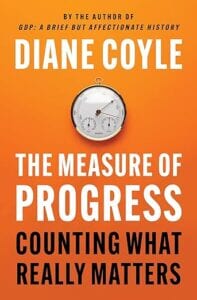
The more research I have done on economic statistics, appreciating the practical challenges, the less certain I am that we know anything solid about today’s economy. –Diane Coyle, The Measure of Progress: Counting What Really Matters,1 (page 29) It would be nice to have definitive measures of economic progress. We would like to know whether progress is faster in one country than in another. We would like to know whether progress was faster in one period of time than in another. We would like to know how different policies and institutional arrangements affect progress. Diane Coyle has spent decades doing research on the problem of measuring progress. Her experience and her thought process make her work, The Measure of Progress: Counting What Really Matters, a valuable treatise. The most commonly used indicator is Gross Domestic Product, reported either as a total amount or on a per capita basis. But GDP data are often quoted in the press or used by economists without much consideration of the problems in constructing the estimates. To start with, consider a simple economy that produces wheat and automobiles. We can measure the bushels of wheat harvested and the number of automobiles manufactured. Suppose that we want to compare total output last year relative to the previous year. We attach a value to a bushel of wheat and a value to an automobile, based on market prices for the two goods. We multiply yearly wheat production by its value and yearly automobile production by its value. Then we sum these values to arrive at GDP. There are some issues with how to get from market prices to relative values, especially if market prices change from year to year. We want to try to determine the extent to which price changes reflect purely monetary inflation. But these issues are relatively minor. A major difficulty is that important sectors of the economy provide goods and services that are not as readily measurable as bushels of wheat or number of automobiles. How do you measure the amount of health care services, or the amount of banking services, or the amount of education provided by colleges? Today, agriculture and manufacturing, which are the most measurable sectors, account for much less of economic activity compared to the 1940s, when GDP statistics were first being developed. In 1947… about half the economy was measurable, by 1990 less than a third, and by 2019 less than a quarter, or more likely only about a fifth…. The structure of the leading economies has changed so much in the last nine decades that the [GDP] framework is a distorting lens, or even a set of blinkers. A new one is needed. (pages 14-15) In a chapter called “Value,” Coyle points out that the measurable sector of the economy consists of goods and services for which we can observe quantity, quality, and prices. For many consumer online activities, we do not observe quantity. For rapidly-changing consumer items, such as smart phones, it is difficult to assess improvements in quality. And in the digital world, where much is provided for free, we do not observe prices. And for many items, prices are artificial: hospital charges, college tuition, and the imputed rent of housing services. To attempt to assess quality, we can think of a product as a bundle of goods. For example, a car’s bundle includes its durability, its fuel efficiency, its styling, its seating capacity, and its amenities. In theory the value of each portion of the bundle can be calculated and the overall bundle can be valued by addition. But consider how fraught this calculation is when trying to value a smart phone. The bundle includes a camera, telecommunication services, a computer, and many apps. Or consider the bundles offered by companies that provide telecommunications services, either cable to the home or wireless. In the United States and other Western countries, since at least the early 1970s, there has been a slowdown in the rate of progress as measured by GDP. Coyle points out that most economists see this slowdown as genuine, and they offer various explanations for it. But it remains a puzzle on which the data do not shed much light. I now think that the exploration of productivity at either firm or sector level will not make much progress…. The reason is that the data available is being asked to bear an impossible weight…. It might be that part of the productivity puzzle is a problem of overstated deflators that lead to underestimates of the value of new and better goods and services. (pages 53-54) The GDP calculations assume that, apart from durable goods such as automobiles that provide services over time, consumption is instantaneous. But the dimension of time has increased in importance. For many digital goods and services the monetary price of consumption is often zero, but time and attention are required. (page 66) This confounds normal ways of measuring the cost of consumption. There is no process for collecting information on the time cost of a consumer item, and in any case this differs among consumers. “Among other things, this shows that in order to tell whether the standard of living has improved, we need to know how different people weigh the importance of different goods in their lives.” Another way that time enters measures of progress is to consider how much a typical person must work in order to purchase various goods. On page 194, Coyle lists some examples for the United Kingdom in 2019 relative to 1990. In 2019, the number of hours worked to buy a refrigerator had fallen in half, but the number of hours worked to buy a movie ticket had tripled. Among other things, this shows that in order to tell whether the standard of living has improved, we need to know how different people weigh the importance of different goods in their lives. Coyle is concerned with how the consumption of natural resources affects living standards, especially going forward. The world is increasing its demand on natural resources in absolute terms. Ed Conway’s Material World (2023) highlights the growth in the human planetary footprint: “In 2019, the latest year at the time of writing, we mined, dug and blasted more materials from the earth’s surface than the sum total of everything we extracted from the dawn of humanity all the way through to 1950″…. Put starkly, we are progressively deforesting and concreting the earth. (page 205) I should point out that this alarmist view is contestable. In a 2015 white paper entitled “Nature Rebounds,” Jesse Ausubel pointed to signs of greater efficiency in food production and distribution’ This was leading to American farmland being returned to wilderness.2 And in their book Superabundance, Marion L. Tupy and Gale L. Pooley point out that the prices of raw materials have been declining, which would indicate that we are not using them up at an unsustainable rate.3 Coyle suggests that the concept of capital should be expanded to include six types of capital: … physical or produced capital and human, natural, social, institutional, and knowledge/intangible capital. (page 212) I agree that all of these elements are important for prosperity. But I am skeptical of her “comprehensive wealth” concept, because I do not see arriving at a nation’s wealth by measuring these elements and employing simple addition. For example, a nation’s institutions affect the productivity of all its other types of capital in a highly nonlinear way. In her concluding chapter, Coyle suggests that, … a time-use accounting framework alongside the measurement of comprehensive wealth provides a holistic approach to understanding progress: How efficiently do societies use all the resources available to them to produce and consume activities and products of value? How sustainable is this activity—are we serving our own well-being by depleting the resources or capabilities available to future generations? (page 258) I came away not convinced by this. Instead of trying to find a better answer to the questions about economic progress, I would suggest thinking more carefully about the questions. Different questions may require different indicators. For more on these topics, see Diane Coyle on GDP. EconTalk. “Pitfalls in GDP Accounting,” by Robert P. Murphy. Library of Economics and Liberty, November 7, 2016. Martha Nussbaum on Creating Capabilities and GDP. EconTalk. It is probably inevitable that progress will mean different things to different people. That suggests that we ought to be skeptical of the project of coming up with a single measure of progress. Instead, we can pay attention to a variety of anecdotes and indicators. And then we can expect people to argue over what these observations imply. Footnotes [1] Diane Coyle, The Measure of Progress: Counting What Really Matters. Princeton University Press, 2025. [2] Nature Rebounds, by Jesse Audubel. Rockefeller.edu, Jan. 13, 2015. PDF file. [3] Marian Tupy and Gale Pooley, Superabundance: The Story of Population Growth, Innovation and Human Flourishing on an Infinitely Bountiful Planet. Cato Institute, 2023. *Arnold Kling has a Ph.D. in economics from the Massachusetts Institute of Technology. He is the author of several books, including Crisis of Abundance: Rethinking How We Pay for Health Care; Invisible Wealth: The Hidden Story of How Markets Work; Unchecked and Unbalanced: How the Discrepancy Between Knowledge and Power Caused the Financial Crisis and Threatens Democracy; and Specialization and Trade: A Re-introduction to Economics. He contributed to EconLog from January 2003 through August 2012. Read more of what Arnold Kling’s been reading. For more book reviews and articles by Arnold Kling, see the Archive. As an Amazon Associate, Econlib earns from qualifying purchases. (0 COMMENTS)

/ Learn More