This is my archive

bar

We’re Number Two; We’re Number Two

  According to Feedspot, EconLog is now the 2nd best economics blogs for students. Go here for the list of the top 30. Of course, we should take this with a grain of salt because often these ratings are ways to get peoples to link to the source, which, of course, is what I’m doing here. Still, a nice sign.   (0 COMMENTS)

/ Learn More

ESG is Bad for a Company’s Share Value

Matt Damon as Sonny Vaccaro in AIR In response to my post about Don Boudreaux’s and my recent op/ed in the Wall Street Journal in which we argued that ESG would get in the way of maximizing shareholder value, frequent commenter (and friend) David Seltzer pointed out that the “annualized return was 0.02% higher for the S&P 500 ESG Index than the S&P 500.” It seemed to him to follow that ESG investing does not hurt shareholder value. We had a phone call recently in which I explained why it does hurt shareholder value and why the evidence on shareholder returns is not evidence. Here’s my explanation. Let’s say a bunch of hypothetical firms decide, without warning, that they will go ESG. If I’m right that it creates uncertainty about what steps the company will follow, then the market value of those firms should fall relative to the market value of firms that haven’t made such an announcement but instead have announced that they won’t do ESG. If that happens, that won’t contradict the findings that David reports above. The reason is, essentially, arbitrage. Once the firms’ values have fallen relative to the values of the other firms, it would be a disequilibrium if their values didn’t rise just as much as those of the other firms from this point on. So someone examining the values of ESG firms will not find a lower rate of return. The rate of return, risk adjusted, will be the same. But the announcement of ESG will have caused a one-time reduction of the value. (Of course, if they get even more “ESGer” in the future than the participants in the market expected at first, the market values of those firms should rise more slowly than the market values of the other firms.) This, by the way, is why financial economists do event studies. They want to find an event that is a surprise to the market and that is expected to affect the market value of specific firms. So they look at cumulative average residuals of that subset of firms from a few days before the event to a few days after. I’m going from memory here about what I learned from dozens of financial economics presentations at the University of Rochester’s Graduate School of Management in the mid to late 1970s when I was an assistant professor, and also what I used to complete my Ph.D. dissertation in 1976. If the literature has changed substantially, I’m open to hearing about it. But here’s what ChatGPT told me: The event window is the period of time over which the effects of the event are expected to be reflected in the stock prices of the affected companies. The event window typically starts a few days before the event and ends a few days after the event. (0 COMMENTS)

/ Learn More

Michael Munger on the Perfect vs. the Good

Is the perfect really the enemy of the good? Or is it the other way around? In 2008, Duke University economist Michael Munger ran for governor and proposed increasing school choice through vouchers for the state’s poorest counties. But some lovers of liberty argued that it’s better to fight for eliminating public schools instead of […] The post Michael Munger on the Perfect vs. the Good appeared first on Econlib.

/ Learn More

MMTers would fight inflation with fiscal austerity

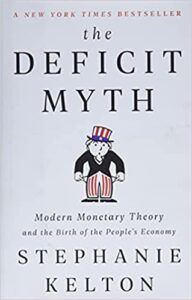
Not long ago, policymakers like Rep. Alexandria Ocasio-Cortez were enamored of something called  Modern Monetary Theory (MMT). This theory starts with a banal observation — that a government that issues the currency its debts are denominated in need never (technically) go bankrupt — and, on that basis, argues that we don’t need to worry about the budget deficit. As a leading MMTer, economist Stephanie Kelton, argued in her 2020 book The Deficit Myth: Modern Monetary Theory and the Birth of the People’s Economy: Uncle Sam has something the rest of us don’t—the power to issue the US dollar. Uncle Sam doesn’t need to come up with dollars before he can spend. The rest of us do. Uncle Sam can’t face mounting bills he can’t afford to pay. The rest of us might. Uncle Sam will never go broke. MMT appealed to many, like AOC, because it seemed to offer the Philosopher’s Stone of economics, the fabled free lunch. But it didn’t. As Kelton wrote: Just because there are no financial constraints on the federal budget doesn’t mean there aren’t real limits to what the government can (and should) do. Every economy has its own internal speed limit, regulated by the availability of our real productive resources— the state of technology and the quantity and quality of its land, workers, factories, machine, and other materials. If the government tries to spend too much into an economy that’s already running at full speed, inflation will accelerate. There are limits. [Emphasis added] Policymakers, then, ought not be looking at the deficit when setting fiscal policy, but at the overall economy – “…the government’s budget isn’t supposed to balance. Our economy is,” Kelton wrote – and to find balance or imbalance in the economy we had to look at the rate of inflation. Kelton explained that: A deficit is only evidence of overspending if it sparks inflation. … Finally, the federal government has historically almost always kept its deficit too small. Yes, too small! Evidence of a deficit that is too small is unemployment. Of course, MMT recognizes that deficits can also be too big. But Senator Enzi had it all wrong. A fiscal deficit isn’t evidence of overspending. For evidence of overspending, we must think of inflation. But we didn’t need to worry about this. This was, MMTers told us, “the prevailing era of too-low inflation”. That era is now over. Briefly put, when COVID-19 hit, the federal government borrowed big and the Federal Reserve printed big, using the new money to buy government debt and keep the government’s borrowing costs down. This money was spent into an economy whose capacity to produce the goods and services to spend it on was constrained by shutdowns and other anti-COVID-19 measures. We hit those limits. Given MMTers had recognized inflation as a problem to be remedied, what did they suggest as the remedy? What would MMTers have been doing these last couple of years if they had been in charge? Because they thought that we were in an “era of too-low inflation”, MMTers like Kelton spent much more time telling us about all the spending they would do than about how they would deal with the inflation that might arise as a result. But they weren’t silent on the matter. Kelton draws on the work of economist Abba P. Lerner: To maintain full employment and keep inflation low, Lerner wanted the government to keep constant watch on the economy. If something happened to move the economy out of balance, Lerner wanted to the government to respond with a fiscal adjustment, either changing taxes or altering government spending. … If inflation began to creep up, Lerner believed that Congress could respond by raising taxes or cutting back its own expenditures. In other words, MMTers would fight inflation with fiscal austerity and, presumably, they would deal with high inflation such as we have had recently with particularly strict fiscal austerity. The Federal budget could certainly use a bit of austerity, but it isn’t clear that it would do very much to fight inflation: how would you get measures like that through Congress? How would fiscal measures fix a monetary problem? Governments in the 1960s and 1970s, when Lerner’s influence was at its peak, did, in fact, use taxes as a tool to fight inflation and with little success because they kept on printing money. Either way, the free lunch that attracted so many to MMT was never really there. MMTers, in fairness to them, never entirely pretended that it was. One wonders whether AOC still supports MMT now that it dictates fiscal austerity?   John Phelan is an Economist at Center of the American Experiment. (0 COMMENTS)

/ Learn More

Leftists and liars

In the future, only two types of people may be able to teach at our major universities—leftists and liars. That’s because it is increasingly necessary to publicly adhere to extreme left wing views in order to be hired to teach at the university level. Here’s The Economist: Davidson College, in North Carolina, asked prospective computer-science staff to write about their “potential to contribute to our commitment to equity and anti-racism”—a cause fervently embraced by the left and despised by the right. Berkeley has distributed guidance on how search committees ought to evaluate diversity statements. They say that any candidate who does not discuss gender or race must be awarded low marks. The same goes for any earnest classical liberal who “explicitly states the intention to ignore the varying backgrounds of their students and ‘treat everyone the same’.” I spent decades teaching economics at the university level.  But given my view that everyone should be treated equally, I’d have no chance at being hired today in many universities (not all.) Of course this sort of thing often occurred in places such as the Soviet Union and the Peoples Republic of China: “People are unwilling to push back because they are afraid to lose their funding, and no one wants to become a martyr for defending reason,” says Anna Krylov, a professor of chemistry at the University of Southern California. Professor Krylov studied in the former Soviet Union and sees parallels that are “a little too close”. Rather than Marxism-Leninism, “you really have to pledge your commitment to critical social justice.” People often ask me why I object to woke ideology.  The fact that they ask this question makes me suspect that they haven’t kept up with what’s going on in our universities. (1 COMMENTS)

/ Learn More

Let Teenagers Work

I got my first job paying hourly wages at age sixteen at a summer resort near my parents’ cottage in Canada. Although you might think that mopping floors doesn’t teach much skill—and you would be right—showing up on time was an important skill. That wasn’t important for the mopping job because it began at 11 a.m., an easy target even for a late-sleeping teenager to hit. But later in the summer the chef at the resort, who saw me faithfully mopping and never slacking, hired me to work in the kitchen as the dishwasher. That job started at 8 a.m. and hitting that target was a challenge. I still remember my conversation with the chef after I had shown up at 8:15 a.m. each day for the first three days. Chef: You need to use an alarm clock. David: I do use an alarm clock. Chef: What time do you set it for? David: 7:30 a.m. Chef: Then why don’t you make it on time? David: When the alarm goes off, I turn it off and then go back to sleep. Chef: That’s your mistake. You need to get up. If you aren’t on time tomorrow, don’t show up because you’re fired. Any guesses whether I was ever late again? This is from David R. Henderson, “Letting Teenagers Work” Defining Ideas, April 20, 2023. In it, as you might guess, I make case for relaxing restrictions on work by teenagers, as is being done in Arkansas, New Jersey, and a few other states. Another excerpt: When my daughter was in third grade, I decided to coach a girls’ basketball team that she was on. Even when she got to middle school and played on her school’s team, I kept coaching other girls because I enjoyed it so much. But it did have its challenges. I remember one girl in particular who didn’t pay attention during timeouts to the plays I was trying to set up. She also didn’t seem to have much skill at dealing with people. She was, in short, high maintenance. Fast forward about four or five years. One day I was checking out at the local Safeway and I noticed the checkout girl, who looked to be about age seventeen, being very pleasant and responsive. Something about her seemed familiar. Then I realized that it was that same girl. Her attitude was almost unrecognizable. Being in a job had taught her some very important skills: good attitude to customers and overall friendliness. You could say that having a job taught her to be more virtuous. I end by quoting Emma Camp of Reason: The aforementioned Emma Camp said it best and so I won’t try to say it better. She wrote, “We need to stop treating teenagers as inherently fragile, or they’ll become that way. Real-world exposure to the challenge of getting paid to do things that other people value will benefit them for the rest of their lives.” Read the whole thing. (0 COMMENTS)

/ Learn More

Risk, Responsibility, and Liberalism

The opening metaphor between books in Learnerville and drugs in our own society is more than skin deep. We can easily tweak the conditions of Learnerville to mimic different regime types. First, there’s full prohibition and criminalization as described previously. Second, decriminalization would sustain the locked building of books but eliminate the proactive efforts to arrest and punish book users. Third, a medicalization regime would effectively turn the locked building into a heavily regulated and controlled library, wherein only verified individuals had controlled access. Carl Hart’s proposals should not be misconstrued as full-scale legalization. His policy pragmatism proceeds from the here and now. No one is trying to buy fentanyl, but the incentives of the black market are making it available, nonetheless. Still, the problem with fentanyl does not stem from its chemical properties but rather the conditions of ignorance surrounding it. Buyers don’t know that the drugs they are buying have fentanyl in them. If buyers did know, they’d still lack the experience and functional strategies to properly dilute it. Hart frames his reform proposals in terms of providing legal and predictable access for those substances that people actually want, alongside affordable resources for assuring and promoting safety, such as clean needle exchange programs and drug testing services. In principle I applaud Carl’s inferences and efforts to promote these non-criminalized methods for assuring health and safety. I do harbor some unresolved questions about decriminalization, legalization, and medicalization. First, why should sober citizens support these proposals when drug users seem so entwined with the patterns of crime and homelessness that devalue and threaten safety in urban spaces? Furthermore, why should drug users trust government organizations and institutions suddenly pivoting towards decriminalization and medicalization given the historic track record of over-criminalization, militarized policing, and mass incarceration? At heart, the problem with how society perceives and reacts to the challenges of drug use and abuse stem from deeply engrained cultural attitudes about intoxication and criminality. I don’t possess definitive proof or evidence of the potentials for my proposed drug regime alternative, but it does seem, at least to me, to be a natural extension of a consistently classical liberal vision of personal responsibility and the limits of the criminal law. We often underestimate the benefits of freedom, because many of the tangible expressions of created value have yet to be discovered. Liberalism errs on the side of freedom in the face of risk. To progress beyond the status quo cultural animosities surrounding drugs, I propose the need for some form of market-based regime. The books of Learnerville should be bought and sold in a marketplace, where businesses compete to drive down costs and increase product and service qualities. Businesses are governed by law, industrial standards, and contractual liability. The varied tastes, preferences and needs of consumers are met with a diverse variety of books and complementary services. Over time, successful companies and brands earn trust and society learns new and preferable ways to interact with what’s for sale. We don’t have the same socio-cultural hang ups surrounding alcohol, caffeine, or nicotine and we are thankfully moving fast in a similar direction with cannabinoids. Carl Hart is not a radical free market economist, so it’s no surprise that he doesn’t emphasize the potentials of open commerce. All goods and services, including drugs, when they are made, sold, bought and consumed, are forms of distilled knowledge. Market behaviors communicate the relative evaluations of the real people involved in their transactions. Our individual pursuits of happiness depend upon knowledge, and knowledge depends upon free communication, and free processes of trade and exchange are the ultimate sources of knowledge transmission in a complex and diverse society. We need more than to just decriminalize drugs. We need a market context so that responsible adults, entrusted with the opportunity to buy and consume potentially dangerous goods and services, may learn the most effective and welfare enhancing patterns of use and consumption. We need a market for drugs.   Daniel J. D’Amico is the Director of the Stephenson Institute for Classical Liberalism and an Affiliated Associate Professor of economics at Wabash College. (0 COMMENTS)

/ Learn More

Heart-breaking Yet Inspiring Story on Chinese Asylum Seekers

Migrants prepared for the Darién crossing in Necoclí, shopping for tents, flashlights and water-purification pills. The passage through the Darién requires hiking along muddy paths in dense, roadless jungle for a couple of days or more, with little access to fresh water or defense against mosquitoes. The cost of a trek like the one Mr. Huang was attempting ranges from $7,000 to $10,000 to pay for smugglers, transportation and lodging, Chinese migrants say. The going rate for more direct or safer smuggling routes, such as air passage to Mexico where snakehead “agents” bribe customs officials to let Chinese in with forged travel documents, is $60,000 or more, the migrants say. This is from Wenxin Fan and Shen Lu, “Fleeing China, Many Take Dangerous Route to U.S.,” Wall Street Journal, April 16 (April 17 print edition.) The news item is a page 1 story and it’s good old-fashioned WSJ reporting. I would love to quote almost every paragraph. These Chinese people are seeking asylum in the United States, and a large percent of them get it, but to get to the southern border, they need to take huge risks. The biggest challenge is crossing the Darien Gap. Imagine how much better things would be, for them and for us U.S. taxpayers, if the U.S. government made it easy for Chinese people to come here and claim asylum and in return charged, say, $30,000 to go towards reducting the federal deficit. There would be tens of thousands of takers, fewer lives lost, and productive people coming due to the selection bias of paying $30,000. Do they come here to work? I would bet almost all of them do, given the age at which they come. But they are also seeking liberty. Remember when many Americans welcomed people who fled from authoritarian and totalitarian governments? (0 COMMENTS)

/ Learn More

Millionaires prefer . . .

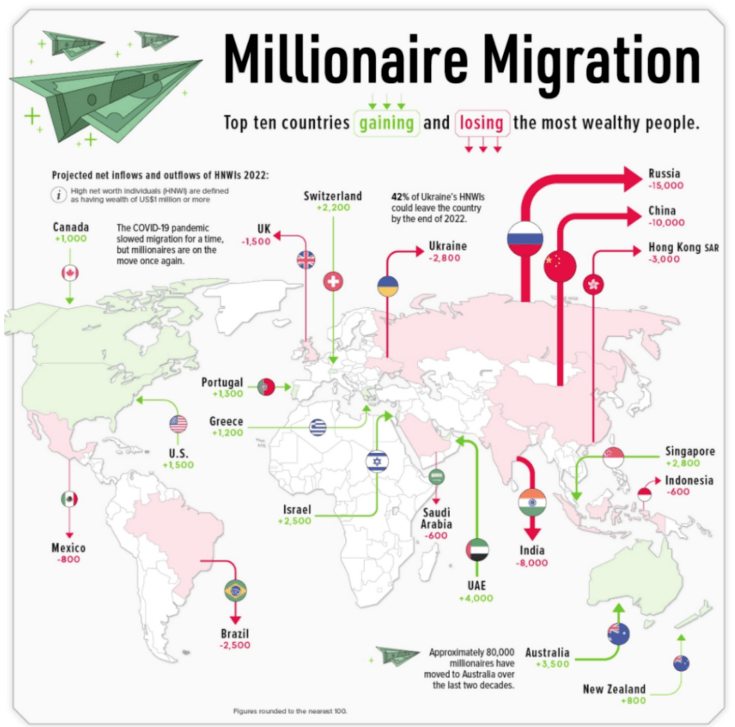
1. Well run tax havens. (UAE, Singapore, Switzerland) 2. Spacious and stable English speaking countries. (Australia, US, Canada, New Zealand) 3. Easy entry points to the EU. (Portugal, Greece) 4. The Jewish homeland. (Israel) Anything I missed? The Financial Times has an article on how three cities are booming in the post-Covid world: Millionaire populations dropped by 12 per cent last year in New York, 14 per cent in Hong Kong, and 15 per cent in Moscow. Dubai, Singapore and Miami are deliberately exploiting this migration by opening their doors to capitalists. These global cities rank among the most appealing to millionaire migrants — and make up the top three among luxury property markets where prices are expected to rise fastest this year. It’s not just the pull of these relatively low tax/regulation cities, it’s also the push of badly run cities elsewhere: Cracks in New York — high taxes, surging crime, simmering anti-capitalist hostility — are reflected in the flight to no taxes and a warm welcome in Miami. A similar effect is visible in Moscow, where a heavy-handed Kremlin and world reaction to the war in Ukraine are chasing rich Russians out. Instead they are opting for more hospitable options, including Dubai. Meanwhile, regulatory pressure from Beijing is driving tycoons to buy second homes in Singapore. Other places would also like to attract millionaires, but it’s easier said than done: Many other countries want to emulate Dubai’s success, including Zimbabwe, which hopes to remake Victoria Falls as a similar hub. Zimbabwe?  I’m not sure if corruption, crime and hyperinflation is the right combination to attract the global elite.   (0 COMMENTS)

/ Learn More

Condemning the Profit Motive: Part 3

While most people accept that business are in the business of pursuing profits, this pursuit nevertheless prompts many complaints, In two previous posts, I outlined ten objections to the profit motive, and I tried to counter each in turn. In this post, I offer ten more complaints that allegedly result from the pursuit of profits. See what you think of this next set, and let me know your thoughts in the comments!   21- Manipulation of financial markets Entrepreneurs have manipulated financial markets in the past and are likely to do so in the future. One of the more notorious examples was the Hunt brothers’ attempt to corner the silver market back in 1980. They lost over $4 billion in the attempt. On the other hand, the Federal Reserve Bank manipulates financial markets as part of its charter. Its easy money policies contributed to the inflation of the 1970s, the Dot Com bubble, the Housing Bubble, and the current wave of bank runs. While financial manipulation by an individual or a firm may cause serious problems, the impact of government manipulation is usually far more widespread and devastating.   22- Expansion of insider trading Making insider trading both legal and public would be a service to investors. Company officials buying or selling large amounts of their own stock would be a useful indicator of the company’s health. While insider trading is not inherently immoral, government officials trading stocks based on their knowledge of pending votes is immoral and all too frequent.   23- Controlling government policies Firms can’t control government policies without government acquiescence. That said, industry influence is unavoidable given government intervention in the marketplace. When an agency is created to regulate an industry, where can it go for industry expertise other than the industry itself? Who has more incentive to lobby the agency than industry leaders? When bureaucrats retire from the agency, where can they go for second careers other than the industry about which they’ve spent their professional lives learning?   24- Disregard of human rights Companies have been accused of human rights violations by building “sweatshop” factories in developing countries. In cases in which activists have succeeded in shutting down those factories, however, the laid-off workers have often had to resort to prostitution and drug trafficking to stay alive. Working conditions that Americans find unacceptable are often the best options that people in impoverished nations have. Taking away those options doesn’t make their lives better however good it makes activists feel.   25- Ignoring consumer needs Companies that ignore consumer needs don’t stay in business long. By contrast, governments routinely ignore consumer needs. Unlike private firms, they don’t have to cater to consumers to stay in business.   26- Incompetent distribution of funds Companies that incompetently distribute their funds don’t stay in business long. By contrast, governments are routinely profligate with taxpayer dollars.   27- Corrupt leadership As opposed to Obama, Trump, and Biden who routinely ignored their oaths to abide by the Constitution? The ESG (environmental, social, governance) movement’s whole aim is to corrupt corporate leadership, redirecting their efforts away from their fiduciary and contractual responsibilities and toward “social justice” issues that are not only ill-defined but beyond both their control and competence.   28- Lack of consumer choice What happened to Bernie Sanders’ complaint that consumers “don’t need 23 choices of deodorant”? Which is it, too much choice or too little?   29- Ignoring consumer safety Companies whose products hurt people are subject to fines, lawsuits, and bankruptcy. By contrast, government agencies that cause harm face no such penalties. For example, what recourse does a patient have when the FDA is slow to approve a life-saving drug that has been on the market in Europe for years? Perfection is not an option. People can be hurt by nearly any human activity. Ideally, the injured should be able to obtain restitution from those responsible. While our tort system does enable people to obtain compensation from private individuals and companies, the government often refuses to pay compensation for the damages that its actions cause.   30- Tampering with medical research results The Food and Drug Administration (FDA) requires drug companies to conduct clinical trials to show the effectiveness and safety of their own drugs. Yes, the FDA establishes strict guidelines for drug trials, reviews the reports, analyzes trial data, and can require additional studies. However, its requirement that companies test their own drugs creates an inherent conflict of interest. Moreover, if a drug does cause harm, the fact that it has been approved by the FDA can reduce the manufacturer’s liability. The problem is less with the profit motive than with the perverse incentives that FDA regulations have created.     Richard Fulmer worked as a mechanical engineer and a systems analyst in industry. He is now retired and does free-lance writing. He has published some fifty articles and book reviews in free market magazines and blogs. With Robert L. Bradley Jr., Richard wrote the book, Energy: The Master Resource. (0 COMMENTS)

/ Learn More