This is my archive

bar

The Wonder of the Emergent Mind (with Gaurav Suri)

How is your brain like an ant colony? They both use simple parts following simple rules which allows the whole to be so much more than the sum of the parts. Listen as neuroscientist and author Gaurav Suri explains how the mind emerges from the neural network of the brain, why habits form, why intuition […] The post The Wonder of the Emergent Mind (with Gaurav Suri) appeared first on Econlib.

/ Learn More

Strong Claims Need Strong Evidence

Each semester that I teach Principles of Microeconomics, I have some variation of this question on my exams: “Joe works at the local supermarket. One day, he says to you: ‘On Monday, we were selling oranges for $0.75 each and we sold 200 that day. On Friday, oranges were $1.00 and we sold 400 that day. The price went up, and so did the quantity demanded! The law of demand must be wrong!’ Evaluate Joe’s statement using the economic way of thinking. Is he right or wrong? Why?” (If you would like to answer for yourself, Dear Reader, stop reading here and pick up with the next paragraph once you are done) The answer I am looking for is something along these lines: “Joe’s statement is incorrect. The law of demand is a ceteris paribus statement. All else held equal, as prices rise, quantity demanded will fall. But what Joe witnesses can easily be explained by an increase in demand. That will cause both the price to rise and the quantity demanded to rise as the increase in demand means buyers are willing to pay more for the same quantity.” The pedagogical lesson I want students to take away from this question is that whenever someone claims to overturn a scientific law, we should be skeptical. Existing theory can often explain the observed phenomenon. In this case, the law of demand is indeed a scientific law, the validity of which has been tested time and time again. And the incentives to find exceptions are quite strong. To quote George Stigler from his classic The Theory of Price: “How can we convince a skeptic that this “law of demand” is really true of all consumers, all times, all commodities? Not by a few (4 or 4,000) selected examples, surely. Not by a rigorous theoretical proof, for none exists – it is an empirical rule. Not by stating, which is true, that economists believe it, for we could be wrong. Perhaps as persuasive a proof is readily summarized is this: if an economist were to demonstrate its failure in a particular market at a particular time, he would be assured of immortality, professionally speaking, and rapid promotion while still alive. Since most economists would not dislike either reward, we may assume that the total absence of exceptions is not from lack of trying to find them. And this of course hints at the real proof: innumerable examples, ranging from the wife who cuts down on strawberries because they are out of season (= more expensive) to elaborate statistical investigation, display this result.” (pp. 22–23 of the 4th ed, emphasis in original) In other words, to say that the law of demand doesn’t hold is an extraordinarily strong claim. Of course, every once in a while, someone builds a theoretical model of a violation of the law of demand. Sometimes, they even include an investigation of one such good that seems to break the law of demand. But, upon further investigation, such examples break down, and the law of demand holds true. Strong evidence is needed for strong claims.  I think of this exam question whenever I read some economic commentator claiming that international trade has weakened America. Such an outcome would be unprecedented. Millennia of experience and evidence suggest trade strengthens nations and that turning away from it weakens them. This is explained by (and is evidence for) the law of comparative advantage. As with the law of demand, anyone who can provide robust and rigorous evidence overturning our understanding of trade will be guaranteed all sorts of professional and pecuniary honors. Despite these incentives, no evidence is forthcoming. Most of the claims that these well-established economic rules have been overturned are made in op-eds and are decidedly lacking in scientific merit.1 None of this is to say that a scientific law can never be overturned. Scientific knowledge is an ever-evolving thing. Miasma theory was backed by millennia of experience and evidence. Yet, it was eventually exposed as incorrect. And that is evidence of my argument.  Those who overturned miasma theory are immortal names in the scientific world: John Snow, Louis Pasteur, and Robert Koch. Could our understanding of international trade and the law of demand suffer the same fate as miasma theory? Of course. But those attempts to overturn the scientific laws need extraordinary evidentiary backing. Thus far, the evidentiary backing for overturning economic laws has been lackluster at best, and often outright false.   Footnotes [1] Note: the claim “trade weakens a nation” is different from the claim “protectionism grows a nation.” The latter still argues that trade improves a nation, just that protectionism creates more prosperity. (0 COMMENTS)

/ Learn More

Pricing Plumbing: Cutsinger’s Solution

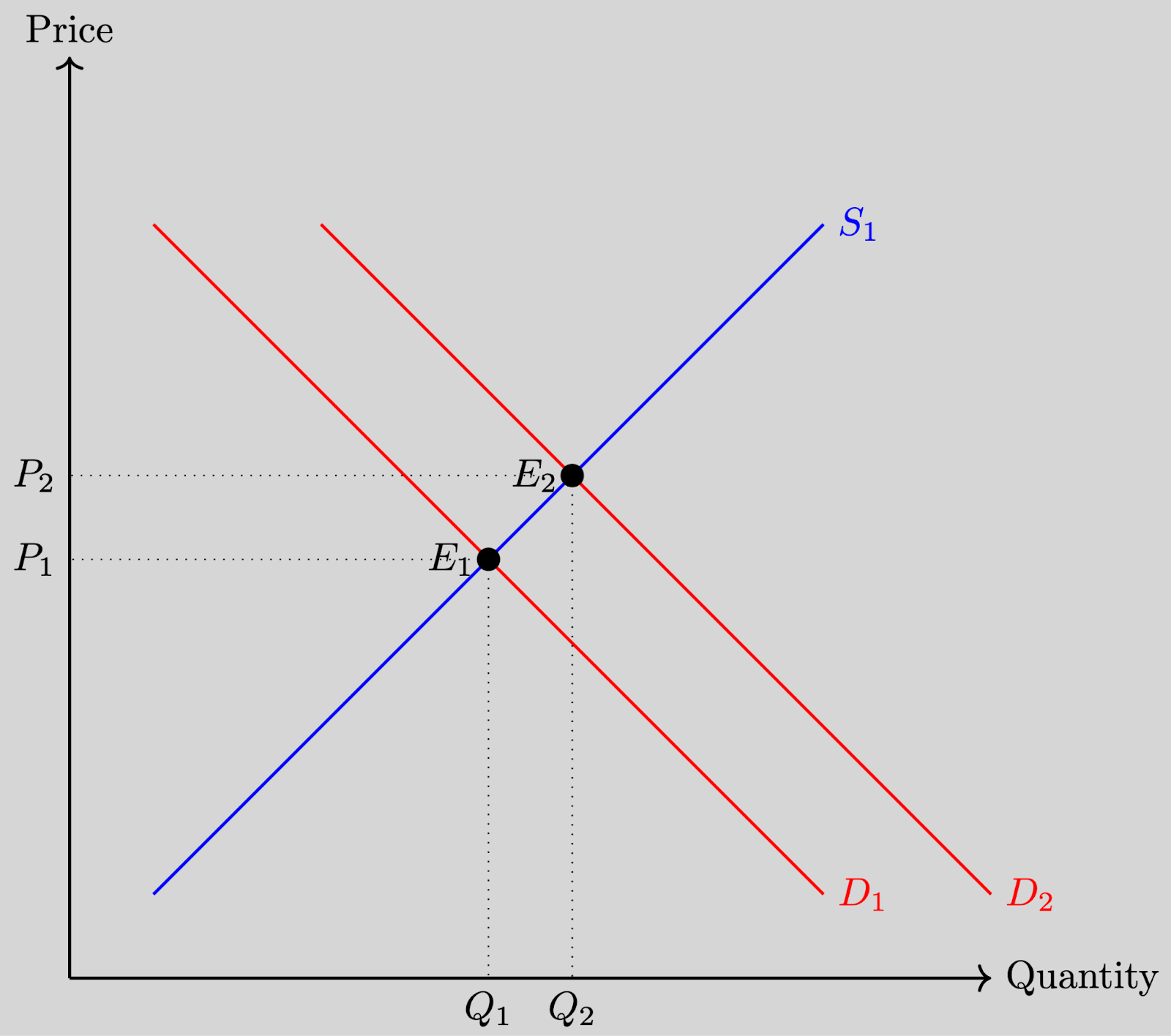
Question: The Texas Minimum Construction Standards require that all plumbing fixtures be WaterSense certified. Examples of requirements under these standards include low-flow faucets, shower heads, and toilets.  Suppose, for the sake of argument, that before the requirement for low-flow toilets went into effect, installing a normal-flow toilet cost $250. Suppose also that installing a low-flow toilet costs plumbers an additional $100 under the regulations, and that their customers value the savings from low-flow toilets at $25 per toilet.  Illustrate how the demand and supply curves for toilets shift as a result of the law. What happens to the price of a new toilet (providing a range of new prices is sufficient)? Who gains from the law: plumbers, their customers, both, or neither? Justify your answer. Solution: I use this question in the classroom to highlight several ideas. For one, it’s not clear that product-quality mandates necessarily make consumers better off. I say not clear because such mandates may be intended to address an externality.  For instance, my former colleague at Texas Tech University, Adam Martin, once pointed out that West Texas—like several other areas of the American West—relies on the Ogallala Aquifer for water. Since no one owns the aquifer, pricing its use is difficult. In this case, we may get the standard tragedy of the commons outcome: each person considers only his or her own costs when using water rather than the full social cost. As a result, the aquifer may be depleted too quickly. For my answer, however, I’m going to ignore this possibility. Another reason I use this question in the classroom is to show that if consumers truly valued the additional quality required by the mandate, firms would already have an incentive to provide it because doing so would be profitable. The question also offers a chance to discuss the incidence of the mandate. In effect, the regulation operates like a tax—but instead of generating revenue for the government, it generates revenue for the suppliers of low-flow toilets in this case, or more generally, for whoever provides the additional quality. Like a tax, the mandate creates a deadweight loss. Since consumers value the water savings from low-flow toilets at $25 per toilet, we can think of the demand for low-flow toilets as being $25 higher than the demand for normal toilets. By the same logic, we can think of the mandate as reducing supply by $100. The additional cost plumbers incur when installing low-flow toilets. Since supply falls more than demand rises, fewer toilets will be installed, and the market price will increase by some amount between $25 and $100. Both plumbers and their customers are worse off: plumbers receive less net revenue after covering their higher costs, and customers pay more than the value they place on the improvement. The result is a deadweight loss, reflecting the reduction in mutually beneficial trades that would have occurred without the mandate. We can illustrate this idea using the supply and demand diagram below.  Image by Bryan P. Cutsinger The initial supply and demand curves, shown in black, reflect market conditions before the mandate takes effect. The mandate shifts the supply curve leftward by the additional cost of providing a low-flow toilet, illustrated by the red supply curve, S′. The red demand curve, D′, reflects consumers’ demand for low-flow toilets. The vertical distance between D′ and the initial demand curve, D, represents the additional value consumers place on the water savings from low-flow toilets.  We’re told that the initial price of a toilet is $250, so the mandate must raise the equilibrium price. How much it rises depends on the elasticities of supply and demand, but we know the new price will lie somewhere between $275 (if demand were perfectly elastic) and $350 (if supply were perfectly elastic). (0 COMMENTS)

/ Learn More

Applaud All Market-Made Millions

In the NFL offseason, star running back Saquon Barkley signed a $40 million contract extension with the Philadelphia Eagles. Make no mistake, he earned it after rushing for 2,005 yards in the regular season and helping to bring another Lombardi Trophy to Philadelphia. I’m not alone in thinking this. As one sports writer put the point, “He deserves it…Barkley is easy to root for, not only because he can jump backward over people, but also because he works hard, he’s kind, and he’s a great teammate.”  Rarely does anyone argue that it’s morally wrong for a football player, or other performer, to earn tens of millions of dollars. But if a CEO earns the same amount, it’s greed, exploitation, or a symptom of the ills of late-stage capitalism.  Even when fans do complain about the high salaries of people who play a game for a living, it never comes with the vitriol that accompanies complaints about the CEO. Why do people react so differently to the wealth of an entertainer and the wealth of an executive? I have a couple of guesses: (1) it’s harder to see the value created by executives and (2) people suspect that they make their millions by exploiting the labor of their employees. But both of these concerns miss the mark. What really matters when it comes to compensation is that it is the result of the value an individual creates. That’s why a CEO is no less deserving of their market-made wealth than the star athlete. Let’s examine each of these guesses about different reactions to high pay. First, with athletes and entertainers, the value they create is visible. You can literally see Barkley hurdle backwards over a defender. You can also see that he’s special because other running backs in the league aren’t doing the same. So the connection between what Barkley does to help his team win games and what he earns is obvious. Similarly, you can hear Taylor Swift sing and see the packed stadiums and elated fanbase. Maybe you’re not a fan of her music, but you can understand why she became a billionaire. In contrast, a CEO’s contribution is buried in spreadsheets and meetings. If they make good decisions, the company thrives—but you don’t see it happen in the way you see Barkley run. There’s no highlight reel for efficient logistics or better management.  Just because we can’t see the value being created doesn’t mean it’s not real. By analogy, great coaches help their teams win even though they’re not on the field themselves. They not only design plays and motivate players, but hire assistants, establish organizational culture, and advise on draft picks. A CEO is a bit like that. The CEO of Starbucks isn’t behind the counter pouring coffee, but they help create and manage the processes and institutions that make it possible for millions of people to get their lattes every morning. That someone’s contribution to an organization’s success is less visible than another’s because it takes place “behind the scenes” doesn’t mean it’s less valuable. Second, people tend to distrust money made through employing others. It’s no problem to get rich by selling tickets to your performance—those are simply willing customers. But many object that CEOs get rich at the expense of their workers, who are really the ones generating value. This is what is meant when people say employers are exploiting workers’ labor. However, an employer no more exploits their employees than Saquon Barkley or Taylor Swift exploits their fans. The deal that entertainers make with their fans is, in a crucial respect, economically and ethically similar to the deal that employers make with employees: they’re both the result of an agreement that people voluntarily accept because they expect it to make them better off. Milton Friedman, a great economic communicator, said, “The most important single central fact about a free market is that no exchange takes place unless both parties benefit.” In effect, Taylor Swift makes people an offer: I’ll put on a concert for you if you’ll pay the ticket price. Someone who’s not a fan doesn’t have to take her up on it, and they’re no worse off for having been given the option. On the other hand, a devoted Swiftie probably believes buying the ticket will make them better off and will accept the deal.  Employers make prospective employees a similar offer: I’ll pay you a certain amount per hour if you’ll pour coffee for my customers. If you don’t want the job, you don’t have to take it, and you’re no worse off for having the offer. On the other hand, if you think earning money as a barista will make you better off, you’ll accept it.  One might object that employers are more exploitative than entertainers because it’s a lot worse to be unemployed than unentertained, so in a meaningful respect, someone has no choice but to take a job. Although there isn’t space to address this point in detail here, I’ll just note that even if you’re sympathetic to this objection, it makes little sense to place special blame on a worker’s employer, assuming the employer is not responsible for the worker’s bad alternatives.  A worker’s employer is the person who made them the best offer they received, as evidenced by the fact that the worker accepted it over all of the other ones. So if you want to criticize someone, it should be all of the employers who offered the worker worse deals or no deal at all. Here’s the point: just as entertainers attract viewers by offering them something they value, so too do executives attract workers by offering them something they value. They both get rich by making others better off. So the market-made wealth of a CEO is no less admirable than that of Saquon Barkley, even if that’s sometimes harder to see. (0 COMMENTS)

/ Learn More

Shampoo, Property Rights, and Civilization (with Anthony Gill)

Why is it okay to take the little shampoo bottles in hotels home with you but not the towels? And what stops people from taking the towels? Listen as political scientist Anthony Gill discusses the enforcement of property rights with EconTalk’s Russ Roberts. Backing up their observations with insights from Adam Smith, Friedrich Hayek, and our […] The post Shampoo, Property Rights, and Civilization (with Anthony Gill) appeared first on Econlib.

/ Learn More

Introducing: Sam’s Links

We’d like to welcome a new voice here at Econlib, Sam Enright. Sam works on innovation policy at Progress Ireland, an independent policy think tank in Dublin, and runs a publication called The Fitzwilliam. Most relevant to us, on his personal blog, he writes a popular link roundup, in which he gives short commentary on the most interesting things he read, watched, and listened to in the previous month. His ‘linksposts’ are sometimes lovingly mocked for their astonishing length; what follows is an abridged version of his Links for October. Blogs and short links 1. Ava Huang on the friendship theory of everything. (I subscribe to this theory.) 2. You don’t have to choose between the environment and economic growth. 3. Free market economics is working surprisingly well. As Noah Smith points out in this piece, the benefits that the Argentine economy has seen so far under Milei are probably mostly attributable to orthodox macroeconomic stabilisation policy. It’s too early to say whether the other reforms will be successful. Is an alternative title “We All Owe the IMF an Apology”? 4. The only countries that tax non-resident citizens on worldwide income are the United States and… Eritrea. Here is a wiki about the other financial and legal restrictions that American citizens face after emigrating, which include not being allowed to invest in the greatest tax instrument in Britain, the individual savings account. That is from Bogleheads, a website of people who… really like John Bogle.1 5. Eventually, we will all come to love congestion pricing. 6. Sebastian Garren’s whirlwind tour of Chilean economic history. You’ll be hearing more about this soon: “Thank you to Sam Enright and the Fitzwilliam for setting me on this quest.” Music and podcasts 7. Chakravarthi Rangarajan on what’s happened to Indian monetary policy since the 1991 liberalisation. I was unaware of how much of a problem fiscal dominance was in India before the 1990s (or even really what it is). 8. Dmitri Shostakovich, Symphony No. 8. And the associated Sticky Notes episode. This is darker and more complicated than the triumphal Symphony No. 7, which would have been a better place to start. I think you can hear the cautious optimism about the Red Army’s advance, and in general, I find it a lot easier to get into composers with specific historical episodes they are associated with (#8 premiered in 1943, #7 to 1942). 9. Tabla Beat Science, Tala Matrix. Another one of Zakir Hussain’s bands. If you still haven’t read Shruti Rajagopalan’s obituary for Zakir, it is the best thing I’ve found written about Indian music. 10. Richard Sutton, the father of reinforcement learning, on why he thinks LLMs are hitting a dead end. When will I learn my own “bitter lesson” that I’m not smart enough to follow these podcasts over audio, and I need to switch to reading the transcripts? Papers  11. P.W. Anderson, More is Different: Broken Symmetry and the Nature of the Hierarchical Structure of Science. I’ve heard the title of this paper countless times before, but I never got around to reading it. The author makes an argument for anti-reductionist pluralism, which is (I think?) similar to what Daniel Dennett is saying in Real Patterns. It’s been a while since I thought about these issues, but from what I recall, I was sympathetic to the claim that “chemistry is just applied physics” is philosophically confused. I also read a 50-year retrospective by Steven Strogatz et al. Sociologically, it is quite fascinating that a non-philosopher managed to write such a widely discussed paper in philosophy in only four pages. 12. Richard Sutton, The Bitter Lesson. I figured if I’m reading Sutton, I may as well get around to this famous essay. Here is the lesson in question:  “The biggest lesson that can be read from 70 years of AI research is that general methods that leverage computation are ultimately the most effective, and by a large margin . . . We have to learn the bitter lesson that building in how we think we think does not work in the long run.” One thing I learned from Sutton is that the more general methods of building AI – that scale up compute, and eschew the symbolic representations of GOFAI – used to be called “weak methods”. People were really convinced that scaling wouldn’t work, and honestly, who can blame them? 13. David Silver, Richard Sutton, Welcome to the Era of Experience.2 I read this accessible essay as part of a machine learning reading group with the nice folks at the coworking space Mox. They have a cool group they call the 90/30 Club, in which week-by-week, they are reading through Ilya Sustkever’s list of the 30 AI papers for which “If you really learn all of these, you’ll know 90% of what matters today.” At some point, they seem to have finished that list and moved on to other papers. I assumed that I wouldn’t be able to follow a conversation with the legendarily “cracked” (am I using this term correctly?) San Francisco engineers, but thankfully, I was also able to listen to Sutton on the Dwarkesh podcast in preparation. To be honest, I find the intense interestingness of the Bay Area to be overstimulating, and this contributed to low mood and distractibility while I was visiting. Something I like about Dublin is that it feels like you can know pretty much everyone with a certain set of interests. Small ponds are underrated. In any case, the basic argument of Silver and Sutton’s paper is that AI is now reaching a limit of what it can learn from human-generated data, and going forward, AI will be learning mostly from experience, trial and error, and so on. In this view, reaching superintelligence will require the fabled “paradigm shift”, and will rely heavily on reinforcement learning. This is the key graph, from page 6: Figure 1: A sketch chronology of dominant AI paradigms. The y-axis suggests the proportion of the field’s total effort and computation that is focused on reinforcement learning. From Silver and Sutton, “Welcome to the Era of Experience.” They have a more detailed picture in which the most advanced AI will be steered by human desires and feedback, which I didn’t quite follow. This paper came out in April and will (eventually) be published in a book called Designing an Intelligence, so I will pre-order it once there is a release date. This is all pretty heavy stuff, and my head hurts, so I will conclude this section with recent wisdom from my mate David: They should call the opposite of an AI doomer a sloptomist. You can read the full version of this post here.   [1] Reading up on this has reminded me of a Marginal Revolution comment from 2023 about how John Bogle should receive the (hypothetical) Nobel Prize for the practice of economics. [2] The name David Silver didn’t ring a bell, but I now realise I saw him in that incredible documentary about AlphaGo. (0 COMMENTS)

/ Learn More

Why Liberalism

When I first started teaching, David Henderson gave me some advice: to be open about who I am regarding my economic philosophy.  At the beginning of class (and several other times throughout), I mention that I am a classical liberal—a free-market economist who argues that individuals rather than governments are best suited to deal with complex social relationships and problems.  I don’t rule out government intervention completely, but I make a strong presumption of liberty that must be overcome before government intervention is justified.  Law exists to enhance liberty, not restrict it. That is some of the best teaching advice I have gotten. For many students, especially those who might disagree philosophically with me, it prompts conversations outside of class about economics and liberalism.  On campus, we have beautiful live oaks.  On nice days I hold office hours outside, so I have had many great conversations with students in their shade.  Some of the students have liberal leanings.  Others do not but are interested in the philosophy (or wish to pose counterarguments).  But all leave the conversation enriched.  Or, at least, I do. Recently, one student asked why I am a liberal.1  It is a good question, and the answer has evolved.  Certainly, I am a liberal for empirical reasons.  Liberalism has led to unprecedented human flourishing, virtually eliminating true poverty in liberal countries.  Liberal countries tend to be more tolerant, peaceful, wealthy, healthy, creative, and happy.  There are countless books that document this, but for those who want a more dramatic read, I recommend The Rise of the Cajun Mariners: The Race for Big Oil by Woody Falgoux.  Woody tells the story of the Cajun boaters who started with nothing, gambled it all, and became “oil boat barons.”  It is a tale that could only come about in a liberal market economy.  As Thomas Sowell once said, “I do not have faith in the market.  I have evidence about the market.” If you asked me, “Why liberalism?” 20 years ago, when I first started learning economics as a high school student, I would have stopped with the empirical evidence.  But I have since engaged with many liberal thinkers, both past (Adam Smith, Frederic Bastiat, John Miller, A.V. Dicey, F.A. Hayek, James M. Buchanan, etc.) and present (Don Boudreaux, David Henderson, Pierre Lemieux, Russ Roberts, Dan Klein, etc.)2. Over that time, I have come to appreciate a deeper understanding of “liberalism” and “human flourishing.”  In fact, I’d say my view now is much less geared toward the empirical; even if liberalism did not result in better material outcomes, I would still be a liberal.  I think James Buchanan put it best in his essay “Natural and Artifactual Man” (reprinted in Volume 1 of The Collected Works of James M. Buchanan): Man wants liberty to become the man he wants to become.  He does so precisely because he does not know what man he will want to become in time.  Let us remove once and for all the instrumental defense of liberty, the only one that can possibly be derived directly from orthodox economic analysis.  Man does not want liberty in order to maximize his utility, or that of society of which he is a part.  He wants liberty to become the man he wants to become. (pg 259, emphasis in original.) Liberalism lets people both discover and become the best versions of themselves, whatever that version may be.  Will some people mess up?  Of course.  And that is ok.  Will some use their freedom to abuse others?  Of course.  And that is where a liberal government in a liberal society has a role: to punish those who commit injustice.  To me, that freedom to find and live your best life, whatever it may entail, so long as you are not harming others, is beautiful. Liberalism is truly a social philosophy.  It encourages social behavior because it encourages peace.  Because of this, liberalism encourages societal cohesion in a way that collectivist ideologies that do not prioritize individuals cannot.  It encourages human flourishing in a myriad of ways.  And for that, I am a classical liberal. Live oaks in the quad at Nicholls State, photo by the author. [1] I use “liberal” and “classical liberal” interchangeably in this post.  They mean the same thing.  “Liberal” here does not refer to the American left or Democratic Party. [2] These lists are not exhaustive.  I have been blessed to engage with many great thinkers.  The exclusion from these lists does not imply a lack of influence or is not meant as a snub to anyone.   As an Amazon Associate, Econlib earns from qualifying purchases.   (0 COMMENTS)

/ Learn More

On Solving Social Dilemmas

A Book Review of Solving Social Dilemmas: Ethics, Politics, and Prosperity, by Richard D Congleton.1 Economists like blackboards. Using chalk (or markers), they construct logically consistent abstractions of the world. They call them “models”. This invites derision from both academics and the general public. However, the abstractions are often tested against the real world to assess their relevance of the models. The bad ones (i.e., those that are irrelevant) are thrown out. In Solving Social Dilemmas, Roger Congleton flips this perspective by asking how real-world individuals, through trial, error, and adaptation, generate rules and norms that sustain cooperation—and how these emergent solutions are later captured by economists in abstract form. To illustrate this flip, consider a small collectivity at the beginning of a long-time scale. Because some members of the collectivity can always act opportunistically, cooperation is hard to sustain (and one can think cooperation is analogous to exchange and trade) so rules must be developed to govern behavior. Sometimes, the discipline of continuous dealings (i.e., losing the stream of benefits from future cooperation because of immediate opportunism) is sufficient. Sometimes, the development of norms and reputations acts as a complement to that discipline. These norms and mores become internalized and reinforced as they generate benefits from sustained cooperation. Then, they are transmitted via socialization. “Norms,” “mores,” “rules,” and other terms more familiar to anthropologists fall broadly into what economists loosely call “institutions” or “governance.” (This category also includes government legislation.) In everyday language, people tend to describe the behavior generated by adherence to these institutions simply as “ethical behavior.” If the relevant collectivity grows to the size of a village, the dilemma of cooperation remains, but it changes in form. More people means that the effectiveness of past solutions may decline. Therefore, the norms must be adapted. Tinkering with the existing rules is one way. Introducing new rules may be necessary. This means a long process of trial and error. If the collectivity grows from a village to a city, the problems change again. The tinkering continues and the innovation must continue as well. This is unavoidable, since each round of growth of the collectivity is made possible by having successfully dealt with the problems of sustaining cooperation in the prior round. Each round generates new problems for sustaining cooperation that must be answered for growth to continue. “In other words, ethics build markets, markets reinforce the very ethos that sustains them, and together they generate the prosperity that allows both to flourish.” This is why Congleton can write “communities with an ethos that tends to support market transactions, team production, specialization, innovation and public policies that do not impede economic development benefit from more extensive and productive commercial networks” (p. 23). In other words, ethics build markets, markets reinforce the very ethos that sustains them, and together they generate the prosperity that allows both to flourish. This is the simplest summary that can be made of Congleton’s Solving Social Dilemmas. And it is a powerful way of expressing more formally the nature of economic development and the process that individuals follow (and understand intuitively) to produce “governance” in their daily lives. Economists can gain from reading this book because it offers ways to conceptualize questions about the evolution of institutions. Economic historians can gain from it a possible way to resolve certain questions regarding divergence between nations. Development economists can use it to understand how “big plans” imposed from above may destroy existing intricate systems of governance in ways that even the most rationally devised plan enacted by the most angelic planner could still make things worse. Even this high praise fails to do justice to the book. For example, the entirety of chapters 4 and 5 can form the basis of advanced undergraduate classes in economic history, economic development, economic philosophy, the history of economic thought and political economy. If expanded, in ways that some of the appendices provided by Congleton allow, they could form entire sections of core courses for graduate students in economics. They could also be easily adapted as a way to bridge conversations with historians and sociologists. Chapter 6 of the book provides a simple exposition, accessible to all, about customary law as “market-based law”. Liberty Fund followers are aware of these arguments, but their full exposition often comes in long treatises such as Theodore Plucknett’s Concise History of The Common Law2 (a misleading title—the book spans 828 pages) or Arthur Hogue’s Origins of the Common Law,3 and (more modern) John Hasnas’s Common Law Liberalism.4 But this chapter in Congleton boils down the entire literature in a digestible way. More importantly, Congleton expresses these ideas in terms that would attract people to the argument. Most notably, it is accessible to economists, who sometimes struggle to connect legal concepts to economic concepts. The understanding that emerges is that customary law has flexibility, offers more room for a smoother tinkering process with new rules as societies change (notably as in my example of changing size), and is cheaper to enforce because of the “customary” part. Finally, Part III of the book could easily form the core of a course in a Politics, Philosophy, and Economics (PPE) curriculum. It connects the economics discussed above with history and philosophy, providing insight into why the successful tinkering and innovation process in the “governance” of social dilemmas has been effective in sustaining cooperation. For more on these topics, see “The Rebirth of Classical Political Economy,” by Pedro Schwartz. Library of Economics and Liberty, July 4, 2016. Michael Munger on Choosing in Groups. EconTalk. “Ethics and Economics,” by Stephen R. C. Hicks. Concise Encyclopedia of Economics. Some may be tempted to dismiss Congleton’s book based on the perception that he is claiming prosperous societies are simply more ethical, while poorer societies are composed of less ethical people. That would be a mistake, since this isn’t what he argues. Instead, Congleton argues that certain ethical systems—discovered through trial and error, innovation, and repeated experimentation—are simply better suited to solving cooperation problems and sustaining markets. He summarizes this best himself: “some ethical systems ameliorate or solve a broader array of dilemmas than others” and “some internalized systems of ethical and normative rules provide more support for commerce than others” (p. 430). In this, Congleton echoes Adam Smith’s belief that prosperity is not the product of men’s personal virtue, but of the rules that govern their behavior.5 That is, in short, the single sentence on which Congleton builds one of the finest works I have read in years. Footnotes [1] Richard D. Congleton, Solving Social Dilemmas: Ethics, Politics, and Prosperity. Oxford University Press, 2022. [2] Theodore F. T. Plucknett, A Concise History of the Common Law. Liberty Fund, 2010. [3] Arthur R. Hogue, Origins of the Common Law. Liberty Fund, 1986. [4] John Hasnas, Common Law Liberalism: A New Theory of the Libertarian Society. Oxford University Press, 2024. [5] William Easterly, 2021. Progress by consent: Adam Smith as development economist. Rev Austrian Econ 34, 179–201. https://doi.org/10.1007/s11138-019-00478-5 *Vincent Geloso is an Assistant Professor of Economics at George Mason University. He holds a PhD in economic history from the London School of Economics and Political Science and a master’s degree in economic history from the same institution. For more articles by Vincent Geloso, see the Archive. As an Amazon Associate, Econlib earns from qualifying purchases. (0 COMMENTS)

/ Learn More

Primal Intelligence (with Angus Fletcher)

What do Shakespeare, Hollywood storytelling, and military special operations have in common? They all excel at inventing new plans, or improvising when we’re facing radical uncertainty. Listen as professor of story science Angus Fletcher tells EconTalk’s Russ Roberts how we’ve misdefined intelligence, equating it with data–driven reasoning in place of what he calls “primal intelligence”–the […] The post Primal Intelligence (with Angus Fletcher) appeared first on Econlib.

/ Learn More

Trust Government Statistics, Not Government

“Expert failure” is clearly having a moment. Pollsters, Wall Street analysts, tech futurists… all are facing demands to reckon with getting it wrong. Economics, though, seems to be getting special attention. Lately, this has metastasized into Orweillian skepticism of government data itself. It’s one thing to argue that economists have misread numbers. It’s quite another to claim that the numbers themselves are lies. Believe me, I understand the reflex. If it’s true that the government fails at so many things it sets out to do, why trust its statistics? But this cynicism commits a category error: confusing the government’s inability to solve economic problems with its capacity to solve technical problems. Understanding this distinction explains why we can simultaneously distrust economic planning efforts while also trusting, e.g., the Bureau of Labor Statistics to provide employment figures. Briefly, economic problems involve mutually exclusive ends and trade-offs. Should we use titanium to build railroad tracks or golf clubs? Should corn become ethanol or be used to feed cattle? Markets solve these through prices, profits, and losses. Governments, as F.A. Hayek demonstrated, are fundamentally incapable of evaluating the trade-offs involved. Technical problems, by contrast, have a singular goal in mind. Build the railroad tracks, feed the cattle, and count the total number of jobs in the US. No trade-offs are involved in these problems, it’s just a matter of execution. Market participants can obviously solve technical problems, but so too can governments. The Soviet Union, for example, beat America to space but couldn’t stock the shelves at the grocery store. This wasn’t a coincidence. Technical problems have clear and specific endpoints. Economic problems require the evaluation of infinite trade-offs that market prices make understandable.  Note that there is nothing here about the cost-effectiveness of the government’s solutions, nor does it suggest that solving the problem was even worthwhile to begin with. Getting to space was an impressive feat in 1961. A more impressive feat, though, is feeding your people. As it turns out, the Soviet Union did the former, but did not accomplish the latter. The result: collapse. What does this have to do with government statistics? In a word: everything. Collecting and analyzing data is a technical problem with a clear, singular objective: accurate measurement. There are no trade-offs for e.g., the BLS to evaluate, no resource allocation problem to solve, and no need for price signals. Consider the BLS’s track record, specifically. Unlike, to take another example, China’s National Bureau of Statistics, which answers directly to the State Council and is more accurately described as a “propaganda arm,” the BLS operates with statutory independence. The much-maligned 911,000 downward revision in total non-farm jobs growth means that the Bureau was still well over 99% accurate—there are over 150 million non-farm employees in the US right now. The 2020 Census was estimated to be off by as many as 782,000 people. With over 330 million people in the US, the Census Bureau was accurate to within 0.25%.. Does this mean that the data collected perfectly matches reality? Of course not. There are serious and legitimate debates about what should count toward GDP, how to adjust the CPI for aspects of things like changes in quality, what the threshold should be before someone is considered “unemployed,” and plenty of other measures. These debates are all about what to measure, not whether the measurements themselves are accurate or technically competent. This distinction matters for classical liberals. We rightly distrust the government’s ability to pick winners, allocate resources, and plan economies. But dismissing government statistics as inaccurate writ large conflates technical competence with economic planning. Could the private sector collect this same data in a more efficient way? Maybe, but keep in mind that Bloomberg Terminals, which cost upwards of $24,000 per user per year, use government data. Should we trust governments to plan economies? Absolutely not. But should we trust government statistics, at least those in the US? The evidence suggests that we should. We should trust them not because governments are virtuous, but because measurement is fundamentally different from deciding what to do with those measurements. (0 COMMENTS)

/ Learn More