This is my archive

bar

Hillary Clinton’s Disturbing Comments on Deprogramming and People’s Freedom

Hillary Clinton as Big Sister. (With apologies to George Orwell.) In an interview with CNN’s Christiane Amanpour, Hillary Clinton made two disturbing comments. One has, quite rightly, received a lot of negative publicity; the other one hasn’t but should. Here’s the 5-minute video. At the 2:15 point, Clinton said, “Maybe there needs to be a formal deprogramming of the cult members.” (She’s referring to MAGA Republicans, whom, recall, she referred to in 2016 as a “basket of deplorables.”) Two things to note about this. First, if she had left out the word “formal,” one could more easily think that she was saying this off the top of her head and didn’t really believe it. But by using the word “formal,” she seems to show that she’s been thinking seriously about this proposal. That’s pretty creepy and dangerous. And to think that on election eve in 2016, after Fox News Channel projected Trump as the winner in Wisconsin, I was hoping for Clinton to pull it out. I now think that we really dodged a bullet. (Better the devil we know, etc.) Second, notice Amanpour’s giggle when Clinton makes her proposal. The part that hasn’t gotten as much notice, but is also dangerous for what it says about Clinton’s views on Americans’ freedom, comes at the 4:52 point. Clinton says: Make America Great Again was a bid for nostalgia, to return to a place where, you know, people could be in charge of their lives, feel empowered, say what they want, insult whoever came in their way. And that was really attractive to a significant portion of the Republican base. So it is like a cult and somebody has to break that momentum. Get it? Somebody has to break the momentum of a movement of people who want more freedom to live their lives as they see fit and to say what they want. And one way she proposes to rid people of this belief in freedom is “formal deprogramming. Yikes!   (0 COMMENTS)

/ Learn More

Start!

Yesterday I had a number of things on my to-do list competing for my attention. I normally have them prioritized, with #1 being most important, etc. Yesterday it was hard to do that. They all felt important. So what did I do? I spent 30 minutes just surfing on Facebook and on my RSS feed before choosing one. I broke my cardinal rule: Start! When you have a number of things competing for your attention and you can’t prioritize, then pick one and start it. The Start rule applies in another way. Sometimes, especially when I have something to write, my brain works overtime to tell me that it’s too hard, I’ll hit obstacles, I’ll come across issues where I need more facts, I won’t have the effect on readers I plan to, blah, blah, blah. Here is where the Start rule is particularly important. You won’t hit any of those obstacles if you don’t do it. But the unfortunate fact is that then you haven’t done it. So start! Start writing and then as you hit obstacles, you find ways around them or through them. And you have a better chance of influencing your audience if you give them something to read versus giving them nothing. P.S. When I was writing regularly for Fortune, from 1984 to about 1990, one of the editors taught me a little trick. You might think it wouldn’t help, but it did. When you’re writing and you have a head of steam, you might need a fact in a particular paragraph. But you don’t know the fact exactly. If you stop to check it, that will slow you down and you might not get back in your groove. This was especially true when you had to go to the library to check a fact. Remember libraries? You’re confident enough that you think the fact will fit with your message. So, for example, you might think some number went up 20% in the relevant period and your point would follow even if it rose by only 10%. And you’re confident that it rose by at least that much and it could have risen by more than 20%. So in that part of the paragraph, you leave the number blank and say TK. The Fortune editor taught me that that means “to come.” I know that it sounds hokey but I’ve written a lot of paragraphs and articles more quickly, even in the era of Google, by using that one trick. (1 COMMENTS)

/ Learn More

Today’s Onerous is Yesterday’s Luxury

In September 1620, my ancestors departed from Plymouth, England on the Mayflower to establish a new home in the New World, some 3,300 miles away. They would ultimately land in November at what is now Plymouth, Massachusetts and immediately faced a harsh winter. About 400 years later, I also undertook a long journey to begin a new life, moving from Massachusetts to Louisiana, approximately 1,500 miles. These two trips could not have been more different. My drive to Louisiana was long. According to Google Maps, it would be approximately 24 hours of driving time. To ease the burden, I decided to do three 8-hour days: Massachusetts to Maryland (Day 1), Maryland to Tennessee (Day 2), and Tennessee to Louisiana (Day 3). At the end of each day, I was exhausted. I’d have a quick dinner and fall asleep in my hotel room. Furthermore, severe thunderstorms forced me to end my planned Day 1 trip in Pennsylvania, leading to a longer Day 2. The temperature steadily rose as I headed further South, hitting the 90s by the time I got to Mississippi. Naturally, this made the times I had to leave my air- conditioned car unpleasant. Eventually, I made it to Louisiana safe and sound. Needless to say, this trip was onerous. Or was it? Compared to the Pilgrims, I traveled in the lap of luxury. It took them 66 days (about 10 weeks) to make their journey. Adjusting for mileage, it would take them about 10 times the amount of time it took me to journey the same length (even longer than that, really. Over-land travel was much slower than sea travel). I was untouched by the weather outside: no matter how hot it was outside, the interior of my car was comfortable thanks to the air conditioning. I was not cramped at all. The Mayflower had approximately 78 cubic feet of living space per person. My car, on the other hand, has about 106 cubic feet, and I was the only one in it. All my food and water were safe and sanitary; no need to worry about rot or disease. I spent each night in a safe hotel room, not having to worry about the element or whether a rogue wave would sink me. I had a GPS to ensure I wouldn’t get lost. I could listen to anything I wanted (The Crown of Swords, Book VII of the Wheel of Time series, by Robert Jordan), rather than having to listen to others’ conversations. My ancestors would have loved those accommodations. The point here is that technological advancement turns luxuries into commonplace necessities and eliminates the onerous. Outside of the poorest of the poor, a trip like the Pilgrims is unthinkable in the world today. The world is a much better, safer, and cleaner place than it once was. Of course, one could object and say that such a comparison between 400 years is true but irrelevant. Things may be better than 400 years ago, but certainly not better than the 70s or 80s. But that, certainly, is just as incorrect. GMU economist Donald Boudreaux often tells stories of waiting in gas lines in the 70s. Don described the heat and humidity as “suffocating,” and that is an apt word. The picture used here is a screenshot of my weather app for Thibodaux, Louisiana, not too far from New Orleans. One cannot breathe easily when outside. Cars at that time had no air conditioning. If, God forbid, American politicians were foolish enough to reimpose price controls on gasoline and create another shortage like the 70s, at least waiting in line would be (marginally) less onerous given we have air conditioning. Humans love to complain. It seems to be a natural instinct as many observers notice how dissatisfied we become with improvements and how long we linger on deterioration. A great antidote to this pessimism is to step back and appreciate how bad things once were and how great things will potentially be.   Jon Murphy is an assistant professor of economics at Nicholls State University. (0 COMMENTS)

/ Learn More

Never reason from a quantity change

Today’s jobs report has been widely viewed as bad news: It’s “bad news for the markets and for the Fed,” Mohamed El-Erian, the chief economic adviser at Allianz SE and a Bloomberg Opinion columnist, said on Bloomberg Television.“The Fed is not going to welcome this report. Over the long term this may end up being bad news for the economy as well,” he said. “Something is likely to break.” Payroll employment rose by 337,000, and the previous two months were revised upward by 117,000.  Nearly 800,000 jobs were created in just the third quarter of 2023 (a period when most economists expected the economy to be in recession.) There are cases when excessive growth in employment is indicative of an overheating economy.   But quantity changes alone are not very informative, you also need to examine why the change occurred.  Was it an increase in labor demand or labor supply?  After all, either shift can increase the total quantity of employment.  Never reason from a quantity change. An increase in labor demand tends to push wages higher, while an increase in labor supply reduces wages.  I was a bit surprised to see nominal wage growth come in at only 0.2% in September, which is less than expected.  Of course that’s only one month’s data, and the rate may tick up over the next few months.  Nonetheless, the slowing wage growth is very good news—indeed the most important part of the employment report.  It seems as though the US is experiencing a surprisingly large increase in labor supply—perhaps partly due to a rebound in immigration from the depressed levels during the Covid period.  This makes a soft landing at least slightly more likely. PS.  Speaking of immigration, do you recall when President Trump spent money that Congress refused to appropriate: Early last year, Trump demanded $5.7 billion for the border wall, but the House of Representatives, under Democratic control, refused, triggering a partial government shutdown that lasted 35 days. The impasse ended when Trump signed a new spending bill that did not include the border wall funding he sought. But a day later, he declared a national emergency and ordered the Pentagon to transfer $2.5 billion to pay for border wall projects. The administration said the new barriers, extending up to 130 miles, were designed to prevent “drug smuggling.” Later, Trump ordered the transfer of another $3.6 billion for new border barriers in Texas. The Constitution says, “No Money shall be drawn from the Treasury but in Consequence of Appropriations made by law.” Authoritarian leaders often cite “national emergencies” when wishing to circumvent the legislature. And do you recall when the Supreme Court ignored the Constitution and upheld Trump’s action? The Supreme Court has allowed President Trump to defy Congress and continue to spend more than $6 billion diverted from military funds to pay for the construction of a border wall in parts of Arizona, New Mexico, Texas and California. President Biden now claims he’s being forced to build a wall that he opposes because Congress appropriated the money back in 2019.  Sorry, but I don’t believe him.  That’s not how our system works in the 21st century.  Presidents can pretty much do what they wish.  The wall will do nothing to address the recent surge in asylum claims.       (0 COMMENTS)

/ Learn More

Paved with Unintended Consequences

Economists, especially those of us who criticize government interventionist policies, often point to bad unintended consequences that many of these policies lead to. Sometimes people say that we delight in pointing to such policies, but that verb certainly doesn’t apply to my attitude. There is typically nothing delightful at all in these consequences, many of them tragic. In this piece, I’ll cover six cases, but they’re a tiny fraction of the cases that exist and even a tiny fraction of the cases I know. We need to distinguish between unintended and unpredicted consequences. Many unintended consequences can be easily predicted. Others might not be. An example of an unintended consequence that I never would have predicted, and that the highly paid “experts” at the Food and Drug Administration didn’t predict, came about because of an FDA regulation that, on its face, looked reasonable. The regulation was an FDA mandate that food containing sesame be labeled as such. Almost instantly, food producers predicted the consequences and acted accordingly. This is from David R. Henderson, “Paved with Unintended Consequences,” Defining Ideas, October 5, 2023. Another excerpt: Ayanna Pressley (D-MA) and Rashida Tlaib (D-MI) have proposed federal legislation to prevent landlords from doing criminal background checks on prospective tenants. In the writeup on Pressley’s site, I can’t find her addressing why landlords would want to know whether potential tenants have a criminal record. Is it because they don’t want criminals no matter what those criminals did? Hard to believe. I own a small share of a large apartment complex and I know why I want the general partner to do criminal background checks: to see if there’s any evidence that they would fail to pay rent, wreck the apartment, or carry on illegal activities in the apartment. The virtue of a criminal background check is that you can find out specifically what crime the person committed. What if he smoked weed twenty years ago? Who cares? My guess is that the general partner doesn’t. What would happen if this bill passes? Would landlords say, “Oh, well, I guess I’ll have to take all comers”? No. Instead, they would look for what statisticians call “noisier” data, data that are correlated with criminality. The result would be that some people with no criminal record would get turned down. Who would be turned down? Two researchers, Marina Mileo Gorzig and Deborah Rho, did a study for the Federal Reserve Bank of Minneapolis to look for the answer. They chose a clever methodology. They sent fictitious e-mails to landlords using names that looked to be those of whites, blacks, and Somalis. After the Minneapolis government banned criminal background checks, they found, “discrimination against African-American and Somali-American men increased.” Moreover, found the researchers, discrimination increased in Minneapolis relative to discrimination in St. Paul, whose government had not imposed the policy. I’m tempted to ask Reps. Pressley and Tlaib, “What do you have against blacks and Somalis?” Read the whole thing.   (0 COMMENTS)

/ Learn More

Taiwan and Montesquieu

American officials are increasingly opposed to trade with China, especially in areas such as tech.  The Taiwanese seem to have a different view of what best serves their interests.  Here’s Bloomberg: Several Taiwanese technology companies are helping Huawei Technologies Co. build infrastructure for an under-the-radar network of chip plants across southern China . . .They included a unit of Taiwanese chip material reseller Topco Scientific Co. and a subsidiary of Taipei-based L&K Engineering Co., according to a Bloomberg News investigation. Across town at another Huawei-affiliated site, Bloomberg identified workers from a subsidiary of construction specialist United Integrated Services Co.Meanwhile, Taiwan’s Cica-Huntek Chemical Technology Taiwan Co. said on its website that it had won contracts to build chemical supply systems for two Chinese chipmakers — Shenzhen Pensun Technology Co. and Pengxinwei IC Manufacturing Co., which was blacklisted by the US last year. Both companies have been identified as working with Huawei to build chip fabrication facilities. I am reminded of this remark by Montesquieu: Peace is the natural effect of trade. Two nations who traffic with each other become reciprocally dependent…their union is founded on their mutual necessities. Trade doesn’t guarantee peace—it just makes it more likely. (1 COMMENTS)

/ Learn More

Thinking About the Economy of the Future

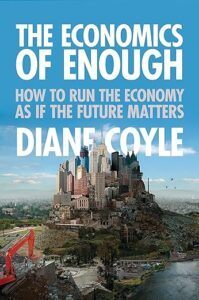
Diane Coyle is the Bennett Professor of Public Policy at University of Cambridge and the founder of Enlightenment Economics. Coyle is also an author, and her book, The Economics of Enough, is the topic of conversation in this episode as she and Roberts discuss the financial crisis, responsible economic action for the future, and the hidden costs that seem to have America on course for economic train-wreck. Roberts and Coyle contemplate the current generation’s role in looking out for the generations to come. Can people forecast the future generation’s needs? Is planning to not be irresponsible a good mindset to have in looking out for the future? We hope you’ll take some time to share your thoughts with us below. Coyle and Roberts ponder the question of how the economy should be run with concern for the future. At the time of the episode (post 2008 recession) challenges in political economy, according to Coyle, included climate change, equality, public services, and the overall issue of thinking about the future. Russ and Coyle agree that parents seem to consult the future given their concern for their children’s lives, but that politicians and their policies do not have the same motivation. How should politicians be incentivized to look out for the future of the economy? Regarding climate change, what do you think should be the approach of the government and the individual? Coyle and Roberts share a concern for the amount of government spending compared to the amount of money the government brings in.  Further, a continual rise of spending results in inflation. Coyle believes that the government has to cut its debt by decreasing spending, or the United States has to be more productive to make up for the discrepancy with innovations for a more productive lifespan of laborers. How could technological innovation help America lessen the issue of extreme debt? How much do you think modern politicians care about the debt, and why?   Banking and creditor insurance is an area of concern for both Roberts and Coyle, as banks have little incentive to be prudent when their credit is ensured by taxpayer money. Coyle believes that regulations make a barrier for smaller banks to enter the market, so larger banks are capitalizing with rents on a market with not enough competition. Is there enough competition in the banking industry? Do banks and government agencies have enough reason to be prudent in protecting the flow of money? How might their incentives by adjusted?   Coyle believes that challenges can be solved with a greater promotion of moral values and standards. Roberts expresses concern for messages coming from politicians who may have perverse intentions, and believes that moral values on the individual level can be more helpful. Should the government promote emotional messages, or would their position create harmful tribalism? Does the modern political landscape provide evidence against politicians making emotional pontifications? Why or why not? Brennan Beausir is a student at Wabash College studying Philosophy, Politics, and Economics and was a 2023 Summer Scholar at Liberty Fund. (0 COMMENTS)

/ Learn More

Trudeau’s New Censorship

In case you haven’t heard, a Canadian government agency, the Canadian Radio-Television and Telecommunications Commission (CRTC), has now been given the power to regulate podcasts. There are a lot of details but Sonja Raath, “Canada’s Online Streaming Act (Bill C-11) explained,” ExpressVPN, April 29, 2023 does a nice job of explaining them. I think Raath’s bias is clear–it’s the same as mine, which is to favor freedom of speech and freedom for consumers and producers to choose–but she lays out the facts clearly. I remember living in Winnipeg in 1970 when I happened to turn on the radio and hear a member of Parliament give an impassioned speech against the Canadian content laws that were being proposed (and were subsequent enacted) to require large percentages of Canadian content on radio and TV. In short, the CRTC has been doing this for over half a century. In 1971, an American friend of mine at the University of Western Ontario, Danny Steinberg, asked me if I thought the motive for the regulations was censorship or protectionism. I answered that it’s both. While it was explicitly about protectionism, it was censorship to achieve protectionism and, given the way governments think, it was probably also censorship to achieve censorship in its own right. As fewer and fewer people watch TV and listen to radio and, instead, turn to streaming, the government has now taken the next step: extending the regulation to the Internet. I regularly read a Substack about Canadian politics called The Line. As best I can tell, its politics are somewhat left of center, but what’s refreshing is how factual the authors are and how they are quite willing to criticize Prime Minister Trudeau and his many failings. They went at this one yesterday with all guns blazing. One of the regular writers, Jen Gerson, titled her post “Do Not Comply.” In making her case, she also lays out how this regulation is likely to grow and become more intrusive. I strongly recommend her whole post. A great excerpt: We will note that C-11 was initially billed as a bit of legislation aimed at “web giants,” and there was no plan to put “user generated content” under the CRTC’s authority. The regulator is sticking to this talking point, insisting that users themselves won’t have to register. Indeed, only companies that generate more than $10 million per year will be subject to disclosure. The Line, for example, is (far, far) too small to qualify. Rather, the CRTC is going to capture companies like Spotify and Apple Podcasts and YouTube. “Oh, so not nice independent media like you!” say our dear readers. Oh, sweet, sweet summer children. She goes on to lay out the likely fact that Apple Podcasts and others, when people complain to the CRTC about The Line‘s content, will likely quit publishing that content. She writes: The end result is a chilling effect. Goodbye candid, freewheeling conversation and F-bombs, everybody. No one will risk offending Canadian sensibilities if it means the risk of losing access to Spotify et al. Remember, these aren’t hobbies, even for relatively small media producers. Revenue from our content is how we pay the mortgage. And there’s a worse outcome to consider: that largely American distributors may simply opt out of all Canadian content rather than fall under the aegis of the Broadcasting Act. This is the choice Meta made, and your Facebook feed is already feeling it. Further, she writes: At its inception, the logic of a Broadcasting Act was rooted in scarcity. Radio and television stations rely on over-the-air broadcasts — frequencies of electromagnetic spectrum — which are considered a public good to be allocated wisely by a public regulator. Too many stations all using the same frequency in too confined an area would muddy reception. Digital media doesn’t work like this. There is no finite digital bandwidth that requires public managing or allocating. Quite the opposite, in fact. Digital space is largely a private good, limited only by constraints on private capital — which, in practice, amounts to virtually no scarcity at all. Digital bandwidth is, effectively, infinite. On her point in the first paragraph, both the late Ronald Coase and Thomas W. Hazlett could give her a run for her money, with Hazlett being way more detailed about the history of the FCC, the U.S. counterpart to Canada’s CRTC. There was never a good case for allocation by a government regulator. And this is a great paragraph: To paraphrase Douglas Murray in his recent Post column: people who think it proper to shut the bank account of a Freedom convoyer while applauding a literal, actual Nazi in Parliament have neither the intelligence nor the moral credibility to regulate the information we consume. I love one of her final paragraphs: To fellow my content creators, and the companies that serve them: don’t register with the CRTC. Civil disobedience is not only appropriate in this case, it’s necessary.   (0 COMMENTS)

/ Learn More

Musings on Opportunity Cost

I want to thank Adam Martin for writing not one, but two thoughtful responses to my essay “Reevaluating the Influence of James Buchanan on Libertarian Thought.” I will respond soon to his post about social welfare functions and debt. For now, I would like to take this opportunity to clarify one link in my essay and then elaborate a bit further on how I think Austrian economists may have been led astray in their understanding of opportunity cost. First, Martin criticizes me for citing Murray Rothbard whom he claims is not a follower of James Buchanan. I’ll defer to Martin on this matter. The link was included because Rothbard’s description of the cost concept succinctly captures a view that is fashionable among Austrian economists today. That view says that cost is a fleeting, psychological phenomenon that cannot be measured.  Having spent more than a decade working at George Mason University’s Mercatus Center and having earned my doctorate at GMU, I have had many interactions with individuals in the Austrian economics community who hold this perspective of cost or some version of it. Moreover, I find they often point to James Buchanan as a source of inspiration on this topic.  Certainly, there were better citations I could have chosen. As I stated in the original piece, I believe Buchanan’s actual position on this issue was somewhat nuanced (which is also a theme of Martin’s response to me). It is true, for example, that Buchanan would certainly have acknowledged that our decisions can impact the real economy. But no one would deny this. Buchanan himself defined cost at times in a manner almost identical to the selected quote from Rothbard. Despite his many caveats, Buchanan has written quite clearly that cost is only born by the decisionmaker, is psychological, cannot be measured, and is instantaneous. At a minimum, Buchanan provides legitimacy to a perspective of cost that I see as little more than an economic fallacy.  It is simply untrue that cost is a fleeting, psychological phenomenon. The act of choosing is fleeting and psychological, but that is not cost. That is choice, a completely different concept. Is it so far-fetched to think that the Nobel laureate author of a book titled, Cost and Choice, who espouses a version of this subjectivist argument, might have significantly contributed to Austrian economists conflating cost and choice? I don’t doubt that other individuals, including Rothbard and perhaps Ludwig Lachmann and others, helped lead Austrian economists down this intellectual cul-de-sac. But they weren’t Nobel Prize winners and they didn’t have the mainstream legitimacy that Buchanan had. I suspect one of the reasons Austrians followed this unfortunate dead end path is that they are misled by the definition of opportunity cost, so I’d like the spend some of this post exploring this idea, since I think it might provide clarity. If you open up a textbook, it will often state that opportunity cost is “the value of next best alternative use” of something. But this definition is arguably incorrect. At best, it is misleading, because it constitutes a special case. Opportunity cost is the difference between what would happen as a result of taking some action and what would occur otherwise. If under scenario A, a factory produces 100 widgets, and under scenario B it produces 95 widgets, the opportunity cost of an action that moves the factory from scenario A to scenario B is 5 widgets. The cost is not 1,000 widgets that might have been produced in some hypothetical scenario C.  Opportunity cost is an objective fact about the world. It involves comparing two moving pictures. It is hard to get our fingers around, because to grasp it we have to understand a counterfactual and our relation to it. But opportunity cost is not subjective. It is both real and quantifiable.  Austrian economists may be thinking of cost as the very best conceivable use of resources, which might be a matter of opinion that differs from person to person. But this is not a very useful definition because the idealized situation it describes doesn’t conform with the state of affairs that would in reality be foregone as a consequence of making some choice.  When I decide what to do with my day, I might have a hundred different options. But when I choose to go to the park, there’s only one option that consists of what I would have done otherwise. Maybe I would have taken a nap. That’s the cost. The opportunity cost of me going to the park is foregoing one nap. It’s not me travelling all over the world or writing some classic work of fiction. Maybe those are better conceivable uses of my time than napping, but those are not what would have transpired and therefore they are not the relevant counterfactual for comparison. This “would have vs. could have” ambiguity was written about clearly in the early writings of Martin Feldstein. All these years later, I suspect opportunity cost continues to create confusion because the models economists employ assume conditions of optimality. In such models, the most likely alternative to some state of affairs is the next best optimum. But in the messy real world, with all its flaws and imperfections, what would have happened otherwise is not the very best alternative. In this sense, the famous quote from Milton Friedman that, “there is no such thing as a free lunch” is not really correct. Free lunches are everywhere. When a regulator engages in a review of his existing rules to assess their effectiveness, the opportunity cost of his time may well be that he would have used it to issue yet another inefficient rule. In that case, the review is better than a free lunch. Society is better off by one fewer bad regulation, even if the review itself achieves no benefits. Finally, with respect to the claim that I supposedly think “radical subjectivism commits one to a rosy view of government policies,” I would put it slightly differently. There is an important role for economists to play in measuring costs. Without solid costs estimates, all manner of terrible public policies are likely to be enacted that we might not get if the costs were made transparent. In my experience, many Austrians consider such endeavors a waste of time. (In this respect, Buchanan’s advice to economists may be yet another area where he has helped lead Austrians astray. But alas, that is a topic for another day.) If there is a danger of a particular view of cost threatening our liberties, it comes from those who downplay the importance of costs by portraying them as merely psychological and who discourage talented individuals from engaging in cost measurement. Costs involve all too real consequences. Fortunately, economists have the tools they need to cast a light on the unseen. (1 COMMENTS)

/ Learn More

Adam Smith on Economic Plenty

Nothing is so mortifying as to be obliged to expose our distress to the view of the public, and to feel, that though our situation is open to the eyes of all mankind, no mortal conceives for us the half of what we suffer. Nay, it is chiefly from this regard to the sentiments of mankind, that we pursue riches and avoid poverty. For to what purpose is all the toil and bustle of this world? what is the end of avarice and ambition, of the pursuit of wealth, of power, and pre-eminence? Is it to supply the necessities of nature? The wages of the meanest labourer can supply them. We see that they afford him food and clothing, the comfort of a house, and of a family. If we examine his economy with rigour, we should find that he spends a great part of them upon conveniences, which may be regarded as superfluities, and that, upon extraordinary occasions, he can give something even to vanity and distinction. (Italics added.) This is from Adam Smith, The Theory of Moral Sentiments. You can find the passage here. I’m working my way through TMS for a speech I’m giving in December. It’s hard slogging but worthwhile. I found the above passage this morning and was struck by it. When we economists compare standards of living in the middle of the 18th century, when Adam Smith wrote TMS, with living standards today, we talk about how incredibly wealthy over 90% of Americans and over 50% of world inhabitants are by comparison with 260 years ago. But even in 1759, Smith thought even low-paid laborers were doing well. Makes ya think. (0 COMMENTS)

/ Learn More