
This is my archive

bar

The Quantity Theory of Money in the Weimar Hyperinflation

In my two previous posts (here and here) I described how hyperinflation hit the Weimar Republic after the end of World War 1. On November 15, 1923, the German Papiermark hit an exchange rate of 2.5 trillion to $1. Two weeks earlier, $1 had bought 133 billion marks; at the start of the year 17,972 marks; on the currency’s introduction in 1914, 4.19. Germany’s currency died. What killed it?   We can begin to answer that question with the equation of exchange, only of the few genuinely useful equations in economics: MV=Py This says that the money supply in an economy (M) multiplied by the number of times it is spent in a given period (velocity of circulation, V) equals the price level (P) multiplied by output (y); nominal spending (MV) equals nominal income (Py).   Assuming that V and y are fixed, it follows that any increase in M must lead to an increase in P: inflation. But in Germany in 1921-1923, Theo Balderston writes, “prices did not rise in step with the money supply as the quantity theory implies.” Instead, he notes that: ..whereas the rate of growth of the monetary base was fairly steady from 1916 to mid-1922, the rate of price rise was anything but steady. In particular, the money supply continued to grow, albeit slowly, in 1920-21, while prices were falling. The quantity theory of money – as restated by Milton Friedman – can account for this, however. It incorporates the ‘demand for money,’ or the demand to hold cash balances. Balderston explains that holding money balances: …gives the holder benefits, chiefly in terms of the convenience of liquidity – the ability to spend without forethought. Thus, a stock of ready money is an asset. However, the convenience afforded by this asset must be balanced against the loss of income or pleasure due to holding one’s wealth in this form…because there is an opportunity cost to holding money, people will not hold unlimited amounts of it. When those opportunity costs change, so does the demand for money. Besides the “‘opportunity cost’ of holding wealth as money balances in terms of the interest income foregone,” Balderston notes that: There is also an ‘opportunity cost’ in holding wealth as money and not as goods if prices are expected to rise, and, finally, in domestic and not in foreign currency if the domestic currency is expected to depreciate. One can therefore hypothesise that, if domestic price inflation and/or nominal interest rates, and/or currency depreciation are expected to increase, the ‘opportunity cost’ of holding real money balances will be perceived to rise, and individuals and firms will economise on these balances. They ‘economise’ by spending their balances: in other words, when the opportunity cost of holding money balances is perceived to rise, the demand for money falls, V increases, and p rises, even if M is kept constant. And, in reverse, when the opportunity cost of holding money balances is perceived to fall, the demand for money rises, V decreases, and p falls, even if M is kept constant.  Data on the forward exchange rate of the mark from 1921 do show a stable, negative relationship between expected inflation and the real demand for money. What drove expectations? Carl-Ludwig Holtfrerich, Balderston notes, “connected expectational changes to reparations crises.” Germany was wrangling with the Allies over the terms of the Versailles Treaty which had concluded World War One. In April 1921, the Allies presented their bill. Seen as unpayable by most Germans, they believed the government would resort to printing money to meet its liabilities. The opportunity cost of holdings marks was perceived to rise and Germans sought to ‘economize’ on their mark holdings by spending them. Further fiscal pressures arising from the Franco-Belgian occupation of the Rhur in January 1923 exacerbated this.     But there is a limit to this. The demand for real money balances cannot fall below a certain level because the time between acquiring money and spending it cannot be compressed to zero. By late 1922, Frank D. Graham argued, marks were being spent as fast as possible. This was the period of people running to the shops as soon as they received their wages.  Thus, Balderston argues, “in the long run, inflation cannot persist if the money supply does not expand.” “In this final period,” he writes, “inflation was probably driven by the money-supply process” outlined by Steven B. Webb, who argued that inflation expectations prompted people to dump government debt which the central bank bought with newly printed money to keep government borrowing costs down.   Milton Friedman famously argued that: Inflation is always and everywhere a monetary phenomenon in the sense that it is and can be produced only by a more rapid increase in the quantity of money than in output. That description fits the Weimar hyperinflation, even if the story is a little more nuanced than that famous formulation suggests.           John Phelan is an Economist at Center of the American Experiment. (0 COMMENTS)
/ Learn More

Jus in Bello

I was talking to a good friend recently about the war between Israel’s government and Hamas. We both agreed that Hamas is out to destroy Israel. (If you don’t agree with that, I’d like to see your comments about why. But even if you don’t agree, you might find the following discussion relevant.) For that reason, my friend and I agreed that it’s legitimate for Israel’s government to fight Hamas. I argued that it’s important that a war be fought justly. That’s the second of the three components of just war theory. (The three are Jus ad bellum, Jus in bello, and Jus post bellum.) Thus the title of this post. I’m focusing on the second part: fighting a war justly. My friend argued that because Hamas is using innocent Gazans as human shields, it’s legitimate to kill those innocent people as a way of getting at the guilty. I, uncomfortably, agreed with him but wanted to find a limiting case. So I came up what I thought would be one. “Suppose, ” I said, “that the only way to kill one Hamas fighter is to kill 10,000 innocent Gazans. Would you agree that that’s too many?” His answered surprised me. “No,” he said, “if that’s the only way to kill that one Hamas person.” I was momentarily speechless, which doesn’t happen to me often. In defending his position, my friend went back to the Jus ad bellum point, the idea, which we both agreed on, that Israel’s government’s fight against Hamas is legitimate. For him, the fact that the fight was just was enough to justify killing tens of thousands of innocent people. But, to be fair, I didn’t have a good idea of the right ratio. Is it 1 to 1, 10 to 1, 100 to 1, 1,000 to 1? I was pretty sure it was under 100 to 1, but I couldn’t say why. So I talked to another friend who has been thinking about this. He gave me a way to think about it that was better than anything I had. “Suppose,” he said, “that the Israeli government knows that beneath an apartment block containing 300 innocent people is a machine gun nest of 5 members of Hamas. If the government has a reasonable expectation that killing the 300 innocents along with the 5 guilty would prevent more than 300 innocent deaths that otherwise would have been carried out by the 5 guilty, then it’s legitimate.” But if it’s fewer, then it’s not. Of course, it’s hard to know. But what probably isn’t hard to know is that those 5, if they survived, would not have killed 10,000 people each. Which would mean that my first friend’s 10,000 number was way too high. That’s all I’ve got. What do you think? ADDENDUM: I should add, in case there’s any doubt, that I think it’s wrong to use innocent people as human shields. That’s why the Israeli Supreme Court, in 2005, said that no longer could the Israeli military do so. There’s some evidence, though, that, even recently, the Israeli military has done so. (0 COMMENTS)

/ Learn More

Prediction Markets: The Statocrats’ Fears

The US government, under the chameleonic excuse of the “public interest,” forbids prediction markets about federal politics except under special permissions and restricted conditions. A bureau, manned by bureaucrats and run by Democratic and Republican appointees, the Commodity Futures Trading Commission (CFTC), is tasked with that. A Financial Times article presents an interesting overview of the situation (Oliver Roeder, “Prediction Markets Can Tell the Future. Why Is the US So Afraid of Them?” November 10, 2023). Illustrating with the case of PredictIt, the only political prediction market currently allowed in America but with severe restrictions, the journalist explains how it works: A share on PredictIt settles at $1 if the listed event comes to pass and $0 if it doesn’t, and its price fluctuates somewhere in the middle meanwhile. Shares can be bought and sold at any time, as a candidate’s fortunes wax and wane before election night, say. The price, therefore, can be read as a probability. A share of Joe Biden winning re-election, for example, is trading at 43 cents, implying a 43 percent chance of him winning a second term. … Donald Trump trails at 37 cents, and anyone else is a long shot. The standard argument for prediction markets is that, similarly to standard financial markets do, they generate prices that incorporate the knowledge of insiders and anybody who chooses to participate. Political prediction markets also motivate participating citizens to acquire relevant information—although it is presumably more about what the other voters will do with their own (meager) information than about substantive issues. Some academic research suggests that the electoral forecasts of prediction markets have been more accurate than opinion polls. Such markets can be useful for more practical purposes. The Financial Times quotes an executive of KalshiEX, a prediction market that allows trading on the probability of events such as government shutdowns but is prohibited by the CFTC from intermediating trading bets on which party will control Congress: “There’s no greater risk that Americans face nowadays than election risk,” Luana Lopes Lara, Kalshi’s CTO, said in an interview with Bloomberg in October. While large investors and institutions can access financial products with exposure to this risk, she said, it’s “a little crazy” to think that everyday Americans shouldn’t also be able to. Interesting argument. But to the extent that political prediction markets would be used as insurance against political risk, which involves betting in favor of the most harmful party or candidate, would dilute these markets’ predictive power. Of course, the bet limit per trader would need to be much higher than the current $850 imposed on PredictIt. At any rate, we can understand why politicians wouldn’t like people being able to partly insure against them. The reasons given last Summer by a group of Democratic senators, including Dianne Feinstein and Elizabeth Warren, to oppose political prediction markets betray their strange democratic mystique. They fear that the bad superrich would wage “extraordinary bets” on the same party to which they contribute (presumably through Political Action Committees). It’s not clear what exactly this would change, but the letter seems to assume that voters are so clueless enough about politics as to be influenced by mere electoral predictions. This last possibility is not incompatible with the individual voter’s well-known rational ignorance of politics (because he has practically zero influence on election results), but it does not exactly glorify democratic politics. The angelic conception of democracy that the senators try to project is not consistent with their poor opinion of voters. They speak about “the sanctity and democratic value of elections,” as if a prediction market was blasphemy. They claim that “introducing financial incentives into the elections process fundamentally changes the motivations behind each vote, potentially replacing political convictions with financial calculations.” As if politicians did not introduce “financial calculations” in their electoral promises and their trillion-dollar deficits. As if they did not buy votes with taxpayers’ money. As I have argued elsewhere, less muddled and more realistic theories of democracy can be found in the works of such theorists as Friedrich Hayek and William Riker (who argues that politics is a quasi-random game) or in the economic school of constitutional political economy that developed around James Buchanan. Note also that, in the UK, political betting is allowed through bookies and the democratic sky hasn’t fallen yet. The politicians’ opposition to political prediction markets may simply reflect the sanctity of their power. This transpires in what Oregon senator Jeff Merkley, the lead author of the letter, told the Financial Times: But he wishes that PredictIt had come to him and his legislative colleagues for authorisation. “They should have come to Congress and said, ‘Well, we’d like to allow very limited gaming for research purposes.’” Under strict conditions—low ceilings on position sizes, transparency and checks for any corrupting influence—“I could see an argument for it,” Merkley said. (0 COMMENTS)

/ Learn More

Hazony on Liberal and Conservative Premises

In my previous post, I explained how I Yoram Hazony linked nationalism with conservatism in his new book, Conservatism: A Rediscovery. Today I’ll look at the premises for the conservative paradigm he offers. He is somewhat hesitant in doing so, because the lessons and experience of history on which conservatism rests are not things that easily reduce to simple premises for the sake of forming tidy syllogisms. However, he acknowledges that this gives liberalism an argumentative advantage, in that liberalism can easily be “reduced to a small number of clearly articulated premises, which are easy to summarize and teach, even to children.” Conservatives hesitate to summarize the conservative outlook in this way, because the “reduction of any worldview to a number of explicit premises invites rigidity and dogmatism, even as important matters go unmentioned.”  Nonetheless, Hazony feels it a necessary task to attempt. He first gives the premises animating Enlightenment liberalism: All men are perfectly free and equal by nature. Political obligation arises from the consent of the free individual. Government exists due to the consent of a large number of individuals, and its only legitimate purpose is to enable these individuals to make use of the freedom that is theirs by nature. These premises are universally valid truths, which every individual can derive on his own, if he only chooses to do so, by reasoning about these matters. A different paradigm is offered by Hazony’s summary of conservative premises: Men are born into families, tribes, and nations to which they are bound by ties of mutual loyalty. Individuals, families, tribes, and nations compete for honor, importance, and influence, until a threat or common endeavor recalls them to the mutual loyalties that bind them to one another. Families, tribes, and nations are hierarchically structured, their members having importance and influence to the degree they are honored within the hierarchy.  Language, religion, law, and the forms of government and economic activity are traditional institutions, develop by families, tribes, and nations as they seek to strengthen their material prosperity, internal integrity, and cultural inheritance to propagate themselves through future generations.  Political obligation is a consequence of membership in families, tribes, and nations.  These premises are derived from experience, and may be challenged and improved upon in light of experience.  We can see major differences between these two worldviews. For example, while liberalism rejects the idea that we can have obligations to which we never voluntarily consented, conservatism teaches that “Political obligation, whether to one’s family, tribe, or nation, does not arise from consent but from the bonds of mutual loyalty and gratitude that bind us to the other members of such loyalty groups, including especially the past generations that built up what we have and was handed down to us…mutual loyalty – which is largely inherited, rather than chosen – is the primary force that establishes political order and holds its constituent parts in place.” In keeping with conservative reasoning, Hazony argues the conservative premises are not abstract principles derived from reason. They are simply what the experience of history shows to be empirical facts about how human societies are formed and maintained. It is by losing this historical grounding that “rationalist political theory has failed”, because its “premises are constructed without reference to experience. For example, experience suggests that Men are born into families, tribes, and nations to which they are bound by ties of mutual loyalty. Wherever we look, throughout history and in every corner of the globe, we see that mutual loyalty or group identification is the strongest force operative in politics, pulling individuals tightly together, forming them into families, clans, tribes, and nations…It is the cause that establishes tribes and nations, states and empires, making them the stable and enduring entities that are the subjects of competent political philosophy.” Hazony is unimpressed with the Enlightenment liberal premises, stating that “None of these premises is empirically true” and in fact they utterly fail to describe “empirical human nature in general. There is no historical context in which these premises can be said to have been true. Nowhere in history do we find conditions in which all human beings, or even most, are capable of attaining universal political insight by means of reason alone; are blessed with perfect freedom and equality; are without membership in, and obligation to, any political collectives except those they have consented to join; and live under a government whose sole purpose is to enable them to enjoy their freedom. And if these things are not empirically true in even a single case, they cannot serve as the foundations for a political theory whose purpose is to understand the political world.” If liberal premises are not derived from experience, on what basis to liberals suppose them to be true? To the rationalist liberal, the premises can be known through pure reason. To conservatives such as Hazony, this “pure reason” is little more than idle speculation at best. Hazony gives no quarter to those who would claim the premises of Enlightenment liberalism are meant as normative principles to guide behavior rather than empirically validated descriptions of human experience, saying “an argument does not become a competent exercise in ‘normative political theory’ by detaching itself from everything we know about human nature and political order from experience” and that attempting to make this move is “just playing at make-believe.” An empirically derived fact of how human societies work, Hazony says, is that “it is the existence of a certain relation between the individual and the family or nation to which he belongs, and not anyone’s consent, that is the source of his obligations to his family or nation, as well as of the obligations of his family and nation toward him.” Because the nation is a system of mutual loyalty and mutual obligation, rooted in shared history and experience, many programs supported by liberals serve to undermine the health of the nation by undermining these necessary bonds. An unyielding commitment to free trade, says Hazony, leads “workers to regard themselves as betrayed” by both business leaders and policymakers as they are left unshielded from the effects of foreign competition, which has the effect of “bursting the bonds of mutual loyalty that had made America a cohesive and internally powerful nation.” Even if free trade is ultimately good for academic measures of economic growth, it comes at the cost of undermining the social cohesion that represents the true health and strength of the nation. There are, Hazony says, “obligations that exist between individuals who have been business partners of long standing, or between an employer and an employee of long standing, and here, too, the obligations that derive from these relations of mutual loyalty” are not reducible to something so simple as “the terms of a written contract.”  Liberals are also too sanguine about the effects immigration has on the social bonds nations need. While immigration can be beneficial to a nation if it’s maintained at a low enough level that immigrants are “willing to assimilate themselves into the language, laws, and traditions of their adopted nation”, when immigrants come too fast and in too large a group, they become “too large and internally cohesive” such that they “resist dissolution and begin to compete with the native population. This can result in open hatred, domestic tension, and violence.” But, says Hazony, Enlightenment liberal philosophy ignores these concerns. Because liberalism “does not recognize strong national and tribal loyalties as an important factor in political affairs”, liberal thinkers “cannot generate any real justification for maintaining what seems, from a liberal perspective, to be arbitrary curtailments of individual liberties” in the form of borders, leading liberals to a situation where “borders have come to be seen as though they have no purpose.”  To the conservative understanding of human nature and the nature of nations, however, borders are far from mere arbitrary impositions. To the conservative, borders “are a spatial expression of the bonds of mutual loyalty that hold nations together. An internally cohesive nation will establish borders to protect its people, its assets, its laws, and its traditions from being exploited and weakened by outsiders who are not bound to it by ties of mutual loyalty.” In the next post, I’ll describe how Hazony views individual liberty, and how this idea is treated differently in the liberal and conservative worldviews.  (0 COMMENTS)

/ Learn More

Value is Subjective

From my friend Ross Levatter, MD. I’ve had several friends, both on Facebook and in real life, diagnosed with cancer over the last few years. And often it is higher stage cancer as it is typically true that symptoms often develop only after cancer has advanced or spread. One method of picking up early cancer (or even pre-cancerous lesions in the breast and colon) is via screening. And yet screening is quite a controversial issue in medicine. Some people are concerned that it’s too expensive: in economics terms, that it doesn’t pass a cost-benefit test;  that there are too many false positive and false negative work ups, leading to increased expense, unnecessary biopsies, undue patient worry, etc. Many well-respected medical statisticians and epidemiologists argue against almost all screening studies, whether they be via imaging (as in breast cancer screening with mammography) or invasive assessment (as with colonoscopy for colon cancer screening) or even simple blood tests (as with prostate cancer screening). Given my knowledge of economics, such as it is [DRH note: it’s quite good], I’ve always held these statistical evaluations as somewhat dubious. That’s because value is subjective and determined by willingness to pay; yet virtually no cost-benefit analysis is done from the perspective of a paying patient (strictly, “customer,” because by definition screenings are performed only on asymptomatic people with no known disease.) The question instead is, “Should the government force insurers to cover this screening study for everyone, or for everyone in certain groups [e.g., women over 40 for mammography; smokers with more than a 40 pack-year smoking history for lung CT screens for early lung cancer] or is it too expensive for society?” No one explores: What happens when entrepreneurial physicians offer screening and those people who think it worth the cost, even with risk of false positive and false negative workups, etc. choose to get it done and pay for it themselves? Because in our society screening is offered only en masse when the government decrees mandatory insurance coverage, doctors spend far more time lobbying Congress regarding the value of screening than advertising to individuals, whose values, after all should count way more than those of members of Congress, regarding the value of screening. But there ARE screens available for many cancers, including the most common (breast, lung, colon, prostate.) Some radiology groups offer whole body screening with either CT or (without radiation) MRI. These can pick up not only cancers but also other problems like vascular aneurysms or stenoses. Each of us should consider whether the possibility of early cancer detection, even if we have to pay out of pocket, is worth it to us. Ross is simply applying the main insight from the marginal revolution. My own personal story. About a year ago, a friend died from a ruptured aortic aneurysm. A number of us, including Ross, were discussing it on Facebook. Ross pointed out that there are often no symptoms before it occurs, so when it occurs, it’s too late. He also noted that the test for an aortic aneurysm is straightforward and that if you have a problem, a surgeon can do something about it. (I told another friend who told me that a doctor acquaintance of his had been flying into Boston when he felt his aorta rupture, and that he knew right then that he would die, which he did.) I sat with that knowledge for a few months and then arranged to see my doctor. I told her my concern. She asked if I had ever smoked. Answer: no. She asked if there was any history of it in my family, (I think she asked that.) Answer: no. Then she felt around and said she couldn’t detect any problem. “If you want to proceed,” she said, “I can order the test, but your insurance might not cover it and it costs hundreds of dollars out of pocket.” “Fine,” I said. I got the test and my insurance company did cover it. I didn’t have a problem. But I’m still glad it did it and would have been glad even if I had paid the whole tab. (1 COMMENTS)

/ Learn More

Libertarianism and free will

Reason magazine has an article that argues for the existence of free will. I don’t plan to debate that issue, but I am a bit disturbed by the implicit claim that the argument for libertarianism is stronger in a world with free will than in a world of determinism. If that’s their argument, it’s clearly wrong. The argument for libertarianism has nothing to do with the existence or non-existence of free will.  Here’s Reason: What is free will? Can a being whose brain is made up of physical stuff actually make undetermined choices? In Free Agents: How Evolution Gave Us Free Will, the Trinity College Dublin neuroscientist Kevin J. Mitchell argues that evolution has shaped living creatures such that we can push back when the physical world impinges upon us. The motions of nonliving things—air, rocks, planets, stars—are entirely governed by physical forces; they move where they are pushed. Our ability to push back, Mitchell argues, allows increasingly complex creatures to function as agents that can make real choices, not “choices” that are predetermined by the flux of atoms. Sorry, but “choices” made by the flux of atoms in peoples’ brains are real choices, regardless of whether people have free will or not.  Determinists don’t argue that people don’t make real choices, they argue that the outcome of those choices is determined by a mix of brain chemistry and external stimuli.  Libertarian determinists favor a free society because they believe that better choices will be made if governments don’t impose regulations that prevent people from making choices that their mix of brain chemistry and external stimuli view as being in their interest.  The term freedom in a free will sense is vastly different from freedom in a political sense. Reason continues: How can that be? After all, just like air and rocks, bacteria and sharks and aardvarks and people are made of physical stuff. Determinism holds that, per the causal laws of nature, the unfolding of the universe is inexorable and unbranching, such that it can have only one past and one future. Human beings do not escape the laws of nature, so any and all of our “choices” have been predetermined from the beginning of the universe. This view poses a moral problem: How can people be held accountable for their actions if they had no choice but to behave the way they did? This is a non-sequitur.  We hold people accountable because doing so provides an external stimuli that nudges their decisions in a more socially optimal direction.  Thus we threaten potential bank robbers with long prison terms in order to deter people from robbing banks.  Those deterrents make people less likely to rob banks, regardless of whether the free will or the determinist position is true.  Even if determinism were shown to be true, we would not legalize murder on the mistaken assumption that killers should not be held accountable. It’s dangerous to tie your ideology to scientific models that might be discredited.  Some progressives deny that there are innate differences in IQ.  Wiser progressives argue that their ideology makes sense even if innate IQ differences exist.  In the old days, some Christians denied that the Earth went around the sun.  When this view was discredited, it pushed some scientists toward atheism.  I would hate to see libertarians tie their ideology to the hypothesis of free will.  If determinism were later shown to be true, this would (unfairly) tend to discredit libertarianism. In my view, a free society is best regardless of whether decisions are made by individuals with free will, or brains in flux responding to external stimuli. (0 COMMENTS)

/ Learn More

The Economic Consequences of the Weimar Hyperinflation

In 1919, John Maynard Keynes wrote: Lenin is said to have declared that the best way to destroy the capitalist system was to debauch the currency. By a continuing process of inflation, governments can confiscate, secretly and unobserved, an important part of the wealth of their citizens. By this method they not only confiscate, but they confiscate arbitrarily; and, while the process impoverishes many, it actually enriches some. The sight of this arbitrary rearrangement of riches strikes not only at security but [also] at confidence in the equity of the existing distribution of wealth. Lenin was certainly right. There is no subtler, no surer means of overturning the existing basis of society than to debauch the currency. This process was seen almost immediately in Germany.   Germany paid for the First World War by printing and borrowing money. The inflation unleashed by the former wiped out the capital of those creditors created by the latter. Theo Balderston writes that:  The main wealth redistribution was from creditors to debtors…The annihilation of internal war debt made the German taxpayer the greatest beneficiary…portfolio diversification should have limited many wealth-redistrubutional effects. It was the small rentier – the ‘widows and orphans’, the house-owners, whose wealth was least diversified, who probably suffered most. The war’s end brought no end to their suffering.  The Weimar Republic faced existential political threats from left and right and bought social peace with printed money. Initially, this helped Germany avoid the high postwar unemployment seen in Britain, for example, whose government implemented austerity measures and tamed inflation. As the mark tumbled against other currencies, German exports boomed. While, in 1921, industrial production fell by 31% in Britain, 22% in the United States, and 12% in France, in Germany it grew by 45%.  But whatever the average German gained from lower unemployment they paid for in higher prices. “German Trade Boom and the Sinking mark,” read a Guardian headline in October 1921. Listing “The results of the depreciation,” the article noted:  In the first place German industry is flourishing in an unprecedented manner. Profits are enormous, big dividends are being paid, export trade has been stimulated, production has increased, and unemployment has almost vanished. In the second place the cost of living is going up and the standard of living down. “The cost of living in Germany has risen by about 40 per cent during the last three months,” it went on: The price of wheat has risen about 300 marks per ton and of rye about 250 marks per ton during the last fortnight…Potatoes cost 1 mark a kilo on February 5, 9 marks on June 4, and 10 marks now. German children are again showing symptoms of under-feeding and malnutrition. People with fixed salaries are feeling the pinch more and more severely… Exporters could either keep the foreign currency they received abroad to avoid depreciation and taxes at home, or repatriate it at an exchange rate more favorable than when they made their initial sale. “[W]e are all actually no longer manufacturers,” said the industrialist Emil Guggenheimer, “but have become speculators.”  Not all Germans were so placed. Ernest Troeltsch, a civil servant, wrote: The downward pressure on the way of living for the entire middle class and official class is also a matter of great sensitivity. These are the new poor, who face the new rich. All their income is swallowed up by housing expenses, heating and food; so far as everything else goes, one lives from old things and uses one’s old clothes absolutely to the limit…But the old things will wear out, and then the hardship will be bitter, without even taking account of the difficult accommodation situation. Eventually, inflation’s palliative effects wore off. Between January and October 1923, unemployment rose from 3% to 27% in Prussia; 8% to 61% in Saxony; 1% to 37% in Hessen.   Discontent boiled over. “Believe me, our misery will increase,” a young veteran claimed: The scoundrel will get by. But the decent, solid businessman who doesn’t speculate will be utterly crushed; first the little fellow on the bottom, but in the end the big fellow on top too. But the scoundrel and the swindler will remain, top and bottom. The reason: because the state itself has become the biggest swindler and crook. A robber’s state!..If the horrified people notice that they can starve on billions, they must arrive at this conclusion: we shall no longer submit to a state which is based on the fraudulent idea of a majority and demand a dictatorship. On November 9, 1923, this veteran led an uprising in Munich to establish this dictatorship. It failed and he was imprisoned. As Germany’s economy recovered, he faded into the background. But the country’s economic calamities were not over and when they reemerged, so, too, would Adolf Hitler.       (0 COMMENTS)

/ Learn More

Hazony on Nationalism

In previous posts (here and here), I introduced Hazony’s vision of conservatism is inextricably linked to the idea of nationalism. Now, that’s certainly a loaded word in today’s vernacular. “Nationalism” brings up images of jingoism, intolerance, and disdain for other people or cultures. But that’s clearly not what Hazony envisions from nationalism, particularly in light of his comment about the wisdom of respecting the laws and traditions of other nations. To Hazony, nationalism is an approach that puts the nation at the center of political life – and he thinks liberals have lost sight of what a nation really is.  According to the liberal paradigm, “the term ‘nation’ (or ‘people’) is merely a collective name for the individuals who live under the state. On this view, the nation comes into existence with the establishment of the state and is dissolved when the state is dissolved.” But to conservatives, “the nation is not the same thing as the government or the state that rules over it. A nation can and often does exist without any fixed government established over it, as was the case of the Greek city-states, whose citizens were well aware of the existence of a Greek ethnos or nation that had never been united under a single government.”  So what suffices to make a nation? To conservatives, a nation is “a number of tribes with a shared heritage, usually including a common language, law, or religious tradition, and a past history of joining together against common enemies and to pursue common endeavors – characteristics that permit tribes united in this way to recognize themselves as a nation distinct from the other nations that are their neighbors.” Not only are nations and states different things (though there obviously can be such a thing as a national state), in the conservative tradition there is also a distinction to be made between government and the state. Not everything that constitutes governance in the socially relevant sense is a function of the state: “Every loyalty group is governed in some way. So we should be able to speak of government in a broad sense, comparing the various ways in which human loyalty groups are led, how they make decisions, and how their decisions are enforced. In such a broad discussion, the form of government familiar to us from modern states should be recognized as one kind of government among others, and the national state, in particular, should be recognized as one form of state. But recent political theory has been so preoccupied with the state that when the term ‘government’ is invoked, it is almost exclusively with reference to the kind of government that we find in states.” Conservatism is mindful about the differences between nation, government, and state. Nationalism sees members of the nation as intrinsically bound together by “a thick matrix of inherited language, values, and history”, rather than being voluntarily associated “by nothing other than reason and consent.” An anti-nationalist view was articulated by “Patrick Henry, a great proponent of independence from Britain” who was also “a great opponent of American nationalism.” In arguing against the Constitution of 1787, Henry made the following comment: “Suppose every delegate from Virginia in the new [national] government opposed a law levying a new tax, but it passes. So you are taxed not by your own consent, but by the people who have no connection to you.” In contrast to Henry’s view that citizens who lived in different states from each other were people with whom you have no connection, Hazony quotes John Jay in Federalist 2 presenting a different view of American citizens: “It appears as if it was the design of Providence than an inheritance so proper and convenient for a band of brethren, united to each other by the strongest ties, should never be split into a number of unsocial, jealous, and alien sovereignties.”  Conservatives are nationalists who see members of the nation as deeply connected by shared history, customs, and bonds of loyalty. Liberals see the nations as nothing but a disparate collection of individual people who have no connection to each other beyond what they may choose by reason and consent, and from which they may withdraw at any time.  In the next post, I will describe how Hazony sees the premises of the liberal and conservative worldviews, and what makes them different.  (0 COMMENTS)

/ Learn More

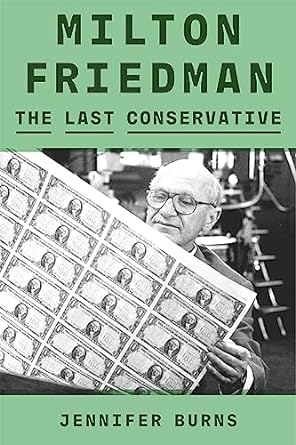
Jennifer Burns on Milton Friedman

Who was Milton Friedman? Jennifer Burns of Stanford University finds in her biography of Friedman that the answer to that question is more complicated than she thought. Listen as she and EconTalk’s Russ Roberts discuss how the now-forgotten Henry Simons shaped Friedman’s thought, the degree to which Friedman had a deep understanding and belief in […] The post Jennifer Burns on Milton Friedman appeared first on Econlib.

/ Learn More

Applying Arnold Kling’s Three Languages of Politics

Matt Yglesias points out that the Israeli-Palestinian conflict is covered more intensively than similar crises in other parts of the world. Here he responds to a question: The Bad Blog: What other problems do you think are like Israel/Palestine in that they should be covered less because they are simply very intractable? To be clear, it’s not the intractability per se of Israel/Palestine that means it should be covered less. My issue is the actual scale. There are more displaced refugees in eastern Congo than the entire population of the West Bank and Gaza combined. But it’s not just that Israel gets more coverage than Congo (there are certainly valid reasons for that), it gets more than 1,000 times as much coverage. And that’s true in both directions: the deaths of Israelis get dramatically more coverage than similar death tolls would elsewhere and so do the deaths of Palestinians. Tractability is the next phase of the analysis. Is all this attention-paying helping? That would be a good reason to pay attention to something. But it pretty clearly isn’t. I find it useful to view this question through the perspective of Arnold Kling’s brilliant three languages of politics. Here’s a quick bullet point summary of Kling’s ideas: – Progressives will communicate along the oppressor-oppressed axis. “My heroes are people who have stood up for the underpriviliged. The people I cannot stand are the people who are indifferent to the oppression of women, minorities and the poor” – A conservative will communicate along the civilization-barbarism axis. “My heroes are people who have stood up for Western values. The people I cannot stand are the people who are indifferent to the assault on moral virtues and traditions that are the foundation for our civilization” – A libertarian will communicate along the liberty coercion axis. “My heroes are the people who have stood up for individual rights. The people I cannot stand are the people who are indifferent to the government taking away people’s ability to make their own decision” The most passionate debate over the recent Israel-Palestine fight is centered on the conservative and progressive views. I’ll call the progressive view “leftist”. Conservatives see the conflict as civilized Israel under siege from barbaric Palestinians. Leftists see the conflict as powerful Israel oppressing weak Palestinians. In the end, I’ll suggest a fourth language, and provide an example. Let’s begin by thinking about views that conservatives and leftists share. They both view Israelis as in some sense being superior to Palestinians. Conservatives believe Israeli culture is superior in a wide range of dimensions; moral, political, religious, economic, etc. Leftists also see Israel as superior, but in a narrower sense. They see Israel as powerful and highly educated, and hold it to higher moral standards than other states that are oppressing minorities (Myanmar, Sudan, Ethiopia, Yemen, Azerbaijan, Congo, etc.)  Leftists typically don’t speak out when minority groups are oppressed in other Middle Eastern countries. Here it helps to recognize that both conservatives and leftists are obsessed with identity politics. Thus the instinctive support than many conservatives have for Israel is closely related to their instinctive hostility to immigration from poorly functioning countries. And the instinctive support that leftists have for Palestinians is related to their instinctive support for low-income minorities in Western countries. You might argue that I’ve oversimplified the situation, and you’d be correct. I am only describing one aspect of the recent debate, although I’ll argue that it’s an increasingly dominant aspect. To be sure, there’s a history to these issues that in some respects cuts in the other direction. The Holocaust is a dark cloud that looms over the Western imagination, especially among people of a certain generation. Throughout much of history, anti-Semitism was associated with the political right. Thus there are still lots of left-of-center people who recall how Jews were victimized and sympathize with Israel, and there are some right-of-center people with anti-Israel feelings motivated by anti-Semitism. But it’s clear that things are evolving in the direction that Kling outlined above. The dispute is increasingly framed as either civilization/barbarism or oppressor/oppressed. Here’s one way to see why it’s evolving in this direction. For centuries, Western European Jews were attempting to live with gentiles in cosmopolitan societies like Germany and Austria. They were willing to do so without substantial political power. But the gentiles would not allow them to live in peace, repeatedly persecuting Jews. After the Holocaust, it’s not surprising that Jews would want their own state, i.e. become “nationalist”. But centuries of anti-Semitism were linked to the notion that Jews were too cosmopolitan, an awkward fit for the increasingly nationalistic politics in Europe during the early 20th century. For this reason, the interests of today’s Jews doesn’t neatly code as either left wing or right wing. But it’s clearly trending right, as younger generations see a (nationalistic) Jewish state that’s now 75-years old, and have only distant memories of when Jews were primarily an oppressed minority group that favored cosmopolitan diversity over nationalism. In my view, there are actually 4 languages of politics—two identity driven ideologies (conservative/leftist) and two universal political ideologies (deontological libertarians and utilitarians). The utilitarians are missing from Kling’s framing. They evaluate issues on a cost-benefit basis, valuing each human being equally. (Deontological libertarians also view each person as having equal worth, but view issues from a liberty/coercion perspective.) Matt Yglesias has several insightful essays that look as the Israeli/Palestinian problem from a dispassionate perspective, not instinctively favoring either group. He’s an excellent example of a utilitarian pundit whose approach doesn’t fit neatly into Kling’s framework. Most utilitarians (including Yglesias) are center-left, although I’m center-right for reasons I’ve explained ad nauseam in other posts. On the Israeli-Palestinian dispute my views are almost identical to those of Yglesias (and if we disagree on any point, he’s probably right and I’m probably wrong.) Here are his essays: https://www.slowboring.com/p/palestinian-right-of-return-matters https://www.slowboring.com/p/israels-two-wars [To be clear, I’m not saying that rational unbiased people must agree with Yglesias; many may sincerely hold alternative views.  I’m saying that most of the passionate debate that you see today is among people that are not unbiased.] If this post seems too cold and clinical, let me assure the reader that I’m human too. At a visceral level, the deaths in this conflict sadden me more than an equal number of deaths in Myanmar. I get why people think it’s important. But I also believe it is important to challenge our biases. One reason we care more about this conflict is because the media gives us heartbreaking stories of individual families that are affected, something they don’t typical do for other conflicts such as Myanmar. Which leads me (finally) to the point I’ve been trying to make from the beginning: The reason we find this dispute to be so compelling is the same reason the dispute exists in the first place. I don’t mean that the press coverage causes the dispute; I mean that we find the dispute compelling because of perceptions (on both the left and the right) that Israelis are very different from Palestinians—and should be treated differently. And that perception of important differences, linked to differences in how we value people, is also why these groups have trouble coexisting. We don’t perceive German and French-speaking Swiss people as being all that different, and thus it’s not surprising that German and French-speaking Swiss people have little trouble co-existing in a single country. I believe the right is wrong about immigration. But the right is correct that the left wing model of immigration is flawed. Bringing in low SES immigrants and then creating separate enclaves via identity politics and a welfare state is a recipe for disaster. Places like the US, Canada and Australia have mostly avoided that problem (there’s lots of intermarriage), but immigration can create problems if not done right (see France). Various ethnic groups do have important differences. PS. Both conservatives and leftists will cite other reasons for caring more about this dispute than about other ethnic conflicts. Don’t believe them. We don’t care so much because Israel is in an important part of the world, or because Israel gets US foreign aid, or any of the other phony excuses often cited. Arnold Kling’s framework explains it. PPS. Slightly off topic, but I also associate myself Matt Yglesias’s recent comments on the implications of this debate for free speech: Most university campuses did not greet the initial Hamas attack on Israeli civilians with the kind of ponderous “statement” that schools have been issuing more and more of in response to noteworthy world events. That prompted backlash from many Jewish alumni who felt a pogrom in southern Israel deserved the full George Floyd treatment. Of course, the reason universities didn’t want to do that is there is a lot of political disagreement about the larger context of the conflict. But — and here’s the point — there’s actually lots of political disagreement about police misconduct and racism and all this other stuff, too. The actual difference is that universities were comfortable taking the progressive side of contested political issues and that was inappropriate. Or to Petrzela’s point, many university offices have been somewhat careless in tossing around the concept of harm or metaphorical violence and that was inappropriate. But the part where the prior conduct was inappropriate is very important. Successfully browbeating universities into issuing statements about how Hamas is bad is a Pyrrhic victory, as is getting them to clamp down on pro-Palestinian demonstrations. Each new inappropriate politicization of the university sets a new baseline and creates a new bad precedent that can be used to further politicize things and further narrow the range of debate. It’s not good enough to say “well, they did it first.”¹ That rapidly becomes a situation where an eye for an eye leaves us all blind. The right thing to do is to use this moment when people are mad and university administrators are vulnerable to pressure institutions to adopt the Chicago Principles on free speech and academic freedom or something very similar. (0 COMMENTS)

/ Learn More