This is my archive

bar

Just when you thought things couldn’t get any worse

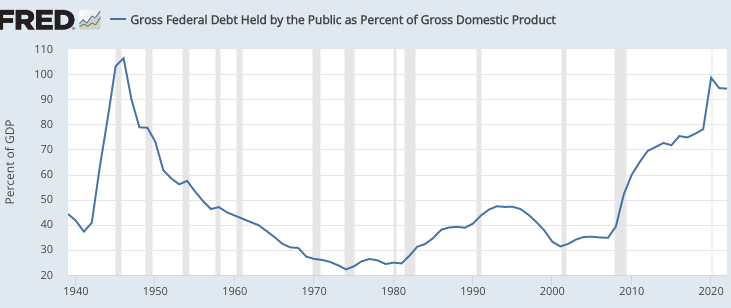
Ever since the late 2010s, the US fiscal situation has been on an unsustainable path. Of course, the problems began even earlier.  But since the late 2010s, the budget deficit has become so large that the ratio of debt to GDP keep rising even during boom periods.  The situation is about to get worse.  Here’s Bloomberg: The US economy is set for an unexpected fiscal boost if lawmakers back a potential deal for $70 billion worth of tax breaks for businesses and families. . . . “This is going to be a decent amount of fiscal cost with very little of it going to encourage new investment in a time when there are still inflation pressures,” Goldwein said. Still, the plan could be a boon for President Joe Biden, whose poll numbers have slumped amid voter anxiety over the economy. Asked how the White House is weighing the potential inflationary impact of any proposal, Biden’s top economic adviser instead emphasized benefits of the bill. Inflation is not the issue here—the Fed offsets the impact of fiscal stimulus.  The real problem is the debt time bomb.  Our political system no longer has “grown-ups in the room”, and thus our fiscal policy increasingly resembles that of a banana republic: At the very least, the tax negotiations underscore that lawmakers remain a long way from entering an era of austerity even amid warnings from ratings firms and investors that the US fiscal trajectory is unsustainable. After WWII, our public debt to GDP ratio fell sharply.  That occurred due to a combination of small budget deficits and fast rising nominal GDP.  Over the past three years, NGDP has again risen rapidly, but this time we no longer have the small budget deficits.  Even worse, NGDP growth is set to slow sharply as part of the Fed’s anti-inflation program.  If this happens, the debt ratio will begin rising again: Even permanently high inflation would only be a temporary expedient, as it would eventually feed into higher nominal interest rates due to the Fisher effect.  (In addition, it’s recently become clear that inflation is extremely unpopular with the general public.) The only long run solution is some combination of higher taxes and lower spending.  The longer we wait, the more painful the adjustment.  I don’t see any major candidate addressing these issues, and thus it’s reasonable to assume that things will get much worse before the problems are addressed.  (0 COMMENTS)

/ Learn More

My Weekly Reading

woman trying to steal trousers from a clothing store Less time to read this week because of a talk I prepped and gave on Friday evening. Four main things. Robert Lawson, “Remembering James Gwartney, 1940-2014,” American Institute for Economic Research, January 10, 2024. Like Bob, I was a fan of Jim, a smart and humane man. I learned a lot from Bob’s appreciation that I hadn’t known. This paragraph stands out: He earned his PhD at the University of Washington writing his dissertation on the economics of labor market discrimination, which led to his first publication in the prestigious American Economic Review. At Washington, Jim took numerous courses from future Nobel Laureate Douglass North, and his interest in institutional economics began at this time. He learned his microeconomics from greats like Walter Oi (who was blind and thus would become an inspiration for Jim in later years) and Yoram Barzel, and he took a course in public choice economics from Tom Borcherding, who had been a student of future Nobel Laureate James Buchanan. What a great faculty Jim learned from. Of the people mentioned above, I knew Walter best because we were colleagues at the University of Rochester, Walter in the econ department and me in the b-school. But I was also a fan of Tom Borcherding, who had such a great unvarnished way of stating basic truths. 2. John F. Early, “Book Review: Poverty by America,” Regulation, Winter 2023-24. Excerpt: His only explicit answer to the question [how much poverty is “so much?”] is a claim that America has more poverty than any other advanced democracy, based on data from the Organisation for Economic Co‐​operation and Development (OECD). But the OECD definition of poverty is different from the American definition, which Desmond adopts throughout the book except when he is justifying his “so much” claim. The OECD defines the poor in a country as families with incomes below one‐​half the median income in their country, but this measure describes poverty in terms of income distribution, not material condition. Consider that Americans whom the OECD deems poor have between 40 percent and 100 percent more income than people it identifies as poor in other advanced OECD countries. This relative measure leads to the paradox that a family in the United States with an income of $30,685 would be counted as poor, while families with income of only $14,141 in Italy or $21,904 in France would not be counted as poor. Using the same income standard for all countries shows the United States has at least 60 percent less poverty than other developed democracies. Early is, of course, the co-author, with Phil Gramm and the late Robert Ekelund, of The Myth of American Inequality, which I reviewed here. 3. Richard B. McKenzie, “The Fragility of Civil Society,” Econlib, January 1, 2024. Excerpt: Contemporary Americans could be witnessing an escalating breakdown in societal norms, with each loss feeding the breakdown of others, like the spread of a contagious disease. Hayek didn’t dwell on this prospect, but I will in this short essay. My arguments rest on a well-worn conceptual foundation in economics, that of the “tragedy of the commons,” which is inherently unstable, because of the role of widespread volition in norms’ value and survival. The theme of this essay is that a breakdown in societal norms shares the same economic foundations as a run on a bank, although perhaps at a slower pace. 4. Frank Markus, “First Drive: Toyota’s $10,000 Pickup Truck Is Perfect: So Why Are We Sad?” Motortrend, November 6, 2023. Excerpt: The Toyota Tacoma pickup is built in America for Americans and Canadians, to dodge the “chicken tax,” but 181 other countries around the world get the Toyota Hilux pickup. It looks a bit like our Tacoma, but more basic. You’d recognize it from global news footage of relief aid or conflict areas. Well, apparently it had gotten a trifle fancy and at about $15,200 to start, it was pricing itself out of some of those markets. The Toyota IMV 0 intends to fill in that low-cost space beneath the Hilux with a target starting price of $10,000. It made its debut at the 2023 Japan Mobility Show, wearing cool Land Cruiser 70 Series style. Shortly after the Tokyo show, we took one for a spin.   (0 COMMENTS)

/ Learn More

Invalid Arguments in a WSJ Editorial

The editorials of the Wall Street Journal are often very good and economically literate. Not so much this one, whether one agrees or not with its conclusions: “Taylor Swift’s Carbon Allowance” (January 16, 2024). It criticizes carbon-offset markets, which offer the very rich (such as Taylor Swift) and large corporations a way to buy virtue. The offsets do not necessarily offset anything because the activity they represent (not cutting trees to offset carbon spitting from a private plane, for example) may not have been carried out anyway. The problem is that the editorialists use arguments that economists have proven invalid a couple of centuries ago. Consider this one: But unlike, say, oil, carbon allowances don’t inherently possess an economic value. “Inherent economic value” is a meaningless expression in economic analysis. Value comes from supply and demand. Anything (1) demanded by somebody willing to pay a price that covers at least its cost, and (2) whose production requires the use of scarce resources that have a value because they can serve to produce something else—any such stuff, material or not, has an economic value. The fact that something is freely exchanged for money on a market proves that it has a value, and it has nothing to do with any “inherent value.” This is true for bubble gum, Picasso paintings, bitcoins, and the services of fortune tellers. Oil only has a value because some people are willing to pay for it and suppliers use resources that could have been used to produce something else of value. If no consumer wanted anything made with oil, its “inherent” value would fall to zero. Ignorance of these elementary economic truths can lead to other errors—for example: [Allowance] credits generated from not logging can be even more profitable than timber sales. Why is that supposed to prove? Innumerable examples exist of higher prices and profits generated from not producing something else, a simple consequence of economic scarcity. A resource has a price precisely because it has alternative uses and one use prevents another. Hunters or even tree huggers (tree huggers are people too) who buy a piece of forest land generate utility (that is, what they prefer to do with their money) for themselves and, for the land seller, something “even more profitable than timber sales.” There is nothing wrong with private environmental associations buying land with private money (see my “Producing Public Goods Privately,” Regulation, Fall 2012). Mortgages generated from building houses instead of planting something on the land can even be more profitable than potato sales. And so forth. I am agnostic as to whether carbon offsets do anything good for the future of mankind (or humor). But, to the extent that the allowances are not purchased or sold under government coercion or threat thereof, pieces of paper that certify whatever and have a market price must respond to a demand from users (say, Taylor Swift) at a price at which suppliers are willing to produce them, even they only certify some presumed virtue. If somebody wants to buy holy water at a price a supplier is happy to accept, who are we to criticize the transaction? Perhaps, as the WSJ editorialists suggest, carbon offsets or some of them are a scam, but the people who buy them are presumably adults. If the scam originates in the intervention or participation of governments or in some other form of coercion, this and not something else is what needs to be criticized and with valid economic arguments. If a cause needs a nonsensical economic argument, it is not a good cause. But why not throw another argument in the balance in case it’s the one that sticks? Well, rational analysis in the search for the truth does not work that way (although the shock of bona fide arguments is useful). I am reminded of an old joke: A guy is sued by his neighbor for returning with a big hole a beer mug he had borrowed. “Your Honor,” the defendant’s lawyer tells the Court, “our case rests on three facts. First, my client never borrowed the mug. Second, when he borrowed it, the hole was already there. Third, he returned it in perfect condition.” (0 COMMENTS)

/ Learn More

Cray 1978 versus iPhone 2022

If you want to see a truly amazing trip down 44 years of memory lane, check out this comparison of the 1978 Cray computer, at the time the most powerful computer in the world, and the 2022 iPhone. I won’t bother giving you the specifics because the narrator, Dave Darling, does a very good job. In talks I gave in the early 2000s in which I highlighted the huge advances in computing, I said that if we had seen the same advances in, say, kidney surgery, you could have decided whether to get kidney surgery–or buy yourself a cup of coffee. Now the comparison would be way more extreme. The video reminds me of the less spectacular, but still spectacular, effects of the lightbulb that William D. Nordhaus pointed out years ago. Interestingly, in granting him his half of the Nobel Prize in economics, the Nobel committee didn’t even bother to mention what I thought was one of his biggest contributions. Here’s what I wrote on the issue in my biography of Nordhaus in David R. Henderson, ed., The Concise Encyclopedia of Economics: He showed that the price of light in 1992, adjusted for inflation, was less than one tenth of one percent of its price in 1800. Failure to take this reduction fully into account, noted Nordhaus, meant that economists have substantially underestimated the real growth rate of the economy and the growth rate of real wages. HT2 Jeff Hummel. (1 COMMENTS)

/ Learn More

What I’ve been reading

Here are a few recent articles that I found to be quite interesting.  1. The first is from Reason magazine: When Trade War Threatens Real War Biden is blurring the lines between economic policy and military action. This excerpt caught my eye: But the Biden administration is building on the Trump administration’s attempts to blur that line. Some former Trump administration officials are giving cover to the effort. In an October interview with The New York Times, the Trump-era national security adviser Matt Pottinger not only echoed Sullivan’s framing of the U.S.-China relationship as one where America must maintain “as large of a lead as possible” but argued that doing so will mean actively inhibiting China’s technological advancement. “The Biden administration understands now that it isn’t enough for America to run faster—we need to actively hamper the [People’s Republic of China]’s ambitions for tech dominance,” Pottinger said. “This marks a serious evolution in the administration’s thinking.” For such officials, it is no longer enough for trade to make America more prosperous. They think it’s at least equally important to prevent certain other countries from prospering too. It’s an inherently militaristic outlook, one that views the entire global economy as part of a battlefield. 2.  In the past, I’ve tried to explain the difference between patriotism and nationalism.  The Economist has an article on European sports that illustrates the difference: For years politicians of the hard right in France grumbled about the national football team being, in their chauvinist eyes, not quite French. Many of its most dazzling stars hailed from the banlieues, sporting names like Zinedine and Karim.  French patriots root for the French team.  French nationalists root for players that share their ethnicity. 3.  People used to roll their eyes when I suggested that anti-smoking regulations were the first step toward an outright ban.  Now the bans are beginning to happen.  The UK is copying New Zealand’s decision to gradually phase in a total ban on cigarettes.  The Economist points out that the nanny state is a good example of how political power corrupts: This intoxicating mix of ease, price and instant legacy means even libertine politicians become statist in power. For years Boris Johnson, a former editor of the Spectator, took aim at the fusspot nature of New Labour. It was the inalienable right of an Englishman to stuff his face with chocolate, crisps and cheese if he so chose. “Face it: it’s all your own fat fault”, ran one of his columns in 2004. But once in power, it was Mr Johnson who pushed an anti-obesity scheme that would ban daytime advertising of junk food. Outside a few columnists and the occasional Tory mp, there are few libertarians in British politics. (0 COMMENTS)

/ Learn More

Wartime Economic Planning

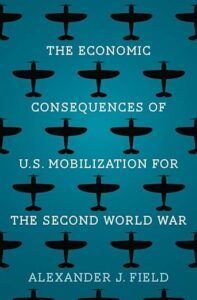
I recently read Alexander Field’s book The Economic Consequences of U.S. Mobilization for the Second World War. Field argues that, contrary to popular belief, wartime production substantially reduced the productivity of the U.S. economy, and the effects of the wartime economy continued to hamper economic productivity for years after the war ended. He makes a persuasive argument, but what I found most interesting about the book was how it presents a case study into the pitfalls of top-down planning. Throughout the book I continued to find jaw-dropping examples of planning decisions that defied all reason. For example, Allied military efforts were severely hampered by a lack of landing craft – the kind of boats used to offload soldiers and equipment directly onto shores and beaches. Field quotes Winston Churchill as saying “How it is that the plans of two great empires like Britain and the United States should be so much hamstrung and limited by a hundred or two of these particular vessels will never be understood by history.” Historians may struggle to understand it, but few economists would be surprised. The number and mix of ships being built was centrally dictated by planners. So the outcome would only be as good as the knowledge or assumptions that could fit into the individual heads of the planners making the call. And, unfortunately, far too few landing craft were built because planners assumed they’d be unnecessary. Field cites a “lack of interest in the navy, which assumed that operable ports would quickly be secured following initial assaults, which would allow men and material to be easily unloaded.” Many major campaigns were called off or severely delayed, because planners simply didn’t know – and had no way of knowing – what kind and amounts of equipment would be best.  Another decision that seems mind-boggling in retrospect was regarding the very serious threat posed by the disruption of rubber – something critically important to military as well as civilian production. The vast majority of rubber was imported from Singapore, and there was a real threat that the Japanese would invade Singapore and cut off the supply of rubber – which is exactly what happened. While this possibility was well known in advance, it was dismissed as worth worrying about, in no small part because “Roosevelt himself apparently thought that if war in the Pacific came, the Japanese could be quickly beaten, that reserve stocks of natural rubber along with scrap rubber drives could enable the country to weather any temporary disruption of imports,” so no care was given to building up a reserve stock of rubber. The failure of this assumption to hold led to attempts to create a domestic synthetic rubber production program, paired with severe rationing of the use of rubber in the United States. Field notes that the synthetic rubber program has been hailed by some as a “miracle.” He takes a rather more dim view. He says that to “describe something as miraculous is to suggest that we witnessed an outcome that could not be or was not reasonably expected or anticipated.” But, reviewing the actual record of the synthetic rubber program, Field argues that describing the performance of the program as a “miracle” amounts to a backhanded compliment, writing “What the United States achieved can appear miraculous only if one has a poor view of U.S. war-planning, organizational, and engineering capabilities. One cannot both have a decent opinion of the latter and claim a miracle.” Ultimately, he concludes the only miracle to be found is that “given the design of the program and the delays in building the plants, it was a miracle its execution did not lead to the loss of the war.”  The litany of terrible decisions made in the synthetic rubber program are too numerous to list out here. But of particular interest is the decision about which basic pathway to use to make synthetic rubber. There were two different routes to take in the production process – one based on petroleum, and one based on alcohol derived from plants. The chemistry had long been worked out, particularly for the alcohol pathway. Field notes that while “the fifty-one government-owned plants had little initial experience with a number of the processes chosen, the chemistry allowing rubber to be created synthetically, based mostly on European research, had been understood for at least two decades.” For example, “During World War I, the Soviet Union produced synthetic rubber from plant sources (mostly potatoes and wheat) and continued to do so during World War II.” Field also notes that the Soviets offered to share their experience with the United States but the offer was ignored.  Field compares what the historical record shows on the pros and cons of the alcohol pathway and the petroleum pathway, and concludes that the alcohol pathway made far more sense. For one, “the country was sitting on an inventory of over a billion and a quarter tons of grain, accumulated as the result of agricultural price support programs in the1930s, and indeed the surpluses were overflowing storage facilities. The grain was available, the costs of acquiring it had already been incurred…at that historical moment the costs of acquiring the feedstock should be treated as sunk, and thus its effective price was zero.” Additionally, “substantial capacity for fermenting molasses lay idle…The idle molasses-refining capacity could easily be converted to use grain as a feedstock.” Adding to the case for alcohol, “the liquor-distilling portions of the alcohol industry…had excess capacity that could be used to produce alcohol from grains. The use of the molasses and grain spirits-distilling capacity, since it was already available, would not conflict with the other war demands for equipment or construction manpower.” Another important point was that unlike using petroleum, “making alcohol from plants was unlikely to conflict with the needs of the aviation fuel program.”  Lastly, “alcohol pathways for producing butadiene had been successfully exploited for years…whereas the petroleum-to-butadiene pathways involved challenges that were likely to delay production. In sum, the alcohol pathways were simpler and there was considerable experience with them, the raw material inputs were in abundant supply, substantial refining capacity was already available, and if additional facilities were needed, they could be built more quickly with fewer requirements for equipment or building supplies that were or were likely to be in short supply.”  You can probably guess what happened next. Planners decided to downplay the alcohol pathway and heavily emphasize the petroleum pathway (much to the delight of Standard Oil), and in the initial round of the program “only 80,000 short tons of the 550,000 short tons of butadiene needed to produce the then-targeted production of GR-S rubber was to be alcohol based (that is, relying on butadiene made from alcohol)…Moreover, none of that alcohol was to come from plants: it was all to be produced from petroleum.” Congress attempted to course-correct this with the Rubber Supply Act of 1942, which would have refocused on alcohol rather than petroleum. However, the Act was vetoed by FDR, because he saw the act as “a direct challenge to his authority, as it removed control from the executive branch agencies he had created.”  No doubt some of these decisions were the result of corruption or just sheer incompetence. But there is another factor that also explains a significant fraction of the issue, which I’ll be touching on in my next post.    (0 COMMENTS)

/ Learn More

Tabling TABOR

In short, TABOR is a way to limit the growth of government. Under the amendment, revenue in excess of the TABOR limit must be returned to taxpayers, though it appears the legislature has some discretion in how it distributes those funds. But Colorado’s legislature, chafing at TABOR’s limits, has been trying to undercut the amendment. It recently succeeded and, in doing so, redistributed revenues from the most productive people to the least productive. This is from David R. Henderson, “Tabling TABOR,” TaxBytes, Institute for Policy Innovation, January 17, 2024. Read the whole thing, which is the shortest TaxBytes I’ve written. (0 COMMENTS)

/ Learn More

Mr. Trump, Meet Princess Mathilde

Donald Trump, who is sued for defamation by writer Jean Carroll, mumbled his discontent visibly or loudly enough yesterday during the latter’s testimony that the judge threatened to remove him. It is tempting to relate this to what he previously advocated for libel laws and also to Princess Mathilde, a niece of Napoléon Bonaparte (portrayed on the featured image of this post). (Libel is written defamation, although I am not sure if Mr. Trump knew or cared about the difference.) When he was running for the presidency in 2016, Trump famously said that he would strengthen libel laws to make suits easier to win. He was targeting his political enemies in the press but the changes he adumbrated might have helped Ms. Carroll’s suit. In February 2016, he said (the short accompanying video is also worth watching): One of the things I’m going to do if I win, and I hope we do and we’re certainly leading. I’m going to open up our libel laws so when they write purposely negative and horrible and false articles, we can sue them and win lots of money. We’re going to open up those libel laws. So when The New York Times writes a hit piece which is a total disgrace or when The Washington Post, which is there for other reasons, writes a hit piece, we can sue them and win money instead of having no chance of winning because they’re totally protected. Trump repeated his threat in 2018. In other countries, notably the United Kingdom, defamation laws are easier to invoke so that the rich and powerful are better able to silence writers and critics with suits or threats thereof. That somebody can be sued for disclosing information about another person does not sit well with libertarian ideals, especially when the information is true and no harassment is involved. Murray Rothbard argued against any ban on defamation. At any rate, defamation laws are an easy tool against free speech. Some people entertain a hedonistic-narcissitic conception of the state, whereby anything that the state does to favor them is good, and anything that the state does not do to favor them is condemnable. Mr. Trump is not the only one to embrace this conception, but he does it with a vengeance and little attempt at coherence. Anthony de Jasay illustrated hedonistic-narcissistic statism with Princess Mathilde. In his article “Before Resorting to Politics,” reproduced in his book Against Politics, de Jasay’s writes: Why does anyone want to resort to politics and why does anyone put one kind of political order above another? Those who are both very earthy and very frank approve the one they believe is doing the most good for them. He then quotes Jacques Bainville, a French old-style conservative (anti-liberal) historian and political writer (the translation is de Jasay’s): The way truly to understand history is the way of Princess Mathilde [Bonaparte]. She would not forgive those who spoke ill of Napoleon because, as she explained, “without that man, I should be selling oranges on the warf in Marseilles.” It is an unavoidable fact if and only if the state has the power to make anybody happy at the detriment of others or miserable in order to favor others. Bainville had nothing against that. Classical liberals and libertarians do. (0 COMMENTS)

/ Learn More

Is the United States Beyond Hope?

On Fox News Channel’s Gutfeld last night, guest Dennis Miller asked frequent guest Emily Compagno if she didn’t just feel hopeless about the way things are going in the United States. One of the things that had led to this was her denunciation of some pro-Palestinian protestors saying “shame on you” to people at a hospital for cancer patients. It was pretty disgusting. The conversation that followed was one of the most interesting I’ve seen on Gutfeld and hard to replicate. Miller was clearly saying that one should feel hopeless about the future of this country. I’m not so convinced. It’s easy to find, in a country with over 300 million people, thousands here and thousands there who just act horribly. But what does that really say about the country? I’ve been at two local events in the Monterey area in the last two weeks that attracted people of divergent political views. I live in a heavily Democratic area and I’m a libertarian who, right now, is registered Republican. The first event was a Braver Angels event. It was dominated by people on the left. But what I noticed, besides that, was the good will among pretty much everyone. An economist friend who was there pointed out that you would expect that because of self-selection. Who goes to such an event when the explicit purpose is to have people of divergent views talk civilly to, and try to understand, others? People willing to do that. But the second event was not at all guaranteed to have people select for reasonableness. It was a meeting with a local politician named Kate Daniels who is running for the Monterey County Board of Supervisors. She got to speak but people at each table got to speak also. She’s clearly a big-government person. One of her ideas that I disliked the most was to subsidize renters who are having trouble paying rent. Subsidizing demand while not allowing more supply is a bad idea. Daniels faced a lot of pushback from various people. It got particularly heated when she was talking about a state requirement that, implemented by a local government agency, required Pacific Grove, the city where the event occurred, to allow the building of 1125 new housing units. Someone in the audience yelled out that he or she (I can’t remember who) wanted no new units. About 5 or so people (out of about 35 people) applauded. But Daniels argued effectively. She pointed out that it’s hard to find a doctor who will take you because even doctors who are starting out find the price of housing in the area daunting. That interaction was actually my favorite moment. It reminded me of my favorite moment in the movie Jerry Maguire. It’s when Cuba Gooding’s character, Rod Tidwell, says to Jerry Maguire, played by Tom Cruise, “You think we’re fightin’ and I think we’re finally talking.” There were lots of differences among the various participants. But the discussion was totally civil. It’s one sample point, I know. But so was that horrible behavior outside the New York hospital. (0 COMMENTS)

/ Learn More

Bad business: The role of subsidy and regulation

According to The Economist, customer service in America is getting worse, and that matches my own experience. For instance, I recently had trouble with my dental insurance, which was accidentally cut off at the beginning of the year. My wife and I had numerous phone conversations with the multiple layers of bureaucracy that handle this policy, but it’s like talking to a brick wall. [If you are interested, my former employer has a company called Voya manage their employee benefits, and they were supposed to instruct CareFirst dental to re-instate my insurance.  Voya insisted they sent the information, CareFirst denied getting it.  Even a three way phone call failed to resolve the issue.] I looked online, and Voya’s Los Angeles office seems to have a horrible record with customers, so we are not alone.  In addition, the exact same problem happened last year, and it was a hassle to get the issue resolved. Although these are all private companies, I blame the government for our distress.  To see why, consider the market for auto repair insurance.  You could buy insurance for auto repairs, to cover the cost when you need a transmission overhaul, a brake job or a replacement of calipers.  But these insurance policies are typically not a very good deal, and I have no interest in purchasing one.  The same is true of home repair policies.   So what makes dental insurance different?  The answer is simple; these policies are heavily subsidized by the federal government, whereas home and auto repair policies are typically not subsidized.  Dental insurance is a very inefficient system, which would have trouble surviving in a free market.  But if a third party is going to pay 40% of the cost (via tax breaks), that’s enough to induce many firms to offer dental insurance as a “fringe benefit”, part of their total compensation package. In this particular case, I would have opted to avoid dental insurance even with the subsidy if I had known how incompetent the firms would be.  But when making a decision, one can only form an estimate of the quality of the output.  With large government subsidies, a product can be highly wasteful to society and yet still be privately beneficial to the buyer.  Note that even if the companies had not screwed up the delivery of my dental insurance, I’d still be paying the salaries of all the people who work for the dental insurance companies, and the companies that manage the benefit plans of my employer.  That’s economic waste, as these people could be doing much more productive things with their time. Dental insurance is only one of many problems with the dentistry industry.  In a new post, Matt Yglesias explains how dentists often prescribe unneeded treatments.  That’s also my experience.  I’ve known of numerous cases where dentists said extensive work was needed, and a second opinion showed the person’s teeth were in fine shape.  This is an example of the principle-agent problem.  The agent (the dentist) has a strong financial incentive to overprescribe dental work. Although dentists are private companies, I also blame the government for this problem.  Yglesias explains the underlying problem: One might think that since the work of a routine dental appointment is done by a hygienist rather than a dentist, a standard oral health appointment would simply be with a hygienist who lets you know if you need more specialized dental care. In reality, however, “scope of practice” rules pretty strictly limit which services a hygienist can provide, and only in Colorado and Oregon can hygienists perform diagnostic work. In a free market, I’d try my best to avoid dentists and instead go to a dental hygienist that did not do actual dental repair.  I would want my “agent” to have no financial interest in overprescribing dental work.  If anything, I’d be more likely to go to a hygienists that under-prescribed dental work, as I’d feel happier leaving the office if told my teeth were in fine shape.  Unfortunately, that sort of rational dental industry is only available in two states.   There are many industries where I have few problems, including grocery stores, hair salons, dry cleaners, clothing stores, etc.  When I do have bad experiences, it’s generally with industries that are heavily distorted by bad regulations and subsidies.  These include health care, insurance, travel, pharmacies, housing, and auto dealers.  The problems fall into several categories: 1. Government subsidies that push customers toward inefficient and annoying firms, such as dental insurance. 2.  Government regulations that prevent efficient ways of delivering a good or service, such as direct sales from a manufacturer to the consumer (as in the auto industry.) 3.  Government regulations that dramatically increase costs and reduce quality by restricting supply, especially in health care and housing. 4.  Government regulations that prevent people from signing contracts promising not to sue over certain issues. Can’t find an effective painkiller for that toothache?  Blame government rules requiring a prescription.  Can’t find a Boston apartment that will rent to families with small children?  Blame government regulations that ban contracts waving your right to sue over lead paint.  Frustrated that US airlines don’t offer the good service you had on Singapore Airlines?  Blame government regulations that ban foreign airlines from serving domestic markets.  Frustrated that your children cannot afford to live where you grew up?  Blame zoning regulations that restrict the supply of housing. People who are ignorant of the role of government often blame “capitalism” for problems they have in various sectors of the economy.  In some cases, that simple explanation is true.  But in most cases I’ve seen, the ultimate problem is government subsidy and regulation. PS.  After writing this post I read the transcript of a Tyler Cowen interview of Patrick McKenzie.  McKenzie was asked why fees for Western Union transfers are so high, and responded: Due to anti–money laundering and know-your-customer requirements, the amount of compliance drag on small transfers of value in the world is very, very large. Again, look closely enough and it’s almost always bad government policies. (0 COMMENTS)

/ Learn More