This is my archive

bar

Defending the Small Stuff

We’ve all heard the adage “don’t sweat the small stuff.” (And if by some chance you’ve never heard it before, well…now you have.) The general idea is that little things, being little, don’t really matter that much and we shouldn’t get too worried about them. This seems fairly reasonable at first glance. But another view was offered on an episode of The Simpsons, by Homer’s temporary new boss (and James Bond style supervillain) Hank Scorpio. Asked by Scorpio why he seems so glum, Homer says it’s just a lot of little things. Scorpio responds by saying “You can’t argue with the little things. It’s the little things that make up life.” Perhaps I’m revealing the hidden depths of my character here, but for now, I’m going to side with the supervillain. But first, a seemingly random tangent on Twitter theatrics. (I’m still saying Twitter and not X, just like I still say Google and not Alphabet.) So, a while ago there was a bit of a row on Twitter about, of all things, banana availability as a metaphor for capitalism. One thread written by one of Twitter’s many socialist denizens mocked the idea that the ready availability of bananas is anything worth caring about, writing “No one, absolutely no one – not even the most dishonest globe emoji neoliberal freak – buys a banana at Trader Joe’s in Calgary in December and marvels in ecstasy at the decadent opulence of modern capitalism. They dully cross it off their list and move on, barely conscious of it.” She further asserts that nobody is made happier by having bananas and we “will not be poorer for replacing them with other foods.”  In case my earlier statement about siding with the supervillain didn’t do enough to reveal the moral rot in the depths of my soul, let me further reveal I apparently exceed what some imagine “even the most dishonest globe emoji neoliberal freaks” are capable of, because I absolutely do have this reaction when buying bananas. I think bananas are great. They’re tasty, they have a fantastic micronutrient profile, and they’re easy to handle and eat. My two young children also really love them, which makes the task of ensuring my children get lots of fruits and vegetables in their diet just that much easier. And the fact that even in the darkest and coldest parts of the Minnesota winters, I can go to any grocery store at any time and buy seven pounds of fresh bananas for about three dollars is something that absolutely inspires a measure of awed delight in me.  (As an aside, she is on to something when she says most people just “cross it off their list and move on, barely conscious of it.” Part of the reason I don’t have that reaction, and am instead filled with wonder and gratitude, comes from studying economics. In The Use of Knowledge in Society, F.A. Hayek described the market system as a marvel and adds that he “deliberately used the word ‘marvel’ to shock the reader out of the complacency with which we often take the working of this mechanism for granted.” This complacency, unfortunately, is still quite widespread.)  Adding to this, consider the time that Senator Bernie Sanders dismissed the importance of consumer choice among a wide range of products, saying that you “don’t necessarily need a choice of 23 underarm spray deodorants or of 18 different pairs of sneakers” available to you. Just as our Twitter socialist thinks nobody’s life would be poorer for lacking bananas, the socialist Senator doesn’t see much value in having a wide variety of deodorants and sneakers. But, again, I have to out myself as an unfathomable freak and disagree with the Senator. Having a wide variety of shoes and deodorants is, in fact, a very good thing.  Let’s start with deodorant. I agree that for many people this isn’t a matter of great importance. I use it out of basic respect for the world, but I don’t really have much of a preference here – most varieties of deodorant are, to me, perfect substitutes. However, my wife is particularly sensitive to smells. Scott Alexander once said of himself, “I can’t deal with noise. If someone’s being loud, I can’t sleep, I can’t study, I can’t concentrate, I can’t do anything except bang my head against the wall and hope they stop.” Smells have a similar effect on my wife, and if I wore a deodorant with a smell she found obnoxious, it was a pretty big deal to her. Luckily, one brand of deodorant I picked out via my usual method (randomly grabbing whatever was closest when I realized I needed to buy more) had a scent she found rather pleasant, so I’ve just stuck with that kind ever since. This benefit may seem trivial when perched on high in Sanders’ ivory tower, but to some people, it makes a really big difference.  The same can be said of shoes. If you’re someone who finds it difficult to find shoes that fit your feet well, or if you have issues with your feet that can make walking difficult or painful, being able to find just the right kind of shoe can have a huge impact on your quality of life. I don’t know how many varieties of shoes Sanders has divined is the “right” amount – fewer than 18, apparently. If the kind of shoe that works out perfectly for you isn’t among the variety of shoes Senator Sanders thinks is important enough to be offered – well, too bad for you I guess. You’ll just have to go on experiencing pain and limited mobility.   Even beyond the functional aspect of shoes, there’s also an aesthetic and cultural component. For example, consider this episode of EconTalk where Russ Roberts interviews Josh Lubar about, among other things, the “sneakerhead” culture. These are people who love sneakers, collect them, trade them, and have a whole community and culture built up around this shared interest. Personally, I don’t get it or understand the interest, but that’s fine – that’s just my opinion and I don’t rule the world. Nor would I want to. But my own personal indifference to sneakers doesn’t change the fact that for many people, having lots of sneakers available is a great source of joy and community, and I’m glad they have that. Unlike either the socialist Senator or the socialist Tweeter, I don’t confuse my own lack of interest in something as proof that it can’t actually be that important to anyone else.  So that’s one upshot of this whole episode. Be aware that just because something may seem trivial to you, this doesn’t mean that it has a trivial impact on the lives of other people. Part of what is lost in the collectivist mindset is a real appreciation of just how wide a diversity of thoughts, opinions, tastes, and preferences there are in the world. It’s just not the case that having only a few different options is basically as good as a wide range of options. People aren’t interchangeable cogs or chess pieces. What looks like trivialities to you might be enormously valuable to someone else.  The second upshot brings me back to Hank Scorpio and his contention that the little things are what make up life. Let’s just grant that the sudden disappearance of bananas would in fact be at most a minor downside for me, and thus the presence of bananas was really only a minor positive. Still, we shouldn’t lose sight of the fact that this “minor” benefit brought about by markets and commerce is just one of a hundred million other similar “minor” benefits – benefits that flood our lives so much they have become as invisible to us as the water in which a fish swims. And a hundred million small improvements to the quality of people’s lives adds up to a monumental improvement in the quality of life. Bananas, deodorant, shoes – these may all be “little things” in the minds of some. But life is made up of the little things, even if some treat those things as beneath them.  (0 COMMENTS)

/ Learn More

The Washington state experiment

Over the years, I’ve done numerous posts pointing to the fact that states without an income tax tend to grow faster than more highly taxed states.  A part of that growth is related to the post-WWII sunbelt phenomenon.  But not all.  States lacking an income tax tend to grow faster than even nearby states with a similar climate. Washington is another interesting case—one of the few northern states without an income tax.  And Washington has also been one of the fastest growing northern states—until now.  Here’s the Wall Street Journal: An interesting natural experiment has been Washington state, which gained tens of thousands of people from other states on net each year in the last decade. But since enacting a 7% capital-gains tax on higher earners in 2021, Washington has been losing residents to other states at an accelerating pace—15,276 this past year. Could that be a reason, or is Seattle’s crime problem a better explanation? I doubt whether crime is the decisive factor—Texas and Florida also have plenty of crime. That’s not to suggest that taxes are the only issue.  Strict zoning laws keep property prices high in place slike California and New York, and that also slows population growth.  But zoning cannot explain why Washington suddenly went from being a high growth state to a slow growth state.  Taxes are very important, especially income taxes. (0 COMMENTS)

/ Learn More

The Case for High Drug Prices

  Almost all new drugs are developed for the U.S. market, no matter where the company’s headquarters are. Why? America is a large, rich country with an advanced medical system. America’s gross domestic product per capita is 65% higher than Britain’s, 57% higher than Germany’s and 87% higher than France’s. There are four Americans for every German and nine Americans for every Canadian. We have many wealthy people. The Food and Drug Administration, which moves slowly, is still often faster at approving new drugs than regulatory bodies in other countries. While far from a free market, our medical system is freer than in many other nations. Countries with single-payer systems often take one to two years to negotiate the price of a new drug. If a patent is granted for 20 years but the first 13 years are dedicated to development and approval, then only seven years of patent-protected sales remain. If two years are added to that timeline for reimbursement negotiations, the interval drops to five years. If new drugs can make it in America, they are developed. If they can’t, they aren’t. Other countries are considered secondarily. They are the cherry on top; we’re the sundae. This is from David R. Henderson and Charles L. Hooper, “Be Thankful for High Drug Prices,” Wall Street Journal, February 4, 2024 (February 5 print edition.) We closed the op/ed with a WSJ editor on Sunday, something I’ve never done before. I’ll post the whole thing in early March. I haven’t been posting as much in the last few days because once again, our electric power is out. We had huge winds that blew over big trees. Our electric power went out Sunday morning while we were closing the piece–thank goodness for modern technology in the form of a hot spot on my phone–and it won’t be back until Thursday evening. This time, though, we have a generator and it’s saving the food in our fridge–and providing some light. Around the time we were closing the op/ed I saw a talk by Deirdre McCloskey that she gave in D.C. on Saturday. It contradicted what we wrote. I’ll post on her reasoning in the next few days. (1 COMMENTS)

/ Learn More

Public Health from the People

There are many ways to privately improve public health. Such responses make use of local knowledge, entrepreneurship, and civil society and pursue standard goals of public health like controlling the spread of infectious diseases. Moreover, private responses improve overall welfare by lowering the total costs of a disease and limiting externalities. If private responses can produce similar outcomes as standard, governmental public health programs—and more—perhaps we should reconsider when and where we call upon governments to improve public health. Two Kinds of Private Responses Following Vernon Smith and his distinction between constructivist and ecological rationality, private actors can engage in two general kinds of public health improvements. They can engage in concerted efforts to improve public health, and they can engage in emergent responses through myriad interactions.1 Three stories below—about William Walsh, Martha Claghorn, and Edwin Gould—indicate concerted efforts to improve public health. Walsh, a Catholic priest and President of the Father Matthew Society in Memphis, Tennessee, used the society to organize a refugee camp outside of the city and helped hundreds of people avoid yellow fever during the 1878 epidemic—one of the worst yellow fever epidemics in the country.2 Shortly after learning mosquitos carried diseases prior to 1901, Claghorn chaired the Civics committee of the Twentieth Century Club in the Richmond Hill area of Long Island and led a community-wide anti-mosquito campaign, which rid the area of potentially infectious mosquitos.3 After realizing that many of his employees were sick with malaria, Gould—president of the St. Louis Southwestern Railway—used his wealth and business firm to finance and develop an anti-mosquito campaign throughout Texas.4 These stories show how individuals recognize a public health problem given their circumstances and use their knowledge and available resources to resolve the problem. More recently, we might all be familiar with private, constructivist responses to Covid-19. We all made plans to avoid others and produce our desired amount of exposure. Many people made facemasks from old clothes or purchased them from facemask producers. Businesses, retailers, restaurants, and many others adapted in various ways to limit exposure for their workers and customers. My favorite example, albeit not relevant for most, is the so-called bubble that was implemented by the NBA, which housed teams, encouraged play, and limited infection. The NBA finished their season and crowned a 2020 champion only because of the privately designed and implemented bubble solution. The key is that the bubble pursued all of those objectives, not just one of them. All of these responses indicate how private interactions among people can minimize their exposure, through negotiation, discussion, and mutually beneficial means. In addition to privately designed solutions, emergent public health responses are also important, perhaps even more so. Long-term migration and settlement patterns away from infectious diseases, consumption to improve nutrition, hygiene, sanitation, and the development of social norms to encourage preventative behavior are all different kinds of emergent public health responses. Each of these responses—developed through the actions of no one person—are substantial ways to improve public health. First, consider how common migration operates as a means of lowering prevalence rates. As soon as people realized that living near stagnant bodies of water increased the probability of acquiring diseases like malaria, they were more likely to leave those areas and subsequently avoid them. Places with such features became known as places to avoid; people also developed myths to dissuade visitors and inhabitants.5 Such myths and associations left places like the Roman Campagna desolate for centuries. These kinds of cultural associations are also widespread; for example, many people in North and South Carolina moved to areas with higher elevation and took summer vacations to avoid diseases like malaria. East End and West End, in London, also developed because of the opportunities people had to migrate away from (and towards) several diseases.6 While these migration patterns might develop over decades, movement and migration also help in more acute public health crises. During the 1878 yellow fever epidemic throughout the southern United States, for example, thousands of people fled their cities to avoid infection. They took any means of transportation they could find. While some fled to other, more northern cities, many acquired temporary housing in suburbs, and many formed campsites and refugee camps outside of their city. The refugee camps outside of Memphis—like the one formed by William Walsh—helped hundreds and thousands of people avoid infection throughout the Fall of 1878. Second, more mundane public health improvements—like improvements in nutrition, hygiene, and sanitation—are also emergent. These improvements arise from the actions of individuals and entrepreneurs, often closely associated with voluntary consumption and markets. According to renowned medical scientist Thomas McKeown, that is, rising incomes encouraged voluntary changes in consumption, which helped improve nutrition, sanitation, and lowered mortality rates.7 These effects were especially pertinent for women and mothers as they often selected more nutritious food and altered household sanitation practices. With advancing ideas about germs, moreover, historian Nancy Tomes argues that private interests advanced the campaign to improve house-hold sanitation and nutrition—full of advice and advertisements in newspapers, magazines, manuals, and books.8 Following Tomes, economic historians Rebecca Stein and Joel Mokyr substantiate these ideas and show that people changed their hygiene, sanitation, house-hold cleaning habits, and diets as they learned more about germs.9 Such developments helped people to provide their desired exposure to germs according to their values. Obviously, there were concerted public health improvements during this time that also explain falling mortality rates. For example, waterworks were conscious efforts to improve public health and were provided publicly and privately, with similar, positive effects on health.10 The point is that while we might be quick to connect the health improvements associated with a public water system, we should also recognize emergent responses like gradual changes in voluntary consumption. Finally, social norms or rules that encourage preventative behavior might also be relevant kinds of emergent public health responses. Such rules identify behavior that should or should not be allowed, they are enforced in a decentralized way, and if they follow from the values of individuals in a community.11 If such rules pertain to public health, they can raise the cost of infectious behavior or the benefits of preventative behavior. Covering one’s mouth when sneezing is not only beneficial from a public health perspective, it also helps avoid earning disapproval. The condom code during the height of the HIV/AIDS epidemic is another example of an emergent public health rule that reduced infectiousness by encouraging safer behavior.12 People who adopted safer sexual practices were seen to be doing the right thing—akin to taking care of a brother. People who refrained from adopting safer sexual practices were admonished. No single person or entity announced the rule; rather, it emerged from the actions and interactions of individuals within various communities to pursue their goals regarding maintaining sexual activity and limiting the spread of disease. Indeed, such norms were more effective in communities where people used their social capital resources to determine which behaviors should be changed and where they can more easily monitor and enforce infractions. This seems like a relevant factor where many gay men and men who have sex with men live in dense urban areas like New York and Los Angeles that foster LGBTQ communities. Covid-19 provides additional examples where social norms encouraged the use of seemingly appropriate behavior, e.g., social distancing, the use of facemasks, and vaccination. Regardless of any formal rule in place, many people adapted their behavior because of social norms that encouraged social distancing, the use of facemasks, and vaccination. In communities that valued such behaviors, people that wore face masks and vaccinated were praised and were seen as doing the right thing; people that did not were viewed with scorn. Indeed, states and cities that have higher levels of social capital and higher values for public health tend to have higher Covid-19 vaccine uptakes.13 Improving Public Health and More “Private approaches tend to lower the total costs of diseases and they limit externalities.” While these private approaches can improve public health, can they do more than typical public health approaches cannot? Private approaches tend to lower the total costs of diseases and they limit externalities. Each aspect of private responses requires additional explanation. Responding to infectious diseases and disease prevention is doubly challenging because not only do we have to worry about being sick, we also have to consider the costs imposed by our preventative behaviors and the rules we might impose. Thus, the total costs of an infectious disease include 1) the costs related to the disease—the pain and suffering of a disease and the opportunity costs of being sick—and 2) the costs associated with preventative and avoidance behavior. While disease costs are mostly self-explanatory, the costs of avoiding infection warrant more explanation. Self-isolation when you have a cold, for example, entails the loss of potentially valuable social activities; and wearing condoms to prevent sexually transmitted diseases forfeits the pleasures of unprotected sexual activity. Diseases for which vaccines and other medicines are available are less worrisome, perhaps, because these are diseases with lower prevention costs than diseases where those pharmaceutical interventions are not available. Governmental means of prevention also add relevant costs. Many readers might be familiar with the costs imposed by our private and public responses to Covid—from isolation to learning loss, and from sharp decreases in economic activity to increased rates of depression and spousal abuse.14 Long before Covid, moreover, people bemoaned wearing masks during the Great Flu,15 balked at quarantine against yellow fever,16 and protested bathhouse closings with the onset of HIV.17 Figure 1 shows the overall problem: diseases are harmful but our responses to those diseases might also be harmful. Figure 1. The Excess Burden of Infectious Diseases This figure follows Bhattacharya, Hyde, and Tu (2013) and Philipson (2000), who refer to the difference between total costs and disease costs as the excess burden of a disease. That is, excess burden depends on how severely we respond to a disease in private and in public. The excess burden associated with the common cold tends to be negligible as we bear the minor inconvenience of a fever, a sore throat perhaps, or a couple days off work; moreover, most people don’t go out of their way to avoid catching a cold. The excess burden of plague, however, is more complicated; not only are the symptoms much worse—and include death—people have more severe reactions. Note too that disease costs rise with prevalence and with worsening symptoms but eventually decline as more severe diseases tend to be less prevalent. Still, no one wants to be infected with a major disease, and severe precautions are likely. We might shun all social interactions, and we might use government to impose strict quarantine measures. As disease severity rises along the horizontal axis, it might be the case that the cure is worse than the disease. The private responses indicated above all help to lower the total costs of a disease because people choose their responses and they use their local knowledge and available resources to select cheaper methods of prevention. Claghorn used her neighborhood connections and the social capital of her civics association to encourage homeowners to rid their yards of pools of water; as such she lowered the costs of producing mosquito control. Similarly, Gould used the organizational structure of his firm to hire experts in mosquito control and build a sanitation department. These are cheap methods to limit exposure to mosquitos. Emergent responses also help to lower the total costs of a disease because such responses indicate the variety of choices people face and their ability to select cheaper options. People facing diseases like malaria might be able to move away and, for some, it is cheaper than alternative means of prevention. Many people now are able to limit their exposure to mosquitos with screens, improved dwellings, and air conditioning.18 Consider the variety of ways people can limit their exposure to sexually transmitted diseases like HIV. If some people would rather use condoms to limit HIV transmission, they are better off doing so than if they were to refrain from sexual activity altogether. Similarly, some people would be better off having relatively risky sexual activity if they were in monogamous relationships or if they knew about their partner’s sexual history. That people can choose their own preventative measures indicates lower total costs compared with blunt, one-rule-for-all, governmental public health responses. Negative and positive externalities of spreadable diseases indicate too much infectious behavior and too little preventative behavior, respectively. Hosting a party is fun, but it also incurs the internal costs of the drinks and appetizers and, more importantly, perhaps the external costs of raising the probability that people get sick. Attending a local cafe can be relaxing, but you have to pay for a cup of coffee and you might also transmit a disease to other coffee drinkers. The same could be said for many other public and social activities that might spread diseases like attending a class or a basketball game, transporting goods and people, and sexual behaviors. Our preventative behaviors from taking a vaccine to covering your mouth and from isolation to engaging in safer sexual practices emits positive externalities. If left unchecked, negative and positive externalities lead to higher rates of infection. For more on these topics, see “Can We Have Welfare Without the Threat of Violence?” by Max Borders. Library of Economics and Liberty, Nov. 7, 2022. Keith Smith on Free Market Health Care. EconTalk. Jay Bhattacharya on the Pandemic. EconTalk. “Who Attends You When You Are Ill? Attendant Services Under Consumer-directed Health Care,” by Linda Gorman. Library of Economics and Liberty, Jun. 6, 2011. Overall, we should continue to think more critically about delineating how private and public actors can improve public health and overall welfare. More importantly, we should recognize that private actors are more capable than we often realize, especially in light of conscious efforts to improve public health and those efforts that emerge from people’s actions and interactions. These private efforts might be better at advancing some public health goals than public actors do. Individuals, for example, have more access to local knowledge and can discover novel solutions that serve multiple ends—often ends they value—rather than the ends of distant officials. Such cases and possibilities indicate cheaper ways to improve public health. Footnotes [1] Smith (2009), Rationality in Economics: Constructivist and Ecological Forms, Cambridge University Press. [2] For more on Walsh, see Carson (forthcoming), “Prevention Externalities: Private and Public Responses to the 1878 Yellow Fever Epidemic,” Public Choice. [3] For more on Claghorn, see Carson (2020), “Privately Preventing Malaria in the United States, 1900-1925,” Essays in Economics and Business History. [4] For more on Gould, see Carson (2016), “Firm-led Malaria Prevention in the United States, 1910-1920,” American Journal of Law and Medicine. [5] On the connection between malarial diseases, dragons, and dragon-slaying saints, see Horden (1992), “Disease, Dragons, and Saints: the management of epidemics in the dark ages,” in Epidemics and Ideas by Ranger and Slack. [6] For more on migration and prevalence rates, see Mesnard and Seabright (2016), “Migration and the equilibrium prevalence of infectious disease,” Journal of Demographic Economics. [7] The American Journal of Public Health published several commentaries on McKeown in 2002: https://www.ncbi.nlm.nih.gov/pmc/issues/130602/ [8] Tomes (1990), “The Private Side of Public Health: Sanitary Science, Domestic Hygiene, and the Germ Theory, 1870-1990,” Bulletin of the History of Medicine. [9] Mokyr and Stein (1996), “Science, Health, and Household Technology: The Effect of the Pasteur Revolution on Consumer Demand,” in The Economics of New Goods, NBER. [10] See Werner Troesken’s work on public and private waterworks in the U.S. around the turn of the 20th century. See Galiani, Gertler, and Shargrodsky (2005), “Water for Life,” Journal of Political Economy. [11] Brennan et al., (2013), Explaining Norms, Oxford University Press. [12] For more on the condom code, see Carson (2017), “The Informal Norms of HIV Prevention: The emergence and erosion of the condom code,” Journal of Law, Medicine and Ethics. [13] Carilli, Carson, and Isaacs (2022), “Jabbing Together? The complementarity between social capital, formal public health rules, and covid-19 vaccine rates in the U.S.,” Vaccine. [14] Leslie and Wilson, “Sheltering in Place and Domestic Violence: Evidence from Calls for Service During Covid-19.” Journal of Public Economics 189, 104241. Mulligan, “Deaths of Despair and the Incidence of Excess Mortality in 2020,” NBER, https://www.nber.org/papers/w28303. Betthauser, Bach-Mortensen, and Engzell, “A systematic review and meta-analysis of the evidence on learning during the Covid-19 Pandemic,” Nature Human Behavior, https://www.nature.com/articles/s41562-022-01506-4 [15] On the great influenza epidemic, see CBS News, “During the 1918 Flu pandemic, masks were controversial for ‘many of the same reasons they are today’.” Oct. 30, 2020. https://www.cbsnews.com/news/mask-1918-flu-pandemic-controversial/ [16] On yellow fever quarantine in Mississippi, see Deanne Nuwer (2009), Plague Among the Magnolias: The 1878 Yellow Fever Epidemic in Mississippi. [17] On these closures, see Trout (2021), “The Bathhouse Battle of 1984.” https://www.sfaf.org/collections/beta/the-bathhouse-battle-of-1984/ [18] Tusting et al. (2017), “Housing Improvement and Malaria Risk in Sub-Saharan Africa: a multi-country analysis of survey data.” PLOS Medicine. *Byron Carson is an Associate Professor of Economics and Business at Hampden-Sydney College in Virginia, where he teaches courses on introductory economics, money and banking, health economics, and urban economics. Byron earned his Ph.D. in Economics from George Mason University in 2017, and his research interests include economic epidemiology, public choice, and Austrian economics. This article was edited by Features Editor Ed Lopez. (0 COMMENTS)

/ Learn More

Elon Musk, Sam Bankman-Fried, and Adam Smith’s Impartial Spectator

Book Review of Going Infinite: The Rise and Fall of a New Tycoon, by Michael Lewis1 and Elon Musk, by Walter Isaacson.2 Economists don’t find people all that interesting. Many of us have friends and family, but our models and analysis are devoid of personality and character. We talk about principles and agents, about the wages of the median worker, and the representative consumer. We don’t write much about people who like ketchup on eggs, coach little league, go to church, or cheat on their spouses. Yes, I know, any competent grad student could build and test a model that explained all of those things—data on the relative price of condiments, the opportunity cost of leisure, and the tradeoff between current pleasure and future pain can’t be that hard to find or fake. But would an ambitious economist ever go there? If you sit in on seminars by up-and-coming assistant professors, you will often hear humble-bragging about how they’re exploring a “novel data set.” There’s nothing wrong with that. But why do we never get a seminar exploring novel people? I’m not saying we need to construct an economics of quirky behavior. I care a lot more about, say, the impact of zoning laws than about whether some lover of spicy eggs prefers Tabasco to salsa. But I wonder if paying more attention to real human beings—maybe even embracing the outliers—can help us see things about how our actual economy works that might not be revealed by even the most novel of data sets. I’ve been thinking about all of this after finishing two recently published biographies of two unusual people: Going Infinite, Michael Lewis’ account of Sam Bankman-Fried [SBF] and Elon Musk, Walter Isaacson’s portrait of Elon Musk. Make no mistake, these books sit atop best seller lists because people like to read about the lifestyles of the rich and famous. But these are also books about important economic events. I wonder if we look at them as economists and not voyeurs, can we learn something about economic ideas? To be honest, I wasn’t thinking about such things when I pre-ordered Going Infinite. Michael Lewis is a good storyteller and I’m a sucker for any story he wants to tell. It showed up in my Kindle on Tuesday, October 3, coincidentally (or not?) just in time for the start of Bankman-Fried’s trial for fraud. I finished the book two days later. The trial ended a month after that with a conviction on all counts. Finishing the book before the end of the trial was not surprising. The book is short and the story—well, it’s not fun in the same way as, say, Moneyball but it’s one of those horrific train-wreck kind of things you have to watch. A trial sorting out all the illegal, unethical, and just deeply creepy things that define Bankman-Fried took time. But as far as I can tell, no one—except maybe Michael Lewis who seemed to form this weird bond with Bankman-Fried—is surprised at the result. In any case, waiting on the slowly turning wheels of justice gave me plenty of time to read Elon Musk. Published just a week before Lewis’ book, I hadn’t really thought about reading it at all, but I needed something to flush the ickiness of the Bankman-Fried story out of my mind. It worked. What Do These Books Tell Us About How the Economy Works? Going Infinite will leave anyone—but especially economists—unnerved that someone as broken and unmoored as SBF could somehow acquire so much wealth and power. I tell my students that markets reward at least a certain kind of virtue. In the well-ordered market economy of my dreams Bankman-Fried would never have lived in a $37 million condo and crisscrossed the world in private jets. If he’d tried really hard to become a better person, maybe he’d have found useful work as an assistant fry cook at a Waffle House. You might come away from Isaacson’s book thinking that Musk is his own kind of broken and unmoored. I think that’s wrong or at least too simplistic, but that’s not the most obvious thing for economists to take from the book. What matters is that whatever kind of crazy lives inside Elon Musk, the stuff that Musk made possible is glorious. Economists need to think about how our economic system worked so spectacularly well in harnessing the talents of Musk and seemingly failed so miserably in dealing with Sam Bankman-Fried. Start with Musk’s most obvious success, Space X, which launched its first rocket capable of safely placing useful objects into low earth orbit in 2006. Before then rockets were the business of Boeing and Lockheed, government contractors designing and building for NASA and the military on cost plus contracts. Before Space X, rocketry was about as far removed from the market as any massive government project could be. That worked about as well as you’d expect. In 2006 thirty-six objects were launched into space from the United States, just one-third of the world-wide total. In 2022 there were 2478 objects launched, with 1939 from the United States. Most of these objects rode on some model of Space X’s Falcon rocket. It once cost $65,000 to launch one kilogram into low earth orbit. To launch something on a Space X rocket now costs about $1500 per kg, with a realistic promise of even more dramatic price drops to come. “Could a modern-day Adam Smith have written about the butcher, the brewer, and the rocket maker?” So, did Space X do such great things because our economic system harnessed Musk’s self-interest in service of the greater good? Could a modern-day Adam Smith have written about the butcher, the brewer, and the rocket maker? Absolutely! Whatever drives Elon Musk—Gordon Gecko like greed, ego, or a maniacal impulse to make the world a better place—his ambitions and desires have been channeled by the same invisible hand that made it possible for Adam Smith to have a beer with his steak sandwich. The cover of Elon Musk is filled with the steely face of the Great Man, the genius iconoclast unconstrained by convention. Isaacson reports that Musk constantly told his employees that “the only immutable rules were those decreed by the laws of physics.”3 Musk may have believed that, but it’s certainly not how he ran Space X. Like any business, Space X was enmeshed and constrained by the invisible hand of the market. Musk set out to build a vastly more efficient launch system. Scientists and engineers have their own definitions of efficiency, but that’s not the kind of efficiency that mattered most to Musk. Space X needed to build rockets that were commercially viable, which is just another way of saying that their rockets had to be economically efficient. And the only way to strive for and measure that kind of efficiency is in reference to prices and other market signals that respond to real and meaningful information. Isaacson’s book has lots of stories of Musk’s maniacal push for better materials, designs, and building methods. Falcon rockets, for example, are full of stainless steel, a material once considered unsuitable for powerful rockets. Without Musk’s relentless bullying of his design team, Falcons would have been made with titanium and aluminum. Yes, of course, Musk pushed for stainless because he’s a brilliant iconoclast who understands the “immutable laws of physics,” But he also knew the relative price of metal and the relative productivity of metal workers. Falcon rockets are a triumph of determined genius. They’re also a triumph of well-functioning markets sending valuable signals. Contrast that with SBF. Suspend disbelief for a moment and imagine that he was something other than an arrogant con man. Is what he did still ok? Did FTX, Alameda, and his other businesses depend on well-functioning market signals to direct resources in an efficient manner? That’s a complicated question but dig deeply enough and you see that the answer is no. SBF’s customers on his crypto exchange, FTX, speculated in highly leveraged derivatives tied to hundreds of different, mostly lightly traded, forms of crypto. Those trades made sense only to those who thought that prices were misaligned. Without the promise of trading profits that rose out of some sort of market failures, FTX would have been about as interesting and profitable as a well-run community bank in West Texas. In other words, unlike Space X, which needed well-functioning markets to know how to build rockets, FTX depended on a certain kind of market failure. Not that there’s anything wrong with that. Moving commodity prices back into alignment with real economic forces is a useful and honorable business. Commodity prices signal important information. Speculators make that information more accurate. A modern-day Adam Smith could have also written approvingly about butchers, brewers, and commodity speculators. But crypto was never a normal commodity. The prices on FTX didn’t signal much of anything real or meaningful. Whatever information was driving the relative prices of all those crypto currencies was not anything anyone working in the real economy needed to know. Elon Musk would not have changed the design of a single fastener on a fuel line because of the relative price of, say, Ripple XRP and Chainlink.4 At first glance crypto markets look a beehive of self-interested trader-drones working to profit by helping to correct tiny markets failures. But shine an economist’s light and you realize those “market failures” are in fact the result of government failure. All those different cryptocurrencies were created and then traded all over the world. Both the currencies and the exchanges were governed by different rules in different places. The price anomalies that made trading exciting arose from all those regulatory differences. Shine an economist’s light and you see regulatory arbitrage. Now here it is important to be clear. A simplistic story that there wasn’t enough regulation is just wrong. Governments all over the world were all over those markets. With the promise of buckets of money, the politicians and bureaucrats were never going to take a laissez-faire, “let the boys have fun” stance. A story about how there were the wrong types of regulations is closer to the truth but still not quite right. Yes, crypto was being regulated by the wrong people in wrong ways, but that wasn’t an accident. People like SBF were driving the regulatory environment. In 2022 SBF contributed $100 million to politicians in the US. In Dubai SBF tried to convince financial regulators to evict Binance, FTX’s main competitor. FTX paid $135 million for naming rights to the Miami Heat’s arena, $162 million for the right to put their logo on baseball umpire’s uniforms and tens-of-millions to secure endorsements from clueless celebrities. These were more than simple advertising, they were investments in PR that would make the political investments pay off. In 1962 George Stigler and Claire Friedland published their paper “What Can Regulators Regulate? The Case of Electricity.” That article inspired a huge body of research on “regulatory capture,” including Stigler’s classic 1971 paper, “The Theory of Economic Regulation.” In the years that followed economists have come to realize that regulations are not written by wise bureaucrats maximizing some social utility function. Regulations come from the self-interest of the regulators and the regulated where the most concentrated interests have a huge advantage. In the world of crypto, SBF and a handful of other players were the concentrated interests. What Would Adam Smith Think? We can’t know, of course, but I suspect that Adam Smith would have come away from these two biographies thinking more about The Theory of Moral Sentiments [TMS] than The Wealth of Nations [An Inquiry into the Nature and Causes of the Wealth of Nations]. That’s a bit embarrassing for me since what I’ve written about so far—how markets and other institutions channel the energy of people like Musk and SBF—comes straight off the pages of The Wealth of Nations. I don’t think Smith would say my answers are wrong or that I’m asking dumb questions but I think he’d remind me that Moral Sentiments comes first. Literally. Moral Sentiments was published seventeen years before Wealth of Nations. Smith wanted people to think about human nature before they started thinking about the consequences of human nature. That’s good advice for economists,5 but it’s hard. It’s not what we’re trained to do. We’re trained to think about human nature as an immutable fact, kind of like gravity.6 Read these two books back-to-back and you see that’s wrong. The differences between people matter. If we’re going to get our economics right, we can’t pretend that people are all alike. Musk and SBF didn’t make different choices because they faced different budget constraints. They made different choices because they were different’ people. How and why were they different? I’m not sure I’ve got good answers—certainly nothing as good as we’d get from Adam Smith—but let me try. Let’s start with something very important to Smith, “self-interest”. It’s something that doesn’t quite mean what some people think it means. Suppose that Musk and SBF were good at business.7 Fine, so was Ebeneezer Scrooge. But do Musk and SBF fit Dickens’ description of Scrooge as a “squeezing, wrenching, grasping, scraping, clutching, covetous old sinners“? Sure. But that doesn’t make them different than you and me. Everybody is greedy. Everybody likes nice things. Rich guys these days—unlike rich guys in Dickens’ day—can enjoy literally every single consumption good available on earth. They can eat whatever they want, watch every sporting event being played anywhere on earth and sleep wherever they prefer. Musk and the un-incarcerated version of SBF would never have sat in the middle seat of a budget airline. But the remarkable thing about modern times is that you don’t have to be super rich to get most of those nice things, ordinary middle-class money is enough. If you want sushi and all the sports channels, just finish school, master some useful skills, and show up for work on time. If you want to avoid the middle seat and fly private, work a bit harder, take some risks and get a bit lucky. The point is that Elon Musk and SBF could have had any material thing they wanted without working nearly as hard, taking as many risks or, in the case of SBF, cheating. In the movie Wall Street Gordon Gecko makes his famous speech about how “Greed is good,” and we’re supposed to see him as a despicable villain. In comparison to the real world billionaires we see in these two biographies, Gecko is just a small-minded, tedious little man. Greed isn’t very remarkable and doesn’t explain very much. So if ordinary greed doesn’t separate Musk from SBF or the rest of us, what does? Again, Adam Smith, this time in TMS, gives us a big clue: the Impartial Spectator. That’s the character Smith describes as “The man within the breast, the abstract and ideal spectator of our sentiments and conduct.” The Impartial Spectator is the part of our nature that makes us something other than Dickensian squeezing, wrenching, grasping, scraping, clutching, covetous old sinners. Fine, you say. We’ve all seen Pinocchio. Everybody knows about your “conscience.” In Smith’s telling, though, the Impartial Spectator does much more than chirping at us when the party gets weird. The Impartial Spectator oversees two very different things: our conduct and our sentiments. We need the Spectator monitoring our conduct because we’re social animals. We need other people. But to make the essential social connections, others have to judge us. And the only way they can do that is by observing our conduct. The Spectator tries to show us how others see us. When you ask yourself what would your Mom think, or how what you’re up to would look on a 60 Minutes feature, you’re consulting your Impartial Spectator. But the Impartial Spectator is also supposed to observe our “sentiment.” That’s different than our conduct and, importantly, means something more than our emotional state of mind. To Smith it’s a way of describing what we value and what we want. Russ Roberts, host of EconTalk and author of How Adam Smith Can Change Your Life, is fond of quoting the famous line from TMS, “Man naturally desires, not only to be loved, but to be lovely.” And how can we “be lovely”? By trying to want the right things. So how well did their Impartial Spectators do with the job of advising Musk and SBF on how other people saw them? Not good at all. Both men were said to lack empathy, something that was attributed to their being somewhere on the spectrum of autism, Lewis and Isaacson are classy writers, but they can’t describe their subjects without using the word “asshole.” The question of how well the Impartial Spectators did on the other job, monitoring sentiment, Is harder to judge. Even the best biography can only tell us what the main character did, not what they wanted. Still, there’s plenty of evidence to suggest that SBF and Musk wanted very different things. The most obvious difference is that SBF was a liar. We now know from the trial that he lied about very big things—the promise to look after $8 billion of other people’s money was a whopper. But Going Infinite makes clear that SBF would lie about anything. The first chapter of Lewis’ book is called “Yup.” It mostly recounts SBF’s agreeing to do things—give a speech, attend a meeting and so forth—with no real intent to do what he promised. There is no such chapter in Musk. Not everyone likes Elon Musk but there aren’t many people who think he’s a liar. Now it may be that Musk was just smarter than SBF, that despite Musk’ lack of empathy he knew it was important to build a reputation for honesty. But it could also be that Musk listened to his Impartial Spectator telling him that he should want to be honest. We can’t know exactly what went wrong inside SBF—maybe his Impartial Spectator didn’t bother to tell him that lying is wrong, or maybe SBF was too busy playing video games to listen. Once you start looking for them, you will find lots of other contrasts between the character of two men. I think it’s important to note that Musk has 11 kids and-despite the complexity of his personal life—appears to be a good, caring father. The childless SBF, on the other hand, has an emotionally abusive relationship with a co-worker. Read both books and see if you agree with me that, in the language of Adam Smith, Musk was a lovely man and SBF was not. For more on these topics, see Erik Hoel on Effective Altruism, Utilitarianism, and the Repugnant Conclusion. EconTalk. Arnold Kling on Twitter, FTX, and ChatGPT. EconTalk. “Neoliberalism on Trial: Artificial Intelligence and Existential Risk,” by Walter Donway. Library of Economics and Liberty, Sep. 4, 2023. Adam Smith Comics: The Butcher, The Baker, and the Brewer. Paula Richey and Jeremy Lott. Adam Smith Works. Someone I respect recommends reading books in groups. That sort of concentrated reading doesn’t just give you different takes on similar questions, it often gives you insights into issues bigger than the narrow topic of the books. Read these two books back-to-back and you’ll see how our economic system allows the creation (and in SBF’s case destruction) of massive wealth. But you’ll also see how important character is in shaping outcomes. Adam Smith understood all of this. Economists should too. Footnotes [1] Michael Lewis, Going Infinite: The Rise and Fall of a New Tycoon. W. W. Norton and Company, 2023. [2] Walter Isaacson, Elon Musk. Simon and Schuster, 2023. [3] Walter Isaacson, Elon Musk (p. 113). Simon & Schuster. Kindle Edition. [4] Now some crypto fans who’ve read this far might say—probably with a bit of patronizing disdain—that I just don’t get it, that crypto-markets matter because blockchain technology will revolutionize payments, contracting and maybe even our whole monetary system. There’s not much evidence of that so far—Musk himself was skeptical of blockchain and after a call with SBF said “My bullshit detector went off like red alert on a Geiger counter.” But even if you think that someday blockchain will be whatever the utopian dreamers dream, there’s no reason to think that trading on FTX signaled anything at all about the value of blockchain. While we’re at it, let’s acknowledge there may be another use for crypto, although not one the advocates are likely to embrace. Even if the market signals coming out of places like FTX don’t matter to real markets, the attention and resources channeled by FTX might still have served an economically useful function: maybe the traders were all just having a bit of fun. Trading crypto is a zero sum game in exactly the same way as betting on football games or any other gamble—the pot is divided between the winners, the losers and the bookie. Musk didn’t depend on the point spread of football games to build rockets, but lots of guys depend on the point spread to get them out of bed by noon on Sunday. [5] And political scientists, and sociologists, and psychologists, and theologians, and…. [6] This isn’t entirely fair, Adam Smith was hardly the last economist to think about human nature. Some economists—Dierdre McClosky and Mary Hirschfeld come immediately to mind—think about the importance of culture and religious sentiment, important aspects of human nature in shaping economic behavior. And who among us hasn’t enjoyed the just-so stories we get from evolutionary psychology. [7] SBF clearly was not. He appears to have no grasp of the value of good internal accounting systems, and he’d have flunked my MBA class in risk and uncertainty. But that’s not important now. * Michael L. Davis is a member of the faculty at Southern Methodist University’s Cox School of Business and is associated with the Bridwell Institute for Economic Freedom. For more articles by Michael L. Davis, see the Archive. (0 COMMENTS)

/ Learn More

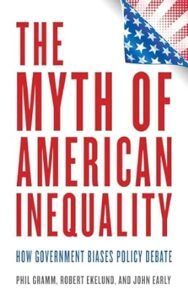
Setting the Record Straight on Income Inequality

Book Review of The Myth of American Inequality: How Government Biases Policy Debate by Phil Gramm, Robert Ekelund, and John Early.1 Everyone knows inequality is growing. As a trio of economists consisting of former senator Phil Gramm, economics professor Robert Ekelund, and economist and former assistant commissioner of the Bureau of Labor Statistics John Early demonstrate, however, everyone is wrong. The supposed rise in American inequality to unacceptable levels has been greatly overstated. Gramm, Ekelund, and Early help us get the facts straight. In The Myth of American Inequality: How Government Biases Policy Debate by Gramm, Ekelund, and Early, their methodological message is simple: “The Census Bureau is accurately measuring what it has chosen to measure, but it is not measuring the right things” (p. 3). Their empirical message is also simple but a lot more controversial: There are certainly people who are physically or mentally unable to care for themselves and have fallen through the cracks in the system that delivers transfer payments, but, for all practical purposes, poverty due to a lack of public or private support has been virtually eliminated in America. (p. 4) The post-tax, post-transfer poverty rate, they argue, is not the 12.3% the Census Bureau reported in 2017, but about 3%. The enormous difference is because the Census Bureau is not measuring the right things. As Gramm, Ekelund, and Early make their argument, they kick the legs out from under the conventional wisdom about inequality. Taxes in the United States are extremely progressive, and the rich pay a higher share of taxes than they earn in income. Income mobility is alive and well. “Tax cuts for the rich” made “the rich” reorganize their affairs so that, as they quote JFK, they spent less time and money on “avoidance of taxes” and more on “production of goods” (pp. 115-116). “Tax cuts for the rich,” they argue, in 1962 and 1986 actually led to the top 1 percent and the top 10 percent paying higher percentages of their incomes in taxes. One of their most striking findings compares the real income distribution today to the real income distribution of the 1960s. After accounting for taxes and transfers, Gramm, Ekelund, and Early argue that the top three quintiles in the 2017 income distribution and two-thirds of the households in the second quintile from the bottom have incomes that would put them in the top quintile of the 1967 income distribution. They recount a series of facts that we take for granted about the diffusion of indoor plumbing, air conditioning, cars, and televisions. Half of households in the bottom two quintiles own homes (p. 28). Restaurant meals used to be the privilege of the rich, but in 2017, “the average bottom-quintile household spent 34 percent of its food budget away from home,” much more than the 27% of top-quintile households in 1967 (p. 146). For the modern rich, cooking is a hobby, not a necessity. To get an idea of what this means, watch an episode from the first season of The Wonder Years, which ran from 1988-1993 and was set in 1968-1973. Would we call the solidly middle-class Arnold family of the late 1960s and early 1970s “poor”? Would we say they hadn’t achieved the American Dream? Their standard of living would have put them in the bottom 40% and maybe even the bottom 20% of the 2017 income distribution. To the extent that the American Dream is harder to achieve today, it is because we have redefined it to mean two (or three) cars rather than one, central heating and air conditioning, a microwave, a programmable coffee pot, multiple streaming subscriptions feeding to multiple giant flat-screen TVs, computers, mobile devices for everyone in the family, an Xbox, and multiple bathrooms (with toilets that would flush and showerheads that would work if they weren’t regulated to reduce water use). In his book The Vision of the Anointed: Self-Congratulation as a Basis for Social Policy, Thomas Sowell referred to what he called “A-ha!” statistics that support left-wing narratives, at least superficially. A bit of further examination, however, causes things to come apart. Talking about what has happened to “the poor,” “the rich,” or “the middle class” across long periods is dangerous because the people at the bottom of the income distribution in 2023 are not the same people who were in the bottom of the income distribution in 1983. First, there is the fact that income distribution statistics are comparing people at different life stages. I was at the bottom of the income distribution as a graduate student in 2002, but it would have been silly to say I was “poor.” I moved up after my wife and I married and created a new household that merged her income with mine. I was in another place in the income distribution in 2012 as an Assistant Professor with three young children, and I occupied yet another place in the income distribution as the Margaret Gage Bush Distinguished Professor of Economics in 2022. I will likely fall down into a lower income quintile should I ever decide to retire (not likely). Second, there is the fact that the population is always changing. Suppose you have five people. One earns $25,000; one earns $48,000; one earns $50,000; one earns $90,000; one earns $100,000. Then two things happen simultaneously: everyone’s income rises by $1000 and four people enter the labor market. One earns $24,000, two earn $30,000, and another earns $200,000. This means we now have one person earning $24,000, one person earning $26,000, two earning $30,000, one earning $49,000, one earning $51,000, one earning $91,000, one earning $101,000, and one earning $200,000. You can expect a flood of headlines about how median earnings have fallen to $49,000 even as the average income in the t​​op quintile has risen by about 50%. The ratio of top to median income has risen from 2:1 to about 4:1, the ratio of top to bottom income has risen from 4:1 to more than 8:1, and people with high incomes are “capturing” a larger share of the total income. The headlines paint a picture of an economy that is working for only the few at the top while everyone else suffers stagnation or decline even though everyone is better off. The real story—that people are earning higher incomes—disappears under the non-story that the median income has fallen not because any actual person’s income has fallen but because the population has changed. The Myth of American Inequality answers the “what’s the point?” question people have about the arcane, minute details of academic research. Measurement is a lot harder than it appears at first. There are well-known problems of technological improvement—a car in 2023 and a car in 1993 or 1973 are very different things—and then there are questions about what to count as “income.” There are wages and salaries, but what about benefits? Should transfers like Medicaid and food stamps be counted as “income”? One of the book’s critics has pointed out that the payments Medicaid makes go to doctors rather than patients and therefore complicate the story, but the patients receive medical services that are, we hope, at least as valuable as what the doctors are being paid for them. Food stamps are not cash, but they spend like cash—at least on approved items (the political economy of how something gets and stays on that list is a dissertation waiting to be written). Do official measures overstate inflation? The answers change how we make policy, write op-eds, argue at the dinner table, and write textbooks. “If we want to know the real story about actual, on-the-ground inequality for living, breathing people, we need to look at measures that account for those taxes and transfers. Once we do so, we get a very different story from what we read in the New York Times.” Since the Census Bureau (and economists) are not measuring the right things, it’s hardly clear we are going to make the right policies. So what should we do in light of this new story about postwar inequality? First, Gramm, Ekelund, and Early argue, we must get the theory straight and do the math right. It is one thing to look at pre-tax, pre-transfer inequality and be horrified. It is something else to think you can get less pre-tax, pre-transfer inequality with taxes and transfers: you cannot, by definition. If we want to know the real story about actual, on-the-ground inequality for living, breathing people, we need to look at measures that account for those taxes and transfers. Once we do so, we get a very different story from what we read in the New York Times. All this makes me wonder why the left does not embrace this book and take a victory lap on behalf of Lyndon Johnson’s Great Society. It seems like, “even Phil Gramm admits we won the war on poverty” would be cause for celebration. All I have seen from the left, however, is breathless indignation about how the authors are heartless because they say poverty has fallen and extol Ebenezer Scrooge’s thrift, and wrong because their approach jars with the claims of economists like Thomas Piketty that ignited the “Occupy” movement in the Great Recession’s aftermath. Second, Gramm, Ekelund, and Early propose changes to how we do welfare with special attention to the work disincentives very high implicit marginal tax rates create. If the 70% marginal tax rates Alexandria Ocasio-Cortez proposed a few years ago would be disincentives to produce at the top of the income distribution, then surely similar implicit rates are disincentives to produce at the bottom of the income distribution. If slashing top marginal tax rates in the 1960s and 1980s unleashed forces of production, then slashing implicit marginal tax rates in 2023 would have a similar effect. Third, the authors go after occupational licensing. When I teach about licensing in my classes, I talk about the medieval guilds and South African apartheid. The logic is the same in all these cases: an interest group enlists the state to protect itself and its members’ incomes from potential competitors. Lest one think these rules are about public safety, they write, New York State recently added a new requirement that entry-level shampoo assistants in beauty parlors and barber shops must complete a five-hundred-hour training course at an average cost of $13,240 before they can practice this complex art that most of us perform daily without mishap. Of course, three of the four regulators issuing this requirement have economic interests in companies that sell the required training. (pp. 181-182) Fortunately, occupational licensing has gotten at least some bipartisan attention—and perhaps more people will come to understand that the poor and downtrodden wouldn’t need so much of our “help” if we weren’t spending so much on trying to “protect” them. I would add another, though I admit it is a pipe dream: we should stop caring so much about inequality per se. It’s reasonable to care about poverty. Having enough food, clothing, and shelter to lead a meaningful life matters, and I am pleased to see people’s possibilities expanding year after year. It’s unreasonable to care about inequality per se. In a commercial society, whether your neighbor has more does not mean you don’t have enough. The qualifier “in a commercial society” is very important. Capitalism is the greatest positive-sum game in history. Competition for admission to elite universities is fierce, but have you been robbed if the kids whose parents read to them every night and hired math tutors get into Stanford, Harvard, and Penn while your kids have to settle for Samford, Haverford, and Penn State? If the extra effort these families put into getting their children into an elite school means they have more skills and higher earnings capacity, then everyone wins. These kids have only been able to get into an elite school by equipping themselves with the tools they need to serve people better. It only becomes a problem when people use those tools to rule rather than serve—by, say, establishing licensing boards and commissions to micromanage the lives of the unshampooed masses. For more on these topics, see Phil Gramm on How Government Biases Policy Debate. The Great Antidote, Adam Smith Works, September 22, 2023. Jeremy Horpedahl on The Real Cost of Thriving Index. The Great Antidote, Adam Smith Works, September 15, 2023. Gabriel Zucman on Inequality, Growth, and Distributional National Accounts. EconTalk. Richard Burkhauser on the Middle Class. EconTalk. “As a nation,” Gramm, Ekelund, and Early write, “we need to get our facts straight.” I agree, and I hope this book moves the policy needle. Resistance will be fierce, of course, given that many people’s careers, incomes, and self-images are inseparable from the “rising poverty and inequality” story and the welfare state we have built to deal with it. The Myth of American Inequality is an important contribution, however, that shows how the story is built on a foundation of theoretical and empirical sand. Footnotes [1] Phil Gramm, Robert Ekelund, and John Early, The Myth of American Inequality: How Government Biases Policy Debate. Rowman and Littlefield, 2022. *Art Carden is Assistant Professor of Economics at Samford University in Birmingham, AL, a Senior Research Fellow with the Institute for Faith, Work, and Economics in McLean, VA, a Research Fellow with the Independent Institute in Oakland, CA, and a Senior Fellow with the Beacon Center of Tennessee. For more articles by Art Carden, see the Archive. (0 COMMENTS)

/ Learn More

The Pre-Modern Order

Pre-industrial society was characterized by low degrees of economic, political and cultural integration. By contrast, a high degree of integration in all three respects is the hallmark of modernity… Economically, modernity breeds integration by its systematic division of labour. All members of modern society specialize in a single economic activity, offering their labour, skill or capital on the market and receiving monetary payment in return. All are thus dependent on the market… Culturally, modernity breeds integration by prising loose the masses from their local communities, getting them together in the same factories and the same cities, subjecting them to the same schooling in the same language from early childhood to late adolescence, bombarding them via the same mass media, and putting an end to the isolation of the communities from which they came. In social and political terms modernity breeds integration by attaching all individuals directly to a bureaucratic state which processes them mechanically without regard for their social, ethnic or religious background. —Patricia Crone, Pre-Industrial Societies: Anatomy of the Pre-Modern World (pp. 206-209).1 Patricia Crone was an historian who specialized in early Islamic society. In Pre-Industrial Societies, which first appeared in 2003, she attempted to spell out the difference between the social order that obtained prior to the industrial revolution and that which we experience today. The book is very broad in terms of its geographic and temporal scope. She draws examples from all of the major continents and over one thousand years of history. But she says that her standard description of pre-modern social orders is “largely based on the Old World civilizations from about 600 BC onwards, and it probably has a medieval bias.” (p. 170) Crone’s thesis is that the preconditions for modernity included mechanized agriculture, energy-powered transportation, and long-distance communication. Without these, subsistence farming prevails rather than markets, long-distance trade is only in luxury goods, a common culture exists only among elites, and rulers have little contact with or control over the periphery of their domains. The fact that agriculture and manufacture alike produced little meant that all pre-industrial societies were dominated by scarcity… the inadequate nature of the means of transportation and communication meant that most people lived in very local worlds. (p. 21) Social stratification was relatively simple. In some societies practically everyone was a peasant apart from the ruling elite, typically less than 2 per cent of the population. More commonly, some 10 per cent of the population were able to leave the production of food. … the contrast with industrialized societies is glaring. Only 2.9 per cent of the population is engaged in agriculture in France, and only 2 per cent in Japan; in early twenty-first-century USA the figure is down to 1.5, and the same is true of Germany. (p. 23) Crone points out that pre-modern peasants produce primarily for themselves, for subsistence. Modern farmers produce primarily for the market, seeking profit. Within a village, very little trade took place, mostly in salt and iron. … the pre-industrial world was characterized by a low degree of economic integration. Where subsistence economy prevailed, every household was more or less self-sufficient and every village largely or wholly independent of the next. (p. 42) Only luxury goods that were worth carrying for long distances, or that could walk themselves, were traded, and these were consumed only by powerful elites. The low level of labor productivity precluded a labor market based on wages and voluntary agreement. Instead, slavery, serfdom, and government conscription (not just for armies) were used to obtain workers. Rather than differentiate workers by skill, All agrarian civilizations made heavy use of ascribed status, that is to say status attributed to a person on the basis of features over which he has no control, such as sex, colour or ancestry… descent rather than market forces determined who should do what (p.38) In the pre-modern era, states were fragile, for a number of reasons. Agricultural societies were vulnerable to raiders, especially those on horseback. It was not until firearms were invented that civilization acquired a decisive advantage over its barbarian rivals (p. 47) The weakness of states, … had its roots partly in scarcity and partly in the absence of modern means of transportation and communication. Scarcity meant that rulers rarely disposed of sufficient resources, or even very stable ones. They were chronically short of personnel and other infrastructure, and frequently unable to pay such personnel as they had. … Being short of personnel, rulers were unable to conduct regular population counts, land-surveys and other forms of inspection required for the regular reassessment of taxes (p. 49) To use James Scott’s terminology, “seeing like a state” was difficult to afford. This was exacerbated by the primitive means of communication that were available. The vast majority of people continued to live in more or less self-sufficient villages with more or less autonomous cultures of their own, a fact which rendered the political unity of pre-industrial states precarious. (p. 51) Pre-modern states had to rest on a narrow base of elite rulers. … the larger a group becomes, the more thoroughly the actions of its members have to be co-ordinated if it is not to disintegrate; and under pre-industrial conditions, large-scale co-ordination was impossible unless power was concentrated in the hands of a few. (p. 53) The ruler’s control was tenuous. The government might issue decrees, but the implementation of these decrees rested with landed magnates, religious authorities, village councils, urban notables, guilds, tribal leaders, or kin groups of various kinds, or in other words with self-governing institutions and groups which might be in close or in loose alliance with the state or which might defy it altogether. (p. 57) Because there was very little state capacity, many functions that we now associate with the state were performed by autonomous groups. Law and order were poorly maintained. Every town had its pickpockets, thieves, burglars, swindlers, murderers, assassins and protection racketeers, just as every road had its highwaymen and every sea its pirates. Private war and local feuds, riots and rebellion, marauding soldiers and brigandage, all these and other forms of disorder were commonplace in most societies most of the time. (p. 66) Moreover, Few pre-industrial states had fixed borders, as opposed to vague frontier areas under the sway of local magnates, tribal groups, bandits or other unruly elements. (p. 77) One can compare this to the model of North, Weingast, and Wallis. Their state is a “limited-access order,” in which the rights to form political and economic organizations are closely held by the members of a ruling coalition. This “natural state” is not in principle one of low state capacity, which sets it apart from Crone’s pre-modern state. Where NWW describe limited-access orders as stable, for Crone, … states were brittle structures which easily collapsed under internal stress or external pressure. The low degree of integration on the one hand and the minimal services performed by the state on the other meant that there was little to hold them together. (p. 70) David Goodhart’s distinction between Somewheres (closely tied to local areas) and Anywheres (cosmopolitan elites) seems to hark back to the pre-modern era, as Crone describes it. The ruling elite had to be everything that the masses were not: where the masses were divided into a myriad of diverse communities, the elite had to be homogeneous and cohesive; and where the masses had a diversity of political interests which mostly had to be suppressed, the various branches of the elite had to have a common interest in serving, representing and perpetuating the state. The masses could not be integrated; the means simply did not exist to turn them into members of the same social, political, economic or cultural world. (p. 79-80) The high cost of transportation meant that frequent travel was a luxury. Each village could thus remain a world unto itself while the elite developed a common culture over and above them. (p. 108) There was no national culture. The masses were sub-national. The elites were super-national. Crone says that a pre-modern ruler had to forge and maintain an alliance that included church leaders, educational institutions, and the wealthy. In particular, Mercantile wealth was accumulated outside the ranks of the ruling elite, from sources other than land, by means other than political service or mastery of the high culture (p. 85) Thus, merchants were generally regarded as a threat. I would note that according to Deirdre McCloskey, overcoming the hostility toward merchants was a necessary step in creating the modern economy. Religion could be a unifying force, because it was one of the few common cultural elements within a polity. But Crone also points out that by the same token many revolts took on a religious character. Education was limited to the elite. But rulers needed to pay attention to educational institutions, because the elite were often the source of revolts. There was no sense of exploration regarding knowledge. The belief that the truth was incarnate in the past also encouraged the view that knowledge was finite: everything had been said; everything could be mastered given sufficient time. (p. 103) Crone says that people conceived of society in hierarchical and holistic terms. For the whole to function, each individual had to remain in his or her proper place. Society was holistic rather than individualistic (as sociologists put it): the individual existed for the benefit of the overall group, not the other way round. (p. 128) Pre-modern societies had very different marriage patterns than what we are used to. If girls were not married off as children, they were usually provided with husbands as soon as they reached physical maturity. (p. 132) Pre-modern societies also had a more central role for religion. Crone suggests as a possible explanation for this: Religions have been more popular in history than their atheist or non-theist counterparts, presumably because supernatural beings endowed with human feelings are easier to understand, love and obey than abstract concepts such as cosmic order, karma or proletarian struggle, which operate like machines without regard for their effect on human beings and which are hard to visualize. (p. 146) Crone also points out that religion was important because of its influence on behavior. She writes, … hominids are forced to supplement their deficient genetic programming with culture; differently put, their genetic programming has stopped giving them specific instructions and started to give them general instructions to be inventive instead. What we invent, or in other words culture, is not an unexpected bonus of high intelligence, but on the contrary what our intelligence is for… Religion is part of culture; indeed, in primitive societies it is more or less synonymous with culture. Humans could be said to have religions precisely because they are dependent on culture for their survival. (p. 147) Years after Crone wrote, Joseph Henrich, Michael Muthukrishna and others called this way of thinking about genes and culture “dual inheritance theory.” Crone further writes, … many cultural rules actually go against genetic instructions: there is no human society without extensive practice of self-control. (p. 151) Religion helps to promote this self-control. Furthermore, it helps to glue a society together. … societies depend for their viability on the existence of value systems which command sufficient consent for a sufficient number of people to live together in accordance with their rules even when coercive attention is withdrawn. (p. 161) “Why did Western Europe enter modernity before India, China, or the Islamic world? Crone says that this transition took place because unlike in those other regions, pre-modern institutions in Western Europe failed.” Why did Western Europe enter modernity before India, China, or the Islamic world? Crone says that this transition took place because unlike in those other regions, pre-modern institutions in Western Europe failed. The stability that was preserved elsewhere was not maintained in Western Europe. Western Europe’s pre-modern institution, feudalism, differed in some respects from the arrangements in other regions. … protection, access to land, social status and political power had all become negotiable assets acquired through agreement with whoever could dispense them rather than by birth into a particular family, lineage or tribe. (p. 178) Also, … north-west Europe was or eventually became unique by its practice of delayed marriage for men and women: both sexes would postpone marriage until their twenties or even thirties… … it enabled Europe to escape the so-called Malthusian cycle. … Where marriage was delayed, men and women of peasant origin would typically accumulate their funds by working as servants (or so at least from the later Middle Ages onwards). Pre-industrial Europe is unique in that service came to be part of the life-cycle, and the prominence of hired servants in the household is the domestic counterpart to the prominence of feudal retainers in the political sphere: in both cases, recruitment was by contract rather than by kinship. (p. 178-179) The relative independence of Western European peasants gave them more leverage. And their feudal lords had more leverage vis-a-vis their rulers. Feudalism amounted to an extreme dispersal of power along vertical lines. No agency had a monopoly on any governmental activity, let alone on the right to use force; taxes had entirely disappeared, the agricultural surplus being siphoned off purely in the form of rent to landlords … society was in an extremely strong position vis-à-vis the state even though it was no longer tribal. It shared with tribal societies the features of being ‘corporate’, that is composed of groups through which the individual acquired well-defined rights and duties; of being passionately defensive of liberty or ‘liberties’, both individual and collective; of being strongly imbued with a sense of reciprocity; and of possessing a leadership of its own as opposed to one imposed by the state. But it owed all of these features to contracts and charters as opposed to kinship on the one hand and to participation in the state as opposed to rejection of it on the other. (p. 182) This was not a viable order. … the feudal solution was too primitive to endure… But kings had to recover their power from very local and very humble levels; they had to work for their money because they could not tax; and they had to bargain because their subjects were endowed with well-entrenched rights… [It was] the weakness of feudal kings which led to the development in Europe of representative institutions. (p. 183-184) European rulers could not as easily tax land and agricultural products. So they had to tolerate the merchant class as another source of tax revenue. They could not arbitrarily exile merchants or confiscate their goods. European rulers were too dependent on subjects too well endowed with contractual rights to indulge in arbitrary fleecing, (p. 186) Crone notes that Europeans had a penchant for technology. She speculates that, It was the failure of the European elite thoroughly to distance itself from the masses which made technology respectable… a state without money generated an aristocracy without manners and bearers of high culture without a proper disdain for flywheels and cranks, let alone for the uneducated men who put such things together. (p.197) For more on these topics, see “A WEIRD Turn in Social Science,” by Arnold Kling. Library of Economics and Liberty, Nov. 2, 2020. Barry Weingast on the Violence Trap. EconTalk. “The Secret History of the Dismal Science. Part IV. Paternalism, Hierarchy, and Markets,” by David Levy and Sandra Peart. Library of Economics and Liberty, Aug. 27, 2001. We think of the industrial revolution primarily in terms of its economic effects. But Patricia Crone’s book reminds us that the pre-modern world had a totally different cultural basis, including strict hierarchies and strong religious influence. It was an order based on social stability rather than prosperity. It was the collapse of this pre-modern order in Western Europe that ushered in modernity. Footnotes [1] Patricia Crone, Pre-Industrial Societies: Anatomy of the Pre-Modern World. Oneworld Publications, 2015. *Arnold Kling has a Ph.D. in economics from the Massachusetts Institute of Technology. He is the author of several books, including Crisis of Abundance: Rethinking How We Pay for Health Care; Invisible Wealth: The Hidden Story of How Markets Work; Unchecked and Unbalanced: How the Discrepancy Between Knowledge and Power Caused the Financial Crisis and Threatens Democracy; and Specialization and Trade: A Re-introduction to Economics. He contributed to EconLog from January 2003 through August 2012. Read more of what Arnold Kling’s been reading. For more book reviews and articles by Arnold Kling, see the Archive. As an Amazon Associate, Econlib earns from qualifying purchases. (0 COMMENTS)

/ Learn More

Should Israel Depend on the US? (with Michael Oren)

For decades, American aid to Israel has sent a strategic message: the greatest superpower in the world stands behind the Jewish state. But does it really? Historian and former Israeli Ambassador to the U.S. Michael Oren tells EconTalk’s Russ Roberts that it’s time for Israel to stop accepting U.S. foreign aid. He also explains why […] The post Should Israel Depend on the US? (with Michael Oren) appeared first on Econlib.

/ Learn More

My Weekly Reading and Viewing for February 4, 2024

  Two reading highlights and one viewing highlight. The 2 Reasons California’s YIMBY Reforms Are Failing by Christian Britschgi, Reason, January 30, 2024. Excerpt: So, what’s going on? Why haven’t other YIMBY housing laws kicked off a boom in new duplexes and transit-adjacent apartments as they have with ADUs? I’d boil it down to two basic problems. Firstly, many YIMBY reforms have focused on handing down better bureaucratic mandates to local governments who have no interest in reforming their own housing laws. Secondly, the Legislature lards down what could be productive housing laws with endless interest group carveouts and handouts. This is so typical government. Start out with a good idea and then marble it with all kinds of legislators’ preferences for how other people should be living their lives. ACLU Sues Ronald McDonald House for Refusing To House People Convicted of Assault by Christian Britschgi, Reason, January 31, 2024. Excerpt: The American Civil Liberties Union (ACLU), the New York Civil Liberties Union (NYCLU), and the Legal Action Center (LAC) are suing Ronald McDonald House Charities and its Hudson Valley chapter, for not providing discounted housing to people with felony assault convictions, a policy they say is a violation of the Fair Housing Act and New York human rights law. “Government agencies have long warned housing providers that unjustified and unnecessary blanket bans from housing based on criminal history disproportionately harm Black and Latine people and are unlawful,” said Amanda Meyer, an ACLU attorney in a press release. Ancient Civilizations Expert CANCELLED over “Forbidden Discovery” | Elizabeth Weiss • 182 Julian Dorey, February 1, 2024. This interview is almost 3 hours long. I’m about halfway through, playing it at 1.5 speed. The way the San Jose State University bureaucracy and many in the anthropology profession went after her for doing her work is just disgusting. HT to my Hoover colleague John Cochrane. Elizabeth tells her story well, and with some genuine humor: that, in itself, is impressive, given how they put her through the ringer. The pic above is of Elizabeth in the interview. (0 COMMENTS)

/ Learn More

Resting on our laurels?

When I was growing up in the 1960s, I recall people saying that global trends began in America, and American trends began in California. Sixty years later, that still seems to be largely true. The newest global trend is AI, which began here in America, and is dominated by firms located in California.I thought about this recently as I read a number of articles about “American exceptionalism.” Our economy is currently booming, and the news media is full of articles about how places like Europe and China are lagging behind. In this post, I’ll argue that the exceptional economies of California and the US are better understood if considered together, not as independent entities. I’ll also argue that to some extent the US is resting on its laurels, and that’s even more true of California.First a few data points:1. US per capita GDP is unusually high, well above most other developed countries.2. Most of the companies that are driving the global tech revolution are American, including Apple, Microsoft, Google, Amazon, Facebook, Tesla and Nvidia.3. California per capita GDP is unusually high, well above most other US states.4. Most of the companies that are driving the global tech revolution are headquartered in California, including Apple, Google, Facebook, and Nvidia.  (Tesla recently moved its headquarters to Austin, while Microsoft and Amazon are up in Seattle.  And even Tesla discovered that it had to keep its cutting edge research department in Silicon Valley) In the past, I’ve argued that the success of the US is largely due to supply side policies.  For instance, the level of government spending is lower than in most other developed countries.  I still believe that to be true, but no longer believe that it fully explains American exceptionalism.  Our GDP isn’t just slightly above other developed countries, it’s substantially above most of them.  And we are even richer that countries like Australia, which has a similar size government sector. Today, both the US and California are benefiting from the advantages of agglomeration.  To a much greater extent than in the past, highly successful people and companies like to be close to each other.  That was less true in the mid-20th century, when America’s industrial success was widely spread among cities like Chicago, Detroit, Cleveland, Pittsburgh, Milwaukee, Buffalo and numerous other places.  Soon after, similar industrial success was achieved in places like Germany and Japan.  There may be mild advantages to agglomeration in certain industrial sectors, but nothing like the advantages observed in 21st century tech. When Elon Musk left South Africa, he could have chosen to move to Belgium, or New Zealand, or Canada.  Instead he chose the US, presumably because he felt it offered the greatest opportunity for entrepreneurial success. I find the politics of “exceptionalism” to be quite interesting.  People on the right often claim that America is more successful than Europe or East Asia because we are more capitalist.  Leftist grumble that we are just lucky, or deny that we are unusually successful.  In the case of California, the politics flips.  Leftists tout the progressive model of governance in California, while conservatives grumble that California is just lucky.  Both groups are partly correct, and partly wrong. California had a great economic model in the mid-20th century (plus good weather.). For decades, it was the number one boom state.  But California’s governance has been deteriorating for decades, as the business climate has turned increasing hostile and opposition to home building has made the region unaffordable for many average people.   The quality of US governance peaked a bit later, during the Carter-Reagan-Clinton neoliberalism era, and has been deteriorating during the 21st century, with an increasing tendency toward protectionism, highly distorting subsidies, and regulation. Fortunately, there is a “great deal of ruin in a nation”.  While we’ve deteriorated in some respects, Europe has been even more hostile to industries such as fracking and GMO foods.  China has recently adopted some capricious anti-business policies, which have slowed its economy.  Japan seems to have difficulty breaking out of traditional ways of doing things. In a sense, the success of both California and the US was earned through sensible economic policies (including high levels of immigration, especially the immigration of highly talented people like Elon Musk.)  But now we are resting on our laurels.  The advantages of agglomeration make the US the true “lucky country”, and California the lucky state (even more so than Australia.). We will be able to rest on on laurels for an extended period of time.  But countries such as Canada now have substantially better trade and immigration policies than the US, and a few decades out they may begin eating into our tech dominance. PS.  The WSJ has a good article on European stagnation. (0 COMMENTS)

/ Learn More