This is my archive

bar

Biden’s War on Credit

Through the Consumer Financial Protection Bureau (CFPB), the Biden administration has proposed a regulation to cap how much credit card companies can charge us when we’re late on a payment to just $8.  This sounds great on the surface, right?  Lower fees mean less stress when we’re struggling to make ends meet, as inflation-adjusted average weekly earnings have been down 4.2 percent. But, as with many things that seem too good to be true, there’s a catch.  This well-meaning price control could make things the most challenging for those it’s supposed to help. First, why do credit card companies charge late fees? It’s not just about making an extra buck. These fees support more credit available for everyone and encourage us to pay on time, which helps the credit system run smoothly. Now, the CFPB is shaking things up by setting a price ceiling on these fees at $8. While it could save us some money if we slip up and pay late, credit card companies will find ways to compensate for this lost income.  And how do they do that? Well, they might start charging more for other things, tightening who they give credit to, or increasing interest rates. That means, in the end, credit could be more expensive and harder to get for all of us. Not just individuals who could feel the squeeze, but small businesses, too.  Many small businesses rely on credit to manage their cash flow and growth. If banks start being pickier about who they lend to or raise their fees, these small businesses will find it more costly to get credit. This isn’t just bad news for them; it’s bad news for everyone, as the result will be higher prices for consumers, lower wages, and fewer jobs for workers. Remember that small banks and credit unions are a big deal for the local economy. These institutions often depend on fees to keep things running. If they can charge less for late payments, they might not be able to lend as much. This could hit communities hard, making it tougher for people to get loans for starting a small business, buying a home, or building a project. Economists have long warned about the dangers of well-intentioned but poorly thought-out regulations. By setting a one-size-fits-all rule for late fees, the government would make credit more expensive and less accessible for everyone. The idea is to protect us from unfair fees, but the real-world result would be different if access to credit were limited for those who need it most. History proves that often the biggest challenge is to protect consumers from the consequences of government actions. In trying to shield us from high late fees, the government will set us up for a situation where credit is harder to come by and more expensive. This doesn’t mean we shouldn’t try to protect consumers. Still, we need to think carefully about the consequences of our actions and let markets work, which is the best way to protect consumers as they have sovereignty over their purchases. While capping credit card late fees sounds like a simple fix, the ripple effects would be complex and wide-reaching. It’s crucial to keep credit accessible and affordable, support small businesses, and ensure the financial system remains robust.  Let’s look at the implications of this price control regulation before rushing into it. Price controls never work as intended, as history has proven. Instead, we should ensure people in the marketplace determine what’s best for them rather than the Biden administration’s top-down, one-size-fits-none approach.    Vance Ginn, Ph.D., is the president of Ginn Economic Consulting, host of the Let People Prosper Show, and was previously the associate director for economic policy of the White House’s Office of Management and Budget, 2019-20. Follow him on X.com at @VanceGinn. (0 COMMENTS)

/ Learn More

Biden’s Economists Are Pretty Decent on Free Trade

  When economists are polled on whether free trade creates net benefits for an economy, the vast majority, sometimes over 90 percent, answer that it does. Politicians, though, are another story. In 2018, President Trump proudly called himself “tariff man” and was true to the label: he imposed many tariffs on imports, even though one of the usual, if mistaken, rationales used to justify restrictions on imports, high unemployment, did not apply. Many economists hoped that whatever other harms President Biden might impose, he would reverse all or most of Trump’s tariffs. Although Biden has had over three years to reverse those measures, he hasn’t done much. It was only natural, then, to wonder how Biden’s economists at the Council of Economic Advisers (CEA) would discuss trade. They could ignore trade, always an option for economists who want to maintain their professional integrity but not dump on the boss. They could call for reducing tariffs: although that would be nice, it might cause some of them to lose their jobs or, at least, be ignored. Or they could talk about the benefits of trade without addressing whether it should be restricted or liberated by tariff reductions. The last, discussing the benefits, is probably the least bad choice. Fortunately, that’s the choice they made in the 2024 Economic Report of the President. These are the opening two paragraphs of my latest Hoover article: David R. Henderson, “Biden’s Economists Are Mostly Open to Free Trade,” Defining Ideas, April 4, 2024. In this paragraph, I bring in my own back-of-the-envelope calculation to make the point they make: In 2016, I computed the gains from freer trade in clothing. The downside is that the US economy lost 650,000 apparel jobs between 1997 and 2007, which is when Chinese imports increased so rapidly. Not all those people found jobs at a pay as much as they earned before. The good news is that, with the increase in international trade, clothing became much cheaper. In his book The Rise and Fall of American Growth, Northwestern University economist Robert J. Gordon reported that between 1980 and 2013, clothing prices fell by an average of 2.6 percent per year. Compounded over that whole period, that’s a 58 percent drop. At the time, households in the bottom two income quintiles had an average after-tax income of $19,266. I computed their gain from lower prices for clothing, both on clothing they would have bought and on the extra clothing they bought because of the lower price. The gain averaged $935 per household. At the time, there were about fifty million households in the lowest two quintiles, so the overall gain was about $46.8 billion annually. Assuming that the 650,000 people who lost their jobs lost as much as $10,000 each per year, which is probably an overestimate, their loss was $6.5 billion, which is less than 15 percent of the gain.   There is more than one but: The other disappointment is its celebration of the US government’s interference in Mexico’s labor market. Read the whole thing. (0 COMMENTS)

/ Learn More

Taboo Your Words, Political Philosophy Edition

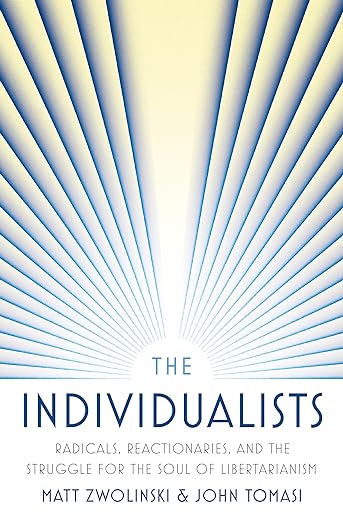
Running the risk of retreading old ground, I wanted to talk one more time about how definitions can be either clarifying or misleading, depending on how they are used. In my first foray into this area, I briefly mentioned Eliezer Yudkowsky’s essay Taboo Your Words, where Yudkowsky suggests people replace words with descriptions of the concepts to which those words are meant to refer, in order to prevent differences in definitions from causing unnecessary confusion. He uses the example of two people disagreeing over whether a falling tree still makes a sound if nobody hears it, where one person is defining sound to mean auditory experience while the other defines sound to mean acoustic vibrations.  The key skill here is what Yudkowsky calls “the general skill of blanking a word out of my mind” – and this is a very important skill when one is trying to understand the views of others. This was made particularly clear to me when I was going through my multiple-post review and critique of Yoram Hazony’s Conservatism: A Rediscovery. Many commentors seemed to be very tripped up over Hazony’s definitions of “conservative” and “liberal.” When reading that book, I did what Yudkowsky describes – I simply blanked out my usual definition of “conservative” and “liberal” and substituted in Hazony’s own. Failing to do this would prevent me from adequately understanding and engaging his case – as I put it in a post dedicated to my evaluation of his definitions, “many people have used the term ‘conservative’ to refer to many different worldviews, and for Hazony to make his case for conservatism effectively it is necessary to make clear exactly what he means when he speaks of conservatism.” Michael Huemer points out:  To speak more cautiously, as far as I can tell, no one—either in the 20th century or any other time—has ever advanced an analysis of any philosophically interesting concept that was widely accepted by philosophers as correct. Nearly all analyses are subject to counter-examples that most philosophers would agree refute the analysis…The attempts to define “knowledge” after 1963 are the most instructive case, because that term received particularly intense scrutiny. Philosophers went through dozens of increasingly complicated analyses and counter-examples over several decades, and no consensus emerged. To this day, we don’t know the definition of “knowledge”. Philosophers had similar experiences when they tried to define such things as “good”, “cause”, “if”, “freedom”, and so on. But even though no concept has a universally valid and accepted definition, we can still have discussions about them. And with most concepts, it works out that most people, most of the time, mean mostly the same things when they use a given word, which is good enough for most communication. But in more serious discussions, definitions need to be more precise in order to make an argument more clear. And all we can do about this is stipulate a definition when we enter a discussion and go from there. Hazony did what we all have to do – in the general space of thinkers and ideas, he drew a line around certain sets of ideas, and thinkers whose work embodied those ideas, and said, “when I say conservatism, I mean everything inside this set.” And he did the same thing for “liberal” – he stipulated a specific set of ideas embodied by particular sets of thinkers and said that when he referred to “liberals” or “liberalism” he was referring to those thinkers and ideas. And when reading his book, I blanked out the words “conservative” and “liberal” in my mind, and replaced them with Hazony’s stipulated definitions, so I could understand his argument on his own terms.  Now, Hazony’s definitions were different from my own, and different from many of EconLog’s readers. But I noticed, with some disappointment, that there were some comments by people who were getting bogged down by insisting that Hazony was “misrepresenting liberalism” or things of that nature, simply because they defined “liberalism” differently from Hazony. One person said Hazony was conflating the French Enlightenment with the Scottish Enlightenment – which was of course simply not true. In order for that to happen, Hazony would have needed to say something like “Scottish Enlightenment thinkers argued XYZ,” where XYZ was some set of ideas that was actually articulated by French Enlightenment thinkers. But Hazony never did this. What I think motivated this comment was the fact that many of the ideas Hazony classified as “liberal” were not held by Scottish Enlightenment thinkers – which are the ideas this commenter had in his mind when thinking of the term “liberalism.”  But Hazony also recognized that Scottish Enlightenment thinkers were in opposition to the ideas he criticized as “liberalism,” writing that against the philosophical rationalists, “empiricist political theorists such as Montesquieu, David Hume, Adam Smith, Adam Ferguson, and Edmund Burke rejected John Locke’s axioms and sought to rebuild political philosophy on the basis of things that can be known from history and from an examination of actual human societies and governments.” That is to say, when Hazony draws boundaries around what sets of thinkers and ideas he means when he says “conservative”, those boundaries include thinkers like Hume, Smith, and Ferguson. So, he never conflates the ideas of French Enlightenment thinkers with Scottish Enlightenment thinkers. He explicitly and unambiguously separated the two, and considers the Scottish Enlightenment thinkers to be part of the conservative tradition, as he defines and defends it.   Again, I define things differently. The boundaries I draw put thinkers like Adam Smith in the “liberal” category, not the “conservative” category. But I don’t pretend that my definition of the concept of “liberalism” is somehow the “objectively correct” one, and that Hazony’s is therefore wrong or somehow guilty of misrepresenting liberalism. And by recognizing that Hazony and I draw these boundaries in different places, I was also able to recognize that there is some degree of overlap between the “liberalism” I advocate and the “conservatism” he advocates. If I hadn’t been able to blank out the meaning of words in my mind and evaluate Hazony’s arguments based on the definitions he stipulated when making his case, it would be very easy to overlook the areas of common ground. And if there’s one thing the world doesn’t need more of right now, it’s lost opportunities to find areas of common ground or shared values.    The more widely one reads the work of political philosophers, the more apparent it becomes how little consensus there is about the meaning of terms like “liberal” or “conservative.” For example, N. Scott Arnold, in his book Imposing Values, wrote of anarcho-capitalists that “whatever their sympathies, these anarchists are not classical liberals because they are not liberals. By definition, all liberals believe in at least the minimal state.” So, by his definition, the very idea of liberal anarchism is ruled out from the get-go. Meanwhile, in their history of libertarianism titled The Individualists: Radicals, Reactionaries, and the Struggle for the Soul of Libertarianism, Matt Zwolinski and John Tomasi also stipulate a set of definitions for various political philosophies. The even put their classification in a handy Venn diagram form. There is a large set called “broad libertarianism,” which contains within it both “strict libertarianism” and “contemporary classical liberalism,” neither of which overlap with each other. But “contemporary classical liberalism” partially overlaps with “neoliberalism,” the latter of which partly extends outside the border of “broad libertarianism.” But there’s another set called “historical classical liberalism” that represents the ideas of thinkers like Hume, Smith, and John Stuart Mill, which has no overlap with any of these other sets. So, in this categorization, the ideas of Smith and Hume and Ferguson sit entirely outside of modern classical liberalism. I could go on, but the point is this – even among people who have spent their entire lives studying liberalism, identify as liberals, and write books defending liberalism, there is no widespread agreement over what “liberal” or “liberalism” mean. So, it should come as no surprise – nor should it be taken as a sign of bad faith – if a critic of “liberalism” also means something differently by that term than you do. If you want to make progress understanding the ideas people hold, both their strengths and weaknesses, it’s worth cultivating an ability to blank out words in your mind, to better focus on the ideas that lay beneath.   (0 COMMENTS)

/ Learn More

The road to serfdom

The housing sector in Irvine, California is booming, partly due to an inflow of investment from China. When I ask Chinese acquaintances where the money comes from, they suggest that it is transferred to the US through mysterious channels. Commenter Ahmed Fares directed me to a Daily Mail story that sheds light on one such channel: First, [Mexican] cartel money-men in the US arrange to deliver an amount of cash with a courier working for the triads, who message their bosses to confirm when the drop has been made.As soon as the message is received, Chinese gangsters transfer the same amount of money in Mexican pesos to the cartels – which they are then free to spend as they like.At the same time, the triads arrange for a wealthy person in China to buy the drug dollars by transferring the same amount of Chinese currency into accounts the gangsters control.There is huge demand for this service in China, as the government prevents people from transferring more than $50,000 out of the country each year in an effort to stop people offshoring their wealth.This gets around the system because the money never moves across a border. The Chinese currency only moves between banks in China, and the dollars never leave the US. . . .Once the wealthy buyer has control of the dollars, they are free to spend them as they would like within America – typically on college tuition or real estate. The US tries to ban drugs, while the Chinese government tries to ban large currency outflows.  Both types of restrictions on freedom have the effect of creating black markets.  I would expect various governments to respond with even further restrictions on freedom.  And I expect people to find ways of evading those additional restrictions. Governments will then respond with even further restrictions on freedom, and more black markets will develop. Rinse and repeat. PS.  The article provided another example of the recent surge in anti-Chinese bias: US officials believe it is highly unlikely that such a large volume of money could be moving through Chinese banks unnoticed by Beijing’s all-seeing bureaucrats, and so reason they are either choosing to turn a blind eye or are involved in it. And yet American officials seem to have no trouble believing that vast quantities of illegal money could move through the US financial system without the authorities being aware of it.  I wonder why? The attitude of American politicians (of both parties) seems to be:  “Why doesn’t China fix America’s drug problem!” (0 COMMENTS)

/ Learn More

Missouri Voters Vote Against Wealth Redistribution

At EconLog, I often catalogue and criticize government measures that reduce our freedom and hurt our economy. So it’s nice when I can report on a recent vote that went the other way: a vote to reduce the role of government in our economy. On Tuesday, April 2, voters in Jackson County, Missouri voted, by 58.1% to 41.% against extending the 3/8 percentage point sales tax that has existed for decades. According to Varad Raigonkar of Reason, extending the sales tax for 40 years would have raised about $2 billion in revenue over the next 40 years. The money would have gone to renovate the Kansas City Royals’ baseball stadium and to build a new stadium for the recent Super Bowl winners, the Kansas City Chiefs. In short, it would have distributed funds from people who pay the sales tax to pretty wealthy team owners. It’s possible, of course, that those funds would have caused prices of tickets to be lower than otherwise because now, without that tax, the two teams will need to raise money from willing payers, which might mean higher ticket prices. Even in that case, though, the funds would go to the relatively wealthy. A high percent of people who pay the current ticket prices are almost certainly relatively wealthy. Thus the title of this post. A majority of the voters voted against redistributing wealth upward. (0 COMMENTS)

/ Learn More

Nothing New Thing Under the Sun: Prohibition, Drugs and the Iron Law

Some time ago, roughly four years, I began this series on how drug prohibition only serves to create the public health crisis that such policies are supposed to mitigate. Of course, I never intended for such a large period to lapse between my last article and this one, but I suppose it is a nice demonstration of the difference between intentions and outcomes. As a refresher, our last discussion highlighted how Prohibition-Era laws such as the Harrison and Volstead Acts begat later laws such as the Boggs Act of 1951 and the Narcotics Control Act of 1956, which begat the modern War on Drugs™. Today, we will explore further the parallels between the two regime paradigms, highlighting why the continuing failure of the drug war is inevitable and wholly predictable; a Pygmalion Effect which creates what it forbids. When the Eighteenth Amendment was passed in 1920, it was widely hailed as a watershed moment that would reduce crime and poverty, absolve the public of paying for prisons and poorhouses, and save the family from the vagaries of drunkenness. Similarly, when President Nixon declared drug addiction Public Enemy Number One in 1971, it was with his 1969 declaration  to Congress that the full forces of government must be marshaled “to cope with this growing menace to the general welfare of the United States.” Again, the nation was told, we would reduce crime and poverty, lower the scope and costs of incarceration, and stamp out a danger to the American family. It is a vast understatement to say that these assurances were wrong, and even this is underselling the deleterious impact of these policies. Between 1916, four years before Prohibition, and 1929, four years before its repeal, both the number of cases terminated in Federal courts and the number of prisoners remanded from those courts effectively quadrupled. This, of course, led to a concomitant rise in prison spending due to overcrowding, which was a clear indication that the promised decrease in crime wasn’t coming. While proponents of Prohibition proudly proclaimed that the tide of crime had lessened, minor crimes such as vagrancy and public swearing had decreased by 50%, while more serious crimes rose precipitously; property theft by 13.2%, homicide by 16.1% and robbery by 83.3%. The tradeoff here is one between a decrease in misdemeanors likely to result in a fine or a night spent in the local jail, and felonies which greatly increased the population of state and Federal prisons. Similarly, claims that the War on Drugs™ would reduce crime have proven unjustifiably optimistic at best. In 2020, there were an aggregate 1.1 million arrests made for drug-related offenses, of which the majority were for simple possession (Cohen, Vakharia, Netherland, & Frederique, 2022). As of 2015, the rate of prisoners as a function of the population has grown from 100 per 100,000 in the period before Nixonian drug policy to over 500 per 100,000 (Pfaff, 2015). As a result, the United States has become the world’s largest jailer, both in absolute terms and in rate. According to Miron and Waldock, expenditures related to drug prohibition – including the increase both in prisoners and the number of prisons/jails needed to accommodate them – now equals or exceeds some $41.3 million annually.  Despite the increase in crime, prison sentences and the cost of enforcement, Prohibition had more of a shifting effect on alcohol consumption; a thing that is also true of drug consumption patterns under the current regime of criminalization. This shift, the effects of which will be discussed in greater detail in my next segment, is comprised of consumers moving away from a product of lesser potency to one of greater. This phenomenon, known as the Iron Law of Prohibition, is a result of fundamental economic principles; the creation of barriers to both entry and supply creates pressure to minimize volume while simultaneously maximizing profit (Beletsky & Davis, 2017). In effect, bulkier products with a lower degree of potency, such as beer or marijuana, are substituted by more potent, less bulky products that are easier to produce and transport, such as hard liquor and cocaine. While beer and marijuana may still be available on the black market, the price of these items rises relative to their more potent, less bulky alternatives, which tilts demand in favor of the harder stuff. Despite the rise in crime associated with such illicit activities and the organized institutions that produce the wares, much of the distribution of prohibited items is carried out by small-scale entrepreneurs (Levine & Reinarman, 1991). While many of the headlines tout the defeat of cartels and gangs, the reality is that most of the arrests are those of small-to-mid-tier neighborhood distributors. At any given time, somewhere between 1-2 million individuals are involved in drug distribution within the U.S., while roughly a half million individuals are incarcerated for drug-related activities (Kleiman, Caulkins, & Hawken, 2011). What this means is that the average dealer-distributor spends a year incarcerated for every two to four years they engage in selling.  A Brief Look at Social Costs All public policy should be judged by comparing costs to benefits, including costs that are social rather than monetary. While monetary costs are easier to examine – it is a balance sheet problem, after all – social costs are no less important. Between 1973 and 2013, over $1 trillion was spent on drug enforcement in the U.S. alone. Yet, in 2016, Americans spent $150 billion on heroin, methamphetamines, cocaine, and marijuana, which doesn’t even factor in other classes of illicit drugs. Perhaps the most troubling aspect of these sunk opportunity costs is that despite a regime of increasing funding for supply-side enforcement, drug prices have continued to decline over the last four decades.  This isn’t to say that they exist in cost parity with legal substances; their prices are still higher. What it does say is that current policy does little to abate demand. Moreover, instead of reducing crime, prohibition simply creates more criminals. Everyone involved in the drug market, from supplier to distributor to consumer, is automatically a criminal. Absent the property rights protections and dispute resolution apparatus available via normal legal channels, interested parties must resolve their own conflicts, often leading to violent means. Benson et al. (2001) find that drug enforcement is not associated with a rise in violent crime, but is also correlated with a rise in property crime; not necessarily because those involved in the drug market are committing these property crimes, but because of the opportunity costs associated with shifting resources away from one set of crimes and towards another.  Just as it was with alcohol during Prohibition, quality control is an issue with illegal drugs. As we discussed earlier, prohibitory laws create incentives to minimize the costs of production and transport while maximizing profit, which in turn trends towards potency as the major concern. Because the product is manufactured by local entrepreneurs, however organized, there are no industry-wide safety standards. Hence, the current issue of heroin laced with fentanyl, for example. This leads to an increase in drug-related overdoses, and other related problems. These are just a few of the more obvious social costs related to the War on Drugs™.Next, we will take a deeper dive into the issue of social costs.   References Beletsky, L., & Davis, C. S. (2017). Today’s Fentanyl Crisis: Prohibition’s Iron Law, Revisited. International Journal of Drug Policy, 46, 156-159. doi:10.1016/j.drugpo.2017.05.050 Benson, B. L., & Leburn, I. S. (2001). The Impact of Drug Enforcement on Crime: An Investigation of the Opportunity Cost of Police Resources. Journal of Drug Issues, 31(4), 989-1006. doi:10.1177/002204260103100410 Cohen, A., Vakharia, S. P., Netherland, J., & Frederique, K. (2022). How the War on Drugs Impacts Social Determinants of Health Beyond the Criminal Legal System. Annals of Medicine, 54(1), 2024–2038. doi:10.1080/07853890.2022.2100926 Kleiman, M., Caulkins, J. P., & Hawken, A. (2011). Drugs and Drug Policy : What Everyone Needs to Know. Oxford: Oxford University Press. Levine, H. G., & Reinarman, C. (1991). From Prohibition to Regulation: Lessons from Alcohol Policy for Drug Policy. The Milbank Quarterly, 69(3), 461-494. doi:10.2307/3350105 Pfaff, J. F. (2015). The War on Drugs and Prison Growth: Limited Importance, and Limited Legislative Options. Harvard Journal on Legislation, 52, 173-220.   Tarnell Brown is an Atlanta based economist and public policy analyst. (0 COMMENTS)

/ Learn More

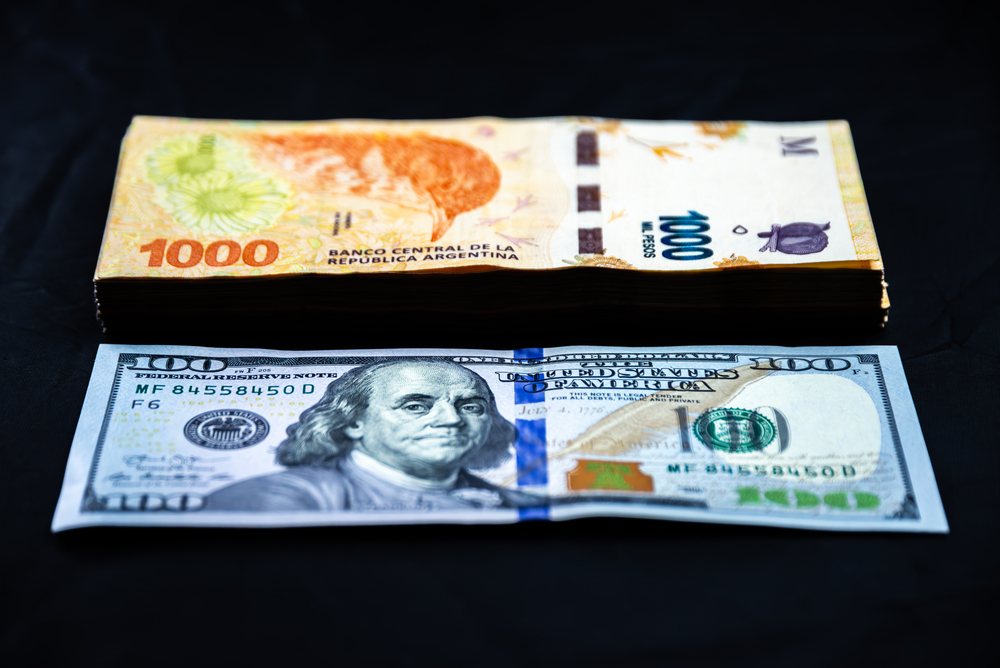
The Dangers of Milei’s Bi-Monetarism

The topic of dollarization sparked controversy during Argentina’s presidential campaign. Javier Milei, the current president, pledged to dollarize, grabbing international media attention. He even announced that Emilio Ocampo, my co-author on the dollarization proposal for Argentina, would lead the central bank, hinting at a possible dollarization and closure of the institution. However, as the elections approached, the idea of swift dollarization was abandoned. The dollarization proposal involves adopting the U.S. dollar as Argentina’s official currency instead of the peso. It also supports the closure of the central bank and the implementation of significant banking reforms, which would give Argentina an integrated financial market globally. Bi-monetarism, as a concept, aims to establish both currencies as valid means of exchange, allowing them to compete evenly. Milei still vows to eventually implement dollarization. Despite this shift, his followers remain hopeful that dollarization remains the ultimate goal. However, recent statements from Milei and prevailing political preferences lean toward a different direction—embracing a bi-monetarism regime, inspired by successful cases like the one that took place in Peru. It’s crucial to recognize that while bi-monetarism may work well in countries like Peru, it doesn’t automatically guarantee success in Argentina. The necessary conditions for sustainable bi-monetarism are absent in Argentina. Relying on Peru as an example for advocating bi-monetarism is akin to chasing an idealistic vision rather than facing reality. Peru’s institutional conditions that allow for bi-monetarism to work there is an ideal scenario for Argentina, not a real one. A key outcome to remember is that it took Peru five years to achieve monthly inflation rates below 0.5% (6.2% annually) after declaring central bank independence in January 2003. This timeframe is not feasible under current market conditions in Argentina, regardless of who the president is. In contrast, the early 1990s saw Argentina’s convertibility achieve a 0.5% monthly inflation rate within two years.  Moreover, for bi-monetarism to succeed, credible institutions are vital, a factor lacking in Argentina. By “credible institutions” I mean that is believed that political leaders will not try to erode the monetary regime in place and that formal political and monetary institutions protect the monetary regime against the politicization of the money supply. Without these foundations, adopting bi-monetarism is akin to standing on shaky ground. Without credible institutions, fiscal deficits erode the foundation of a bi-monetarist regime, increasing the ongoing demand for U.S. dollars. Can market actors trust that, in this scenario, the Argentine government would not try to limit access to U.S. dollars as so many times did in history? It is worth remembering that current capital controls were imposed by the Cambiemos coalition, the republican opposition to the kirchneristas. Any monetary reform in Argentina must consider the possibility of a new populist regime taking power. The likelihood of Argentina electing a populist government sooner or later is 100%. Any monetary regime reform must be done assuming that the kirchneristas (or another populist) will win the next presidential election. Bi-monetarism presents an easy target for such regimes to manipulate. The uncertainty stemming from a weak monetary regime would force the Argentine central bank to offer higher returns to entice investors to hold onto pesos. This turns the peso into a financial speculative tool, creating uncertainty and instability in the financial sector. Bi-monetarism would be a short-lived solution – if “solution” is the right word here. While bi-monetarism may offer short-term relief, its long-term sustainability is questionable, especially given Argentina’s turbulent economic history. Assuming that a new monetary regime will succeed solely based on technical soundness ignores Argentina’s historical evidence, which repeatedly shows that technically consistent but non-credible monetary regimes are destined to fail.   Nicolás Cachanosky is a professor of Economics and Director of the Center for Free Enterprise at University of Texas at El Paso, Senior Fellow at the American Institute of Economic Research (AIER), and Fellow of the UCEMA Friedman-Hayek Center for the Study of a Free Society. He also serves as co-editor of LIBERTAS: Segunda Época.  (0 COMMENTS)

/ Learn More

Decriminalization doesn’t solve the problem

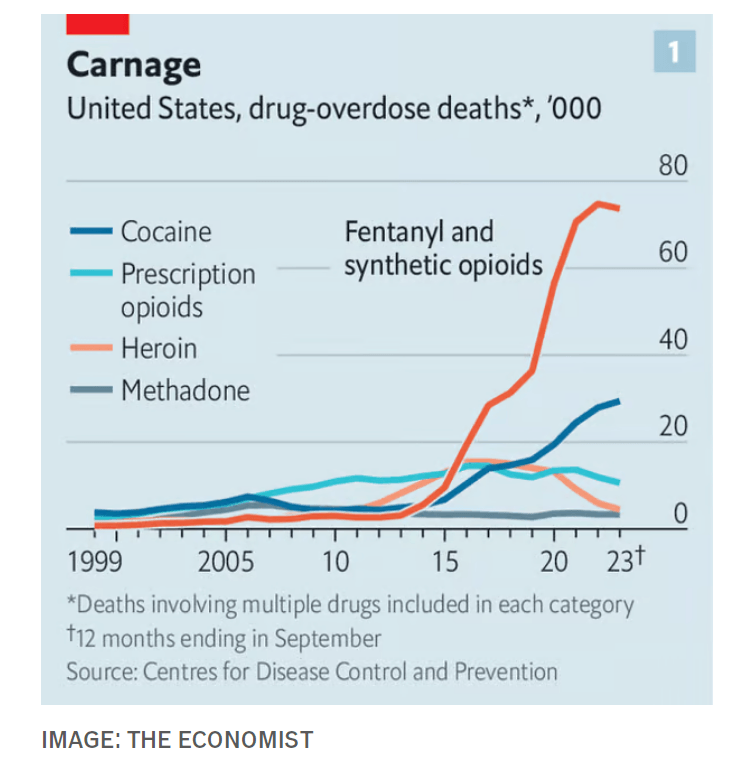
The Economist has a major article discussing the fentanyl crisis.  This graph has some discouraging data: I knew about the horrific fentanyl data, but was surprised to see the huge increase in cocaine deaths.  I doubt that cocaine usage has increased that dramatically in recent years.  Instead, I suspect that cocaine use has become much more deadly.  But why? The graph provides a hint.  Since 2013, the increase in cocaine deaths appears highly correlated with the increase in fentanyl deaths.  Both lines rise modestly from 2013-15, then very rapidly from 2015-17, then a bit more slowly from 2017 to 2019, then very rapidly for three years, before slowing in 2023.  One possibility is that cocaine uses are dying because their drug is adulterated with fentanyl. The same issue of the Economist has an editorial pointing out that it is impossible to stop the flow of fentanyl into the US (despite the claims of grandstanding politicians who talk of invading Mexico to shut down drug labs.) But their policy suggestions are disappointingly weak: And they should decriminalise less lethal drugs, such as cocaine, so as to free time and scarce funds to focus on the one that is killing Americans in droves. This will not solve the problem shown in the graph above.  Even a decriminalized cocaine market is still an underground market, with all the associated problems such as lack of quality control.  Tens of thousands of Americans will continue dying from accidentally ingesting fentanyl while consuming what they thought was cocaine.  This is especially disappointing given that I recall The Economist as previously being one of the few major publications brave enough to advocate the legalization of drugs. In fairness, they may have assumed that decriminalization was the only feasible reform within the current Overton Window.  Their advocacy of decriminalization was followed by this observation: Politicians of all stripes dislike such ideas, since they appear to condone taking drugs. America’s are unlikely to try anything so radical. But fentanyl is already a problem in Canada and is spreading in Mexico, too. Even more potent synthetic opioids called nitazenes have arrived in Britain. If the world is to cope it will, like the traffickers, have to innovate. Drugs are not an easy issue for policymakers.  Because of the severe penalties associated with the use of hard drugs, there is a correlation between drug use and other problems such as crime, unemployment and mental illness.  (To be clear, the correlation is far from perfect—there is a substantial number of hidden drug users with stable jobs, who don’t make the news.)  If an individual state legalizes all drugs, it risks becoming a magnet for “undesirables”.  That has not been a major problem with marijuana legalization, but it might have played a role in Oregon’s recent decision to reverse its policy of decriminalizing certain drugs.  (Reason magazine has an alternative view.) This is analogous to immigration.  If only a single developed country adopts open borders, that country becomes a magnet for the world’s poorest people. (0 COMMENTS)

/ Learn More

Bills on the Sidewalk

There’s an old joke about economists that usually goes along these lines: Two economists are walking down the street. One of them says “Look, there’s a twenty-dollar bill on the sidewalk!” The other economist says “No there’s not. If there was, someone would have picked it up already.” There are a few ways to interpret this joke. The one most charitable to economists is to see it as a call for intellectual humility. If you think you see something valuable, just sitting out there in plain view, and for some reason nobody else has noticed it, you should pause and reconsider if things really are as they appear to you. Maybe you’re right and there really is something there, but it’s more likely that your eyes are fooling you.  There is a real kernel of wisdom in this. When someone comes up with what they think is a brilliant new idea, it’s reasonable to ask, “If this really is a great idea, why hasn’t anyone else thought about it or done it?” This question isn’t insurmountable – there are certainly valid answers. After all, every successful innovation comes about from an idea nobody had thought of before or nobody had been able to successfully implement. But it’s worth keeping the question in mind. As Paul Johnson aptly put it: The study of history is a powerful antidote to contemporary arrogance. It is humbling to discover how many of our glib assumptions, which seem to us novel and plausible, have been tested before, not once but many times and in innumerable guises; and discovered to be, at great human cost, wholly false. The interpretation of the joke that is less charitable to economists is by painting economists in a Panglossian light – as people whose knee-jerk reaction is to assume that the way things are currently done must be the best way of doing things, because if there was a better way, someone would have already done it. There are certainly some economists out there of whom that might be true. But I have a somewhat different view of the twenty-dollar bill on the sidewalk metaphor – one that I think bridges these two, and more accurately describes how markets work.  In my understanding, there definitely are twenty-dollar bills on the sidewalk. But here’s the thing – the sidewalk is also really chaotic and dirty. It’s covered with leaves, mud, and clumps of lawn trimmings. It’s very easy for twenty-dollar bills to get mixed up in and covered by all the mess. And at the same time, this makes it very easy for your eyes to play tricks on you, and to think you see a twenty-dollar bill in what turns out to be a patch of leaves.  (On an unrelated note, I really hope there isn’t some international convention against torturing metaphors.) In this setup, elements of the charitable and uncharitable interpretations are present. In any given case, when someone thinks they see a twenty-dollar bill, they’re probably wrong, and it’s probably their eyes playing tricks on them. So, when you think you see one, it’s worth taking a moment to wonder if things are really as you thought. But at the same time, you can’t just glibly dismiss the possibility by saying if there really was a twenty-dollar bill someone would have already picked it up. After all, it’s hard to actually see where those bills are, so the idea that nobody might have noticed this specific twenty-dollar bill isn’t so implausible. If your goal is to maximize the amount of bills that are found, you’d want a system that does two things. You’d want people to have a reason to be alert and looking for those bills amidst all the muck, and you’d want to have a way to quickly separate the false positives from the true positives, so people don’t fill their pockets with leaves and mud. And this is exactly what markets do. As Israel Kirzner wrote about extensively, the market process is driven by the entrepreneur, constantly looking for opportunities that have gone unnoticed or unclaimed. This process carries on because such opportunities to spot inefficiencies actually exist. There really are twenty-dollar bills on the sidewalk nobody has (yet) noticed. But we also need a process that quickly identifies and sorts out the duds and false starts – and that’s what competition and the profit-and-loss system achieves. Most new businesses fail, and most new ideas are terrible, because most of the time when someone thinks they see a twenty-dollar bill their eyes are fooling them. Through entrepreneurship, competition, profits, and losses, markets are a system allowing us to both keep ourselves alert for new opportunities while preventing too many resources from being wasted pursuing dead ends.  For example, maybe there’s a market out there who for people who think “You know, not enough people are spending time taking lighthearted economics jokes way too seriously, and spending hundreds of words overanalyzing them in excessive detail.” That certainly looked like a twenty-dollar bill to me! But maybe I just grabbed a handful of mud and leaves. I’ll let the EconLog readers be the judge of that.    (0 COMMENTS)

/ Learn More

China’s Belt and Road Initiative: If You Build It, Will They Come?

To begin with a bit of trivia, who said the following line? “When you give roses to others, their fragrance lingers on your hand.” If you guessed Cole Porter, you’d be wrong. Nor does this line hail from a wooden quote board for sale on Etsy. It was delivered by China’s President Xi Jinping at the 10th anniversary celebration of China’s Belt and Road Initiative (BRI) in October 2023.1 Originally announced by President Xi in 2013, the Belt and Road Initiative (BRI) is Beijing’s signature program for promoting economic development and connectivity across nearly 140 countries. Plausible estimates project that Beijing has invested nearly one trillion dollars in the BRI’s panoply of projects around the world, including transportation infrastructure, energy, and telecommunications projects. Notables include one of the largest dryports in the world called the Khorgos Gateway in Kazakhstan, a high-speed railway in Indonesia called “The Whoosh”, and a network of infrastructure projects comprising the China-Pakistan Economic Corridor (CPEC). Of the latter, China’s foreign minister Wang Yi said, “If [BRI] is like a symphony involving and benefitting every country, then construction of the [CPEC] is the sweet melody of the symphony’s first movement.”2 Roses and symphonies. What are the success prospects of China’s BRI? To answer this question, I offer a story from class. Whether they realize it or not, students frequently are a source of terrific classroom anecdotes, some of which occasionally become inputs into research. While discussing China’s BRI, a student raised his hand and offered an invaluable story. For part of his childhood, he lived in Niger’s capital city, Niamey. For decades, he explained, the city had one bridge crossing the Niger River that split the city, the aptly-named John F. Kennedy Bridge. This highly-congested two lane bridge was the main alternative for crossing the river until the mid-2000s. Then China provided funding and a construction workforce to build a brand new four-lane bridge just downstream from the Kennedy bridge. To my student’s surprise, when the new bridge was completed, he saw very few local people actually using it. He suspected that mistrust towards China (and the association of low-quality goods with China) led local people to regard the bridge with suspicion, despite its newness and larger size. He also reported hearing locals refer to the bridge with assorted expletives from the Hausa language. “Should we expect BRI projects to be value-adding for local peoples, or will they instead reject those projects—and why?” My student’s vignette led me down a new research path. Should we expect BRI projects to be value-adding for local peoples, or will they instead reject those projects—and why? BRI: A Primer Beijing conceives of the BRI as the creation of a “21st century Silk Road”, aiming to “… realize diversified, independent, balanced and sustainable development in [BRI countries]” through “[promoting] the connectivity of Asian, European and African continents and their adjacent seas”.3 Xi Jinping has emphasized the centrality of infrastructure projects to achieve this goal, as he stated of BRI in 2017: “Infrastructure connectivity is the foundation of development through cooperation… We should promote land, maritime, air and cyberspace connectivity, concentrate our efforts on key passageways, cities and projects and connect networks of highways, railways and seaports…”4 In pursuit of these ends, China has emerged as the world’s largest official lender of government-to-government loans in the world. While some argue that BRI largely boils down to a rebranding of the “Going Global” policies pursued by Xi’s predecessors to address excess domestic industrial capacity, the rollout of BRI has nonetheless sparked a great deal of international attention. The international community has responded in kind with counter initiatives to fund infrastructure projects, including the G7’s “Build Back Better World” Initiative. Since the Chinese government is opaque regarding the operation of BRI, researchers around the world have rushed to compile data on the scope and scale of the BRI portfolio. Such efforts have resulted in detailed maps depicting BRI as a massive, cohesive web of interconnected projects. These maps—which take on the appearance of board games like Ticket-to-Ride or Risk—present an image of top-down orderliness and cohesion within the BRI that differs to a considerable degree from the reality on the ground. How large is that difference? Knowledge Constraints: Who Is Planning for Who? While there’s little doubt that BRI funds have initiated more infrastructure projects than would otherwise have been the case, it is less clear whether those projects actually add value for local peoples over and above their opportunity costs. In this respect, the success of BRI along the lines of China’s stated ends—promoting economic development and connectivity—rests upon coordination mechanisms generated by markets. Its success depends less on centralized decision makers within Chinese state and policy banks or state-owned enterprises. Within markets, the price system provides the mechanism to coordinate the disparate and conflicting plans of millions of people. Market prices serve as signals, providing information and incentives to individuals as they seek to accomplish their desired ends. Profit and loss signals generate continuous feedback for market participants to assess whether resources are being deployed to their highest-valued uses among alternatives. Likewise, relative price changes provide the means for rapid adaptation as economic plans are carried out. BRI projects, chosen through the political process, are unable to leverage these coordinating mechanisms. Projects are bid upon primarily by Chinese or host-country state-owned enterprises (SOEs). After vetting by state officials, projects are funded by Chinese state and policy banks. Two in particular, the Chinese Export-Import Bank and China Development Bank, account for over two-thirds of BRI lending. At each step of this process, resources are allocated through central planning, bureaucratic processes, and political criteria. Decision-makers in these institutional contexts cannot use market signals to guide, adapt, and evaluate their decisions, but instead must rely on other means—such as output targets and politically-salient narratives. Of the challenges facing BRI decision-makers, analyst Jonathan Hillman has argued that the success of BRI, “… hinges on China having the discipline to choose the right projects and walk away from the wrong ones.”5 Without the discipline of market signals and incentives, BRI decision-makers—both in China and in host countries—lack the ability to choose the “right projects” as well as the ability to detect error and adapt to correct inefficiencies with respect to their chosen projects. Yet they still promise roses and symphonies. Institutional Constraints: Hirschman’s Trait-Making and Trait-Taking In his 1967 book, Development Projects Observed, the economist Albert Hirschman (1915-2012) chronicled his observations while studying development projects all over the world on behalf of the World Bank. Through these experiences, Hirschman developed a sharp eye for anticipating negative unintended consequences associated with large-scale development projects. Of relevance to the analysis of BRI are Hirschman’s concepts of “trait-making” versus “trait-taking”, a framework for assessing the existing constraints relevant to projects’ success prospects. On the one hand, “trait-making” refers to the decision to introduce new inputs and processes—including technological capabilities, institutions, sociopolitical conditions and cultural values—required to achieve some desired output.6 In contrast, “trait-taking” refers to the decision to accept certain inputs and processes (i.e. traits) as “temporarily unchangeable aspects of the environment”. (Hirschman, p. 120) Of the two, decisions involving trait-making have played an outsized role in the difficulties presenting themselves to BRI decision-makers. Hirschman recognized the great frequency with which desired project outcomes were conditional upon some existing constraint (e.g. ineffective rule of law, insecure property rights) somehow being relaxed. Of this, Hirschman wrote: “Bringing, as they do, new activities into a pre-existing environment, development projects are likely to imply far more would-be trait-making than is commonly realized, and a principal task of the project analyst is to uncover the most significant economic and sociopolitical changes on which the success of the project is implicitly premised.” (p. 134) Unbeknownst to central planners, initiating projects unduly premised on trait-making has been a central flaw of BRI’s operation. For a salient example of this, we’ll consider one of BRI’s flagships in Central Asia. Application: The China-Pakistan Economic Corridor (CPEC) The China-Pakistan Economic Corridor (CPEC), a set of projects including highway, port, railway, and energy projects, among others, is widely regarded as the flagship of BRI. Within CPEC, the “crown jewel” is the project developing port and city of Gwadar in western Pakistan. Having received upwards of $500 million, BRI decision-makers desire to complement the port with a new city, complete with an international airport, industrial park, and tourist attractions. BRI decision-makers envision Gwadar to be a key input into the economic development of the landlocked western China. As Portuguese diplomat and author Bruno Maçães has put it, “If Kazakhstan serves as China’s gateway to Europe, Pakistan is its gateway to the Indian Ocean,” explaining that Pakistan “may become China’s California, granting it access to a second ocean and resolving the Malacca dilemma”.7 Besides the armed groups that occasionally block the port’s entrance, very little activity is taking place at Gwadar to date. Approximately 1,000 people currently work at the port, a far cry from the stated goal of 500,000 Chinese professionals moving to Gwadar by 2023. Likewise, the goal of increasing regional economic activity (especially between Karachi and Gwadar) has run into difficulties, making it hard for officials to adapt. Indicative of this, China’s COSCO shipping lines opted to terminate their container shipping services between Karachi and Gwadar due to inadequate cargo handled at the port and continual delays in construction of the Gwadar Free Trade Zone. Ships at Gwadar are far more likely to load and unload construction equipment related to other BRI projects in Pakistan compared to commercial goods.8 This scenario is illustrative of a more general pattern within the BRI of procuring funds to construct infrastructure that is highly questionable in terms of its demand by market participants. To date, very few Chinese businesses have demonstrated interest in setting up factory operations in Gwadar. A former Pakistani official recently told the Financial Times, “… it’s OK to borrow money and build infrastructure, but it’s more difficult to bring investors into our zones to make stuff and sell it”. Again, from the Financial Times, “[the] lack of follow-through from Chinese private companies has arguably been CPEC’s biggest shortcoming”.9 Clearly, private actors are not bullish on Gwadar’s prospects. To use Hirschman’s terminology, CPEC projects—most notably at Gwadar—have involved a tremendous deal more trait-making than envisioned, particularly as a number of CPEC projects appear unwelcomed by local people. The Financial Times pointed out of CPEC that “… the plan took insufficient account of violent militant groups.” Attacks on Chinese engineers in August 2023 increased the security fears associated with the Gwadar port, which sits largely quiet in part due to the dangers that come with utilizing the highway that serves Gwadar. Similarly, in 2021 the main road leading to the Gwadar Port was “blocked [for months] by thousands of locals in a sit-down protest”.10 The BRI, and CPEC in particular, presents a striking example of the truth that economic development is not merely a technological problem. For projects to have any success, decision-makers must take into account local realities as they pertain to the successes of projects. As economist Christoph Trebesch pointed out of this pattern within BRI, “[Chinese lenders] really went into many countries that turned out to have particularly severe problems”.11 Given that the allocation of funding for BRI projects occurs through political processes more likely to be based upon salient narratives, the lack of enthusiasm and follow-through from private actors—themselves subject to the discipline of profit and loss—comes as little surprise. Conclusion: Technological versus Coordination Problems The mistakes made by BRI decision-makers to a large degree boil down to thinking of the challenge of economic development as a technological, input-output problem. While supplying specific inputs to produce a narrow and clearly defined output (e.g. supplying mosquito nets to combat malaria) is one thing, the challenge of economic development is clearly not of that variety. Economic development is everywhere limited by institutional constraints and depends on the coordinating mechanisms generated by the market process, including market prices and the discipline of profit and loss, that guide and reconcile the plans of individuals. As Thomas Sowell put it in Knowledge and Decisions, “the most fundamental question is not what decision to make but who is to make it—through what processes and under what incentives and constraints, and with what feedback mechanisms to correct the decision if it proves to be wrong.”12 For more on these topics, see “Touching the Elephant,” by Kwok Ping Tsang. Library of Economics and Liberty, Apr. 3, 2023. Branko Milanovic on Capitalism, Alone. EconTalk. “How the Collapse of Communism Has Undermined Faith in American Capitalism,” by Richard B. McKenzie. Library of Economics and Liberty, Sep. 7, 2020. While it’s possible for port, highway, and railway projects to provide value for local people, large infrastructure projects are not themselves sufficient for economic development, even if they do connect otherwise disparate people. China’s BRI thinking confuses cause and effect. Growing roses depends on healthy soil and fortunate weather. Symphonies are coordinated efforts. Even the benefits associated with centrally planned projects may well be the result of progress that’s already occurred as opposed to the spark for growth itself. Upon publication, Albert Hirschman’s Development Projects Observed was largely ignored or dismissed by economists at the World Bank. As Michele Alacevich put it, “Hirschman’s insistence on uncertainty as a structural element in the decision-making process did not fit in well with the operational drive of Bank economists and engineers.”13 BRI decision-makers could use some Hirschman in their analysis. Unless there’s a dramatic turn of fortune, BRI may be best remembered by the CCP’s slogans associated with it. In view of this, I’ll add my own slogan to the mix: “Building it doesn’t mean they’ll come…”. Footnotes [1] Financial Times, “Ten years of China’s Belt and Road: What has $1tn achieved?” Gated. [2] Maçães, B. (2019). Belt and Road: A Chinese World Order. Hurst. (p. 43) [3] State Council of the People’s Republic of China. (2015). Full text: Action plan on the Belt and Road Initiative. In Chinese. [4] Xi, J. (2017). Full text of President Xi’s speech at opening of Belt and Road forum. Belt and Road Forum for International Cooperation, Beijing. [5] Hillman, J. E. (2020). The emperor’s new road: China and the project of the century. Yale University Press. (p. 14) [6] Hirschman, A. O. (1967). Development projects observed. Brookings Institution Press. (pp. 126, 140) [7] Maçães, B. (2019). Belt and Road: A Chinese World Order. Hurst. (p. 64) [8] Chaudhury, D. R. (2019). Gwadar Port: China-Pakistan Gwadar Port runs into rough weather. The Economic Times. [9] Leahy, J., Kynge, J., & Parkin, B. (2023). Ten years of China’s Belt and Road: What has $1tn achieved? Financial Times Gated. [10] Aamir, Adnan (2021). China-Pakistan Belt and Road Initiative hits buffers. Financial Times, Dec. 7, 2021. Gated. [11] Kynge, James (2023, March 28). China grants billions in bailouts as Belt and Road Initiative falters. Financial Times, Mar. 28, 2023. Gated. [12] Sowell, Thomas. (1980). Knowledge and Decisions. Basic Books. [13] Alacevich, M. (2014). Visualizing uncertainties, or how Albert Hirschman and the World Bank disagreed on project appraisal and what this says about the end of “high development theory”. Journal of the History of Economic Thought, 36(2), 137-168. * Greg Caskey is Assistant Professor of Economics in the Baker School of Business at The Citadel. This article was edited by Features Editor Ed Lopez. (0 COMMENTS)

/ Learn More