This is my archive

bar

Progressive Jonathan Lipow Defends Economics

  This is the second of my series of posts on Jonathan Lipow’s 2023 book, Pubic Policy for Progressives. In “Economics without Apology,” a subsection of Chapter 1, Jonathan addresses his concern about progressives rejecting economics, writing: Now, lamentably, many progressives regard economics with great suspicion.  Indeed, instinctual hostility towards economics is a textbook example of the Left’s tendency to take automatic positions without reference to either basic moral principles or scientific evidence.  For example, many progressives believe that Adam Smith, the founder of the field that later came to be known as economics, invented capitalism or justified its excesses.  This is simply untrue.  Smith’s seminal contribution, The Wealth of Nations, described the systemic features of the capitalist institutions that were already emerging a hundred years earlier to replace the feudal order in Europe, and analyzed both their virtues and vices.  And far from preaching that greed is “good,” Smith, in The Theory of Moral Sentiments – the book that laid the intellectual foundation upon which Wealth of Nations was built – strongly associated “good” with social solidarity and concern for the plight of others. He then follows with one of my favorite quotes from The Theory of Moral Sentiments: How selfish soever man may be supposed, there are evidently some principles in his nature, which interest him in the fortunes of others, and render their happiness necessary to him, though he derives nothing from it, except the pleasure of seeing it. Of this kind is pity or compassion, the emotion we feel for the misery of others, when we either see it, or are made to conceive it in a very lively manner. That we often derive sorrow from the sorrows of others, is a matter of fact too obvious to require any instances to prove it; for this sentiment, like all the other original passions of human nature, is by no means confined to the virtuous or the humane, though they perhaps may feel it with the most exquisite sensibility. He also gets the origin of the term “Dismal Science” right: The early economists pressed for freedom of religion and conscience, argued for women’s rights, and, above all, took an uncompromising stand hostile to the institution of slavery.  All this long before any of it was fashionable with the cool kids.  In fact, the reason why economics is often called “the Dismal Science” is that early economists had a bad habit of ruining dinner parties by lecturing the other guests about the profound evil of forced servitude. The nickname was actually coined by Thomas Carlyle, who was trying to delegitimize economists opposed to his “visionary” proposal to reintroduce slavery to the United Kingdom. I’m not sure about the “dinner parties” part but he correctly identifies the originator of the term and Carlyle’s reason for coining the term.   (0 COMMENTS)

/ Learn More

Tom Holden on monetary policy

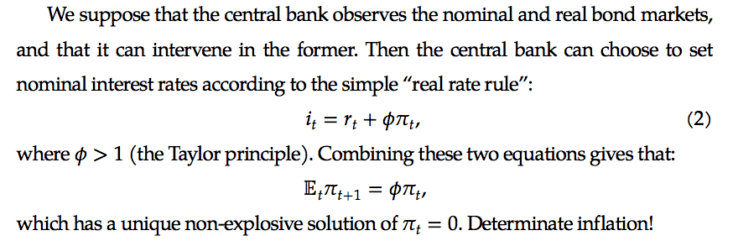
In recent years, I’ve become depressed by the state of research in macroeconomics. I find many new research papers to be almost unreadable. Perhaps this reflects the fact that my own work is increasingly outside the mainstream. Thus I was very pleasantly surprised to see a new paper by Tom Holden that embraces many of the themes that I have been emphasizing.  Even better, the paper is extremely well written (unusual for a macro theory paper) and is forthcoming in the highly prestigious journal Econometrica. Before discussing Holden’s paper, let me be clear that I’m not suggesting that he necessarily agrees with my overall view of macro. He uses more of a New Keynesian approach whereas I am a monetarist, and he advocates inflation targeting while I prefer NGDP targeting. But on a number of important points we end up in the same place, even if we arrive there by different routes. Consider the following claims, which sound vaguely monetarist: In this model, only monetary policy shocks affect inflation. Of course, if there is a nominal rigidity in the model, monetary shocks may have an impact on real variables. But as long as the central bank follows a rule like this, these real disruptions have no feedback to inflation. Causation runs from inflation to real variables, not the other way round. We can understand inflation without worrying about the rest of the economy . . .  This is consistent with causation only running from inflation to the output gap, not in the opposite direction.  Likewise, Miranda-Agrippino & Ricco (2021) find that a contractionary monetary policy shock causes an immediate fall in the price level, while impacts on unemployment materialise more slowly. Again, this suggests that causation runs from inflation to unemployment, not the other way round. In the traditional Keynesian model, causation runs from real shocks (more physical purchases and more hiring) to nominal outcomes (higher wages/prices.)  Milton Friedman saw causation running from nominal shocks (money and inflation) to real effects (more jobs and output).  Both views of causation are consistent with the correlations observed in Phillips Curve studies, but the monetarist interpretation tends to nudge people more toward monetary policy as the key stabilization tool. Here is Holden’s policy proposal for stabilizing inflation: Unlike with previous Taylor Rule proposals, Holden envisions deriving the real interest rate from inflation-indexed bonds, i.e. “TIPS”.  In the past, I’ve argued that economists focus too much on the public’s inflation expectations, and that the key to successful monetary policy is stabilizing the expectations of financial market participants.  Here’s Holden: The only expectations that matter are the expectations of participants in the markets for nominal and real bonds. It is much more reasonable to assume financial markets lead to prices consistent with rational expectations than to assume rationality of households more generally. This is all music to my ears.  Here’s another gem: Real rate rules also have a second source of robustness: they do not require an aggregate Phillips curve to hold. The slope of the Phillips curve can have no impact on the dynamics of inflation. If a central bank is unconcerned with output, they do not even need to know if the Phillips curve holds, let alone its slope. Nor does it matter how firms form inflation expectations. The Fisher equation and the monetary rule pin down inflation, so while non-rational firm expectations could affect output fluctuations, they will not alter inflation dynamics. I’ve also argued against using the Phillips Curve in monetary policy.  I favor stabilizing market expectations of NGDP, while Holden is proposing the stabilization of market inflation expectations, but the underlying approach is the same—stabilize market expectations of a nominal macro goal variable.  Don’t try to manipulate the Phillips Curve. I’ve emphasized that any successful monetary policy regime leads to almost complete monetary offset of other demand side factors, such as tax cut-financed fiscal stimulus.  Holden goes even further with monetary offset, as he is proposing an inflation target.  So his proposed policy rule also offsets supply side influences on inflation, although he later argues (correctly) that policymakers may wish to adjust their target when there are supply shocks. In my own work, I’ve strongly criticized the view that monetary policy works by changing interest rates, at least in the Keynesian sense of impacting the economy through changes in both nominal and real interest rates.  I’ve created various thought experiments where prices are flexible and the effects of monetary policy on nominal aggregates cannot possibly derive from changes in real interest rates.  Holden makes a similar claim: An even more fundamental question of monetary economics is “how does monetary policy work?”. The traditional answer involves movements in nominal rates leading to movements in real rates, due to sticky prices. But this cannot be the transmission mechanism under flexible prices, as then real rates are exogenous. Nor too can it be the transmission mechanism under a real rate rule, as then real rate movements are irrelevant. In these cases, monetary policy works exclusively through the Fisher equation’s link between nominal rates and expected inflation. Since we will see that dynamics under a real rate rule are qualitatively so similar to dynamics under a traditional rule, it would be surprising if monetary policy worked by a fundamentally different channel under a traditional rule. Instead, this suggests that the main channel of monetary policy in New Keynesian models is the one also present even under flexible prices, via the Fisher equation. Rupert & Šustek (2019) draw the same conclusion based on the observation that contractionary (positive) monetary shocks can lower real rates in New Keynesian models with capital. I have argued that a contractionary monetary shock actually lowered real interest rates in 2008, but it also lowered NGDP—creating a severe recession.  During the 1980s, a number of economists including Earl Thompson, Robert Hall, David Glasner, Robert Hetzel and myself proposed policies that would effectively target the financial market forecast of inflation or (in my case) NGDP growth.  Holden suggests that his real rate rule is in that tradition: Additionally, in older work, Hetzel (1990) proposes using the spread between nominal and real bonds to guide monetary policy, and Dowd (1994) proposes targeting the price of futures contracts on the price level. This has a similar flavour to a real rate rule, as these rules effectively use expected inflation as the instrument of monetary policy. Forecast targeting has also been proposed by Hall & Mankiw (1994) and Svensson (1997), amongst others. In the past, I’ve suggested that the Fed’s interest rate target should be adjusted daily, not every 6 weeks.  Here’s Holden: Note that while under conventional monetary policy, nominal interest rates are approximately constant between monetary policy committee meetings, this may not be the case here. . . . the central bank’s trading desk could have to continuously tweak the level of [interest rates] . . . While this is a departure from current operating procedures, there is no reason why holding [TIPS spreads] approximately constant should be any harder than holding [interest rates] approximately constant. This is thanks to the real-time observability of [real interest rates] via inflation-protected bonds. I’ve argued that central banks should determine the strategy of monetary policy (i.e. whether to target prices or NGDP, and whether to target levels or growth rates), whereas market expectations should be used to actually implement the policy.  Holden concludes his paper with a similar observation: We have presented a design for the practical implementation of a real rate rule with a time-varying short-term inflation target. Under this proposal, central bank boards keep the crucial role of choosing the desired path of inflation. Only the technical decision of how to set rates to hit that path is delegated to the rule. The rule embeds no politically sensitive views about the slope of the Phillips curve or the costs of inflation. And the rule can be implemented using assets for which there is already a liquid market: either nominal and real long-maturity bonds, or inflation swaps. In my recent book, I steered clear of the issue of “indeterminacy” (i.e. multiple possible equilibria), which is an issue where I don’t have expertise.  Based on what I have read, however, it seems to be a bigger problem with interest rate targeting than with monetary regimes that stabilize a price, such as the gold standard or a fixed exchange rate regime.  I suspect that indeterminacy is less of a problem with a real rate rule because TIPS spreads are analogous to a CPI futures contract, and hence stabilizing TIPS spreads is akin to targeting the price of a CPI futures contract.  A gold standard avoids indeterminacy because gold prices are visible and controllable in real time.  The same is true of CPI futures contract prices.  If this is inaccurate, please correct me in the comment section. Although I favor NGDP targeting, I believe Holden is wise to frame his proposal as an inflation-targeting regime.  Unlike with NGDP expectations, we already have deep and liquid TIPS markets, and real world central banks have opted for inflation targeting over NGDP targeting.  Framing the proposal as an inflation-targeting regime is the best way of moving real world policymakers toward the broader goal of targeting market expectations of the goal variable.  (0 COMMENTS)

/ Learn More

The Right to Build

In a recent interview with Tyler Cowen, Nobel Prize winning economist Joseph Stiglitz stated his opposition to housing deregulation: One person’s freedom is another person’s unfreedom. That means that what I can do . . . I talk about freedom as what somebody could do, his opportunity set, his choices that he could make. And when one person exerts an externality on another by exerting his freedom, he’s constraining the freedom of others. If you have unfettered building — for instance, you don’t have any zoning — you can have a building as high as you want. The problem is that your high building deprives another building of light. There may be noise. Stiglitz is no doubt right that increased construction creates negative externalities. But he’s wrong to suggest that this settles the matter. For one, increased construction creates positive externalities that likely exceed the negative ones. Increasing the supply of housing makes it easier for workers to move to better jobs, which accelerates economic growth. And denser cities reduce the need for cars, which in turn reduces carbon emissions. But another reply to Stiglitz spotlights a point that’s often overlooked in discussions of negative externalities—sometimes you have the right to create them. Take a simple case inspired by the philosopher Robert Nozick. Carl proposes marriage to the love of his life, Alice. While Alice is mulling it over, Bob proposes and Alice accepts. Crucially, Alice would have accepted Carl’s proposal were it not for the one made by Bob. So Carl lives out the rest of his life alone and miserable thanks to Bob. Bob’s proposal to Alice, then, creates a grave negative externality. Indeed, the harm that Carl suffers is far worse than the harm suffered by those whose view is blocked by a freshly built high-rise. Still, Bob has the right to marry Alice even though doing so harms Carl. In short, he has the right to propose marriage and Alice has the right to accept. Moreover, Carl does not have a right that Alice accept his marriage proposal. So while the outcome is regrettable for Carl, he has no grounds for interfering with it because no one’s rights were violated.  In the same vein, the mere fact that a new high-rise makes a resident worse off doesn’t justify blocking its construction. To sort out that question we’d need to sort out the relevant rights claims. Assuming that the property used to build the high-rise has been acquired justly, then its construction is at least presumptively permissible. The developer has the right to use her property as she sees fit, including using it to build something tall. Of course, not everything you might do with your property is permissible. You can’t use your baseball bat to kneecap the opposing pitcher. But that’s because the pitcher has a right of bodily autonomy that protects his knees from being smashed.  Is there a similar right in the case of building that could void the developer’s property rights? I’m skeptical. At first blush, the best candidate is something like a right to not have a desirable view be obstructed. Unfortunately for the opponent of housing deregulation, this sort of right simply doesn’t seem plausible.  To see why, suppose you adore the sight of my hair. Suddenly I decide to start wearing a hat. I’ve obstructed a view that you find desirable, but clearly you have no right to stop me from doing so. At the very least, the idea that you have a right to an unobstructed view needs some refinement. Maybe idea can be salvaged by restricting it to cases of severe harm. Plausibly, the harm you suffer from an obstructed view of the sunset is greater than the harm you suffer from an obstructed view of my hair. But the severity of the negative externality alone isn’t enough to show that someone isn’t within their rights to impose it. The harm Carl suffers as a result of Bob’s marriage proposal is greater than he harm he suffers as a result of a new high-rise. Since Bob may propose to Alice, it seems as though he may also build a high-rise near Carl. After all, it would be strange to allow Bob to impose the more harmful negative externality (a life of solitude and misery for Carl) but not the less harmful negative externality (an obstructed view of the sunset for Carl). Or imagine that Carl owns a small bookstore and Bob moves in next door with a Barnes & Noble. Bob might end up running Carl out of business, but he’s still allowed to do it. The broader point is that an actor may be free to act even in cases where the action creates a negative externality. At most, the presence of a negative externality starts a conversation, but it doesn’t end it.   Christopher Freiman is a Professor of General Business in the John Chambers College of Business and Economics at West Virginia University. (0 COMMENTS)

/ Learn More

Jonathan Lipow Is a Fair-Minded Progressive

    At its core, the Woke are building a movement that subverts the Left and renders it impotent in the face of its very real theocratic and fascist enemies.  It sets male against female, straight and cis-gendered against queer, Black against white, and the working class against the intelligentsia.  It debases science with various offshoots of the meaningless pseudo-science known as “critical theory” – a field so rigorous that one of its leading journals published a (fabricated) paper that purported to chronicle endemic rape culture…at a dog park.[1]  Above all, however, the Woke teach young and idealistic students that they should seek refuge in “safe places” rather than learn how to overcome their fears…and their enemies. It is almost as if our enemies invented this thing. [1] Lindsay, James, Peter Boghassian, and Helen Pluckrose. “Academic Grievance Studies and the Corruption of Scholarship.” Areo, 10 February 2018. This is from Jonathan Lipow, Public Policy for Progressives, 2023. Jonathan is a professor of economics at the Naval Postgraduate School. He’s in a different part of the university than the one I was in but we interacted as colleagues for many years. Jonathan is a progressive and he wants to talk to other progressives who he thinks, correctly, need to hear his economic message. Jonathan and I don’t agree on everything, of course. Remember that he’s a progressive. But we agree on a number of things. In the next week or so, I’ll have a few more posts about content in his book. Here’s one more excerpt, with my brief commentary, for now: Yet, as we shall see, logic and evidence strongly suggest that some policies currently popular among American leftists are indeed literally ridiculous, such as opposition to charter schools and nuclear energy.  Meanwhile, other policies widely advocated by progressives – such as a $15 minimum wage – are not silly, but large bodies of evidence suggest that they are ineffective and essentially a waste of time.  [DRH note: I wish they were just a waste of time rather than a policy that makes it more difficult for young unskilled workers to get on the first rung of the economic ladder.] On the other hand, readers might be pleased to know that progressives’ instinctual support for universal health insurance [DRH note: hmmm] and liberal immigration policies [DRH note: yes] are well supported by both logic and evidence. More to follow. Postscript: Here’s a post I did in 2016 about a previous book by Jonathan in which he said nice things about me: he did so to argue that my libertarian views wouldn’t work in the world nearly as well as I thought they would.   (0 COMMENTS)

/ Learn More

Contrarian Ideas on the Administrative or Whimsical State

There are credible theories, bolstered by the public choice analysis of bureaucracy, that the administrative state is economically inefficient and politically dangerous—“politically dangerous” meaning a risk of growing or feeding Leviathan. (For an overview, see Gordon Tullock, Bureaucracy, Liberty Fund, Inc., 2004]; and Dennis C. Mueller, Perspectives on Public Choice [Cambridge University Press, 1997].) At the opposite end of the democratic power spectrum stands the political state or politicians’ state, where elected officials can overrule the state bureaucracy at will. Many critics of the administrative state, even when they make good points, often ignore the drawbacks of the politicians’ state (see for of “Philip Hamburger on the Threats of the Administrative State,” a Future of Liberty podcast with host Mitch Daniels). If we can think of the administrative state as equivalent to the “administrative despotism” that Alexis de Tocqueville described in Democracy in America (Chapter 6 of Volume 4), the politicians’ state is not without resemblance to the whimsical aspect of the French political scientist’s description of ancient and arbitrary tyranny.  Although I did not always think so, the whimsical tyranny of the politicians’ state is at least as bad for liberty and prosperity as the administrative state’s despotism. This is exemplified by a fact revealed in the prosecution and trial of Senator Sen. Bob Menendez, whom a New York federal jury condemned on several charges of bribery and corruption on July 16 (“Sen. Bob Menendez Found Guilty of Corruption Charges,” Wall Street Journal, July 16, 2024). The Wall Street Journal previously reported (“Menendez Declared His ‘Resurrection.’ Then He Fell in Love,” July 10, 2024), speaking of a Wael Hana, a New Jersey businessman who was simultaneously condemned for paying bribes to Menendez and his wife: Hana had been seeking a lucrative export contract from Egypt for his halal business—despite having no experience in the field. Menendez called a U.S. agriculture official whose agency had raised concerns about the monopoly the contract would create. “Stop interfering with my constituent,” Ted McKinney, the agriculture official, recalled Menendez saying on the call. The US Department of Agriculture’s large bureaucracy is of course representative of the administrative state, which administers laws voted by elected officials in Congress. It also indirectly influences legislation through its regulations if not its influence on the political agenda. I don’t know why exactly the USDA had intervened in Hana’s exports to Egypt, for the monopoly of halal beef kidneys imports into that country had been granted by the Egyptian government. The Washington Post suggests the reason was that Hana’s monopoly would cut other American exporters of this product from the Egyptian market, as happens every time a foreign government so decides for whatever reason. (See also “Menendez Bribery Trial Witness Details Egyptian Halal Beef Monopoly Scheme,” Courthouse News Service, July 3, 2024.) Matters political and bureaucratic being what they are, it would not be surprising if Hana needed some license or unofficial nod to export his beef kidneys to Egypt. But my point is that, notwithstanding the supposed rule of law, an elected official was able to impose his whim, whether corrupted or not, on civil servants. How is that better than the administrative state? The fact that under secretaries of agriculture, Mr. McKinney’s then position, are political appointees does not change the inherent opposition between the administrative state and the whimsical state. It just shows that the administrative state is less autonomous, more subject to the whimsical state in the United States, than in many, if not all, large Western countries. Many other examples could be found, perhaps more potent. There are good arguments suggesting that a central bank is detrimental compared to free banking and private currencies. But given that government exists with a partial monopoly on issuing domestic currency, who would argue that this power would be less dangerous in the hands of the president or Congress as opposed to an independent bureaucracy such as the Fed? Tariff policy is another example: Congress set the tariffs in the 19th century, and its political horse-trading was not exactly a success (see Doug Irwin’s Clashing Over Commerce), and recent presidents have been, if anything, even worse. What is the bottom line? When the state has the power to confer great privileges (money or other sorts of advantages) to some citizens at the expense of others, we must expect that rent-seekers will spend resources to get their hands in the treasure chest, including with informal or (like in the Menendez case) formal bribes. There is no way an ambitious, activist, nosy government can exist without a large administrative apparatus or whimsical and arbitrary political rulers, or a combination of both. The basic problem is not the administrative state or the politicians’ whimsical state, it is the powerful state. Worship of elected officials is as bad as the administrative state. These general results do not depend on the ideological shade of the party in power nor on the country considered. ****************************** The whimsical politician state. By DALL-E under the influence of your humble blogger (0 COMMENTS)

/ Learn More

Deontic Facts, Agents, and Hayek

If you read the supplemental material to which I link with the diligence I expect and require, dear reader (tongue is firmly in cheek here!), you will have read this paper I referenced that examines proposed symmetry breakers between the modal ontological argument for the existence of god and the reverse modal ontological argument against the existence of god. One of the symmetry breakers, and the response to it, reminded me of something F. A. Hayek said when evaluating the concept of “social justice.”  The symmetry breaker in question is the deontic symmetry breaker, which deals with deontic properties. Deontic properties are properties related to what ought to be the case, “properties of obligation and permission (e.g., rightness, wrongness, oughtness, etc.)”, which are distinct from evaluative properties that deal with “properties of value and disvalue (e.g., goodness, badness, etc.)” The deontic symmetry breaker goes as follows (with citation removed): God is defined as a most perfect being. But a most perfect being ought to exist. So, God ought to exist. But what ought to be the case is possibly the case. Hence, God possibly exists. Therefore, according to this proposed symmetry breaker, we have reason to prefer premise 1 of the modal ontological argument over premise 1 of the reverse modal ontological argument.  One objection to this comes from William Vallicella, who argues that deontic properties can’t sensibly be applied to non-agential contexts. That is, it doesn’t make sense to speak of what ought or ought not be the case in situations that are not under the control of any agent:  As Vallicella puts the worry, “every state of affairs that ought to be or ought not to be necessarily involves an agent with power sufficient to either bring about or prevent the state of affairs in question.” But if deontic properties are inapplicable to non-agential contexts, then it is not true that God ought to exist—there is no agent with the power to bring about or prevent God’s existence, and so the context at hand is non-agential. This notion of the inapplicability of deontic properties to non-agential contexts reminded me of Hayek’s criticism of social justice, an idea idea he maintained “does not belong to the category of error but to that of nonsense, like the term ‘a moral stone.’” To Hayek, the reason “social justice” was nonsense is because the outcomes of social processes are non-agential. There are no agents with sufficient knowledge and power to bring about or prevent specific end results of social processes. As Hayek put it in The Mirage of Social Justice, the second volume of Law, Legislation, and Liberty: “If we apply the terms to a state of affairs, they have meaning only in so far as we hold someone responsible for bringing it about or allowing it to come about…Since only situations which have been created by human will can be called just or unjust, the particulars of a spontaneous order cannot be just or unjust.” And the inability of agents to control the outcomes of social processes isn’t exactly an idea that’s only held by those on the political right – Friedrich Engels likewise said “What each individual wills is obstructed by everyone else, and what emerges is something that no one willed.” So you can be on the left, even the very far left, and still acknowledge that the outcomes of social processes are beyond anyone’s control. To use an analogy, suppose there is a father who deliberately favors some of his children over others. He deliberately showers his favored child with love, attention, and resources, while outright neglecting and ignoring his other children. This, Hayek would say, is unjust, because the outcomes experienced by the children are entirely agential. But the outcomes of vast and complicated social processes are non-agential, and to speak of those outcomes as just or unjust, as if they were analogous to the hypothetical father above, is nonsensical.  But not everyone shares Hayek’s take that the outcomes of social processes can’t be controlled in a reliably agential way. Jeffrey Friedman wrote extensively of people who hold to a “simple-society ontology” and who believed that certain actors (politicians, technocrats, etc.) can reliably control social outcomes in a way that is analogous to the hypothetical father’s ability to control the way he treats his own children. Thus, the more one holds to a simple-society ontology, the more likely they are to embrace “social justice” and find it a meaningful project, because they believe social outcomes are in fact under reliable agential control. Friedman described how such people expressed themselves in political polling data: Conversely, as Hibbing and Theiss-Morse show with focus-group and survey evidence, disillusionment and anger can follow from the perception that government is failing to act. The authors’ angry, disillusioned respondents did not allow that inaction might be caused by arguments about which actions will succeed or what their effects might be, let alone that such arguments might be justified. On the contrary: they seemed to agree that, as one put it, all it would take to solve the extant problems is for the two parties’ leaders to get together and say to each other, “There’s a problem. We won’t leave this room until it’s fixed.”…The respondents’ chronic dissatisfaction with elected officials was due, it would seem, to the conviction that the officials had bad intentions, not inadequate knowledge, such that they deliberately, willfully declined to solve problems they knew how to solve. These voters believed that “the reason social problems persist is that elected officials have ‘the ability but not the will to take care of the nation’s problems.’ The ability was, for them, the easy part, or so it seems; the hard part was the will.” But if you think that politicians and technocrats haven’t solved social problems because they simply don’t know how to do so, then you lose the ability to meaningfully ascribe deontic properties. This doesn’t mean one can’t still ascribe evaluative properties to certain outcomes, and speak of the goodness or badness of such outcomes. If a landslide that nobody created and nobody could have prevented wipes out a village tomorrow, I can ascribe evaluative properties to that event (“it’s a tragedy this happened”) even though it makes no sense to ascribe deontic properties to that event (“all those rocks and mud ought not to have overrun that village.”) But people who harbor a simple-society ontology can lose sight of the distinction between evaluative claims and deontic claims – leading them to believe that an outcome that is evaluatively bad is therefore deontically unjust. But this is a mistake, and we should resist falling into it.  (0 COMMENTS)

/ Learn More

How to think about supply shocks

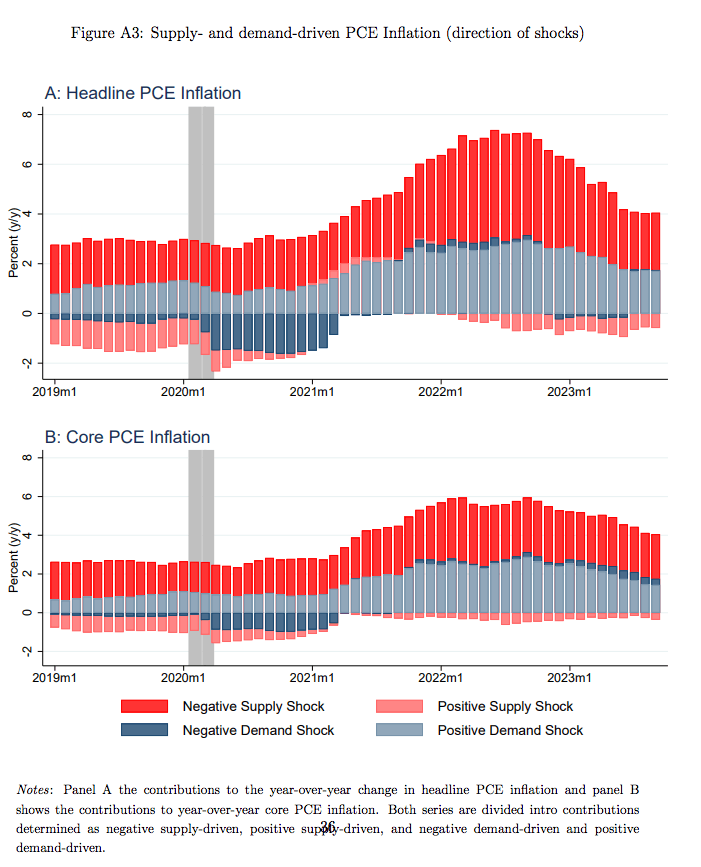
In a previous post, I argued that more than 100% of the inflation since late 2019 has been demand side. There were some adverse supply shocks around 2021-22 that led to significant inflation, but there have also been major positive supply shocks (notably immigration) that have tended to depress inflation. In net terms, the cumulative inflation is all demand sideI regard nominal GDP growth as a useful proxy for the contribution of demand. Because real GDP tends to rise at about 2%/year, on average, a 4% NGDP growth rate is a useful benchmark for appropriate monetary policy. Since late 2019, there’s been roughly 11% cumulative excess NGDP growth (i.e., above 4%), which can more than fully explain the roughly 9% cumulative excess PCE inflation (above 2%).Most economists clearly don’t look at things this way. Most economists seem to regard the high inflation of 2020-24 as resulting from a mix of supply and demand shocks.  A recent San Francisco Fed working paper by Adam Hale Shapiro provides a decomposition of supply and demand side inflation this is broadly consistent with estimates I’ve seen from a number of economists: Notice that both negative supply shocks and positive demand shocks play a major role, with negative supply shocks being especially important for headline inflation (which includes food and energy prices.) Shapiro uses an interesting technique to tease out the contributions of supply and demand shocks: Since inflation is constructed as the weighted sum of category-level inflation rates, it is straightforward to divide inflation by category, or groups of categories. I separate categories each month into those where prices moved due to a surprise change in demand from those where prices moved due to a surprise change in supply. The methodology is based on standard theory about the slopes of the supply and demand curves. Shifts in demand move both prices and quantities in the same direction along the upward-sloping supply curve, while shifts in supply move prices and quantities in opposite directions along the downward-sloping demand curve. To say I have mixed feelings about this is an understatement.  I strongly support the technique of looking at co-movements of prices and output to identity supply and demand shocks, but I strongly oppose making inferences about aggregate price changes by aggregating sectoral price changes. One of my first published papers (JPE, 1989, co-authored with Steve Silver) looked at real wage cyclicality.  We tried to estimate how real wage cyclicality depended on whether the economy was hit by supply shocks or demand shocks.  We identified these two types of shocks by looking at periods where prices and employment went in the same direction (demand shocks) and periods where prices and employment went in opposite directions (supply shocks). So I’m completely on board with that sort of identification strategy.  One can also compare changes in inflation with changes in real GDP growth rates.  Indeed my view that 2019-24 is all demand side inflation is due to the fact that growth was above trend—both prices and output were moving in the same direction. Shapiro looks at price and output data for more than 100 categories of goods and services.  This is the part I don’t agree with (or perhaps don’t adequately understand.)  In any complex economy, some markets will show positive price/output correlations and some markets will show negative price/output correlations.  I fear that this technique will lead to overestimates of the role of supply, as even in an economy where 100% of inflation was demand generated you would find individual markets with negative price/output correlations (indicating supply shocks.) Consider a thought experiment with an economy featuring stable but high rate of inflation, generated by fast money growth.  Also assume the public has become used to the rapid inflation, so wage and financial contracts factor in the inflation.  I.e., assume that money is roughly neutral.  You could imagine an economy where the money supply doubled every 12 months, and all wages and prices rose at a similar rate.  Output is (by assumption) at the natural rate.  By assumption, this would be an economy where almost 100% of inflation is demand side (from monetary policy).  And yet the price/output correlations would vary a great deal between sectors, as you would still have all sorts of changes in relative prices due to a variety of local supply and demand shocks.  In other words, the factors that affect relative prices in individual markets are radically different from the factors that affect the overall price level (monetary policy in this case, although velocity is another possibility.) Shapiro directed me to a new study of Turkish inflation that leads me to believe that my thought experiment is more than just a hypothetical concern.  Before considering their study, think about how much inflation is likely to result from supply side factors.  If monetary policy generates 4% NGDP growth, then you will end up with 2% inflation if output grows at its 2% trend rate.  But if adverse supply shocks reduce output growth to negative 1%, and NGDP continues growing at 4%, then inflation will rise to 5%.  Thus I have no problem with the claim that supply shocks could briefly push inflation 3 percentage points above trend.  But what would it take for supply shocks to add 30% or 50% to a nation’s inflation rate? The Turkish study by Okan Akarsu and Emrehan Aktu ̆g produced this graph: Notice that Turkish inflation peaked at about 80% in 2022, and generally runs well ahead of the US.  Also note that the proportion attributed to supply and demand shocks is similar to the estimates shown in Shapiro’s graph for headline inflation.  You might think that fact is not surprising–the Turkish authors used a similar model—citing Shapiro’s work.  But I’d expect the contribution of supply shocks in an absolute sense to be relatively similar in the two countries—say low to mid-single digits.  Then if Turkey has a monetary policy that generates extremely high NGDP growth, I’d expect almost all of the inflation in Turkey to be demand side. Here’s the abstract of the Turkish paper: We document the demand and supply-driven components of inflation in Turkiye by following the decomposition method of Shapiro (2022). The results suggest that the recent hike in inflation, which started with the Covid-19 pandemic but deviates significantly from global inflation rates, was initially driven by supply factors, but over time it transitioned into an inflationary environment predominantly driven by demand forces. Consistent with theory, oil supply and exchange rate shocks increase the supply-driven contribution, while monetary policy tightening reduces the demand-driven contribution to inflation. This decomposition can potentially serve as a useful real-time tracker for policymakers. Perhaps the phrase “exchange rate shocks” is one source of disagreement.  In my thought experiment where the money supply doubled each year, I assumed that wages and prices also doubled.  And one very important price is the price of foreign exchange—aka “the exchange rate”.  Thus one year it might take 100 Turkish lira to buy a US dollar, then a year later 200 lira, then 400 lira, then 800 lira.  I suppose that could be viewed as an “exchange rate shock”, but to me it is just one aspect of demand side inflation—which pushes all prices higher, including the price of foreign exchange. We are so far apart that I wonder if the problem here is terminology.  The terms “supply” and “demand” were developed to explain relative price changes in specific markets for goods and services, not aggregate price changes.  There’s always been a split between those who prefer to think about inflation as depreciation in the purchasing power of money, caused by shifts in money supply and demand, and those who think about inflation more in terms of the sum of individual price rises, caused by supply and demand factors in a wide range of markets.  I’m on the monetarist side of that divide. For the concept I’m interested in, we might be better off using entirely different terminology.  Thus I could use the term “nominal inflation” for any variation in inflation associated with variations in NGDP growth.  And I could use the term “real inflation” for any variations in inflation caused by real output changes, holding NGDP constant.  Of course, these terms would then merely represent accounting, and have no causal implications.  I do think that NGDP growth is ultimately determined by monetary policy (including monetary policy errors of omission), but that sort of causal claim does require evidence, it’s not just a tautology. In any case, I might be missing something obvious here, and would be interested in how other view claims such as the estimate than half of Turkey’s 80% inflation in 2022 was supply side.  Does that seem plausible?  If so, what’s your definition of “supply driven”? I’ve never seen a clear definition of supply side and demand side inflation.  In the absence of a consensus view, each empirical study of the question becomes a de facto definition.  Perhaps there’s no real debate at all, just differing definitions. PS.  There is a method that makes supply inflation seem even lower than my estimates.  There’s an argument that any increase in real output tends to depress prices.  Thus if RGDP rises by 2% and NGDP rises by 4%, you could argue that the supply side has depressed the price level by 2%, ceteris paribus, and the demand side has raised prices by 4%, yielding 2% net inflation. (0 COMMENTS)

/ Learn More

Trade Has No Losers

International trade, it is commonly said, has winners and losers. Consumers in the U.S. gain when they buy wine imported from France while winemakers in California lose. C’est la vie, counsel economists. Nothing should be done about this situation. The reason is that it’s also commonly said – at least among those of us in the economic know – that the winners’ gains from free international trade are easily shown to exceed the losers’ losses, thus making trade efficient. Economists call this outcome “Kaldor-Hicks efficient.” Because the winners’ gains exceed the losers’ losses, the winners could in principle fully compensate the losers, wiping out the losses while still leaving net gains for the winners. Therefore, even without actual compensation of the losers, free trade makes society as a whole better off despite the fact that some individuals suffer net losses. Crack open any textbook in international trade and you’ll find that the author, when presenting the normative case for free trade, almost certainly offers an argument similar to the one in the previous paragraph. This argument is sophomoric utilitarianism and, hence, unconvincing. “Why,” a serious trade skeptic asks, “should we tolerate policies that allow some people – even a majority of people – to gain at the expense of other people?” Good question. It’s one the economics-textbook author cannot answer. Fortunately, the common claim that “trade has winners and losers” is emphatically not correct. One way to see the flaw in this claim is to recognize that trade is merely one among countless different sources of economic change. There’s nothing unique or special about trading with foreigners that causes some businesses to lose profits and some workers to lose jobs. Every change in economic activity has these effects. If Americans have fewer babies, Americans buy fewer diapers, thus causing profit and job losses among American producers of diapers. If Americans come to enjoy taking more meals at home, they buy fewer restaurant meals, thus causing profit and job losses in American restaurants. Improvements in automotive technology over the years have reduced the demand for neighborhood garage mechanics. The polio vaccine wiped out lots of jobs in factories making wheelchairs, leg braces, and crutches. In light of this reality, if someone wants to continue to describe trade as “having winners and losers,” that person – to be consistent – must describe every economic change, such as the introduction of the polio vaccine, as having winners and losers. This description proves that there is nothing unique about international trade. But there’s a deeper reason why it’s wrong to say that trade has winners and losers – namely, losses differ from costs. There are indeed costs to be borne by participating in commercial society, but these costs are not losses. Someone who truly loses from trade is someone whose life would be better if she had never been part of a society in which trade occurs. If the worker whose job is destroyed by imports would, in light of this job loss, have had a better life had she lived in a country that had no international trade, this worker might fairly be described as being among trade’s losers. But if this person’s life, even given her loss of a job, is on the whole better than she would have experienced had she lived in a country with no foreign trade, describing her as being among trade’s losers makes no sense. Living in a country whose economy is connected to the global economy ensures that her access to goods and services – and, likely, to another job – is almost certainly much greater than that access would be were her country never to have had commercial contact with foreigners. It might be true that had the particular imports that destroyed her job never been admitted into the country she would have been better off than she finds herself with the imports allowed in. But if, as is almost certainly the case, her life overall is so enriched by trade that her life, taken as a whole – even taking account of her job loss – is better than it would have been had her country been autarkic, then she is no loser from trade. One reason why innovative, commercial free markets produce such an abundance of material goods and services for ordinary people is that consumers, not producers, call the shots. A foundational rule of a market economy is that consumption is an end, and production is a means of achieving this end. Anyone who wishes to enjoy the (ample) benefits of a market economy must agree to play by this rule. But playing by this rule has its costs, one of which is the risk that, in your role as producer, you must adjust to the demands of consumers. The worker in a market economy who loses her job to imports – or to labor-saving technology, or simply to changes in consumer tastes – pays the cost of admission and participation in this economy. Of course, this worker would prefer not to pay this cost. But all benefits in our valley of eternal scarcity come with costs. Payment of this particular cost is no more a loss than is, say, my paying my monthly mortgage bill: I’d prefer to be relieved from the obligation to make this payment. But I’m nevertheless thrilled that I had the opportunity to agree to incur this monthly cost, for otherwise no one would have loaned me money to buy my home. My monthly mortgage payments aren’t losses; they’re costs incurred for the greater benefit of borrowing money to purchase a home. Likewise, a worker whose particular job is destroy by economic change doesn’t suffer a loss; that worker, instead, pays the cost of participating in an economy that promises a material bounty unmatched by any other kind of economy. This worker, even having lost a good job, remains far better off living in an economy with trade than she would be were her economy cut off from the rest of the world.   Donald Boudreaux is Professor of Economics, George Mason University. He blogs at Café Hayek (www.cafehayek.com). (0 COMMENTS)

/ Learn More

Why I am Skeptical of Market Failure Corrections

In just about any economics textbook, one will find a discussion of market failure.  The conversation will usually go something like this: markets are great, but sometimes they fail.  If transaction costs are low, then no government remedy is needed.  But if transaction costs are high, then the government can (and should) step in to correct the failure.  One of the most common methods advocated to correct a market failure is the original from British economist Arthur C. Pigou: taxes. A Pigouvian tax is a tax designed to fix a specific market failure: negative externalities.  A negative externality is a situation where costs are imposed on a 3rd party outside of the transaction.  Since they are not part of the original transaction, the monetary price that occurs in the market does not fully take into account their costs.  Thus, a tax can be applied that raises the market price, reduces the quantity in the market, compensates for the costs imposed, and the market failure is removed.  Negative externalities seem to be pervasive in society (pollution, bad smells, second-hand smoke, etc).  Furthermore, transaction costs are high (imagine if a power plant had to negotiate with every person who is affected by its smog!).  Consequently, you have many economists taking the need for Pigouvian taxes as a given. I, however, am very much in a minority.  While I understand the logic behind Pigouvian taxes, I reject them as a practical solution; I do not think they are a 1st-best, or even 12th-best solution to market failure.  Public Choice economics gives us a major reason to be skeptical of government-imposed market failures, even so-called “market-based” interventions like Pigouvian taxes or cap-and-trade.  The assumption behind Pigouvian taxes (or any government intervention in the economy) is that the government is a benevolent dictator; it seeks to do the right thing and can do so unilaterally.  But Public Choice teaches us that we must consider the world as it actually is as opposed to some idealized alternative state. In the real world, the government is neither benevolent nor a dictatorship.  Government agents are not benevolent, but neither are they generally malevolent.  They, like all of us, are looking out for their own best interests.  They want to keep their jobs, they want to do a good job, they want to go home to their families at the end of the day, etc.  They have hopes, dreams, and desires.  And they act in line with their incentives and their goals, which probably differ from most other people.  What incentive, then, is there for them to assign “the proper” tax to solve an externality, or even to gather all necessary information to properly assign it? In the real world, the government (at least in the United States) is not a dictatorship.  It has many working parts.  Many policy decisions are made in committees, or determined by Congressional vote.  Policy-makers and decision-makers are balancing many, many different issues.  Consequently, policy more often than not deviates from a theoretical ideal and hedges more toward being politically correct. (By that I mean: the policy is correct for some political goal rather than some non-political goal.)   In a recent post, Pierre Lemieux highlights one such case of politically-correct policy: tariffs on Chinese-made electric vehicles (EVs).  We are often told that global warming is a significant issue and one that warrants significant government involvement.  Indeed, it is the justification for many government subsidies to green energy (a reverse Pigouvian tax) and a carbon tax.  From that perspective, the tariffs on Chinese-made EVs make no sense.  If there is a negative externality, and there is a product on the market that can reduce the externality, then why effectively prohibit it?  The answer: because those cars were not politically correct.  They solved the market failure, but not in the politically desired way.  Thus, the administration, looking to protect its voter base and accomplish its own goals of staying elected, opted to take an action that makes the externality worse rather than better.  All in the name of stopping the externality.   Why do I oppose a carbon tax?  Because I see no reason why it also will not become subject to such political correctness.  Even if it were possible to accurately and costlessly calculate the necessary tax, why should we believe it would not be implemented and designed in such a way as to favor certain groups and achieve political goals rather than economic?     Jon Murphy is an assistant professor of economics at Nicholls State University. (2 COMMENTS)

/ Learn More

What Would Change My Mind?

Here, I call on EconLog readers to try to change my mind!  Let me start this out with a proverbial throat-clearing on what we all know are the well-worn difficulties of changing someone’s mind. Doing so is often very difficult, and people are reluctant to change their mind. And we’re all biased to believe we are all more open-minded than we actually are. That said, I do think I’m better than most at being willing to change my mind, even on very fundamental issues that have major life implications. Two examples – for a significant fraction of my life, I was a quite devout and believing Christian. But I am now an atheist, because I encountered a variety of arguments I found convincing and thus changed my mind on the subject. (This also makes me somewhat skeptical when people say things like “it’s pointless to debate religion, nobody ever changes their mind,” because I certainly did, and I know many others who have as well, for the same reasons as me.) Second, I used to have such a meat-heavy diet that I was pretty close to people who abide by the so-called “carnivore diet” today. But I read Michael Huemer’s debate with Bryan Caplan over ethical vegetarianism, and I stopped eating meat that same day, because I found Huemer’s arguments far more powerful and convincing than Caplan’s. I felt no difficulty with abandoning my lifelong religious beliefs or fundamentally altering my diet and lifestyle once coming across persuasive arguments that were contrary to my own views at that time.  So, here’s a few things I believe to be true that are, I think, controversial enough that a number of readers would dispute. Now, I’m not asking you to try to adjudicate the issue in the comments here – there’s only so much one can do in a blog post or a comment. Instead, if you disagree with my take on something, what would you hold up as the best, strongest, most persuasive account for the opposite view – an argument you’d personally be willing to sign off on? Depending on what comes through, I’ll pick one and read it, and might turn my reaction into one of my multi-post in depth reviews.  With that stage now set, here’s a few ideas I have in mind. Moral realism – the idea that there are objective moral facts about what is right and wrong, independently of what anyone thinks about them. That is, if Nazi Germany had won WWII and gone on to conquer the entire world, and all subsequent generations had been raised to believe that the Holocaust was a great good, it would still be the case that the Holocaust was wrong. While this isn’t exactly an unpopular view of mine (moral realism is the majority view among philosophers, after all), there’s still enough disagreement out there to make it worth exploring. If you incline towards moral antirealism, what book or article or essay do you think makes the best case?   There is nothing morally special about the state. By this I don’t mean state action is never justified. What I mean is that there is nothing that justifies coercion by the state that does not also equally justify coercion for an individual. If a situation doesn’t justify coercion on the part of an individual, it does not justify state coercion either. Again, this does not mean that justified state action is an empty set – because justified individual coercion is also not an empty set. But the two sets are equal, or so it seems to me. Additionally, I reject what Jason Brennan calls the “special immunity thesis” in favor of the “moral parity thesis.” That is, the actions of the state are to be evaluated by the same moral standards as any other person or organization, and can be justly resisted on the same basis. If you disagree and believe that the justness of coercion depends not on the circumstances creating the justification but rather on who is doing the coercing, what’s the best argument you know supporting this? Or if you believe that agents of the state enjoy a special moral immunity against being resisted when acting unjustly, what argument do you think makes the strongest case for this?  Equality of outcome has no intrinsic value. While there might be instrumental benefits to equality of outcome, the benefits are instrumental only. Of course, being “merely” instrumentally beneficial doesn’t mean something is unimportant. But still, equality of outcome has no value in and of itself. Imagine one world of vast, crippling, and equal poverty, and another world where nobody suffers from any poverty but some are better off than others. Someone who believes in the intrinsic value of equal outcomes could still accept that the second world is better overall – they might allow that the intrinsic value of equal outcomes is outweighed by the instrumental value of eliminating poverty. But they would still have to argue that there is at least some sense in which the first world is better, even if the second is better overall. To me, there is no sense in which the first world is better – equality of misery and suffering doesn’t create an offsetting good by virtue of its equality. But if you do think that there is real, intrinsic value on equal outcomes, what is the best argument you can point me to?  There is no coherent concept of aggregated decisions or preferences. That is, phrases like “we as a society have decided” such and such are at the very best a misleading shorthand, and at worst are fundamentally incoherent. There is no meaningful sense in which individual decisions can be aggregated into an overall social decision, or individual preferences somehow average out to a meaningful social preference. But perhaps you disagree, and believe that there is some deeply meaningful concept of social preferences. If so, tell me who makes the strongest argument for that case and where I can find it.  I’ll leave it at these four for now, but if this proves fruitful I may try this approach again. Commenters, have at it! (0 COMMENTS)

/ Learn More