This is my archive

bar

The Valence of Unintended Consequences

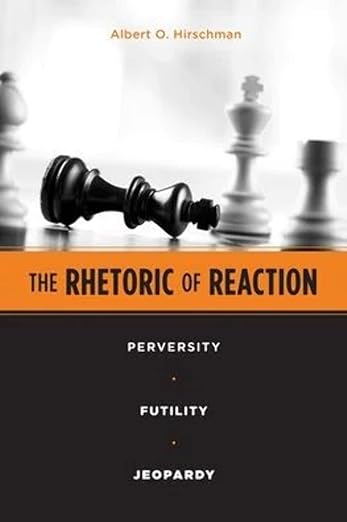
How should we think about the problem of unanticipated consequences? And what are the implications for the possibility of unintended consequences regarding top-down, technocratic policy initiatives that aim to mitigate targeted social problems?  For example, I’ve occasionally heard it argued that we shouldn’t be too worried about unanticipated consequences of interventions, because unanticipated consequences don’t have to be bad. They might be good! Albert Hirschman made this claim in his book The Rhetoric of Reaction, where he advanced two claims – the idea that “purposive social action” leads to adverse unintended consequences only “occasionally,” and that “it is obvious that there are many unintended consequences or side effects of human actions that are welcome rather than the opposite.”  In his book Power Without Knowledge, Jeffrey Friedman argued that Hirschman’s case falls flat on both points. To start, “Hirschman’s first claim is a generalization of naïve technocratic realism. It tacitly appeals to the reader’s agreement that if we tally up our first-order assessments of technocratic wins and losses, technocracy comes out ahead, begging the epistemological question by assuming the reliability of these tallies.” Given that the ability to accurately tally such things is the very point under dispute, trying to resolve the dispute by appealing to those tallies would indeed be a textbook case of question-begging.  The second claim Hirschman makes might provide a basis for defending technocracy, but Hirschman fails to adequately defend it, Friedman argues: To counteract worries about the adverse unintended consequences of technocracy he would have had to contend that the unanticipated consequences of technocrats actions will tend to be beneficial, not merely that they may be beneficial. Thus he would have had to argue not that “there are many unintended consequences or side effects…that are welcome,” but that, even though policymakers may be ignorant of the side effects of their actions, something or other ensures that these effects will be more welcome than unwelcome overall. This claim would not be naively realistic, as it would gesture toward a second-order factor or factors that might explain the on-balance beneficial valence of unintended consequences. However, since Hirshcman does not specify what this factor or factors might be, it is hard to imagine how the claim could be supported, saved through a quasi-religious providentialism.  That is, Friedman argues that if one wants to salvage the argument in favor of technocracy in situations where technocrats lack what Friedman called “type 4 knowledge” – knowledge that the costs of a technocratic policy (consisting of both the costs of implementing the solution as well as any unanticipated and unintended costs) will not be higher than the costs of the initial problem – merely pointing out that unanticipated outcomes could in principle be beneficial is simply inadequate. One would need to provide some positive grounds for believing that unintended consequences will have an overall tendency to be beneficial.  In his book, Friedman simply adopts the fairly modest premise that “while the tendency of unintended consequences might be either more harmful than beneficial or more beneficial than harmful, we do not know which is the case…The question, then, is whether our ignorance of the valance is more damaging to epistemological criticisms of technocracy or to defenses of it.” He argues that the simple fact of uncertainty is fatal to the argument for technocracy, and to say otherwise “would fly in the rationalist face of technocracy, for it would license the adoption of policies that – like policies pulled from a hat – are justified not by knowledge, but by hope.” Appealing to the mere possibility that unintended consequences might be beneficial as a defense of technocracy actually rebuts the argument in favor of technocracy. Friedman left the question of how to judge the valence of unanticipated consequences unexamined – his case didn’t depend on making a positive case that the valence will be neutral or even negative. But I want to look a step further than Friedman did – do we have reason to think that valence of unintended consequences will tend to be positive, neutral, or negative? And on what basis would we examine such a claim? Friedman argues (correctly, I believe) that we need to make a second-order argument on this issue. A second-order argument is one that focuses on systemic reasoning about the workings of a system, rather than first-order arguments where one attempts to tally up points on a case by case basis. For example, one might argue that government operates inefficiently compared to market activity by first-order means, perhaps pointing out that building a public restroom consisting of a “tiny building with four toilets and four sinks” cost the taxpayers of New York City over two million dollars, while by contrast “privately managed Bryant Park, in the middle of Manhattan, gets much more use and its recent bathroom renovation cost just $271,000.” But the same article also makes a second-order argument about the systematic differences under which state and private enterprises operate, arguing that since “government spends other people’s money, it doesn’t need to worry about cost or speed. Every decision is bogged down by time-wasting ‘public engagement,’ inflated union wages, and productivity-killing work rules.” So we can distinguish between the first order argument (examining specific cases) and the second order argument (comparative institutional analysis). Thus, the article uses a first-order case as an example of government being wildly wasteful and inefficient in what it does, and also offers a second-order argument for why this sort of disparity is systemic rather than random. In my next post, I will be considering a second-order argument about the valence of unintended consequences, and whether we should expect them to have a tendency to be positive, neutral, or negative.    (0 COMMENTS)

/ Learn More

Tariffs are taxes on trade

The claim in the title of this post might sound obvious. But I encounter lots of people that think import tariffs are taxes on imports, but not exports. In fact, taxes discourage both imports and exports, to a roughly equal extent.Just to be clear, tariffs might reduce imports a bit more than they reduce exports if they led to a smaller budget deficit. I doubt there’s anyone who believes that has been the case for the tariffs imposed in the US by recent administrations.Another misconception is that tariffs on imports reduce exports only in the case where other countries retaliate. That’s not true. Tariffs move the exchange rate to a position where exports are likely to fall roughly as much as imports decline, even if there is absolutely no explicit “retaliation” from other countries.The intuition here is that exports are the way we pay for imports. If you tax one side of a transaction you will reduce both sides, just as a tax on gasoline reduces both the sale of gasoline and the purchase of gasoline.  It makes no difference whether the tax is imposed on buyers or sellers.To be sure, the quantity of imports and exports of goods can differ if countries are also exchange financial assets in trade.  The trade balance (technically current account balance) is national saving minus national investment.  But unless tariffs reduce the budget deficit (which is negative saving), they are not likely to increase the trade surplus, or reduce the trade deficit.   Bloomberg has an article discussing how US farmers are losing market share to Brazilian farmers: An aging rural population is the latest strike against a country that’s been losing its agricultural dominance for years. That standing has been a crucial source of political power, including crucially with China, the biggest agricultural importer. But US-China relations frayed during Donald Trump’s trade war, allowing Brazil to take the place of some US supplies. Already the top exporter of soybeans, Brazil may now be on pace to overtake the US in corn exports, too. As the US’s agricultural trade deficit widens to a record $32 billion in fiscal 2024, households will find themselves at increasing risk of supply-chain disruptions and price spikes when far-flung disasters hit. A loss in agricultural export competitiveness is exactly what you’d expect when a country adopts higher tariffs.  It has nothing to do with “US-China relations”, and everything to do with the real exchange rate. None of this means that tariffs are necessarily a bad idea.  Rather this analysis suggests that it would be a mistake to move toward protectionism under the assumption that tariffs only reduce imports, whereas in fact tariffs reduce both imports and exports, and by a roughly equal amount.  PS.  The same applies to an export tax, which also reduces imports.  For the same general reason, a policy regime that combines a uniform import tariff with an equal export subsidy is pretty close to a pure free trade regime, as the two policies roughly offset.  Thus countries like South Korea were far less “mercantilist” during their high growth phase than many people claim. (0 COMMENTS)

/ Learn More

Reading a Love Letter to Justice

Was it divine intervention or simply the fact of being right that makes the infamous “Letter from Birmingham Jail” timeless, profound and even life-changing for some readers? If you haven’t met Dwayne Betts in an earlier EconTalk episode, get ready for Russ Roberts’s phenomenal friend and guest. Betts is so present in the moment and affected by the beauty, truth, and humility of the great Martin Luther King that his voice sometimes cracks answering Roberts’s questions. In this episode, he shares moments from his own history and the effect King’s work has had on him. Betts’s 9 years in prison and remarkable journey since uniquely qualify him as the King family’s choice author for the introduction to Letter from Birmingham Jail (The Essential Speeches of Dr. Martin Luther King). We hope this conversation stirs thoughts about freedom in you. Please share a thought or insight in the comments below.     1- Both Roberts and Betts have appreciated King’s great speech in different ways upon revisiting it. Roberts calls it a love letter to justice in his (King’s) country. As you pause and read “Letter From Birmingham Jail,” by Martin Luther King Jr., what do you notice that perhaps you didn’t remember?   2- How does Betts argue that King’s urgent letter, a response to criticism of his nonviolent protesting, honored the eight clergy critics?    3- Betts states, “I feel like it’s much more challenging to name what the side of justice looks like,” referring to the difficulty of arguing with conviction on contemporary topics. To what extent do you agree with this statement and, with what examples would you explain?   4- “Turning regrets into feathers” versus “Economics explains everything except justice”.  John Rawls (not Robert Nozick) is in The Freedom Library in 340 prisons. Confronting the sense of “nobodiness,” which conversation strand would you want to pursue over dinner, and why? (0 COMMENTS)

/ Learn More

Should the Fed placate the markets?

Should the Fed placate the markets? Yes and no. Let’s start with the no. Today’s Bloomberg has a piece by Mohamed El-Erian with the following title and subtitle: The Fed Should Resist Placating MarketsThe central bank needs to avoid being rushed into another policy mistake by making an emergency interest-rate cut. The Financial Times has a similar piece by Barry Eichengreen: The Federal Reserve will not let markets dictate a rate cut Stock moves are not a reliable signal of looming economic downturn I mostly agree with both commentators.  The Fed should not be in the business of trying to prevent big moves in the stock market, and yesterday’s 3% decline in the S&P500 was not even a particularly large move.   (Yes, it was significantly larger than average, but I’ve seen numerous moves that were far larger.  As I write this, the S&P500 is up over 2%.)   So why do I say “yes and no” at the beginning of this post?  I think it depends on exactly what one means by “placate the markets.”  Imagine there were a NGDP futures market.  In that case, I would strongly support having the Fed adopt a monetary policy that placated the NGDP futures market.    Of course we do not have an NGDP futures market.  But we do have many markets that indirectly provide information as to market expectations of NGDP growth.  Start with the fact that NGDP growth is the sum of inflation and real GDP growth.  And then note that we have (admittedly imperfect) market indicators of expected inflation.  In addition, there are many market indicators that are substantially correlated with expected real and nominal growth.  Yesterday I recall a market commentator mentioning that risk spreads in the bond market had increased.  Risk spreads are certainly correlated with NGDP growth, as borrowers have more trouble servicing debt when NGDP growth slows sharply.   Suppose the Fed constructed a model to estimate market expectations of NGDP growth, which used a weighted average of all sort of relevant market prices.  It might make sense to try to stabilize that index, without trying to stabilize any single individual component of that index.  Would that be “placating the markets”?  I think that’s sort of a question of terminology.  The Fed would not have market stability as a primary goal; rather they would merely be trying to stabilize markets to the extent that doing so would stabilize NGDP growth.  As a practical matter, they might occasionally respond to severe stock or bond market movements, but not because they cared about the plight of investors. (1 COMMENTS)

/ Learn More

The Draft Would Reduce Skin in the Game for Most Citizens

In the last 5 weeks, I’ve written two articles on the draft for the Hoover Institution’s on-line publication Defining Ideas. The first made the case against the military draft; the second made the case against universal national service. In responses on the Defining Ideas site, some commenters argued that one advantage of the draft is that it causes people who benefit from defense to have “skin in the game.” In response to my first article, one commenter wrote: Our freedom is not for free. David Henderson wants those who are prepared to risk their lives for our freedom to do that for the benefit of those who want their freedom for free. In response to my second article, one commenter wrote: When American men do not serve their country, they put no skin in the game and, as a result, do not feel that they are obliged to fight and defend. Actually, though, if the goal is for beneficiaries of defense to have skin in the game, an all-volunteer force does a better job than the draft. Why? The reason is that the draft puts a disproportionate burden on draftees. An all-volunteer force, on the other hand, spreads the burden to beneficiaries of defense whether or not they are in the military. In the late 1970s, there was a serious push, spearheaded by Senator Sam Nunn (D-GA), to restore the draft. I got copies of all of the bills to do that. Every single one of them—and there were many—explicitly cut first-term pay, often by a large percent. Why pay when you can threaten potential draftees with prison sentences for not complying? So the burden would have been placed disproportionately on those who were drafted. Consider, by contrast, an all-volunteer force. The reason the military had problems recruiting high-quality personnel in the late 1970s was that we had an economic boom combined with high inflation. It was a double whammy. The boom gave potential recruits good alternatives to military service; failure to raise pay in line with the Consumer Price Index made military service even less attractive than otherwise. President Jimmy Carter got wise to the situation relatively late in his 4-year stint in the White House and, with Congress, raised first-term pay. Then Ronald Reagan became president and raised it again. That’s how we got out of the late 1970s recruiting doldrums. So note what happened. Because we had a volunteer military, the burden of defense couldn’t be shifted onto the shoulders of young military personnel. Instead it was shared by all taxpayers. We saw something similar in the middle of the 2000s, during the second war against Iraq. Here’s what I wrote in September 2015, drawing on a scholarly article co-authored with then Marine Major Chad W. Seagren: Henderson and Seagren note that, as the number of troops in Vietnam increased from 1964 on, real military personnel outlays per military member barely budged. By contrast, real military personnel outlays per member rose substantially as the U.S. government got in wars in Afghanistan and Iraq. From an average of $73,887 per member between 1996 and 2001, real outlays rose to an average of $103,772 from 2004 to 2010, an increase of 40 percent. The reason: the government had to increase pay to meet its manpower targets. Henderson and Seagren point out that this higher cost per military member resulted in about an extra $45 billion per year in U.S. government spending. That higher cost was, admittedly, financed mainly with deficits rather than with current taxes. But deficits now, unless the government later defaults or cuts spending, lead to higher taxes in the future. And if, as seems likely, the future tax system even roughly resembles the present tax system in forcing higher income people to pay a much higher percent of their income in taxes, the rich and powerful will pay more for war. The bottom line is that if you want all people who benefit from defense to have skin in the game and not just focus on a small group, you should oppose the draft and favor an all-volunteer military. Postscript: In researching this piece, I came across this Econlib article by Chad Seagren, “Service in a Free Society,” May 2, 2011. I had lined it up and edited it during my time as editor of the Econlib articles. I had forgotten about it. It speaks to many of the issues with the draft, and does so well. (0 COMMENTS)

/ Learn More

Better Economic Maps

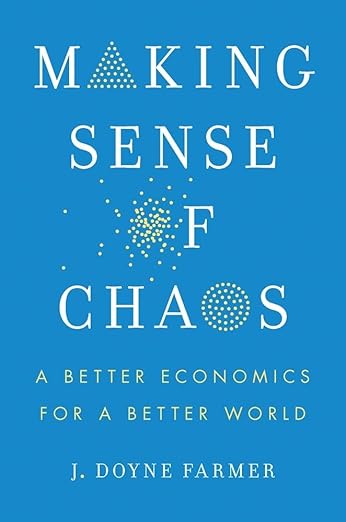
Our new model incorporates several innovative features: For example, rather than using a representative household, it features a demographically accurate synthetic population with millions of households (matching age, education, race, and consumption habits). Instead of using a representative firm, we model the behavior of tens of thousands of the largest firms, in one-to-one correspondence with real firms…. J. Doyne Farmer, Making Sense of Chaos: A Better Economics for a Better World,1 p. 258 Mainstream economics is willing to build a model of an economy in terms of a “representative individual.” One hypothetical consumer represents every household. One hypothetical firm represents every business. Many different types of workers are aggregated as “labor.” Many different types of machines and other productivity-enhancing factors (such as business reputation or process knowledge) are aggregated as “capital.” I have long questioned this way of doing economics, which I refer to as the “GDP factory” method of analysis. For decades, J. Doyne Farmer and his relatively small cohort of like-minded researchers have advocated for and implemented a different approach. Borrowing from the field of ecology, they wish to build models incorporating agents that employ different strategies within the overall system. The representative-individual approach involves carefully choosing a set of assumptions in the economist’s head about human behavior, representing those as equations, and solving the equations for a single equilibrium. It predates the age of the computer. Farmer’s approach, illustrated in his new book Making Sense of Chaos, requires a very different modeling strategy, called “agent-based modeling.” It starts with observations about how different individuals choose strategies for earning a living, consuming, and investing. The goal is to see how these strategies interact with one another over time. This requires computer simulation. For example, consider the stock market. The “representative individual” approach assumes a single investor with full information and one strategy for maximizing returns relative to risk. Farmer’s approach instead starts by looking at the types of strategies different investors actually use. Some focus on fundamentals. Others try to spot trends. Everyone has different information and uses different heuristics. For more on these topics, see “The Stock Market,” by Robert P. Murphy. Library of Economics and Liberty, Oct. 4, 2010. John Bogle on Investing. EconTalk. Luca Dellanna on Risk, Ruin, and Ergodicity. EconTalk. The representative-individual models of the stock market tend to have dynamic properties that are uninteresting and unrealistic. They predict minimal market movement, much less trading than we observe, and nothing like the pattern of run-ups and crashes that seems to characterize existing markets. The models with heterogeneous investors are able to replicate the patterns we actually observe in the stock market. One of the most interesting findings from representative-agent models is that as the influence of players using one strategy increases, the dynamics of the financial market change. Strategies that dampen volatility for a while can suddenly cause instability. For example, Farmer points out that in the late 1990s major investment banks adopted “value at risk” (VaR) as a strategy for controlling market exposure. VaR measures the loss from, say, an adverse price movement of two-standard deviations. Using such a metric, a risk manager would say that you can increase risk exposure as market volatility declines, and you have to decrease it when volatility goes up. In good times, you get a self-reinforcing feedback loop that raises asset prices as banks expand their portfolios. But then a little adversity leads everyone using VaR to try to sell at once, causing a really severe self-reinforcing loop on the downside. Farmer says that this describes what happened in financial markets before and during the financial crisis of 2008. Farmer and colleagues also have used computer simulations of heterogeneous-agent strategies to analyze the energy market, with a particular focus on trying to assess the feasibility of an “energy transition” to forestall climate change. According to their analysis, the main cost from shifting toward renewable energy sources is upgrading the electric grid. But actually producing energy will be cheaper, so that overall a faster energy transition is a positive for the economy. In 2050, for example, our estimated global annual expenditure on the electricity network for the Fast Transition is about $670 billion per year, compared with $530 billion per year for the No Transition. However, the expected total system cost in 2050 is about $5.9 trillion for the Fast Transition and $6.3 trillion per year for the No Transition. Thus, although the additional $140 billion of grid costs might seem expensive, it is significantly less than the savings that come from cheaper energy. p. 253 The mainstream approach to doing economic theory will always have the advantage of being easy to communicate and to replicate. When someone shows the results of a mainstream model, you can solve the equations yourself and get a feel for what is driving the results. For empirical work, replication is not so reliable. Farmer reports that when he was with a company that was interested in exploiting stock market inefficiency, his team looked at published papers on market anomalies. For around half of the papers, we couldn’t reproduce the results, even when we tested the postulated deviation from efficiency using the same data. p. 146 “If economists are going to adopt agent-based modeling, they are going to have to develop ways to articulate, explain, and justify the choices they make in constructing the models.” Simulations are more opaque to those of us who are not on the team that built the model. We cannot reproduce the results for ourselves. If economists are going to adopt agent-based modeling, they are going to have to develop ways to articulate, explain, and justify the choices they make in constructing the models. I think of economic models as being like maps. With an old-fashioned triptych, if the map said to take the George Washington Bridge to get from where I live to Boston, I would have been stuck with that. With the map on my smart phone, I can consider alternatives, and even make adjustments in real time based on traffic conditions. For economists, vast amounts of data are becoming available. Computer power has gone up by orders of magnitude. This presumably makes the trends favor agent-based modeling relative to the representative-individual standard. But as maps for policy makers, agent-based models are still far from reliable. I would be careful not to presume that they make centralized decision-making a good way to operate an economy. One should not bet the farm on Farmer. Footnotes [1] J. Doyne Farmer, Making Sense of Chaos: A Better Economics for a Better World. Yale University Press, 2024. *Arnold Kling has a Ph.D. in economics from the Massachusetts Institute of Technology. He is the author of several books, including Crisis of Abundance: Rethinking How We Pay for Health Care; Invisible Wealth: The Hidden Story of How Markets Work; Unchecked and Unbalanced: How the Discrepancy Between Knowledge and Power Caused the Financial Crisis and Threatens Democracy; and Specialization and Trade: A Re-introduction to Economics. He contributed to EconLog from January 2003 through August 2012. Read more of what Arnold Kling’s been reading. For more book reviews and articles by Arnold Kling, see the Archive. As an Amazon Associate, Econlib earns from qualifying purchases. (0 COMMENTS)

/ Learn More

What’s a Parent to Do?

A Book Review of The Anxious Generation: How the Great Rewiring of Childhood Is Causing an Epidemic of Mental Illness, by Jonathan Haidt.1 When an academic writes a book for a popular audience, one of their main goals is to have an impact on the world. Jonathan Haidt’s new book The Anxious Generation is clearly already having an impact. The book has been sitting near the top of the New York Times bestseller list since it was released. But it’s already having an impact where academics care the most: public policy. Consider the following set of recommendations that Arkansas Governor Sarah Huckabee Sanders recently gave in her state-of-the-state address:2 Experts suggest goals like no smartphones before high school; no social media before 16; phone-free schools; and more outdoor play and childhood independence. I listened to that speech at the same time I started reading Haidt’s book. Here is how Haidt summarizes the suggestions in the conclusion of his book (page 290): 1. No smartphones before high school 2. No social media before 16 3. Phone-free schools 4. Far more unsupervised play and childhood independence It seems quite clear that, either directly or indirectly, the expert that Sanders is getting her recommendations from Haidt. It’s almost word-for-word. She prefaced her list with this context: Study after study shows that too much social media exposure leaves our kids anxious and depressed. Suicide rates for young teens have tripled since 2007. Depression among teenagers is up 150%. 30% of teenage girls now seriously consider suicide. This paragraph could easily have been a blurb for Haidt’s book. Clearly, Haidt is having an impact, and a very immediate impact on national conversations, that most academics could only dream of from a lifetime of doing research on a topic and trying to inject it into the public debate. Given Haidt’s clear impact, it is useful to examine his book in detail, and the research that he (and others, like Governor Sanders) cites to support the conclusion that the mental health issues teenagers are experiencing in America (and elsewhere) are the direct result of social media use on smartphones. And states are not waiting for more research to take action. Even before Sanders’ speech this year, Arkansas has already been at the forefront of restricting social media use for teenagers, with the 2023 “Social Media Safety Act” which requires age verification to use social media, and requires parental consent for anyone under age 18. While I have not seen Haidt comment on the Arkansas law, he praised a similar Utah law and said that every state should do the same. From Free Play to Instagram Addiction Haidt’s story of generational decline is neatly summed up by his four recommendations from above, but in reverse order. It starts with number 4 on his list, the decline of “free play.” For most of human history, kids had a lot of unsupervised play with kids their own age. Haidt tells us that this is an important part of childhood development, both in terms of learning how to interact with others (and resolve disputes) and to correctly wire young brains. Starting in the 1980s, parents began to give kids in the United States and other countries less time to engage in free play, in response to real and perceived threats to children in the world, driven by media stories about child abductions and murders. That’s part one of the story. But the real problem doesn’t arise until decades later in Haidt’s telling. The decline in free play left a void in child development, but also a void in how children spent their time. One way that time was occupied was with more intensive parenting, as parents started spending a lot more time actively involved with their kids (rather than their kids playing with other kids). Structured “play” time was also increasingly introduced, such as organized team sports, music and dance lessons, and all variety of clubs for kids to engage their interests. There were, of course, screens to occupy the time of kids. Lots of screens: TVs, VCRs and DVDs, video games, computers, computers with the internet. Then in the mid-to-late 2000s, a new and dangerous form of screen entered the scene: the smartphone. Around the same time, social media began to grow in influence, among both young and old. 2010 is a crucial year: the newest iPhone adds a front-facing camera and Instagram is introduced. After 30 years of mulling around with the decline of free play, kids finally found something to really occupy their time: spend 5 hours a day perfecting their online persona. The lack of actual social connections with other young people, and the replacement of it with pseudo-, often toxic, social connections online has led to a crisis of mental health. Haidt documents in chapter 1 the “tidal wave” of suffering in the United States, especially among young people, and particularly among girls. This suffering includes not just self-reported or diagnosed mental health issues (e.g., 30 percent of teen girls with major depression, more than doubling since 2010), but obviously objectively bad outcomes, such as suicide, rising 167 percent in a decade for girls ages 10-14 in the United States. A crisis, no doubt. The cause? Haidt is convinced and spends the rest of the book trying to convince the reader, that the double-whammy of declining free play in the 1980s and the rise of smartphones and social media in the 2000s is the culprit. Screens Are Annoying Any parent will tell you that screens are a double-edged sword. On the one hand, screens provide additional learning and entertainment opportunities, as well as temporary distractions for kids when adults need a break or need the kids quiet. This was true from TVs all the way up through the iPad (also introduced in 2010). One of the biggest downsides of screens is that they are annoying. Most of the entertainment is pretty mindless, whether it was the Honeymooners in the 1950s or Cocomelon today. What’s worse is kids become dependent on the screens. They whine for them when they don’t have them, and they seem unable to sit still in normal social settings. Kids never misbehaved in the past, of course (I’m only half kidding). Screens are not just disruptive for young people: they often disrupt adult social interactions too. The annoyance of screens, though, is not what Haidt’s book is about. Haidt is concerned very narrowly on smartphones with access to social media; this is clear from his first three recommendations. And he’s primarily concerned with mental health, not annoyance per se. Because Haidt is a good social scientist, he demands the best evidence, for he knows that two things can often follow each in time trends but either be unrelated, or both be caused by some third factor. Is It Causal? “Haidt argues very strongly that the relationship between social-media-equipped smartphones and teen mental health is causal, not a mere correlation. What is the evidence?” Haidt argues very strongly that the relationship between social-media-equipped smartphones and teen mental health is causal, not a mere correlation. What is the evidence? For a book that asserts this so heavily, you might be surprised to learn that there is just one paragraph focusing on randomized-control trials that address this question. It can be found on page 148. In that paragraph he summarizes just two studies that attempt to measure the effect of social media on mental health. In a footnote, he tells us further that there are 14 RCTs showing harm, and another 6 that found no harm (but he regards these 6 as low quality studies), and then points us to an online Google Document that he put together with his collaborators. There are multiple documents that he has put together on his website that relate to the research behind this book, but the one on Social Media and Mental Health runs 356 pages, longer than the text of the book itself! Haidt is to be applauded for putting this all online transparently, but as a social-science nerd, I would have liked to see this take up more than a single paragraph of the book. A few chapters perhaps? But that probably wouldn’t have landed the book on the New York Times bestseller list. Anyway, back to the 356-page Google Document. The discussion of RCTs begins on page 168 (of the current version as I write—this is a living document) and runs for 20 pages. There are now 23 studies showing causal negative effects, and another 8 studies showing no effect, 11 more studies than when the book went to print just a few weeks ago. I won’t dive into all 31 of these studies, but given that Haidt is laser-focused for both the trends and policy recommendations on teenage girls, how many of the RCT studies would you guess are about teenage girls? The answer: just one. The other papers study college undergraduates, adults, or young adults. It’s not that there is nothing we can learn about teenage mental health by studying people older than them. But what’s so striking about this fact—just one study of teenage girls!—is that Haidt is so confident in his overall hypothesis despite the evidence being so razor thin. And what of this one single study? Also interesting: it wasn’t even teens in the United States, but rather in the Netherlands. Again, there is nothing wrong about studies outside of the United States, but as I will argue below, the worst of the mental health problems seem confined to teenage girls in the United States, yet we have no studies of teenage girls in the United States. The paper in question is well done. It randomly assigns girls to two groups, and one group shows manipulated Instagram photos that make the subjects more attractive. The girls that received the treatment reported lower body satisfaction, about 0.4 points on a 9-point scale. This result is statistically significant, but… is it enough to worry us? Is it good proof that social media is causing a mental health crisis, when you have a small change on the scale of body image from one single study of 144 teenage girls in the Netherlands, with no follow-up for long-term effects? This seems, to me, to be a very weak reed to build an entire apparatus of restricting phone use for teenagers around the world. Is It Really Happening Everywhere? While Haidt spends much of the book discussing evidence from the United States, he suggests that this is a global phenomenon. In Chapter 1, he spends three pages expanding his charts on teen mental health to other English-speaking countries (Canada, the United Kingdom, Australia). He has another two and half pages on “the rest of the world,” but the evidence here is pretty thin: a chart on psychological stress in Nordic nations, and a chart on alienation in school by broad regions (Asia, Europe, and English-speaking Latin America). As with the summary of studies, there are other Google Docs to consult from Haidt and collaborators. For example, while the Nordic nations get just one paragraph and one chart in the book, the Nordic adolescent mood disorders online document runs over 100 pages. And much of that document is less certain and ambiguous than the text of the book. While there is plenty of evidence of rising mental health diagnoses and self-reports, evidence on self-harm and suicide doesn’t show increases. In some cases, it shows decreases. In Denmark, self-harm was reduced by almost 50 percent from 2007 to 2016 among teenage girls and boys—there had been a rise in the decade before 2007, but it came back down after that. Teenage suicides in Sweden exhibited a similar pattern, with a rise from 2000 to about 2008, then coming back down. To go beyond the Nordic Nations, another Google Doc (Haidt is very thorough and transparent) on Adolescent mood disorders is useful. But the studies summarized in Section 3.6, looking outside of the Anglosphere (United States, Canada, United Kingdom, Australia, New Zealand) are not very convincing. The first study they summarize looks at suicides rates for ages 15-24 from 2006-2017 in several high-income countries. The only clear increases are in the Anglosphere, and even if we limit the analysis to girls, only Spain is added to the unfortunate group of rising youth suicide. France and Italy are declining, Germany and Poland are flat. There is no evidence that social media and smartphones have proliferated less in those countries than the Anglosphere. They also look at OECD data, but it is no more promising for their hypothesis: “Teenage suicides rates have, on average, declined slightly over the past two decades or so.” There does seem to be something particularly bad happening in the United States and other large English-speaking countries, but our non-English-speaking peer nations aren’t seeing the same trends (though some are seeing the rise in reported mental health issues). What Is to Be Done? We can think of the question “What is to be done?” in two ways. Haidt is convinced that the evidence is overwhelming on the connection between social media, smart phones, and teen mental health. If you are also convinced, the thing to be done is find policy solutions or suggest changes in social behavior. But the second way to think of “What is to be done?” is to think about what further research needs to be done to better understand the relationship between social media and teen mental health. Perhaps the two questions can be merged: targeted policy interventions could also produce good research results, to be used for future potential interventions. On page 263-64, Haidt suggests just that merging of the questions, when he proposes that state educational authorities set up random-assignment of schools into one of four groups, such as phone-free, free-play, both, and a control group (status quo policy). What’s really important here is to note that no such studies exist or Haidt would have cited them. He is really making recommendations without much good evidence yet. But as Haidt notes earlier in the book (page 249), 77 percent of schools in the United States already say that they ban phones—they just aren’t enforcing the bans. So clearly schools have this power (as they do have the power to limit all sorts of student behaviors and activities), they just aren’t using it. Haidt says: use that power but use it in a way that we can learn from it. If the governors of, say, Utah, Florida, and Arkansas (three states that have passed some restrictions on youth social media use) took this opportunity to conduct randomized experiments on schools, other states could learn from their experiments. It may seem cruel to treat school children as test subjects, but that’s actually we are already doing, we’re just doing it poorly and in a way that is hard to study the actual effects. Unfortunately, it does not seem that any well-done studies have tried this randomized approach yet (you may have heard about a new paper supposedly on phone bans in Norway, but Haidt acknowledged on social media that the paper “does not really tell us much”). What’s a Parent to Do? Most of Haidt’s recommendations aren’t clearly directed at anyone, but rather are directed at everyone. The “no social media before 16” recommendation could be a call for laws. But the book can also be read as advice to parents. Indeed, Haidt’s final chapter before the conclusion of the book is pitched as advice to parents. Haidt correctly identifies the nature of the issue: this is a collective action problem. Deciding on their own, most parents would probably follow Haidt’s recommendations about delaying the use of smartphones and social media. But one family alone making this decision is in a difficult spot, given that most other families are allowing their kids to use smartphones and social media. How to back out of this social dilemma? For more on these topics, see Emily Oster on the Family Firm. EconTalk. Emily Oster on Cribsheet. EconTalk. Emily Oster on Pregnancy, Causation, and Expecting Better. EconTalk. Bryan Caplan on Parenting. EconTalk. “Parenting Tips (and Other Helpful Advice) for Economists,” by Michael L. Davis. Library of Economics and Liberty, Apr. 5, 2021. Haidt has a lot of advice for parents! Not all of it is backed by randomized controlled trials, but most of what we do as parents doesn’t have strong evidence (but thank you to Emily Oster for trying to write several books which do bring together the evidence that exists). He breaks down the evidence by the age of your children, and certainly some it is involves less screen time (or more productive uses of screens), but much of the advice is just good parenting advice. For example, for kids ages 6-13, Haidt recommends things such as encouraging sleepovers, walking to school, free play after school (instead of “enrichment activities), camping, sleepaway camps, and forming child-friendly neighborhoods. These suggestions have nothing to do with screens (though some are to avoid the temptation of screens), and are all good advice regardless of whether social media is causing a mental health crisis. Parents are always making choices under uncertainty. That’s the nature of parenting. But hopefully public policy requires better evidence for imposing rules on the entire population, especially when public policy is precisely the area that has the power to conduct controlled experiments, so that we may possibly find out what is going on with youth mental health in the English-speaking world. Footnotes [1] The Anxious Generation: How the Great Rewiring of Childhood Is Causing an Epidemic of Mental Illness, by Jonathan Haidt. Penguin Press, March 26, 2024. [2] “Governor Sanders Delivers State of the State Address”. Online at governor.arkansas.gov. *Jeremy Horpedahl is Associate Professor of Economics at the University of Central Arkansas. He blogs at Economist Writing Every Day. For more articles by Jeremy Horpedahl, see the Archive. As an Amazon Associate, Econlib earns from qualifying purchases. (0 COMMENTS)

/ Learn More

Patriotism and Universal Benevolence: Are They Consistent?

In 1776, the British MP Soame Jenyns wrote a work titled A View of the Internal Evidence of the Christian Religion.1 The bulk of the work is an apologetic for Christian orthodoxy against the claims of skeptical deism, but it has a notable political dimension. The political dimension is manifest in Jenyns’ discussion of New Testament ethics, in which he depicted patriotism as a pagan virtue inconsistent with Christianity: A christian is of no country, he is a citizen of the world; and his neighbours and countrymen are the inhabitants of the remotest regions, whenever their distresses demand his friendly assistance: Christianity commands us to love all mankind, Patriotism to oppress all other countries to advance the imaginary prosperity of our own: Christianity enjoins us to imitate the universal benevolence of our Creator, who pours forth his blessings on every nation on earth; Patriotism to copy the mean partiality of an English parish officer, who thinks injustice and cruelty meritorious, whenever they promote the interests of his own inconsiderable village. This claim elicited many responses in Britain in the final decades of the eighteenth century. The matter was taken up in debate clubs, and it provoked the publication of some significant pamphlets and philosophical works. Sampling the responses illuminates an important perspective on the consistency of patriotism with the ethical ideal of moral equality. Two responses to Jenyns came from students of the great Scottish philosopher Francis Hutcheson. Both emphasized epistemic reasons supporting the virtues of patriotism. Drawing on Hutcheson’s insights on the providential design of the moral sentiments, Archibald Maclaine, a minister of the Church of Scotland in The Hague, advanced the prime importance of caring for our particular social attachments in light of our contextual knowledge. We are best equipped to care for our families, our friends, our communities, and our countries because we have unique insights into their character. A particular focus on the good of our familiars need not, however, be inconsistent with a commitment in principle to the good of strangers. Maclaine believed that God, in his providence, has arranged a potential for mutually beneficial human relationships at all levels of social interaction, including at the level of the nation. This last proposition is broadly attested to by social science, at least according to the insights of another student of Hutcheson, Adam Smith. In The Wealth of Nations2 Smith deployed the tools of political economy to demonstrate the mutual entailment of the good of our country with the prosperity of our international neighbors and the good of humankind more broadly. In the 1790 edition of his work The Theory of Moral Sentiments,3 [TMS] Smith brought insights from his political economy to bear explicitly on the issue of patriotism, tapping into the discourse sparked by Jenyns fourteen years earlier. Smith rearticulated arguments from Hutcheson and Maclaine about the virtues of particularity given our epistemic limitations, and he complemented those arguments with comments on the mutually beneficial nature of international trade. Maclaine and Smith understood that many proposals framed as serving the common good of the nation do no such thing. Many ostensibly patriotic proposals are at best misguided and at worst screens for the advancement of factional interest. This fact does not, however, detract from the virtue of true patriotism. It just shows that not all that self-advertises as patriotism is properly patriotic. Patriotic Sentiments In his book Patriotism, Morality, and Peace,4 Stephen Nathanson distinguished four central aspects of patriotic sentiments: “(1) special affection for one’s own country; (2) a sense of personal identification with the country; (3) special concern for the well-being of the country; (4) willingness to sacrifice to promote the country’s good” (pp. 34-35). Such sentiments are natural and widespread in the modern world. Some believe they morally require correction. For Jenyns, our tendency to prioritize the interests of our country ought to give way to a cosmopolitan ethic, which he framed as consistent with the Christian imperative to universal benevolence. We should view ourselves as citizens of a common city of humankind. We should no more prefer the welfare of our own local neighborhood to the welfare of the city of humanity than a man should prefer the good of his hand to the good of his whole person. Thus, the sin of patriotism ultimately reduces to the sin of pride: to prioritize one’s own country is predicated on the mistaken belief that we are in fact of greater moral significance than our neighbors. One prominent counterpoint to the arguments of Jenyns in contemporary philosophy can be found in the writings of Roger Scruton. Scruton saw the duties of patriotism flowing from our unchosen moral obligations to the nation, which is to be distinguished from the state. The nation is the outer bound of the community that has shaped and nurtured us into the people we have become. There are of course idealized and fictitious visions of the nation that are recruited for ideological purposes; but that doesn’t detract from the reality and formative significance of the national community. Loyalty is due to the nation by virtue of the rootedness of self-understanding in the realities of place. Moreover, without patriotic affection for pre-political social community that constitutes the nation, Scruton argues, our political associations will not sufficiently cohere. They will fail to provide us with law, order, and the protection of individual freedom. The responses to Jenyns’ argument against patriotism in the eighteenth century pursued a different but not entirely inconsistent line of argument. Most respondents to Jenyns mainly affirmed the Christian duty to “universal benevolence,” that is, the duty to organize our affairs in a way that actively contributes to the good of humankind at large. But they emphasized the consistency of serving universal benevolence with a devotion to family, community, and country, in keeping with longstanding Christian teachings on particularity. An early expression of those teachings in Christianity can be found in Augustine’s De Doctrina Christiana,5 where he argued that we are to focus special attention on our social connections, notwithstanding the general Christian imperative to love all men equally: “Further, all men are to be loved equally.  But since you cannot do good to all, you are to pay special regard to those who, by the accidents of time, or place, or circumstance, are brought into closer connection with you.” We have limited attention and resources, and we cannot actively serve the good of everyone. To discriminate, then, Augustine argues that we are to choose those with whom we have some personal connection. Our familiars are not morally superior to strangers. But in the sea of humanity, they are our focal points: “since you cannot consult for the good of [all people], you must take the matter as decided for you by a sort of lot, according as each man happens for the time being to be more closely connected with you.” The point about our special obligations to our familiars featured in the early eighteenth century in debates about the compatibility of self-love and neighbor-love. The philosophical terms of that debate were then in turn mapped onto the later intellectual debates about patriotism debates sparked by Jenyns. A prominent figure in the early debates on self-love was Francis Hutcheson. In his 1725 Inquiry into the Original of Our Ideas of Beauty and Virtue,6 Hutcheson emphasized the providential orientation of our sentiments towards the good of our familiars, beginning with our own person. Augmenting a point along the lines of Augustine’s teachings on particularity, Hutcheson focused on our epistemic limits. We can admire the wisdom of God in the orientation of our affections towards our familiar connections because we have so little understanding—and therefore power—to enhance the lives of those at great social distance. The whole of humankind lies far beyond our comprehension and power. We are most empowered to serve the good of our own person, hence the virtuousness of proper self-love; beyond ourselves, we are equipped with the contextual knowledge to effectively serve our families, communities, and, at the outer bound of familiarity and effectiveness, our country. A student of Hutcheson, Archibald Maclaine, drew from Hutcheson’s analysis to respond to Jenyns in 1777. He charged Jenyns with promoting a “fanatical quietism” by equating the love of country with “pride, revenge, and savage feroscity.” The fact that many acts flying under the head of patriotism are covers for nationalistic domination and the subjugation of others does not detract from the virtue of a true patriotism: “we should not imagine that there is no genuine coin, because we meet with a multitude of counterfeits.” True patriotism is warranted for Maclaine because it orients our focus towards the largest social group that we might hope to positively impact. Patriotism, like friendship, for Maclaine is to be understood as a particular expression of the general duty to universal benevolence, a species within the higher genus of love: Universal benevolence is a generous sentiment, a noble affection; but its real exertion is beyond the reach of humanity, and it can only become active and useful by its application to particular objects. A man would certainly make a ridiculous figure, who, under the pretext of being obliged by christianity to exercise only universal benevolence, should neglect his country, and those smaller societies, to which alone the useful effects of his zeal can extend.7 Framing the Christian ethic of moral equality and neighborly love as in conflict with obligations to our local attachments is, for Maclaine, a grave moral error. The duty to love our neighbors finds expression not in abstract planning or high-level political schemes, in the first instance, but in the active care for those within our spheres of influence and attention, of which the country is the focal endpoint. Similar points came forward in Adam Smith’s final edition of The Theory of Moral Sentiments in 1790. In a chapter called “Of Universal Benevolence,” which was new to the final edition of the work, Smith affirmed the ethical ideal of universal benevolence. Like Maclaine, however, he argued that an abstract focus on universal benevolence could distract from our concrete duties, through which the good of our neighbors are in fact served. “To man is allotted a much humbler department” than the care of the universe: “the care of his happiness, of that of his family, his friends, his country.” Rearticulating the insight of Hutcheson, he points to the wisdom manifest in our natural orientation: That wisdom which contrived the system of human affections, as well as that of every other part of nature, seems to have judged that the interest of the great society of mankind would best be promoted by directing the principal attention of each individual to that particular portion of it, which was most within the sphere of both his abilities and understanding. Smith added the claim in his discussion that we do not—and should not—simply love our countries out of consequentialist considerations. We should love our country “for its own sake, and independently of such considerations”; in a similar fashion, we should love our families for their own sake, independently of the considerations of the widespread social usefulness that comes from the attachment of each to his or her family. But we can, nonetheless, appreciate the benefits of virtuous familial love, friendship, and patriotism to humanity at large. Patriotism as Virtue “Do we live in a world in which the gain of one nation comes at the loss of another? Answering the question requires insights from economics.” Justifying patriotism on epistemic grounds along the lines just sketched doesn’t answer a fundamental question: is the good of our country actually consistent with the good of our neighbors? Do we live in a world in which the gain of one nation comes at the loss of another? Answering the question requires insights from economics. In 1781, a cleric named John Prince delivered an address before the English Antigallican Society called “True Christian Patriotism.” In the address he articulated a moderated version of patriotism, in response to Jenyns. Patriotism is virtuous not in the form it was practiced by the pagans: the “passion for national glory… incited the ancient Romans to trample upon the natural rights of mankind, in order to aggrandize themselves.” But patriotism is virtuous and consistent with Christianity so long as the good of one’s country is pursued by “fair, just, and reasonable means.” His address essentially concluded with an admission, however, that pursuing the good of one’s nation by fair, just and reasonable means will often run against the material interests of other nations: You [society members] have devoted yourselves to your country, which includes in it your brethren and companions, and every other beloved relation: to defend and maintain your religion against the wiles and attacks of Popery: You have engaged yourselves to encourage the honest industry of your own countrymen, and to prefer their manufactures and workmanship, in spite of the tyranny of fashion, to Gallic fopperies: You have not enriched foreigners, and starved your own country’s artificers: You have served your country in a way that must render your patriotism and loyalty unsuspected.8 To be patriotic means to care for the good of one’s nation. To care for the good of one’s nation means to care for the wealth of the nation. For Prince, the wealth of the nation is furthered by the privileging of domestic industry, which harms one’s neighbors, but through a complex of policy measures, not through open warfare. Smith had taken such arguments to task in 1776 in The Wealth of Nations. In that work, essentially, he argued that the jealousy of trade—”the malignant jealousy and envy” (WN, 228) with which we view the success of our neighbors—is fundamentally unpatriotic because it is predicated on the backwards notion that the material success of our neighbors means our own poverty. It also can be seen as unpatriotic in a more classical sense: the jealousy of trade, such as Prince expressed in his sermon, is typically a product of special interests. Policies stemming from that jealousy privilege the interests of certain market incumbents over the good of the nation as a whole. Smith’s contemporary Josiah Tucker, whose books Smith owned in his personal library, had made a similar point earlier, arguing that “the Interest of the Trader, and the Interest of the Kingdom, are two very distinct Things.” The “able Statesman, and judicious Patriot” will distinguish between the two and promote the good of the country through the arts of peace and commerce. In 1790, in the context of his discussion of patriotism, Smith alluded to his analysis in The Wealth of Nations and pointed to the relevance of economic analysis in appreciating what patriotism ought to look like in practice. We have limited power outside our spheres of familiarity, but the study of political economy illuminates the large extent to which the pursuit of the good of our country entails the good of our international neighbors, at least in times of peace. Patriotism doesn’t require us to levy protective tariffs on goods and services, to or subsidize failing domestic industries. The commercial success of our allied neighbors ought to be seen as a boon—something the patriot, a person by definition interested in furthering and even sacrificing for the national interest—ought to generally promote, through efforts at commercial liberalization. As he put the point in TMS, France and England may each of them have some reason to dread the increase of the naval and military power of the other; but for either of them to envy the internal happiness and prosperity of the other, the cultivation of its lands, the advancement of its manufactures, the increase of its commerce, the security and number of its ports and harbours, its proficiency in all the liberal arts and sciences, is surely beneath the dignity of two such great nations. These are real improvements of the world we live in. Mankind are benefited, human nature is ennobled by them. In such improvements each nation ought, not only to endeavour itself to excel, but from the love of mankind, to promote, instead of obstructing the excellence of its neighbours. These are all proper objects of national emulation, not of national prejudice or envy. (TMS, 229) For more on these topics, see “A Brief History of the Editions of TMS: Part 2,” by Erik Matson. AdamSmithWorks, Dec. 4, 2020. Yoram Hazony on the Virtue of Nationalism. EconTalk. One way to conceive of patriotism as a matter of proper focus: in a world of billions, we owe allegiance and attention to the good of the place in which we reside, partly because we have such little knowledge, and therefore ability to make a positive difference, beyond our national borders. This doesn’t sufficiently capture the psychology of patriotism, and there are other aspects of patriotism not here considered, chiefly the notion of sacrifice, which situates the good of the nation above the good of the individual. But when coupled with insights from economics, as advanced by Smith, the point about proper focus illuminates the consistency of the love of one’s country with the good of other nations. There are, of course, instances of conflict over borders or certain natural resources in which the good of different national political forces are at odds. But such conflicts don’t reduce the potentiality of a mutually beneficial cooperation of the nations. Smith in particular worked to illustrate that potential. As Jeremy Bentham wrote in 1843, the work of Adam Smith was “a treatise upon universal benevolence” in which “the nations are associates and not rivals in the grand social enterprise.” Footnotes [1] Soame Jenyns, A View of the Internal Evidence of the Christian Religion, Hard Press, 2018. [2] An Inquiry into the Nature and Causes of the Wealth of Nations, by Adam Smith. Cannan edition online at Econlib. [3] The Theory of Moral Sentiments, by Adam Smith. Online at Econlib. [4] Stephen Nathanson, Patriotism, Morality, and Peace. Rowman & Littlefield, 1993. [5] De Doctrina Christiana, by St. Augustine. Available in translation online at On Christian Doctrine (Book II). NewAdvent.org. [6] An Inquiry into the Original of Our Ideas of Beauty and Virtue (1726, 2004), by Francis Hutcheson. Online Library of Liberty. [7] Archibald Maclaine, A series of letters addressed to Soame Jenyns, Esq. on occation of his view of the internal evidence of Christianity by Archibald Maclaine. HardPress, 2018. [8] John Prince, True Christian Patriotism. A Sermon Preached Before the Several Associations of the Laudable Order Antigallicans. Gale ECCO, Print Editions. 2018. *Erik W. Matson is a Senior Research Fellow, Mercatus Center at George Mason University and Deputy Director of Adam Smith Program at GMU Department of Economics. For more articles by Erik W. Matson, see the Archive. As an Amazon Associate, Econlib earns from qualifying purchases. (0 COMMENTS)

/ Learn More

Nature by the Numbers

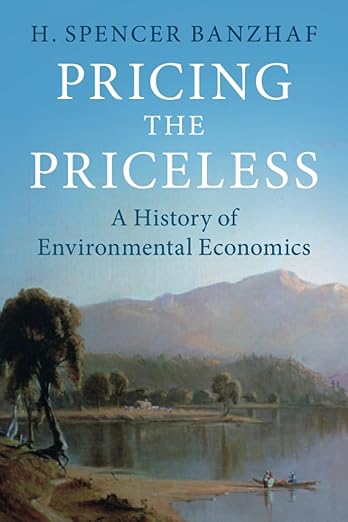
A Book Review of Pricing the Priceless: A History of Environmental Economics, by H. Spencer Banzhaf.1 How do you price scarce and valuable resources that are not traded in a market? Before answering that question, one may need to ask: why do we want to price those resources? In Spencer Banzhaf’s account of the history of environmental economics these are the two most pressing questions that environmental economists have asked. In Pricing the Priceless, Banzhaf starts from a version of the second question. The environment is a resource we want to conserve for future generations so they can also use it. It is our responsibility, therefore, to rationally plan for its continuous use. But the environment is also a resource worth preserving as it is, for its beauty, for our spiritual enjoyment of it, for its own sake, even if, or perhaps especially because, it does not have any use. The idea of conservation, firstly associated with Gifford Pinchot (1865-1945), and the idea of preservation, firstly associated with John Muir (1838-1914), are the intellectual lines around which the debate develops in Banzhaf’s volume. Both approaches share the problem of pricing the priceless. The story that Banzhaf tells us is a story of the development of ideas, a story that is not linear, not obvious (especially ex-ante), and a story of both tensions and synergies between academia, think tanks, and public agencies. Banzhaf notes that the term environmental economics was not used until the 1960s, then become commonly used only in the 1970s, but its problems were older than the name. The development of environmental economics is entangled with the development of the understanding of externalities, both in Pigouvian and in Coaseian terms, of the public finance tradition, with agricultural economics, and with the government and the military in particular. “Cost-benefit analysis works well if one has commensurable costs and benefits. But what if the benefit or cost is the environment itself?” When the government had to develop a policy, it faced the problem of understanding if that policy was worthwhile. But how could we know? Cost-benefit analysis works well if one has commensurable costs and benefits. But what if the benefit or cost is the environment itself? Or nature? Or maybe outdoor recreation? Can we measure how much people are willing to travel to be outdoors? Can we reliably ask them how much they value the outdoors? Or how much they are willing to pay not to have it destroyed? What if we can compensate those who are facing the costs? What if we can only potentially compensate those who are facing the costs? What incentives do people have to tell the truth? Or what if high prices caused by the increased scarcity incentivize the discovery and use of substitutes? The problem of the environment became more pressing during the Cold War. One of the problems was to make sure there would be enough resources to outlast the communist threat. Conservation and “efficient management” became a priority, especially in terms of water resources. It was difficult to try to find a method to estimate the value of the losses to nature generated by a water dam, let alone to human life. The pushback to any attempt to put a monetary value on an individual life, among other seemingly priceless things, incentivized economists to think not just in terms of costs and benefits but also in terms of trade-offs. So rather than just trying to recommend optimization, some preferred to simply identify the trade-offs among incommensurables. This allowed economic experts to offer policy makers an array of options to choose from, leaving the ultimate decision regarding what to do to politics, thus avoiding unpleasant and unpopular recommendations. Part of the problem was that optimization outcomes would not always be consistent with political outcomes, as concentrated interests would win out over the diffused interests of taxpayers and consumers (p. 185). Thus, economists found themselves divided between a belief in consumer sovereignty and a belief in political sovereignty, without any obvious solution. To this reader, the book is thus a wonderful window into the discipline as well as into post-war America. Yes, it is a history of environmental economics, but environmental economics grew within economics, and economics grew within post-war American politics. To me, the message of the book is summarized in the following sentence: Having come into the government to bring their expertise to practical problems, they [economists] had at least partially lost control of their research agenda and were forced by their government agencies to perform such valuations. Thus, bureaucratic necessities became the mother of economic invention” (p. 229). For more on these topics, see “From Prometheus to Arcadia: Liberals, Conservatives, the Environment, and Cultural Cognition,” by Pierre Desrochers. Library of Economics and Liberty, June 6, 2022. Jesse Ausubel on Agriculture, Technology, and the Return of Nature. EconTalk. Terry Anderson on the Environment and Property Rights. EconTalk. The book highlights the intricate and unintended intertwining between an academic discipline and a political reality. There is much, much more in the book, from the history of and reasoning behind cap-and-trade polluting permits to the links with experimental economics. Everything is explained in detail and rigorously documented, as the forty pages of references testify. While perhaps not a book for a general audience, but an economist, or an educated person keenly interested in the environment, should be able to appreciate its rich content and its thorough narrative. Footnotes [1] Pricing the Priceless: A History of Environmental Economics, by H. Spencer Banzhaf. Cambridge University Press. 2024. *Maria Pia Paganelli is a Professor of Economics at Trinity University. She works on Adam Smith, David Hume, 18th century theories of money, as well as the links between the Scottish Enlightenment and behavioral economics. For more articles by Maria Pia Paganelli, see the Archive. As an Amazon Associate, Econlib earns from qualifying purchases. (0 COMMENTS)
/ Learn More

Deliver Us From Love

Most people don’t have a reasoned theory to understand how the state and politics work. Many believe mythological stories they caught at home or in school. Many think their own country is unquestionably the best in the world, and their intuitions and beliefs flow from that. We must not disparage ordinary people. The poorer the country, the more they need all their energy to survive and raise families. In richer countries, ordinary people are those who, when they were left free, have formed middle classes that launched and maintained the Industrial Revolution. The problem comes when, through the state, which they don’t understand, they want to get benefits and privileges at the expense of others and dictate how others should live (see my “Princess Mathilde and the Immorality of Politics,” Econlib, April 1, 2024). The political leaders they follow, and often yearn to obey blindly, don’t necessarily have a more serious theory of the state except as an instrument of their ambitions and power. Nicolás Maduro, who was just, fraudulently from what we know, reelected president of Venezuela, a country he ran to the ground with his mentor and predecessor Hugo Chávez, seems to have a simple theory of the state, which happens to be very convenient for his own self-interest. The Financial Times reports (“Nicolás Maduro, Venezuela’s Contested President,” August 2, 2024): Ultimately, his fate is likely to be decided by the powerful military and whether it remains loyal. In the meantime, he is focused on burnishing his image. “I’m just Nicolás Maduro, a student, worker, union leader, constituent assembly member, legislator and foreign minister,” he told the news conference. “And I act out of love.” A different passage of this report is the journalist’s matter-of-fact statement that “Maduro drew closer to China and Russia and adopted free-market policies.” If “free-market policies” are policies to respect and protect voluntary interindividual cooperation without coercive direction from political authorities, Maduro did no such thing, because it would threaten his power. What the newspaper means is that Maduro recently allowed the circulation of the dollar to deflect the discontent of those whose political support he needs. In its different manifestations, love is a natural and useful sentiment in private and small-group interactions. But public love from unrestrained political rulers and coercive busybodies is a very dangerous thing. James Buchanan and the contemporary school of constitutional political economy defend a diametrically opposite ideal: institutions constraining political leaders to contribute to the maintenance of a free society based on an ethics of reciprocity among equally free individuals. In their seminal The Calculus of Consent, James Buchanan and Gordon Tullock wrote: Christian idealism, to be effective in leading to a more harmonious social order, must be tempered by an acceptance of the moral imperative of individualism, the rule of equal freedom. The acceptance of the right of the individual to do as he desires so long as his action does not infringe on the freedom of other individuals to do likewise must be a characteristic trait in any “good” society. The precept “Love thy neighbor, but also let him alone when he desires to be let alone” may, in one sense, be said to be the overriding ethical principle for Western liberal society. (0 COMMENTS)

/ Learn More